Market Overview
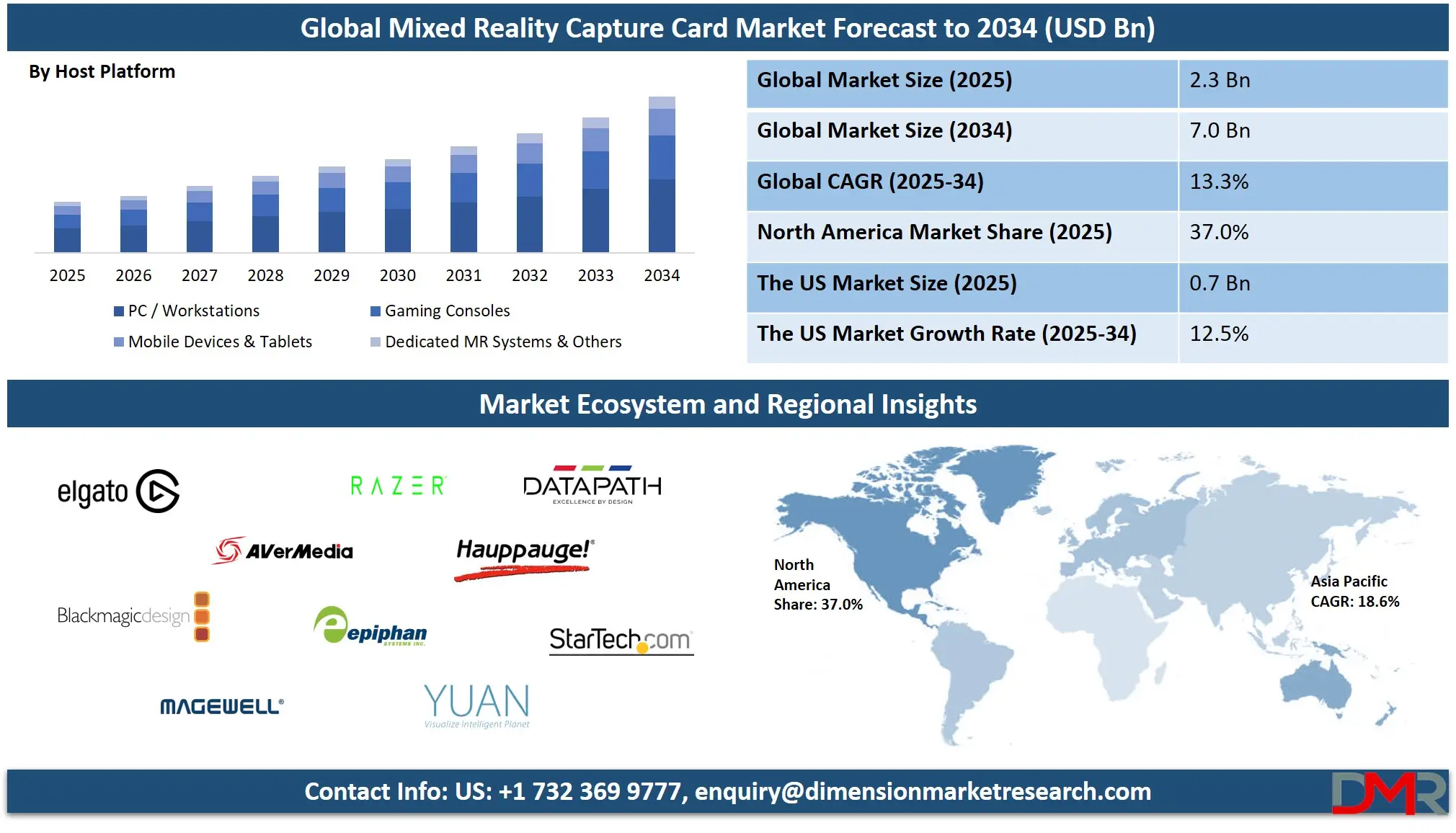
The Global Mixed Reality Capture Card Market was valued at USD 2.3 billion in 2025 and is projected to reach USD 7.0 billion by 2034, expanding at a CAGR of 13.3%, driven by rising adoption of mixed reality hardware, immersive content creation, virtual production workflows, and high resolution video capture solutions across gaming, media, and enterprise applications.
A Mixed Reality Capture Card is a specialized hardware component designed to capture, process, and transmit synchronized video feeds from physical cameras and digital mixed reality environments in real time. It enables the seamless blending of real world visuals with virtual or augmented elements by ingesting high resolution inputs from cameras, head mounted displays, gaming consoles, or workstations and converting them into usable digital signals.
ℹ
To learn more about this report –
Download Your Free Sample Report Here
These capture cards play a critical role in mixed reality production workflows by ensuring low latency, accurate color reproduction, and stable frame rates, making them essential for immersive content creation, live streaming, virtual production, and interactive experiences.
The global Mixed Reality Capture Card market represents the worldwide ecosystem of hardware solutions used to support mixed reality content capture across gaming, media, entertainment, education, healthcare, and enterprise environments. Market growth is driven by rising adoption of mixed reality technologies, increasing demand for immersive gaming and esports streaming, and expanding use of virtual production techniques in film and broadcast studios. The market includes internal and external capture cards with varying resolution capabilities, connectivity interfaces, and performance levels designed to support real time rendering and high fidelity video processing.
ℹ
To learn more about this report –
Download Your Free Sample Report Here
At a global level, the Mixed Reality Capture Card market is shaped by advancements in video capture technology, increasing penetration of high resolution displays, and growing creator economies across digital platforms. North America and Asia Pacific remain key regions due to strong gaming infrastructure, content creation communities, and rapid technology adoption, while Europe contributes through media production and enterprise use cases. The market continues to evolve with innovation in low latency capture, multi input support, and compatibility with mixed reality software platforms, positioning capture cards as a foundational component of the broader extended reality and immersive media ecosystem.
The US Mixed Reality Capture Card Market
The U.S. Mixed Reality Capture Card market size was valued at USD 0.7 billion in 2025. It is further expected to witness subsequent growth in the upcoming period, holding USD 2.1 billion in 2034 at a CAGR of 12.5%.
The US Mixed Reality Capture Card market is driven by strong adoption of mixed reality technologies across gaming, esports, media production, and professional content creation ecosystems. The country has a well-established base of streamers, virtual production studios, and immersive media companies that rely on high performance capture cards for real time video capture, low latency processing, and seamless integration of physical and virtual environments.

ℹ
To learn more about this report –
Download Your Free Sample Report Here
Growing demand for 4K and 8K video capture, advanced connectivity interfaces such as PCIe and Thunderbolt, and compatibility with mixed reality software platforms continues to support market expansion across consumer and commercial segments.
Additionally, the US market benefits from continuous technological innovation and high investment in extended reality infrastructure across enterprise training, education, healthcare simulation, and corporate communication use cases. The presence of leading capture card manufacturers, gaming hardware brands, and professional broadcast solution providers accelerates product development and adoption. Increasing use of mixed reality capture solutions in live streaming, virtual events, and cinematic virtual production further strengthens demand, positioning the US as a key revenue generating and innovation driven market within the global mixed reality capture card industry.
Europe Mixed Reality Capture Card Market
The European Mixed Reality Capture Card market was valued at approximately USD 60.0 million in 2025, reflecting steady growth driven by increasing adoption of immersive technologies across gaming, media production, broadcast, and enterprise applications. The region benefits from a well-established ecosystem of professional content creators, virtual production studios, and esports organizations that demand high performance capture solutions capable of supporting real time video processing, low latency performance, and multi camera integration. Rising investments in extended reality infrastructure, advanced PCs, and high resolution displays further support the adoption of mixed reality capture hardware across both commercial and individual user segments.
The market in Europe is expected to grow at a CAGR of around 12.0%, underpinned by ongoing innovation in capture card technology, including improved connectivity interfaces, higher resolution capabilities, and compatibility with virtual and augmented reality software platforms. Demand is also fueled by the region’s strong media and entertainment sector, educational institutions integrating immersive learning tools, and enterprises leveraging mixed reality for training and simulation. The combination of growing professional content creation, technological advancements, and increased awareness of immersive experiences positions Europe as a key contributor to the global mixed reality capture card market.
Japan Mixed Reality Capture Card Market
The Japanese Mixed Reality Capture Card market was valued approximately USD 19.0 million in 2025, driven by increasing adoption of immersive technologies in gaming, esports, and professional content creation. Japan’s strong gaming culture, growing esports industry, and rising interest in mixed reality applications for education and enterprise training are fueling demand for high performance capture cards.
Both internal and external capture solutions are being utilized to support real time video processing, low latency streaming, and high resolution output, enabling gamers, content creators, and studios to deliver immersive experiences with precision and reliability.
The market in Japan is expected to grow at a CAGR of around 11.5%, supported by technological advancements in capture hardware, including improved connectivity interfaces, AI driven video optimization, and multi input support for mixed reality workflows. Increasing investments in virtual production, corporate training, and live streaming initiatives are also contributing to market expansion. While the overall market size is smaller compared to regions like North America and Europe, Japan’s focus on high quality immersive content and early adoption of advanced technologies positions it as an important and steadily growing segment within the global mixed reality capture card market.
Global Mixed Reality Capture Card Market: Key Takeaways
- Market Growth and Revenue Potential: The global Mixed Reality Capture Card market is projected to grow from USD 2.3 billion in 2025 to USD 7.0 billion by 2034 at a CAGR of 13.3%, driven by rising adoption of immersive content creation, virtual production, and high resolution video capture solutions across gaming, media, and enterprise applications.
- Dominance of Hardware and Performance Segments: Internal capture cards and PCIe connectivity dominate due to superior performance, low latency, and multi input support, while mid-range and 4K resolution capture cards lead adoption in both commercial and individual user segments.
- Regional Insights: North America holds the largest revenue share at 37.0% in 2025 due to established gaming, esports, and media ecosystems, while Asia Pacific, led by China and Japan, is witnessing fast adoption driven by immersive media, virtual production, and enterprise training initiatives.
- Impact of Artificial Intelligence: AI-powered features such as real time video optimization, automated background segmentation, and intelligent object tracking enhance capture card performance, enabling low latency, high fidelity mixed reality experiences in healthcare, training, and live streaming applications.
- Key Applications and End Users: Gaming, esports, live streaming, virtual production, education, and healthcare simulation remain core drivers, with commercial and enterprise users capturing 58.0% of the market share, while individual creators adopt external and mid-range capture cards for personal and semi-professional content creation.
Global Mixed Reality Capture Card Market: Use Cases
- Gaming and Esports Content Creation: Mixed Reality Capture Cards are widely used in gaming and esports to combine real world player footage with virtual gameplay environments in real time. These solutions enable low latency video capture, high frame rate recording, and seamless integration with game engines and streaming platforms. Content creators and professional gamers rely on advanced capture hardware to deliver immersive viewer experiences, support multi camera setups, and maintain high resolution output for live streaming and recorded content across global digital platforms.
- Virtual Production and Media Studios: In virtual production environments, mixed reality capture cards play a critical role in blending physical camera feeds with computer generated backgrounds and digital assets. Film studios, broadcast networks, and production houses use these capture solutions to support real time compositing, color accuracy, and synchronized video workflows. The growing adoption of LED volumes and real time rendering tools has increased demand for reliable capture cards capable of handling high bandwidth video inputs and complex mixed reality production pipelines.
- Education and Professional Training: The education and training sector uses mixed reality capture card technology to create interactive learning experiences and simulation based training programs. Universities, research institutions, and enterprise training centers deploy these solutions to record and stream mixed reality demonstrations, virtual labs, and skill based simulations. High quality video capture and low latency processing help ensure realistic visual feedback, improving knowledge retention and enabling scalable remote learning and immersive training delivery.
- Healthcare and Medical Simulation: Mixed Reality Capture Cards are increasingly applied in healthcare for medical simulation, surgical training, and telemedicine applications. Hospitals and medical training centers use capture hardware to record mixed reality procedures, combine real world clinical footage with virtual anatomical models, and support live instruction sessions. The ability to capture high resolution visuals with minimal delay enhances accuracy, collaboration, and training effectiveness, supporting the broader adoption of mixed reality technologies in the global healthcare ecosystem.
Impact of Artificial Intelligence on the global Mixed Reality Capture Card market
- Artificial intelligence enhances Mixed Reality Capture Cards by enabling real time video optimization, automated background segmentation, and intelligent object tracking, improving visual accuracy and reducing manual post processing in mixed reality content creation workflows.
- AI driven analytics and machine learning algorithms improve capture performance through adaptive frame rate control, latency reduction, and automated color correction, supporting high resolution mixed reality streaming, virtual production, and immersive media applications.
- Integration of artificial intelligence expands use cases for mixed reality capture hardware across healthcare simulation, enterprise training, and live broadcasting by enabling smart scene recognition, predictive system optimization, and seamless integration with advanced mixed reality software platforms.
Global Mixed Reality Capture Card Market: Stats & Facts
- OECD – An Immersive Technologies Policy Primer
- Global AR and VR headset sales peaked at 11.2 million units in 2021.
- AR and VR headset sales declined to 8.8 million units in 2022.
- AR and VR headset sales further declined to 6.7 million units in 2023.
- Sales trends continued downward into the first half of 2024.
- Consumer XR device prices in OECD regions ranged between USD 300–600 in 2024, with high‑end models exceeding USD 3,500.
- Professional grade devices can reach USD 10,000 or higher in headset pricing.
- Country / Regional Official XR Device Data (China Government & Public Sources)
- China’s AR/VR shipments reached 72.5 million units in 2023 across all headset categories.
- AR shipments in China in 2023 rose by 154.4 %.
- VR shipments in China in 2023 declined by 57.9 %.
- China’s AR/VR devices made up 36.1 % AR share of overall AR/VR shipments in 2023.
- China’s full‑year 2024 XR device sales (consumer) were 53.6 million units.
- In 2024, VR/MR devices accounted for 89.3 % of China’s XR shipments, with AR at 10.7 %.
- China AR retail shipments grew by 32.1 % in 2024.
- China XR online sales accounted for 44.6 % of total market in 2024.
- China’s XR hardware sales declined by 12.5 % in 2024 compared with 2023.
Global Mixed Reality Capture Card Market: Market Dynamics
Global Mixed Reality Capture Card Market: Driving Factors
Rising Adoption of Mixed Reality and Immersive Media
The increasing use of mixed reality technologies across gaming, esports, media production, and enterprise training is a major growth driver for the Mixed Reality Capture Card market. Demand for immersive content creation, real time video capture, and seamless blending of physical and virtual environments continues to rise as organizations invest in advanced extended reality solutions. High performance capture cards support low latency processing, high frame rate recording, and compatibility with mixed reality software platforms, making them essential for modern immersive workflows.
Growth of Live Streaming and Virtual Production Ecosystems
The rapid expansion of live streaming, virtual events, and virtual production studios is accelerating demand for reliable mixed reality capture hardware. Content creators, broadcasters, and studios require advanced capture solutions capable of handling high resolution video inputs, multi camera setups, and real time compositing. This shift toward digital first content delivery strengthens adoption of professional grade capture cards across global media and entertainment markets.
Global Mixed Reality Capture Card Market: Restraints
High Cost of Advanced Capture Hardware
Premium mixed reality capture cards with 4K and 8K resolution support, high bandwidth interfaces, and low latency processing remain expensive, limiting adoption among small creators and cost sensitive organizations. The need for compatible high end PCs, cameras, and mixed reality systems further increases total ownership costs, slowing market penetration in developing regions.
Technical Complexity and Integration Challenges
Mixed reality capture solutions require technical expertise for configuration, calibration, and integration with software platforms and rendering engines. Issues related to system compatibility, driver support, and performance optimization can hinder adoption, particularly among non-professional users and smaller enterprises lacking specialized technical resources.
Global Mixed Reality Capture Card Market: Opportunities
Expansion in Enterprise Training and Healthcare Simulation
Growing adoption of mixed reality solutions in enterprise training, industrial simulation, and healthcare education presents strong opportunities for capture card vendors. Organizations increasingly rely on immersive training environments and medical simulations that require accurate real time video capture and synchronization. This trend supports demand for reliable capture hardware designed for professional and institutional use cases.
Advancements in AI Driven Capture Technologies
Integration of artificial intelligence into capture card technology creates opportunities for differentiation and value addition. AI powered features such as automated scene detection, real time background segmentation, and intelligent video optimization enhance performance and usability. These advancements expand the addressable market by improving workflow efficiency and lowering technical barriers for mixed reality content creation.
Global Mixed Reality Capture Card Market: Trends
Shift toward High Resolution and Low Latency Capture
The market is witnessing a strong trend toward 4K and 8K mixed reality capture cards with ultra-low latency performance. As immersive content quality expectations rise, users demand higher visual fidelity and smoother real time interaction. This trend is driving innovation in capture interfaces, bandwidth management, and processing capabilities across global markets.
Increasing Convergence of Mixed Reality and Virtual Production
Mixed reality capture cards are increasingly used within virtual production pipelines, particularly in film, broadcast, and live event production. The convergence of mixed reality technology with real time rendering engines and virtual sets is shaping product development, encouraging manufacturers to design capture solutions optimized for cinematic workflows, multi input support, and professional studio environments.
Global Mixed Reality Capture Card Market: Research Scope and Analysis
By Product Type Analysis
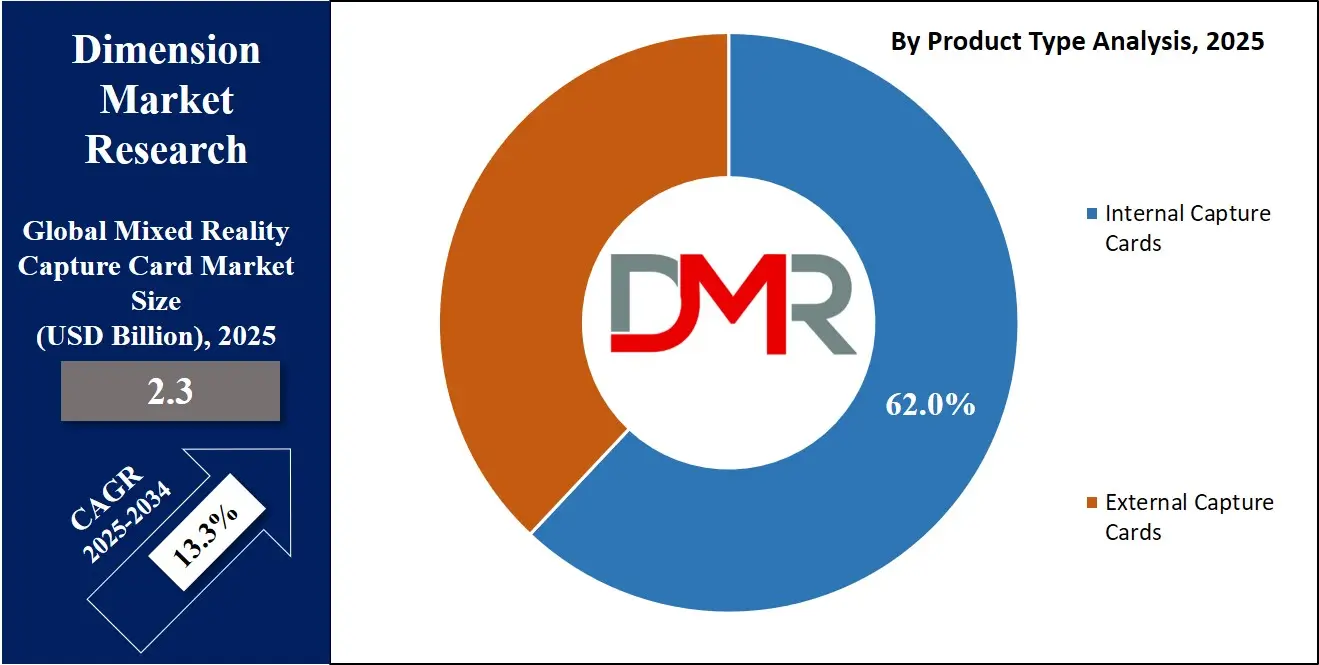
Internal Capture Cards are anticipated to dominate the product type segment of the Mixed Reality Capture Card market, capturing approximately 62.0% of the total market share in 2025, primarily due to their superior performance, stability, and low latency capabilities. These cards are widely preferred in professional environments such as gaming studios, virtual production facilities, broadcast stations, and enterprise mixed reality setups where high resolution video capture, real time processing, and consistent data throughput are critical.
Internal capture cards typically support advanced interfaces like PCIe, enabling higher bandwidth, better synchronization with GPUs and processors, and improved compatibility with complex mixed reality workflows. Their ability to handle 4K and 8K video streams, multi input configurations, and demanding rendering tasks positions them as the preferred choice for commercial and industrial users seeking reliable and high performance capture solutions.
ℹ
To learn more about this report –
Download Your Free Sample Report Here
External Capture Cards, while accounting for a smaller share of the product type segment, play an important role in expanding market adoption due to their portability, ease of use, and flexible deployment. These capture cards are commonly used by individual content creators, educators, and small production teams who require plug and play functionality without complex system integration.
External capture cards connect through interfaces such as USB and Thunderbolt, making them suitable for laptops, mobile workstations, and console based setups. Their growing adoption is supported by increasing demand for live streaming, remote content creation, and entry level mixed reality applications, particularly among users who prioritize convenience, cost effectiveness, and cross platform compatibility over ultra-high performance requirements.
By Host Platform Analysis
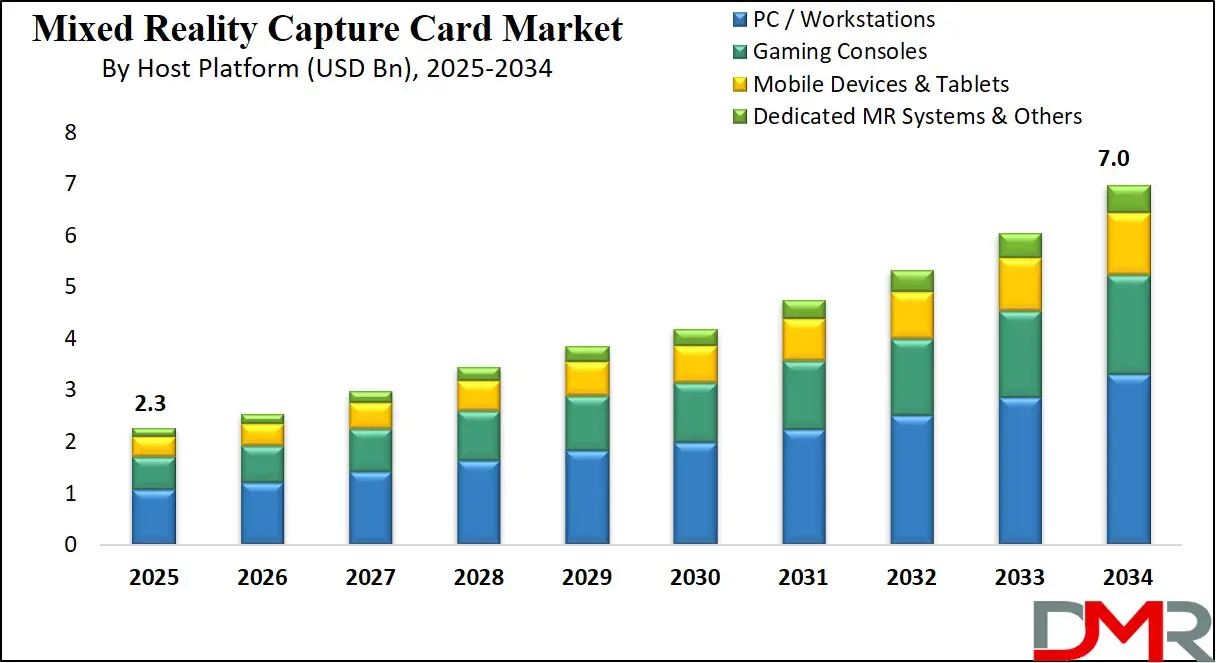
PC and workstation platforms are anticipated to dominate the host platform segment of the Mixed Reality Capture Card market, accounting for approximately 47.0% of the total market share in 2025, due to their high processing power, flexibility, and compatibility with advanced mixed reality software ecosystems. These platforms are widely used in professional gaming, virtual production, broadcast studios, and enterprise environments where real time rendering, high resolution video capture, and low latency performance are essential.
PCs and workstations support powerful GPUs, multi core processors, and high bandwidth interfaces such as PCIe and Thunderbolt, enabling seamless integration of internal and external capture cards. Their scalability and customization capabilities make them the preferred choice for complex mixed reality workflows that require multi camera setups, real time compositing, and advanced content creation tools.
Gaming consoles also represent a significant segment within the host platform category, driven by the expanding gaming and live streaming community. Consoles such as PlayStation and Xbox are widely used by content creators and esports players who rely on external capture cards to record and stream gameplay while maintaining system performance.
The simplicity, reliability, and standardized hardware environment of gaming consoles make them attractive for mixed reality capture in consumer and semiprofessional use cases. As console based streaming and immersive gaming experiences continue to grow globally, demand for compatible and high quality capture solutions supporting console ecosystems is expected to remain strong within this market segment.
By Resolution Capability Analysis
4K capture cards are anticipated to dominate the resolution capability segment of the Mixed Reality Capture Card market, capturing approximately 56.0% of the total market share in 2025, as they offer an optimal balance between visual quality, performance, and cost. These capture cards are widely adopted across gaming, live streaming, virtual production, and professional content creation environments where high resolution output and smooth frame rates are essential.
The growing demand for immersive mixed reality experiences, realistic virtual environments, and high fidelity streaming has made 4K capture a standard requirement. In addition, broader availability of 4K displays, cameras, and mixed reality headsets has reinforced adoption, while compatibility with existing hardware and software ecosystems makes 4K capture cards a practical and scalable choice for both commercial and advanced consumer users.
8K and advanced high frame capture solutions, while representing a smaller share of the resolution capability segment, are gaining traction in specialized and high end applications. These capture cards are primarily used in cinematic virtual production, broadcast grade studios, research environments, and future ready mixed reality deployments where ultra-high resolution and exceptional motion clarity are required.
Support for 8K resolution and high frame rates enables greater realism, precise visual detail, and enhanced post production flexibility, particularly for large format displays and immersive installations. Although higher costs and increased system requirements currently limit widespread adoption, ongoing advancements in processing power and display technology are expected to gradually expand the role of 8K and high frame capture cards within the global mixed reality capture card market.
By Connectivity Interface Analysis
PCIe based capture cards are anticipated to dominate the connectivity interface segment of the Mixed Reality Capture Card market, capturing approximately 49.0% of the total market share in 2025, due to their high bandwidth capabilities, low latency performance, and direct integration with PC and workstation architectures. These interfaces are widely preferred in professional gaming setups, virtual production studios, broadcast environments, and enterprise mixed reality systems where stable data transfer and real time video processing are critical.
PCIe connectivity enables capture cards to handle high resolution video streams, multi input configurations, and advanced mixed reality workflows with minimal performance bottlenecks. Their ability to support demanding applications such as 4K and 8K capture, real time compositing, and synchronized multi camera feeds makes them the dominant choice among commercial and industrial users.
USB based capture cards, while accounting for a smaller share of the connectivity interface segment, play a crucial role in expanding accessibility and adoption across consumer and entry level markets. These solutions are favored for their plug and play functionality, portability, and compatibility with a wide range of devices including laptops, gaming consoles, and mobile workstations.
USB capture cards are commonly used by content creators, streamers, educators, and small production teams who prioritize ease of installation and flexible deployment over maximum bandwidth. Continuous improvements in USB standards have enhanced performance and reliability, supporting growing demand for USB based capture solutions in live streaming, remote content creation, and mixed reality applications requiring mobility and convenience.
By Price Range Analysis
Mid-range capture cards are anticipated to dominate the price range segment of the Mixed Reality Capture Card market, capturing approximately 46.0% of the total market share in 2025, as they offer an effective balance between performance, functionality, and affordability. These products are widely adopted by professional content creators, streamers, small studios, and enterprise users who require reliable mixed reality video capture without the cost burden of premium systems.
Mid-range solutions typically support 4K resolution, stable frame rates, and versatile connectivity options, making them suitable for gaming, live streaming, virtual production, and training applications. Their broad compatibility with common hardware and software platforms further drives adoption across global markets.
High end capture cards, although representing a smaller portion of the price range segment, are critical for advanced and mission critical mixed reality applications. These solutions are designed for broadcast studios, large virtual production facilities, and industrial or research environments that demand ultra-low latency, high bandwidth, and support for 8K resolution or high frame rate capture.
High end capture cards often integrate advanced processing capabilities, multi-channel input support, and enhanced reliability for continuous professional use. While higher costs limit adoption to specialized users, ongoing investments in immersive media, cinematic production, and enterprise scale mixed reality deployments continue to sustain demand within this premium segment.
By Distribution Channel Analysis
Online channels are anticipated to dominate the distribution channel segment of the Mixed Reality Capture Card market, capturing approximately 61.0% of the total market share in 2025, due to their global reach, convenience, and ability to provide detailed product information and comparisons. E‑commerce platforms, brand stores, and online marketplaces allow consumers and professional users to access a wide range of capture card options, compare features, read reviews, and make purchases from anywhere. The growing preference for online shopping, integrated with faster delivery services and easy return policies, has strengthened adoption, particularly among individual creators, small studios, and enterprises seeking specific mixed reality hardware solutions without geographic limitations.
Offline distribution channels, while holding a smaller share, continue to play an important role in the market by providing direct customer interaction, in store demonstrations, and personalized support. Retail electronics stores, authorized distributors, and specialized system integrators cater to professional users and commercial clients who prefer hands on evaluation, immediate availability, and post purchase assistance.
Offline channels are particularly relevant for bulk purchases, enterprise deployments, and high end capture cards where buyers often require consultation on compatibility, installation, and technical integration. Despite the rise of online sales, offline channels remain essential for building customer trust, supporting complex workflows, and serving regions with limited e‑commerce penetration.
By Application Analysis
Gaming and esports are anticipated to dominate the application segment of the Mixed Reality Capture Card market, capturing approximately 40.0% of the total market share in 2025, driven by the rapid growth of competitive gaming, immersive gameplay, and professional streaming. Mixed reality capture cards enable gamers and esports professionals to combine real world footage with virtual game environments in real time, supporting high resolution output, low latency performance, and multi camera setups. The increasing popularity of live tournaments, online streaming platforms, and content sharing communities has intensified demand for reliable capture solutions that can handle fast motion, complex graphics, and interactive experiences, making gaming and esports the largest use case within the market.
Live streaming and content creation represent another key application segment, gaining significant traction due to the global rise of digital content platforms, social media, and creator economies. Capture cards in this segment allow individual creators, educators, and small studios to record and broadcast mixed reality experiences with professional quality visuals and sound.
They support seamless integration with video editing software, streaming platforms, and interactive tools, enabling engaging online presentations, tutorials, and entertainment content. The growing demand for immersive experiences, virtual events, and high quality streaming has made this application essential for expanding market adoption among both professional and amateur content creators worldwide.
By End User Analysis
Commercial and enterprise users are anticipated to dominate the end user segment of the Mixed Reality Capture Card market, capturing approximately 58.0% of the total market share in 2025, driven by the widespread adoption of mixed reality technologies in professional environments. Organizations across media production, virtual production studios, corporate training, and educational institutions rely on high performance capture cards to support real time video capture, multi camera setups, and seamless integration with mixed reality software platforms.
The need for reliable, low latency, and high resolution capture solutions in large scale deployments ensures that commercial and enterprise users remain the largest segment, as these systems are critical for delivering immersive experiences, virtual simulations, and professional content at consistent quality.
Individual consumers represent another significant segment within the market, comprising content creators, gamers, and hobbyists who use capture cards for personal or semiprofessional applications. These users prioritize ease of use, portability, and compatibility with gaming consoles, laptops, and streaming setups, often opting for external or mid-range capture cards.
Rising interest in live streaming, esports participation, online tutorials, and immersive gaming experiences drives demand among individual consumers. While their requirements are generally less demanding than those of commercial users, this segment is expanding rapidly as mixed reality technologies become more accessible and affordable, contributing to overall market growth.
The Mixed Reality Capture Card Market Report is segmented on the basis of the following:
By Product Type
- Internal Capture Cards
- External Capture Cards
By Host Platform
- PC / Workstations
- Gaming Consoles
- Mobile Devices & Tablets
- Dedicated MR Systems & Others
By Resolution Capability
- Up to Full HD (1080p)
- 4K Capture Cards
- 8K & Advanced High-Frame Capture
By Connectivity Interface
- PCIe
- USB
- Thunderbolt
- Other Interface
By Price Range
- Low-Cost
- Mid-Range
- High-End
By Distribution Channel
- Brand Stores
- E-commerce
- Marketplace
- Retail
- System Integrators
- Distributors
By Application
- Gaming & eSports
- Live Streaming & Content Creation
- Virtual Production & Media Studios
- Education & Training
- Healthcare & Medical Simulation
- Others
By End User
- Commercial & Enterprise Users
- Individual Consumers
- Industrial & Institutional Users
Global Mixed Reality Capture Card Market: Regional Analysis
Region with the Largest Revenue Share
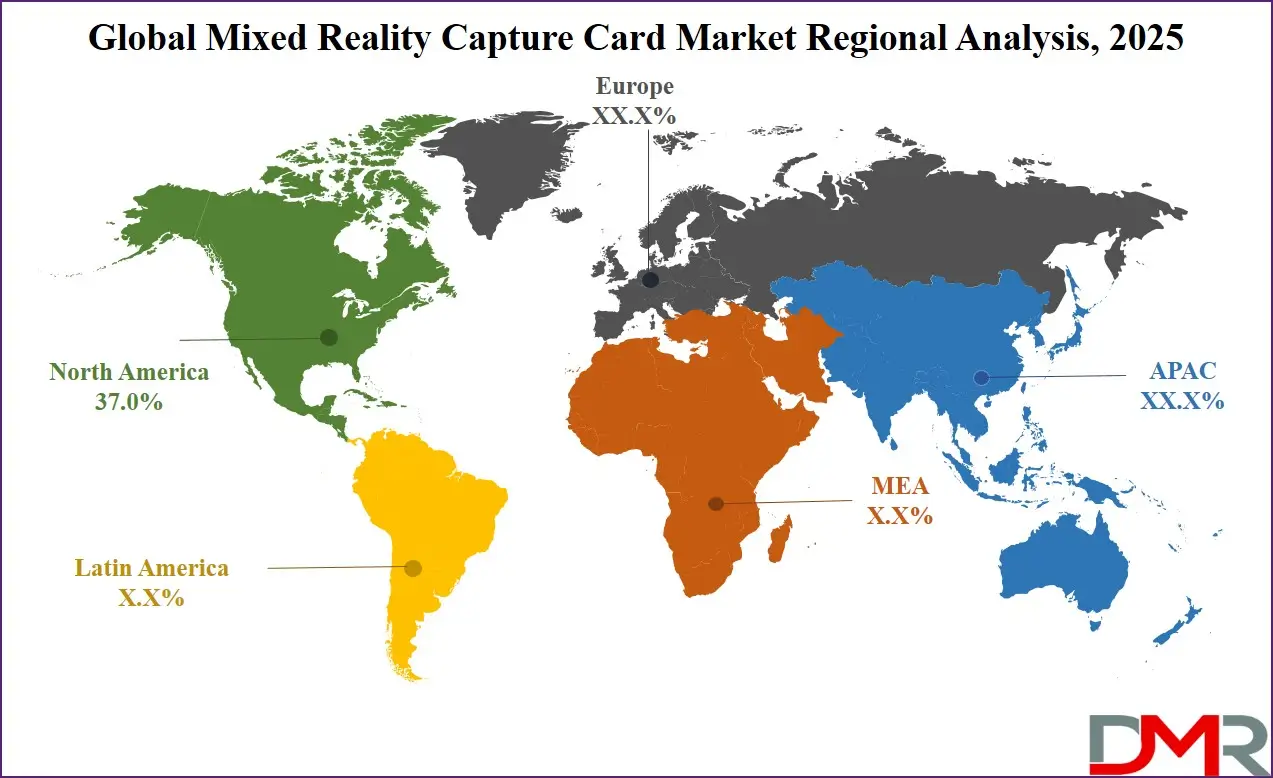
North America is anticipated to lead the global Mixed Reality Capture Card market, accounting for approximately 37.0% of total market revenue in 2025, driven by strong adoption of mixed reality technologies across gaming, esports, media production, and enterprise applications. The region benefits from a well-established ecosystem of content creators, virtual production studios, and professional broadcast networks that rely on high performance capture cards for real time video processing, low latency performance, and high resolution output.
ℹ
To learn more about this report –
Download Your Free Sample Report Here
Advanced infrastructure, widespread availability of high end PCs and workstations, and a large consumer base for immersive gaming and streaming further support market growth. Continuous innovation by leading capture card manufacturers and increasing investments in extended reality applications make North America the most significant and revenue generating region in the global market landscape.
Region with significant growth
The Asia Pacific region is expected to experience significant growth in the Mixed Reality Capture Card market over the forecast period, driven by rapid adoption of gaming, esports, and immersive media technologies across countries such as China, Japan, South Korea, and India. Expanding digital content creation communities, increasing investments in virtual production studios, and growing demand for high resolution streaming and mixed reality applications in education and enterprise sectors are fueling market expansion.
Rising disposable incomes, broader access to high performance PCs, consoles, and mobile devices, along with government initiatives supporting technology adoption, are contributing to the region’s accelerating growth and positioning Asia Pacific as a key emerging market in the global mixed reality capture card landscape.
By Region
North America
Europe
- Germany
- The U.K.
- France
- Italy
- Russia
- Spain
- Benelux
- Nordic
- Rest of Europe
Asia-Pacific
- China
- Japan
- South Korea
- India
- ANZ
- ASEAN
- Rest of Asia-Pacific
Latin America
- Brazil
- Mexico
- Argentina
- Colombia
- Rest of Latin America
Middle East & Africa
- Saudi Arabia
- UAE
- South Africa
- Israel
- Egypt
- Rest of MEA
Global Mixed Reality Capture Card Market: Competitive Landscape
The global Mixed Reality Capture Card market is highly competitive, characterized by continuous technological innovation, rapid product launches, and strategic partnerships across hardware, software, and immersive media ecosystems. Key players focus on developing high performance, low latency capture solutions with advanced connectivity interfaces, multi input support, and compatibility with mixed reality and virtual production platforms.
The market is shaped by differentiation through resolution capabilities, AI integration, and ease of use for both professional and consumer applications. Intense competition also drives pricing strategies, regional expansion, and service offerings such as technical support, firmware updates, and bundled software solutions, fostering overall growth and innovation in the industry.
Some of the prominent players in the global Mixed Reality Capture Card market are
- Elgato
- AVerMedia Technologies
- Blackmagic Design
- Magewell Electronics
- Razer
- Epiphan Systems
- Datapath
- Hauppauge Computer Works
- Yuan High-Tech Development
- StarTech.com
- ASUS
- AJA Video Systems
- Matrox Electronic Systems
- Bluefish444
- Teradek
- IO Industries
- Euresys
- DIGITNOW!
- Shenzhen Uniscom Technology
- Inogeni
- Other Key Players
Global Mixed Reality Capture Card Market: Recent Developments
- December 2025: A leading capture card maker released a new external capture card that enables affordable 4K 60 fps gameplay recording with HDR passthrough and enhanced compatibility for consoles and PC streaming setups, targeting gamers and mixed reality content creators.
- October 2025: A major tech manufacturer unveiled its latest mixed reality headset built on an open Android XR platform designed for immersive experiences and multimodal interaction, marking a significant step in spatial computing and XR device integration.
- July 2025: A deep tech XR pixel‑streaming specialist raised €10 million in growth capital to scale its streaming technology globally, enhancing accessibility of AR/VR applications and enabling high performance cloud and edge workflows.
- May 2025: An enterprise XR device management platform announced the acquisition of an XR learning analytics company to integrate unified performance tracking and LMS compatibility into its solution suite, advancing VR training offerings for global enterprises.
Report Details
| Report Characteristics |
| Market Size (2025) |
USD 2.3 Bn |
| Forecast Value (2034) |
USD 7.0 Bn |
| CAGR (2025–2034) |
13.3% |
| The US Market Size (2025) |
USD 0.7 Bn |
| Historical Data |
2019 – 2024 |
| Forecast Data |
2026 – 2034 |
| Base Year |
2024 |
| Estimate Year |
2025 |
| Report Coverage |
Market Revenue Estimation, Market Dynamics, Competitive Landscape, Growth Factors and etc. |
| Segments Covered |
Product Type (Internal Capture Cards, External Capture Cards), Host Platform (PC / Workstations, Gaming Consoles, Mobile Devices & Tablets, Dedicated MR Systems & Others), Resolution Capability (Up to Full HD (1080p), 4K Capture Cards, 8K & Advanced High-Frame Capture), Connectivity Interface (PCIe, USB, Thunderbolt, Other Interface), Price Range (Low-Cost, Mid-Range, High-End), Distribution Channel (Online, Offline), Application (Gaming & eSports, Live Streaming & Content Creation, Virtual Production & Media Studios, Education & Training, Healthcare & Medical Simulation, Others), and End User (Commercial & Enterprise Users, Individual Consumers, Industrial & Institutional Users). |
| Regional Coverage |
North America – The US and Canada; Europe – Germany, The UK, France, Russia, Spain, Italy, Benelux, Nordic, & Rest of Europe; Asia-Pacific – China, Japan, South Korea, India, ANZ, ASEAN, Rest of APAC; Latin America – Brazil, Mexico, Argentina, Colombia, Rest of Latin America; Middle East & Africa – Saudi Arabia, UAE, South Africa, Turkey, Egypt, Israel, & Rest of MEA |
| Prominent Players |
Elgato, AVerMedia Technologies, Blackmagic Design, Magewell Electronics, Razer, Epiphan Systems, Datapath, Hauppauge Computer Works, Yuan High-Tech Development, StarTech.com, ASUS, AJA Video Systems, Matrox Electronic Systems, Bluefish444, Teradek, IO Industries, Euresys, and Others. |
| Purchase Options |
We have three licenses to opt for: Single User License (Limited to 1 user), Multi-User License (Up to 5 Users), and Corporate Use License (Unlimited User) along with free report customization equivalent to 0 analyst working days, 3 analysts working days, and 5 analysts working days respectively. |
Frequently Asked Questions
How big is the global Mixed Reality Capture Card market?
▾ The global Mixed Reality Capture Card market size is estimated to have a value of USD 2.3 billion in 2025 and is expected to reach USD 7.0 billion by the end of 2034.
What is the size of the US Mixed Reality Capture Card market?
▾ The US Mixed Reality Capture Card market is projected to be valued at USD 0.7 billion in 2025. It is expected to witness subsequent growth in the upcoming period as it holds USD 2.1 billion in 2034 at a CAGR of 12.5%.
Which region accounted for the largest global Mixed Reality Capture Card market?
▾ North America is expected to have the largest market share in the global Mixed Reality Capture Card market, with a share of about 37.0% in 2025.
Who are the key players in the global Mixed Reality Capture Card market?
▾ Some of the major key players in the global Mixed Reality Capture Card market are Elgato, AVerMedia Technologies, Blackmagic Design, Magewell Electronics, Razer, Epiphan Systems, Datapath, Hauppauge Computer Works, Yuan High-Tech Development, StarTech.com, ASUS, AJA Video Systems, Matrox Electronic Systems, Bluefish444, Teradek, IO Industries, Euresys, and Others.