Global Mobile Collaboration Productivity Innovation From Workplace Market Snapshot
- Market Size in 2026: USD 7.6 Billion
- Market Size in 2035: USD 14.9 Billion
- Global CAGR, 2026–2035: 7.8%
- Leading Offering Segment, 2026 : Collaboration Software, 72%
- Leading Deployment Segment, 2026: Cloud-Based, 74%
- Leading Organization Segment, 2026: Large Enterprises, 63%
- Leading Application Segment, 2026: Communication & Messaging, 31%
- Fastest-Growing Application: Workflow & Process Management, 10.2% CAGR
- Leading End-User Industry, 2026: IT & Telecom, 24%
- Leading Region, 2026: North America, 36%
- Fastest-Growing Region: Asia-Pacific, 9.5% CAGR
What is the Global Mobile Collaboration Productivity Innovation From Workplace and its Market Size?
The Global Mobile Collaboration Productivity & Workplace Innovation Market represents software, services and digitally enabled workplace capabilities that allow employees to communicate, coordinate, create, share information, manage workflows and generate innovation from mobile or mobile-connected work environments. It includes collaboration applications, mobile messaging, cloud document collaboration, project and task management, workflow automation, employee productivity tools and associated implementation and support services.
ℹ
To learn more about this report –
Download Your Free Sample Report Here
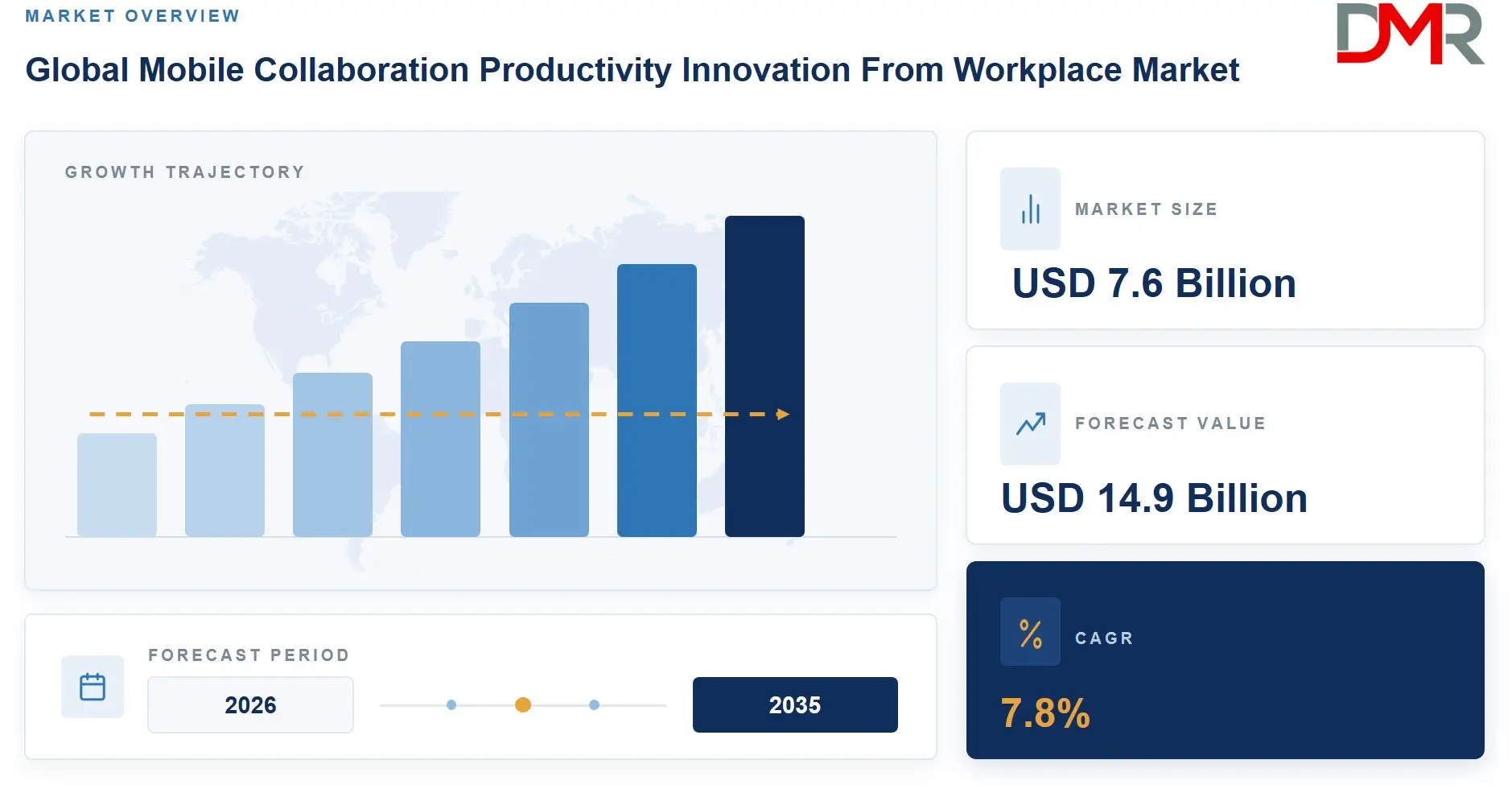
The market is estimated at USD 7.6 billion in 2026 and is projected to reach approximately USD 14.9 billion by 2035, representing a 7.8% CAGR. This trajectory reflects the continued normalization of hybrid work, growth in distributed and frontline workforces, smartphone-led enterprise application adoption, cloud migration and demand for unified digital workplaces.
The market is also being reshaped by generative and agentic AI. Collaboration vendors increasingly seek to transform mobile applications from communication interfaces into systems of action that summarize conversations, retrieve organizational knowledge, generate documents, assign tasks and execute workflows. Zoom, for example, introduced ZoomMate in June 2026 to connect workplace conversations with search, content creation and workflow execution, illustrating the industry's movement toward agentic productivity.
Use Cases
- Mobile communication: Real-time messaging, voice, video and presence capabilities keep distributed employees connected.
- Document collaboration: Employees access, edit, approve and share enterprise documents from mobile devices.
- Project coordination: Teams assign tasks, monitor deadlines and manage projects regardless of employee location.
- Workflow automation: Mobile applications trigger approvals, notifications, service requests and operational processes.
- Frontline productivity: Field, retail, healthcare and logistics workers receive information and complete workflows away from desks.
- Workplace innovation: Teams capture ideas, institutional knowledge and feedback to accelerate product and process innovation.
Key Takeaways
- The market is estimated at USD 7.6 billion in 2026 and could reach USD 14.9 billion by 2035 at approximately 7.8% CAGR.
- Hybrid work, distributed workforces and mobile-first employee experiences remain fundamental demand drivers.
- Collaboration software represents the dominant offering, while cloud deployment leads because of scalability and cross-device accessibility.
- Workflow and process management is expected to be the fastest-growing application as enterprises seek measurable productivity gains rather than communication alone.
- North America remains the largest market because of enterprise software maturity, high cloud adoption and the presence of major collaboration-platform providers.
- Asia-Pacific is expected to be the fastest-growing region, supported by digital transformation, expanding enterprise software adoption and large mobile workforces.
How AI/Gen AI is Transforming the Mobile Collaboration Productivity Innovation From Workplace Market?
AI is moving mobile collaboration platforms beyond messaging and meetings toward intelligent work orchestration. AI assistants can summarize conversations, retrieve enterprise knowledge, draft documents, identify action items, translate communications, prioritize tasks and recommend next steps. In 2026, vendors increasingly introduced agentic capabilities that allow AI to perform actions across connected enterprise systems. Slack, for example, positioned its platform as an environment where workplace AI agents can be built, deployed and managed, while Atlassian reported a sharp increase in agentic automations among its customers.
The principal benefits are reduced administrative effort, faster information retrieval, fewer application switches and improved continuity between meetings, messages, documents and workflows. Mobile users benefit particularly because AI can compress complex desktop workflows into conversational interfaces.
Key Drivers in the Global Mobile Collaboration Productivity Innovation From Workplace Market
Expansion of Hybrid, Distributed and Frontline Work
The continued evolution of workplace models is a primary driver of mobile collaboration adoption. Employees increasingly work across offices, homes, client sites, production facilities and field locations, creating demand for applications that maintain continuity regardless of physical location. Mobile devices are particularly important for employees who cannot depend on traditional desktop workstations.
Enterprise Demand for Unified Productivity Platforms
Organizations increasingly seek to consolidate messaging, meetings, documents, project management, search, automation and knowledge access into integrated digital workplaces. Fragmented application environments create switching costs, duplicate information and productivity losses.
Restraints in the Global Mobile Collaboration Productivity Innovation From Workplace Market
Security, Privacy and Enterprise Governance
Mobile collaboration expands the number of endpoints, applications and data flows that organizations must secure. Lost devices, unauthorized applications, insecure networks, excessive permissions and third-party integrations can increase cybersecurity exposure. Collaboration platforms also process potentially sensitive employee, customer and corporate information.
Growth Opportunities in the Global Mobile Collaboration Productivity Innovation From Workplace Market
AI-Native Mobile Work Assistants
The strongest opportunity is the development of AI assistants that understand organizational context and execute tasks from mobile interfaces. Rather than requiring users to navigate several applications, an employee could ask an assistant to summarize a project, prepare an approval, retrieve a customer record and initiate the next workflow.
Frontline and Deskless Workforce Digitization
Large portions of the global workforce still have limited access to sophisticated workplace software. Mobile devices can provide a lower-cost interface to schedules, training, operational instructions, communication and workflow management.
Trends in the Global Mobile Collaboration Productivity Innovation From Workplace Market
From Collaboration Tools to Systems of Action
The market is moving from communication toward execution. Zoom's 2026 AI strategy explicitly emphasizes moving from conversations to completed work, while Slack is positioning AI agents directly inside workplace collaboration.
Context-Aware and Multimodal Workplace AI
AI is increasingly being embedded across voice, text, documents, meetings and enterprise search. Google has expanded conversational voice capabilities across Workspace applications, while Zoom has developed AI capabilities that connect meeting and organizational context.
Research Scope and Analysis
The market is segmented By Offering, By Deployment, By Organization Size, By Application and By End-User Industry. Percentages represent modeled 2026 revenue shares within this defined market and are intended for strategic market sizing rather than audited accounting measurement.
ℹ
To learn more about this report –
Download Your Free Sample Report Here
By Offering Analysis
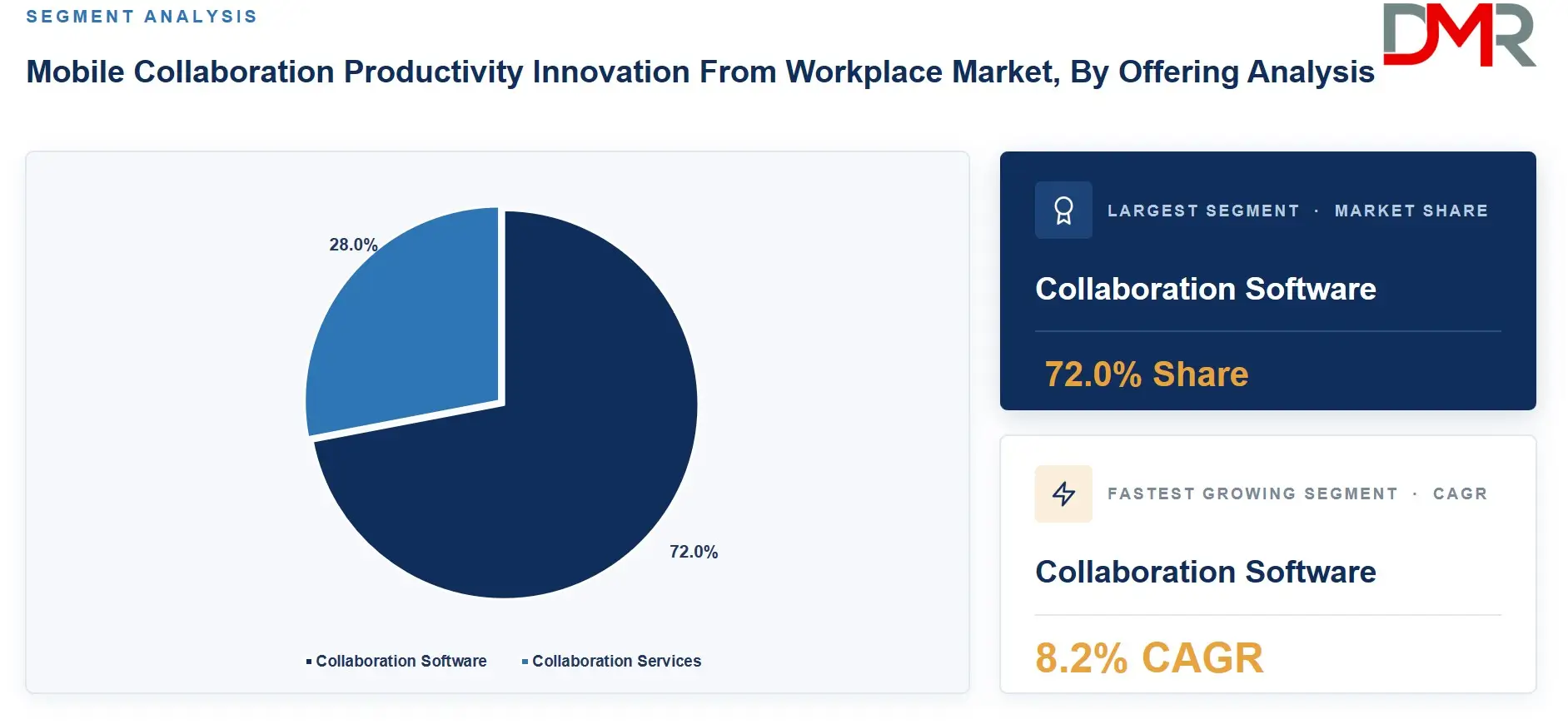
Collaboration Software is the dominant offering, accounting for an estimated 72% share in 2026, while Collaboration Services represent approximately 28%. Software leads because organizations increasingly adopt subscription-based platforms that combine messaging, meetings, file sharing, project coordination, productivity and AI capabilities. Cloud-native SaaS models also make mobile access easier to deploy across geographically distributed employee populations. Collaboration Services remain important for implementation, integration, customization, security, training and managed support, particularly among large enterprises with complex IT environments. However, software is expected to maintain its lead as vendors increasingly package implementation and AI functionality into recurring subscription offerings. Collaboration Services are projected to grow at approximately 6.8% CAGR, while software is expected to expand at around 8.2% CAGR. The software category is also benefiting from the broader team-collaboration market's shift toward integrated digital workspaces, where communication and productivity functions increasingly converge.
By Deployment Analysis
Cloud-Based deployment is estimated to hold approximately 74% of the market in 2026, making it the dominant deployment model. Cloud platforms provide cross-device accessibility, centralized administration, faster updates and scalable pricing, which are particularly valuable for mobile workforces. On-Premises deployment accounts for approximately 26% and remains important in regulated industries and organizations with stringent data-residency, security or legacy-infrastructure requirements. Cloud deployment is also the fastest-growing category, with an estimated 8.5% CAGR, compared with approximately 5.4% for on-premises solutions. The direction is consistent with broader collaboration-software research showing cloud deployment as the leading model. Grand View Research estimates cloud collaboration software represented more than half of the broader market in 2025. The emergence of controlled-environment AI could, however, preserve demand for private-cloud and on-premises architectures; Zoom's 2026 introduction of Zoom AI On-Prem illustrates this requirement among regulated enterprises.
By Organization Analysis
Large Enterprises are estimated to account for approximately 63% of 2026 revenue, supported by larger technology budgets, geographically distributed workforces and greater requirements for integrated communication, security and workflow platforms. These organizations also have stronger incentives to measure productivity improvements and consolidate fragmented software portfolios. Small & Medium Enterprises represent approximately 37% but are expected to grow faster, at an estimated 9.2% CAGR, as SaaS pricing and mobile-first applications reduce implementation barriers. SMEs can often adopt cloud collaboration without the extensive infrastructure associated with traditional enterprise deployments. The second-largest opportunity within this segment is therefore the mid-market, where businesses require enterprise-grade collaboration but favor standardized cloud platforms. Increasing availability of AI features within collaboration subscriptions should further lower the cost of advanced productivity capabilities for smaller organizations.
By Application Analysis
Communication & Messaging leads with an estimated 31% share in 2026, reflecting the foundational role of messaging, voice, video, presence and team communication. File & Document Collaboration represents approximately 23%, followed by Project & Task Management at 19%, Workflow & Process Management at 13%, and Employee Engagement & Productivity at 14%. However, Workflow & Process Management is projected to be the fastest-growing application at approximately 10.2% CAGR, because organizations increasingly demand measurable automation rather than communication alone. Workflow platforms can convert conversations into approvals, tasks, tickets and transactions. Project and task management should grow at roughly 8.8%, while communication and messaging should expand more moderately as penetration rises. The broader market is already shifting toward intelligent collaboration assistants, workflow automation and integrated enterprise ecosystems, reinforcing this transition.
By End User Industry Analysis
IT & Telecom is estimated to lead with approximately 24% of 2026 market revenue, reflecting high digital maturity, distributed teams, software-development workflows and early adoption of AI-enabled collaboration. Professional Services and BFSI are estimated at approximately 16% and 14%, respectively, followed by Healthcare at 11%, Retail & E-Commerce at 10%, Manufacturing at 9%, Education at 7%, Government & Public Sector at 5%, and Other Industries at 4%. Healthcare and Manufacturing are expected to be among the faster-growing categories because mobile collaboration can connect frontline employees with specialists, operational data and enterprise workflows. Retail and logistics also present significant opportunity because employees frequently operate away from desktops. Industry-specific security, compliance and workflow requirements will increasingly determine vendor selection, creating opportunities for verticalized mobile collaboration platforms.
The Global Mobile Collaboration Productivity Innovation From Workplace Market Report is segmented on the basis of the following:
By Offering
- Collaboration Software
- Collaboration Services
By Deployment
By Organization Size
- Large Enterprises
- Small & Medium Enterprises
By Application
- Communication & Messaging
- File & Document Collaboration
- Project & Task Management
- Workflow & Process Management
- Employee Engagement & Productivity
By End-User Industry
- IT & Telecom
- BFSI
- Healthcare
- Retail & E-Commerce
- Manufacturing
- Education
- Government & Public Sector
- Professional Services
- Other Industries
Regional Analysis
North America is the Leading Region in the Global Mobile Collaboration Productivity Innovation From Workplace Market
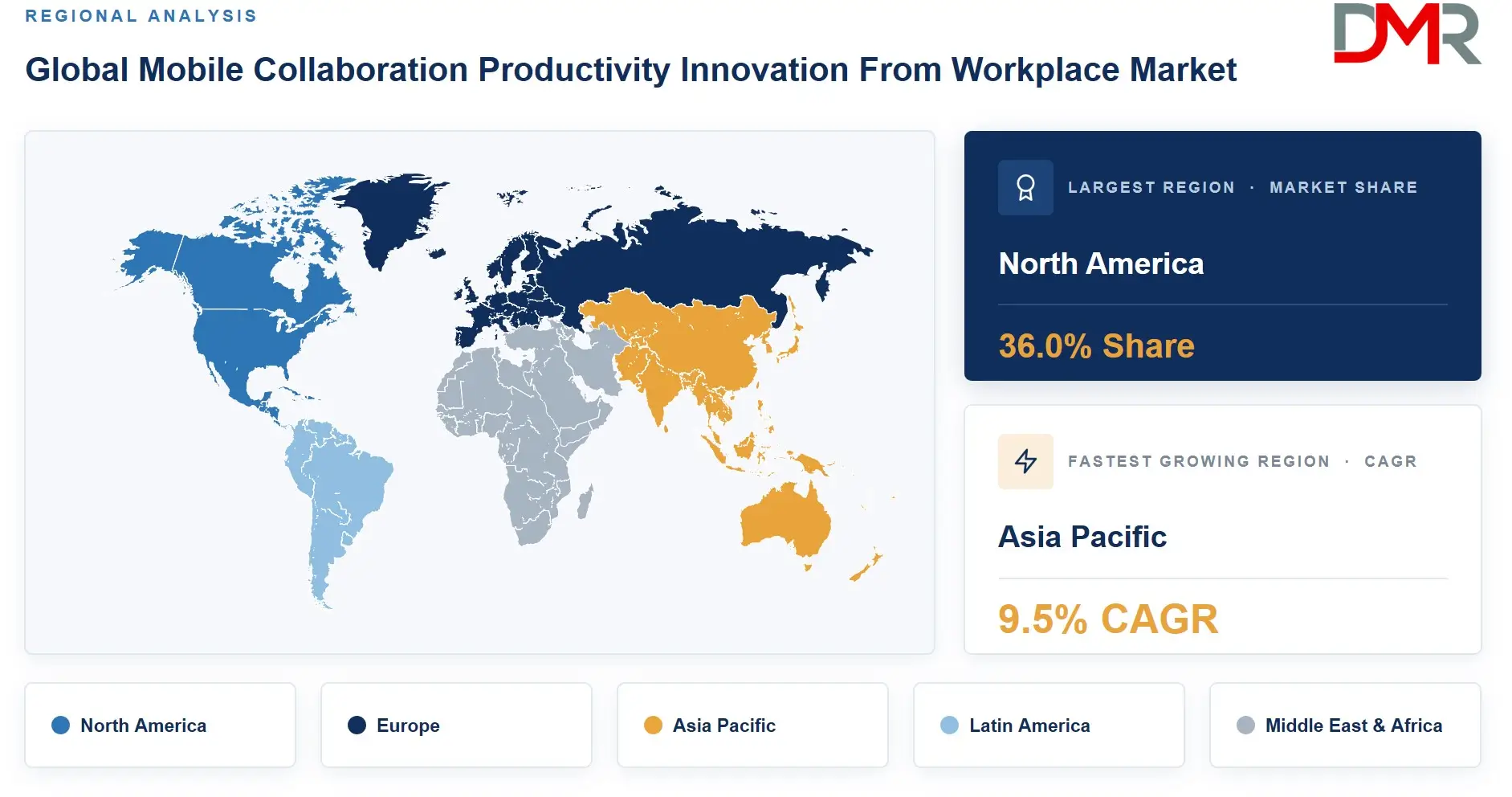
North America is expected to maintain its leadership, representing approximately 36% of global market revenue in 2026, or about USD 2.7 billion. The region benefits from high enterprise SaaS penetration, extensive hybrid-work adoption, strong smartphone and cloud infrastructure, mature cybersecurity capabilities and the presence of major collaboration-platform providers. U.S. enterprises are also among the earliest adopters of generative AI and agentic workplace technologies. The region's lead is reinforced by high spending on enterprise software and a mature ecosystem of cloud, communications, cybersecurity and productivity vendors. Broader team-collaboration research similarly identifies North America as the largest region, with estimates ranging from roughly 38% to 40% depending on market scope.
ℹ
To learn more about this report –
Download Your Free Sample Report Here
Asia Pacific is the Fastest-Growing Region in the Global Mobile Collaboration Productivity Innovation From Workplace Market
Asia-Pacific is projected to be the fastest-growing regional market, with an estimated 9.5% CAGR from 2026 to 2035. Growth is supported by expanding enterprise digitization, mobile-first workforces, cloud adoption, technology-services industries and increasing use of collaboration platforms among SMEs. India, China, Southeast Asia, South Korea and Australia represent major demand centers. Asia-Pacific's large mobile-user base gives mobile-first workplace applications a structural advantage, particularly where smartphone adoption has preceded widespread desktop enterprise-software adoption. Broader collaboration-software research also identifies Asia-Pacific as the fastest-growing regional market.
The Europe Mobile Collaboration Productivity Innovation From Workplace Market
The European market is estimated at approximately USD 1.8 billion in 2026 and is projected to reach USD 3.2 billion by 2035, representing approximately 6.5% CAGR. Demand is supported by hybrid work, enterprise digitization, cloud adoption and productivity initiatives across Germany, the U.K., France, Italy and the Nordic economies. Security, privacy and data sovereignty are particularly important competitive factors. The EU regulatory environment, including GDPR and the EU AI Act, is encouraging vendors to strengthen governance, transparency, access controls and AI risk-management capabilities. The market is therefore likely to favor enterprise platforms capable of demonstrating strong data governance and compliance.
Latin America Mobile Collaboration Productivity Innovation From Workplace Market
Latin America is estimated at approximately USD 0.55 billion in 2026 and could reach USD 1.1 billion by 2035, representing an estimated 7.9% CAGR. Brazil and Mexico account for most regional demand. Growth is supported by cloud adoption, expanding digital services, remote work, mobile connectivity and the modernization of SMEs. Mobile-first deployment can be particularly attractive where organizations want to extend collaboration capabilities without substantial desktop infrastructure. Cost-efficient SaaS pricing, Spanish- and Portuguese-language interfaces, local data hosting and integration with regional business applications will be important competitive differentiators.
MEA Mobile Collaboration Productivity Innovation From Workplace Market
The MEA market is estimated at approximately USD 0.45 billion in 2026 and is projected to reach approximately USD 0.9 billion by 2035, representing a 7.9% CAGR. Gulf economies, particularly Saudi Arabia and the UAE, are leading adoption through government digitization, smart-city initiatives, enterprise modernization and large-scale technology investment. Africa presents a longer-term opportunity through smartphone-led access to digital work tools, particularly for SMEs and distributed workforces. Local hosting, cybersecurity, Arabic-language capabilities and integration with government and enterprise platforms will shape competitive positioning.
Major Countries Analysis
United States Mobile Collaboration Productivity Innovation From Workplace Market
The U.S. mobile collaboration productivity market is estimated at approximately USD 2.0 billion in 2026, rising to about USD 3.7 billion by 2035, representing a 7.0% CAGR. Demand is supported by mature SaaS adoption, hybrid work, AI investment and the presence of leading vendors. AI agents, enterprise search, workflow automation and integrated productivity suites are becoming important purchasing criteria.
Japan Mobile Collaboration Productivity Innovation From Workplace Market
Japan is estimated at approximately USD 0.42 billion in 2026 and is projected to reach approximately USD 0.78 billion by 2035, representing a 7.1% CAGR. Adoption is supported by workplace digitalization, labor-productivity initiatives, aging workforce dynamics and demand for automation. Mobile collaboration is increasingly relevant for field operations, manufacturing, healthcare and distributed enterprise teams.
Saudi Arabia Mobile Collaboration Productivity Innovation From Workplace Market
Saudi Arabia's market is estimated at approximately USD 0.12 billion in 2026 and is expected to reach approximately USD 0.27 billion by 2035, representing an estimated 9.5% CAGR. Vision 2030-related digital transformation, cloud adoption, smart-city development and enterprise modernization support demand. Government, construction, energy, professional services and large diversified enterprises represent important applications.
Regulatory Landscape
The regulatory environment is becoming an increasingly important component of mobile workplace technology procurement. European deployments must consider GDPR, the EU AI Act, cybersecurity requirements and sector-specific rules, particularly when collaboration platforms process employee or customer information. AI-enabled systems can create additional obligations involving transparency, risk management, human oversight, data governance and security. India's Digital Personal Data Protection Act and Rules are also becoming operationally significant for digital platforms processing personal data. India's rules were notified in November 2025, strengthening requirements around purpose limitation, user rights and data governance. For regulated enterprises, data residency and private deployment are becoming competitive differentiators; Zoom's introduction of AI On-Prem in 2026 illustrates the growing demand for controlled AI environments.
Investment and White Space Analysis
The strongest investment opportunities lie in AI-native mobile workflow automation, frontline-worker collaboration, industry-specific mobile assistants, privacy-preserving AI, offline collaboration and cross-platform enterprise integration. Healthcare, manufacturing, logistics, retail and field services are particularly attractive because significant employee populations remain mobile or deskless. Asia-Pacific offers the strongest geographic white space because of its high mobile penetration and relatively rapid enterprise digitization. Investors should also examine middleware that connects collaboration applications with ERP, CRM, ITSM and knowledge systems. The market's next competitive phase is likely to favor platforms that can demonstrate measurable productivity outcomes, such as reduced administrative time, faster approvals, and higher task completion rates, rather than simply increasing message or meeting volumes.
By Region
North America
Europe
- Germany
- France
- The U.K.
- Italy
- Spain
- Rest of Europe
Asia-Pacific
- China
- Japan
- India
- Australia
- South Korea
- Rest of APAC
Latin America
- Mexico
- Brazil
- Rest of LATAM
Middle East & Africa
- Saudi Arabia
- The UAE
- South Africa
- Rest of MEA
Competitive Landscape
The market is moderately concentrated at the platform level but highly fragmented across specialized applications. Major ecosystems compete through integrated productivity suites, communication platforms, AI assistants and enterprise workflow capabilities, while specialized vendors compete through project management, document collaboration, knowledge management, employee engagement and industry-specific applications. Key competitive strategies include AI integration, platform consolidation, strategic partnerships, API ecosystems, enterprise security, vertical specialization and geographic expansion. Differentiation is increasingly shifting from basic messaging and conferencing toward contextual intelligence, interoperability, workflow execution, data governance and measurable productivity outcomes.
Some of the prominent players in the Global Mobile Collaboration Productivity Innovation From Workplace Market are:
- Microsoft
- Google
- Slack Technologies
- Zoom Communications
- Cisco Systems
- Salesforce
- Atlassian
- Asana
- Monday.com
- Notion Labs
- Dropbox
- Box
- Adobe
- Smartsheet
- ClickUp
- Miro
- Airtable
- Wrike
- Microsoft Teams
- RingCentral
- 8x8
- GoTo
- Zoho
- Freshworks
- HubSpot
- ServiceNow
- SAP
- Oracle
- IBM
- Citrix Systems
- OpenText
- Egnyte
- DocuSign
- Flock
- Workplace from Meta
- Basecamp
- Teamwork.com
- Lucid Software
- Chanty
- Mattermost
- Other Key Players
Recent Developments
- In June 2026, Zoom expanded AI agents and introduced Zoom AI On-Prem, addressing automation needs while providing controlled deployment options for regulated organizations.
- In June 2026, Zoom launched ZoomMate, combining agentic search, AI-generated deliverables and workflow execution across systems including Salesforce, Jira, Slack and ServiceNow.
- In May 2026, Atlassian highlighted its AI-native organization strategy, reporting a 7x increase in agentic automations across customers during the preceding six months and expanding the role of Rovo agents in enterprise workflows.
- In May 2026, Google expanded AI capabilities across Workspace, introducing conversational voice functionality and additional AI experiences intended to help users create, organize and complete workplace tasks.
- In April 2026, Slack announced an agent-focused platform strategy, enabling organizations to build, deploy and manage AI agents directly within the workplace environment, emphasizing shared context between agents and human teams.
Report Details
| Report Characteristics |
| Market Size (2026) |
USD 7.6 Bn |
| Forecast Value (2035) |
USD 14.9 Bn |
| CAGR (2026–2035) |
7.8% |
| The US Market Size (2026) |
USD 2.0 Bn |
| Historical Data |
2021 – 2025 |
| Forecast Data |
2026 – 2035 |
| Base Year |
2025 |
| Segments Covered |
By Offering, By Deployment, By Organization Size, By Application, By End-User Industry |
| Regional Coverage |
North America – The US and Canada; Europe – Germany, France, The UK, Italy, Spain, Rest of Europe; Asia-Pacific – China, Japan, India, Australia, South Korea, Rest of APAC; Latin America – Mexico, Brazil, Colombia, Argentina, Rest of LATAM; Middle East & Africa – Saudi Arabia, The UAE, South Africa, Rest of MEA |
Frequently Asked Questions
What is the market size of the Global Mobile Collaboration Productivity & Workplace Innovation Market in 2026?
▾ The Global Mobile Collaboration Productivity & Workplace Innovation Market is estimated at approximately USD 7.6 billion in 2026.
What will be the market size of the Global Mobile Collaboration Productivity & Workplace Innovation Market by 2035?
▾ The Global Mobile Collaboration Productivity & Workplace Innovation Market is projected to reach approximately USD 14.9 billion by 2035.
What is the CAGR of the Global Mobile Collaboration Productivity & Workplace Innovation Market from 2026 to 2035?
▾ The Global Mobile Collaboration Productivity & Workplace Innovation Market is expected to expand at a 7.8% CAGR from 2026 to 2035.
What are the key factors driving the Global Mobile Collaboration Productivity & Workplace Innovation Market?
▾ Hybrid work, mobile workforces, cloud adoption, AI assistants, workflow automation and demand for unified digital workplaces are driving the Global Mobile Collaboration Productivity & Workplace Innovation Market.
Which segment dominates the Global Mobile Collaboration Productivity & Workplace Innovation Market?
▾ Collaboration Software dominates the Global Mobile Collaboration Productivity & Workplace Innovation Market, accounting for approximately 72% of the market in 2026.
Which region leads the Global Mobile Collaboration Productivity & Workplace Innovation Market?
▾ North America leads the Global Mobile Collaboration Productivity & Workplace Innovation Market, accounting for approximately 36% of global market revenue in 2026.
Which region is expected to grow fastest in the Global Mobile Collaboration Productivity & Workplace Innovation Market?
▾ Asia-Pacific is projected to be the fastest-growing region in the Global Mobile Collaboration Productivity & Workplace Innovation Market, with an estimated 9.5% CAGR.
Who are the key players in the Global Mobile Collaboration Productivity & Workplace Innovation Market?
▾ Key players in the Global Mobile Collaboration Productivity & Workplace Innovation Market include Microsoft, Google, Salesforce/Slack, Zoom and Atlassian, alongside specialized collaboration and workflow providers.