Market Overview
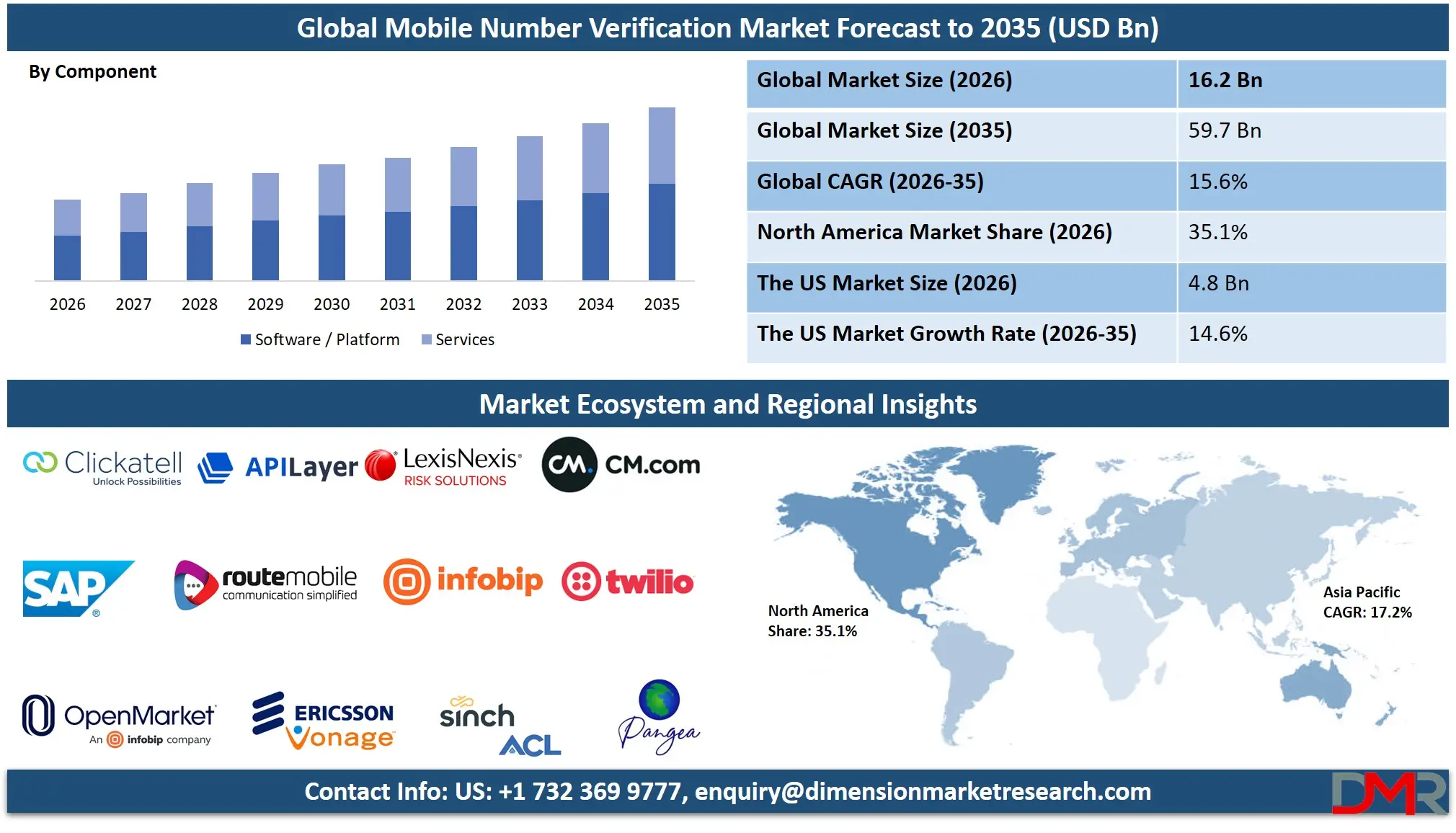
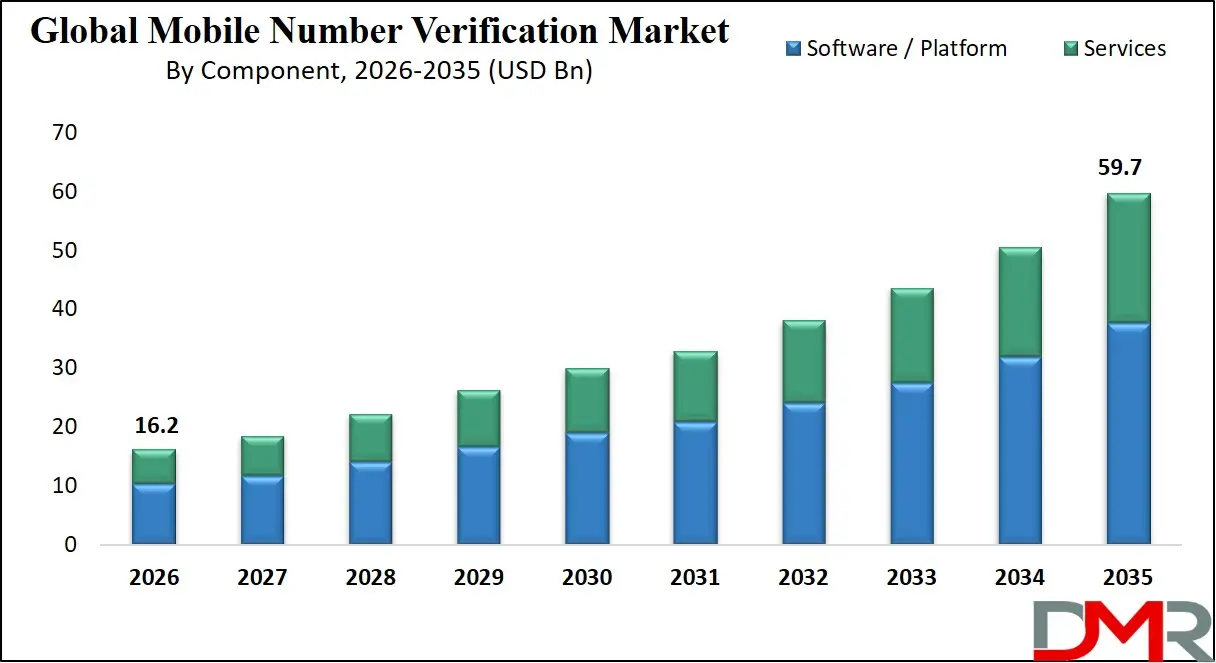
The Global Mobile Number Verification Market is set for substantial expansion, reaching an estimated USD 16.2 billion in 2026 and projected to grow at a strong CAGR of 15.6% from 2026 to 2035, to the market value of USD 59.7 billion by 2035. This robust growth trajectory is fueled by the accelerating adoption of digital identity verification solutions, real-time phone number validation APIs, SMS authentication services, and multi-factor authentication (MFA) platforms across industries.
ℹ
To learn more about this report –
Download Your Free Sample Report Here
Rising incidents of identity theft, SIM swap fraud, account takeover attacks, phishing scams, and financial cybercrime are compelling organizations to implement advanced mobile authentication systems and secure customer onboarding frameworks. The rapid expansion of fintech platforms, digital banking, e-commerce marketplaces, online gaming, telecom services, and subscription-based applications is significantly increasing demand for reliable number verification tools.
Additionally, growing regulatory compliance requirements related to Know Your Customer (KYC), Anti-Money Laundering (AML), data privacy laws, and digital security standards are further accelerating market adoption. Businesses are increasingly integrating OTP verification, two-factor authentication (2FA), silent network authentication, carrier lookup intelligence, and AI-driven fraud detection solutions to enhance user trust and prevent fraudulent activities.
Cloud-based deployment models, API-driven integration, and scalable SaaS verification platforms are enabling enterprises and SMEs to implement cost-effective and globally accessible authentication services. As mobile-first strategies dominate digital ecosystems and smartphone penetration continues to rise worldwide, the Mobile Number Verification Market is expected to witness sustained double-digit growth through 2035, driven by cybersecurity prioritization and digital transformation initiatives.
ℹ
To learn more about this report –
Download Your Free Sample Report Here
Growing government initiatives promoting digital identity frameworks, secure online transactions, and cross-border data compliance further accelerate global adoption. However, barriers such as varying data privacy regulations (GDPR, CCPA), high latency in international lookups, reliance on telecom infrastructure quality, and the rising sophistication of fraud rings remain. Despite these limitations, the convergence of telecom data, AI, and cloud-based API platforms positions mobile number verification as a central pillar of global digital trust and security through 2035.
The US Mobile Number Verification Market
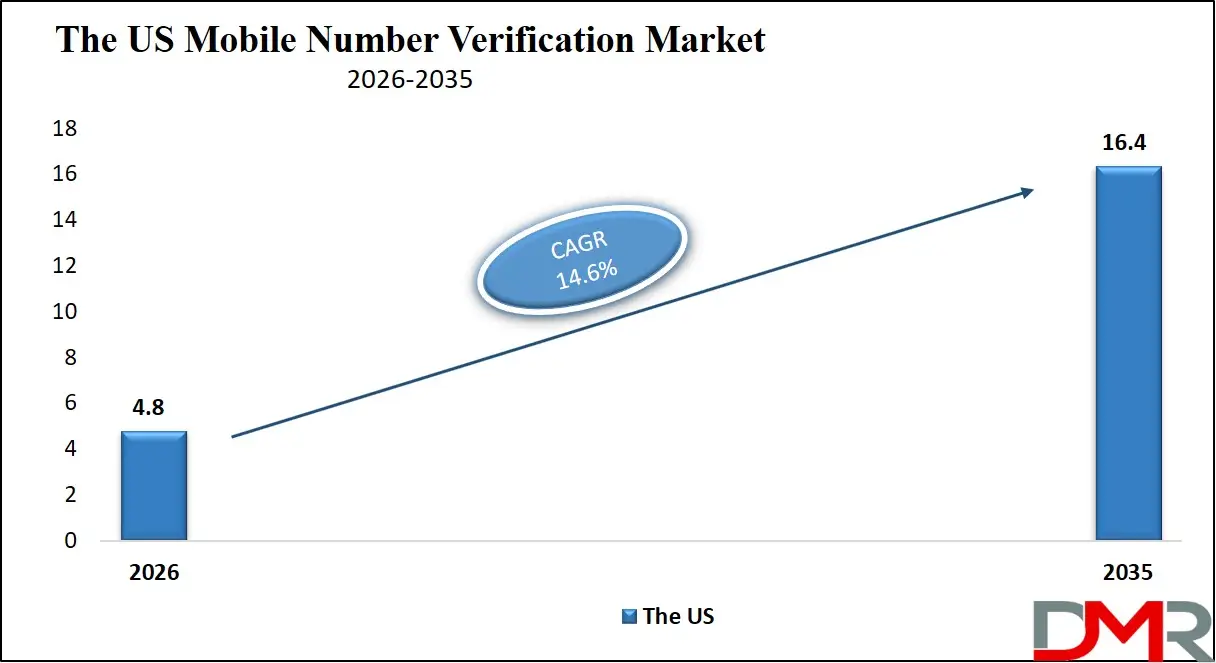
The U.S. Mobile Number Verification Market is projected to reach USD 4.8 billion in 2026 and grow at a CAGR of 14.8%, reaching USD 16.6 billion by 2035. The U.S. leads global adoption due to its mature digital economy, high incidence of online fraud, and a strong regulatory push for consumer data protection from bodies like the FCC and FTC.
ℹ
To learn more about this report –
Download Your Free Sample Report Here
The proliferation of digital-first services in banking, healthcare, and e-commerce, coupled with consumers' expectation of seamless yet secure logins, fuels demand for robust verification solutions. Major technology platforms, financial institutions, and sharing economy giants such as Uber, Airbnb, and JPMorgan Chase are integrating advanced number verification to mitigate risks during user onboarding and high-risk transactions.
U.S. regulatory support for digital identity trust, alongside frameworks like the Digital Identity Guidelines, encourages investment in verification technologies. The market is witnessing a shift toward carrier-direct pathways and real-time number intelligence, reducing reliance on less accurate data sources and enhancing the user experience. The rise of SIM swapping attacks as a high-profile threat vector has further intensified the focus on sophisticated verification and porting history checks, positioning the U.S. as a critical innovator in this space.
The Europe Mobile Number Verification Market
The Europe Mobile Number Verification Market is projected to be valued at approximately USD 4.8 billion in 2026 and is projected to reach around USD 17.9 billion by 2035, growing at a CAGR of about 15.6% from 2026 to 2035. Europe's leadership is anchored by its stringent regulatory environment, particularly the GDPR and the revised Payment Services Directive (PSD2), which mandate Strong Customer Authentication (SCA) for electronic payments.
Countries such as Germany, the U.K., France, and the Nordic region are widely adopting verification services, driven by a high emphasis on data privacy and security. The U.K.'s Online Safety Bill and the EU's evolving eIDAS 2.0 framework further necessitate robust user verification mechanisms across social platforms and digital service providers.
Europe's high smartphone penetration, cross-border digital commerce, and a mature fintech ecosystem drive the demand for seamless, compliant verification solutions. Funding and support for digital single market initiatives encourage cross-carrier data collaboration and the standardization of verification APIs across member states. With a sophisticated user base and a regulatory landscape that prioritizes consent and privacy, Europe remains a highly advanced and essential region for mobile verification services.
The Japan Mobile Number Verification Market
The Japan Mobile Number Verification Market is anticipated to be valued at approximately USD 1.2 billion in 2026 and is expected to attain nearly USD 4.7 billion by 2035, expanding at a CAGR of about 15.6% during the forecast period. Japan's aging population and a government push for a "Digital Garden City Nation" initiative are driving the adoption of secure and accessible digital services, making verification a cornerstone of digital inclusion.
The Ministry of Internal Affairs and Communications (MIC) actively supports the development of secure digital infrastructure, promoting the use of mobile identity for public and financial services. Japan's leadership in mobile carrier technology and high smartphone adoption provides a robust foundation for advanced verification methods, including network-based authentication and SIM checks.
Japan's concept of "Society 5.0" , driven by major corporations and financial groups, integrates mobile identity into everything from banking to government portals. Companies are deploying mobile number verification to combat rising cases of online fraud and ensure the integrity of digital transactions in Tokyo's bustling e-commerce sector and regional administrative services. Japan's cultural emphasis on security and reliability positions it as a high-growth, quality-focused market for verification solutions.
Global Mobile Number Verification Market: Key Takeaways
- Strong Global Market Growth Outlook: The Global Mobile Number Verification Market is expected to be valued at USD 16.2 billion in 2026 and is projected to reach USD 59.7 billion by 2035, showcasing rapid expansion supported by rising demand for digital trust and fraud prevention.
- High CAGR Driven by Fraud Prevention Adoption: The market is expected to grow at an impressive CAGR of 15.6% from 2026 to 2035, fueled by accelerating digital transformation, AI-driven security protocols, and increasing sophistication of cyber threats worldwide.
- Strong Growth Trajectory in the United States: The U.S. Mobile Number Verification Market stands at USD 4.8 billion in 2026 and is projected to reach USD 16.4 billion by 2035, expanding at a CAGR of 14.6% due to high digital fraud rates and strong technology infrastructure.
- Regional Dominance: North America is expected to capture approximately 35.1% of the global market share in 2026, supported by stringent regulatory frameworks, a mature fintech ecosystem, and high consumer data protection standards.
- Rapid Advancement in Verification Technologies: Innovations including AI-based number reputation scoring, real-time SIM swap detection, silent/network-based authentication, and blockchain-anchored verification logs are significantly enhancing accuracy, speed, and security of verification services.
- Growing Digital Fraud Boosts Adoption: Rising global incidents of account takeover, synthetic identity fraud, and SIM-swapping, coupled with the need for frictionless user experiences, is driving sustained demand for robust, real-time number verification solutions.
Global Mobile Number Verification Market: Use Cases
- User Onboarding in Fintech: Banks and neobanks verify new user phone numbers instantly during account creation to meet KYC/AML regulations and prevent fake account sign-ups.
- E-commerce Transaction Verification: Online retailers verify phone numbers during high-value purchases or first-time orders to reduce payment fraud and confirm delivery logistics.
- Social Media & Messaging Apps: Platforms verify user identity via SMS or silent verification during registration to combat bots, spam, and fake profiles.
- Ride-Hailing & Delivery Services: Apps verify both riders and drivers to build trust and safety within the platform, confirming active, legitimate users.
- Healthcare Appointment Reminders: Providers use number validation to ensure accurate contact details for sending sensitive health information and appointment notifications, maintaining compliance.
Global Mobile Number Verification Market: Stats & Facts
International Telecommunication Union (ITU)
- 82% of individuals aged 10+ globally own a mobile phone.
- Mobile phone ownership exceeds 95% in high-income countries.
- In upper-middle-income countries, ownership surpasses 90%.
- In low-income economies, only 53% of individuals own a mobile phone.
- 87% of males globally own a mobile phone.
- 78% of females globally own a mobile phone.
- Global mobile cellular subscriptions exceed the total world population, indicating penetration above 100 subscriptions per 100 inhabitants.
- Over 5.4 billion people worldwide use the Internet, with mobile phones being the primary access device.
World Bank (Telecommunications Data)
- Global mobile cellular subscriptions surpassed 8.5 billion connections.
- In many developed economies, mobile subscription rates exceed 120 per 100 people.
- More than 75% of the global population lives within 4G coverage.
- Mobile broadband subscriptions continue to rise annually across emerging markets.
GSMA (Global System for Mobile Communications Association)
- Mobile technologies contribute approximately 5%–6% of global GDP, equivalent to over USD 6 trillion in economic value.
- There are more than 5.6 billion unique mobile subscribers globally.
- Smartphones account for over 75% of total mobile connections worldwide.
- 5G connections surpassed 1.5 billion globally.
- Over 80 mobile operators worldwide have adopted API-based security initiatives such as SIM swap detection.
Federal Bureau of Investigation (FBI) – IC3 Report
- The FBI received over 850,000 cybercrime complaints in a single year.
- Reported cybercrime losses exceeded USD 12 billion annually.
- Phishing and spoofing were among the most reported cybercrime types.
- Business email compromise and impersonation scams accounted for billions in losses.
Federal Trade Commission (FTC), United States
- The FTC received over 6 million consumer fraud reports annually
- Identity theft accounts for approximately 20% of total fraud reports.
- Credit card fraud represents more than 40% of identity theft cases.
- Online shopping and payment scams are among the top reported fraud categories.
UK Office for National Statistics (ONS)
- Fraud and computer misuse offenses total over 3 million incidents annually in the UK.
- Unauthorized access to personal information is a significant portion of reported cyber offenses.
Cifas (UK Fraud Prevention Service)
- SIM swap fraud cases increased by over 1,000% year-on-year in the UK.
- Telecommunications identity fraud rose by nearly 80% in one reporting period.
Telecom Regulatory Authority of India (TRAI) / Department of Telecommunications (DoT)
- India has over 1.1 billion wireless subscribers, making it one of the largest mobile markets globally.
Global Mobile Number Verification Market: Market Dynamic
Driving Factors in the Global Mobile Number Verification Market
Escalating Digital Fraud and Identity Theft
The growing global incidence of cybercrime, including account takeovers, synthetic identity fraud, and SIM-swapping, is a major driver for mobile number verification. Fraudsters increasingly target mobile numbers as the gateway to personal data and financial accounts. Verification systems that check number status, porting history, and active SIM details provide a critical layer of security. This allows businesses to block high-risk activities in real-time, protecting both their revenue and their users' sensitive information, especially in high-risk sectors like finance and digital payments.
Stringent Regulatory Compliance Mandates
Mobile number verification benefits heavily from global regulatory frameworks like GDPR in Europe, PSD2 for payments, and KYC/AML directives worldwide. These regulations legally require businesses to positively identify their users, making verification not just a security best practice but a mandatory compliance step. The ability to verify a phone number against a network in real-time provides an auditable trail and helps meet due diligence requirements, avoiding heavy fines and reputational damage associated with non-compliance.
Restraints in the Global Mobile Number Verification Market
Fragmented Telecom Infrastructure and Data Latency
The significant challenge of aggregating and accessing data from thousands of disparate global telecom carriers creates friction. Achieving real-time, accurate lookups (e.g., SIM swap status, line type) requires deep carrier network integration, which can be inconsistent. In many regions, data latency or lack of comprehensive coverage can lead to verification failures or delays, negatively impacting user experience and forcing businesses to rely on less accurate, derivative data sources.
Regulatory and Data Privacy Complexity
Data privacy regulations like GDPR impose strict rules on how personal data, including phone numbers, can be processed and stored. Obtaining user consent, ensuring data is used only for specified purposes, and managing cross-border data flows create significant operational and legal complexity for verification providers and their clients. Varying interpretations of "consent" and "legitimate interest" across jurisdictions make it difficult to build a single, universal verification workflow.
Opportunities in the Global Mobile Number Verification Market
Expansion into Emerging Digital Economies
Emerging markets in Asia-Pacific, Africa, and Latin America represent major growth opportunities due to rapid mobile penetration, leapfrogging of traditional finance, and increasing government focus on digital identity. Countries like India, Indonesia, Nigeria, and Brazil are seeing a surge in mobile money and digital services, creating massive demand for onboarding and transaction verification. Localized solutions, partnerships with regional carrier aggregators, and pay-as-you-go pricing models can improve accessibility, driving the next wave of market expansion.
AI-Driven Risk-Based Authentication (RBA)
The integration of AI not only for number validation but for analyzing behavioral patterns, device intelligence, and network anomalies creates new value streams. AI can power RBA, where step-up verification is triggered only when a transaction or login is deemed high-risk based on number reputation, location mismatch, or velocity checks. This transforms verification from a static checkpoint into an intelligent, adaptive security layer that optimizes user friction and continuously improves fraud detection models.
Trends in the Global Mobile Number Verification Market
Silent/Network-Based Authentication
The rise of silent verification methods, which authenticate a user's number in the background without requiring an OTP or user input, is gaining significant traction. This trend leverages the data connection between the mobile app and the carrier network to provide a seamless, frictionless user experience. This method is far more secure against phishing than OTPs and is becoming the gold standard for user experience in super-apps and digital wallets.
API-Driven Orchestration and Fallback Logic
Centralized cloud platforms are enabling smart routing and orchestration across multiple verification pathways (SMS OTP, silent verification, WhatsApp OTP, voice OTP). This ensures the highest possible success rate and speed by automatically selecting the optimal channel based on the user's country, carrier, and real-time network conditions. This trend supports global scalability for businesses with a geographically diverse user base, ensuring reliable verification everywhere.
Global Mobile Number Verification Market: Research Scope and Analysis
By Component Analysis
The software/platform segment is projected to dominate the Global Mobile Number Verification Market, accounting for the largest revenue share compared to professional and managed services. This dominance is primarily driven by the growing need for automated, scalable, and real-time verification systems that can seamlessly integrate into digital ecosystems. Businesses across banking, fintech, e-commerce, telecom, and digital media require API-driven verification engines capable of processing millions of authentication requests instantly.
Modern verification software provides advanced capabilities such as number validation, carrier lookup, line type detection, SIM swap detection, fraud scoring, and geo-location intelligence. These features significantly reduce the risk of identity theft, fake registrations, spam accounts, and financial fraud. Enterprises prefer customizable and cloud-integrated platforms that offer analytics dashboards, reporting tools, and compliance tracking features, enabling proactive fraud management.
Additionally, the shift toward digital onboarding and remote customer acquisition has increased reliance on automated verification APIs. Subscription-based SaaS models further strengthen the software segment's dominance, as companies can deploy solutions quickly without significant infrastructure investment.
While services such as consulting, implementation, and technical support are important, they typically complement software offerings rather than act as primary revenue generators. As digital transformation accelerates globally and businesses adopt mobile-first strategies, the software/platform segment is expected to maintain its leadership position due to continuous innovation, automation, and AI-driven verification capabilities.
By Deployment Mode Analysis
Cloud-based deployment is expected to dominate the market due to its flexibility, scalability, and cost efficiency. Organizations increasingly prefer cloud verification solutions because they eliminate heavy capital expenditure on IT infrastructure while offering seamless global scalability. As businesses expand digitally across multiple geographies, cloud platforms enable real-time verification across borders without physical server installations.
Cloud-based solutions allow instant API integration into mobile applications, websites, payment gateways, and CRM systems. They support high transaction throughput, automatic system updates, and centralized data management. This is particularly beneficial for fintech companies, e-commerce platforms, and telecom operators handling large user bases.
Another major advantage of cloud deployment is its ability to integrate advanced analytics, AI-based fraud detection, and behavioral monitoring tools. These features enhance security while maintaining a smooth user experience. The pay-per-use pricing model further supports adoption among startups and small enterprises, accelerating overall market penetration.
Although on-premises deployment remains relevant for highly regulated industries requiring complete data control, its adoption is comparatively limited due to higher maintenance costs and lower flexibility. As cybersecurity threats increase and businesses prioritize agility, cloud-based verification solutions continue to lead the market and are projected to maintain dominance over the forecast period.
By Verification Type Analysis
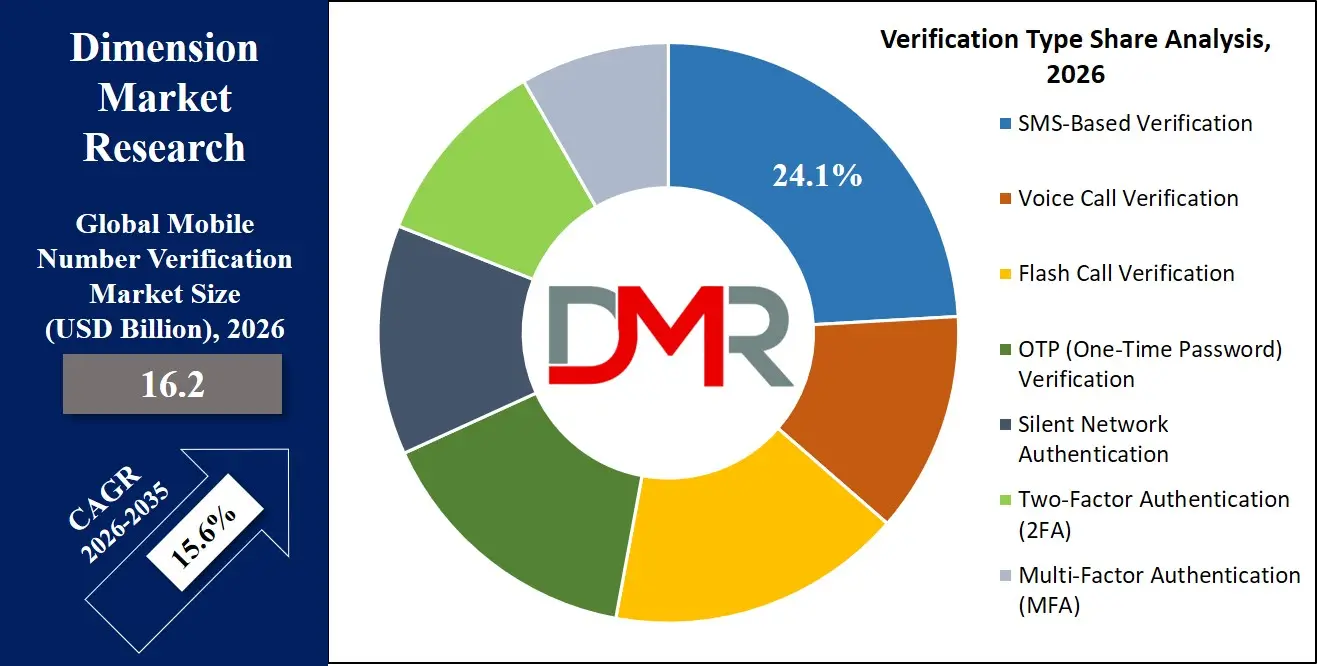
OTP (One-Time Password) and Two-Factor Authentication (2FA) is anticipated to dominate the verification type segment due to their strong balance between security, cost-effectiveness, and user convenience. These methods are widely used for secure logins, transaction authentication, password recovery, and account verification processes.
OTP-based verification remains popular because it is simple to implement and highly effective in confirming user identity. It is extensively used by banks, digital wallets, online marketplaces, telecom providers, and government platforms. 2FA strengthens security by adding an additional verification layer beyond passwords, significantly reducing risks of unauthorized access and account takeover fraud.
ℹ
To learn more about this report –
Download Your Free Sample Report Here
Regulatory requirements in financial services and data protection frameworks across various countries mandate strong authentication practices, further driving adoption. As digital transactions increase, organizations are prioritizing secure authentication frameworks to combat phishing attacks, SIM swap fraud, and identity manipulation.
Although silent authentication and flash call verification are gaining traction due to enhanced user experience, OTP and 2FA continue to dominate because of their regulatory acceptance, global familiarity, and proven effectiveness. Their widespread adoption across multiple industries ensures continued leadership in this segment.
By Organization Size Analysis
Large enterprises is projected to dominate the organization size segment due to higher transaction volumes, complex security requirements, and substantial IT budgets. Multinational banks, telecom operators, e-commerce giants, and digital service providers process millions of verification requests daily, requiring highly scalable and reliable authentication systems.
These organizations prioritize fraud prevention, compliance management, and customer data protection. Regulatory mandates in banking, insurance, and telecommunications require strong verification protocols, prompting enterprises to invest heavily in advanced authentication infrastructure. Additionally, large enterprises often operate across multiple countries, necessitating verification systems capable of handling international carrier databases and global number validation.
Large enterprises also adopt AI-driven fraud detection, real-time risk assessment, and analytics-based monitoring tools. Their financial capability allows them to integrate comprehensive identity verification frameworks that go beyond basic OTP authentication.
While SMEs are increasingly adopting mobile verification solutions due to digital transformation and online expansion, their spending capacity and transaction scale remain lower compared to large enterprises. Consequently, large enterprises continue to generate the majority of market revenue and are expected to sustain their dominant position.
By Application Analysis
User authentication and fraud prevention is forecasted to dominate the application segment, driven by the growing need to secure digital identities and online transactions. With rising cybercrime, fake account creation, and financial fraud, businesses rely heavily on mobile number verification to validate genuine users and prevent unauthorized access.
Financial institutions use verification tools to secure login sessions, authorize transactions, and protect sensitive customer information. E-commerce platforms leverage authentication systems to prevent fake registrations and payment fraud. Similarly, digital service providers use verification to maintain data integrity and user trust.
Fraud prevention has become increasingly important as cybercriminals adopt sophisticated techniques such as phishing, account takeover attacks, and SIM swap fraud. Mobile number verification provides a critical security checkpoint during account creation and transaction approval processes.
Although applications such as marketing validation and CRM database cleansing are growing, authentication and fraud prevention remain the primary revenue drivers. As digital payment ecosystems expand globally, this segment will continue to dominate due to its direct role in enhancing security and compliance.
By End-Use Industry Analysis
The BFSI (Banking, Financial Services, and Insurance) sector is expected to dominate the end-use segment due to strict regulatory requirements and high fraud sensitivity. Financial institutions require robust verification mechanisms for customer onboarding, transaction authorization, password resets, and account recovery.
Anti-money laundering (AML) regulations, Know Your Customer (KYC) mandates, and data protection laws require financial institutions to implement secure authentication processes. The rise of digital banking, neobanks, and fintech platforms has further accelerated demand for reliable mobile verification systems.
Insurance companies and investment platforms also rely on verification to secure policyholder data and prevent identity misuse. Given the high financial risks associated with fraud, BFSI institutions allocate significant budgets toward cybersecurity and authentication technologies.
While telecom, e-commerce, healthcare, and government sectors also contribute significantly, BFSI remains the largest revenue contributor due to regulatory intensity and high transaction frequency.
The Global Mobile Number Verification Market Report is segmented on the basis of the following:
By Component
- Software / Platform
- API-Based Verification Solutions
- SDK-Based Verification Tools
- Real-Time Validation Engines
- Bulk Verification Systems
- Services
- Integration & Deployment Services
- Consulting Services
- Managed Verification Services
- Support & Maintenance
By Deployment Mode
By Verification Type
- SMS-Based Verification
- Voice Call Verification
- Flash Call Verification
- OTP (One-Time Password) Verification
- Silent Network Authentication
- Two-Factor Authentication (2FA)
- Multi-Factor Authentication (MFA)
By Organization Size
- Large Enterprises
- Small & Medium Enterprises (SMEs)
By Application
- User Authentication
- Fraud Prevention
- Customer Onboarding (KYC)
- Marketing & CRM Validation
- Identity Verification
- Transaction Security
By End-Use Industry
- BFSI (Banking, Financial Services & Insurance)
- E-commerce & Retail
- Telecommunications
- Healthcare
- IT & Software
- Travel & Hospitality
- Government & Public Sector
- Media & Entertainment
- Gaming & Online Betting
- Others
Impact of Artificial Intelligence in the Global Mobile Number Verification Market
- AI for Fraud Pattern & Anomaly Detection: AI analyzes vast datasets of verification requests to identify subtle patterns indicative of fraud rings, bot networks, or synthetic identities. This allows systems to flag or block suspicious numbers with high precision in real-time.
- AI-Driven Risk-Based Authentication (RBA): AI algorithms assess the risk profile of a verification attempt by combining number intelligence (e.g., prepaid vs. postpaid, SIM swap age) with behavioral data (e.g., typing speed, device fingerprint) to determine if step-up verification is needed.
- Predictive Number Reputation Scoring: AI-powered systems continuously learn from global fraud reports to build and maintain dynamic reputation scores for billions of phone numbers. A high-risk score can be used to automatically trigger additional scrutiny.
- AI-Based Routing Optimization for OTP Delivery: AI analyzes real-time network conditions and historical delivery rates across multiple channels (SMS, Voice, RCS) to select the most reliable and fastest pathway for delivering a one-time passcode, maximizing conversion rates.
- Learning from Global Threat Intelligence: AI systems aggregate and anonymize data across a global customer base to identify emerging fraud vectors (e.g., a new type of SIM-swapping scam), enabling all clients to benefit from collective learning and updated defense models.
Global Mobile Number Verification Market: Regional Analysis
Region with the Largest Revenue Share
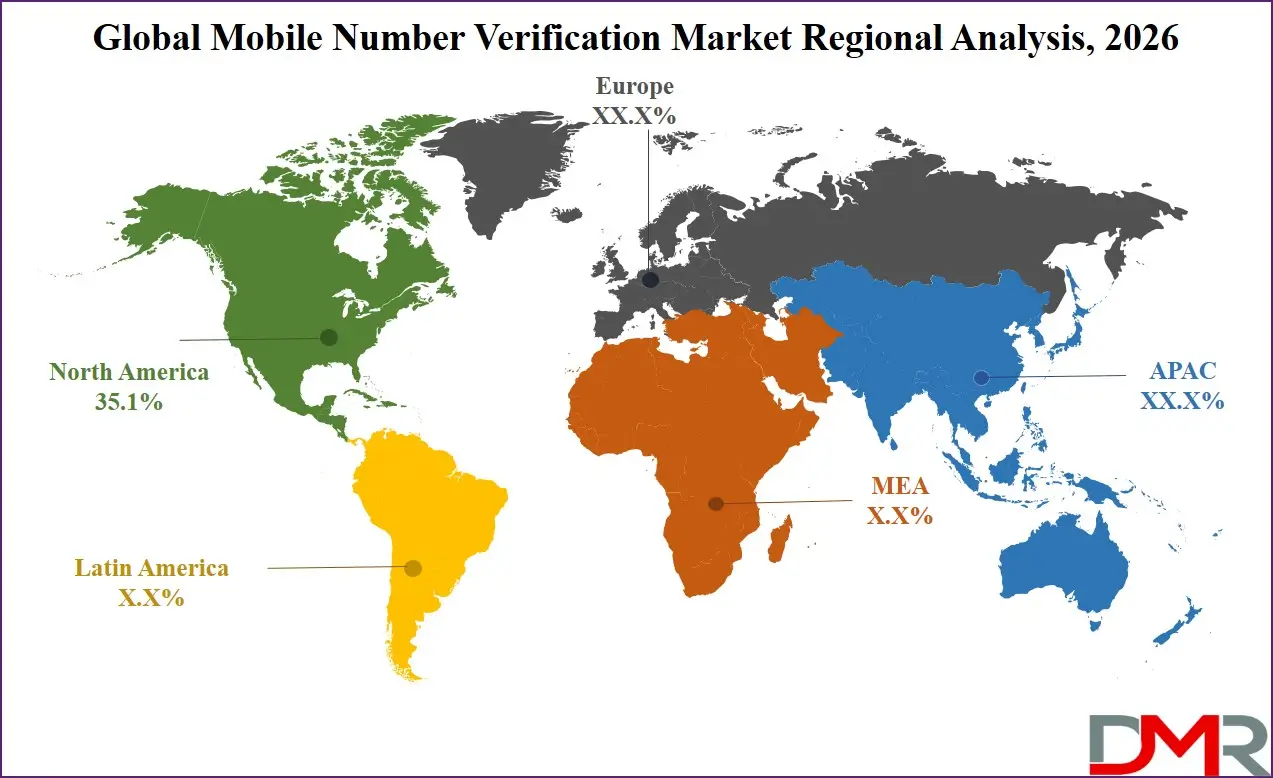
North America is projected to dominate the regional segment with the highest market share as it is anticipated to hold 35.1% of the total market revenue by the end of 2026, due to advanced digital infrastructure, high smartphone penetration, and widespread adoption of online banking and e-commerce platforms. The region is home to leading fintech innovators and authentication solution providers, driving technological advancements in verification services. Strong regulatory frameworks regarding data privacy and cybersecurity compel businesses to adopt secure authentication practices. High consumer awareness regarding digital fraud and identity protection further strengthens demand.
ℹ
To learn more about this report –
Download Your Free Sample Report Here
The United States, in particular, accounts for the largest share within North America due to its large digital economy and high transaction volumes. Although Asia Pacific is the fastest-growing region, North America continues to hold the largest revenue share due to early adoption of advanced authentication technologies and strong cybersecurity investments.
Region with the Highest CAGR
Asia-Pacific holds the highest CAGR and is poised to achieve rapid market share growth due to its massive mobile-first user base, booming e-commerce and fintech sectors, and significant government push for digital identity. Countries like India, Indonesia, China, and the Philippines are investing heavily in digital public infrastructure. India's "India Stack" (including Aadhaar authentication and mobile verification) and similar initiatives across Southeast Asia are creating fertile ground for adoption. The region's price sensitivity is being addressed through local data centers, pay-as-you-go API models, and partnerships between global verification providers and regional telecom giants. This, combined with an immense volume of new digital users, positions APAC as the fastest-growing market for mobile number verification systems.
By Region
North America
Europe
- Germany
- The U.K.
- France
- Italy
- Russia
- Spain
- Benelux
- Nordic
- Rest of Europe
Asia-Pacific
- China
- Japan
- South Korea
- India
- ANZ
- ASEAN
- Rest of Asia-Pacific
Latin America
- Brazil
- Mexico
- Argentina
- Colombia
- Rest of Latin America
Middle East & Africa
- Saudi Arabia
- UAE
- South Africa
- Israel
- Egypt
- Rest of MEA
Global Mobile Number Verification Market: Competitive Landscape
The Global Mobile Number Verification Market is moderately consolidated, featuring a mix of global telecommunication data aggregators, specialized verification API platforms, and cybersecurity firms. Leading players like Twilio, Sinch, and Vonage (a subsidiary of Ericsson) leverage their vast carrier network connections and CPaaS (Communications Platform as a Service) infrastructure to offer verification as a core service. Pure-play verification innovators such as Telesign (a BICS company), Pangea, and Numverify (APILayer) are driving market dynamics with specialized, high-accuracy data intelligence and fraud detection features.
Telecom infrastructure groups like BICS, Syniverse, and Tata Communications play a crucial role as tier-1 data providers, while cybersecurity giants such as LexisNexis Risk Solutions and Experian are increasingly integrating mobile verification into their broader identity and fraud platforms. Regional players and mobile network operator (MNO) consortia are also active, forming joint ventures to monetize their subscriber data directly.
Some of the prominent players in the Global Mobile Number Verification Market are:
- Twilio Inc.
- Sinch AB (including ACL Mobile)
- Vonage Holdings Corp. (Ericsson)
- Tata Communications Limited
- Pangea Connectivity Technology Limited
- APILayer (Numverify)
- MessageBird B.V.
- Infobip Ltd.
- Route Mobile Limited
- OpenMarket Inc. (Infobip)
- Kaleyra Inc.
- Clickatell
- CM.com
- Vibes Media LLC
- SAP SE (SAP Customer Data Platform)
- LexisNexis Risk Solutions
- Experian Information Solutions, Inc.
- Telesign (BICS)
- BICS SA
- Syniverse Technologies, LLC
- Other Key Players
Recent Developments in the Global Mobile Number Verification Market
- November 2025: Telesign introduced its "Trust Score" feature, using machine learning to provide a real-time risk score for every verification request, enabling businesses to make instant, automated decisions on user trustworthiness.
- October 2025: Sinch demonstrated its enhanced silent verification solution at Mobile World Congress 2026, highlighting seamless, one-click authentication for mobile apps with near-instant confirmation and improved global carrier coverage.
- September 2025: Twilio announced a multi-year agreement with a top-3 global streaming service to power its user onboarding and account recovery verification across 190+ countries, signaling the critical role of verification in subscriber management.
- August 2025: BICS completed the acquisition of a specialist AI analytics firm to enhance its mobile identity and verification platform's ability to detect sophisticated SIM-swapping and roaming fraud patterns in real-time.
- July 2025: A Horizon Europe grant was awarded to a consortium developing quantum-resistant encryption methods for mobile identity data transfer, linking verification security with next-generation data protection goals.
- June 2025: Pangea partnered with a major Brazilian digital bank to provide its real-time SIM swap and number portability checks, aiming to set new standards for secure financial transactions in the region.
Report Details
| Report Characteristics |
| Market Size (2026) |
USD 16.2 Bn |
| Forecast Value (2035) |
USD 59.7 Bn |
| CAGR (2026–2035) |
15.6% |
| The US Market Size (2026) |
USD 4.8 Bn |
| Historical Data |
2020 – 2025 |
| Forecast Data |
2027 – 2035 |
| Base Year |
2025 |
| Estimate Year |
2026 |
| Report Coverage |
Market Revenue Estimation, Market Dynamics, Competitive Landscape, Growth Factors and etc. |
| Segments Covered |
By Component (Software/Platform, Services), By Deployment Mode (Cloud-Based, On-Premises), By Verification Type (SMS-Based Verification, Voice Call Verification, Flash Call Verification, OTP (One-Time Password) Verification, Silent Network Authentication, Two-Factor Authentication (2FA), Multi-Factor Authentication (MFA)), By Organization Size (Large Enterprises, Small & Medium Enterprises (SMEs)), By Application (User Authentication, Fraud Prevention, Customer Onboarding (KYC), Marketing & CRM Validation, Identity Verification, Transaction Security), By End-Use Industry (BFSI (Banking, Financial Services & Insurance), E-commerce & Retail, Telecommunications, Healthcare, IT & Software, Travel & Hospitality, Government & Public Sector, Media & Entertainment, Gaming & Online Betting, Others) |
| Regional Coverage |
North America – The US and Canada; Europe – Germany, The UK, France, Russia, Spain, Italy, Benelux, Nordic, & Rest of Europe; Asia- Pacific– China, Japan, South Korea, India, ANZ, ASEAN, Rest of APAC; Latin America – Brazil, Mexico, Argentina, Colombia, Rest of Latin America; Middle East & Africa – Saudi Arabia, UAE, South Africa, Turkey, Egypt, Israel, & Rest of MEA |
| Prominent Players |
Twilio Inc., Sinch AB (including ACL Mobile), Vonage Holdings Corp. (Ericsson), Tata Communications Limited, Pangea Connectivity Technology Limited, APILayer (Numverify), MessageBird B.V., Infobip Ltd., Route Mobile Limited, OpenMarket Inc. (Infobip), Kaleyra Inc., Clickatell, CM.com, Vibes Media LLC, SAP SE (SAP Customer Data Platform), LexisNexis Risk Solutions, Experian Information Solutions, Inc., Telesign (BICS), BICS SA, Syniverse Technologies, LLC., and Other Key Players |
| Purchase Options |
We have three licenses to opt for: Single User License (Limited to 1 user), Multi-User License (Up to 5 Users) and Corporate Use License (Unlimited User) along with free report customization equivalent to 0 analyst working days, 3 analysts working days and 5 analysts working days respectively. |
Frequently Asked Questions
How big is the Global Mobile Number Verification Market?
▾ The Global Mobile Number Verification Market size is estimated to have a value of USD 16.2 billion in 2026 and is expected to reach USD 59.7 billion by the end of 2035.
What is the growth rate in the Global Mobile Number Verification Market?
▾ The market is growing at a CAGR of 15.6 percent over the forecasted period of 2026-2035.
What is the size of the US Mobile Number Verification Market?
▾ The US Mobile Number Verification Market is projected to be valued at USD 4.8 billion in 2026. It is expected to witness subsequent growth as it holds USD 16.4 billion in 2035 at a CAGR of 14.6%.
Which region accounted for the largest Global Mobile Number Verification Market?
▾ North America is expected to have the largest market share in the Global Mobile Number Verification Market with a share of about 35.1% in 2026.
Who are the key players in the Global Mobile Number Verification Market?
▾ Some of the major key players in the Global Mobile Number Verification Market are Twilio Inc., Sinch AB, Vonage Holdings Corp., Telesign, BICS, Pangea, and many others.