What is the Mobile Phone Insurance Ecosystem Market Size in 2026?
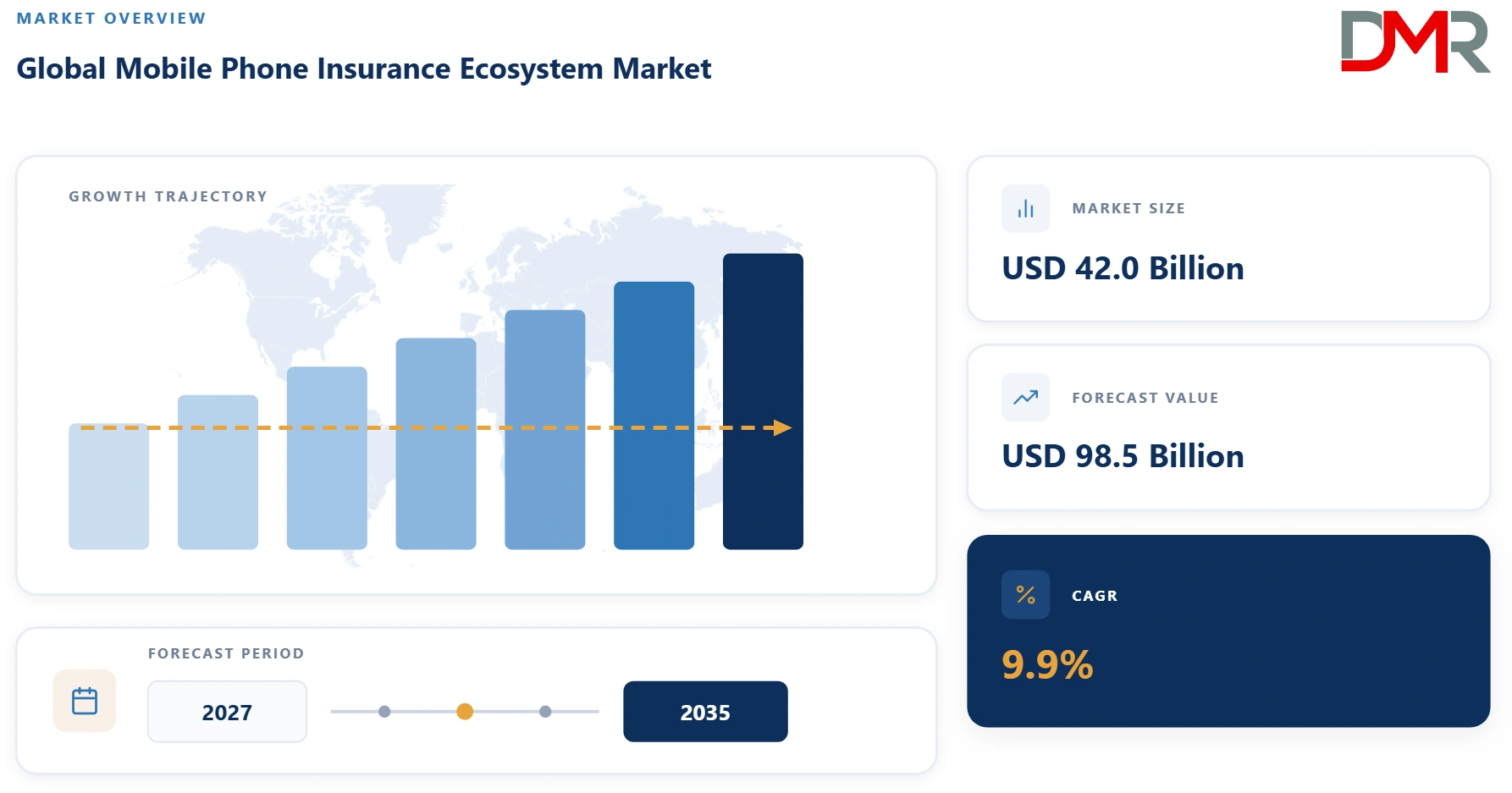
The global mobile phone insurance ecosystem market is valued at USD 42.0 billion in 2026 and is projected to reach USD 98.5 billion by 2035, growing at a CAGR of 9.9% from 2027 to 2035. Growth is driven by rising premium device costs, expanding embedded insurance distribution through carrier and OEM channels, and heightened consumer awareness of repair and replacement risks across both mature and emerging markets.
ℹ
To learn more about this report –
Download Your Free Sample Report Here
The mobile phone insurance ecosystem encompasses the interconnected network of insurers, mobile network operators, device OEMs, retailers, banks, and third-party administrators that collectively design, distribute, and service protection products for mobile handsets. Coverage spans accidental damage, theft and loss, liquid ingress, mechanical breakdown, and increasingly, digital security and data protection. The ecosystem includes insurance-backed policies, extended warranties, subscription protection plans, and self-insured programs delivered through carrier billing, retail point-of-sale, OEM checkout, and direct digital channels, serving individual consumers and organizational buyers across the device lifecycle.
The report examines the full value chain of mobile device protection, from underwriting and product design through distribution, claims administration, and repair or replacement fulfillment. Coverage extends across all handset tiers, from budget and feature phones to premium and refurbished smartphones, recognizing that protection demand varies by device value and user segment. Distribution analysis captures the shift toward embedded and digital channels while acknowledging the continued dominance of carrier and retail touchpoints. The competitive landscape profiles insurers, carriers, OEMs, and technology platforms that are converging around integrated protection experiences. Forecasts account for regional differences in insurance penetration, regulatory frameworks, and smartphone replacement cycles.
Mobile Phone Insurance Ecosystem Market Snapshot
Mobile Phone Insurance Ecosystem Market Snapshot, 2026-2035
| Metric |
Value |
| Market Size (2026) |
USD 42.0 Billion |
| Forecast Value (2035) |
USD 98.5 Billion |
| CAGR (2027-2035) |
9.9% |
| Largest Region (2026) |
North America, 38% share |
| Fastest-Growing Region (2027-2035) |
Asia Pacific, 12.4% CAGR |
| Leading Coverage Type (2026) |
Accidental Damage and Screen Protection, 34% share |
| Leading Device Type (2026) |
Premium Smartphones, 41% share |
| Key Players |
Apple Inc., Asurion LLC, Assurant Inc., Allstate Protection Plans (SquareTrade), Bolttech, Chubb Limited, AT&T Inc., Verizon Communications |
Mobile Phone Insurance Ecosystem Market: Key Takeaways
- Market growth: USD 42.0 billion (2026) to USD 98.5 billion (2035), at 9.9% CAGR.
- Coverage leader: Accidental damage and screen protection holds 34% share in 2026, led by high repair costs and frequent drop and screen damage incidents.
- Fastest coverage type: Theft and loss protection set to grow at 11.6% CAGR through 2035, ahead of the overall market.
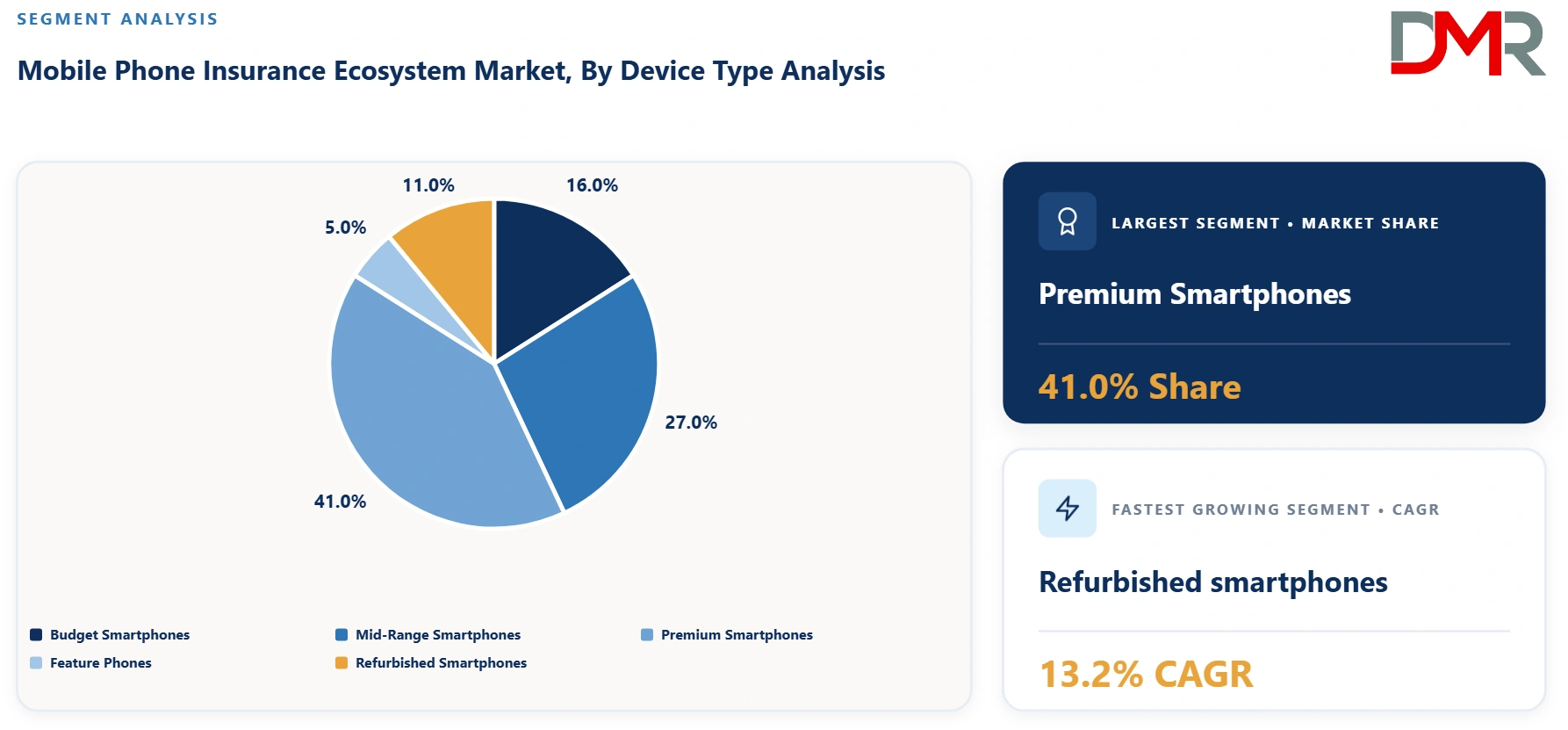
- Device type leader: Premium smartphones account for 41% of 2026 demand, as flagship replacement costs exceed USD 1,000 and drive protection attachment.
- Fastest device type: Refurbished smartphones projected to grow at 13.2% CAGR, supported by circular economy adoption and standalone protection product launches.
- Regional picture: North America leads with 38% share in 2026, while Asia Pacific is fastest-growing at 12.4% CAGR.
What are the Key Use Cases of Mobile Phone Insurance Ecosystem?
- Accidental damage claims: Screen cracks and drop damage represent the highest-frequency claim category, driving carrier and OEM bundled protection adoption.
- Theft and loss replacement: Urban theft incidence and high resale value incentivize policy enrollment for premium device owners.
- Carrier-bundled subscription protection: MNOs embed monthly protection into postpaid plans, achieving high attachment through frictionless billing.
- Refurbished device coverage: Extends protection to secondary-market handsets, supporting circular economy models and trade-in ecosystems.
How are Foundation Models and Generative AI Transforming the Mobile Phone Insurance Ecosystem Market?
Foundation models and generative AI are reshaping the mobile phone insurance ecosystem across claims processing, underwriting, and customer engagement. AI-powered image recognition enables instant damage assessment from smartphone photographs, reducing claims adjudication from days to minutes and lowering adjustment costs for high-volume screen and liquid damage claims. Generative AI chatbots handle first-notice-of-loss intake, guide policyholders through documentation, and detect inconsistent narratives indicative of fraud, addressing an issue that costs the telecommunications sector billions annually. Underwriting models increasingly incorporate device usage patterns, geolocation risk, and real-time diagnostic data transmitted from handsets to price premiums more accurately.
Adoption is accelerating among carriers and third-party administrators seeking to compress claims cycles and improve customer retention. Operational benefits include reduced fraud losses, lower customer acquisition costs through personalized upgrade and renewal offers, and automated compliance monitoring across regional regulatory requirements. Market impact is most pronounced in the premium smartphone segment, where rapid replacement and concierge-level service enabled by AI differentiate offerings. However, deployment requires careful governance to ensure algorithmic accountability and maintain human oversight for complex or disputed claims, as regulatory scrutiny of automated insurance decisions intensifies.
Mobile Phone Insurance Ecosystem Market Dynamics at a Glance
Drivers, Restraints, Opportunities and Trends in the Mobile Phone Insurance Ecosystem Market
| Type |
Factor |
Impact |
| Driver |
Escalating premium smartphone replacement costs |
High |
| Driver |
Embedded insurance distribution through carrier and OEM channels |
High |
| Restraint |
Low insurance penetration and awareness in emerging markets |
Medium |
| Restraint |
Fraudulent claims inflating premiums and eroding trust |
High |
| Opportunity |
Untapped emerging markets with rising smartphone adoption |
Medium |
| Opportunity |
Protection for refurbished and pre-owned devices |
High |
| Trend |
AI-enabled instant claims and fraud detection |
Medium |
| Trend |
Bundling of cybersecurity and digital wallet protection |
High |
What is Driving the Growth of the Mobile Phone Insurance Ecosystem Market?
Escalating Premium Smartphone Replacement Cost
The steady climb in flagship device prices, with premium models routinely exceeding USD 1,000, has transformed mobile phones from discretionary purchases into high-value assets requiring protection. Screen repair costs alone reached USD 8.3 billion in the United States in 2023, nearly triple the 2018 figure, according to Allstate Protection Plans data. This cost trajectory makes insurance economically rational for consumers who would otherwise face full replacement expenses after accidental damage or theft. Insurers and carriers have responded by designing tiered protection products with low deductibles and unlimited screen repair options, capturing consumers who previously self-insured through cases and screen protectors. The market impact is a sustained increase in attachment rates across premium device purchases and a shift toward subscription models that bundle protection with upgrade flexibility.
Embedded Insurance Distribution through Carrier and OEM Channels
Mobile network operators and device OEMs have become the most efficient distribution engines for device protection, embedding insurance into postpaid billing and checkout flows where friction is minimized. Mobile operators accounted for 41% of distribution channel value in the recent market period, reflecting their control over subscriber relationships and billing infrastructure. OEM programs, notably AppleCare and Samsung Care, leverage device diagnostics and integrated repair networks to offer seamless protection experiences. Partnerships between insurers and carriers, such as Bolttech’s bancassurance arrangement with ING Bank across European markets, demonstrate the expanding reach of embedded models beyond traditional telecom boundaries. This distribution efficiency lowers customer acquisition costs and improves retention, but also concentrates pricing power among channel owners, pressuring standalone insurers to differentiate through service quality and claims speed.
What are the Key Restraints in the Mobile Phone Insurance Ecosystem Market?
Low Insurance Penetration and Awareness in Emerging Markets
Despite rapid smartphone adoption across Asia, Africa, and Latin America, insurance remains unfamiliar to large segments of the population. In low-income countries, nearly 90% of individuals lack any form of private insurance, and in Nigeria, insurance penetration stands at approximately 0.5% of GDP, compared with over 12% in South Africa. This gap reflects limited financial literacy, mistrust of insurers, and the absence of habitual insurance purchasing. Many consumers in these markets consider protection only after a loss occurs, rather than proactively. The market impact is significant: addressable demand vastly exceeds actual uptake, and insurers face high customer education costs. Overcoming this restraint requires localized product design, micro-premium pricing, and partnerships with trusted mobile operators and fintech platforms that already serve these populations.
Fraudulent Claims Inflating Premiums and Eroding Trust
Fraud represents a persistent structural challenge, forcing insurers to raise premiums and introduce verification friction that diminishes the customer experience. The Communications Fraud Control Association estimated global telecommunications fraud losses at approximately USD 39.89 billion in 2025, with device insurance fraud contributing to this burden through staged thefts, falsified damage claims, and subscription fraud. Insurers respond with stricter documentation requirements, IMEI verification, and forensic claims review, which extend processing times and frustrate legitimate policyholders. The resulting cycle of higher premiums and more cumbersome claims processes deters price-sensitive consumers and undermines trust in protection products. Addressing fraud without compromising service quality requires investment in AI-driven anomaly detection and cross-industry data sharing, costs that smaller insurers may struggle to absorb.
What are the Key Opportunities in the Mobile Phone Insurance Ecosystem Market?
Untapped Emerging Markets with Rising Smartphone Adoption
India alone presents a smartphone user base approaching one billion, yet device insurance uptake remains minimal due to limited awareness and fragmented distribution. Similar patterns exist across Africa and Latin America, where mobile phones serve as primary tools for banking, commerce, and communication, elevating their economic importance. The opportunity lies in designing affordable, localized products distributed through mobile network operators and fintech platforms that already have trusted relationships with these consumers. Micro-premium models, embedded point-of-sale protection, and simplified claims processes can unlock first-time insurance buyers who have never interacted with a traditional insurer. Early entrants that establish brand trust and distribution partnerships in these markets can build durable customer relationships before competition intensifies, capturing share in what will become the industry’s largest growth pool over the forecast period.
Protection for Refurbished and Pre-Owned Devices
The secondary smartphone market has expanded rapidly, with the global market for refurbished phones and repair services projected to exceed USD 150 billion by 2027 according to GSMA estimates. Historically underserved by insurance because of valuation complexity and warranty limitations, refurbished devices now represent a significant opportunity for repair-focused protection policies that extend device lifecycle rather than prioritizing replacement. Insurers are launching standalone coverage for pre-owned handsets, often distributed through refurbishment marketplaces and trade-in platforms. This product innovation aligns with circular economy preferences among environmentally conscious consumers and cost-sensitive buyers who cannot afford new flagship devices. The market impact includes expanded addressable volume, differentiation from carrier-bundled new-device programs, and alignment with sustainability trends that increasingly influence purchasing decisions.
What are the Latest Trends in the Mobile Phone Insurance Ecosystem Market?
AI-Enabled Instant Claims and Fraud Detection
Artificial intelligence is compressing claims cycles from days to minutes while simultaneously strengthening fraud detection. Image recognition algorithms assess device damage from user-submitted photographs, automating adjudication for high-volume screen and liquid damage claims. Real-time IMEI verification and usage pattern analysis flag suspicious claims before payout, reducing losses that have historically inflated premiums. The market impact is dual: improved customer experience through faster resolution and lower operational costs that enable competitive pricing. Carriers and third-party administrators that deploy these capabilities report higher retention and lower claims leakage, while smaller insurers face pressure to invest or partner for access to AI infrastructure. As regulatory scrutiny of automated insurance decisions grows, providers are building human oversight into AI-driven workflows to maintain compliance and customer trust.
Bundling of Cybersecurity and Digital Wallet Protection
As smartphones become the primary interface for banking, payments, and identity verification, consumer risk has expanded beyond physical damage to include digital threats. Insurers are responding by bundling software security features and financial reimbursement clauses into premium protection tiers, covering identity theft, unauthorized transactions, and phishing losses. The urgency is evident in threat data: 82% of phishing sites specifically targeted mobile devices in 2024, according to Zimperium’s Global Mobile Threat Report. This evolution transforms device insurance from a hardware repair product into a broader digital protection service, expanding average premium and deepening customer engagement. The trend favors insurers that can partner with cybersecurity vendors and banks to deliver integrated protection, while standalone hardware-only products face commoditization pressure.
Research Scope and Analysis
The report analyzes revenue across coverage types device tiers distribution channels service models end users and five regional markets with historical data from 2021 to 2026 and forecasts from 2027 to 2035.
ℹ
To learn more about this report –
Download Your Free Sample Report Here
By Coverage Type Analysis
Accidental damage and screen protection led with 34% share in 2026, driven by the frequency of drop and screen damage claims and high repair costs for premium devices. Theft and loss protection is the fastest-growing coverage segment at 11.6% CAGR, supported by rising urban theft incidence and consumer awareness of replacement costs. Liquid damage protection maintains steady demand, while mechanical and electrical breakdown coverage benefits from extended warranty bundling. Comprehensive protection plans are gaining traction among high-value device owners seeking simplified single-policy coverage.
By Device Type Analysis
Premium smartphones dominated with 41% share in 2026, reflecting higher attachment rates driven by replacement costs exceeding USD 1,000 for flagship models. Budget and mid-range smartphones represent high-volume but lower-premium segments where carrier-bundled offerings drive penetration. Refurbished smartphones are the fastest-growing device category at 13.2% CAGR, as insurers launch standalone protection for pre-owned handsets and trade-in ecosystems expand. Feature phones remain a niche protection segment concentrated in emerging markets with basic coverage needs.
By Distribution Channel Analysis
Mobile network operators held the leading position with 38% share in 2026, leveraging subscriber billing relationships and embedded postpaid plan integration. OEM programs benefit from device diagnostics and integrated repair networks, particularly for premium handsets. Electronics retailers capture point-of-sale attachment, while insurance companies maintain direct and online channels for standalone policies. Banks and financial institutions are emerging as a growth channel through embedded protection bundled with device financing and digital wallet services.
By Service Model Analysis
Insurance-backed protection led with 46% share in 2026, sustained by established insurer partnerships, regulated policy frameworks, and carrier billing relationships across premium device tiers. Subscription-based device protection is the fastest-growing service model at 13.1% CAGR from 2027 to 2035, driven by demand for flexible monthly coverage bundled with upgrade options and embedded into postpaid plans and device financing. Extended warranty and third-party services hold steady demand in retail and refurbished channels, while self-insured plans remain concentrated among large enterprises and government fleets.
By End User Analysis
Individual consumers accounted for 78% of demand in 2026, reflecting the personal nature of device ownership and protection purchasing. SMEs represent the fastest-growing end-user segment at 11.8% CAGR, as small businesses increasingly equip mobile workforces and recognize device protection as operational risk management. Large enterprises and government organizations procure coverage through corporate device management programs, while educational institutions remain a nascent segment with growing tablet and smartphone deployment.
How is the Mobile Phone Insurance Ecosystem Market Segmented?
By Coverage Type
- Accidental Damage and Screen Protection
- Theft and Loss Protection
- Liquid Damage Protection
- Mechanical and Electrical Breakdown
- Comprehensive Protection Plans
By Device Type
- Budget Smartphones
- Mid-Range Smartphones
- Premium Smartphones
- Feature Phones
- Refurbished Smartphones
By Distribution Channel
- Mobile Network Operators
- Original Equipment Manufacturers (OEMs)
- Electronics Retailers
- Insurance Companies (Direct and Online)
- Banks and Financial Institutions
By Service Model
- Insurance-Backed Protection
- Extended Warranty
- Subscription-Based Device Protection
- Self-Insured Protection Plans
- Third-Party Device Protection Services
By End User
- Individual Consumers
- Small and Medium Enterprises (SMEs)
- Large Enterprises
- Government Organizations
- Educational Institutions
Which Region Leads the Mobile Phone Insurance Ecosystem Market?
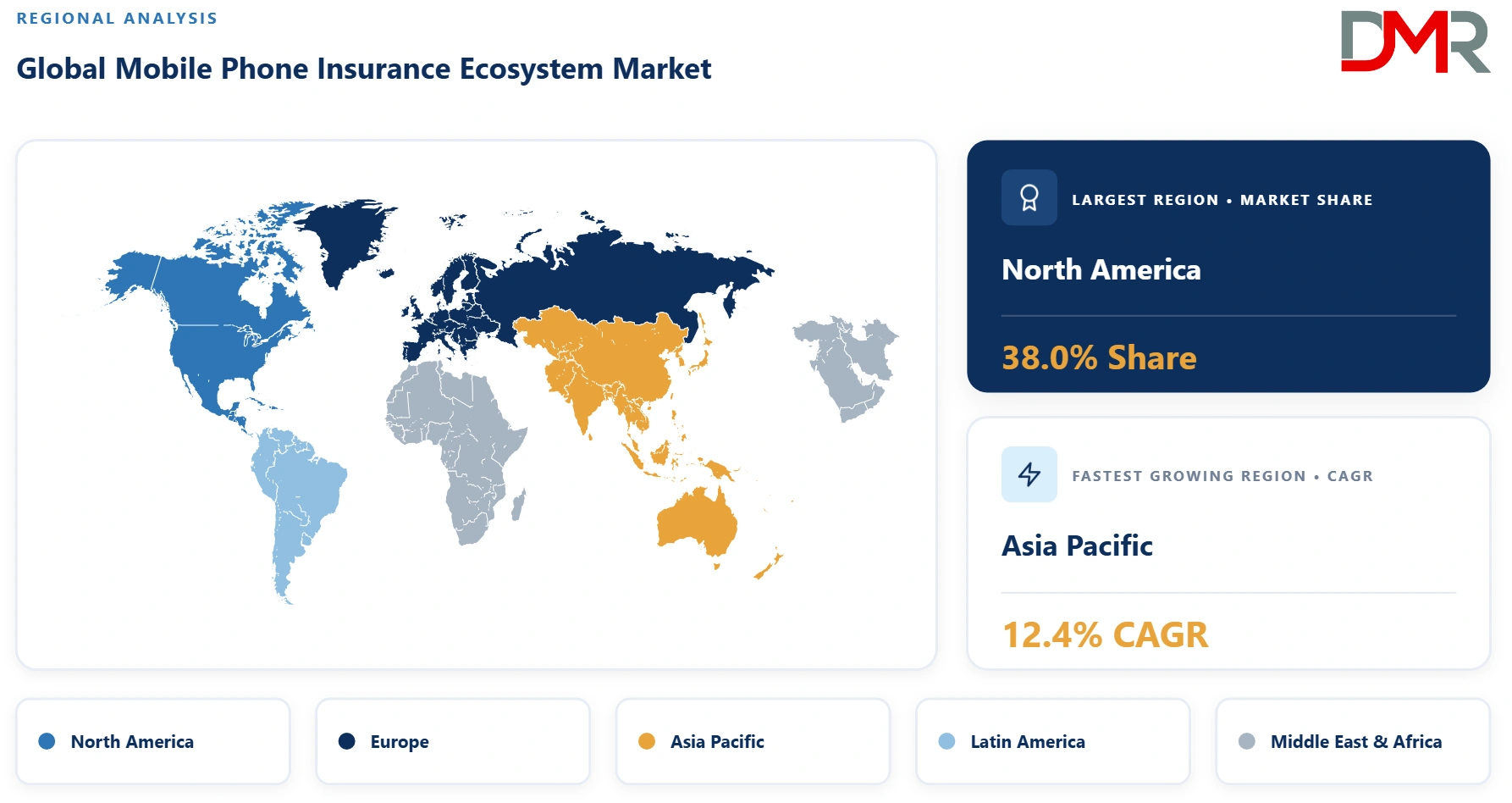
North America leads with 38% share in 2026, while Asia Pacific is projected to grow at 12.4% CAGR from 2027 to 2035.
ℹ
To learn more about this report –
Download Your Free Sample Report Here
Region with the Largest Revenue Share
North America’s dominance reflects high premium device penetration, established carrier insurance programs, and consumer willingness to pay for protection. The United States accounts for the majority of regional revenue, supported by carrier-bundled offerings from AT&T, Verizon, and T-Mobile, alongside OEM programs like AppleCare. Canada contributes steady growth through carrier partnerships and retail distribution. Demand is sustained by high replacement costs and theft awareness in urban centers. Outlook remains stable, with growth driven by premium device mix and digital claims innovation rather than penetration gains, as attachment rates are already relatively mature.
Region with the Highest CAGR
Asia Pacific is the fastest-growing region at 12.4% CAGR, propelled by smartphone adoption in India, Southeast Asia, and China’s tier-two and tier-three cities. India alone presents a user base approaching one billion, with insurance uptake still minimal, creating substantial headroom for carrier-bundled and embedded protection. China’s market benefits from OEM-integrated programs and digital insurance platforms, while Japan and South Korea show steady premium protection demand. The regional outlook is transformative: distribution partnerships with mobile operators and fintech platforms will determine competitive positioning, and localized micro-premium products will unlock first-time insurance buyers across income tiers.
Regional Analysis
Europe Mobile Phone Insurance Ecosystem Market
The European market grows steadily, led by the United Kingdom, Germany, and France, where carrier and retail distribution are supplemented by bancassurance partnerships such as Bolttech’s arrangement with ING Bank. Demand is driven by premium smartphone penetration and regulatory emphasis on transparent product terms. Southern and Eastern European markets show lower penetration but expanding digital distribution. Outlook is moderate, with growth concentrated in embedded and subscription models.
Latin America Mobile Phone Insurance Ecosystem Market
Brazil and Mexico lead regional demand, supported by high smartphone dependency for banking and commerce and growing carrier insurance programs. Insurance penetration remains low relative to device value, creating long-term potential. Distribution is dominated by mobile operators, with fintech platforms emerging as alternative channels. Economic volatility and currency fluctuations pose risks, but device financing and protection bundling are gaining traction among middle-income consumers.
Middle East & Africa Mobile Phone Insurance Ecosystem Market
Gulf Cooperation Council markets, particularly the UAE and Saudi Arabia, show rising premium device adoption and protection uptake through carrier channels. Sub-Saharan Africa remains largely untapped, with insurance penetration below 1% in several markets and device protection often limited to informal repair arrangements. Mobile network operators are the most viable distribution channel for scaling affordable coverage. Long-term outlook is positive but dependent on financial literacy improvements and trust-building.
By Region
North America
Europe
- Germany
- France
- The U.K.
- Italy
- Spain
- Rest of Europe
Asia-Pacific
- China
- Japan
- India
- Australia
- South Korea
- Rest of APAC
Latin America
- Mexico
- Brazil
- Rest of LATAM
Middle East & Africa
- Saudi Arabia
- The UAE
- South Africa
- Rest of MEA
Regulatory Landscape
Mobile phone insurance operates within a fragmented regulatory environment that varies significantly by jurisdiction, shaping product design and distribution economics. In mature markets, conduct regulators scrutinize add-on insurance sold alongside device purchases, requiring clear disclosure of exclusions, cooling-off periods, and value assessments. The United Kingdom’s Consumer Duty and similar European frameworks impose affirmative obligations to demonstrate fair value, pressuring insurers to justify premiums relative to claims ratios and repair costs. Data protection regulations, notably GDPR and emerging AI governance rules, constrain how device diagnostics and usage data can inform underwriting and claims decisions. In emerging markets, microinsurance regulations are evolving to accommodate digital distribution and low-premium products, creating opportunities for carrier-bundled models where traditional insurance licensing would be prohibitive. Regulatory divergence increases compliance costs for global operators but rewards those that localize product structures and build adaptable compliance infrastructure.
Competitive landscape
The competitive landscape is converging around integrated protection platforms that combine underwriting, distribution, and service delivery. Apple and Samsung leverage device integration and repair networks to offer OEM-certified programs with high attachment among their installed bases. Asurion and Assurant dominate third-party administration, serving carriers and retailers with white-label programs and global service infrastructure. Carriers including AT&T, Verizon, and Vodafone retain distribution advantage through billing relationships but increasingly rely on specialist partners for product design and claims management. The strategic imperative is scale in claims processing and repair networks, which determines both cost position and customer experience quality. Consolidation is likely as insurers seek distribution access and carriers seek differentiated protection products.
Who are the Leading Companies in the Mobile Phone Insurance Ecosystem Market?
The mobile phone insurance ecosystem is moderately concentrated, with the top five providers accounting for approximately 45–50% of global protection revenue. Apple and Asurion lead through OEM integration and carrier partnerships respectively, while Assurant and Allstate Protection Plans (SquareTrade) compete on third-party administration scale. Carriers retain distribution power, and technology platforms like Bolttech are scaling embedded insurance infrastructure across banking and telecom channels. Differentiation increasingly rests on claims speed, repair network quality, and digital integration rather than price alone.
- Apple Inc. (United States): AppleCare+ and integrated device protection, leveraging retail and support infrastructure and device diagnostics.
- Asurion LLC (United States): Global device protection and technology services, serving major carriers and retailers with white-label programs.
- Assurant, Inc. (United States): Connected device protection and extended service contracts, with carrier and OEM partnerships across multiple regions.
- Allstate Protection Plans / SquareTrade (United States): Retail and direct-to-consumer device protection, emphasizing transparent pricing and rapid claims resolution.
- Bolttech (Singapore): Embedded insurance platform connecting insurers, telecoms, and banks for device and digital protection distribution.
Some of the prominent players in the Global Mobile Phone Insurance Ecosystem Market are:
- Asurion
- Assurant
- Apple (AppleCare)
- Allstate Protection Plans (SquareTrade)
- Bolttech
- Likewize
- MyCoverGenius
- Worth Ave. Group
- CPP Group
- Insurance2go
- OneAssist
- Samsung Electronics
- AIG
- AXA
- Chubb
- Allianz Insurance
- Aviva
- AmTrust
- Zurich
- CNA Financial
- Hollard Group
- Verizon
- AT&T
- Vodafone
- T-Mobile
- O2 (Telefónica)
- EE (BT Group)
- NTT DOCOMO
- SoftBank
- Sprint
- Virgin Mobile
- Best Buy (Geek Squad)
- Brightstar Corporation
- Ping An Insurance
- ZhongAn Online
- Google
- Samsung Electronics America
- Bajaj Allianz
- ICICI Lombard
- Policybazaar
- Other Key Players
Recent Developments
- In July 2026, Assurant and Cogeco Communications launched a digital-first mobile device solution for Canadian customers, integrating protection, financing, and trade-in into a single lifecycle journey.
- In June 2026, Bolttech and ING Bank announced an embedded insurance partnership across the Netherlands, Italy, Poland, and Belgium, scaling device protection through banking channels.
- In May 2026, Associated Carrier Group selected Likewize as its device protection partner to support regional operators and MVNOs with customizable protection and repair services.
- In May 2026, KDDI and Okinawa Cellular launched povo Smartphone Insurance in Japan, offering carrier- and device-agnostic coverage from JPY 190 per month for new and used smartphones.
- In March 2025, GSMA projected the global market for refurbished phones and repair services to exceed USD 150 billion by 2027, signaling expanded protection opportunities for pre-owned devices.
Mobile Phone Insurance Ecosystem Market Report Scope and Research Methodology
Market definition: Mobile phone insurance ecosystem revenue comprises premiums and fees from accidental damage, theft, loss, liquid damage, and mechanical breakdown protection products for mobile handsets, distributed through carriers, OEMs, retailers, insurers, and financial institutions.
Methodology: Dimension Market Research built the estimate bottom-up from carrier and insurer protection revenue disclosures, device shipment data, and attachment rate estimates by device tier and region, then checked it top-down against total mobile insurance premiums and device protection spending aggregates. Primary interviews with carrier product managers, insurance underwriters, and third-party administrators validated adoption rates, claims frequency, and pricing structures. Forecasts apply segment-level growth assumptions for 2027–2035, incorporating smartphone replacement cycles, distribution channel expansion, and regulatory developments, reviewed at each report update.
Report Details
| Report Characteristics |
Details |
| Market Size (2026) |
USD 42.0 Billion |
| Forecast Value (2035) |
USD 98.5 Billion |
| CAGR (2027-2035) |
9.9% |
| Historical Data |
2021–2026 |
| Forecast Data |
2027–2035 |
| Base Year |
2026 |
| Estimate Year |
2027 |
| Segments Covered |
By Coverage Type, By Device Type, By Distribution Channel, By Service Model, By End User |
| Regional Coverage |
North America (The US, Canada); Europe (Germany, France, The UK, Italy, Spain, Rest of Europe); Asia Pacific (China, Japan, India, Australia, South Korea, Rest of APAC); Latin America (Mexico, Brazil, Rest of LATAM); Middle East & Africa (Saudi Arabia, The UAE, South Africa, Rest of MEA) |
Frequently Asked Questions
How big is the Mobile Phone Insurance Ecosystem Market in 2026?
▾ The global Mobile Phone Insurance Ecosystem Market is valued at USD 42.0 billion in 2026.
What is the growth rate of the Mobile Phone Insurance Ecosystem Market?
▾ The Mobile Phone Insurance Ecosystem Market is projected to grow at a CAGR of 9.9% from 2027 to 2035.
Which region leads the Mobile Phone Insurance Ecosystem Market?
▾ North America leads the Mobile Phone Insurance Ecosystem Market with 38% share in 2026.
Which product segment dominates the Mobile Phone Insurance Ecosystem Market?
▾ Accidental damage and screen protection dominates the Mobile Phone Insurance Ecosystem Market, holding 34% share in 2026.
Which end user is growing fastest in the Mobile Phone Insurance Ecosystem Market?
▾ Small and Medium Enterprises (SMEs) are growing fastest in the Mobile Phone Insurance Ecosystem Market, at 11.8% CAGR through 2035.
Who are the key players in the Mobile Phone Insurance Ecosystem Market?
▾ Key players in the Mobile Phone Insurance Ecosystem Market include Apple Inc., Asurion LLC, Assurant Inc., Allstate Protection Plans (SquareTrade), Bolttech, Chubb Limited, AT&T Inc., and Verizon Communications.
What are the main challenges facing the Mobile Phone Insurance Ecosystem Market?
▾ The main challenges facing the Mobile Phone Insurance Ecosystem Market are low insurance awareness and penetration in emerging markets, and fraudulent claims that inflate premiums and complicate the customer experience.