What is the Modular Construction Market Size?
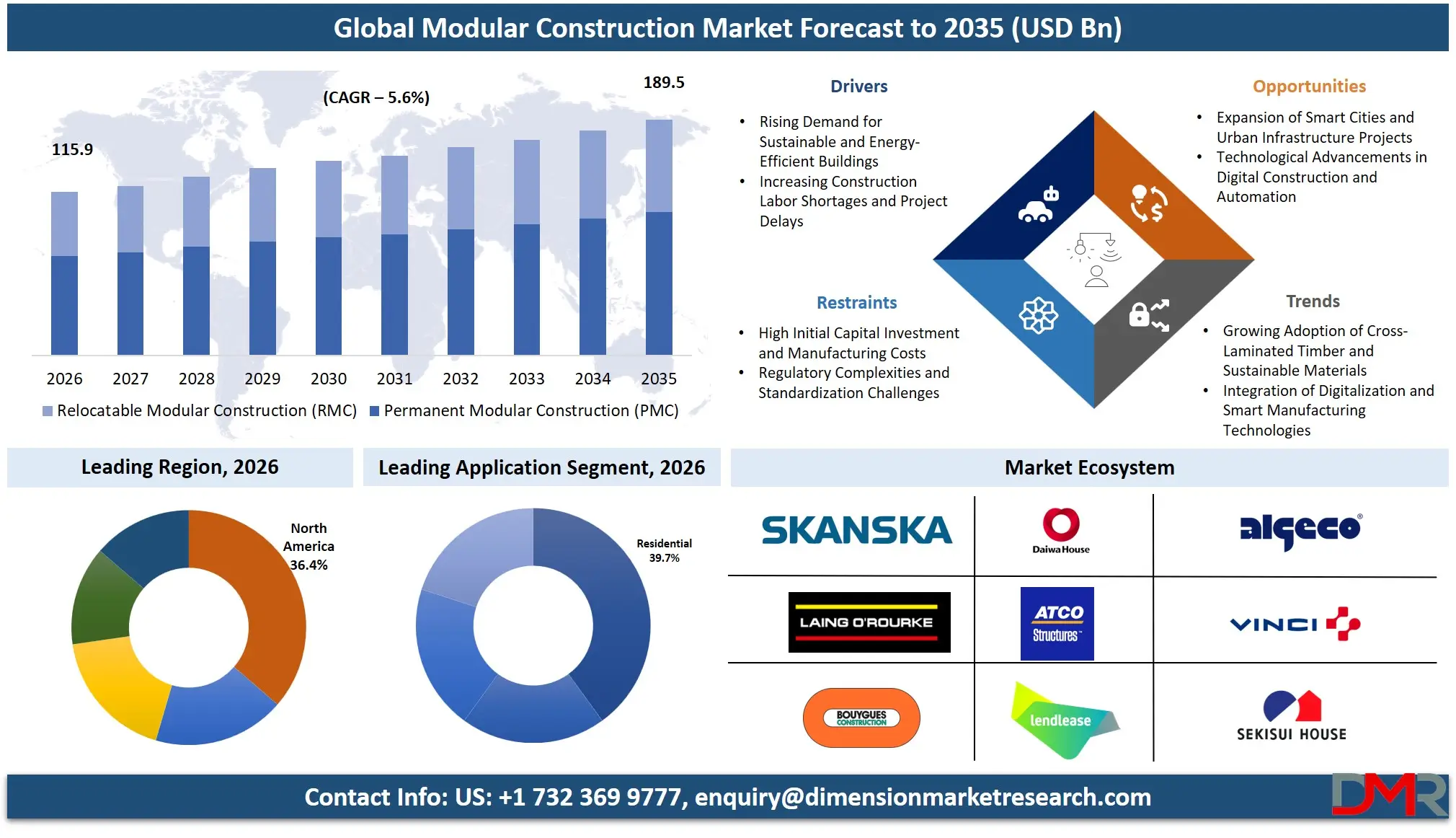
The Modular Construction Market size is expected to be USD 115.9 billion in 2026 and increase at a compound annual growth rate of 5.6% to USD 189.5 billion in 2035 due to environmental initiatives and increased government regulations.
ℹ
To learn more about this report –
Download Your Free Sample Report Here
The Modular Construction market is concerned with the production of standard building elements in controlled factory settings and their installation in the actual construction sites for various purposes such as residential, commercial, institutional, and industrial. This market consists of permanent modular construction, relocatable modular constructions, volumetric modules, panelized systems, and prefabricated pods made from steel, timber, concrete, and composite materials. Its growth is fueled by factors such as rapid urbanization, scarcity of labor in traditional construction practices, and increased preference for cost-effective and sustainable infrastructures. Digital technologies in construction, BIM, automation, and green buildings are rapidly transforming the industry, supported by governments' offsite construction practices to shorten completion times and minimize carbon footprint.
ℹ
To learn more about this report –
Download Your Free Sample Report Here
The US Modular Construction Market
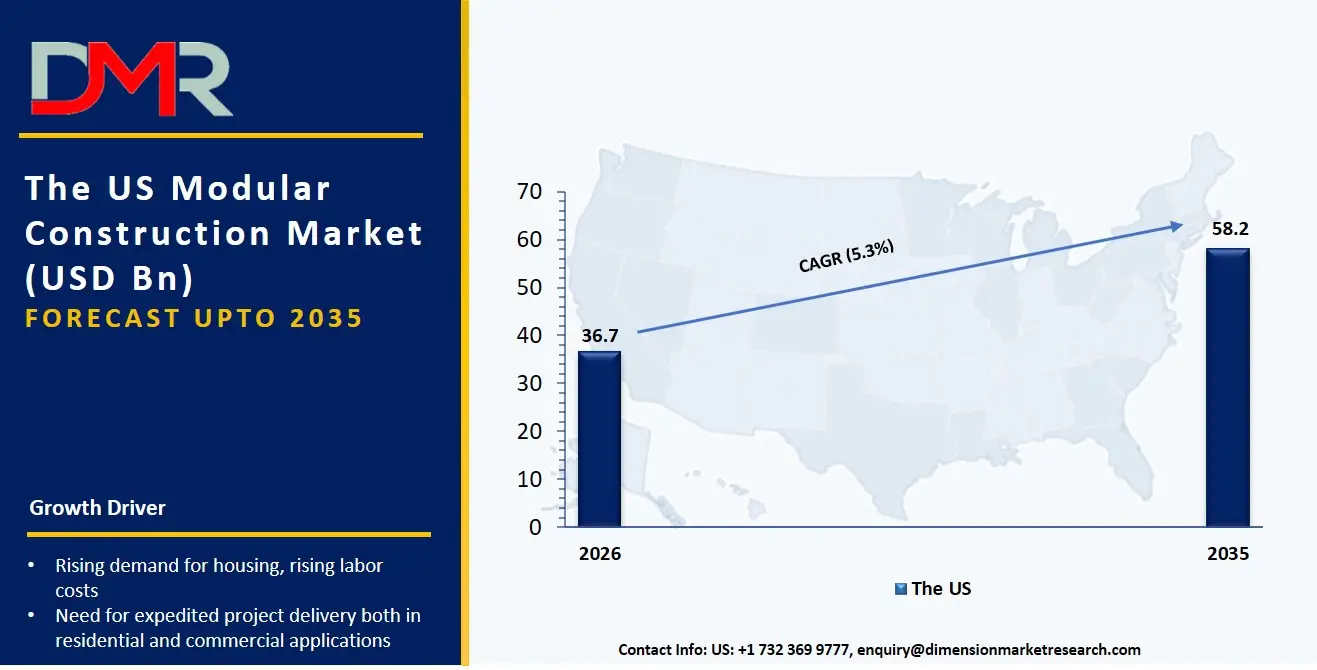
The US Modular Construction Market size is estimated to be USD 36.7 billion in 2026 and is expected to increase at a CAGR of 5.3% over the forecast period.
The US Modular Construction market is witnessing a consistent rise because of the rising demand for housing, rising labor costs, and the need for expedited project delivery both in residential and commercial applications. The efforts by the government on investing in infrastructure development and providing affordable housing have led to an increase in the application of off-site construction technology. The country has a high level of advancements in manufacturing techniques and wide usage of BIM technology. Commercial building developers are also embracing modular construction in the development of hotels, health care facilities, and educational institutions.
ℹ
To learn more about this report –
Download Your Free Sample Report Here
Europe Modular Construction Market
The Europe Modular Construction Market size is estimated to be USD 27.8 billion in 2026 and is expected to increase at a CAGR of 5.2% over the forecast period.
The European Modular Construction market is being fueled by regulations on sustainable practices, carbon neutrality buildings, and policy backing within the region's climate plans. There is an increased use of modular practices in Europe owing to affordable housing challenges and high productivity levels in construction processes. Investments in low carbon construction material and energy efficiency of modular construction will be accelerated through the European Green Deal. Major application markets are healthcare, student housing, and commercial development sectors. Technological advances in the area of engineered wood, cross-laminated timber construction, and digitalization of the industry are boosting its development.
Japan Modular Construction Market
The market size of Japan Modular Construction will be USD 4.6 billion in 2026 and at a CAGR of 5.1% in the forecast period.
The Japan Modular Construction Market thrives on factors such as superior manufacturing skills, issues associated with its aging population, and growing interest in structures that can withstand disasters. Due to rapid urban regeneration and shortage of construction labor, there has been an increasing preference for prefabrication and automation in construction activities. Japan possesses advanced seismic resistant modular systems, thereby ensuring easy implementation of modules across both residential and commercial applications. There is government backing in creating intelligent cities with modern and sustainable infrastructural designs in Japan, thereby aiding growth prospects in the market.
Key Takeaways
- Market Size & Forecast: The Modular Construction Market size is projected to reach USD 115.9 billion in 2026 and is anticipated to have a value of USD 189.5 billion in 2035.
- Growth Rate & Outlook: The Modular Construction Market size is set to grow at a compound annual growth rate of 5.6% during the forecast period of 2026 to 2035.
- Primary Growth Drivers: Some of the major growth drivers in the market Increased Demand for Sustainable Buildings & Energy Efficient Buildings, and more.
- Key Market Trends: Some of the major trends in the market are Integration of Digitalization and Smart Manufacturing Technologies, and more.
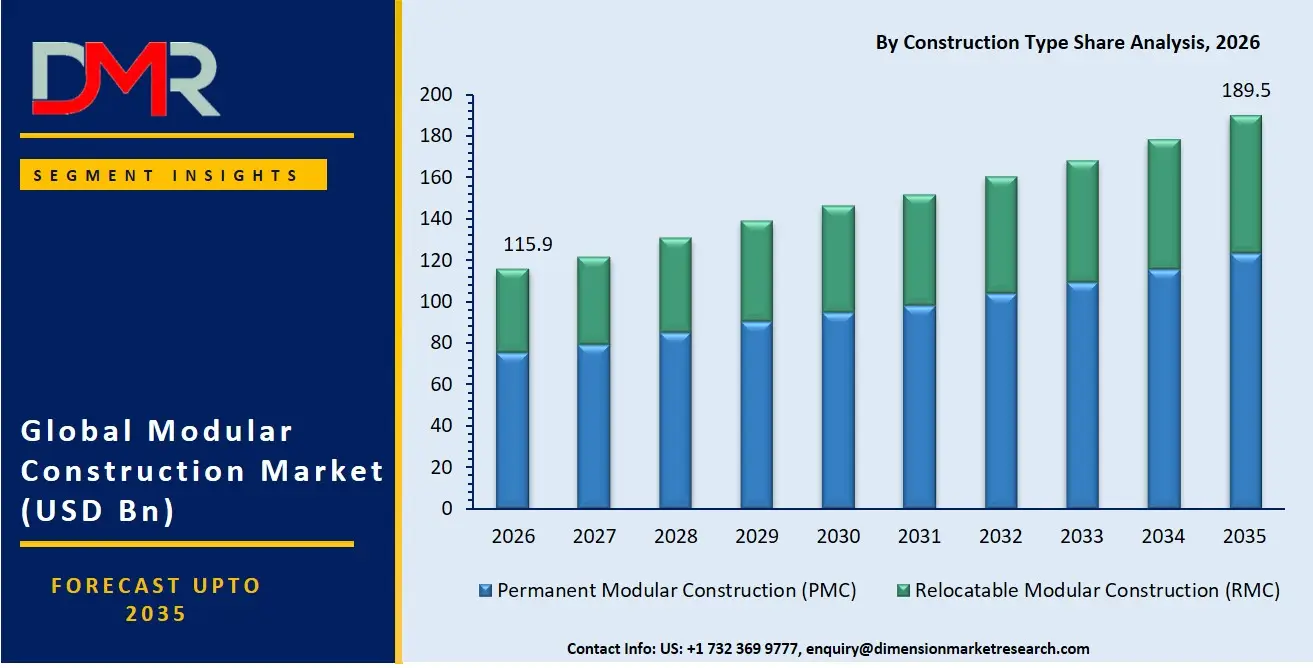
- By Construction Types: Permanent Modular Construction (PMC) segment is anticipated to get the majority share of the Modular Construction Market in 2026.
- By Material Type: Steel is expected to get the largest revenue share in 2026 in the Modular Construction Market.
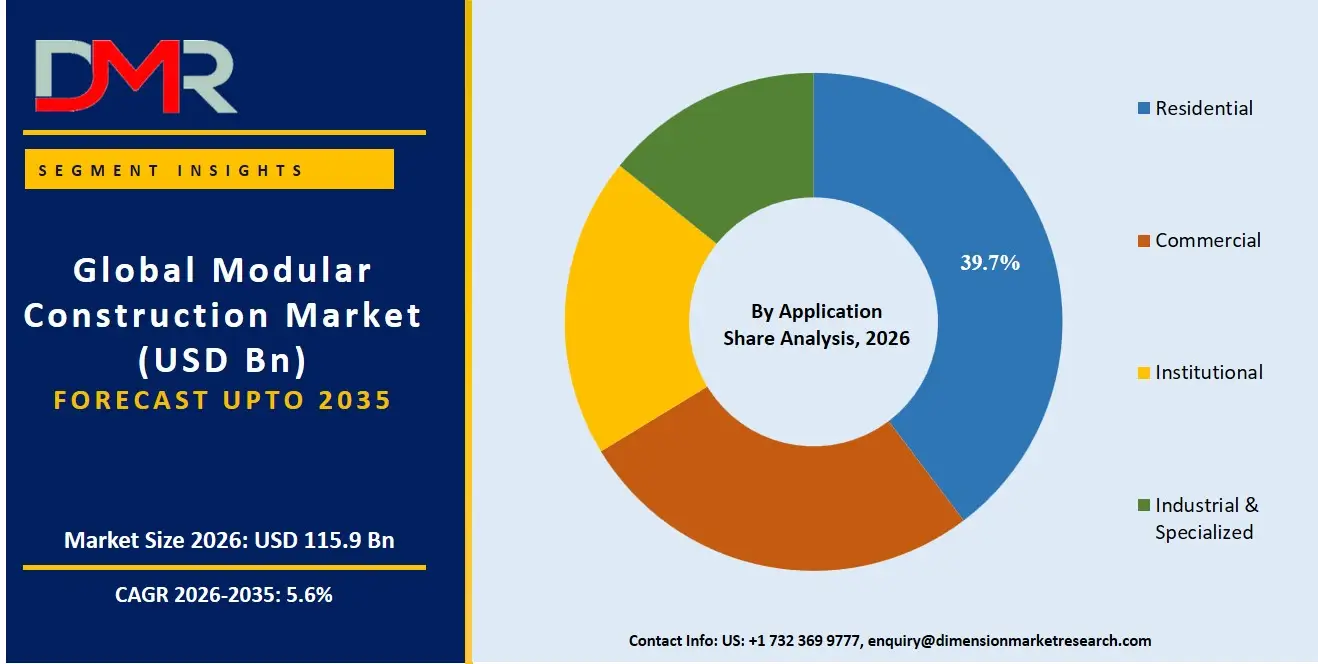
- By Application: Residential segment is expected to get the largest revenue share in 2026 in the Modular Construction Market.
- Regional Leadership: North America is set to lead the Modular Construction Market with an estimated 36.4% share in 2026.
What is the Modular Construction?
Modular Construction refers to a form of building that incorporates building elements or sections being fabricated in off-site facilities and then transported to the construction site where they will be assembled. Modular construction includes standardized modules with systems of structures, electricity, water, interiors, among others. This building strategy allows applications in various areas such as housing, hospitals, schools, hotels, retail outlets, industries, and many other sectors. The concept reduces wastage, reduces reliance on laborers, enhances work efficiency, and makes construction practices more scalable.
Use Cases
- Affordable Housing Construction: Modular construction is highly prevalent in affordable housing construction since it allows construction to be completed within shorter periods of time, minimizes material wastage, and enhances cost predictability. Both governments and private builders are employing prefabricated housing modules to overcome shortages in urban housing supplies as well as cater to rapidly increasing populations in urban areas.
- Healthcare Infrastructure Growth: Hospitals and other healthcare organizations use modular construction techniques to build clinics, emergency units, labs, and temporary healthcare facilities. Prefabricated systems allow the quick deployment of healthcare units when necessary, while ensuring quality construction standards and compliance with health standards and future expansions.
- Commercial Buildings and Hospitality Sector: Office buildings, hotels, and malls are incorporating modular systems to enhance construction speed and decrease disruption at construction sites. Modules can be easily expanded in size, and they help save on labor costs by enhancing the efficiency of constructions processes.
- Industrial and Data Center Facilities: Industrial companies are using modular systems to construct warehouses, factories, worker accommodations, and data centers since this allows faster and consistent construction compared to traditional construction methods. The increasing demand for digital infrastructure in an era of cloud computing is making modular construction popular among industries.
How AI Is Transforming the Modular Construction Market
Artificial intelligence is revolutionizing modular construction through improved planning and operation throughout the construction process. AI-based predictive analysis helps to enhance logistics, minimize wastage of materials, and schedule production in prefabricated plants more efficiently. The application of machine learning techniques within building information modeling helps in identifying inconsistencies in designs and enhances the overall quality assurance and project coordination among parties involved in the project.
Moreover, AI-based techniques enhance the automation process in prefabrication plants through robotics and computer inspection techniques. Construction firms use AI-based analytical models to determine project risks, workforce needs, and other maintenance activities required for completion. Digital twins of modules are created using AI technologies, which allow for efficient monitoring and management of infrastructures through Internet-of-things applications.
Market Dynamic
Driving Factors in the Modular Construction Market
Increased Demand for Sustainable Buildings & Energy Efficient Buildings
Environmental initiatives and increased government regulations have been some of the key factors behind the increase in modular construction. Compared to conventional building techniques, factory manufacturing has been found to use fewer materials, energy, and emit less greenhouse gases than conventional methods. With increasing pressure from investors and governments to develop environmentally friendly buildings, there is an increasing demand for modular structures that include energy-efficient systems and green building materials.
Restraints in the Modular Construction Market
Higher Costs in Starting and Producing
Creating factories for producing modules entails huge investments in automation systems, infrastructural aspects, transportation issues, and equipment. Smaller construction firms may be financially constrained and not adopt the methods due to financial constraints. In addition, high costs of transporting huge modular items could be another expense that adds on to the total cost, especially for places lacking adequate infrastructures. This could hinder their adoption in the market despite the many operational benefits involved.
Opportunities in the Modular Construction Market
Expansion of Smart Cities and Urban Infrastructure Developments
Increasing urbanization and developments associated with smart cities create many opportunities for modular constructions. Modern governments around the world are increasingly spending money on the development of sustainable urban infrastructure projects, low-cost housing, transport nodes, and other public buildings where quick deployment is critical. Modular construction facilitates easy scalability and minimal damage to the environment, in addition to effective use of space, making it very suitable for urban development projects. Developing nations of Asia-Pacific, Middle East, and Latin American regions will require significant modular infrastructure investments in future years.
Trends in the Modular Construction Market
Integration of Digitalization and Smart Manufacturing Technologies
The integration of digitalization and smart manufacturing technologies into the process of modular construction has transformed the process. For example, automation processes, internet of things devices, digital twins, and cloud-based project management technologies have been incorporated. The use of robotics in production and artificial intelligence in analytics improves the process of quality control and helps to identify errors in production. In addition, smart technologies can be used for predictive maintenance, monitoring of projects, and customization purposes.
Research Scope and Analysis
Scope of Market Research in Modular Construction comprises analysis of construction type, module system, material, application, end-user, regional trends, competitive scenario, innovations, sustainability aspects, and regulatory environment of the market. Growth determinants, restraints, opportunities, role of artificial intelligence (AI), and demand scenario impacting the adoption of modular construction solutions are analyzed herein.
ℹ
To learn more about this report –
Download Your Free Sample Report Here
By Construction Type Analysis
It is expected that Permanent Modular Construction (PMC) will continue to maintain its leadership in the global market of modular construction, holding a dominant position with an expected market share of 64.8% by 2026 driven by the high demand for PMC structures in residences, healthcare, offices, and institutions. PMC solutions have advantages in terms of durability, sustainability, and better designs, which can be used in large-scale urban developments. Growth is also being driven by the rise in investment in affordable housing, education, and healthcare infrastructure. At the same time, the Relocatable Modular Construction (RMC) segment will become the fastest-growing one, as there will be a high demand for healthcare facilities, housing, emergency facilities, and mobile offices.
By Module Type Analysis
Volumetric Modules, or 3D Modules, are expected to hold a market share of around 42.5% in 2026 because of their capability of providing an integrated solution with regards to both structural and interior construction through limited on-site assembly. This type of module has been proven to provide fast-paced construction with consistent results especially for hotels, residential buildings, and health care centers. More developers opt for volumetric modules for large scale urban construction due to the need for speed and consistent results. On the other hand, Hybrid Modular Construction Systems are seen to have the highest growth rate among all types of modular construction due to the increased demand for architectural flexibility.
By Material Type Analysis
Steel-based modular construction is estimated to account for almost 46.3% of the market by 2026 because of the strength, durability, and fire-resistant qualities that make steel-based modular construction ideal for both tall buildings and commercial applications. Steel-based modular buildings are easy to manufacture and assemble; hence, they have been widely accepted across all sectors. In addition, the increase in steel-based modular construction in the healthcare sector, offices, and data centers further enhances the share in the industry. Nevertheless, Wood and Timber materials, especially Cross-Laminated Timber (CLT), are anticipated to register the fastest rate of growth in the coming years because of the high need for low-carbon emissions building methods.
By Application Analysis
The Residential segment is projected to lead the modular construction market by holding a dominant market share of 39.7% by 2026. This can be attributed to factors such as increasing urbanization, rising issues of affordability, and increasing government spending on residential infrastructure. The use of modular construction provides quicker housing construction, reduced reliance on labor and increased efficiency in costs, especially when building affordable and multifamily homes. The construction of student housing and senior care housing is contributing to the growth of this segment. On the other hand, the fastest-growing segment is expected to be Industrial & Specialized. This can be attributed to the growing investment in emergency infrastructure, manufacturing units, warehouses, and data centers.
By End User Analysis
Real Estate Developers will occupy a market share of approximately 37.9% by 2026, as the industry focuses on quick project delivery, cost savings, and green-building practices. Urbanization and the shortage of homes have prompted many real estate developers to adopt the concept of modularization in their residential and mixed projects. Moreover, the offsite nature of modular building construction helps to ensure predictability and protection from weather-related problems. The Government/Public Sector category will experience the highest growth owing to increased spending in public housing projects, healthcare facilities, schools, and shelters during disasters.
The Modular Construction Market Report is segmented on the basis of the following:
By Construction Type
- Permanent Modular Construction (PMC)
- Relocatable Modular Construction (RMC)
By Module Type
- Volumetric Modules (3D Modules)
- Panelized Modules (2D Panels)
- Hybrid Modular Systems
- Modular Pods
- Bathroom Pods
- Kitchen Pods
- Utility Pods
By Material Type
- Steel
- Wood / Timber
- Cross-Laminated Timber (CLT)
- Engineered Wood
- Concrete
- Composite Materials
By Application
- Residential
- Single-Family Housing
- Multi-Family Housing
- Affordable Housing
- Student Housing
- Senior Living
- Commercial
- Office Buildings
- Retail Spaces
- Hospitality Buildings
- Mixed-Use Developments
- Institutional
- Educational Facilities
- Healthcare Facilities
- Government Buildings
- Industrial & Specialized
- Manufacturing Facilities
- Warehouses
- Data Centers
- Workforce Accommodation
- Emergency / Disaster Relief Buildings
By End User
- Real Estate Developers
- Government/Public Sector
- Industrial Enterprises
- Commercial Organizations
Regional Analysis
Leading Region in the Modular Construction Market
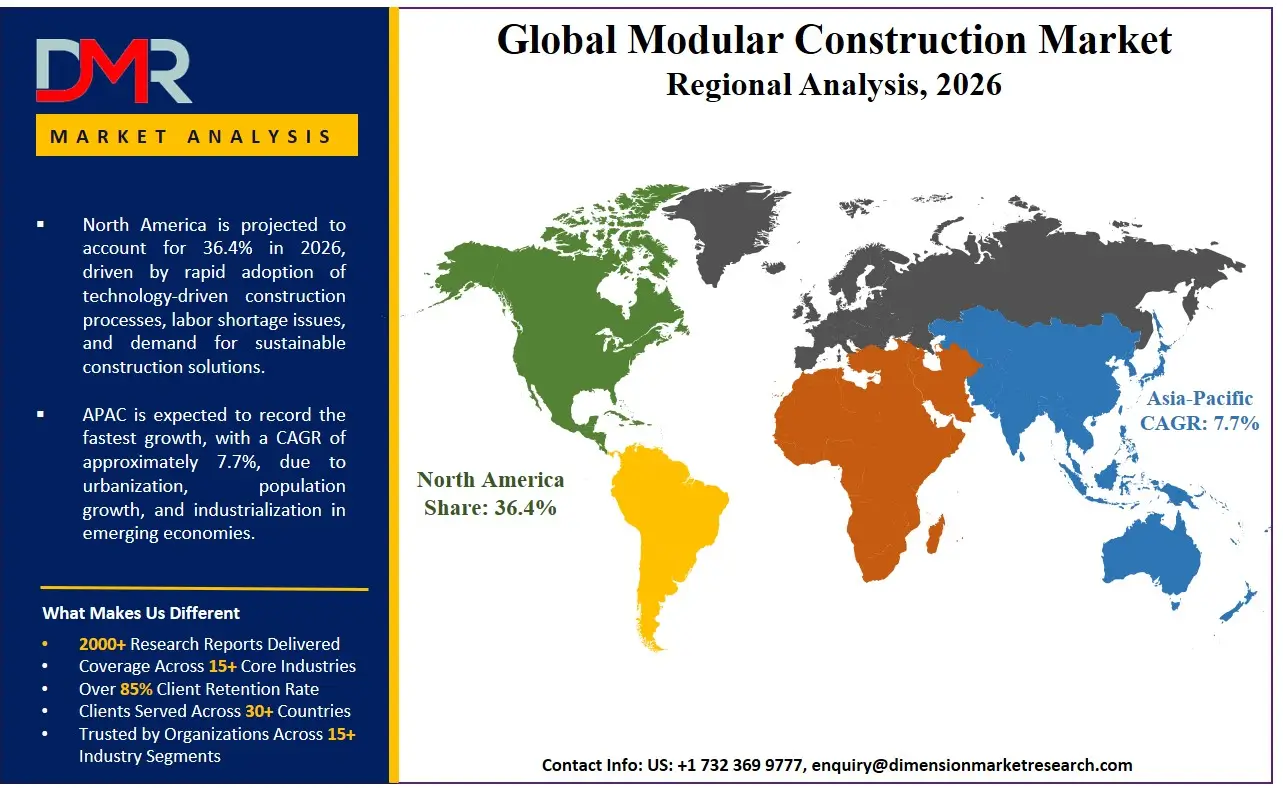
North America is anticipated to have a 36.4% market share in 2026 because of rapid adoption of technology-driven construction processes, labor shortage issues, and demand for sustainable construction solutions. This region enjoys substantial investments in housing, hospitals, education, and commercial construction projects through modular construction practices. Investments in government infrastructure upgrades and a growing trend of investing in energy-efficient buildings is helping drive this market. Moreover, the extensive use of BIM technology, automation, and manufacturing through factories has made North America the front-runner in the market.
ℹ
To learn more about this report –
Download Your Free Sample Report Here
Fastest Growing Region in the Modular Construction Market
The Asia Pacific region is projected to be the fastest growing segment of the modular construction industry due to urbanization, population growth, and industrialization in emerging economies. The emerging economies of China, India, Japan, and South East Asia are spending extensively on affordable housing schemes, smart cities, transportation networks, and industries. The role played by government in encouraging sustainable construction and prefabrication construction practices is helping the modular construction market grow. Labor shortages, higher construction costs, and the need for rapid development of infrastructures have been contributing to the growth of the modular construction market.
By Region
North America
Europe
- Germany
- The U.K.
- France
- Italy
- Russia
- Spain
- Benelux
- Nordic
- Rest of Europe
Asia-Pacific
- China
- Japan
- South Korea
- India
- ANZ
- ASEAN
- Rest of Asia-Pacific
Latin America
- Brazil
- Mexico
- Argentina
- Colombia
- Rest of Latin America
Middle East & Africa
- Saudi Arabia
- UAE
- South Africa
- Israel
- Egypt
- Rest of MEA
Competitive Landscape
Competition among the modular construction industry environment is becoming more competitive because of the improvements in technology, efficiency, and geographical reach. Competitive advantage in the market environment is acquired through automation, digitalization, environmental sustainability materials, and production capacity. There have been increasing instances of businesses in the market developing sophisticated prefab factories, improving their logistical systems, and forging ties with developers and governments in order to improve their ability to complete projects successfully. Entry into the market is moderately difficult based on the requirements for a substantial investment and expertise.
Some of the prominent players in the global Modular Construction are:
- Laing O'Rourke
- Skanska
- Bouygues Construction
- VINCI Construction
- Sekisui House
- Daiwa House Industry
- Lendlease
- Clayton Homes
- CIMC Modular Building Systems
- ATCO Structures & Logistics
- Modulaire Group
- Algeco
- Champion Homes
- Guerdon Modular Buildings
- Portakabin
- Wernick Group
- Premier Modular
- Berkeley Modular
- Modscape
- KEF Infra
- Other Key Players
Recent Developments
- In April 2026, AluHouse Group unveiled their North American presence through participation in the World of Modular 2026 event in Las Vegas, presenting their steel modular multifamily project which is moving closer to completion in the United States. The company also bagged four Awards of Distinction for four different projects that have already been completed in Hong Kong. This project from California is completely pre-assembled in accordance with US building codes.
- In March 2026, Dassault Systèmes stated that MODS Inc. is now using the 3DEXPERIENCE Platform and Virtual Twin technology for industrializing modular home manufacturing. By combining the processes of designing, logistics management, manufacturing at a facility, and assembling on-site, MODS plans to speed up the process of building affordable homes in Canada. The effort is boosted by AI technology and a service called Virtual Twin as a Service.
- In December 2025, S2A Modular introduced a new modular construction system to provide zero-energy apartments, which will help cut down on construction time by up to 50%. It is a combination of modular fabrication within a factory setting, together with the application of graphene solar technology, energy-efficient systems, and energy storage through Tesla Powerwalls. The company has been using its MegaFactory approach for quicker construction projects.
Report Details
| Report Characteristics |
| Market Size (2026) |
USD 115.9 Bn |
| Forecast Value (2035) |
USD 189.5 Bn |
| CAGR (2026–2035) |
5.6% |
| Historical Period |
2021 – 2025 |
| Forecast Period |
2027 – 2035 |
| Base Year |
2025 |
| Estimate Year |
2026 |
| Segments Covered |
By Construction Type, By Module Type, By Material Type, By Application, By End User |
| Regional Coverage |
North America – The US and Canada; Europe – Germany, The UK, France, Russia, Spain, Italy, Benelux, Nordic, & Rest of Europe; Asia-Pacific – China, Japan, South Korea, India, ANZ, ASEAN, Rest of APAC; Latin America – Brazil, Mexico, Argentina, Colombia, Rest of Latin America; Middle East & Africa – Saudi Arabia, UAE, South Africa, Turkey, Egypt, Israel, & Rest of MEA |
Frequently Asked Questions
How big is the Modular Construction Market?
▾ The Modular Construction Market size is expected to reach USD 115.9 billion by 2026 and is projected to reach USD 189.5 billion by the end of 2035.
What is the CAGR of the Modular Construction Market from 2026 to 2035?
▾ The market is growing at a CAGR of 5.6 percent over the forecasted period.
What factors are driving the growth of the Modular Construction Market?
▾ Increased Demand for Sustainable Buildings & Energy Efficient Buildings, and more are the factors driving the growth of the Modular Construction Market.
What are the major trends in the Modular Construction Market?
▾ Integration of Digitalization and Smart Manufacturing Technologies, and more are some of the major trends in the market.
Who are the key players in the Modular Construction Market?
▾ Some of the key players in the Modular Construction Market include ATCO, VINCI, DAIWA House, and more
How is the Modular Construction Market segmented?
▾ The Modular Construction Market is segmented by construction type, module type, material type, application, end user.
Which region held the largest share of the Modular Construction Market in 2026?
▾ North America is set to lead the Modular Construction Market with an estimated 36.4% share in 2026.
Which region is expected to grow the fastest in the Modular Construction Market?
▾ Asia Pacific is the fastest-growing region in the Modular Construction Market during the forecast period.