Market Overview
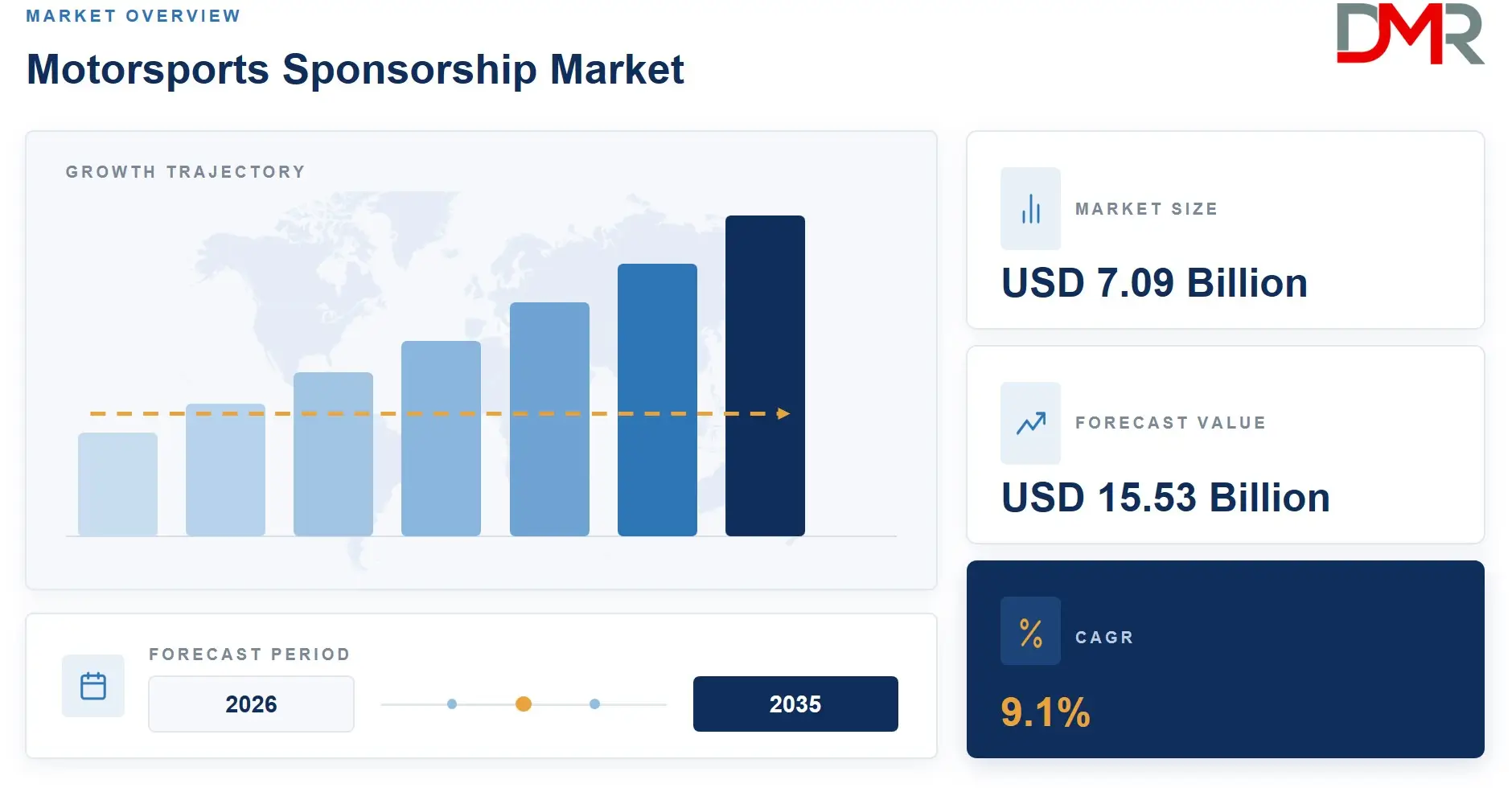
The Global Motorsports Sponsorship Market size is estimated at USD 7.09 Billion in 2026, and is projected to reach USD 15.53 Billion by 2035, exhibiting a CAGR of 9.1% during the forecast period. As reported by Relometrics, Formula 1 partners alone generated $665 million in sponsor media value across broadcast and social platforms from March through June 2025. That single-series, single-half-year figure validates the forecast trajectory and signals that premium motorsport properties are delivering returns that justify continued budget escalation from brand partners.
Data from Ampere Analysis confirmed that F1 sponsorship spend was projected to surpass $3 billion for the 2026 season, driven by a wave of AI platform activations from brands including Meta AI and Anthropic. Liberty Media's completed acquisition of MotoGP commercial rights holder Dorna Sports in July 2025 restructured the supply side of global motorsport IP. Two of the world's three largest racing audiences now sit under a single commercial operator, concentrating pricing power and enabling cross-series bundled sponsorship deals that were previously unavailable. Sports Technology platforms embedded in these ecosystems are becoming a primary vehicle for sponsor activation and fan data monetization.
The motorsports sponsorship market covers commercial partnerships between rights-holding entities and brand sponsors across race teams, series organizers, track operators, and digital content platforms. Adjacent markets in traditional broadcast advertising and general sports sponsorship sit outside this definition, though measurement frameworks increasingly blend the two. Technology brands and fintech entrants now account for the fastest-growing share of new deal volume, replacing automotive OEMs as the dominant sponsor category in several tier-one series.
ℹ
To learn more about this report –
Download Your Free Sample Report Here
Key Takeaways
- The market size is USD 7.09 Billion in 2026, and is projected to hit USD 15.53 Billion by 2035 at a CAGR of 9.1%.
- By Type: Race Teams led as the largest category with a 60.8% share in 2026.
- By Race Series: Formula Racing led as the largest category with a 58.1% share in 2026.
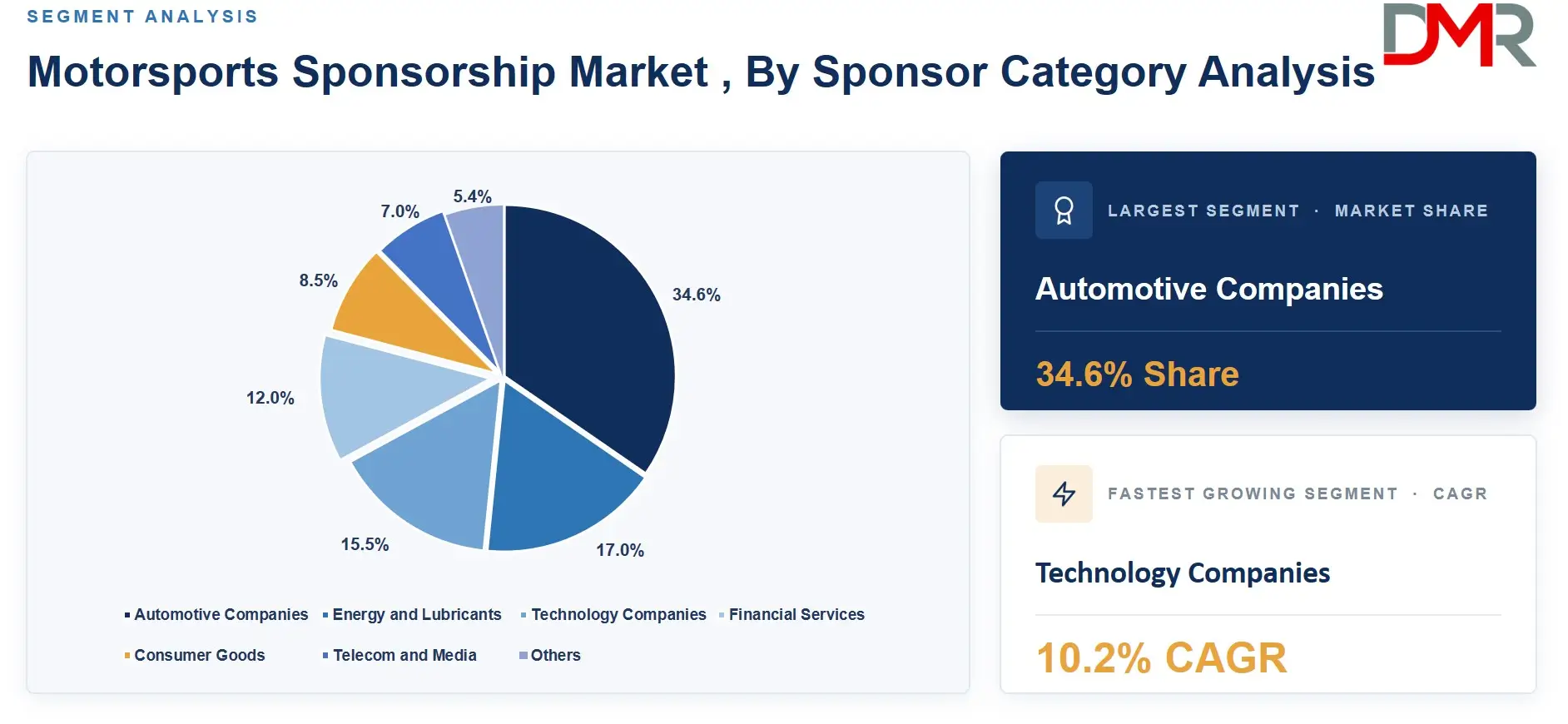
- By Sponsor Category: Automotive Companies led as the largest category with a 34.6% share in 2026.
- By Sponsorship Asset: Team Sponsorship led as the largest category with a 44.8% share in 2026.
- By Region: North America led with a 43.8% share in 2026.
- LVMH's 10-year global partnership with Formula 1, launched in January 2025, marks luxury conglomerates as a structurally new sponsor category entering the market at sustained, multi-decade budget commitments.
Type Analysis
Race Teams led the Type segment with a 60.8% share in 2026. Race teams command the largest portion of sponsorship spend because they offer the densest bundle of brand inventory: livery, driver apparel, social content channels, hospitality access, and IP licensing under a single commercial agreement. Brands that sign with a competitive team gain not just broadcast exposure but ongoing content production across a season, generating earned media that outlasts the race weekend itself. LEGO's 2025 British Grand Prix activation illustrated this dynamic precisely. Seven master builders produced trophies across more than 210 combined hours, generating content value that far exceeded the production cost of the asset itself. League Organizers and Promoters represent the second commercial tier, capturing series-level naming rights and entitlement deals that deliver broader audience reach but less demographic precision than team contracts. Qatar Airways' activation at the 2025 British Grand Prix delivered more than 170 complimentary haircuts to paddock attendees, demonstrating how experiential inventory tied to event organizers generates social amplification through unexpected, shareable activations. Track and Venue Sponsorship remains the smallest Type segment. Gordon Ramsay's F1 Garage partnership operated at 10 Grands Prix during the 2025 season, showing how hospitality-led venue partnerships are creating premium B2B entertainment inventory that commands pricing above traditional signage contracts.
Race Series Analysis
Formula Racing accounted for 58.1% of Race Series demand in 2026, the highest of any category. Formula 1's global television footprint and the audience expansion driven by Drive to Survive have created a sponsorship environment where premium brands pay for access to demographics that traditional sport sponsorship cannot reach. The series attracts CMOs from financial services, technology, and luxury who view F1 as a surrogate for international media buys. Sportswear and lifestyle brands now compete for the same paddock inventory as automotive OEMs, compressing availability and sustaining price escalation across tier-one contracts. One-Make Series and Touring Car Racing serve regional commercial strategies better than global ones. Stock Car Racing retains structural dominance in North America through NASCAR's deeply embedded sponsor culture. GT Racing and Rally and Off-Road Racing serve collectors, OEM testing programs, and legacy manufacturer narratives that mainstream sport cannot provide. Motorbike Racing, following Liberty Media's acquisition of Dorna Sports, is being repositioned toward bundled cross-series sponsorship deals rather than standalone MotoGP placements, which will alter deal structures for buyers from 2026 onward.
Sponsor Category Analysis
Automotive Companies captured 34.6% of the Sponsor Category segment in 2026, ahead of all rivals. Automotive brands sponsor motorsport for product validation, engineering credibility, and halo-brand transfer. OEM electrification programs are now redirecting budget from Formula 1 toward Formula E and Extreme E, where the racing platform aligns with product roadmap narratives. That budget migration is creating vacancy in F1's sponsor roster that technology companies and fintech entrants are filling at equivalent or higher price points. Energy and Lubricants brands maintain deep team-level partnerships through technical supply arrangements that double as brand activation. Technology Companies and Financial Services sponsors are the fastest-growing categories by deal count. Consumer Goods brands enter at experiential and event tiers. Telecom and Media sponsors concentrate in broadcast integration and streaming partnerships, where digital activation amplifies the value of a logo placement through always-on content distribution.
ℹ
To learn more about this report –
Download Your Free Sample Report Here
Sponsorship Asset Analysis
With a 44.8% share in 2026, Team Sponsorship outpaced all other Sponsorship Asset categories. Team sponsorship bundles more inventory per contract than any other asset class, enabling sponsors to activate across livery, hospitality, digital, driver content, and IP simultaneously. Brands paying for team-level access are buying a content production partnership as much as a logo placement. Sports Tourism packages tied to race hospitality have become a measurable revenue line for teams and a retention mechanism for sponsor renewal. Driver Sponsorship is outperforming team livery deals on a per-impression basis in social reach and demographic targeting precision, making athlete-linked personal brand deals attractive for brands targeting Gen Z. Event Sponsorship and Track and Venue Sponsorship serve brands prioritizing geographic audience concentration over global scale. Digital and Streaming Sponsorship and Esports and Sim Racing Sponsorship represent the fastest-growing asset classes by deal volume, as endemic and non-endemic sponsors access younger audiences through always-on platforms without physical event dependency.
Key Market Segments
By Type
- Race Teams
- League Organizers and Promoters
- Track Owners and Runners
By Race Series
- Formula Racing
- One-Make Series
- Touring Car Racing
- Stock Car Racing
- GT Racing
- Rally and Off-Road Racing
- Motorbike Racing
By Sponsor Category
- Automotive Companies
- Energy and Lubricants
- Technology Companies
- Financial Services
- Consumer Goods
- Telecom and Media
- Others
By Sponsorship Asset
- Team Sponsorship
- Driver Sponsorship
- Event Sponsorship
- Track and Venue Sponsorship
- Digital and Streaming Sponsorship
- Esports and Sim Racing Sponsorship
Regional Analysis
North America led the global motorsports sponsorship market with a 43.8% share in 2026, reflecting the region's concentration of premium series revenue, sponsor depth across NASCAR and IndyCar, and Formula 1's accelerating U.S. audience build. North America holds structural commercial advantages that no other region currently replicates at scale. NASCAR's deeply embedded fan-sponsor relationship, Formula 1's three U.S. Grand Prix calendar positions, and IndyCar's corporate hospitality culture create overlapping sponsorship demand from brands across automotive, financial services, and technology sectors. The 2025 Global F1 Fan Survey collected more than 100,000 responses from self-identified engaged fans across 186 countries, confirming that North American fan engagement metrics now lead globally by volume and commercial intent.
Europe
Europe retains the highest concentration of tier-one race team operations and serves as the primary hub for hospitality and paddock-club inventory that commands premium B2B pricing. Formula 1's seven European Grand Prix calendar positions create dense geographic clustering that allows sponsors to activate continuously through the summer season. LVMH's 10-year partnership anchored to hospitality and timekeeping across F1 was structured specifically around European race weekends as the activation backbone.
Asia Pacific
Asia Pacific is the region offering the largest addressable sponsorship audience relative to current monetization rates. Formula 1's Japan, Singapore, and Chinese Grand Prix positions provide commercial entry points for brands targeting East Asian consumer markets. The F1 Sim Racing India Open launched in May 2026 signals that digital-first sponsorship inventory is being created in India before physical event infrastructure matures, giving first movers access to a market of 1.4 billion before competition intensifies.
.webp)
ℹ
To learn more about this report –
Download Your Free Sample Report Here
Latin America
Brazil anchors Latin America's motorsport commercial ecosystem through its historically passionate fan base and the São Paulo Grand Prix's consistent calendar presence. Sponsor penetration remains concentrated at series and event level rather than team level, reflecting the absence of a Latin American–based team with global sponsor appeal. Regional consumer goods and telecom brands are the primary sponsor categories active at this tier.
Middle East & Africa
The Middle East has become a structurally important calendar endpoint for Formula 1, with Bahrain, Saudi Arabia, and Abu Dhabi Grand Prix positions creating a cluster of state-backed sponsorship demand unlike any other region. Government-linked entities and national airlines occupy premier sponsor positions as part of destination branding strategies. First-mover pricing advantages remain available to non-endemic international sponsors willing to enter regional series before audience maturation closes the gap with European pricing benchmarks.
Key Regions and Countries
North America
Europe
- Germany
- France
- The UK
- Spain
- Italy
- Rest of Europe
Asia Pacific
- China
- Japan
- South Korea
- India
- Australia
- Rest of APAC
Latin America
- Brazil
- Mexico
- Rest of Latin America
Middle East & Africa
- GCC
- South Africa
- Rest of MEA
Macroeconomic Impact
Premium motorsport sponsorship budgets track corporate earnings cycles more closely than consumer discretionary spending. When technology sector valuations contracted through 2022 and 2023, CMO budgets for experiential and sponsorship marketing tightened first. The recovery in equity markets and corporate earnings from late 2023 onward directly preceded the wave of new high-value F1 partnerships signed through 2025 and 2026, confirming that macro-led confidence, not audience growth alone, drives deal velocity at the top of the market. Formula 1's LEGO Drivers' Parade in 2025 achieved a total global earned-media reach of 12 billion, a figure that sponsors now cite in internal ROI models as evidence that experiential activations can generate mainstream media returns without proportional media-buy spend. Inflation pressures on event operations, hospitality catering, and cross-border logistics have pushed activation costs upward, but premium sponsors have absorbed these increases because the relative cost of comparable audience access through paid digital channels has risen faster.
Market Dynamics
Driver: Dual-Screen Engagement and Fan Purchase Intent Create Measurable ROI
Motorsport sponsorship produces a rare combination of live broadcast exposure and simultaneous social amplification that digital-first media channels cannot replicate. Social media generated 63% of Formula 1's total sponsor media value in the first half of 2025, equivalent to approximately $417 million, as reported by Relometrics. TikTok delivered an average of $45,200 in F1 sponsor media value per post versus $15,200 for Instagram and $9,100 for YouTube in the same period, confirming that content format, not platform scale alone, determines return per activation dollar. Fan intent data reinforces the commercial case for sponsor investment. According to the 2025 Global F1 Fan Survey, 76% of respondents said sponsors enhance the Formula 1 experience, a perception score that converts directly into brand equity for partners. MRI-Simmons confirmed in its 2026 study that 74% of NASCAR fans believe drivers could not race without sponsor support, and 63% rated sponsor contributions as greater than in comparable sports. LVMH's January 2025 launch of its 10-year F1 global partnership reflected precisely this confidence in sustained fan brand affinity. F1 title partners collectively earned $89 million in media value during the first half of 2025, with social media supplying 83% of that figure, as reported by Blackbook Motorsport. Sports Equipment brands observing these returns are entering motorsport sponsorship for the first time, treating series-level deals as performance media buys rather than brand awareness investments.
Restraint: ROI Attribution Complexity Limits Budget Commitment From Non-Endemic Brands
CMOs outside the automotive and technology sectors face a structural problem when evaluating motorsport sponsorship against digital performance marketing benchmarks. Click-through rates, cost-per-acquisition, and return-on-ad-spend metrics do not translate directly from a livery placement or a paddock hospitality event to a measurable purchase funnel. Budget holders in consumer packaged goods and retail are reluctant to commit seven- or eight-figure sponsorship contracts when internal finance teams demand the same attribution certainty they receive from programmatic digital buys. Concentration risk compounds this restraint. Premium audience reach is overwhelmingly concentrated within Formula 1, NASCAR, and MotoGP. Lower-tier series struggle to present audience data that justifies sponsorship pricing above regional media buys, leaving the vast majority of motorsport properties commercially undermonetized and inaccessible to the mid-market brands that could expand the overall sponsor pool.
Opportunity: Esports Integration and Experiential Inventory Open New Sponsor Categories
According to the 2025 Global F1 Fan Survey, one in three respondents said they were more likely to purchase from Formula 1 partners. Among Gen Z respondents specifically, that purchase likelihood rose to 40%, as reported by Blackbook Motorsport. Non-endemic brands targeting younger demographics now have quantitative audience data, not just reach projections, to underpin sponsorship investment decisions aimed at Gen Z consumer bases. LEGO's experiential activation at the 2025 Miami Grand Prix generated $14 million in sponsor media value across social platforms in a single day, as reported by Relometrics. That figure demonstrates that well-executed non-automotive, non-technology brand activations can produce returns comparable to title-level partnerships, opening the experiential tier to consumer goods brands that previously viewed motorsport as inaccessible.
Porter's Five Forces
The motorsports sponsorship market operates under conditions of moderate-to-high competitive intensity, shaped most critically by the concentration of premium inventory in fewer than five global series. Barriers to entry for new rights holders are substantial, requiring capital investment in series infrastructure, broadcast distribution, and audience development before sponsor revenue becomes viable. Supplier power among elite teams, notably Ferrari, Mercedes-AMG, Red Bull, and McLaren, is structurally high because their combined audience reach and media value production give them pricing leverage that smaller teams cannot match. MRI-Simmons data from 2026 confirmed that NASCAR fans were 48% more likely than the average U.S. adult to notice brand sponsorships, 64% more likely to believe athlete-supported products are superior, and 56% more likely to act on that belief through purchase. Buyer power varies sharply by series tier: title sponsors of elite series have almost no substitutable alternatives at equivalent audience quality, while sponsors of mid-tier series can switch properties with limited penalty. Substitute threats are real but not immediate: programmatic digital advertising and influencer marketing offer cost-per-impression advantages but cannot replicate motorsport's in-broadcast, non-skippable brand exposure model. Rivalry among the top four or five series for a finite pool of premium sponsors is the single biggest structural constraint on market expansion.
AI and Gen AI Impact
In February 2026, Salesforce and Formula 1 launched an AI-powered fan companion application built on Agentforce 360, providing personalized insights to a global fan base of 827 million. The platform creates a structured data layer between sponsors and fans that enables precision targeting at a scale no static livery placement can match. AI at the fan-interface level converts previously anonymous audience reach into addressable, behaviorally segmented sponsor inventory. Data from MRI-Simmons showed that 62% of NASCAR fans noticed sponsorship mentions during broadcasts, 61% noticed logos on athletes' uniforms, and 64% noticed signs and billboards at venues in 2026. AI-powered broadcast tracking tools now quantify this recognition at frame-by-frame resolution, converting passive logo exposure into auditable sponsor media value. The NTT DATA-powered INDYCAR app reached more than 700,000 new users since its relaunch with usage rising by more than 30% and users distributed across more than 100 countries, demonstrating that AI-enhanced fan applications are expanding the addressable audience beyond physical event attendance.
Market Trends
Fan Loyalty Mechanics and Blockchain Activation Redefine Sponsor Engagement
MRI-Simmons confirmed in 2026 that 50% of NASCAR fans recommended a brand because of its NASCAR involvement, and 50% reported loyalty to brands simply because those brands support the sport. Fan token programs and digital collectible platforms are formalizing this loyalty into transactional sponsor activation models, embedding blockchain-based rewards directly into supporter ecosystems. LEGO's Miami activation cars, each built from nearly 400,000 bricks capable of reaching 20 kilometres per hour, illustrated how physical-to-digital sponsor content creates multi-platform amplification loops that outlast the race event by weeks.
Market Competition Overview
The motorsports sponsorship market is moderately consolidated at the premium series tier and highly fragmented below it. Formula 1, NASCAR, and MotoGP account for the overwhelming majority of total sponsor spend, and commercial operators within those series hold structurally superior pricing power over the rest of the market. Relometrics data showed that Formula 1 sponsorship content generated 300 billion social impressions carrying brand value and 2.5 million detected brand exposures from March through June 2025, a reach concentration that no other single sports property matched in that period. More than 110 Formula 1 sponsor brands each generated at least $1 million in sponsor media value during the first half of 2025, confirming that mid-tier sponsors within the series capture material returns alongside title partners. Recreation Clubs and regional sports properties seeking to compete for the same brand budgets face a credibility gap: brands with premium budget flexibility consistently choose elite motorsport series over competing inventory because audience intent data favors motorsport fans on purchase conversion metrics. The competitive dynamic is shifting, however, as new series in esports racing, women's motorsport, and regional Asia-Pacific championships begin to present audience growth trajectories that attract first-mover sponsors before pricing reaches elite-series levels.
Pricing Analysis
Cadillac's 2026 Formula 1 entry provided the clearest public pricing benchmark the market has seen in a new-team launch cycle. As reported by Motorsport.com, the team marketed a five-year title-sponsorship package at $55 million–$70 million per year. Premium partnerships were priced at $20 million–$30 million each, with up to five positions available. Eight official-team partnerships were offered at $3 million–$15 million each, and technical-supplier positions were priced at approximately $500,000 per supplier annually, establishing a tiered inventory architecture that brands can enter across a wide budget range. NASCAR fans were 64% more likely than the average U.S. adult to switch brands when their favorite athlete changed sponsors, according to MRI-Simmons 2026. That behavioral metric gives driver-linked personal sponsorship deals a premium valuation argument at renewal, creating upward price pressure on athlete contracts that flows directly into team-level sponsorship packaging costs. Challengers entering mid-tier series face the opposite dynamic: pricing remains below demonstrated ROI thresholds, but audience data is insufficient to convince CMOs at scale.
Company Profiles
Scuderia Ferrari delivered approximately $73 million in social-media value for its sponsors during the first half of the 2025 Formula 1 season, as reported by Relometrics. Ferrari's brand equity is self-reinforcing: the Prancing Horse insignia generates organic fan content that amplifies sponsor exposure beyond paid or owned channel activations. The Ferrari–HP partnership alone generated $26.6 million in media value in H1 2025, compared with $15.2 million for Red Bull–Oracle and $12.9 million for Mercedes–Petronas, as confirmed by Blackbook Motorsport. Ferrari's commercial position means sponsors pay a premium for association that competitors cannot fully replicate regardless of on-track performance. Mercedes-AMG Petronas Formula One Team built a commercial model that balances engineering credibility with lifestyle brand crossover. The team's title partner structure historically prioritized energy and chemical sector sponsors, but the addition of technology and financial services brands through 2024 and 2025 reflects a deliberate repositioning toward the sectors now growing fastest within F1's sponsor pool. The team's global broadcast footprint and consistent competitive presence give sponsors media value guarantees that smaller teams with higher volatility cannot underwrite.
Key Players
- Mercedes-AMG Petronas Formula One Team
- Scuderia Ferrari
- McLaren Racing
- Ducati
- Oracle Red Bull Racing
- Alpine F1 Team
- Haas F1 Team
- Aston Martin Aramco Formula One Team
- Team Penske
- Cadillac F1 Team
- Hendrick Motorsports
- Ferrari
- Joe Gibbs Racing
- Trackhouse Racing
- Chip Ganassi Racing (IndyCar)
- Andretti Global
- 23XI Racing
- VR46 Racing Team (MotoGP)
- Gresini Racing (MotoGP)
- Yamaha Factory Racing (MotoGP)
- Other Key Players
Supply Chain and Value Chain Analysis
The motorsports sponsorship value chain begins with series rights holders and governing bodies, who license broadcast and commercial rights to teams, event organizers, and digital platform operators. Teams sit at the center of value creation, aggregating sponsor inventory across livery, hospitality, driver content, telemetry data, and IP licensing into unified commercial packages. NTT DATA's 2026 INDYCAR technology partnership embedded more than 150 sensors per race car, capable of generating up to 8 billion data points during a race event, demonstrating that real-time performance data has become a distinct category of sponsor inventory. Maximum value creation occurs at the point where team brand equity, driver personal brand, and live broadcast distribution intersect. Bottlenecks concentrate in two areas: the finite supply of premium calendar positions within elite series, which limits total sponsor inventory at the top tier, and the attribution gap between activation spend and measurable commercial outcome, which slows budget release from new sponsor categories. Agencies and measurement technology providers occupy the mid-chain position, translating raw impression and engagement data into the standardized ROI metrics that sponsor procurement teams require to authorize contract renewals.
Regulatory Landscape
Motorsport governing bodies, including the FIA for Formula 1 and Formula E and the FIM for MotoGP, set commercial regulations that directly constrain sponsor category eligibility, livery design, and naming rights structures. Tobacco advertising bans across European Union race venues remain the most material category exclusion, removing a historically significant sponsor tier from premium Grand Prix inventory. Alcohol and gambling brand restrictions vary by host nation, creating a patchwork of category eligibility rules that sponsor procurement teams must navigate event by event. NTT DATA's 2026 carbon-accounting and automated data-collection platform supported emissions reporting across more than 100 INDYCAR organizations and partners. Sustainability disclosure requirements are becoming a new regulatory layer for series sponsors, particularly those operating in ESG-committed sectors. Brands entering sustainability-linked sponsorship structures must now meet co-investment reporting standards that governing bodies and series operators are formalizing in partnership agreements.
Investment and White Space Analysis
Investment is flowing most visibly into esports motorsport platforms, women's motorsport series, and regional Asia-Pacific championships, all three of which offer first-mover pricing before audience maturation closes the gap with established series benchmarks. NTT DATA's AI venue systems supported operational decision-making across the 1,000-acre Indianapolis Motor Speedway, which hosted more than 350,000 spectators for sold-out Indianapolis 500 races in both 2025 and 2026. Technology infrastructure investment at elite venues confirms that digital fan experience enhancement has become a permanent cost center for series operators and an embedded activation platform for technology sponsors. Women's motorsport represents the clearest undermonetized white space by commercial-to-audience potential ratio. Broadcast reach is expanding across multiple series, but sponsorship pricing remains below the level that audience engagement metrics would support at equivalent male-series tier positions. Sustainability-linked sponsorship structures are a second underserved category: ESG-committed brands face limited standardized frameworks for co-investment partnerships with motorsport rights holders, creating an entry point for intermediaries capable of structuring carbon offset and impact measurement deals within sponsorship contracts.
Recent Developments
- July 2024: Avenue Sports Fund made a multi-million dollar investment in Trackhouse Entertainment Group to expand its global operational footprint across motorsport commercial entertainment platforms.
- September 2024: Accel and HPS Investment Partners completed an equity acquisition of shares in the Aston Martin Formula One Team, with the transaction valuing the team entity at more than £1.5 billion, confirming private equity confidence in motorsport sponsorship monetization.
- January 2024: Sauber launched its new identity as Stake F1 Team Kick Sauber, bringing online casino Stake and streaming platform Kick into a joint naming-rights activation structured as a multi-year commercial runway ahead of the Audi factory program rollout.
- May 2026: Formula 1 and Mumbai Falcons launched the F1 Sim Racing India Open 2026, a nationwide virtual racing competition designed to expand grassroots engagement and create digital-first sponsorship inventory in the Indian market.
- June 2025: Peter Auto and SRO Motorsports Group announced the launch of the GT3 Revival Series, a historic racing championship targeting collectors, legacy manufacturers, and premium luxury event sponsors.
- April 2025: Motorsport Games secured a strategic investment of $2.5 million to expand its virtual digital offerings and access the rising esports motorsport sponsorship inventory.
- August 2025: NASCAR and O'Reilly Auto Parts announced a major multi-year entitlement partnership, rebranding the secondary series tier as the NASCAR O'Reilly Auto Parts Series from January 1, 2026, with new broadcast integrations on The CW Network.
Report Scope
| Report Characteristics |
| Market Value (2026) |
USD 7.09 Billion |
| Forecast Revenue (2035) |
USD 15.53 Billion |
| CAGR (2026 to 2035) |
9.1% |
| Base Year for Estimation |
2025 |
| Historic Period |
2020 to 2024 |
| Forecast Period |
2026 to 2035 |
| Report Coverage |
Revenue Forecast, Market Dynamics, Competitive Landscape, Recent Developments |
| Segments Covered |
By Type (Race Teams, League Organizers and Promoters, Track Owners and Runners), By Race Series (Formula Racing, One-Make Series, Touring Car Racing, Stock Car Racing, GT Racing, Rally and Off-Road Racing, Motorbike Racing), By Sponsor Category (Automotive Companies, Energy and Lubricants, Technology Companies, Financial Services, Consumer Goods, Telecom and Media, Others), By Sponsorship Asset (Team Sponsorship, Driver Sponsorship, Event Sponsorship, Track and Venue Sponsorship, Digital and Streaming Sponsorship, Esports and Sim Racing Sponsorship) |
| Regional Analysis |
North America (US and Canada), Europe (Germany, France, The UK, Spain, Italy, and Rest of Europe), Asia Pacific (China, Japan, South Korea, India, Australia, and Rest of APAC), Latin America (Brazil, Mexico, and Rest of Latin America), Middle East & Africa (GCC, South Africa, and Rest of MEA) |
| Competitive Landscape |
Mercedes-AMG Petronas Formula One Team, Scuderia Ferrari, McLaren Racing, Ducati, Oracle Red Bull Racing, Alpine F1 Team, Haas F1 Team, Aston Martin Aramco Formula One Team, Team Penske, Cadillac F1 Team, Hendrick Motorsports, Ferrari, Joe Gibbs Racing, Trackhouse Racing, Chip Ganassi Racing (IndyCar), Andretti Global, 23XI Racing, VR46 Racing Team (MotoGP), Gresini Racing (MotoGP), Yamaha Factory Racing (MotoGP), Other Key Players |
| Customization Scope |
Customization for segments and region or country level will be provided. Additional customization can be done based on requirements. |
| Purchase Options |
Three license options: Single User License, Multi-User License (Up to 5 Users), Corporate Use License (Unlimited Users and Printable PDF) |
Frequently Asked Questions
What is the biggest investment opportunity in the Motorsports Sponsorship market?
▾ Women's motorsport series and esports racing platforms represent the highest-growth, lowest-competition investment entry points in the current market cycle. Both categories offer first-mover pricing before audience maturation forces sponsorship costs to premium-series benchmarks. Sustainability-linked partnership structures layered over these properties add ESG credential value for brand investors.
Who are the top companies in the Motorsports Sponsorship market?
▾ Leading commercial entities include Mercedes-AMG Petronas Formula One Team, Scuderia Ferrari, McLaren Racing, Oracle Red Bull Racing, Aston Martin Aramco Formula One Team, Cadillac F1 Team, Team Penske, Hendrick Motorsports, Ducati, and VR46 Racing Team, among others. Ferrari delivered approximately $73 million in social-media sponsor value in the first half of the 2025 season, the highest of any single team tracked by Relometrics in that period.
Which segment is growing fastestin the Motorsports Sponsorship market and why?
▾ Digital and Streaming Sponsorship and Esports and Sim Racing Sponsorship are the fastest-growing asset categories by deal volume, driven by non-endemic brands targeting Gen Z audiences through always-on digital platforms. Among Gen Z respondents in the 2025 Global F1 Fan Survey, purchase likelihood from F1 partners reached 40%, giving data-backed justification for brands to allocate budget to digital motorsport inventory ahead of physical-event-dependent alternatives.
Which region is growing fastest in the Motorsports Sponsorship marketand why?
▾ Asia Pacific is growing fastest, fueled by Formula 1's calendar expansion in the region and the development of digital-first sponsorship infrastructure in India before physical event capacity matures. The F1 Sim Racing India Open launched in May 2026 confirms that rights holders are building sponsor inventory in the region now, ahead of projected audience scale. First-mover sponsors entering Asia-Pacific series today face pricing below what comparable audience engagement would command in North America or Europe.
What is the biggest challenge holding in the Motorsports Sponsorship market back?
▾ ROI attribution complexity is the primary structural barrier preventing CMO budget expansion from non-endemic sponsor categories. Brands outside automotive and technology cannot reconcile motorsport sponsorship costs against the performance marketing benchmarks their finance teams require. Until measurement platforms deliver purchase-funnel attribution equivalent to digital advertising standards, the total addressable sponsor pool will remain narrower than audience size alone would support.