Market Overview
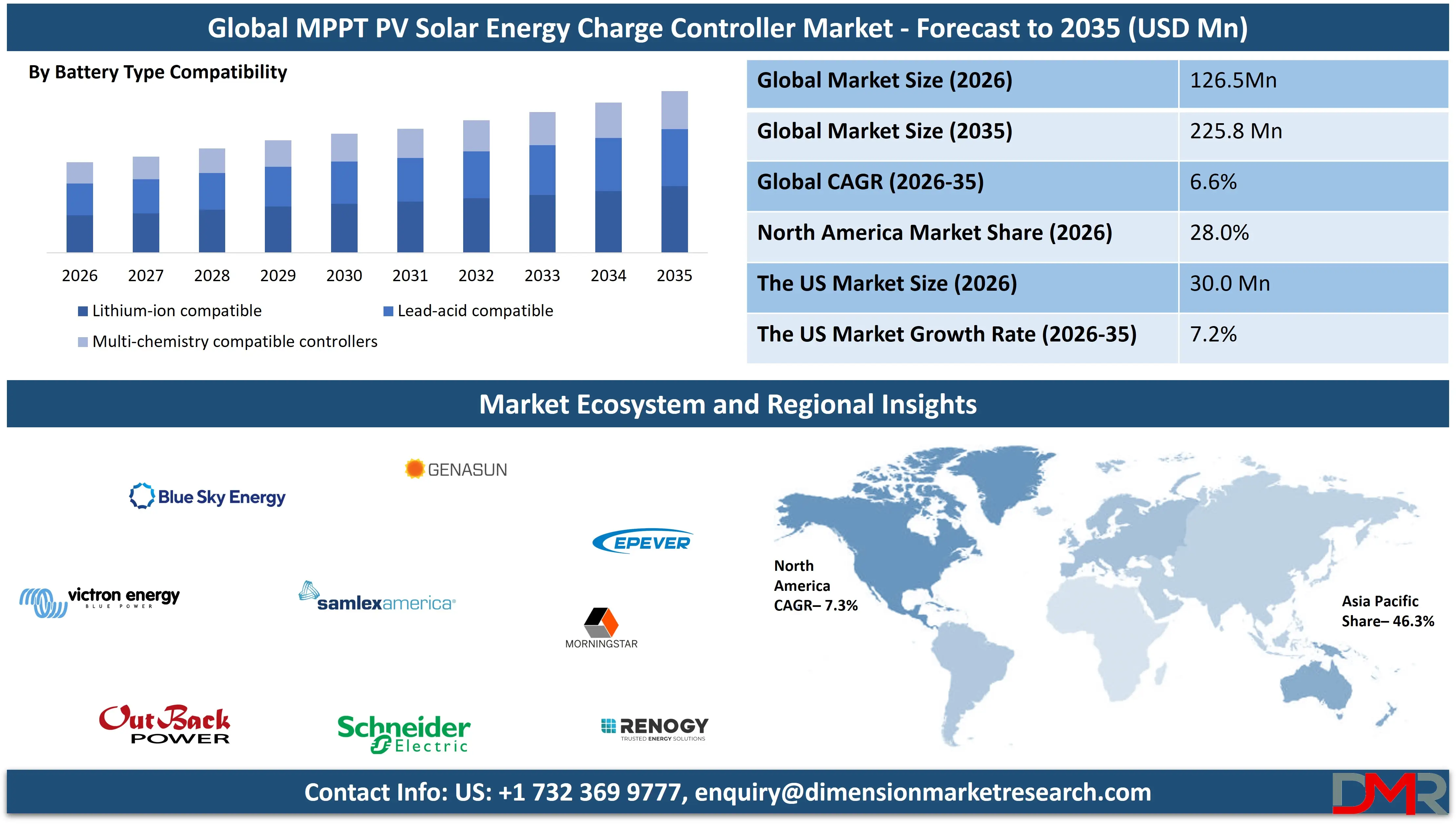
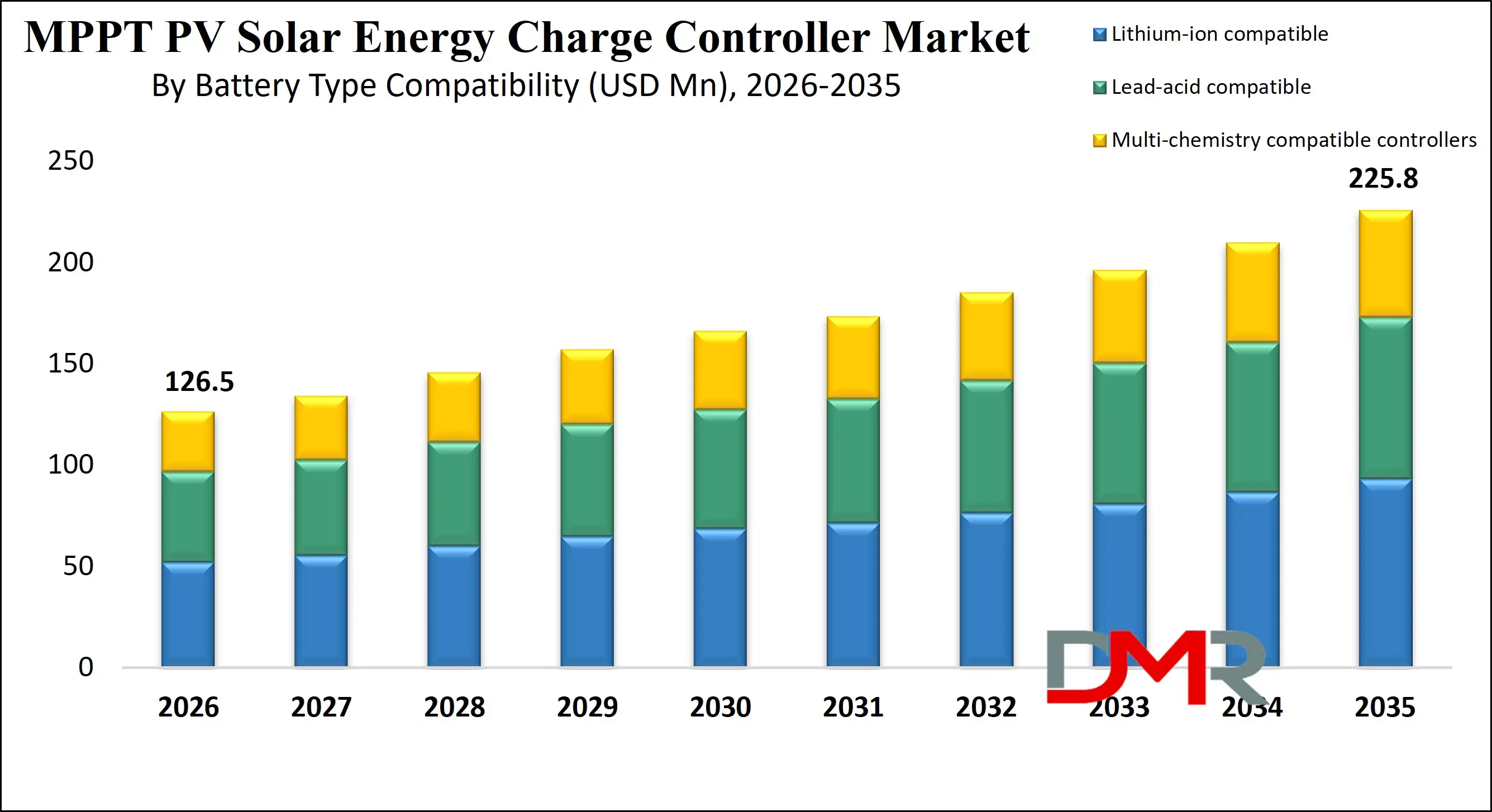
The Global MPPT PV Solar Energy Charge Controller Market size is projected to reach USD 126.5 million in 2026 and grow at a compound annual growth rate of 6.6% to reach a value of USD 225.8 million in 2035.
ℹ
To learn more about this report –
Download Your Free Sample Report Here
MPPT PV Solar Energy Charge Controller refers to advanced power electronics devices that optimize the output from photovoltaic (PV) panels by continuously tracking the maximum power point to ensure maximum energy harvest. These controllers regulate voltage and current between solar panels and battery systems, enhancing charging efficiency and protecting batteries from overcharging or deep discharge. They are integral components in residential, commercial, industrial, utility-scale, and off-grid solar installations. By using algorithms and DC-DC conversion technology, MPPT controllers improve system efficiency by 20–30% compared to PWM controllers, making them crucial in modern distributed energy systems.
The market is gaining prominence as global solar installations accelerate and battery storage adoption expands. Increasing electrification in remote areas, integration of lithium-ion batteries, and rising demand for smart energy management solutions are reshaping product innovation. Regulatory mandates encouraging renewable deployment and declining solar module costs further amplify demand for efficient charge control systems.
ℹ
To learn more about this report –
Download Your Free Sample Report Here
Industry transformation is characterized by digital monitoring, IoT-enabled controllers, modular high-capacity units for industrial use, and compatibility with hybrid inverters. Strategic collaborations between solar equipment manufacturers and storage solution providers are accelerating commercialization. Investments in rural electrification, telecom infrastructure power backup, and decentralized renewable energy systems continue to shape long-term expansion.
The US MPPT PV Solar Energy Charge Controller Market
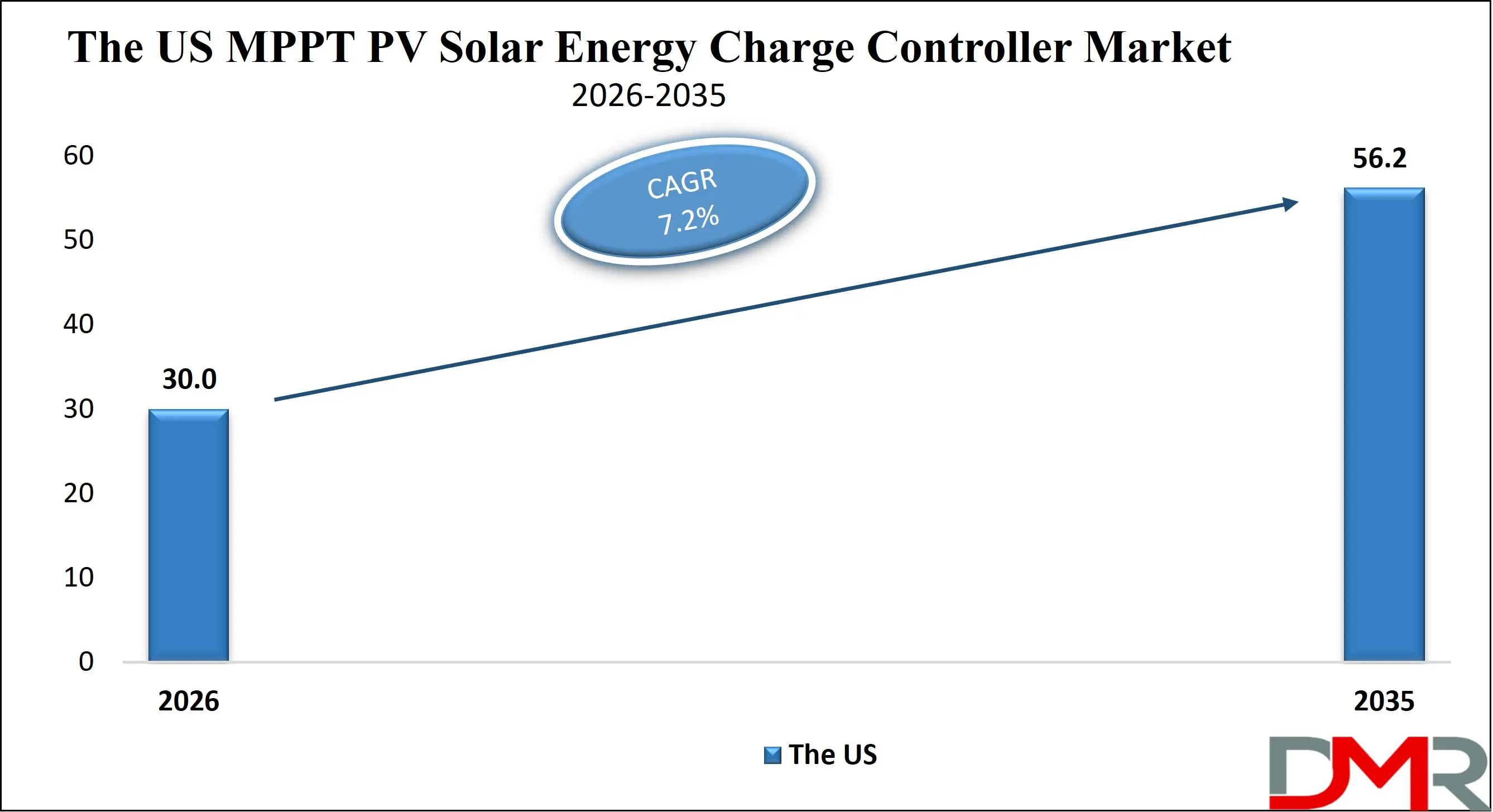
The US MPPT PV Solar Energy Charge Controller Market size is projected to reach USD 30.0 million in 2026 at a compound annual growth rate of 7.2% over its forecast period.
ℹ
To learn more about this report –
Download Your Free Sample Report Here
The US market benefits from strong solar deployment under federal incentives such as the Investment Tax Credit (ITC). Growth is driven by rising rooftop solar installations, energy storage integration, and expansion of off-grid systems in rural and disaster-prone areas. Increasing adoption of lithium-ion batteries in residential storage systems boosts demand for advanced MPPT controllers with integrated battery management. Commercial and industrial (C&I) sectors are installing higher-capacity controllers for peak shaving and energy resilience. Supportive state-level renewable portfolio standards and grid modernization programs further enhance adoption across utility and distributed segments.
Europe MPPT PV Solar Energy Charge Controller Market
Europe MPPT PV Solar Energy Charge Controller Market size is projected to reach USD 22.8 million in 2026 at a compound annual growth rate of 6.5% over its forecast period.
Europe’s market is influenced by decarbonization goals and policies such as the European Green Deal. Countries including Germany, Spain, and Italy are expanding rooftop solar and battery storage installations, driving demand for smart, multi-chemistry-compatible controllers. Strict grid codes and energy efficiency standards encourage high-performance MPPT technologies. Rural electrification in Eastern Europe and microgrid development in remote regions contribute additional growth. Rapid adoption of residential solar-plus-storage systems and incentives for self-consumption models are accelerating advanced controller penetration across commercial and utility-scale projects.
Japan MPPT PV Solar Energy Charge Controller Market
Japan MPPT PV Solar Energy Charge Controller Market size is projected to reach USD 11.4 million in 2026 at a compound annual growth rate of 6.0% over its forecast period.
Japan’s market is shaped by energy security concerns and strong distributed solar adoption following post-Fukushima energy reforms. Urban rooftop solar systems and compact storage units require efficient, space-optimized MPPT controllers. Industrial automation and telecom backup systems also present strong growth avenues. Government support for renewable expansion and decarbonization targets stimulates innovation in high-efficiency and hybrid-compatible controllers. However, land constraints and grid integration challenges necessitate advanced monitoring and performance optimization features, creating demand for smart, digitally enabled MPPT solutions.
MPPT PV Solar Energy Charge Controller Market: Key Takeaways
- Market Growth: The MPPT PV Solar Energy Charge Controller Market size is expected to grow by USD 91.8 million, at a CAGR of 6.6%, during the forecasted period of 2027 to 2035.
- By Battery Type Compatibility: The lithium-ion compatible segment is anticipated to get the majority share of the MPPT PV Solar Energy Charge Controller market in 2026.
- By Application: The residential solar systems segment is expected to get the largest revenue share in 2026 in the MPPT PV Solar Energy Charge Controller market.
- Regional Insight: Asia Pacific is expected to hold a 46.3% share of revenue in the global MPPT PV Solar Energy Charge Controller market in 2026.
- Use Cases: Some of the use cases of MPPT PV Solar Energy Charge Controller include industrial facilities, telecom towers, and more.
MPPT PV Solar Energy Charge Controller Market: Use Cases
- Residential Rooftop Solar: Optimizes energy harvest and ensures safe battery charging in home solar-plus-storage systems.
- Commercial Rooftop Installations: Enhances performance for offices, malls, and warehouses with higher-capacity battery banks.
- Industrial Facilities: Supports heavy-load energy management and peak demand reduction strategies.
- Utility-Scale Solar Projects: Ensures efficient DC optimization for large battery storage farms.
- Rural Electrification: Provides reliable off-grid power in remote villages and developing regions.
- Telecom Towers: Maintains uninterrupted power supply for remote communication infrastructure.
- Remote Infrastructure: Powers monitoring stations, border security systems, and isolated industrial sites.
Stats & Facts
- International Energy Agency reported that global solar PV capacity additions reached 507 GW in 2024.
- U.S. Energy Information Administration stated that solar accounted for 53% of new U.S. electricity capacity additions in 2024.
- European Commission indicated that the EU installed over 65 GW of new solar capacity in 2024.
- Japan Ministry of Economy, Trade and Industry reported that Japan’s cumulative solar PV capacity exceeded 90 GW in 2024.
- International Renewable Energy Agency confirmed that global renewable power capacity reached 3,870 GW in 2024.
- U.S. Department of Energy highlighted that battery storage installations grew by over 70% year-on-year in 2024.
- Eurostat recorded that renewables accounted for over 24% of gross final energy consumption in the EU in 2024.
- Government of India Ministry of New and Renewable Energy reported 75 GW of installed solar capacity by early 2025.
- China National Energy Administration stated that China added more than 216 GW of solar capacity in 2024.
- World Bank reported that over 675 million people globally still lacked electricity access in 2024, supporting off-grid solar demand.
Market Dynamic
Driving Factors in the MPPT PV Solar Energy Charge Controller Market
Growing Solar PV and Energy Storage Integration
The rapid expansion of global solar installations combined with increasing battery storage deployment is a primary growth catalyst. As solar penetration rises, efficient energy harvesting becomes critical, positioning MPPT controllers as essential components. Advanced algorithms maximize panel output despite shading or temperature fluctuations. Increasing hybrid systems integrating solar, storage, and grid connectivity further require intelligent charge control systems, enhancing demand across residential, commercial, and utility-scale applications.
Technological Advancements and Smart Monitoring
Innovations in digital control, IoT integration, and AI-enabled performance optimization significantly drive adoption. Modern MPPT controllers now offer remote monitoring, predictive maintenance, and multi-chemistry battery compatibility. High-power modular units address industrial-scale needs, while compact smart units cater to rooftop systems. Improved semiconductor materials and high-frequency switching technologies increase efficiency and reliability, strengthening product value propositions.
Restraints in the MPPT PV Solar Energy Charge Controller Market
High Initial Costs and Technical Complexity
MPPT charge controllers involve higher upfront costs compared to conventional PWM alternatives due to advanced circuitry, embedded software, and intelligent tracking algorithms. For small-scale users in price-sensitive markets, the initial investment may act as a barrier despite long-term efficiency gains. Additionally, system configuration often requires skilled installation and technical knowledge, particularly in hybrid or high-capacity setups. Limited technical expertise in certain developing regions can slow adoption, creating challenges for manufacturers aiming to penetrate cost-conscious and infrastructure-constrained markets.
Supply Chain Volatility and Component Shortages
The market remains vulnerable to semiconductor shortages, raw material price fluctuations, and global logistics disruptions. MPPT controllers depend heavily on advanced power electronics components such as microcontrollers, MOSFETs, and capacitors, making supply chain stability critical. Geopolitical tensions and trade restrictions can further impact sourcing and manufacturing timelines. These uncertainties increase production costs and extend delivery cycles, affecting profit margins and project execution schedules. Smaller manufacturers are particularly exposed to such risks, limiting scalability and competitive positioning.
Opportunities in the MPPT PV Solar Energy Charge Controller Market
Expansion of Off-Grid and Rural Electrification Projects
Emerging economies investing in decentralized solar systems present substantial growth opportunities for MPPT charge controller manufacturers. Off-grid villages, remote communities, telecom towers, and agricultural operations rely heavily on efficient battery charging solutions. Governments and development agencies are increasingly funding rural electrification initiatives, accelerating deployment of standalone solar systems. MPPT controllers improve energy yield and battery lifespan, making them ideal for isolated installations where reliability is crucial. Growing focus on energy access and distributed generation strengthens long-term market potential.
Growth of Lithium-Ion and Multi-Chemistry Battery Systems
The rising adoption of lithium-ion and other advanced battery chemistries creates significant opportunities for intelligent MPPT controllers. These batteries require precise voltage regulation, temperature monitoring, and programmable charging profiles, encouraging demand for sophisticated charge management systems. Multi-chemistry compatibility also enables flexibility in system design and future upgrades. As residential storage and commercial battery banks expand globally, manufacturers can differentiate through enhanced communication protocols, battery management integration, and software-driven optimization features that cater to evolving energy storage technologies.
Trends in the MPPT PV Solar Energy Charge Controller Market
Integration with Smart Energy Management Systems
MPPT controllers are increasingly integrated into broader smart energy ecosystems that include hybrid inverters, home automation systems, and cloud-based monitoring platforms. This integration enables seamless energy flow optimization between solar panels, batteries, and grid supply. Real-time performance tracking via mobile applications enhances user engagement and operational transparency. Advanced analytics provide insights into consumption patterns and system efficiency. As digitalization transforms the renewable energy landscape, interconnected and data-driven MPPT solutions are becoming standard across modern installations.
Modular High-Capacity Solutions for C&I and Utility Applications
Large-scale commercial, industrial, and utility solar projects are driving demand for modular, high-capacity MPPT architectures. These systems offer multi-input tracking, parallel connectivity, and scalable configurations to manage extensive PV arrays efficiently. Enhanced cooling mechanisms and ruggedized designs ensure stable performance under high loads and harsh environmental conditions. Modular designs also simplify maintenance and system expansion. As solar farms and microgrids grow in size and complexity, scalable MPPT solutions are increasingly preferred for improving reliability and maximizing long-term energy output.
Impact of Artificial Intelligence in MPPT PV Solar Energy Charge Controller Market
- Predictive Maintenance: AI analyzes performance data to anticipate component failures and reduce downtime.
- Dynamic Power Optimization: Algorithms adjust tracking parameters based on irradiance and temperature patterns.
- Battery Health Analytics: AI improves battery lifespan through adaptive charging profiles.
- Load Forecasting: Intelligent systems predict demand patterns for efficient energy allocation.
- Fault Detection: Automated diagnostics identify wiring or shading issues.
- Energy Yield Forecasting: Enhances production estimates for grid planning.
- Remote System Automation: Enables autonomous operation in remote installations.
- Performance Benchmarking: AI compares system efficiency across installations to optimize settings.
Research Scope and Analysis
By Product Type Analysis
Standalone MPPT charge controllers represent the traditional and widely deployed product category, particularly across small residential and off-grid solar systems. These controllers are valued for their reliability, cost-efficiency, and ease of integration with existing PV modules and battery banks. They are extensively used in rural electrification, telecom backup power units, agricultural solar pumps, and small commercial installations where independent control units are preferred. In 2026, standalone MPPT controllers are projected to account for 38.4% of the total market share, driven by continued adoption in emerging markets and retrofit installations replacing older PWM units. Their dominance is supported by lower technical complexity compared to fully integrated smart systems, while still delivering superior energy optimization, improved battery lifespan, and consistent performance under varying irradiance conditions. Demand remains strong in decentralized solar deployments where simplicity, field-serviceability, and long-term durability are critical purchasing factors.
Smart and advanced MPPT controllers are the fastest-growing segment due to rising demand for remote monitoring, integrated battery management, and IoT-enabled diagnostics. These controllers are increasingly deployed in residential solar-plus-storage systems and C&I installations requiring real-time performance visibility and predictive maintenance capabilities. Growth is further supported by rapid lithium-ion battery adoption and hybrid inverter integration, which require programmable and adaptive charging algorithms. As energy systems become more digitized, end users prefer controllers that provide app-based monitoring, cloud connectivity, firmware upgrades, and data analytics dashboards. Enhanced safety features, grid-interactive functionality, and compatibility with energy management systems are accelerating this segment’s expansion, particularly in developed markets focused on automation and smart energy infrastructure.
By Rated Current Capacity Analysis
Medium-capacity MPPT controllers dominate installations across residential and small-to-medium commercial projects due to their balanced power handling capability and cost efficiency. They are particularly suitable for rooftop solar systems paired with moderate-capacity battery banks and hybrid inverter setups. In 2026, this segment is expected to hold 36.7% of the market share, supported by the rapid global increase in distributed solar adoption. Their flexibility in supporting both lithium-ion and lead-acid batteries enhances their market appeal. Additionally, small commercial rooftops, educational institutions, healthcare facilities, and energy-resilient small enterprises increasingly adopt this capacity range to manage daily operational loads while retaining scalability for future PV expansion.
High-capacity MPPT controllers are the fastest-growing category, fueled by expanding utility-scale storage projects, industrial solar systems, and microgrid deployments. Large commercial rooftops, manufacturing plants, and infrastructure projects require multi-input MPPT systems capable of handling higher currents and larger PV arrays efficiently. Growth is also closely linked to telecom infrastructure expansion and remote industrial operations that rely on high-load battery systems. These controllers often feature modular architectures, parallel connectivity options, and advanced thermal management systems to ensure reliability under heavy loads and high ambient temperatures. As battery storage capacities increase globally, demand for high-current MPPT controllers is expected to accelerate significantly.
By Battery Type Compatibility Analysis
Lithium-ion compatible MPPT controllers are emerging as the dominant category due to the global transition toward advanced battery chemistries in solar-plus-storage systems. These controllers offer programmable charging profiles, voltage precision control, and temperature compensation optimized specifically for lithium-ion batteries. By 2026, they are projected to capture 41.2% of the total market share. The rapid deployment of residential storage systems, commercial battery banks, and hybrid energy solutions significantly contributes to their leadership. Lithium-ion batteries provide longer lifecycle performance, higher energy density, and improved safety compared to traditional chemistries, reinforcing demand for controllers capable of intelligent battery communication and performance optimization.
Multi-chemistry compatible controllers represent the fastest-growing segment, as end users increasingly seek flexibility in battery selection and system upgrades. These controllers are designed to support lead-acid, lithium-ion, gel, AGM, and emerging battery chemistries within a single platform. Such adaptability reduces upgrade barriers and ensures long-term system compatibility. Growing hybrid energy systems, community microgrids, and distributed renewable installations favor controllers capable of automatically adjusting charging algorithms based on battery type. This versatility is particularly valuable in regions where battery availability varies or where future battery transitions are anticipated, driving strong adoption across both developed and developing solar markets.
By Application Analysis
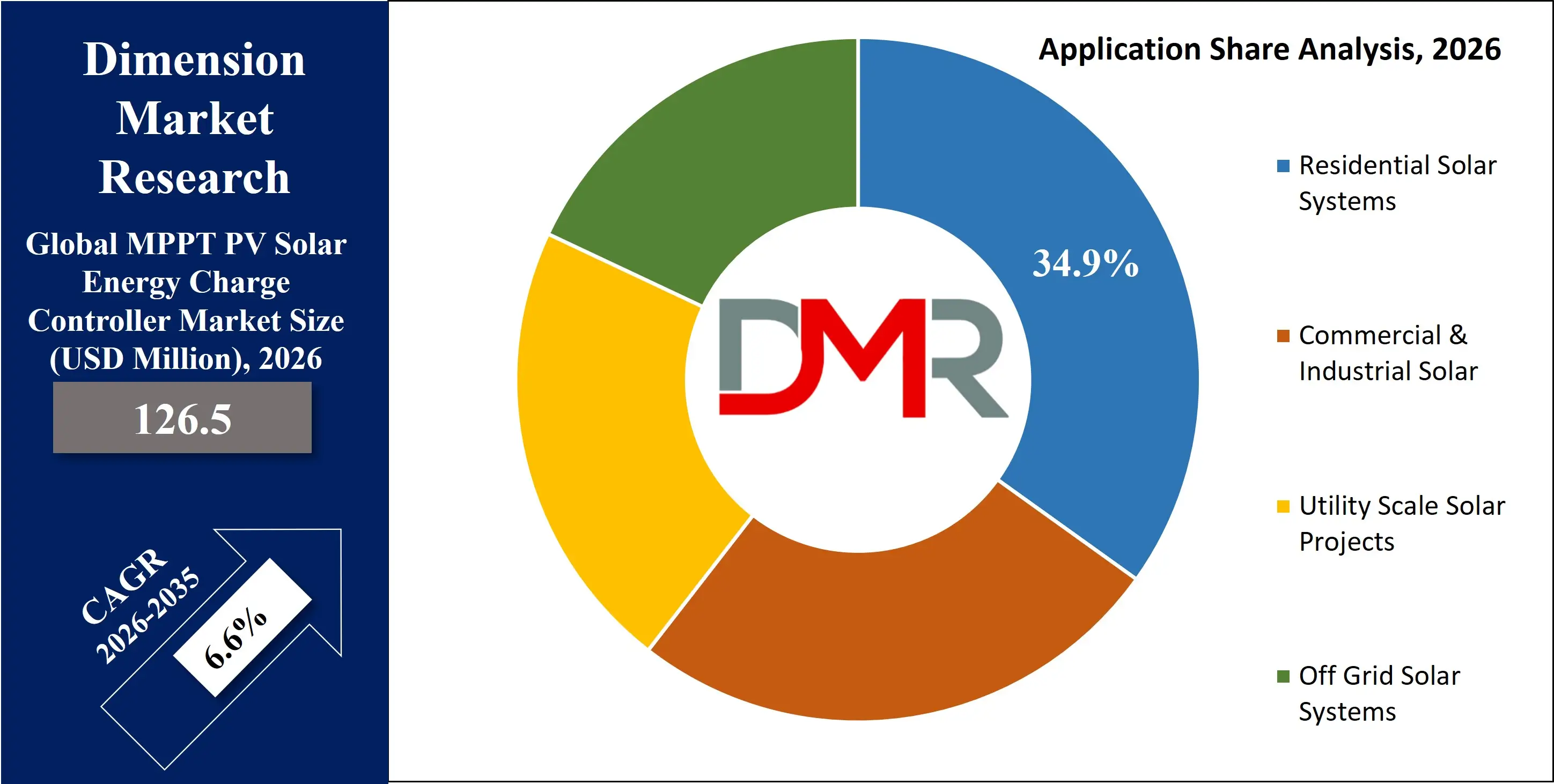
Residential solar systems represent the leading application segment, expected to hold 34.9% of the market share in 2026. The surge in rooftop solar adoption, favorable net metering policies, and increasing home battery installations drive demand for efficient MPPT controllers. Rising electricity tariffs and growing consumer interest in energy independence further support expansion. Homeowners are increasingly investing in solar-plus-storage systems for backup power during grid outages and to reduce utility bills. Compact controller designs, quiet operation, and smart home integration features make MPPT systems attractive for residential use. Additionally, digital monitoring capabilities allow homeowners to track system performance, increasing product value and long-term adoption.
ℹ
To learn more about this report –
Download Your Free Sample Report Here
The Commercial & Industrial (C&I) solar segment is the fastest-growing application area due to rising corporate sustainability commitments and energy cost optimization strategies. Industrial facilities, warehouses, shopping centers, and office complexes deploy higher-capacity and modular MPPT systems to manage peak loads and enhance operational efficiency. Businesses are increasingly adopting solar-plus-storage solutions to reduce reliance on grid electricity and mitigate tariff volatility. Government incentives, tax benefits, and renewable procurement mandates further amplify adoption. MPPT controllers in C&I applications often integrate with centralized energy management platforms, enabling performance analytics, load balancing, and improved return on investment for commercial energy users.
By End User Analysis
Residential users account for a leading 33.6% market share in 2026, driven by widespread distributed solar adoption and growing battery storage installations. Energy resilience concerns, especially in regions prone to extreme weather events and grid instability, encourage homeowners to invest in reliable charge control systems. Increasing affordability of rooftop solar kits and lithium-ion batteries further accelerates demand. Residential consumers prioritize ease of installation, compact size, safety features, and remote monitoring capabilities. Integration with smart home ecosystems and mobile applications enhances user engagement and performance transparency. As decentralized energy generation gains momentum globally, residential users will continue to represent a substantial portion of controller demand.
Utility developers represent the fastest-growing end-user group as grid-scale storage projects, hybrid solar plants, and large renewable installations expand worldwide. High-capacity and modular MPPT controllers are essential for optimizing DC output and improving system efficiency in large battery-integrated projects. Utilities are increasingly deploying advanced controllers to manage voltage stability, minimize energy losses, and enhance plant performance monitoring. Investments in renewable infrastructure modernization, decarbonization targets, and large-scale storage mandates contribute to this segment’s acceleration. Additionally, the integration of AI-driven diagnostics and centralized monitoring platforms further strengthens demand among utility-scale operators seeking high-efficiency and scalable solar energy management solutions.
The MPPT PV Solar Energy Charge Controller Market Report is segmented on the basis of the following
By Product Type
- Standalone MPPT Charge Controllers
- Smart/Advanced MPPT Charge Controllers
- Remote monitoring enabled
- Integrated battery management
- Modular / High-Power MPPT Controllers
- Multi-input MPPT
- Scalable industrial units
By Rated Current Capacity
- Low Capacity (≤ 40 A)
- Medium Capacity (41–80 A)
- High Capacity (> 80 A)
By Battery Type Compatibility
- Lead-Acid Compatible
- Lithium-Ion Compatible
- Multi-Chemistry Compatible Controllers
By Application
- Residential Solar Systems
- Commercial & Industrial (C&I) Solar
- Commercial rooftops
- Industrial facilities
- Utility-Scale Solar Projects
- Off-Grid Solar Systems
- Rural electrification
- Telecom towers
- Remote infrastructure
By End-User
- Residential Users
- Commercial & Industrial Enterprises
- Utility Developers
- Telecom Operators
- Government & Public Infrastructure
Regional Analysis
Leading Region in the MPPT PV Solar Energy Charge Controller Market
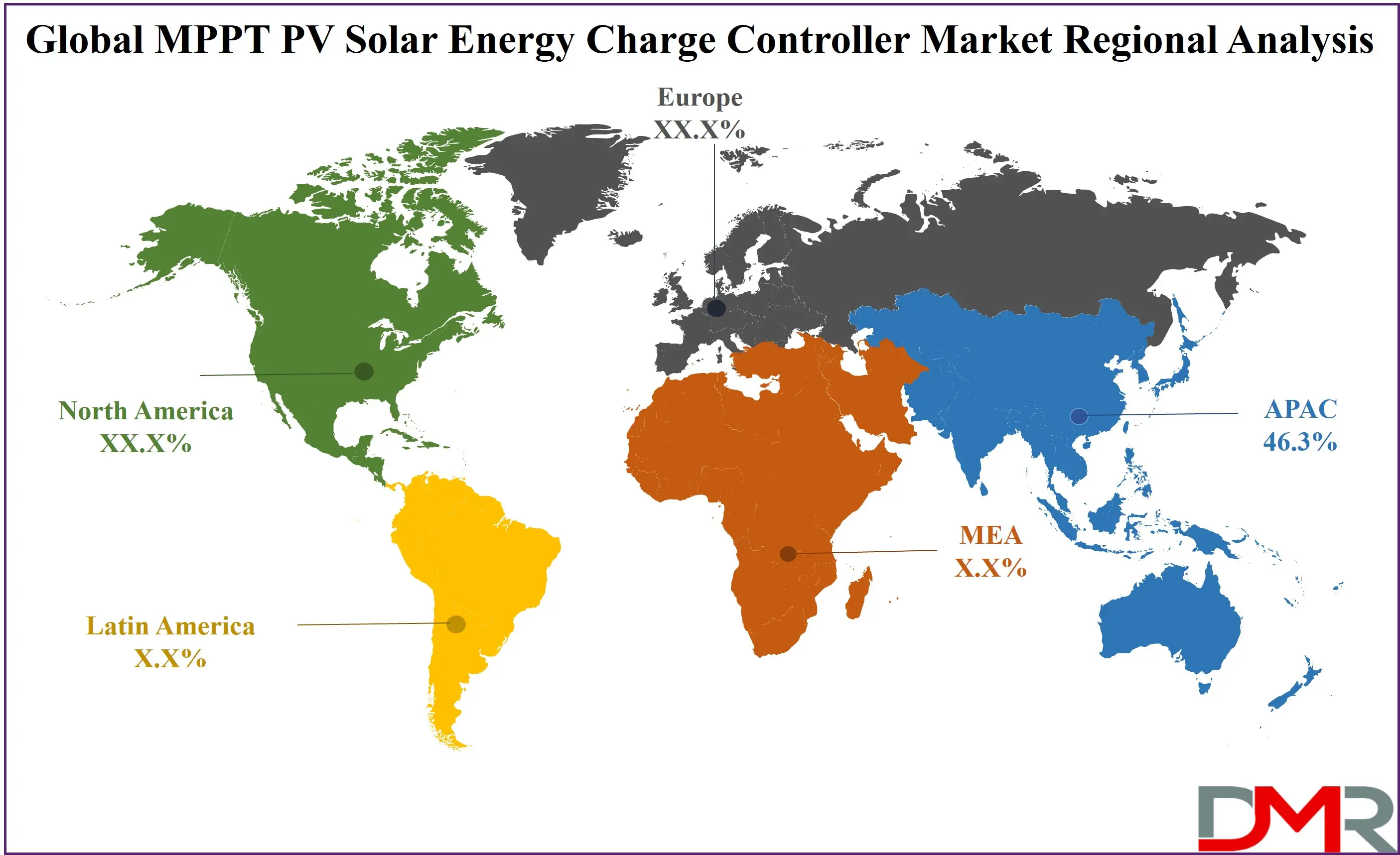
Asia-Pacific is projected to dominate the global MPPT PV solar energy charge controller market with an estimated 46.3% share in 2026. The region’s leadership is driven by massive solar capacity additions in China and India, strong rooftop solar expansion in Japan, and aggressive renewable targets across Southeast Asia and Australia. Rapid industrialization and expanding urban infrastructure increase electricity demand, encouraging decentralized solar adoption.
ℹ
To learn more about this report –
Download Your Free Sample Report Here
Government-backed rural electrification programs and off-grid solar deployments further stimulate controller demand. Additionally, the presence of well-established solar component manufacturing hubs lowers production costs and strengthens supply chain resilience. Increasing battery storage integration, favorable policy incentives, and ongoing grid modernization initiatives collectively reinforce Asia-Pacific’s dominant position in both residential and utility-scale installations.
Fastest Growing Region in the MPPT PV Solar Energy Charge Controller Market
North America is anticipated to witness the fastest growth in the MPPT PV solar energy charge controller market over the forecast period. Expansion is largely fueled by increasing residential solar-plus-storage installations supported by federal tax incentives and state-level renewable energy programs. Rising electricity costs and growing concerns about grid reliability are encouraging homeowners and businesses to invest in energy storage systems requiring advanced MPPT technology. Grid modernization projects, microgrid deployment across commercial campuses, and renewable integration in remote communities are further accelerating demand. The rapid growth of battery energy storage systems, particularly lithium-ion technologies, enhances the need for intelligent, programmable charge controllers. Strong R&D activity and digital energy management adoption continue to position North America as the most dynamic regional market.
By Region
North America
Europe
- Germany
- The U.K.
- France
- Italy
- Russia
- Spain
- Benelux
- Nordic
- Rest of Europe
Asia-Pacific
- China
- Japan
- South Korea
- India
- ANZ
- ASEAN
- Rest of Asia-Pacific
Latin America
- Brazil
- Mexico
- Argentina
- Colombia
- Rest of Latin America
Middle East & Africa
- Saudi Arabia
- UAE
- South Africa
- Israel
- Egypt
- Rest of MEA
Competitive Landscape
The MPPT PV solar energy charge controller market is characterized by technological differentiation, product innovation, and strategic alliances. Companies compete through efficiency improvements, integrated digital monitoring, and multi-chemistry compatibility. Entry barriers include advanced power electronics expertise, certification requirements, and supply chain capabilities. Market participants prioritize R&D investment to enhance algorithm performance and reduce thermal losses. Partnerships with inverter manufacturers and battery suppliers strengthen ecosystem positioning. Cost optimization, localization of manufacturing, and after-sales service networks remain key competitive strategies to sustain market share across residential, C&I, and utility segments.
Some of the prominent players in the global MPPT PV Solar Energy Charge Controller are
- Victron Energy
- Morningstar Corporation
- Schneider Electric
- EPEVER (Beijing Epsolar Technology)
- Renogy
- OutBack Power
- Phocos AG
- Steca Elektronik
- MidNite Solar
- Genasun
- Xantrex Technology
- Samlex America
- Studer Innotec
- Blue Sky Energy
- Remote Power International
- Magnum Energy
- SMA Solar Technology
- SolarEdge Technologies
- Delta Electronics
- Powertech Systems
- Luminous Power Technologies
- Other Key Players
Recent Developments
- In June 2025, EPEVER introduced the IT-NC G3 and ET-NC G3 MPPT charge controllers (50A–100A), designed for improved performance, flexibility, and lithium battery integration. Both series support RS485/CAN BMS communication, parallel connection up to six units, and dual PV input on select models. With multi-battery compatibility, low standby consumption, and remote monitoring options, they enhance reliability for residential, commercial, and off-grid solar systems.
- In February 2024, Beijing Epsolar Technology launched the XTRA-N G3 Series MPPT solar charge controller featuring lithium battery compatibility, adaptive charging technology, integrated Bluetooth, and enhanced MPPT algorithms for higher efficiency. The series supports improved system integration, enabling seamless communication with modern energy management systems, delivering smarter monitoring, optimized performance, and greater reliability for residential and small commercial solar applications.
Report Details
| Report Characteristics |
| Market Size (2026) |
USD 126.5 Mn |
| Forecast Value (2035) |
USD 225.8 Mn |
| CAGR (2026–2035) |
6.6% |
| The US Market Size (2026) |
USD 30.0 Mn |
| Historical Data |
2021 – 2025 |
| Forecast Data |
2027 – 2035 |
| Base Year |
2025 |
| Estimate Year |
2026 |
| Report Coverage |
Market Revenue Estimation, Market Dynamics, Competitive Landscape, Growth Factors, etc. |
| Segments Covered |
By Product Type (Standalone MPPT Charge Controllers, Smart/Advanced MPPT Charge Controllers, Modular / High-Power MPPT Controllers), By Rated Current Capacity (Low Capacity (≤ 40 A), Medium Capacity (41–80 A), High Capacity (> 80 A)), By Battery Type Compatibility (Lead-Acid Compatible, Lithium-Ion Compatible, Multi-Chemistry Compatible Controllers), By Application (Residential Solar Systems, Commercial & Industrial (C&I) Solar, Utility-Scale Solar Projects, Off-Grid Solar Systems), By End-User (Residential Users, Commercial & Industrial Enterprises, Utility Developers, Telecom Operators, Government & Public Infrastructure) |
| Regional Coverage |
North America – US, Canada; Europe – Germany, UK, France, Russia, Spain, Italy, Benelux, Nordic, Rest of Europe; Asia-Pacific – China, Japan, South Korea, India, ANZ, ASEAN, Rest of APAC; Latin America – Brazil, Mexico, Argentina, Colombia, Rest of Latin America; Middle East & Africa – Saudi Arabia, UAE, South Africa, Turkey, Egypt, Israel, Rest of MEA |
| Prominent Players |
Victron Energy, Morningstar Corporation, Schneider Electric, EPEVER (Beijing Epsolar Technology), Renogy, OutBack Power, Phocos AG, Steca Elektronik, MidNite Solar, Genasun, Xantrex Technology, Samlex America, Studer Innotec, Blue Sky Energy, Remote Power International, Magnum Energy, SMA Solar Technology, SolarEdge Technologies, Delta Electronics, Powertech Systems, Luminous Power Technologies, and Other Key Players |
| Purchase Options |
We have three licenses to opt for: Single User License (Limited to 1 user), Multi-User License (Up to 5 Users), and Corporate Use License (Unlimited User) along with free report customization equivalent to 0 analyst working days, 3 analysts working days, and 5 analysts working days respectively. |
Frequently Asked Questions
How big is the Global MPPT PV Solar Energy Charge Controller Market?
▾ The Global MPPT PV Solar Energy Charge Controller Market size is expected to reach USD 126.5 million by 2026 and is projected to reach USD 225.8 million by the end of 2035.
Which region accounted for the largest Global MPPT PV Solar Energy Charge Controller Market?
▾ Asia Pacific is expected to have the largest market share in the Global MPPT PV Solar Energy Charge Controller Market, with a share of about 46.3% in 2026.
How big is the MPPT PV Solar Energy Charge Controller Market in the US?
▾ The US MPPT PV Solar Energy Charge Controller market is expected to reach USD 30.0 million by 2026.
Who are the key players in the MPPT PV Solar Energy Charge Controller Market?
▾ Some of the major key players in the Global MPPT PV Solar Energy Charge Controller Market include EPEVER, Renogy, SMA Solar and others
What is the growth rate in the Global MPPT PV Solar Energy Charge Controller Market?
▾ The market is growing at a CAGR of 6.6 percent over the forecasted period.