What is the Multi Cloud Management Market Size?
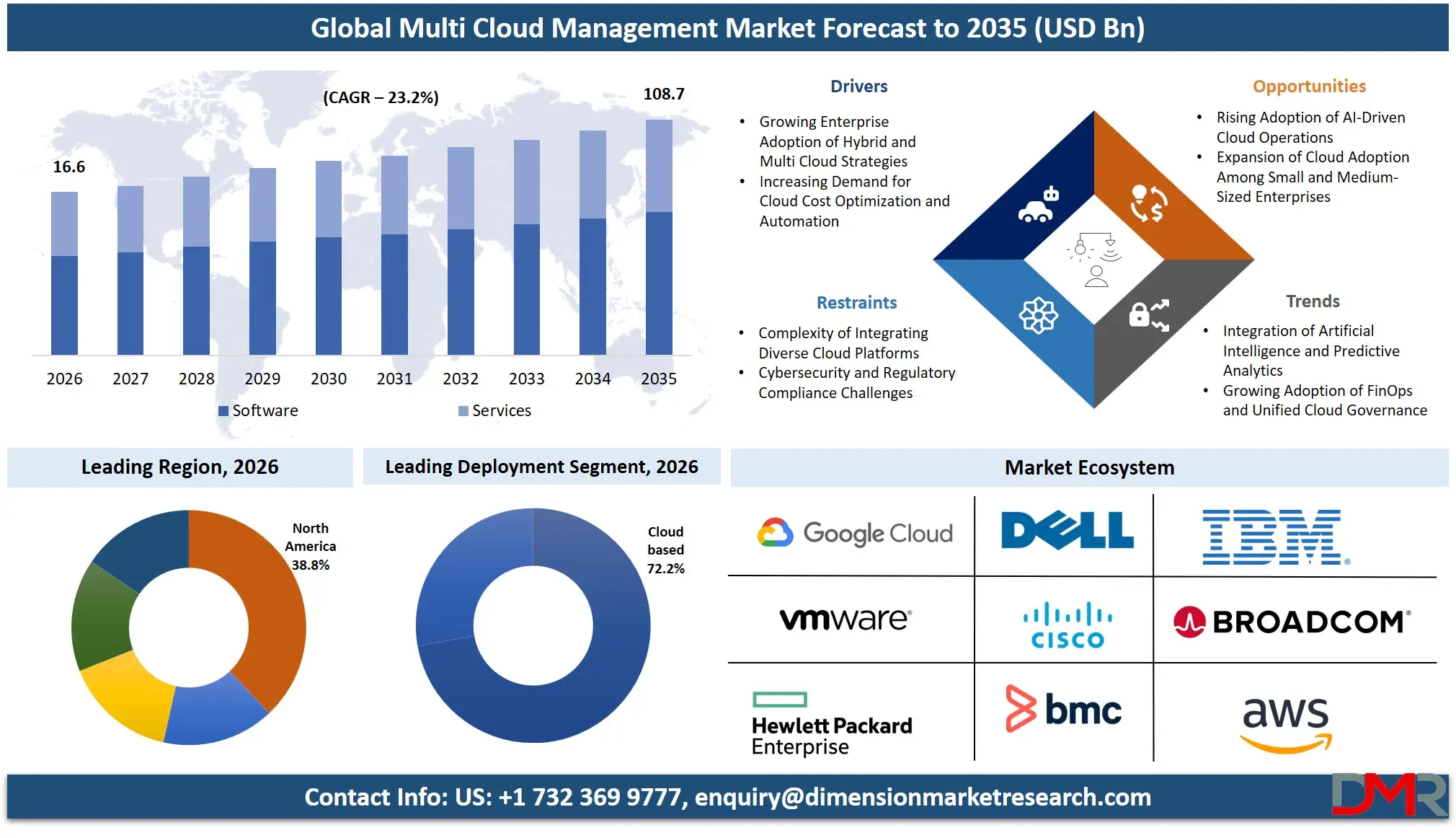
The Multi Cloud Management Market size is expected to be USD 16.6 billion in 2026 and increase at a compound annual growth rate of 23.2% to USD 108.7 billion by 2035 due to increasing demand for cloud cost optimization and automation.
ℹ
To learn more about this report –
Download Your Free Sample Report Here
Multi Cloud Management refers to the strategies, software platforms, and operational practices used to centrally manage, monitor, secure, and optimize workloads deployed across multiple cloud environments. It enables organizations to coordinate resources spanning public, private, and hybrid clouds while ensuring consistent governance, compliance, automation, and cost control. The growing adoption of digital transformation initiatives, cloud-native applications, artificial intelligence, and distributed IT infrastructure has significantly increased the need for unified cloud management solutions. Enterprises are increasingly prioritizing workload portability, vendor flexibility, enhanced cybersecurity, and FinOps practices, making multi cloud management an essential component of modern enterprise IT operations.
The US Multi Cloud Management Market
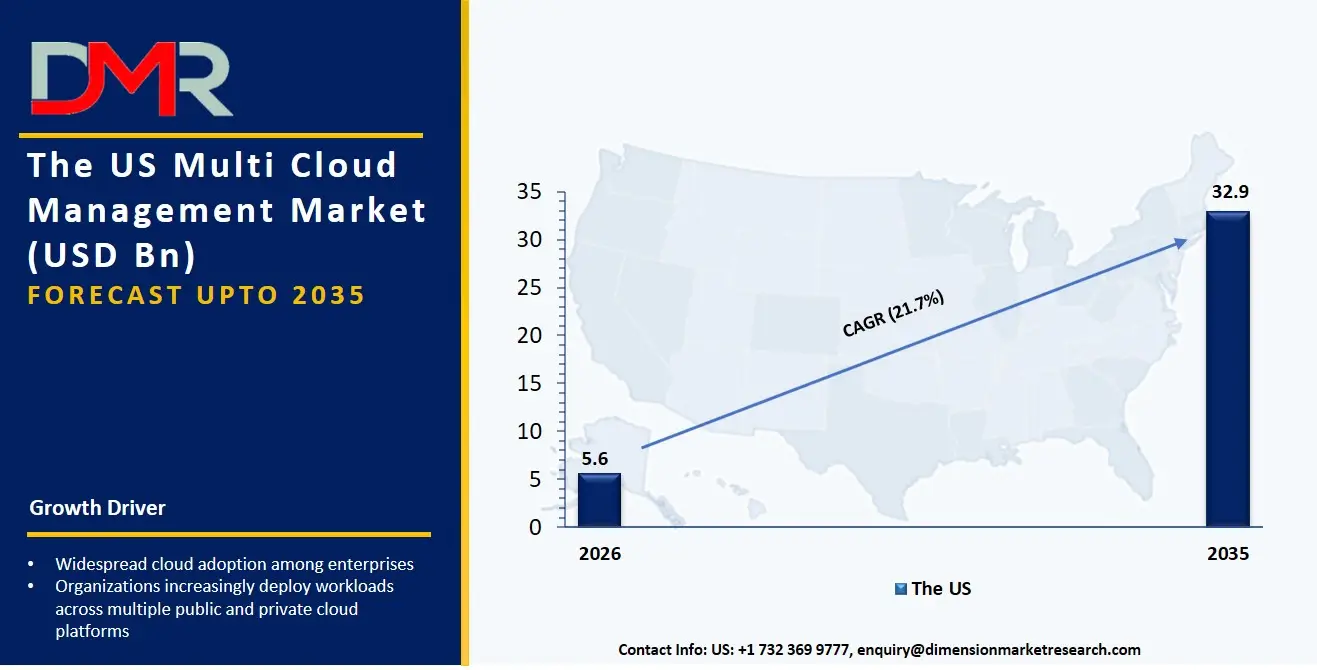
The US Multi Cloud Management Market size is estimated to be USD 5.6 billion in 2026 and is expected to increase at a CAGR of 21.7% over the forecast period.
ℹ
To learn more about this report –
Download Your Free Sample Report Here
The United States represents one of the most mature markets for multi cloud management due to widespread cloud adoption among enterprises, government agencies, financial institutions, and technology companies. Organizations increasingly deploy workloads across multiple public and private cloud platforms to improve resilience, business continuity, and operational flexibility. Strong investments in AI, cybersecurity, edge computing, and digital transformation continue to accelerate market expansion. The presence of leading cloud service providers, software vendors, and managed service providers further supports innovation. Regulatory frameworks emphasizing cybersecurity and data protection also encourage enterprises to adopt centralized cloud governance and management solutions.
Europe Multi Cloud Management Market
The Europe Multi Cloud Management Market size is estimated to be USD 3.8 billion in 2026 and is expected to increase at a CAGR of 21.5% over the forecast period.
Europe continues to experience robust adoption of multi cloud management solutions as organizations seek secure, compliant, and interoperable cloud environments. Data privacy regulations and sustainability initiatives encourage enterprises to adopt advanced governance and cloud optimization platforms. Organizations increasingly utilize multi cloud strategies to avoid vendor lock-in while ensuring business continuity and regulatory compliance. Manufacturing, financial services, healthcare, and public sector organizations are major adopters. The European Green Deal and increasing investments in digital infrastructure further encourage cloud modernization, automation, and energy-efficient IT operations across the region.
Japan Multi Cloud Management Market
The market size of Japan Multi Cloud Management will be USD 830 million in 2026 and at a CAGR of 21.9% in the forecast period.
Japan is witnessing steady growth in the multi cloud management market as enterprises modernize legacy IT systems and accelerate cloud migration initiatives. Increasing adoption of AI, industrial automation, smart manufacturing, and digital government services is driving demand for centralized cloud management platforms. Large enterprises are investing in hybrid and multi cloud environments to enhance operational resilience and disaster recovery capabilities. Government initiatives supporting digital transformation, combined with strong demand from manufacturing, financial services, and telecommunications sectors, continue to create favorable opportunities despite challenges related to workforce shortages and legacy infrastructure integration.
Key Takeaways
- Market Size & Forecast: The Multi Cloud Management Market size is projected to reach USD 16.6 billion in 2026 and is anticipated to have a value of USD 108.7 billion in 2035.
- Growth Rate & Outlook: The Multi Cloud Management Market size is set to grow at a compound annual growth rate of 23.2% during the forecast period of 2026 to 2035.
- Primary Growth Drivers: Some of the major growth drivers in the market are Increasing Demand for Cloud Cost Optimization and Automation and more.
- Key Market Trends: Some of the major trends in the market are Increasing Growing Adoption of FinOps and Unified Cloud Governance and more.
- By Component Type: Software segment is anticipated to get the majority share of the Multi Cloud Management Market in 2026.
- By Deployment Type: Cloud based is expected to get the largest revenue share in 2026 in the Multi Cloud Management Market.
- By Enterprises Type: Large enterprises is expected to get the largest revenue share in 2026 in the Multi Cloud Management Market.
- Regional Leadership: North America is set to lead the Multi Cloud Management Market with an estimated 38.8% share in 2026.
What is the Multi Cloud Management?
Multi Cloud Management is the process of administering, monitoring, securing, automating, and optimizing applications, infrastructure, and services deployed across two or more cloud computing environments through a unified management platform. It encompasses cloud provisioning, workload orchestration, performance monitoring, policy enforcement, cost optimization, security management, governance, and lifecycle automation while enabling organizations to maintain operational consistency, improve resource utilization, reduce vendor dependency, and ensure compliance across diverse cloud ecosystems.
Use Cases
- Centralized Multi-Cloud Infrastructure Management: Organizations use multi-cloud management platforms to monitor, manage, and optimize workloads across multiple cloud providers through a unified interface. This improves operational visibility, simplifies administration, ensures consistent governance, and reduces the complexity of managing diverse cloud environments.
- Disaster Recovery and Business Continuity: Enterprises deploy applications and data across multiple cloud environments to ensure high availability and resilience. Multi-cloud management solutions automate backup, failover, and recovery processes, minimizing downtime and maintaining business continuity during outages or unexpected disruptions.
- Cloud Cost Optimization and Resource Allocation: Businesses leverage multi-cloud management tools to monitor cloud spending, optimize resource utilization, and eliminate unnecessary expenses. Intelligent workload placement, automated scaling, and cost analytics help organizations maximize return on cloud investments while maintaining performance.
- Regulatory Compliance and Security Management: Organizations use multi-cloud management platforms to enforce consistent security policies, identity management, data protection, and compliance controls across multiple cloud providers. This helps meet industry regulations, reduce security risks, and maintain governance in complex cloud environments.
How AI Is Transforming the Multi Cloud Management Market
Artificial intelligence is transforming the multi cloud management market by automating routine administrative tasks, improving workload orchestration, optimizing cloud resource allocation, and enabling predictive infrastructure monitoring. AI-powered analytics continuously evaluate system performance, identify anomalies, forecast capacity requirements, and recommend corrective actions before operational disruptions occur.
AI also strengthens cybersecurity by detecting suspicious activities, automating threat response, and enhancing compliance monitoring across multiple cloud environments. Furthermore, intelligent automation improves customer experiences through faster service delivery, reduced operational costs, smarter cloud provisioning, and more efficient infrastructure management, enabling organizations to maximize the value of their multi cloud investments.
Market Dynamic
Driving Factors in the Multi Cloud Management Market
Increasing Demand for Cloud Cost Optimization and Automation
Rapid growth in cloud infrastructure spending has made cost optimization a strategic priority for enterprises. Multi cloud management platforms enable organizations to monitor resource utilization, automate provisioning, optimize workloads, and improve financial accountability through FinOps capabilities. Advanced automation reduces manual administrative tasks while enhancing infrastructure efficiency. As organizations continue expanding cloud deployments, demand for intelligent cloud management platforms capable of delivering operational savings and improved resource utilization continues to strengthen.
Restraints in the Multi Cloud Management Market
Cybersecurity and Regulatory Compliance Challenges
Although multi cloud environments improve operational flexibility, they also expand the attack surface and increase compliance complexity. Organizations must continuously monitor identities, access controls, workloads, and sensitive data across multiple cloud providers. Meeting evolving regulatory requirements while maintaining consistent security policies demands advanced management capabilities and skilled personnel, which may slow adoption among organizations with limited cybersecurity resources.
Opportunities in the Multi Cloud Management Market
Expansion of Cloud Adoption Among Small and Medium-Sized Enterprises
Small and medium-sized enterprises are increasingly adopting cloud technologies to improve scalability, operational agility, and digital competitiveness. As these organizations expand their use of multiple cloud services, demand for affordable and simplified cloud management platforms continues to increase. Vendors offering subscription-based, cloud-native, and automated management solutions can capitalize on this growing customer base while supporting digital transformation initiatives across emerging economies.
Trends in the Multi Cloud Management Market
Growing Adoption of FinOps and Unified Cloud Governance
Organizations are increasingly integrating FinOps practices with multi cloud management platforms to gain better visibility into cloud expenditures and resource utilization. Unified governance frameworks help enterprises standardize policies, automate compliance monitoring, and improve financial accountability across cloud environments. This trend supports more sustainable cloud operations while enabling organizations to maximize the value of their cloud investments.
Research Scope and Analysis
The research scope covers a comprehensive evaluation of the Multi Cloud Management Market across key segments, including component, deployment, organization size, function, and end user. The analysis examines market trends, adoption patterns, technological advancements, competitive dynamics, regional performance, growth drivers, challenges, and emerging opportunities to provide strategic insights into current developments and future market potential.
ℹ
To learn more about this report –
Download Your Free Sample Report Here
By Component Analysis
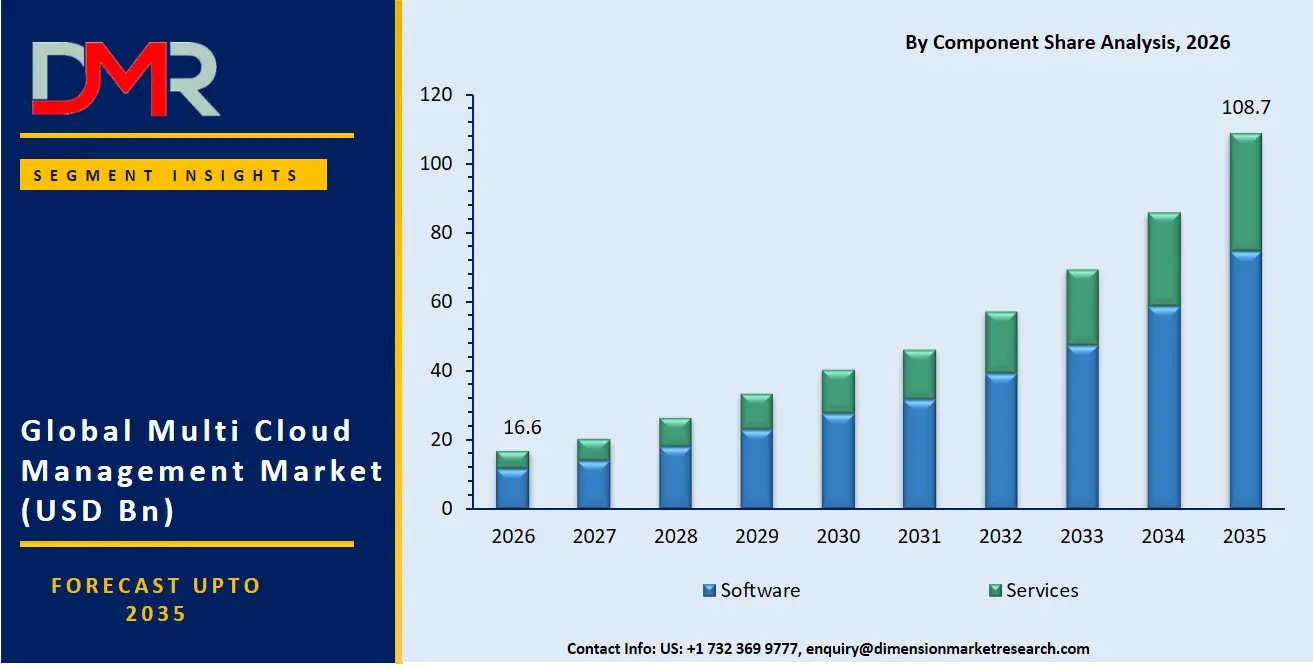
The Software segment is expected to dominate the Multi Cloud Management Market, accounting for an estimated 68.4% market share in 2026. Its leadership is attributed to increasing enterprise demand for centralized cloud governance, workload orchestration, cloud cost optimization, security monitoring, policy management, automation, and performance analytics across diverse cloud environments.
ℹ
To learn more about this report –
Download Your Free Sample Report Here
Organizations continue investing in software platforms that provide a unified dashboard for managing multiple public and private cloud infrastructures while simplifying compliance and operational efficiency. Meanwhile, the Services segment is projected to witness the fastest growth as enterprises increasingly require consulting, implementation, migration, integration, and managed services to support complex cloud transformation initiatives. Growing adoption among SMEs, expanding hybrid cloud deployments, and the shortage of skilled cloud professionals are expected to drive sustained demand for professional and managed services throughout the forecast period.
By Deployment Analysis
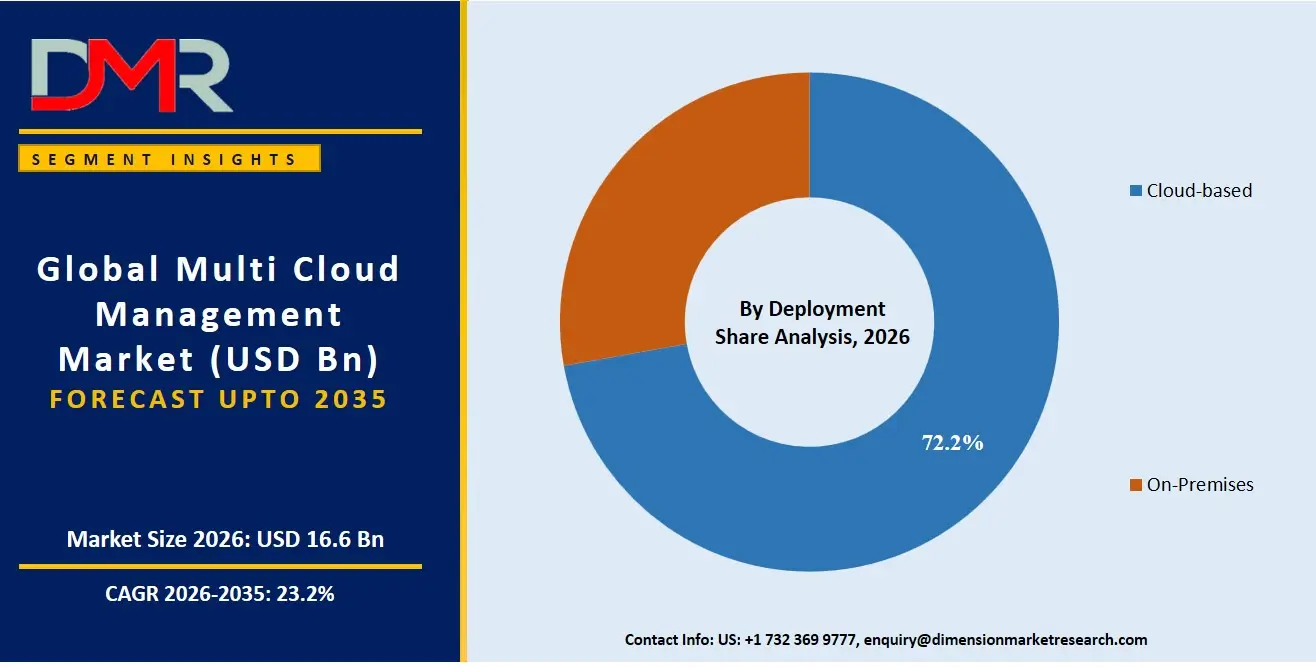
The Cloud-Based segment is projected to hold the largest share of the Multi Cloud Management Market, representing an estimated 72.2% market share in 2026. Enterprises increasingly prefer cloud-native deployment models because they offer scalability, lower infrastructure costs, continuous software updates, remote accessibility, and simplified deployment across geographically distributed operations. Cloud-based solutions also facilitate AI-enabled automation, real-time monitoring, and seamless integration with leading public cloud providers. The On-Premises segment is anticipated to register the fastest growth among organizations operating in highly regulated industries such as BFSI, healthcare, defense, and government, where strict data sovereignty, security, and compliance requirements necessitate greater control over IT infrastructure. Increasing hybrid cloud adoption is also encouraging organizations to modernize existing on-premises environments with advanced multi cloud management capabilities.
By Organization Size Analysis
The Large Enterprises segment is anticipated to account for an estimated 69.7% market share in 2026, maintaining its leadership due to extensive cloud adoption, complex IT ecosystems, and significant investments in digital transformation. Large organizations typically manage workloads across multiple public and private cloud providers, requiring advanced governance, automation, security, and FinOps capabilities. These enterprises also possess the financial and technical resources needed to implement comprehensive multi cloud management platforms. The Small & Medium-Sized Enterprises (SMEs) segment is expected to experience the fastest growth as cloud services become increasingly affordable and subscription-based deployment models reduce implementation barriers. SMEs are rapidly embracing multi cloud strategies to improve operational flexibility, enhance cybersecurity, and support business expansion without substantial capital expenditure.
By Function Analysis
The Cloud Monitoring & Performance Management segment is expected to lead the market with an estimated 24.4% market share in 2026. Organizations increasingly prioritize real-time infrastructure visibility, application performance monitoring, workload optimization, incident management, and predictive analytics to ensure business continuity across multiple cloud environments. Continuous monitoring enables enterprises to maintain service reliability while improving operational efficiency and user experience. The Cost & Billing Management (FinOps) segment is projected to register the fastest growth as enterprises focus on controlling escalating cloud expenditures through intelligent budgeting, automated cost allocation, resource optimization, and financial accountability. Growing awareness of cloud spending efficiency continues to accelerate investment in FinOps solutions integrated with multi cloud management platforms.
By End User Analysis
The IT & Telecommunications segment is forecast to dominate the Multi Cloud Management Market with an estimated 27.9% market share in 2026. Rapid cloud migration, large-scale data processing, software development, telecommunications network modernization, and continuous digital service delivery have made this sector the largest adopter of multi cloud management solutions. Organizations require centralized platforms to optimize infrastructure utilization, automate cloud operations, and ensure service reliability across multiple cloud providers. The Healthcare & Life Sciences segment is expected to witness the fastest growth due to increasing digital healthcare initiatives, electronic health records, AI-enabled diagnostics, telemedicine expansion, and stringent regulatory compliance requirements. Rising investments in secure cloud infrastructure are further supporting adoption within the healthcare ecosystem.
The Multi Cloud Management Market Report is segmented on the basis of the following:
By Component
- Software
- Services
- Professional Services
- Managed Services
By Deployment
By Organization Size
- Large Enterprises
- Small & Medium-Sized Enterprises (SMEs)
By Function
- Cloud Provisioning & Orchestration
- Cloud Monitoring & Performance Management
- Cost & Billing Management (FinOps)
- Security & Compliance Management
- Governance & Policy Management
- Backup & Disaster Recovery
- Automation & Infrastructure Management
By End User
- BFSI
- IT & Telecommunications
- Healthcare & Life Sciences
- Retail & E-commerce
- Manufacturing
- Government & Public Sector
- Media & Entertainment
- Energy & Utilities
- Others
Regional Analysis
Leading Region in the Multi Cloud Management Market
ℹ
To learn more about this report –
Download Your Free Sample Report Here
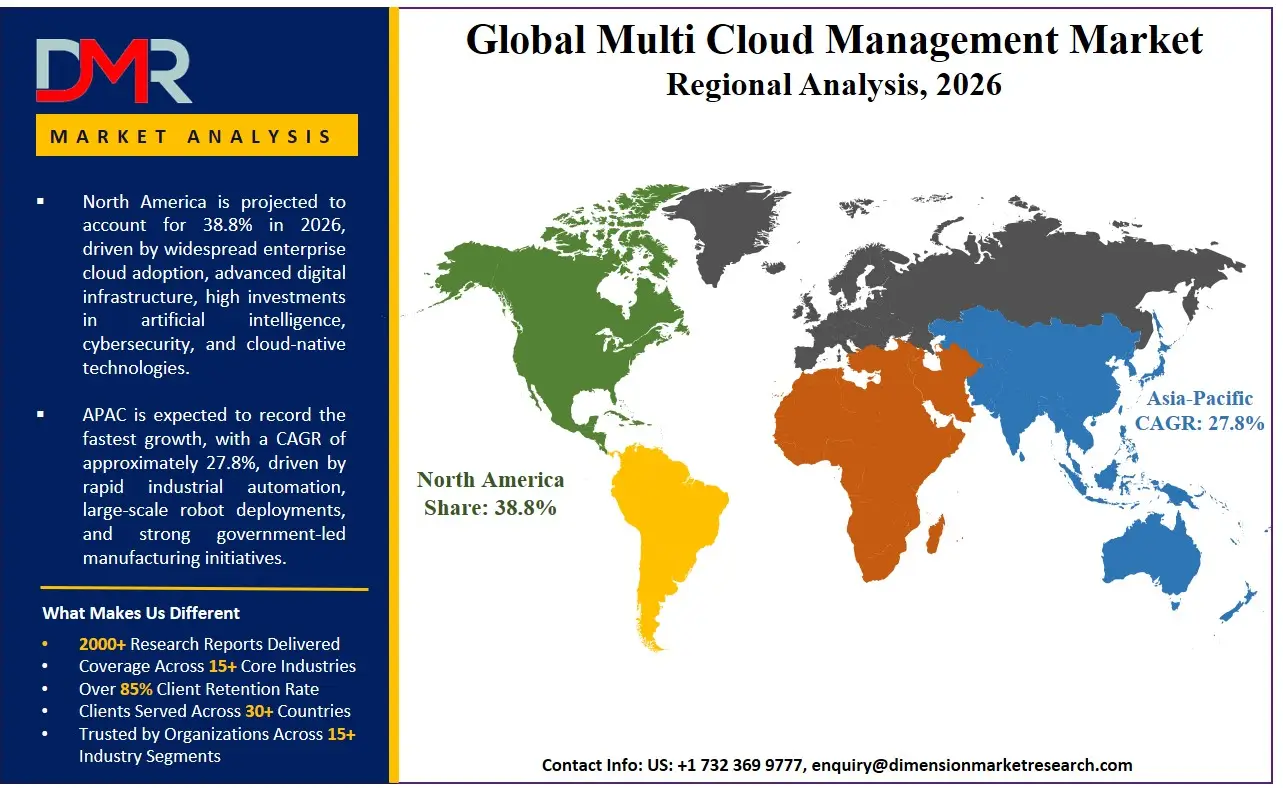
North America is projected to remain the leading regional market, accounting for an estimated 38.8% of the global Multi Cloud Management Market in 2026. The region benefits from widespread enterprise cloud adoption, advanced digital infrastructure, high investments in artificial intelligence, cybersecurity, and cloud-native technologies, along with the presence of major cloud service providers and technology innovators. Organizations across BFSI, healthcare, retail, manufacturing, government, and telecommunications continue expanding multi cloud deployments to improve operational resilience and regulatory compliance. Strong enterprise IT spending, mature cloud ecosystems, and continuous innovation in automation and cloud governance further reinforce North America's leadership position throughout the forecast period.
Fastest Growing Region in the Multi Cloud Management Market
Asia-Pacific is expected to be the fastest-growing regional market due to rapid digital transformation, expanding cloud infrastructure, increasing internet penetration, and rising enterprise adoption of hybrid and multi cloud strategies. Countries such as China, India, Japan, South Korea, Singapore, and Australia are investing heavily in cloud computing, AI, and smart industrial initiatives. Government programs supporting digital economies, increasing investments in data centers, and the rapid growth of SMEs are creating substantial opportunities for multi cloud management vendors. Growing demand for cloud security, automation, and cost optimization solutions is expected to sustain strong regional growth during the forecast period.
By Region
North America
Europe
- Germany
- The U.K.
- France
- Italy
- Russia
- Spain
- Benelux
- Nordic
- Rest of Europe
Asia-Pacific
- China
- Japan
- South Korea
- India
- ANZ
- ASEAN
- Rest of Asia-Pacific
Latin America
- Brazil
- Mexico
- Argentina
- Colombia
- Rest of Latin America
Middle East & Africa
- Saudi Arabia
- UAE
- South Africa
- Israel
- Egypt
- Rest of MEA
Competitive Landscape
The Multi Cloud Management Market is characterized by intense competition driven by continuous technological innovation, platform enhancements, and expanding cloud ecosystems. Market participants primarily compete through investments in artificial intelligence, automation, cloud security, workload optimization, FinOps capabilities, and unified governance solutions. Strategic collaborations with cloud service providers, acquisitions of specialized technology firms, and expansion of managed service portfolios remain common growth strategies. High technical expertise, strong integration capabilities, comprehensive customer support, and continuous research and development investments create significant entry barriers while encouraging ongoing product differentiation and long-term customer retention.
Some of the prominent players in the global Multi Cloud Management are:
- IBM
- VMware
- Microsoft
- Amazon Web Services (AWS)
- Google Cloud
- Cisco Systems
- Broadcom
- Hewlett Packard Enterprise (HPE)
- Dell Technologies
- Nutanix
- Flexera
- CloudBolt Software
- Morpheus Data
- Snow Software
- BMC Software
- ServiceNow
- Red Hat
- HashiCorp
- Canonical
- CloudHealth Technologies
- Other Key Players
Recent Developments
- In May 2025, Microsoft announced significant enhancements to Azure Arc, introducing expanded AI-powered management, improved policy governance, enhanced Kubernetes management, and stronger security capabilities for hybrid and multi cloud infrastructures. The latest upgrades enable organizations to centrally manage resources across Azure, on-premises environments, and third-party cloud platforms while improving operational consistency. The announcement further strengthened Microsoft's strategy of supporting unified cloud operations, compliance management, and intelligent automation for enterprise customers adopting multi cloud architectures.
- In April 2025, Google Cloud introduced new generative AI-powered cloud operations capabilities designed to simplify infrastructure management across hybrid and multi cloud environments. The enhancements include intelligent troubleshooting, predictive performance monitoring, automated resource optimization, and AI-assisted operational recommendations integrated into Google Cloud's management portfolio. These innovations enable enterprises to improve workload efficiency, accelerate incident resolution, reduce cloud operational costs, and enhance governance across increasingly complex cloud infrastructures while supporting enterprise-scale digital transformation initiatives.
- In March 2025, IBM expanded its Hybrid Cloud Mesh capabilities by introducing enhanced AI-assisted application connectivity, automated networking policies, and improved workload visibility across hybrid and multi cloud environments. The update enables enterprises to simplify application deployment, improve network observability, and strengthen security across distributed cloud infrastructures. The enhanced platform also supports greater automation for cloud operations, helping organizations reduce operational complexity while improving application performance, governance, and resilience in increasingly distributed enterprise IT environments.
Report Details
| Report Characteristics |
| Market Size (2026) |
USD 16.6 Bn |
| Forecast Value (2035) |
USD 108.7 Bn |
| CAGR (2026–2035) |
23.2% |
| Historical Period |
2021 – 2025 |
| Forecast Period |
2027 – 2035 |
| Base Year |
2025 |
| Estimate Year |
2026 |
| Segments Covered |
By Component, By Deployment, By Organization Size, By Function, By End User |
| Regional Coverage |
North America – The US and Canada; Europe – Germany, The UK, France, Russia, Spain, Italy, Benelux, Nordic, & Rest of Europe; Asia-Pacific – China, Japan, South Korea, India, ANZ, ASEAN, Rest of APAC; Latin America – Brazil, Mexico, Argentina, Colombia, Rest of Latin America; Middle East & Africa – Saudi Arabia, UAE, South Africa, Turkey, Egypt, Israel, & Rest of MEA |
Frequently Asked Questions
How big is the Multi Cloud Management Market?
▾ The Multi Cloud Management Market size is expected to reach USD 16.6 billion by 2026 and is projected to reach USD 108.7 billion by the end of 2035.
What is the CAGR of the Multi Cloud Management Market from 2026 to 2035?
▾ The market is growing at a CAGR of 23.2 percent over the forecasted period.
What factors are driving the growth of the Multi Cloud Management Market?
▾ Increasing Demand for Cloud Cost Optimization and Automation, and more are the factors driving the growth of the Multi Cloud Management Market.
What are the major trends in the Multi Cloud Management Market?
▾ Growing Adoption of FinOps and Unified Cloud Governance, and more are some of the major trends in the market.
Who are the key players in the Multi Cloud Management Market?
▾ Some of the key players in the Multi Cloud Management Market include Vmware, IBM, Cisco, and more
How is the Multi Cloud Management Market segmented?
▾ The Multi Cloud Management Market is segmented by component, deployment, organization size, function, end user
Which region held the largest share of the Multi Cloud Management Market in 2026?
▾ North America is set to lead the Multi Cloud Management Market with an estimated 38.8% share in 2026.
Which region is expected to grow the fastest in the Multi Cloud Management Market?
▾ Asia Pacific is the fastest-growing region in the Multi Cloud Management Market during the forecast period.