ℹ
To learn more about this report –
Download Your Free Sample Report Here
Further, the smarter multi-function display is anticipated to become more popular than its regular version. As it's used in military, commercial aviation, automobiles, and ships, it works well with main flight screens in new & advanced aircraft, which shows the digital progress in aviation. Moreover, the market is growing because of better technology and more efficient systems, which is making way for a bright future for the market as well.
Advances in display technology such as high-resolution screens, touch functionality and intuitive user interfaces have significantly enhanced the usability and effectiveness of multi-function displays (MFDs) in mission-critical applications. Nearly 90% of new commercial aircraft feature MFDs, with 70% featuring
4K TV-like touchscreen displays for optimal resolution. Military use of helmet-mounted displays (HMDs) has also dramatically increased, with 60% of fighter jets employing this technology.
Automotive applications of MFDs have seen steady adoption. 40% of electric vehicles now incorporate MFDs to show essential information such as battery health and navigation. This is driving growth not only in smart cockpit technology but also in related areas such as
Automotive Collision Repair, where real-time diagnostics and display integration are becoming increasingly critical. Meanwhile, digital transformation across aerospace, defense and automotive is fueling MFD demand due to their ability to improve operational efficiencies through integrated functionality.
Key Takeaways
- Market Growth: Driven by increasing adoption in aviation, automotive, marine, and military applications.
- Key Applications: Used in aircraft cockpits, automotive dashboards, naval ships, and industrial control systems.
- Technological Advancements: Integration of touchscreen interfaces, augmented reality (AR), and AI-driven data visualization.
- Regional Dominance: North America leads due to high defense spending, followed by Europe and Asia-Pacific.
- Major Players: Honeywell, Garmin, BAE Systems, Rockwell Collins, and Raymarine are key market leaders.
- Challenges: High initial costs, cybersecurity risks, and complex integration with legacy systems.
- Future Outlook: Growth driven by demand for advanced avionics, autonomous vehicles, and smart display solutions.
Use Cases
- Aviation & Avionics: Used in commercial and military aircraft cockpits for real-time navigation, flight data monitoring, and situational awareness.
- Automotive & Transportation: Integrated into vehicle dashboards for displaying GPS navigation, infotainment, driver assistance alerts, and system diagnostics.
- Defense & Military: Deployed in tanks, submarines, and fighter jets to provide mission-critical data, targeting assistance, and battlefield visualization.
- Marine Navigation: Utilized in ships and submarines for route mapping, weather monitoring, radar integration, and sonar data visualization.
- Industrial & Healthcare Applications: Used in control rooms and medical devices for monitoring processes, equipment diagnostics, and real-time data analysis.
Market Dynamic
The Global Multi-Function Display Market is showing growth due to its wide application in military and commercial aircraft, automotive, ships, and aviation. Further, the increasing demand for aircraft and the adoption of multi-function displays for border security and ground control stations further drive the market's growth.
Moreover, the advancement of
OLED Display technology is also fueling adoption, as it delivers brighter visuals, lower power consumption, and improved durability, making it highly suitable for aviation, automotive, and military environments.
Driving Factors
The multi-function display (MFD) market is driven by increasing demand for advanced cockpit systems in aviation, automotive, and defense sectors. MFDs provide real-time information that enhances situational awareness and operational efficiency for pilots and drivers, increasing situational awareness and operational efficiencies for them.
With increasing air traffic volumes modernized aircraft fleets are adopting MFDs to facilitate seamless navigation and safety; similarly in automotive sectors luxury electric vehicle integration of MFDs improve user experience by consolidating infotainment, navigation, diagnostics etc; additionally technological advances like high resolution displays or augmented reality integration further promotes adoption across industries.
Trending Factors
One key trend in the multi-function display market is the increasing adoption of touchscreen and augmented reality (AR) interfaces. Touchscreen-enabled MFDs have become increasingly popular for their intuitive operation in aviation and automotive applications. AR technology enhances situational awareness by overlaying critical data over real-world views to aid navigation and obstacle detection.
This trend can be found particularly evident in next-generation aircraft, defense systems and autonomous vehicles. Manufacturers are focused on producing lightweight displays with improved energy efficiency for extreme conditions; OLED and AMOLED technologies also support this shift toward user-friendly interfaces.
Restraining Factors
The multi-function display market faces challenges due to high costs associated with advanced display technologies and their integration into complex systems. MFDs with advanced features, like HD touchscreens and AR capabilities, require significant upfront capital investments that restrict their accessibility for small and medium-sized enterprises.
Integration obstacles arise in industries such as aviation and defense, where compatibility with existing systems is of utmost importance. Furthermore, reliability in extreme environments such as altitude or temperature variations increases cost and technical complexity while discouraging potential adopters from investing in MFDs in cost-sensitive markets; ultimately limiting widespread deployment.
Opportunities
Emerging markets present multi-function display manufacturers with tremendous growth prospects due to increased industrialization and technological adoption. Demand for modernized vehicles, aircraft and defense equipment across Asia-Pacific, Latin America and the Middle East drives MFD adoption. Governments in these regions are investing heavily in infrastructure, transportation and military upgrades that facilitate MFD deployment.
Furthermore, electric and autonomous vehicle sales continue to expand market potential; partnerships between global manufacturers and local players can facilitate faster market penetration of high-tech solutions and make high-tech MFD solutions more accessible and affordable in fast-growing economies.
Research Scope and Analysis
By Platform
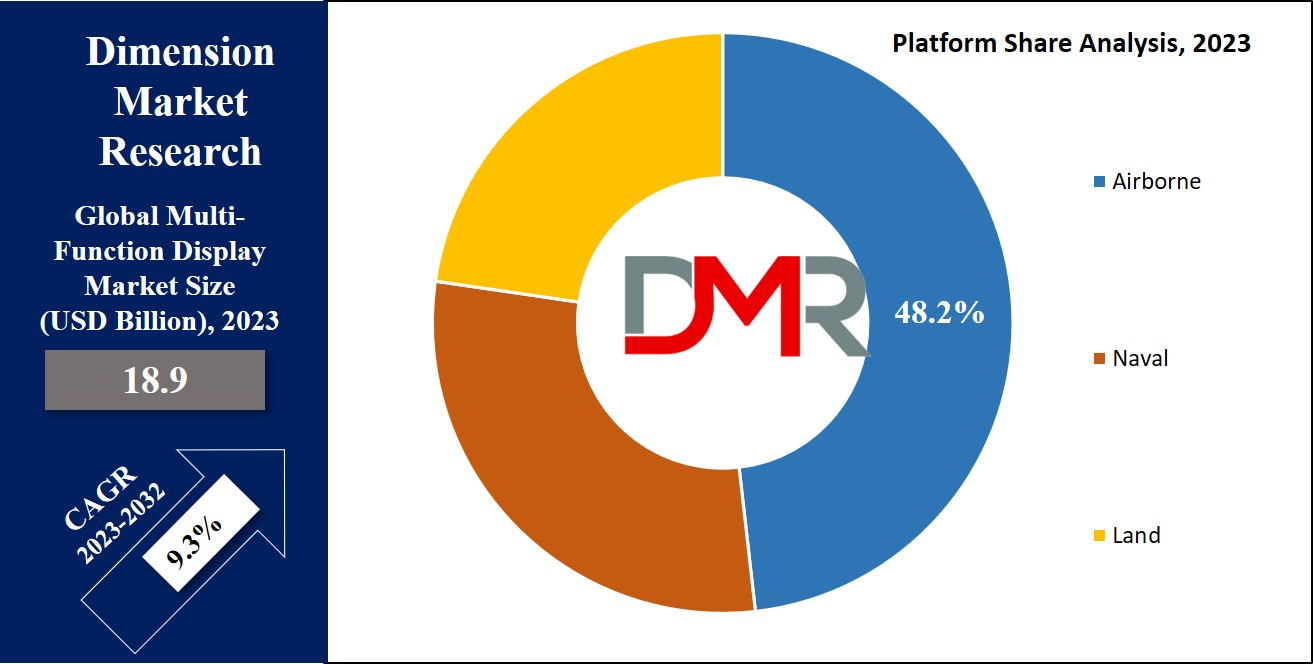
The airborne platform emerges as the dominant platform segment in 2023 and is anticipated to experience substantial growth over the forecast period. Multi-function displays (MFDs) are integral components of the digital era in modern helicopters & airplanes. The market's expansion can be seen due to the increasing adoption of MFD technology in both military & commercial aircraft.
This advancement allows pilots to streamline critical information onto a unified screen, surrounding moving maps, navigation routes, weather radar, airport particulars, and safety systems. Additionally, MFDs offer advantages like efficient cockpit space utilization and multi-page data presentation, boosting the market's growth.
ℹ
To learn more about this report –
Download Your Free Sample Report Here
By System
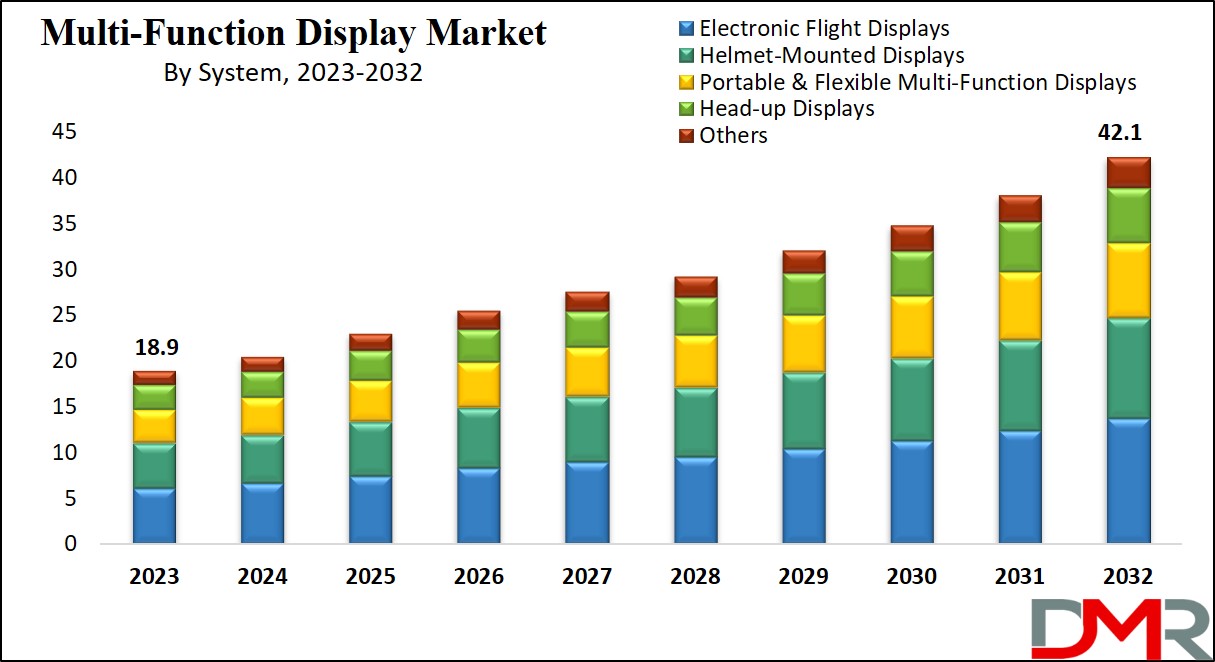
In 2023, the electronic flight display (EFD) segment dominates the overall global market and is further anticipated to stay the same over the forecasted period. This trend is expected to continue due to the advantages EFDs offer. As cockpit instrument displays, EFDs provide flight data electronically, replacing older methods.
They include important components such as altimeters & heading indicators, helping pilots understand obstacles, weather, and altitude. Additionally, EFDs provide essential details about aircraft systems such as fuel 7 electrical systems, which further drives the growth in this segment.
By Technology
The Light Emitting Diode (LED) segment, which dominates in 2023, demonstrated significant revenue growth in recent years and is anticipated to hold its position during the forecasted period. This growth is projected to continue, with the LED segment positioned for major expansion. Operating as a flat panel display, LEDs utilize an array of diodes to visibly project images and videos on screens. The importance of this technology enhances its major role in driving the dynamic evolution of display landscapes.
Moreover, the advancement of technologies like AMLCD (Active Matrix Liquid Crystal Display) has the potential to significantly fuel the multi-function display market. These advancements provide enhanced capabilities and functionalities. AMLCDs deliver high-end displays with improved clarity & responsiveness. As these technologies develop and integrate into multi-function displays, they are positioned to play a major role in driving market growth.
The Global Multi-Function Display Market Report is segmented on the basis of the following:
By Platform
By System
- Electronic Flight Displays
- Helmet-Mounted Displays
- Portable and Flexible Multi-function Displays
- Head-up Displays
- Others
By Technology
- Active-Matrix Liquid-Crystal Display (AMLCD)
- Thin-Film Transistor (TFT)
- Liquid-Crystal Display (LCD)
- Light-Emitting Diode (LED)
- Synthetic Vision
- Organic Light-Emitting Diode (OLED)
How Does Artificial Intelligence Contribute To Improve Multi-Function Display Market ?
- Enhanced Data Processing & Visualization: AI enables real-time data analysis and predictive insights, improving situational awareness in aviation, defense, and automotive applications.
- Intelligent User Interface (UI) & Personalization: AI-powered MFDs adapt to user preferences, optimize display layouts, and provide intuitive touchscreen or voice-controlled interactions.
- Augmented Reality (AR) Integration: AI-driven AR overlays enhance pilot and driver vision, displaying critical navigation, terrain mapping, and obstacle detection data.
- Predictive Maintenance & System Monitoring: AI algorithms analyze system performance, detect anomalies, and predict potential failures, reducing downtime and maintenance costs.
- Autonomous & Smart Decision Support: AI assists in mission-critical operations by providing automated alerts, decision-making recommendations, and real-time risk assessment.
Regional Analysis
North America, led by the US and Canada, leads the market in
2023, contributing about 34.1% of total revenue. This dominant position is expected to stay, as the influence of the US and Canada is a major factor in driving the market's growth within the region. This growth is further attributed to the widespread adoption of multi-function displays across military, business, & commercial aircraft.
The North American market's growth is further boosted by the adoption of diverse safety management systems & devices in aircraft. Government initiatives as well as investments in the military & commercial aviation sectors contribute significantly to the growth of the market.
Further, strict government regulations aimed at pilot and passenger safety, along with the growing use of multifunction displays in automotive vehicles, fuel the market's expansion. Furthermore, the vibrant global air transportation sector plays a major role in boosting the North American market.
By Region
North America
Europe
- Germany
- The U.K.
- France
- Italy
- Russia
- Spain
- Benelux
- Nordic
- Rest of Europe
Asia-Pacific
- China
- Japan
- South Korea
- India
- ANZ
- ASEAN
- Rest of Asia-Pacific
Latin America
- Brazil
- Mexico
- Argentina
- Colombia
- Rest of Latin America
Middle East & Africa
- Saudi Arabia
- UAE
- South Africa
- Israel
- Egypt
- Rest of MEA
Competitive Landscape
In this market, research and development (R&D) along with innovation remain major growth strategies. Some of the major industry players, including Honeywell Aerospace, Rockwell Collins, Thales SA, Avidyne Corporation, and BAE Systems, uses this approach.