What is the Museum Software Market Size in 2026?
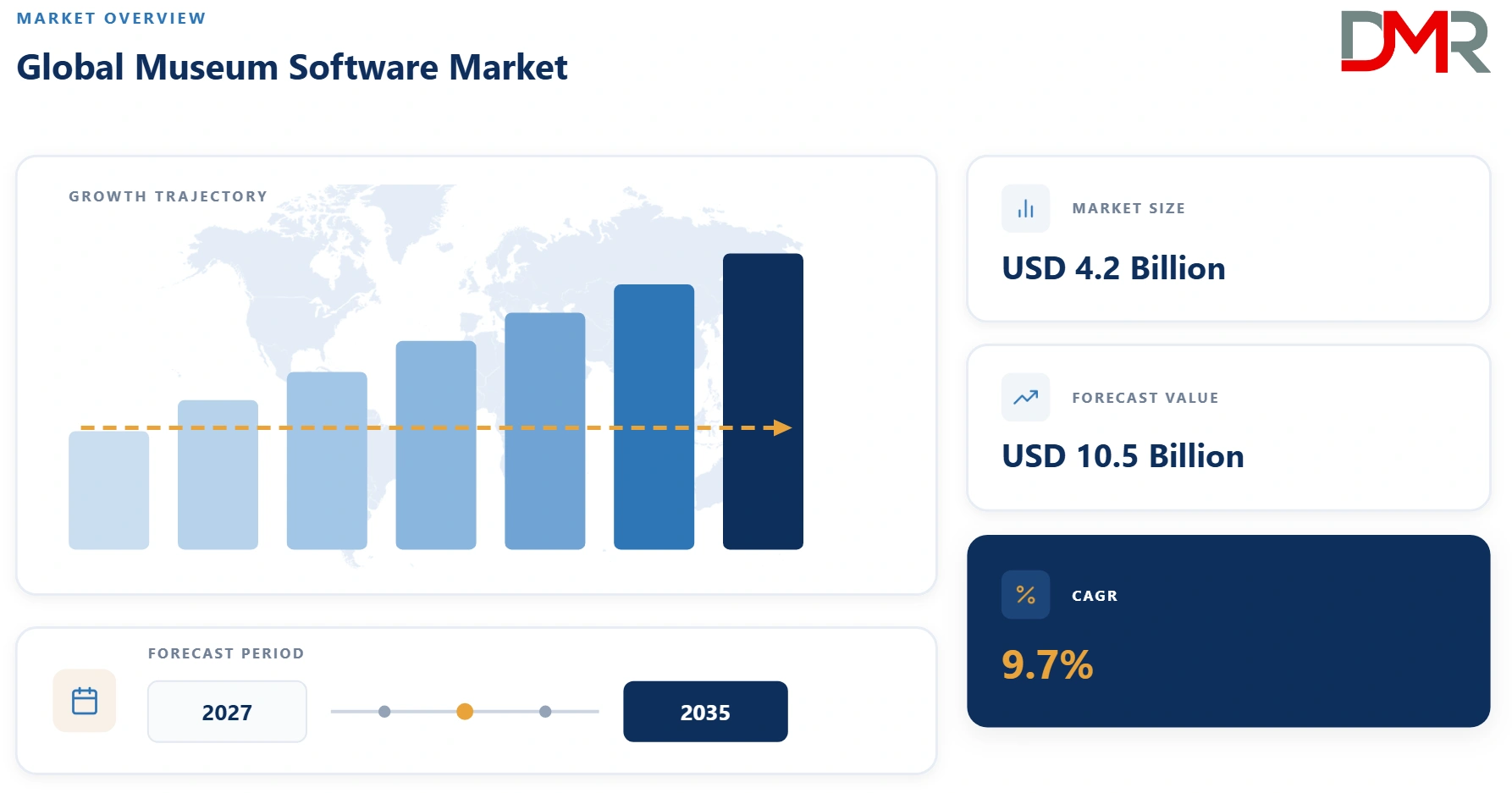
The global museum software market is valued at USD 4.2 billion in 2026 and is projected to reach USD 10.5 billion by 2035, growing at a CAGR of 9.7% from 2027 to 2035. Growth is driven by accelerating cultural heritage digitization, rising demand for cloud-based accessibility, and government funding for institutional modernization.
ℹ
To learn more about this report –
Download Your Free Sample Report Here
Museum software refers to digital solutions purpose-built for cultural institutions to catalog, track, preserve, and showcase collections while managing visitor engagement, ticketing, and day-to-day operations. Primary users are museums and galleries, with use cases spanning digital documentation, inventory tracking, and exhibition planning, streamlining workflows and enhancing visitor experiences through interactive platforms.
The report covers software products and services across the full museum operations chain, from core collection management to public-facing ticketing experiences, spanning institutions of all ownership types and sizes. The analytical framework includes component structure, deployment methods, functional applications, institution types, and end-user dimensions, broken down by major global regions to present competitive landscape and strategic dynamics.
Museum Software Market Snapshot
Museum Software Market Snapshot, 2026-2035
| Metric |
Value |
| Market Size (2026) |
USD 4.2 Billion |
| Forecast Value (2035) |
USD 10.5 Billion |
| CAGR (2027-2035) |
9.7% |
| Largest Region (2026) |
North America, 39% share |
| Fastest-Growing Region (2027-2035) |
Asia Pacific, 11.5% CAGR |
| Leading Component (2026) |
Software, 68% share |
| Leading Museum Type (2026) |
Art Museums, 32% share |
| Key Players |
Axiell Group, Lucidea, Gallery Systems, PastPerfect Software, zetcom AG, Blackbaud, Veevart, CollectionSpace |
Key Takeaways
- Market growth: USD 4.2 billion in 2026, USD 10.5 billion by 2035, CAGR of 9.7%.
- Component leader: Software holds a 68% share in 2026, led by automation and data management needs.
- Fastest component: Services set to grow at 11.2% CAGR through 2035, ahead of the overall market.
- Deployment leader: On-premises accounts for 45% of 2026 demand, as large institutions prioritize data security.
- Fastest deployment mode: Cloud-based projected to grow at 12.5% CAGR, supported by remote access and lower maintenance costs.
- Regional picture: North America leads with 39% share in 2026, while Asia Pacific is fastest-growing at 11.5% CAGR.
What are the Key Use Cases of Museum Software?
- Collection cataloging and inventory tracking: Centralized digital records reduce loss risk and streamline audits across large holdings.
- Ticketing and membership management: Integrated platforms boost repeat visitation and simplify revenue reconciliation for institutions.
- Visitor management and experience personalization: Real-time flow analytics and digital guides improve engagement and crowd control.
- Digital asset and exhibition management: Rights-managed media libraries support virtual exhibitions and licensing revenue streams.
How are Foundation Models and Generative AI Transforming the Museum Software Market?
Generative AI is reshaping museum software through automated metadata generation, AI-driven image tagging, and conversational visitor guides. Foundation models enable institutions to produce multilingual exhibition descriptions and searchable collection archives at a fraction of manual cost, while predictive analytics improve ticketing demand forecasting and staffing optimization. Adoption is accelerating fastest among mid-sized museums seeking to close digital gaps without expanding headcount.
Operationally, AI copilots embedded in collection management platforms reduce cataloging time and support provenance research, while generative tools power virtual docents and personalized visitor journeys. Market impact is visible in rising software subscription tiers with embedded AI modules, growing demand for data governance services, and vendor differentiation through proprietary cultural heritage models. Over 2027–2035, AI functionality is expected to become a standard feature rather than a premium add-on, compressing pricing and shifting competition toward integration depth and data quality.
Museum Software Market Dynamics at a Glance
Drivers, Restraints, Opportunities and Trends in the Museum Software Market
| Type |
Factor |
Impact |
| Driver |
Accelerating cultural heritage digitization programs |
High |
| Driver |
Government and philanthropic funding for institutional modernization |
High |
| Restraint |
Budget constraints at small and mid-sized museums |
Medium |
| Restraint |
Data privacy and provenance compliance complexity |
High |
| Opportunity |
AI-enabled collection cataloging and virtual experiences |
Medium |
| Opportunity |
Cloud migration in emerging cultural markets |
High |
| Trend |
Subscription and SaaS pricing models replacing perpetual licenses |
Medium |
| Trend |
Integrated visitor experiences platforms converging ticketing and engagement |
High |
What is Driving the Growth of the Museum Software Market?
Accelerating cultural heritage digitization programs
Museums worldwide are under pressure to digitize collections for preservation, research access, and public engagement. National digitization initiatives across Europe and Asia, alongside UNESCO-backed heritage programs, have increased institutional budgets for collection management software and digital asset platforms. The market impact is visible in rising software license and subscription revenues, growing demand for migration and metadata services, and vendor expansion into archival and rights-management modules that extend beyond traditional cataloging.
Government and philanthropic funding for institutional modernization
Public funding programs and private foundations increasingly tie grants to digital infrastructure upgrades. Museums receiving modernization grants often allocate significant portions to software procurement, including ticketing, visitor analytics, and collection platforms. This funding stream sustains demand through economic cycles and disproportionately benefits mid-sized institutions that previously deferred upgrades. The market impact includes faster procurement cycles, stronger demand for implementation services, and vendor strategies targeting grant-eligible institutions with bundled offerings.
What are the Key Restraints in the Museum Software Market?
Budget constraints at small and mid-sized museums
A large share of museums operates on thin margins with limited IT budgets, making software procurement a discretionary spend. Small institutions often rely on spreadsheets or legacy systems rather than investing in modern platforms. This restrains addressable market expansion, particularly in lower-income regions. The market impact is visible in pricing pressure, growth of low-cost and open-source alternatives, and vendor difficulty monetizing long-tail institutions, which collectively slow volume growth despite strong demand from larger organizations.
Data privacy and provenance compliance complexity
Museums handle sensitive provenance data, donor information, and visitor records subject to evolving privacy regulations and cultural property laws. Compliance requirements vary by jurisdiction and increase software complexity, raising implementation costs and slowing procurement. The market impact includes longer sales cycles for cross-border deployments, greater demand for compliance consulting services, and vendor investment in audit trails and data governance features, which raise development costs and can delay product releases.
What are the Key Opportunities in the Museum Software Market?
AI-enabled collection cataloging and virtual experiences
Generative AI and computer vision can automate metadata creation, image tagging, and multilingual description generation, dramatically reducing cataloging backlogs. Vendors embedding these capabilities can differentiate on efficiency gains and unlock budgets previously reserved for manual documentation. The market impact includes new AI-tier subscriptions, expansion into archival and research institutions, and opportunities to bundle virtual exhibition tools that generate licensing and ticketing revenue for museums seeking new income streams.
Cloud migration in emerging cultural markets
Museums across Asia Pacific, Latin America, and the Middle East are investing in digital infrastructure as cultural tourism grows. Cloud-based platforms lower entry costs and enable rapid deployment, making them attractive to institutions without legacy IT teams. The market impact includes accelerated cloud adoption, vendor expansion into underserved regions, and growth in implementation and training services, with local partnerships becoming a key route to market for international software providers.
What are the Latest Trends in the Museum Software Market?
Subscription and SaaS pricing models replacing perpetual licenses
Museums increasingly prefer predictable operating expenditure over large capital outlays, driving vendors toward subscription pricing. SaaS models lower entry barriers, improve cash flow for institutions, and create recurring revenue for vendors. The market impact includes higher vendor valuation multiples, faster upgrade cycles, and greater emphasis on customer success and retention, with hybrid pricing emerging for large institutions that require on-premises data residency alongside cloud services.
Integrated visitor experiences platforms converging ticketing and engagement
Museums are consolidating fragmented point solutions into unified platforms combining ticketing, membership, visitor analytics, and digital guides. This convergence reduces integration costs and provides a single view of visitor behavior. The market impact includes consolidation among vendors, stronger competitive advantage for platform providers, and rising expectations for open APIs, as institutions demand interoperability with CRM, fundraising, and e-commerce systems.
Research Scope and Analysis
The report segments the museum software market by component, deployment mode, application, museum type, and end user, with regional breakdowns across five geographies. Revenue scope covers software licenses, subscriptions, and associated services including implementation, training, and maintenance, providing a complete view of market value.
ℹ
To learn more about this report –
Download Your Free Sample Report Here
By Component Analysis
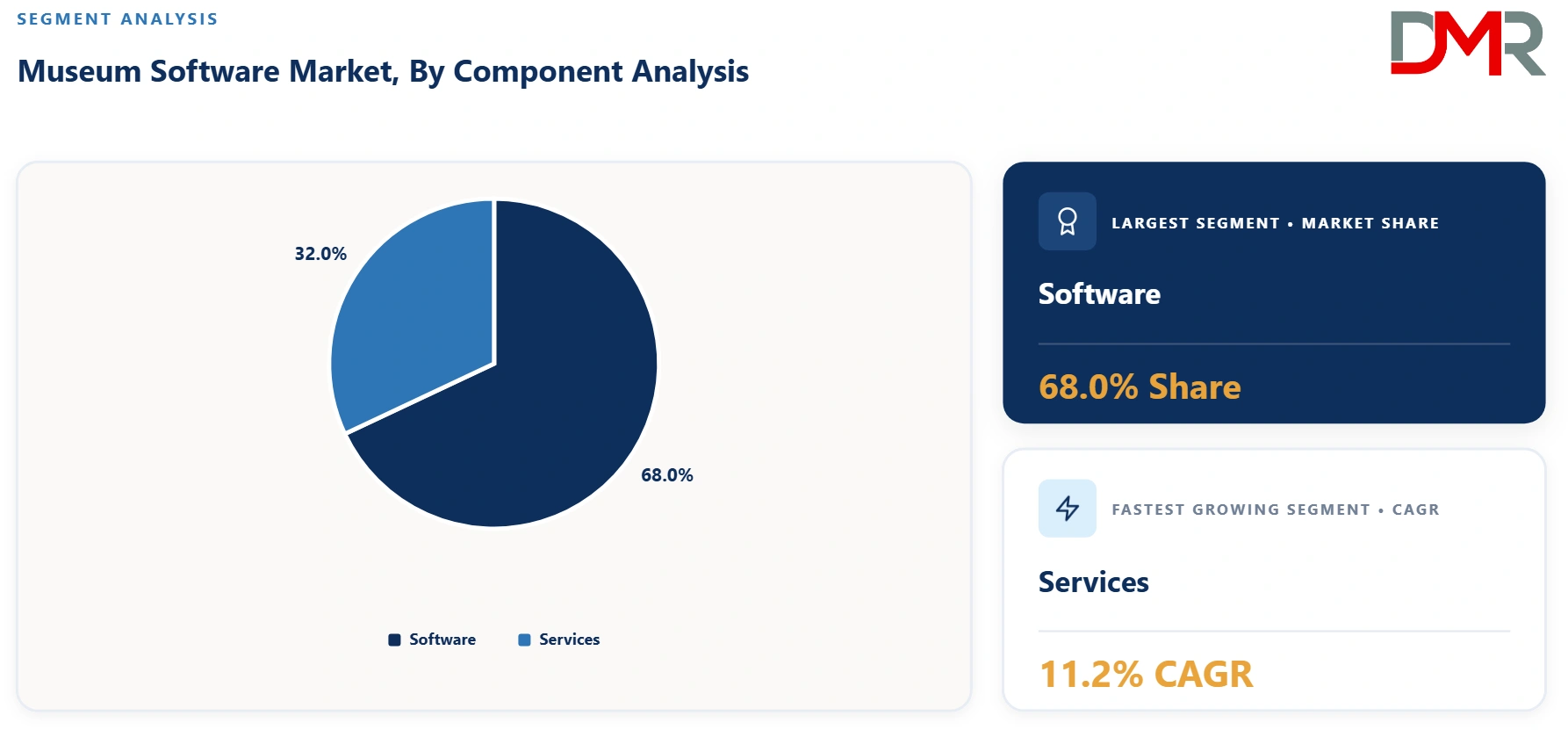
Software leads with a 68% share in 2026, driven by core collection management and ticketing platforms that form the operational backbone of museums. Services represent the fastest-growing component at 11.2% CAGR, as institutions invest in implementation, data migration, and staff training to maximize software value.
By Deployment Mode Analysis
On-premises deployment holds a 45% share in 2026, favored by large institutions with strict data sovereignty requirements and legacy infrastructure. Cloud-based deployment is the fastest-growing mode at 12.5% CAGR, driven by lower upfront costs, remote accessibility, and vendor-managed updates that appeal to mid-sized and emerging-market museums.
By Application Analysis
Collection management leads with a 34% share in 2026, reflecting its role as the foundational system for cataloging and preservation. Ticketing and membership management is the fastest-growing application at 12.8% CAGR, supported by rising visitor expectations for seamless digital purchasing and integrated membership experiences.
By Museum Type Analysis
Art museums hold a 32% share in 2026, driven by high-value collections requiring robust provenance and rights management. Science and technology museums are the fastest-growing type at 11.8% CAGR, as interactive exhibits and digital engagement tools drive software adoption for immersive visitor experiences.
By End User Analysis
Public museums lead with a 41% share in 2026, supported by government digitization funding and large visitor volumes. Private museums are the fastest-growing end user at 11.6% CAGR, as wealthy collectors and foundations invest in modern platforms to professionalize operations and enhance visitor experiences.
How is the Museum Software Market Segmented?
By Component
- Software
- Services
- Professional Services
- Implementation & Integration
- Training & Support
- Maintenance Services
By Deployment Mode
- Cloud-Based
- On-Premises
- Hybrid
By Application
- Collection Management
- Visitor Management
- Ticketing & Membership Management
- Digital Asset Management
- Exhibition & Event Management
By Museum Type
- Art Museums
- History Museums
- Science & Technology Museums
- Natural History Museums
- Specialized Museums
By End User
- Public Museums
- Private Museums
- University & Academic Museums
- Corporate Museums
- Non-Profit Museums
Which Region Leads the Museum Software Market?
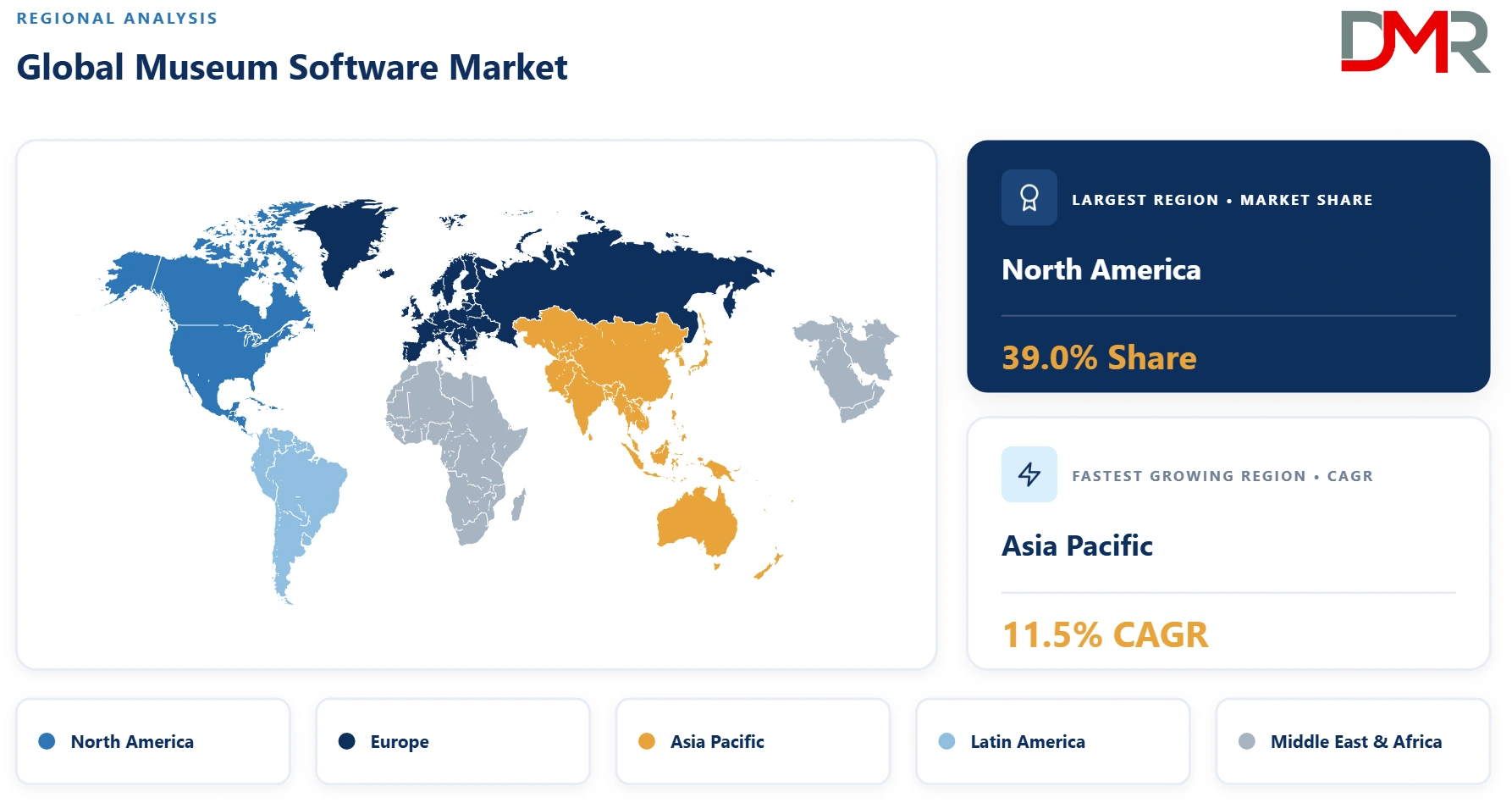
North America leads with a 39% share in 2026, while Asia Pacific is projected to grow at an 11.5% CAGR from 2027 to 2035.
ℹ
To learn more about this report –
Download Your Free Sample Report Here
Region with the Largest Revenue Share
North America holds a 39% share in 2026, with the U.S. and Canada as key markets. Well-funded institutions, mature digital infrastructure, and strong vendor presence drive adoption of integrated collection and ticketing platforms. Demand is sustained by foundation grants and government cultural funding, with outlook pointing to steady replacement cycles and AI feature upgrades through 2035.
Region with the Highest CAGR
Asia Pacific is projected to grow at an 11.5% CAGR, led by China, Japan, and India. Rapid museum construction, rising cultural tourism, and government digitization initiatives drive demand. Cloud-based platforms are gaining traction among newer institutions without legacy systems, and the outlook points to sustained double-digit growth as local vendors and international partnerships expand.
Regional Analysis
Europe Museum Software Market
Europe grows steadily, with Germany, France, and the U.K. as key contributors. Strong public funding and heritage digitization mandates drive adoption of collection management and digital asset platforms. Demand is focused on provenance compliance and multilingual visitor experiences, with the outlook supported by EU cultural heritage programs.
Latin America Museum Software Market
Latin America shows moderate growth, led by Mexico and Brazil. Cultural tourism and municipal modernization programs drive demand for ticketing and visitor management software. Budget constraints limit large-scale deployments, but cloud-based solutions and vendor financing options are expanding access, with the outlook pointing to gradual acceleration.
Middle East & Africa Museum Software Market
The region grows from a small base, with Saudi Arabia and the UAE investing heavily in cultural infrastructure and new museums. Demand centers on integrated ticketing and visitor experience platforms for flagship institutions. South Africa contributes steady demand from public museums, with the outlook supported by tourism diversification strategies.
By Region
North America
Europe
- Germany
- France
- The U.K.
- Italy
- Spain
- Rest of Europe
Asia-Pacific
- China
- Japan
- India
- Australia
- South Korea
- Rest of APAC
Latin America
- Mexico
- Brazil
- Rest of LATAM
Middle East & Africa
- Saudi Arabia
- The UAE
- South Africa
- Rest of MEA
Technology Analysis
Museum software is shifting toward cloud-native architectures, open APIs, and AI-assisted cataloging. Vendors are embedding computer vision for automated image tagging, natural language processing for multilingual metadata, and analytics dashboards for visitor flow optimization. Interoperability standards such as Linked Art and IIIF are gaining adoption, reducing migration risk and enabling collection data sharing. Risks include integration complexity with legacy systems and cybersecurity exposure as institutions connect visitor-facing platforms to core collection databases. The market impact is faster product cycles, rising expectations for open ecosystems, and vendor differentiation through AI depth and data governance capabilities.
Investment and White Space Analysis
Investment in museum software is concentrated in SaaS platforms, AI tooling, and visitor experience startups. White space exists in underserved segments including small museums, emerging-market institutions, and academic collections, where low-cost cloud offerings and modular pricing can unlock demand. Strategic acquirers are targeting ticketing and engagement platforms to build integrated suites, while venture funding favors AI-enabled cataloging and virtual exhibition tools. Risks include long public-sector sales cycles and budget cyclicality. The market impact is accelerating consolidation and pushing vendors toward partner-led distribution in regions where direct sales are uneconomical.
Who are the Leading Companies in the Museum Software Market?
The market is moderately concentrated, with specialized vendors and diversified software providers competing across collection management, ticketing, and engagement platforms. Differentiation rests on integration depth, AI capabilities, and cultural-sector expertise, with partnerships and acquisitions increasingly used to build end-to-end suites.
- Axiell Group (Sweden): Collection management and library systems; strong European and North American institutional base.
- Lucidea (Canada): Integrated museum and archive management platforms; focus on mid-sized institutions.
- Gallery Systems (U.S.): TMS and EmbARK collection management; market leader in large art museums.
- PastPerfect Software (U.S.): Affordable collection management for small and mid-sized museums.
- zetcom AG (Switzerland): Museum management and digital asset platforms; strong in European art institutions.
Some of the prominent players in the Global Museum Software Market are:
- Axiell Group
- Lucidea
- Gallery Systems
- PastPerfect Software
- zetcom AG
- Blackbaud
- Veevart
- CollectionSpace
- Vernon Systems
- Modes Complete
- KE Software
- Adlib Information Systems
- Cuadra Associates
- Argus
- Re:discovery Software
- Eloquent Systems
- Willoughby Associates
- Intellect
- Axiell Collections
- TMS Suite
- EmbARK
- PastPerfect Web Edition
- MuseumSpace
- Collectish
- CatalogIt
- Artwork Archive
- Collector Systems
- eHive
- MuseumPlus
- GallerySystems TMS
- Omeka
- Arches
- CollectionSpace Community
- OpenKultur
- MuseumIndex
- Mu.SA
- Digirati
- Orange Logic
- Extensis
- Other Key Players
Recent Developments
- In October 2026, Axiell Group launched an AI-assisted cataloging module for its collections platform, reducing metadata entry time for European institutions.
- In July 2026, Gallery Systems announced a cloud migration program for TMS customers targeting mid-sized art museums in North America.
- In April 2026, Lucidea acquired a visitor engagement software provider to integrate ticketing with collection management.
- In January 2026, zetcom AG partnered with a European heritage consortium to deploy multilingual digital asset management across member museums.
- In September 2025, PastPerfect Software released a subscription-based cloud edition aimed at small and mid-sized museums.
Report Scope and Research Methodology
Market definition: Museum software encompasses digital platforms for collection cataloging, visitor management, ticketing, digital asset and exhibition management, sold as software and related services to museums of all types and ownership models.
Methodology: Dimension Market Research built the estimate bottom-up from vendor revenues, license and subscription data, and software value per institution for each component and end-user segment, then checked it top-down against cultural-sector IT spending totals. Primary interviews with museum technology officers, vendors, and cultural ministry officials validated adoption rates and pricing. Forecasts apply segment-level growth assumptions for 2027–2035 and are reviewed at each report update.
Report Details
| Report Characteristics |
Details |
| Market Size (2026) |
USD 4.2 Billion |
| Forecast Value (2035) |
USD 10.5 Billion |
| CAGR (2027-2035) |
9.7% |
| Historical Data |
2021–2026 |
| Forecast Data |
2027–2035 |
| Base Year |
2026 |
| Estimate Year |
2027 |
| Segments Covered |
By Component, By Deployment Mode, By Application, By Museum Type, By End User |
| Regional Coverage |
North America (The US, Canada); Europe (Germany, France, The UK, Italy, Spain, Rest of Europe); Asia Pacific (China, Japan, India, Australia, South Korea, Rest of APAC); Latin America (Mexico, Brazil, Rest of LATAM); Middle East & Africa (Saudi Arabia, The UAE, South Africa, Rest of MEA) |
Frequently Asked Questions
How big is the Museum Software Market in 2026?
▾ The global Museum Software Market is valued at USD 4.2 billion in 2026.
What is the growth rate of the Museum Software Market?
▾ The Museum Software Market is projected to grow at a CAGR of 9.7% from 2027 to 2035, reaching USD 10.5 billion by 2035.
Which region leads the Museum Software Market?
▾ North America leads the Museum Software Market with a 39% revenue share in 2026, driven by well-funded institutions and mature digital infrastructure.
Which product segment dominates the Museum Software Market?
▾ Software dominates the Museum Software Market with a 68% share in 2026, led by core collection management and ticketing platforms.
Which end user is growing fastest in the Museum Software Market?
▾ Private museums are the fastest-growing end user at an 11.6% CAGR, as collectors and foundations invest in modern platforms to professionalize operations.
Who are the key players in the Museum Software Market?
▾ Key players include Axiell Group, Lucidea, Gallery Systems, PastPerfect Software, zetcom AG, Blackbaud, Veevart, and CollectionSpace.
What are the main challenges facing the Museum Software Market?
▾ Main challenges include budget constraints at small and mid-sized museums, data privacy and provenance compliance complexity, legacy system integration, and long public-sector procurement cycles.