Netherlands Food Logistics & Cold Chain Market Snapshot
- Netherlands Food Logistics & Cold Chain Market Size in 2026: USD 6.7 Billion
- Netherlands Food Logistics & Cold Chain Market Size in 2035: USD 11.9 Billion
- Netherlands CAGR from 2026 to 2035: 6.6%
- Refrigerated/Cold Storage Warehousing is the leading service type segment in 2026: 46.3%
- Frozen is the leading temperature type segment in 2026: 42.7%
- Roadways is the leading mode of transport segment in 2026: 58.9%
- Fresh Produce and Horticulture is the leading application segment in 2026: 33.4%
- Food and Beverage Industry is the leading end user segment in 2026: 78.6%
What is the Netherlands Food Logistics & Cold Chain Market and its Market Size?
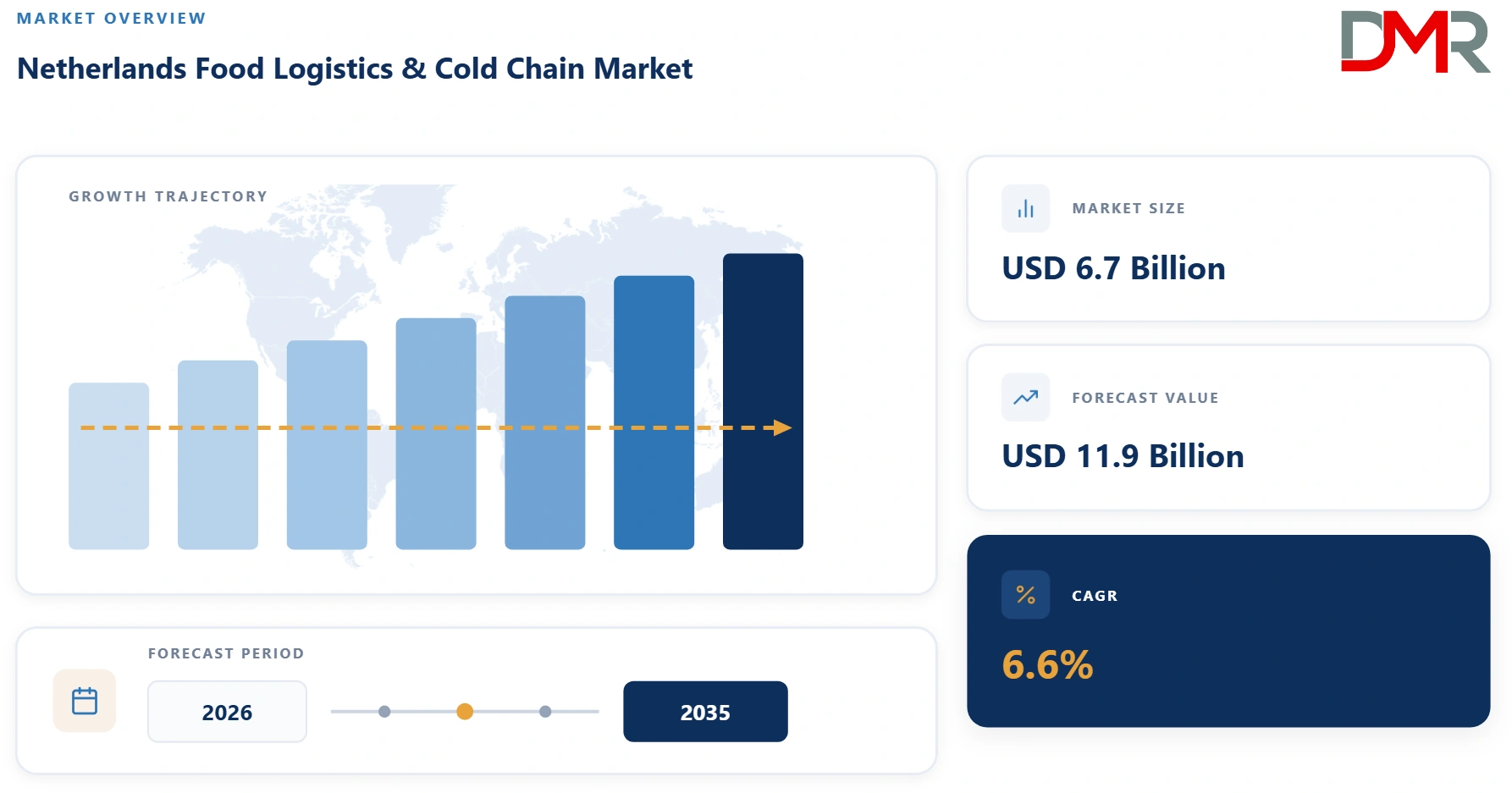
The Netherlands Food Logistics & Cold Chain Market is projected to be valued at USD 6.7 Billion in 2026 and is projected to reach USD 11.9 Billion by 2035, expanding at a CAGR of 6.6% during the forecast period.
ℹ
To learn more about this report –
Download Your Free Sample Report Here
Growth is being propelled by the Netherlands' position as Europe's principal gateway for fresh produce, flowers, and food product imports and re-exports through the Port of Rotterdam and Schiphol Airport, the country's globally leading greenhouse horticulture and dairy export industries requiring extensive temperature-controlled logistics infrastructure, and continued growth in European grocery e-commerce and pharmaceutical cold chain distribution routed through Dutch logistics hubs. The maturing of highly automated, energy-efficient cold storage warehousing clustered around the Netherlands' major ports and logistics corridors, growing investment in multimodal cold chain infrastructure connecting road, rail, and inland waterway transport, and the Netherlands' role as a European distribution and cross-docking hub for temperature-sensitive pharmaceutical and food products are reshaping the market from a traditional import-export logistics function into one of Europe's most technologically advanced and strategically central cold chain networks. Investment is accelerating as Dutch cold chain operators expand automated warehousing capacity while serving as the primary European entry and redistribution point for a substantial share of the continent's fresh food and pharmaceutical trade.
Use Cases
- Fresh Produce and Flower Import-Export Logistics Through Rotterdam and Schiphol: International fresh produce and flower importers and exporters rely on the Netherlands' extensive cold storage and refrigerated transportation infrastructure clustered around the Port of Rotterdam and Schiphol Airport to process and redistribute perishable goods across the broader European market.
- Temperature-Controlled Pharmaceutical Distribution Through Dutch Logistics Hubs: Pharmaceutical distributors leverage the Netherlands' advanced cold chain infrastructure and central European location to establish regional distribution centers for temperature-sensitive medications and biologics serving the broader European market.
- Dairy and Cheese Export Cold Chain Logistics: Dutch dairy cooperatives and exporters depend on integrated cold chain networks connecting processing facilities, port cold storage, and refrigerated ocean and road freight to preserve product quality for the Netherlands' substantial cheese and dairy export trade.
- Cross-Docking and Redistribution for European Grocery E-Commerce: Grocery e-commerce platforms and food distributors use the Netherlands' strategically located, highly automated cold storage facilities as cross-docking and redistribution points serving multiple European markets from a single centrally located hub.
Key Takeaways
- Market Size: The Netherlands Food Logistics & Cold Chain Market is anticipated to be valued at USD 6.7 Billion in 2026 and is forecast to reach USD 11.9 Billion by 2035, expanding at a CAGR of 6.6%.
- Growth Outlook: Market expansion is sustained by the Netherlands' position as Europe's principal fresh produce and food import-export gateway, its leading dairy and horticulture export industries, and continued growth in European grocery e-commerce and pharmaceutical cold chain distribution routed through Dutch logistics hubs.
- Primary Growth Drivers: The Netherlands' role as Europe's primary gateway for fresh produce and food trade through Rotterdam and Schiphol, the country's globally leading horticulture and dairy export industries, growing pharmaceutical cold chain distribution through Dutch regional hubs, and continued investment in automated, multimodal cold chain infrastructure are accelerating market growth.
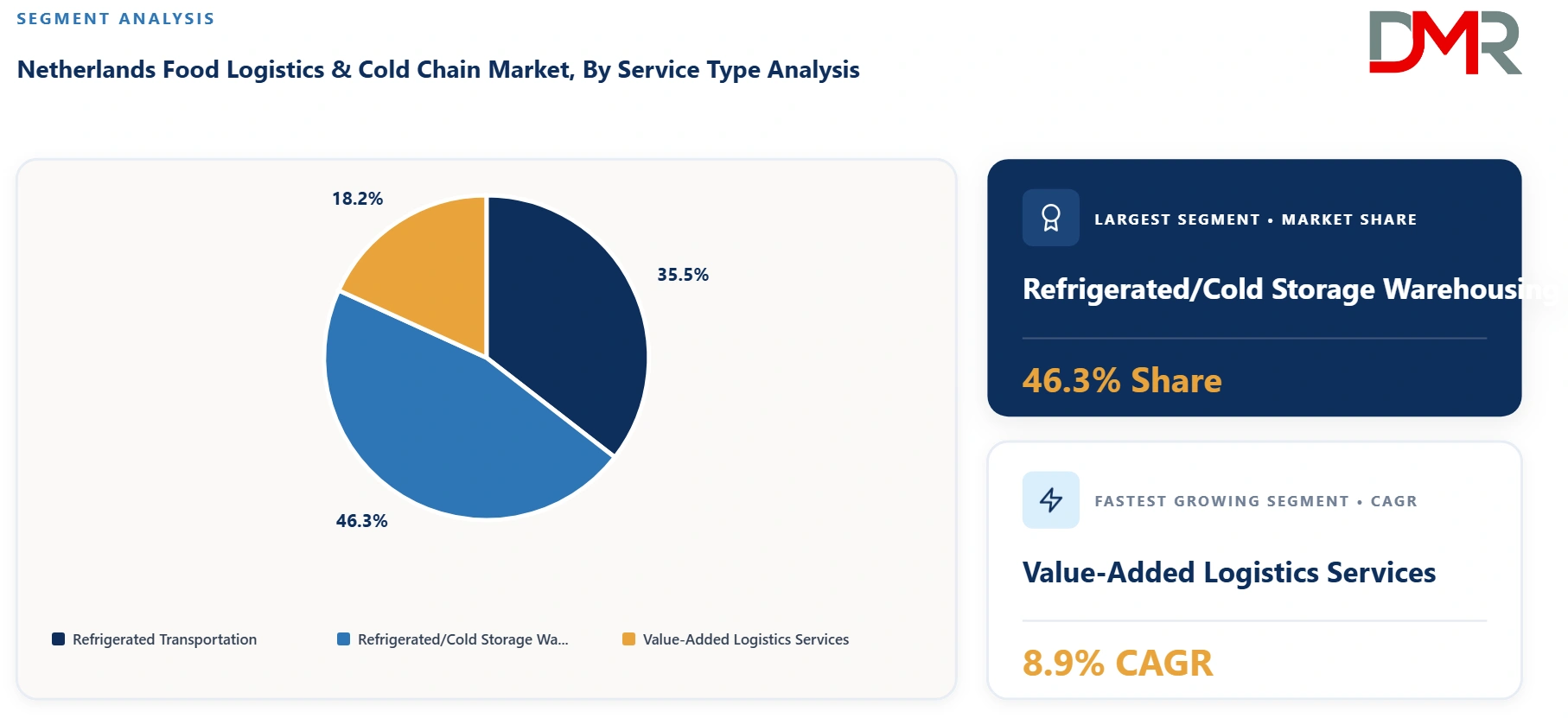
- By Service Type Analysis: Refrigerated/Cold Storage Warehousing is projected to lead the service type segment with a 46.3% share in 2026, reflecting the Netherlands' role as a major European cold storage and redistribution hub. Value-Added Logistics Services is the fastest-growing service type segment at 8.9% CAGR, driven by rising demand for cross-docking, repackaging, and inventory management services supporting European redistribution.
- By Temperature Type Analysis: Frozen is expected to dominate with a 42.7% share in 2026, supported by extensive frozen food and seafood import-export trade volumes. Deep-Frozen is the fastest-growing temperature type segment at 9.2% CAGR, driven by expanding pharmaceutical biologics distribution requiring ultra-low temperature handling through Dutch logistics hubs.
- By Mode of Transport Analysis: Roadways is poised to lead with a 58.9% share in 2026, reflecting the central role of refrigerated trucking within the Netherlands' broader multimodal logistics network. Waterways is the fastest-growing mode of transport segment at 8.3% CAGR, driven by growing investment in refrigerated inland waterway container transport leveraging the Netherlands' extensive river and canal infrastructure.
- By Application Analysis: Fresh Produce and Horticulture is expected to command a 33.4% share in 2026, underpinned by the Netherlands' position as Europe's leading fresh produce and flower trading hub. Pharmaceuticals and Healthcare is the fastest-growing application segment at 9.8% CAGR, driven by expanding regional pharmaceutical distribution routed through Dutch cold chain infrastructure.
- By End User Analysis: Food and Beverage Industry is projected to dominate with a 78.6% share in 2026, reflecting the sector's overwhelming share of cold chain volume tied to the Netherlands' fresh produce and dairy trade. Pharmaceutical and Healthcare Industry is the fastest-growing end user segment at 9.4% CAGR, driven by sustained growth in temperature-sensitive drug and biologics distribution through Dutch regional hubs.
Key Drivers in the Netherlands Food Logistics & Cold Chain Market
The Netherlands' Position as Europe's Principal Fresh Produce and Food Trade Gateway
The Netherlands, anchored by the Port of Rotterdam, Europe's largest port, and Amsterdam's Schiphol Airport, one of Europe's busiest cargo airports, serves as the primary entry and redistribution point for a substantial share of the continent's fresh produce, flower, and broader food product imports. This gateway function creates enormous scale advantages for cold chain infrastructure investment, as facilities serving this trade flow benefit from consistent, high-volume throughput that supports continued investment in automation and capacity expansion. This structural trade gateway role is expected to remain a central and durable driver of Dutch cold chain market growth throughout the forecast period.
Global Leadership in Horticulture and Dairy Export Industries
The Netherlands' globally renowned greenhouse horticulture sector and substantial dairy and cheese export industry generate sustained, high-volume demand for temperature-controlled logistics infrastructure connecting production facilities to both domestic distribution and extensive European and international export markets. The precision and efficiency characteristic of Dutch agricultural production extends to the cold chain logistics supporting it, with growers, processors, and exporters requiring highly reliable, technologically sophisticated cold chain partners capable of preserving product quality across the country's substantial export volumes.
Restraints in the Netherlands Food Logistics & Cold Chain Market
Land Scarcity and Rising Real Estate Costs for Cold Storage Facility Development
The Netherlands' limited available land and high real estate costs, particularly in the logistics-dense areas surrounding Rotterdam, Schiphol, and other major distribution corridors, represent a significant restraint on the Food Logistics & Cold Chain Market. Developing new cold storage warehousing capacity in these strategically important but space-constrained locations requires substantial capital investment and often involves vertical, multi-story warehouse designs or automated high-density storage systems to maximize capacity within limited land availability, increasing development costs relative to less land-constrained European markets.
Growth Opportunities in the Netherlands Food Logistics & Cold Chain Market
Automated, High-Density Cold Storage Facility Development
The Netherlands' land constraints present a significant opportunity for developers and logistics providers investing in highly automated, multi-story, high-density cold storage facilities capable of maximizing storage capacity within limited available land near key ports and logistics corridors. Companies pioneering advanced automated storage and retrieval systems specifically designed for space-constrained urban and near-port logistics environments can capture premium positioning in a market where land availability represents an increasingly binding constraint on capacity expansion.
Regional European Distribution Hub Services for Pharmaceutical Cold Chain
The Netherlands' central European location, advanced logistics infrastructure, and established pharmaceutical industry presence create a substantial opportunity for cold chain logistics providers to expand specialized pharmaceutical and biologics regional distribution hub services. Providers capable of meeting stringent validation, monitoring, and chain-of-custody documentation requirements while leveraging the Netherlands' central location to efficiently serve multiple European markets from a single distribution point can capture premium, long-term contracts with pharmaceutical manufacturers.
Trends in the Netherlands Food Logistics & Cold Chain Market
Growing Investment in Multimodal Cold Chain Infrastructure Leveraging Inland Waterways
Dutch cold chain logistics providers are increasingly investing in multimodal transportation infrastructure that leverages the Netherlands' extensive network of rivers and canals alongside traditional road transport, aiming to reduce emissions and road congestion while maintaining the temperature control integrity required for food and pharmaceutical cargo. This trend reflects both the Netherlands' favorable inland waterway geography and growing European Union emphasis on reducing transportation-related carbon emissions across supply chains.
Consolidation and Automation Investment Among Major Cold Storage Operators
The Netherlands Food Logistics & Cold Chain Market is experiencing continued consolidation as larger international cold storage and logistics companies acquire or expand Dutch operations to capitalize on the country's strategic gateway position, while existing operators invest heavily in automation to maximize capacity within land-constrained facility footprints. This consolidation and automation trend is gradually concentrating the most sophisticated, highest-capacity cold storage infrastructure among a smaller number of larger, well-capitalized operators positioned at the Netherlands' key logistics nodes.
Research Scope and Analysis
The Netherlands Food Logistics & Cold Chain Market is segmented by service type, temperature type, mode of transport, application, and end user, covering refrigerated transportation, cold storage warehousing, value-added logistics services, chilled, frozen, deep-frozen temperature ranges, and food, pharmaceutical, and retail end users.
ℹ
To learn more about this report –
Download Your Free Sample Report Here
By Service Type Analysis
Refrigerated/Cold Storage Warehousing is projected to dominate the Netherlands Food Logistics & Cold Chain Market with 46.3% share in 2026, reflecting the country's role as a major European cold storage and cross-docking redistribution hub anchored by Rotterdam and Schiphol logistics infrastructure. Value-Added Logistics Services is expected to register the highest CAGR of 8.9% during 2026-2035, driven by rising demand for cross-docking, repackaging, labeling, and inventory management services supporting the Netherlands' extensive European redistribution function.
By Temperature Type Analysis
Frozen is anticipated to dominate the Netherlands Food Logistics & Cold Chain Market by temperature type, accounting for 42.7% share in 2026, supported by extensive frozen food and seafood import-export trade volumes flowing through Dutch ports. Deep-Frozen is projected to register the highest CAGR of 9.2% between 2026 and 2035, driven by expanding pharmaceutical biologics distribution requiring ultra-low temperature handling and storage through the Netherlands' regional distribution infrastructure.
By Mode of Transport Analysis
Roadways is projected to lead the Netherlands Food Logistics & Cold Chain Market with an estimated 58.9% share in 2026, reflecting the central role of refrigerated trucking connecting the country's ports, airports, and distribution centers with broader European destination markets. Waterways is expected to register the fastest CAGR of 8.3% through 2035, driven by growing investment in refrigerated inland waterway container transport that leverages the Netherlands' extensive and well-developed river and canal network as a lower-emission alternative to road transport.
By Application Analysis
Fresh Produce and Horticulture is projected to lead the Netherlands Food Logistics & Cold Chain Market with an estimated 33.4% share in 2026, underpinned by the Netherlands' position as Europe's leading fresh produce and flower trading and redistribution hub. Pharmaceuticals and Healthcare is expected to register the fastest CAGR of 9.8% through 2035, driven by sustained growth in temperature-sensitive medication and biologics distribution routed through the Netherlands' central European logistics infrastructure.
By End User Analysis
Food and Beverage Industry is projected to dominate the Netherlands Food Logistics & Cold Chain Market with 78.6% share in 2026, reflecting the sector's overwhelming share of total cold chain volume tied to the country's substantial fresh produce, dairy, and broader food trade. Pharmaceutical and Healthcare Industry is expected to register the fastest CAGR of 9.4% through 2035, driven by sustained growth in temperature-sensitive drug, vaccine, and biologics distribution leveraging the Netherlands' strategic central European logistics position.
The Netherlands Food Logistics & Cold Chain Market Report is segmented based on the following:
By Service Type
- Refrigerated Transportation
- Refrigerated/Cold Storage Warehousing
- Value-Added Logistics Services
By Temperature Type
- Chilled
- Frozen
- Deep-Frozen
By Mode of Transport
- Roadways
- Waterways
- Railways
- Airways
By Application
- Fresh Produce and Horticulture
- Dairy Products
- Meat, Poultry and Seafood
- Bakery and Confectionery
- Pharmaceuticals and Healthcare
- Others
By End User
- Food and Beverage Industry
- Pharmaceutical and Healthcare Industry
- Retail and E-Commerce
- Others
Technology Analysis
Technology investment is increasingly shaping competitiveness in the Netherlands Food Logistics & Cold Chain Market as operators adopt automated storage and retrieval systems, IoT-based real-time temperature monitoring, and AI-enhanced logistics optimization software to maximize efficiency within the country's land-constrained facility environment. Growing use of digital freight matching and multimodal transport coordination platforms is helping optimize the Netherlands' complex, multi-modal logistics network spanning road, rail, water, and air transport. Opportunities are expanding for providers investing in energy-efficient, high-density automated cold storage technology, electric and alternative-fuel refrigerated vehicle fleets, and blockchain-based chain-of-custody documentation supporting the country's extensive pharmaceutical and premium food distribution activity. However, the high capital costs associated with advanced automation and land-efficient facility design remain a significant barrier to entry for smaller logistics providers.
Investment and White Space Analysis
Investment opportunities in the Netherlands Food Logistics & Cold Chain Market are expanding alongside the country's central role in European fresh produce and pharmaceutical trade, sustained horticulture and dairy export strength, and continued investment in automated, multimodal cold chain infrastructure. Significant white space exists in automated, high-density cold storage facility development, regional pharmaceutical distribution hub services, and multimodal infrastructure leveraging the Netherlands' inland waterway network. Operators with strong automation capability, strategic port and airport proximity, and established pharmaceutical and food industry client relationships are positioned to capture premium, longer-duration contracts serving the broader European market. However, land scarcity and rising real estate costs, intense competition among established international logistics operators, and the capital intensity of automated facility development can constrain margins and expansion pace for smaller or newly entering operators.
Competitive Landscape
The Netherlands Food Logistics & Cold Chain Market is moderately consolidated and highly competitive, comprising large international cold chain and logistics companies with substantial Dutch operations, specialized Dutch port and airport logistics providers, and diversified European logistics groups leveraging the Netherlands as a central distribution hub. Competition centers on automated facility capacity and land-use efficiency, strategic proximity to Rotterdam and Schiphol logistics infrastructure, multimodal transport integration capability, and pharmaceutical-grade validation and monitoring credentials. Large international operators benefit from global scale and integrated multi-country distribution network capability, while specialized Dutch providers compete on deep local port and logistics infrastructure relationships. Companies increasingly differentiate through automation and land-use efficiency innovation, multimodal sustainability credentials, and specialized pharmaceutical cold chain capability rather than storage capacity alone.
Some of the prominent players in the Netherlands Food Logistics & Cold Chain Market are:
- Lineage Logistics
- Kloosterboer
- NewCold
- STEF Netherlands
- Frigolanda Cold Logistics
- Frigomundo Cold Store
- Blankendaal Coldstores
- Froster Frozen Food Logistics
- Blokland Coldstores
- HSF Logistics
- DFDS Logistics
- DHL Supply Chain
- DSV
- Kuehne + Nagel
- CEVA Logistics
- Rhenus Logistics
- DB Schenker
- Americold Logistics
- Dachser Netherlands Food Logistics
- Daily Logistics Group
- Grolleman Coldstore Group
- Frigocare Rotterdam
- HIWA Rotterdam Port Cold Stores
- DL Logistics Group
- Agro Merchants Group
- Van den Bosch
- Nunner Logistics
- H.Essers
- Katoen Natie
- Nichirei Logistics Group
- Maersk
- LCL Netherlands
- Gartner Holland
- Thermotraffic
- Müller Fresh Food Logistics
- Bakker Logistiek
- Nabuurs
- Peter Appel Transport
- Cornelissen Transport
- Simon Loos
- Other Key Players
Recent Developments
- July 2026: NewCold commissioned an advanced battery energy storage system at its Global Innovation and Support Center in Breda. The system is designed to manage peak electricity demand, support further electrification, and improve the energy efficiency of cold-chain operations.
- June 2026: Port of Rotterdam Authority, Necron Group, and PTP Group signed an agreement to develop 38 hectares at the Rotterdam Food Hub for storage and transshipment of chilled and frozen agrifood products, including warehouses, terminal infrastructure, and a new quay wall.
- June 2025: Lineage broke ground on an expansion of its fully automated cold-storage facility in Bergen op Zoom. The project is expected to increase capacity by about 40%, taking the site to more than 250,000 pallet positions.
- April 2025: NewCold started operations at its new highly automated cold-storage facility in Dinteloord. The site has approximately 134,000 pallet positions and represents NewCold’s first greenfield warehouse project in the Netherlands.
Report Details
| Report Characteristics |
| Market Size (2026) |
USD 6.7 Bn |
| Forecast Value (2035) |
USD 11.9 Bn |
| CAGR (2026–2035) |
6.6% |
| Historical Data |
2021 – 2025 |
| Forecast Data |
2026 – 2035 |
| Base Year |
2025 |
| Segments Covered |
By Service Type, By Temperature Type, By Mode of Transport, By Application, and By End User |
| Country Coverage |
Netherlands |
Frequently Asked Questions
How big is the Netherlands Food Logistics & Cold Chain Market?
▾ The Netherlands Food Logistics & Cold Chain Market is valued at USD 6.7 Billion in 2026 and is projected to reach USD 11.9 Billion by 2035, reflecting the country's central role as Europe's principal fresh produce and food trade gateway and its leading dairy and horticulture export industries.
What is the CAGR of the Netherlands Food Logistics & Cold Chain Market from 2026 to 2035?
▾ The market is projected to expand at a compound annual growth rate (CAGR) of 6.6% between 2026 and 2035, supported by the Netherlands' gateway trade position, growing pharmaceutical cold chain distribution, and continued investment in automated, multimodal cold chain infrastructure.
What factors are driving the growth of the Netherlands Food Logistics & Cold Chain Market?
▾ Growth is driven by the Netherlands' role as Europe's primary gateway for fresh produce and food trade through Rotterdam and Schiphol, the country's globally leading horticulture and dairy export industries, growing pharmaceutical cold chain distribution through Dutch regional hubs, and continued investment in automated, multimodal cold chain infrastructure.
What are the major trends in the Netherlands Food Logistics & Cold Chain Market?
▾ Major trends include growing investment in multimodal cold chain infrastructure leveraging inland waterways, continued consolidation and automation investment among major cold storage operators, and expanding regional pharmaceutical distribution hub services.
Who are the key players in the Netherlands Food Logistics & Cold Chain Market?
▾ Key market participants include Kloosterboer, NewCold Advanced Logistics, Lineage Logistics, Americold Logistics, and Kuehne+Nagel Netherlands, among other international and specialized Dutch cold chain logistics providers.
How is the Netherlands Food Logistics & Cold Chain Market segmented?
▾ The market is segmented by service type, temperature type, mode of transport, application, and end user, with demand analysis concentrated around the Port of Rotterdam, Schiphol Airport, and the broader Randstad logistics corridor.