Netherlands Food Processing Equipment Market Snapshot
- Netherlands Food Processing Equipment Market Size in 2026: USD 2.6 Billion
- Netherlands Food Processing Equipment Market Size in 2035: USD 4.6 Billion
- Netherlands CAGR from 2026 to 2035: 6.2%
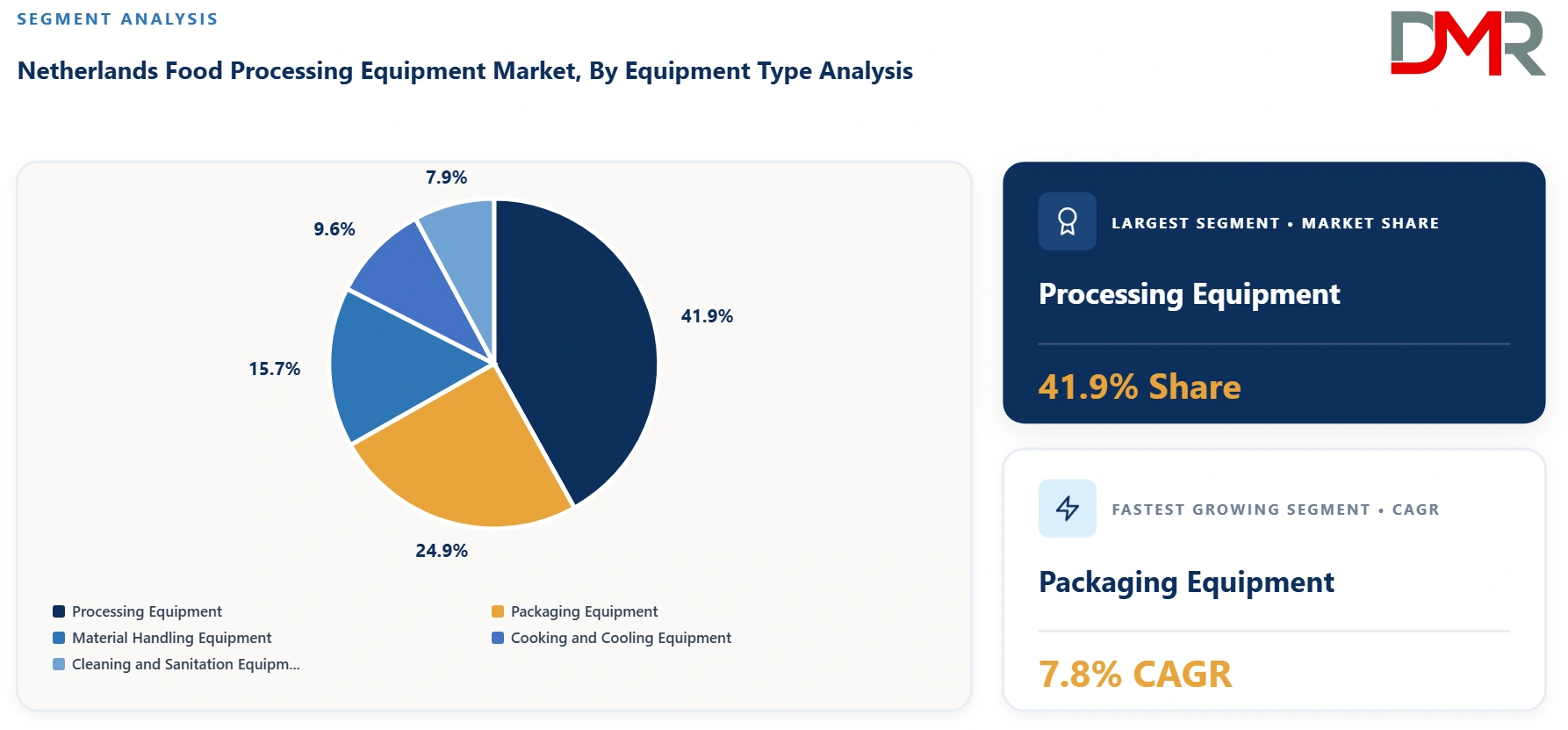
- Processing Equipment is the leading equipment type segment in 2026: 41.9%
- Automatic is the leading mode of operation segment in 2026: 61.4%
- Dairy Products is the leading food category segment in 2026: 26.8%
- Large-Scale Food Processors is the leading end user segment in 2026: 63.9%
What is the Netherlands Food Processing Equipment Market and its Market Size?
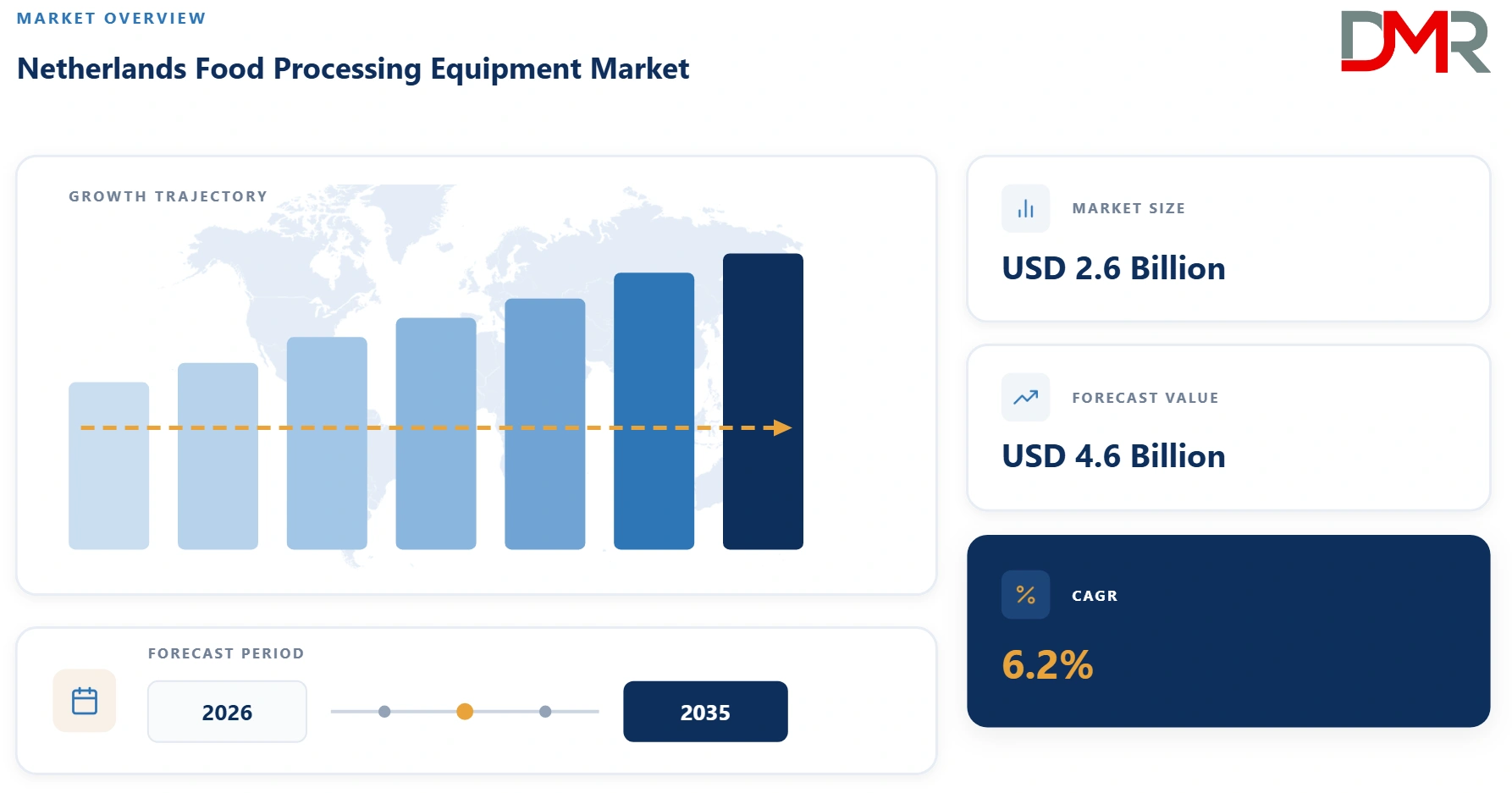
The Netherlands Food Processing Equipment Market is projected to be valued at USD 2.6 Billion in 2026 and is projected to reach USD 4.6 Billion by 2035, expanding at a CAGR of 6.2% during the forecast period.
ℹ
To learn more about this report –
Download Your Free Sample Report Here
Growth is being propelled by the Netherlands' position as one of the world's largest agri-food exporters relative to its size, driven by highly efficient, technology-intensive greenhouse horticulture and dairy processing industries, sustained investment in automation to address persistent labor shortages, and the country's role as a global leader in food processing and agricultural technology innovation. The maturing of highly precise, hygienic automated equipment suited to the Netherlands' export-oriented, quality-focused food processing sector, growing processor investment in Industry 4.0-aligned smart factory systems, and continued strength of Dutch food processing equipment and agricultural technology companies as both domestic suppliers and global technology exporters are reshaping the market from conventional equipment procurement into a more strategic, innovation-driven capital investment category. Investment is accelerating as Dutch processors modernize dairy, produce, and processed food facilities while pursuing both efficiency gains and continued global export competitiveness.
Use Cases
- Automated Dairy Processing for Export-Oriented Cheese and Milk Powder Production: Dutch dairy cooperatives and processors invest in automated pasteurization, cheese-making, and drying equipment to maintain the Netherlands' position as one of Europe's largest dairy exporters, particularly for cheese and infant formula-grade milk powder.
- Fresh Produce Sorting and Packing Automation for Horticultural Exports: The Netherlands' extensive greenhouse horticulture and fresh produce export sector relies on automated sorting, grading, and packing equipment to process high volumes of fruits, vegetables, and flowers for distribution across the Netherlands' major European trading and logistics hubs.
- Meat and Poultry Processing Automation Addressing Labor Constraints: Dutch meat and poultry processors invest in automated cutting, deboning, and portioning equipment to manage persistent labor shortages while maintaining the food safety and quality standards required for both domestic consumption and substantial European export trade.
- Industry 4.0-Enabled Smart Factory Integration Across Food Manufacturing: Dutch food manufacturers, benefiting from close proximity to leading domestic agricultural and food technology companies, integrate connected, sensor-equipped processing equipment into broader smart factory systems supporting real-time production monitoring and predictive maintenance.
Key Takeaways
- Market Size: The Netherlands Food Processing Equipment Market is anticipated to be valued at USD 2.6 Billion in 2026 and is forecast to reach USD 4.6 Billion by 2035, expanding at a CAGR of 6.2%.
- Growth Outlook: Market expansion is sustained by the Netherlands' position as a leading global agri-food exporter, persistent labor shortages driving automation investment, and the country's strength as a global center of food and agricultural technology innovation.
- Primary Growth Drivers: The Netherlands' outsized role in global agri-food exports relative to its geographic size, persistent food processing labor shortages, the country's leadership in food and agricultural technology innovation, and sustained investment in Industry 4.0-aligned smart factory systems are accelerating equipment investment.
- By Equipment Type Analysis: Processing Equipment is projected to lead the equipment type segment with a 41.9% share in 2026, reflecting its central role across the Netherlands' dairy, produce, and meat processing operations. Packaging Equipment is the fastest-growing equipment type segment at 7.8% CAGR, driven by rising demand for automated, sustainable packaging line systems supporting export compliance.
- By Mode of Operation Analysis: Automatic equipment is expected to dominate with a 61.4% share in 2026, reflecting the Netherlands' advanced industrial automation adoption relative to many other European markets. Automatic is also the fastest-growing mode of operation segment at 8.1% CAGR, as persistent labor shortages and strong domestic technology capability continue to favor high automation levels.
- By Food Category Analysis: Dairy Products is expected to command a 26.8% share in 2026, underpinned by the Netherlands' substantial cheese and milk powder export industry. Fruits and Vegetables is the fastest-growing food category segment at 7.6% CAGR, driven by continued investment in automated sorting and packing equipment supporting the country's extensive horticultural export trade.
- By End User Analysis: Large-Scale Food Processors are projected to dominate with a 63.9% share in 2026, reflecting greater capital availability for comprehensive automation investment. Small and Medium-Sized Processors is the fastest-growing end user segment at 7.9% CAGR, driven by falling automation equipment costs and strong domestic technology accessibility.
Key Drivers in the Netherlands Food Processing Equipment Market
The Netherlands' Outsized Role in Global Agri-Food Exports
Despite its relatively small geographic size, the Netherlands ranks among the world's largest agri-food exporters, driven by exceptionally efficient greenhouse horticulture, dairy processing, and food manufacturing industries. This export-oriented agricultural and food processing model requires substantial and continuous investment in high-throughput, quality-consistent processing and packing equipment capable of meeting the demanding standards of international export markets. This structural export orientation provides a sustained, quality-driven demand base for food processing equipment investment that distinguishes the Dutch market from more domestically consumption-oriented food processing sectors.
Netherlands' Global Leadership in Food and Agricultural Technology Innovation
The Netherlands hosts a globally significant concentration of food and agricultural technology companies, research institutions, and innovation clusters, providing Dutch food processors with close proximity to cutting-edge processing, sorting, and automation technology. This technology leadership creates a favorable environment for rapid domestic adoption of advanced processing equipment, as Dutch technology companies often showcase and refine new equipment technologies within their home market before broader international commercialization, reinforcing sustained equipment investment and modernization across the Dutch food processing sector.
Restraints in the Netherlands Food Processing Equipment Market
High Capital Costs Amid Land and Facility Space Constraints
Significant upfront capital investment required for modern automated processing equipment, combined with the Netherlands' limited available land and higher facility space costs relative to less densely populated European markets, represents a meaningful restraint on the Netherlands Food Processing Equipment Market. Dutch processors must often achieve greater production efficiency and throughput within more constrained physical footprints than processors in larger, less land-constrained markets, requiring more sophisticated and often more expensive space-efficient equipment solutions to achieve comparable production capacity.
Growth Opportunities in the Netherlands Food Processing Equipment Market
Space-Efficient, Vertically Integrated Processing Equipment Solutions
The Netherlands' land constraints present a distinctive opportunity for equipment vendors developing compact, vertically integrated processing and packing solutions capable of maximizing throughput within limited physical footprints. Vendors offering equipment specifically engineered for space efficiency, building on the same design principles that have made Dutch greenhouse horticulture globally renowned for productivity per unit area, can differentiate in a market where facility space constraints are a persistent and distinctive operational consideration.
Export Compliance and Traceability-Integrated Equipment Systems
Growing international buyer requirements for verified traceability and food safety documentation present an opportunity for equipment vendors offering processing and packing systems with integrated digital traceability and quality documentation capability. Given the Netherlands' extensive role in agri-food export and re-export trade, equipment solutions that seamlessly generate the documentation required for diverse international market compliance requirements can capture premium positioning among Dutch export-oriented processors.
Trends in the Netherlands Food Processing Equipment Market
Deepening Integration Between Food Processing Equipment and Precision Agriculture Technology
Dutch food processing equipment investment is increasingly converging with the country's broader precision agriculture and greenhouse technology innovation, with data flowing between farm-level production systems and processing facility equipment to optimize scheduling, quality grading, and processing parameters based on real-time crop and product characteristics. This convergence reflects the tightly integrated nature of the Netherlands' agri-food value chain and is creating opportunities for equipment vendors capable of offering solutions that bridge traditionally separate agricultural production and food processing technology domains.
Growing Emphasis on Energy Efficiency and Sustainability in Equipment Design
Dutch food processors are placing increasing emphasis on energy efficiency and overall environmental performance in equipment purchasing decisions, reflecting both the Netherlands' ambitious national sustainability policy environment and rising European industrial energy costs. Equipment vendors are responding with more prominent energy consumption and efficiency performance data, positioning sustainability credentials as an increasingly important competitive differentiator alongside traditional automation and throughput considerations.
Research Scope and Analysis
The Netherlands Food Processing Equipment Market is segmented by equipment type, mode of operation, food category, and end user, covering processing, packaging, material handling, cooking and cooling, and cleaning and sanitation equipment across dairy, produce, meat, and beverage processing categories.
ℹ
To learn more about this report –
Download Your Free Sample Report Here
By Equipment Type Analysis
Processing Equipment is projected to dominate the Netherlands Food Processing Equipment Market with 41.9% share in 2026, reflecting its central role across the country's dairy, fresh produce, meat, and beverage processing operations. Packaging Equipment is expected to register the highest CAGR of 7.8% during 2026-2035, driven by rising processor investment in automated, sustainable packaging line systems supporting compliance with both Dutch national sustainability targets and international export market requirements.
By Mode of Operation Analysis
Automatic equipment is anticipated to dominate the Netherlands Food Processing Equipment Market by mode of operation, accounting for 61.4% share in 2026, reflecting the Netherlands' advanced industrial automation adoption supported by strong domestic food technology capability. Automatic equipment is also projected to register the highest CAGR of 8.1% between 2026 and 2035, as persistent labor shortages and continued technology innovation favor increasing automation levels across Dutch processing facilities of all sizes.
By Food Category Analysis
Dairy Products is expected to lead the Netherlands Food Processing Equipment Market by food category, accounting for 26.8% share in 2026, underpinned by the Netherlands' substantial cheese, milk powder, and broader dairy export industry requiring specialized, export-quality processing equipment. Fruits and Vegetables is projected to achieve the fastest CAGR of 7.6% during 2026-2035, driven by continued investment in automated sorting, grading, and packing equipment supporting the country's extensive greenhouse horticulture and fresh produce export trade.
By End User Analysis
Large-Scale Food Processors are projected to dominate the Netherlands Food Processing Equipment Market with 63.9% share in 2026, reflecting greater capital availability for comprehensive automation and export-oriented equipment investment. Small and Medium-Sized Processors are expected to register the fastest CAGR of 7.9% through 2035, driven by falling automation equipment costs and strong domestic accessibility to advanced food processing technology.
The Netherlands Food Processing Equipment Market Report is segmented based on the following:
By Equipment Type
- Processing Equipment
- Packaging Equipment
- Material Handling Equipment
- Cooking and Cooling Equipment
- Cleaning and Sanitation Equipment
By Mode of Operation
- Automatic
- Semi-Automatic
- Manual
By Food Category
- Dairy Products
- Fruits and Vegetables
- Meat, Poultry and Seafood
- Bakery and Confectionery
- Beverages
- Others
By End User
- Large-Scale Food Processors
- Small and Medium-Sized Processors
- Artisanal and Specialty Food Producers
Technology Analysis
Technology development is central to the trajectory of the Netherlands Food Processing Equipment Market as vendors invest in AI-enhanced sorting and grading systems, compact space-efficient equipment design, and integrated traceability technology reflecting the Netherlands' land-constrained, export-oriented food processing environment. Growing use of precision agriculture data integration is enabling processing equipment to optimize parameters based on real-time crop and product quality data flowing from the Netherlands' advanced greenhouse and farm production systems. Opportunities are expanding for vendors developing energy-efficient processing and refrigeration technology, space-efficient vertically integrated processing solutions, and equipment offering seamless digital traceability documentation supporting the Netherlands' extensive export and re-export trade. However, achieving cost-effective automation solutions within the Netherlands' constrained facility space and rising energy cost environment remains a distinctive technical and economic challenge for equipment vendors.
Investment and White Space Analysis
Investment opportunities in the Netherlands Food Processing Equipment Market are expanding alongside the country's outsized global agri-food export role, persistent labor shortages, and strong domestic food and agricultural technology innovation capability. Significant white space exists in space-efficient, vertically integrated processing equipment solutions, export compliance and traceability-integrated systems, and continued convergence between processing equipment and precision agriculture technology. Vendors with strong space-efficient design capability, export market compliance expertise, and close relationships within the Netherlands' concentrated food technology innovation ecosystem are positioned to capture premium, longer-duration contracts. However, high capital costs amid facility space and rising energy cost constraints, along with intense competition among globally leading equipment manufacturers, can constrain adoption pace for smaller Dutch processors.
Competitive Landscape
The Netherlands Food Processing Equipment Market is moderately consolidated and highly innovative, comprising globally significant Dutch food and agricultural technology companies, large diversified international food processing equipment manufacturers, and specialized Dutch equipment suppliers serving the country's dairy, horticulture, and meat processing industries. Competition centers on space-efficient equipment design, export-quality processing precision, digital traceability integration, and close collaboration with the Netherlands' leading agricultural and food technology research institutions. Dutch technology companies benefit from deep domestic expertise in precision agriculture and export-oriented food processing, while international equipment manufacturers compete on global scale and broader product portfolio breadth. Companies increasingly differentiate through precision agriculture integration, space-efficient design innovation, and sustainability credentials rather than equipment sales alone.
Some of the prominent players in the Netherlands Food Processing Equipment Market are:
- JBT Marel
- GEA Group
- Tetra Pak
- Bühler
- Alfa Laval
- Kiremko
- Tummers Food Processing Solutions
- Dinnissen Process Technology
- Meyn Food Processing Technology
- Foodmate
- Hosokawa Micron
- Pentair
- Vanmark
- Florigo Industry
- Sormac
- Marcelissen
- Selo
- Moba
- Viscon Group
- Handtmann
- MULTIVAC
- Middleby Corporation
- BAADER
- Cabinplant
- Clextral
- Coperion
- Hiperbaric
- SPX FLOW
- Krones
- Syntegon
- Heat and Control
- Ishida
- FAM STUMABO
- Elea Technology
- Jansen & Heuning
- Hecht Technology
- Royal Kaak
- Tanis Food Tec
- VDL Systems
- Lalesse Logistic Solutions
- Other Key Players
Recent Developments
- June 2026: Gpi De Gouwe rebranded as Gpi Process Technology, reflecting its expanded position in advanced food-processing systems. The Netherlands-based company provides turnkey equipment for applications including fries, sauces, ready meals, chocolate, and confectionery processing.
- February 2026: Tummers Food Processing Solutions strengthened its manufacturing capabilities by bringing production of cookers, coolers, and blanchers in-house. The initiative also featured its new E2E blancher, aimed at improving efficiency and processing performance in potato-production lines.
- January 2026: FPS Food Process Solutions announced a major international expansion that included additional capacity in the Netherlands, alongside facilities in Morocco, the United States, Brazil, and China. The expansion is intended to strengthen manufacturing, logistics, R&D, and technical training capabilities for food-processing equipment.
Report Details
| Report Characteristics |
| Market Size (2026) |
USD 2.6 Bn |
| Forecast Value (2035) |
USD 4.6 Bn |
| CAGR (2026–2035) |
6.2% |
| Historical Data |
2021 – 2025 |
| Forecast Data |
2026 – 2035 |
| Base Year |
2025 |
| Segments Covered |
By Equipment Type, By Mode of Operation, By Food Category, By End User |
| Country Coverage |
Netherlands |
Frequently Asked Questions
How big is the Netherlands Food Processing Equipment Market?
▾ The Netherlands Food Processing Equipment Market is valued at USD 2.6 Billion in 2026 and is projected to reach USD 4.6 Billion by 2035, reflecting sustained investment in automated processing equipment supporting the country's outsized global agri-food export role.
What is the CAGR of the Netherlands Food Processing Equipment Market from 2026 to 2035?
▾ The market is projected to expand at a compound annual growth rate (CAGR) of 6.2% between 2026 and 2035, supported by persistent labor shortages, the Netherlands' leadership in food and agricultural technology innovation, and continued export-oriented processing capacity investment.
What factors are driving the growth of the Netherlands Food Processing Equipment Market?
▾ Growth is driven by the Netherlands' outsized role in global agri-food exports relative to its geographic size, persistent food processing labor shortages, the country's leadership in food and agricultural technology innovation, and sustained investment in Industry 4.0-aligned smart factory systems.
What are the major trends in the Netherlands Food Processing Equipment Market?
▾ Major trends include deepening integration between food processing equipment and precision agriculture technology, growing emphasis on energy efficiency and sustainability in equipment design, and rising investment in space-efficient, vertically integrated processing solutions.
Who are the key players in the Netherlands Food Processing Equipment Market?
▾ Key market participants include GEA Group, Tetra Pak, Marel, Bühler Group, and TOMRA Food, among other globally significant Dutch and international food processing equipment manufacturers.
How is the Netherlands Food Processing Equipment Market segmented?
▾ The market is segmented by equipment type, mode of operation, food category, and end user, with demand analysis concentrated across the Randstad, Brabant, and Gelderland regions.