Netherlands Sustainable Food Packaging Market Snapshot
- Netherlands Sustainable Food Packaging Market Size in 2026: USD 2.8 Billion
- Netherlands Sustainable Food Packaging Market Size in 2035: USD 5.9 Billion
- Netherlands CAGR from 2026 to 2035: 8.5%
- Paper and Paperboard is the leading material type segment in 2026: 34.2%
- Flexible Packaging is the leading packaging type segment in 2026: 43.7%
- Fresh Produce is the leading application segment in 2026: 27.1%
- Retailers and Grocery Chains is the leading end user segment in 2026: 39.8%
What is the Netherlands Sustainable Food Packaging Market and its Market Size?
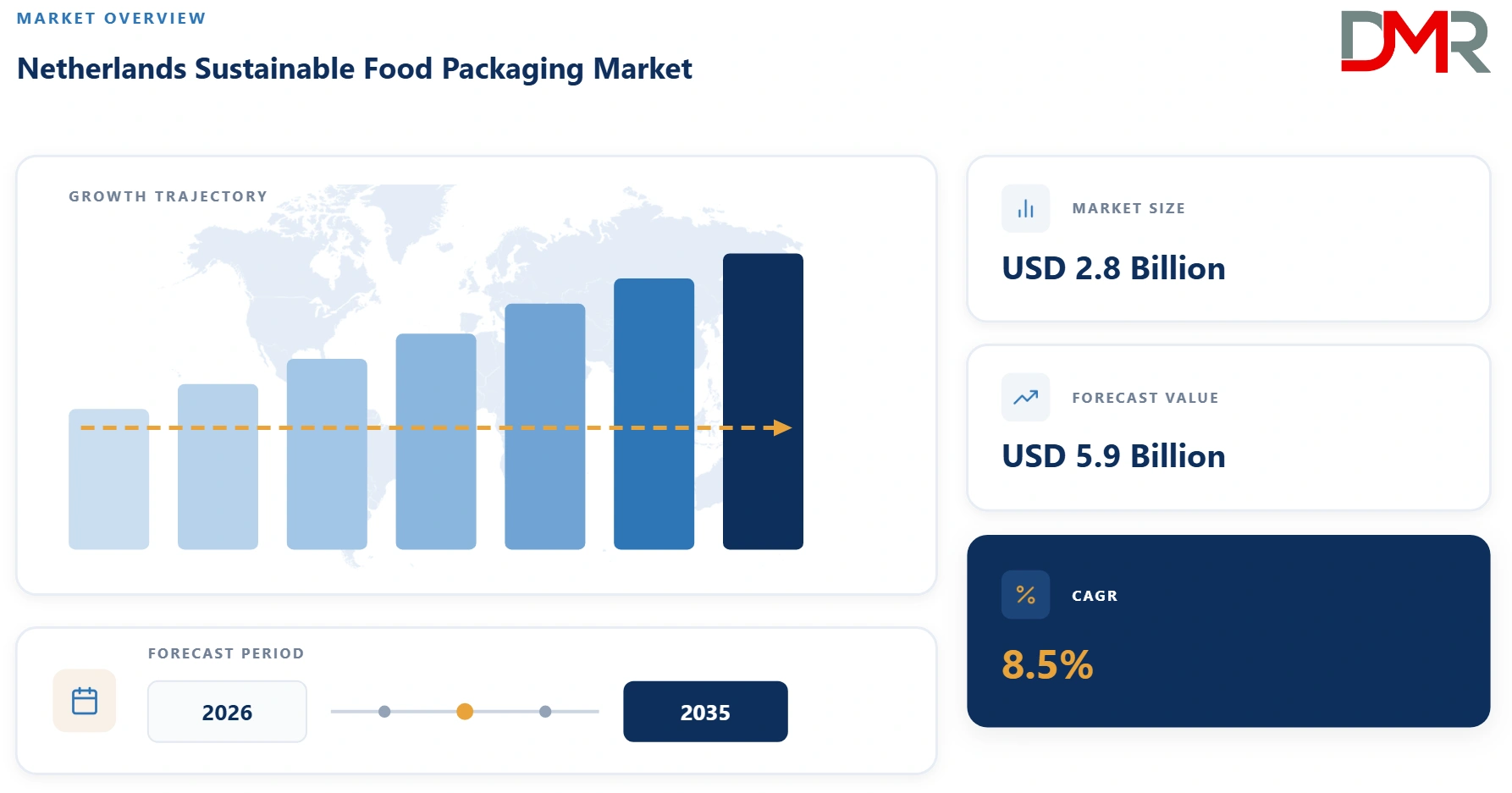
The Netherlands Sustainable Food Packaging Market is projected to be valued at USD 2.8 Billion in 2026 and is projected to reach USD 5.9 Billion by 2035, expanding at a CAGR of 8.5% during the forecast period.
ℹ
To learn more about this report –
Download Your Free Sample Report Here
Growth is being propelled by the Netherlands' position as one of Europe's most advanced circular economy policy environments, the country's role as a major European agri-food trading and re-export hub requiring extensive sustainable packaging for fresh produce and processed food distribution, and aggressive Dutch national targets for plastic packaging reduction and recycled content that exceed broader European Union baseline requirements. The maturing of recyclable and compostable packaging technologies capable of matching the barrier performance demanded by the Netherlands' extensive fresh produce distribution and re-export trade, growing retailer and food manufacturer investment in packaging redesign to meet the country's Extended Producer Responsibility and Plastic Pact commitments, and the Netherlands' concentration of innovative packaging technology startups and research institutions are reshaping the market from a conventional protective packaging category into one of Europe's most advanced sustainable packaging innovation environments. Investment is accelerating as Dutch packaging manufacturers and food companies pursue some of the most ambitious circular packaging targets in Europe while serving as a testing ground and early-adoption market for emerging sustainable packaging technologies.
Use Cases
- Sustainable Packaging for Fresh Produce Re-Export and Distribution: The Netherlands' major agricultural trading ports and distribution centers, serving as a European gateway for fresh produce imports and re-exports, rely on increasingly recyclable and compostable protective packaging to preserve product quality across the country's extensive fresh produce logistics network.
- Retailer-Led Plastic-Free and Reduced-Packaging Initiatives: Dutch grocery retailers, among the most advanced in Europe on packaging sustainability, implement plastic-free produce sections, refill stations, and reduced-packaging store formats, driving demand for packaging suppliers capable of supporting these more radical packaging reduction retail formats.
- Compostable Packaging for Meal Delivery and Quick-Commerce Platforms: Food delivery and quick-commerce platforms operating in Dutch urban centers adopt compostable and recyclable packaging solutions to align with strong Dutch consumer environmental expectations and municipal organic waste composting infrastructure.
- Recycled-Content Packaging for Dairy and Beverage Products: Dutch dairy and beverage manufacturers, serving both domestic and significant European export markets, incorporate recycled plastic content and recyclable mono-material structures into packaging to meet the Netherlands' Plastic Pact recycled-content commitments.
Key Takeaways
- Market Size: The Netherlands Sustainable Food Packaging Market is anticipated to be valued at USD 2.8 Billion in 2026 and is forecast to reach USD 5.9 Billion by 2035, expanding at a CAGR of 8.5%.
- Growth Outlook: Market expansion is sustained by the Netherlands' advanced circular economy policy environment, its position as a major European fresh produce trading and re-export hub, and continued retailer and manufacturer investment in packaging reduction and recycled-content initiatives.
- Primary Growth Drivers: Aggressive Dutch national plastic packaging reduction and recycled-content targets, the Netherlands' role as a major European agri-food distribution and re-export hub, strong Dutch consumer environmental awareness, and a concentrated domestic sustainable packaging innovation ecosystem are accelerating adoption.
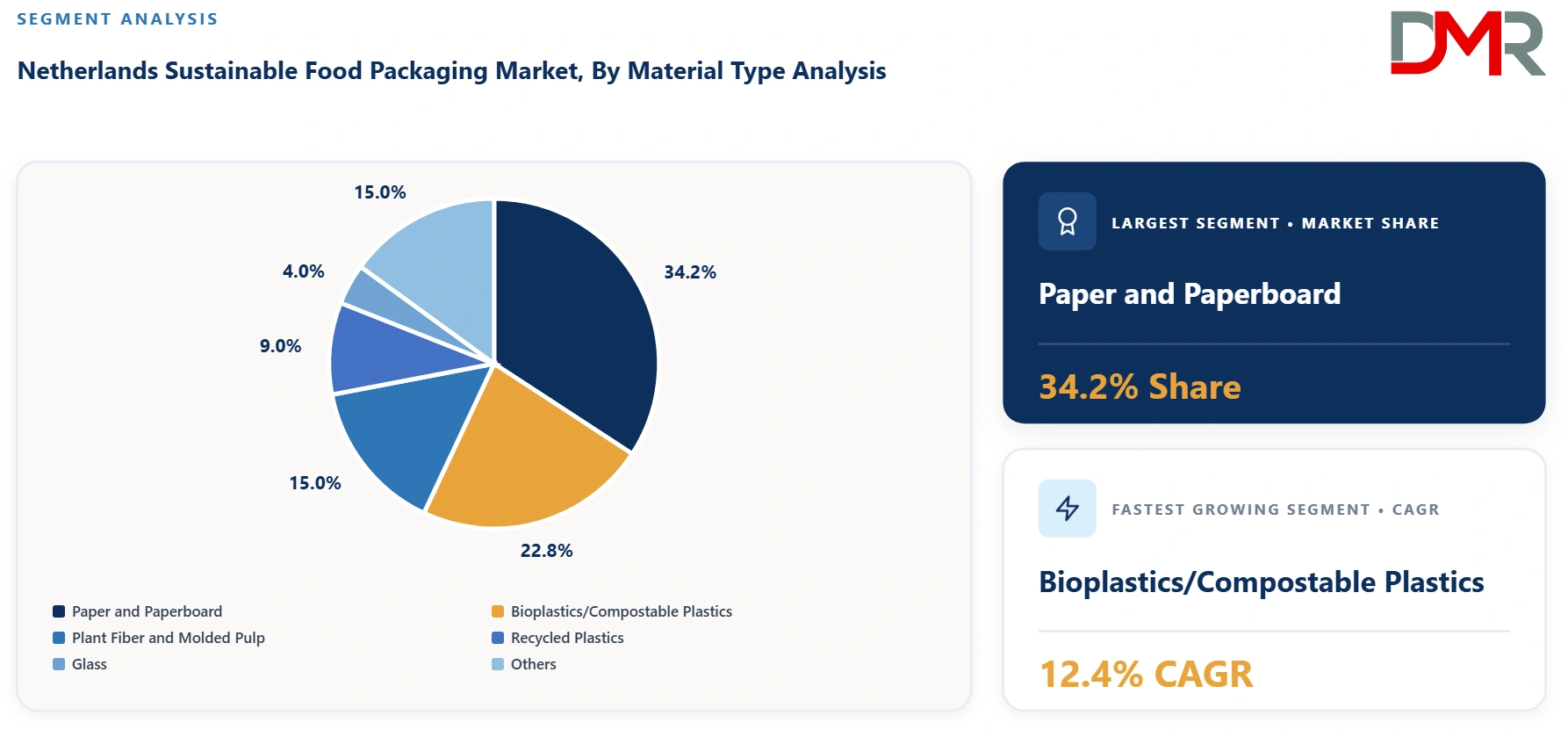
- By Material Type Analysis: Paper and Paperboard is projected to lead the material type segment with a 34.2% share in 2026, reflecting broad applicability and well-established Dutch recycling infrastructure. Bioplastics/Compostable Plastics is the fastest-growing material type segment at 12.4% CAGR, driven by expanding compostable packaging adoption supported by extensive Dutch municipal organic waste composting infrastructure.
- By Packaging Type Analysis: Flexible Packaging is expected to dominate with a 43.7% share in 2026, supported by widespread use across fresh produce and packaged food categories. Foodservice Disposables is the fastest-growing packaging type segment at 10.6% CAGR, driven by accelerating transition among Dutch foodservice and delivery operators toward compostable and recyclable disposable formats.
- By Application Analysis: Fresh Produce is poised to lead with a 27.1% share in 2026, reflecting the Netherlands' position as a major European fresh produce trading and distribution hub. Ready-to-Eat and Prepared Meals is the fastest-growing application segment at 10.1% CAGR, driven by expanding meal delivery and quick-commerce platform adoption of sustainable packaging.
- By End User Analysis: Retailers and Grocery Chains are projected to dominate with a 39.8% share in 2026, reflecting the leading role Dutch retailers play in driving packaging reduction and sustainability initiatives. Foodservice and Delivery Operators is the fastest-growing end user segment at 10.8% CAGR, fuelled by expanding meal delivery platform adoption of compostable and recyclable packaging.
Key Drivers in the Netherlands Sustainable Food Packaging Market
Aggressive National Plastic Reduction and Recycled-Content Policy Targets
The Netherlands has established some of Europe's most ambitious national packaging sustainability targets, including commitments under the Dutch Plastic Pact covering plastic packaging reduction, recycled-content minimums, and recyclability standards that in several respects exceed broader European Union baseline requirements. These aggressive national targets, combined with strong government-industry collaboration through voluntary and regulatory frameworks, are driving Dutch food and beverage manufacturers and retailers to pursue sustainable packaging transformation more rapidly than in many other European markets, positioning the Netherlands as an early-adoption and testing ground market for advanced sustainable packaging technologies.
The Netherlands' Role as a Major European Agri-Food Trading and Re-Export Hub
The Netherlands serves as one of Europe's principal gateways for fresh produce and processed food imports and re-exports, with major ports and logistics infrastructure supporting substantial agri-food trade volumes distributed across the broader European market. This trading hub function creates significant demand for sustainable packaging solutions capable of meeting both Dutch domestic sustainability requirements and the varying packaging standards of destination markets across Europe, positioning Dutch packaging suppliers and logistics providers at the center of a substantial, sustainability-conscious European fresh produce packaging value chain.
Restraints in the Netherlands Sustainable Food Packaging Market
Balancing Ambitious Domestic Targets with Practical Export Packaging Requirements
Reconciling the Netherlands' ambitious domestic packaging sustainability targets with the varying packaging standards and performance requirements of the many European export destinations served by Dutch re-export trade represents a meaningful restraint on the Netherlands Sustainable Food Packaging Market. Packaging formats optimized for Dutch domestic recyclability and compostability standards must also satisfy the sometimes differing requirements of destination markets, creating complexity for exporters and packaging suppliers seeking to standardize packaging formats across the Netherlands' extensive European trade network.
Growth Opportunities in the Netherlands Sustainable Food Packaging Market
Sustainable Packaging Innovation Hub Leveraging Dutch Research and Startup Ecosystem
The Netherlands' concentration of packaging research institutions, agri-food technology startups, and innovation-focused venture investment presents a substantial opportunity for the country to serve as a leading European hub for sustainable packaging technology development and early commercialization. Companies and research consortia developing next-generation compostable materials, recyclable barrier coatings, and innovative packaging reduction technologies can leverage the Netherlands' supportive innovation ecosystem and receptive early-adopter retail and food manufacturer base to accelerate commercialization before broader European market rollout.
Reusable and Refillable Packaging Systems for Retail and Foodservice
Growing Dutch retailer and consumer interest in reusable and refillable packaging systems, extending beyond recyclability toward genuine packaging reduction, presents an opportunity for companies developing reusable container, refill station, and deposit-return infrastructure suited to Dutch retail and foodservice environments. The Netherlands' relatively compact geography, high urban density, and strong existing deposit-return system infrastructure for beverage containers provide a favorable foundation for expanding reusable packaging models into a broader range of food categories.
Trends in the Netherlands Sustainable Food Packaging Market
Retailer-Led Radical Packaging Reduction Initiatives
Dutch grocery retailers are increasingly pursuing packaging reduction initiatives that go beyond material substitution toward genuine packaging elimination, including plastic-free produce sections, bulk and refill purchasing formats, and store designs that minimize overall packaging volume rather than simply substituting more sustainable materials for conventional plastic. This retailer-led approach reflects the Netherlands' generally more advanced position on the packaging sustainability hierarchy, prioritizing reduction and reuse alongside recyclability and compostability.
Growing Integration of Digital Deposit-Return and Traceability Systems
Building on the Netherlands' well-established beverage container deposit-return infrastructure, packaging stakeholders are increasingly exploring digital deposit-return and packaging traceability systems extending to a broader range of food packaging categories. These digital systems aim to improve return rates, verify recycled-content claims, and provide consumers with clearer end-of-life disposal guidance, reflecting the Netherlands' generally technology-forward approach to circular economy infrastructure development.
Research Scope and Analysis
The Netherlands Sustainable Food Packaging Market is segmented by material type, packaging type, application, and end user, covering paper and paperboard, bioplastics, molded pulp, recycled plastics, flexible and rigid packaging, foodservice disposables, and food and beverage manufacturer, retail, and foodservice end users.
ℹ
To learn more about this report –
Download Your Free Sample Report Here
By Material Type Analysis
Paper and Paperboard is projected to dominate the Netherlands Sustainable Food Packaging Market with 34.2% share in 2026, reflecting broad applicability across categories and well-established Dutch recycling and paper processing infrastructure. Bioplastics/Compostable Plastics is expected to register the highest CAGR of 12.4% during 2026-2035, driven by expanding use in compostable films and rigid containers, supported by the Netherlands' extensive municipal organic waste composting infrastructure that enables practical end-of-life processing for compostable packaging formats.
By Packaging Type Analysis
Flexible Packaging is anticipated to dominate the Netherlands Sustainable Food Packaging Market by packaging type, accounting for a 43.7% share in 2026, supported by widespread use across fresh produce, snacks, and packaged food categories requiring lightweight, cost-effective barrier protection. Foodservice Disposables is projected to register the highest CAGR of 10.6% between 2026 and 2035, driven by accelerating transition among Dutch foodservice, restaurant, and meal delivery operators away from conventional plastic disposables toward compostable and recyclable formats.
By Application Analysis
Fresh Produce is projected to lead the Netherlands Sustainable Food Packaging Market with an estimated 27.1% share in 2026, reflecting the Netherlands' position as a major European fresh produce import, distribution, and re-export hub requiring substantial protective packaging volumes. Ready-to-Eat and Prepared Meals is expected to register the fastest CAGR of 10.1% through 2035, driven by expanding meal delivery and quick-commerce platform adoption of sustainable packaging formats aligned with Dutch consumer environmental expectations.
By End User Analysis
Retailers and Grocery Chains are projected to dominate the Netherlands Sustainable Food Packaging Market with 39.8% share in 2026, reflecting the leading and proactive role Dutch grocery retailers play in driving packaging reduction and sustainability initiatives beyond baseline regulatory compliance. Foodservice and Delivery Operators are expected to register the fastest CAGR of 10.8% through 2035, fuelled by expanding meal delivery and quick-commerce platform growth and their adoption of compostable and recyclable packaging aligned with strong Dutch consumer sustainability expectations.
The Netherlands Sustainable Food Packaging Market Report is segmented based on the following:
By Material Type
- Paper and Paperboard
- Bioplastics/Compostable Plastics
- Plant Fiber and Molded Pulp
- Recycled Plastics
- Glass
- Others
By Packaging Type
- Flexible Packaging
- Rigid Packaging
- Foodservice Disposables
By Application
- Fresh Produce
- Bakery and Confectionery
- Dairy Products
- Beverages
- Meat, Poultry and Seafood
- Ready-to-Eat and Prepared Meals
- Others
By End User
- Food and Beverage Manufacturers
- Retailers and Grocery Chains
- Foodservice and Delivery Operators
Technology Analysis
Technology development is central to the trajectory of the Netherlands Sustainable Food Packaging Market as the country's concentrated packaging research and agri-food technology innovation ecosystem drives advances in recyclable barrier coatings, compostable resin formulations, and digital traceability systems. Growing use of chemical recycling and advanced sorting technology, supported by the Netherlands' well-developed waste management infrastructure, is improving end-of-life outcomes for more complex packaging formats. Opportunities are expanding for companies developing reusable packaging and refill system technology, PFAS-free barrier coating alternatives, and packaging formats specifically engineered to meet both Dutch domestic sustainability standards and the varying requirements of the Netherlands' extensive European export and re-export trade. However, ensuring packaging performance consistency across the diverse regulatory and consumer expectations of destination export markets remains an ongoing technical and commercial challenge.
Investment and White Space Analysis
Investment opportunities in the Netherlands Sustainable Food Packaging Market are expanding alongside the country's aggressive national sustainability policy targets, its role as a major European agri-food trading hub, and its concentrated packaging innovation ecosystem. Significant white space exists in reusable and refillable packaging system infrastructure, digital deposit-return and traceability technology, and packaging solutions engineered to satisfy both Dutch domestic standards and broader European export market requirements. Companies with strong domestic innovation capability, established retailer and food manufacturer relationships, and export-market packaging expertise are positioned to capture premium, longer-duration contracts and serve as a launching point for broader European sustainable packaging commercialization. However, the complexity of balancing ambitious domestic targets with practical export packaging requirements, along with intense competition among established European sustainable packaging suppliers, can constrain margins for smaller domestic innovators.
Competitive Landscape
The Netherlands Sustainable Food Packaging Market is moderately fragmented and highly innovative, comprising large diversified global packaging companies with Dutch operations, specialized Dutch sustainable packaging startups and scale-ups, and packaging research institutions collaborating closely with food manufacturer and retailer partners. Competition centers on sustainability innovation leadership, compliance with the Netherlands' aggressive national packaging targets, export market packaging performance capability, and collaborative relationships with major Dutch retailers driving packaging reduction initiatives. Large diversified packaging companies benefit from scale and established customer relationships across the Netherlands' significant export trade, while Dutch startups and scale-ups compete on cutting-edge sustainability innovation and close collaboration with the country's leading sustainability-focused retailers. Companies increasingly differentiate through verified circularity credentials, reusable packaging system capability, and innovation partnership relationships rather than material cost alone.
Some of the prominent players in the Netherlands Sustainable Food Packaging Market are:
- Amcor
- Mondi
- Smurfit Westrock
- Huhtamaki
- Tetra Pak
- Sealed Air
- Constantia Flexibles
- Coveris
- Stora Enso
- Metsä Board
- Oerlemans Packaging Group
- Paardekooper
- Royal LC Packaging
- BioPak
- ALPLA
- Greiner Packaging
- ProAmpac
- Ardagh Group
- O-I Glass
- CANPACK
- Coexpan
- SÜDPACK
- Schur Flexibles
- Berry Global
- Sonoco
- Graphic Packaging International
- DS Smith
- SIG
- Walki Group
- Bischof+Klein
- Sappi
- UPM Specialty Papers
- delfort
- Mondi Kalenobel
- Faerch
- PACCOR
- NatureWorks
- Novamont
- Sabert
- Gualapack
- Other Key Players
Recent Developments
- June 2026: OPACKGROUP/Oerlemans Packaging Group highlighted new recyclable barrier packaging solutions designed to replace conventional laminated structures while maintaining protection requirements for food applications. The development supports growing demand in the Netherlands for mono-material and recycling-compatible flexible packaging.
- April 2026: Oerlemans Plastics advanced the CIFLEX material innovation project in collaboration with TNO and the University of Twente, focusing on next-generation flexible packaging materials and improved circularity performance.
- April 2026: Amcor, together with Metsä Group and G. Mondini, introduced an integrated fiber-based tray solution for meat, protein and chilled ready-meal packaging. The system is designed to reduce plastic use while maintaining barrier performance, shelf life and recyclability.
Report Details
| Report Characteristics |
| Market Size (2026) |
USD 2.8 Bn |
| Forecast Value (2035) |
USD 5.9 Bn |
| CAGR (2026–2035) |
8.5% |
| Historical Data |
2021 – 2025 |
| Forecast Data |
2026 – 2035 |
| Base Year |
2025 |
| Segments Covered |
By Material Type, By Packaging Type, By Application, and By End User |
| Country Coverage |
Netherlands |
Frequently Asked Questions
How big is the Netherlands Sustainable Food Packaging Market?
▾ The Netherlands Sustainable Food Packaging Market is valued at USD 2.8 Billion in 2026 and is projected to reach USD 5.9 Billion by 2035, reflecting the country's advanced circular economy policy environment and its role as a major European fresh produce trading and re-export hub.
What is the CAGR of the Netherlands Sustainable Food Packaging Market from 2026 to 2035?
▾ The market is projected to expand at a compound annual growth rate (CAGR) of 8.5% between 2026 and 2035, supported by aggressive national packaging reduction targets, strong Dutch consumer environmental awareness, and a concentrated sustainable packaging innovation ecosystem.
What factors are driving the growth of the Netherlands Sustainable Food Packaging Market?
▾ Growth is driven by aggressive Dutch national plastic packaging reduction and recycled-content targets, the Netherlands' role as a major European agri-food distribution and re-export hub, strong Dutch consumer environmental awareness, and a concentrated domestic sustainable packaging innovation ecosystem.
What are the major trends in the Netherlands Sustainable Food Packaging Market?
▾ Major trends include retailer-led radical packaging reduction initiatives such as plastic-free produce sections, growing integration of digital deposit-return and traceability systems, and expanding investment in reusable and refillable packaging models.
Who are the key players in the Netherlands Sustainable Food Packaging Market?
▾ Key market participants include DS Smith Netherlands, Amcor, Trivium Packaging, Solidus Solutions, and Huhtamaki Netherlands, among other diversified and specialty Dutch and European sustainable packaging companies.
How is the Netherlands Sustainable Food Packaging Market segmented?
▾ The market is segmented by material type, packaging type, application, and end user, with demand analysis concentrated across the Randstad region, including Rotterdam, Amsterdam, and The Hague.