What is the Network as a Service Market Size?
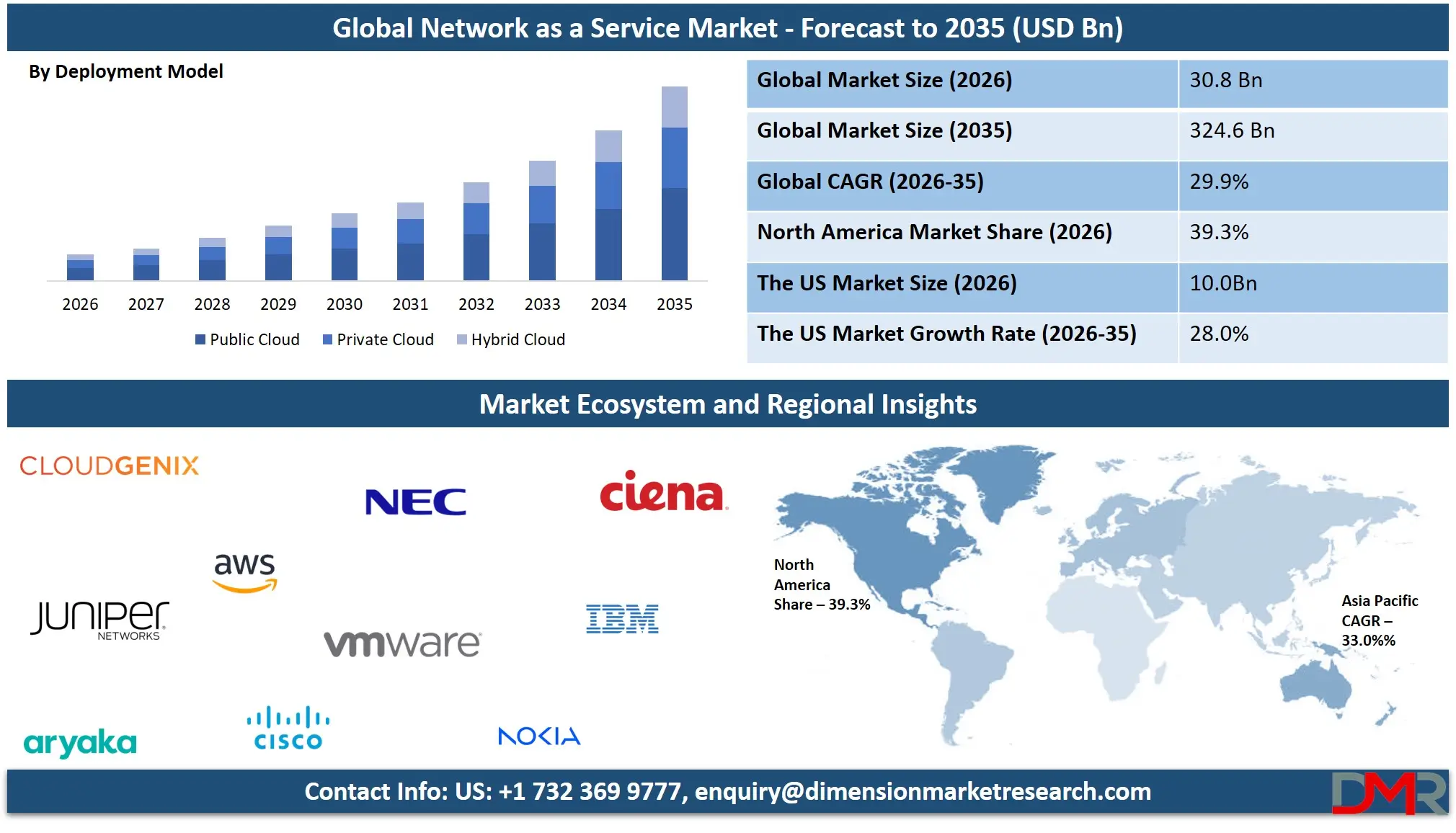
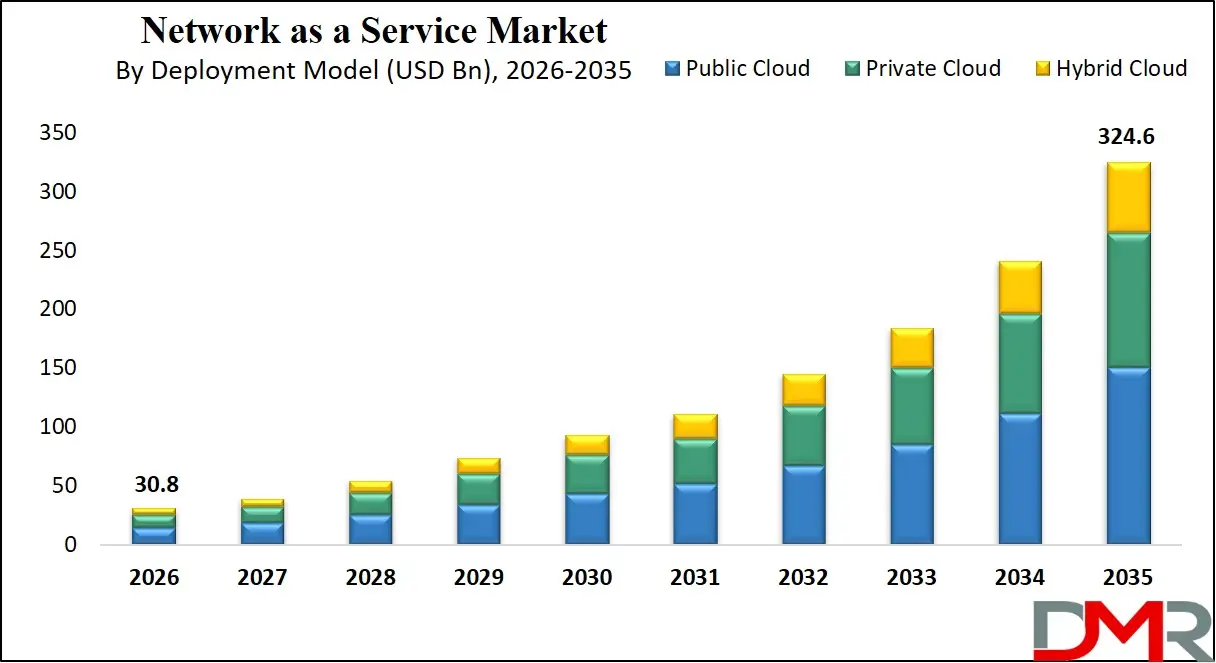
The Network as a Service Market size is expected to be USD 30.8 billion in 2026 and increase at a compound annual growth rate of 29.9% to USD 324.6 billion in 2035 due to fast transition towards cloud-based technologies and digital transformation.
ℹ
To learn more about this report –
Download Your Free Sample Report Here
The growth of the Network as a Service (NaaS) market is experiencing rapid development because companies are gradually moving to adopt cloud-based networks and infrastructure services. Enterprises are embracing a transition from legacy hardware-based networks to flexible software-based networks that ensure efficiency, flexibility, and easy management. The growth is being propelled by increased usage of SD-WAN, edge computing, and remote work. In addition to this, the use of analytics, automation, and security solutions is changing the approach to enterprise networking.
ℹ
To learn more about this report –
Download Your Free Sample Report Here
The US Network as a Service Market
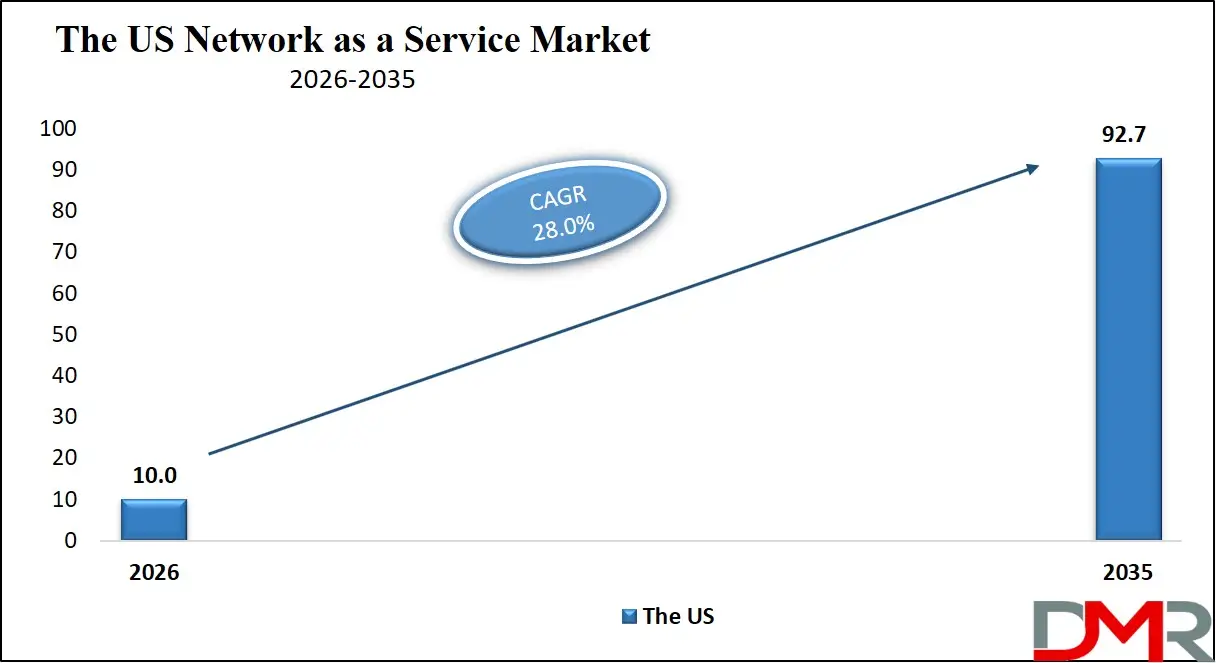
The US Network as a Service Market size is estimated to be USD 10.0 billion in 2026 and is expected to increase at a CAGR of 28.0% over the forecast period.
ℹ
To learn more about this report –
Download Your Free Sample Report Here
Cloud technology is widely embraced by the US market, owing to the prevalence of cutting-edge IT infrastructure and the demand for enterprise-wide network connectivity systems. Large businesses use NaaS for their digital transformation and remote work management. Government support for cybersecurity and cloud computing helps drive growth. The availability of prominent technology firms and advancements in software-defined wide-area networks (SD-WANs) and edge computing also fuel growth in the market. Finally, the implementation of data security regulations pushes companies to adopt more secure NaaS services.
Europe Network as a Service Market
The Europe Network as a Service Market size is estimated to be USD 7.7 billion in 2026 and at a CAGR of 28.4% over the forecast period.
The Europe Network as a Service (NaaS) market is shaped by the presence of stringent laws related to data privacy and the need for sustainability through initiatives like the European Green Deal. Enterprises are leveraging energy-efficient cloud-based networks. There is high demand for the technology in industrial verticals including manufacturing, banking, finance, securities, insurance, and government services. Favorable policies that aim at developing digital infrastructure and connecting borders are also aiding the growth of NaaS adoption.
Japan Network as a Service Market
The market size of Japan Network as a Service will be USD 1.2 billion in 2026 and at a CAGR of 28.5% in the forecast period.
Japan's network market features advanced technology infrastructure as well as active participation by the government in digitalizing the market. The fast rate of urbanization and industrialization in Japan leads to higher demands for flexible network infrastructure. Some of the important sectors involved include manufacturing, telecommunication, and smart infrastructure. Various government projects aimed at expanding the use of 5G infrastructure and smart cities have fueled the adoption of networks. However, some challenges, like integration difficulties, still exist. Despite all of this, opportunities keep increasing.
Key Takeaways
- Market Size & Forecast: The Network as a Service Market size is projected to reach USD 30.8 billion in 2026 and is anticipated to have a value of USD 324.6 billion in 2035.
- Growth Rate & Outlook: The Network as a Service Market size is set to grow at a compound annual growth rate of 29.9% during the forecast period of 2026 to 2035.
- Primary Growth Drivers: Some of the major growth drivers in the market include growing adoption of cloud and digital transformation, rising demand for secure and scalable networking, and more.
- Key Market Trends: Some of the major trends in the market are integration of AI and automation, shift toward zero-trust security models, and more.
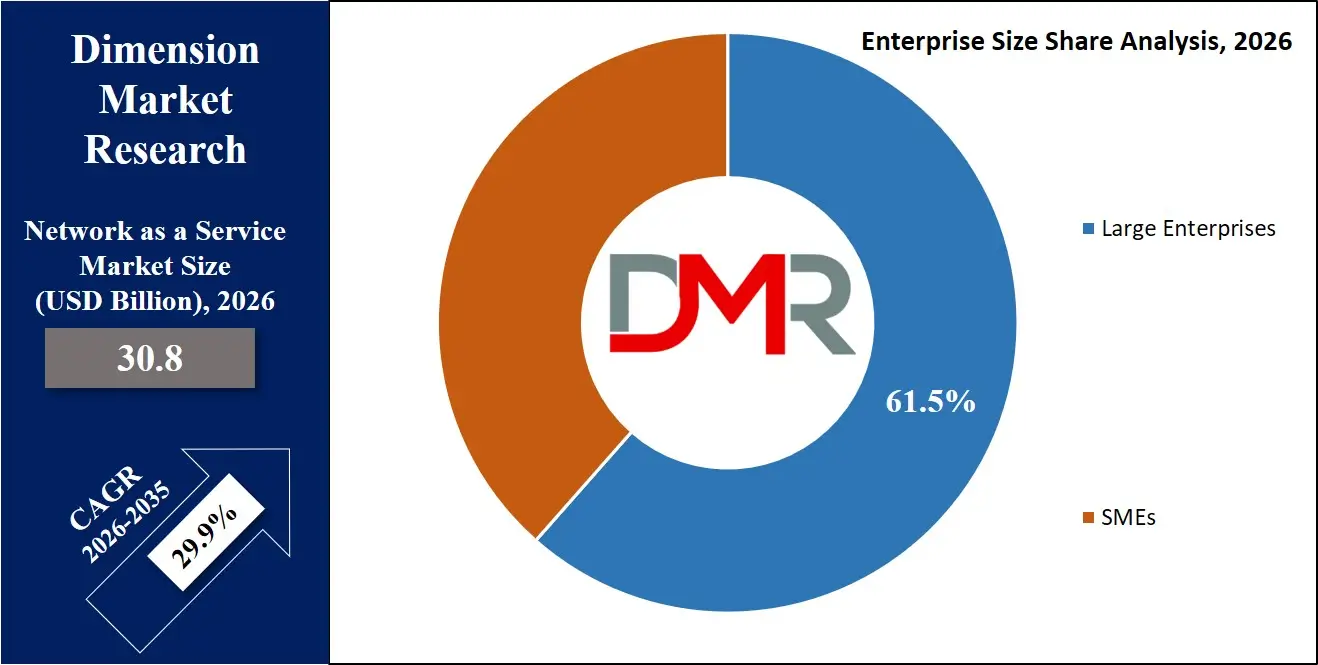
- By Enterprise Size: The large enterprise segment is anticipated to get the majority share of the Network as a Service market in 2026.
- By Deployment Model: The public cloud segment is expected to get the largest revenue share in 2026 in the Network as a Service market.
- By End User Industry: The IT & Telecom segment is expected to get the largest revenue share in 2026 in the Network as a Service market.
- Regional Leadership: North America is set to lead the Network as a Service market with an estimated 39.3% share in 2026.
What is the Network as a Service?
Network as a Service (NaaS) is defined as a cloud computing delivery approach whereby the functionalities associated with networking, which include connectivity, security, management, and monitoring, can be accessed as a service either through subscriptions or pay-per-use models. Some of the examples of NaaS are software-defined wide area networking (SD-WAN), virtual private networks, and network security solutions. The advantage of NaaS is that it facilitates dynamic scaling and optimization of network resources while reducing the cost of ownership. It offers great importance in providing software-defined networking that aligns with digital environments.
Use Cases
- Enterprise Network Modernization: Organizations replace legacy infrastructure with cloud-managed networking, enabling scalability, centralized control, and reduced operational costs while improving performance and agility.
- Remote Workforce Enablement: NaaS supports secure remote access through VPN and zero-trust frameworks, ensuring seamless connectivity and productivity for distributed teams.
- Multi-Cloud Connectivity: Businesses use NaaS to integrate and manage connectivity across multiple cloud platforms, improving workload performance and reducing latency.
- Branch Network Optimization: Retail chains and enterprises deploy SD-WAN-based NaaS to streamline branch connectivity, enhance reliability, and enable real-time analytics.
How AI Is Transforming the Network as a Service Market
AI technology is revolutionizing the NaaS industry through network intelligence and automation. By leveraging AI-powered solutions to monitor network traffic and predict possible failures, optimization of the network operations can be achieved, which will minimize costs while providing reliable services to businesses.
On the other hand, AI is also helping to improve customer experience as well as ensuring network security through personalized services and threat prevention capabilities.
Market Dynamic
Driving Factors in the Network as a Service Market
Growing Adoption of Cloud and Digital Transformation
One of the major forces behind the growth of the NaaS industry is the fast transition towards cloud-based technologies and digital transformation. Companies opt for cloud-based services because these allow enhancing the efficiency and performance of their operations. NaaS ensures smooth implementation into any cloud platform, and therefore it works well with hybrid and multi-cloud systems. Thus, the company does not depend on hardware but focuses on adapting to new circumstances rapidly. Furthermore, digital transformation trends push the development of flexible networks for applications.
Rising Demand for Secure and Scalable Networking
With the evolution of cyberattacks, companies need reliable networking services. NaaS comes with inherent security solutions like zero trust access, encryption, and monitoring. These functions enable firms to safeguard their information and comply with regulations. The growing complexity of organizational networks along with the demand for instant data access is boosting interest in flexible networking services. NaaS fulfills these requirements with its central management and automation services for security.
Restraints in the Network as a Service Market
High Dependence on Reliable Connectivity Infrastructure
The success of NaaS is largely dependent upon a stable and fast internet connection. In locations where infrastructure is not well developed, there could be problems regarding internet performance, thereby making it difficult for NaaS services to gain popularity. Businesses will find it difficult to make the switch from the old networking model due to dependence on the internet connection.
Data Privacy and Regulatory Challenges
Network as a Service might be adversely affected by stringent data protection policies and guidelines. It is necessary for organizations to ensure that the third-party providers of networking services comply with the laws in place concerning the use of the data. It may prove difficult to deploy NaaS due to the increased cost involved.
Opportunities in the Network as a Service Market
Expansion of 5G and Edge Computing
The development of 5G and edge computing technology has opened up new avenues for the growth of NaaS. This is due to the rapid processing of data and low latency, which supports complex applications like Internet of Things (IoT) and real-time analytics. With this, NaaS companies can offer superior services that will attract customers from various sectors, including health care, manufacturing, and smart city management.
Increasing Adoption Among SMEs
The increasing trend among SMEs for utilizing NaaS offerings can be attributed to their relatively lower costs and scalability. As opposed to conventional networking solutions, there are no large capital outlays needed by using NaaS. Hence, more SMEs will embrace this technology as they gradually transition towards digitalization in their operations.
Trends in the Network as a Service Market
Integration of AI and Automation
Networks managed by AI are emerging as a significant trend in the NaaS space. With the ability to monitor networks in real time and allocate resources efficiently, automation leads to lesser downtime and increased efficiency of the network infrastructure. The analytics generated from AI can offer insights into the usage patterns of the network.
Shift Toward Zero-Trust Security Models
There has been an evolution of NaaS through the implementation of zero trust security approaches. Companies have shifted from the conventional security approach based on perimeter security to an approach where all access requests are verified. This is because the number of cyberattacks has increased in recent times, necessitating more stringent security.
Research Scope and Analysis
The market is analyzed across service types, deployment modes, enterprise sizes, end-user industries, and applications. Key trends highlight dominance of network security services, public cloud deployment, large enterprises, IT & telecom sector, and rapid growth in hybrid cloud and remote workforce solutions.
ℹ
To learn more about this report –
Download Your Free Sample Report Here
By Service Type Analysis
Network Security as a Service will continue to lead the market with its projected dominance of 34.7% by 2026, owing to the rising threats associated with security issues and regulations. Organizations have become conscious of securing their networks, thus making them opt for services like ZTNA and FWaaS. WAN as a Service will emerge as another important segment, owing to the adoption of SD-WAN in enterprises. In addition, Network Monitoring & Analytics will be the fastest-growing segment, propelled by the rising need for predictive analysis and resolving issues on a timely basis.
By Deployment Mode Analysis
Public Cloud will be the leading market segment with 46.2% share in 2026 due to its scalability, cost-efficiency, and ease of implementation. Public clouds are widely used by enterprises because they are flexible, accessible globally, and lower the cost of infrastructure maintenance. Hybrid Cloud is set to become the fastest growing segment because companies look for ways to maintain both security and efficiency through the use of a hybrid cloud strategy. This enables organizations to keep critical processes safe within a private environment and scale their resources via public clouds.
By Enterprise Size Analysis
The Large Enterprises will have the largest market share of 61.5% by 2026 owing to their high networking needs, intricate IT infrastructure, and substantial financial resources allocated towards digital transformation projects. The Large Enterprises are pioneers in adopting innovative networking technologies such as AI-enabled networking management and zero trust architecture. Nevertheless, the SMEs will be the most rapidly growing market segment because of the rise in digitalization and the need for efficient and cost-effective networking solutions. NaaS allows the SMEs to leverage the benefits of enterprise-level networking without any substantial capital expenditure.
By End User Industry Analysis
The IT and Telecommunications vertical is expected to dominate, accounting for 29.8% of the market in 2026 due to the requirement for state-of-the-art network technologies that can handle data-driven requirements, cloud computing, and faster connectivity options. BFSI and the healthcare verticals have been important contributors owing to the dependency of these industries on robust and secure networks. Retail & E-commerce emerges as the fastest growing vertical owing to an increase in online transactions and omni-channel retailing initiatives.
By Application Analysis
The Cloud Connectivity segment is anticipated to hold a dominant position with a market share of 38.4% in 2026 owing to the growing use of cloud-based apps, SaaS products, and distributed loads. The advantages of cloud connectivity include high performance and low latency among others. The Branch Connectivity segment is likely to continue gaining prominence due to the necessity of efficient management of distributed networks. The Remote Workforce Enablement segment is predicted to be the fastest growing, owing to hybrid work arrangements, dependency on remote tools, and secure access requirements.
The Network as a Service Market Report is segmented on the basis of the following:
By Service Type
- Wide Area Network (WAN) as a Service
- SD-WAN
- MPLS-based WAN
- Hybrid WAN
- Local Area Network (LAN) as a Service
- Wired LAN
- Wireless LAN (WLAN)
- Virtual Private Network (VPN) as a Service
- Remote Access VPN
- Site-to-Site VPN
- Network Security as a Service
- Firewall as a Service (FWaaS)
- Secure Web Gateway (SWG)
- Zero Trust Network Access (ZTNA)
- Cloud Access Security Broker (CASB)
- Network Monitoring & Analytics
By Deployment Model
- Public Cloud
- Private Cloud
- Hybrid Cloud
By Enterprise Size
- Small & Medium Enterprises (SMEs)
- Large Enterprises
By End-User Industry
- BFSI
- IT & Telecommunications
- Healthcare
- Retail & E-commerce
- Manufacturing
- Government & Public Sector
By Application
- Branch Connectivity
- Remote Workforce Enablement
- Cloud Connectivity
- Data Center Interconnect
Regional Analysis
Leading Region in the Network as a Service Market
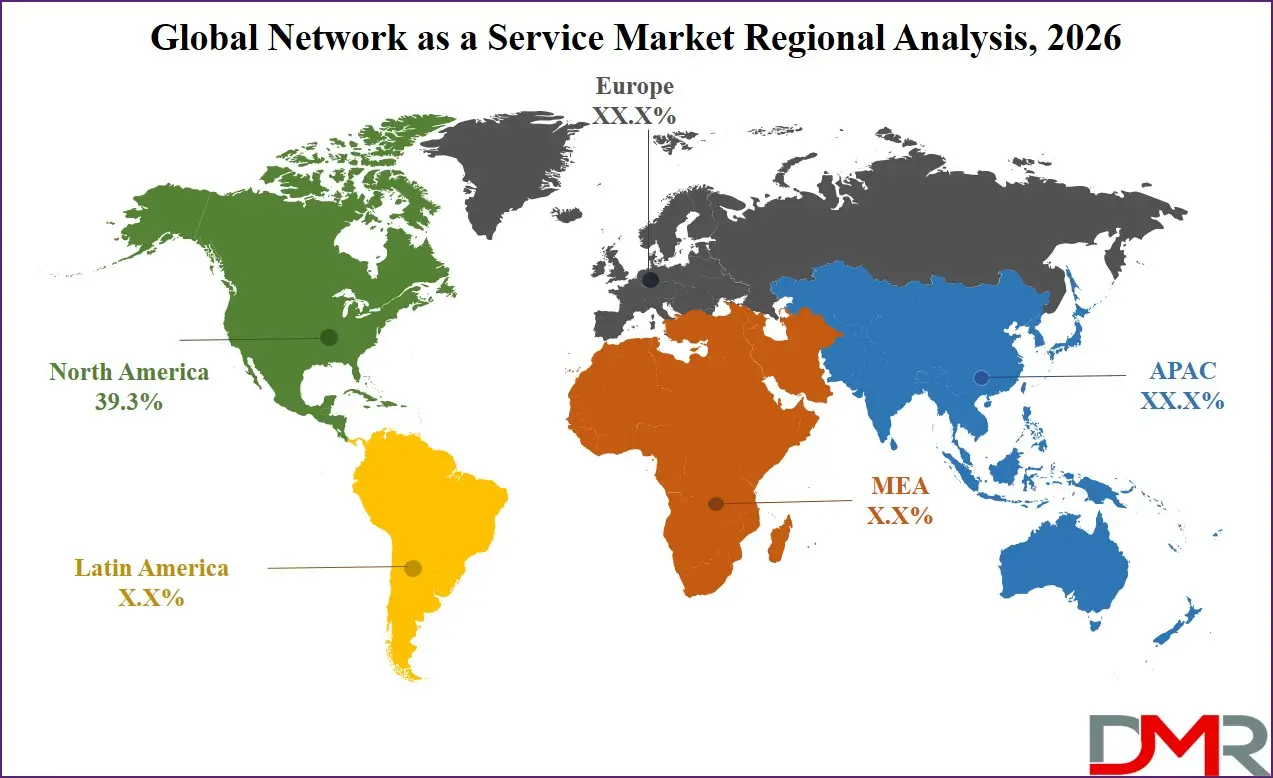
North America is predicted to hold a 39.3% market share by 2026 in the NaaS market. This is due to the fact that North America has advanced IT infrastructure, has high adoption rates of the cloud, and is home to major technology vendors with networking innovations. Further, government programs related to cybersecurity, data security, and digital transformation contribute towards the development of the market in North America. North American enterprises are among the earliest adopters of advanced technology solutions like AI, SD-WAN, and edge computing.
ℹ
To learn more about this report –
Download Your Free Sample Report Here
Fastest Growing Region in the Network as a Service Market
The Asia-Pacific region is witnessing a higher rate of growth in the NaaS market than any other region because of the high pace of digitalization and urbanization, along with investments in IT infrastructure. There is an активное uptake of cloud computing technology, the development of 5G infrastructure, and developments in smart cities in countries within the region, which has been greatly contributing towards the growth of the market. In addition, the increasing number of small and medium enterprises, along with internet usage and the need for efficient IT solutions, have helped fuel market growth.
By Region
North America
Europe
- Germany
- The U.K.
- France
- Italy
- Russia
- Spain
- Benelux
- Nordic
- Rest of Europe
Asia-Pacific
- China
- Japan
- South Korea
- India
- ANZ
- ASEAN
- Rest of Asia-Pacific
Latin America
- Brazil
- Mexico
- Argentina
- Colombia
- Rest of Latin America
Middle East & Africa
- Saudi Arabia
- UAE
- South Africa
- Israel
- Egypt
- Rest of MEA
Competitive Landscape
The NaaS industry is highly competitive, where there are innovations constantly being brought about and collaboration of strategic partners. There are heavy investments being made in the provision of services, research and development, as well as incorporation of sophisticated technology such as artificial intelligence and automation. The level of difficulty of entering the industry is quite high because of its need for sophisticated technological infrastructure. Competition in this industry is based on collaboration, acquisition, and cloud-based strategy.
Some of the prominent players in the global Network as a Service are:
- Cisco Systems
- Juniper Networks
- IBM
- NEC Corporation
- VMware
- Aryaka Networks
- Nokia (Alcatel-Lucent)
- Brocade Communications Systems
- AT&T
- Ciena Corporation
- Extreme Networks
- Akamai Technologies
- Amazon Web Services
- Broadcom
- Lumen Technologies
- Citrix Systems
- CloudGenix
- Cradlepoint
- Rackspace Technology
- Silver Peak Systems
- Other Key Players
Recent Developments
- In February 2026, NWN enhanced its Intelligent Cloud services to support scalable AI adoption, combining AI-powered managed services, unified visibility through its Experience Management Platform, and expert-led cloud modernization. The offering helps enterprises manage growing infrastructure demands, security challenges, and rising costs across AWS, Microsoft Azure, and hybrid environments. By addressing fragmented tools and limited visibility, NWN delivers continuous operations and predictable outcomes, enabling organizations to operate more efficiently and confidently in complex cloud ecosystems.
- In January 2026, Colt Technology Services expanded its Internet On Demand service to ten additional countries, increasing availability to 27 markets across Europe, Asia, and North America, with bandwidth up to 10Gbps. The service supports growing demand for flexible, automated digital infrastructure as businesses scale globally. Customers in the UK and France also gain access to an energy-efficient virtual router, with broader rollout planned. With features like real-time connectivity and pay-as-you-go pricing, the solution helps organizations optimize costs, reduce emissions, and enhance network agility.
- In December 2025, PacketFabric launched PacketFabric.ai, an AI-native Network-as-a-Service platform that allows enterprises to design, price, and provision connectivity using natural-language commands. Backed by Digital Alpha, the solution streamlines processes that once took weeks into seconds by delivering instant pricing, validated options, and automated provisioning. By removing manual steps and complexity, PacketFabric.ai enhances speed, transparency, and efficiency, enabling organizations to deploy network services seamlessly and scale infrastructure with greater agility.
Report Details
| Report Characteristics |
| Market Size (2026) |
USD 30.8 Bn |
| Forecast Value (2035) |
USD 324.6 Bn |
| CAGR (2026–2035) |
29.9% |
| Historical Period |
2021 – 2025 |
| Forecast Period |
2027 – 2035 |
| Base Year |
2025 |
| Estimate Year |
2026 |
| Segments Covered |
By Service Type (Wide Area Network (WAN) as a Service, Local Area Network (LAN) as a Service, Virtual Private Network (VPN) as a Service, Network Security as a Service, Network Monitoring & Analytics), By Deployment Model (Public Cloud, Private Cloud, Hybrid Cloud), By Enterprise Size (Small & Medium Enterprises (SMEs), Large Enterprises), By End-User Industry (BFSI, IT & Telecommunications, Healthcare, Retail & E-commerce, Manufacturing, Government & Public Sector), By Application (Branch Connectivity, Remote Workforce Enablement, Cloud Connectivity, Data Center Interconnect) |
| Regional Coverage |
North America – The US and Canada; Europe – Germany, The UK, France, Russia, Spain, Italy, Benelux, Nordic, & Rest of Europe; Asia-Pacific – China, Japan, South Korea, India, ANZ, ASEAN, Rest of APAC; Latin America – Brazil, Mexico, Argentina, Colombia, Rest of Latin America; Middle East & Africa – Saudi Arabia, UAE, South Africa, Turkey, Egypt, Israel, & Rest of MEA |
Frequently Asked Questions
How big is the Network as a Service Market?
▾ The Network as a Service Market size is expected to reach USD 30.8 billion by 2026 and is projected to reach USD 324.6 billion by the end of 2035.
What is the CAGR of the Network as a Service Market from 2026 to 2035?
▾ The market is growing at a CAGR of 29.9 percent over the forecasted period.
What factors are driving the growth of the Network as a Service Market?
▾ Growing adoption of cloud and digital transformation, rising demand for secure and scalable networking, and more are the factors driving the growth of the Network as a Service Market.
What are the major trends in the Network as a Service Market?
▾ Integration of AI and automation, shift toward zero-trust security models, and more are some of the major trends in the market.
Who are the key players in the Network as a Service Market?
▾ Some of the key players in the Network as a Service Market include IBM, Cisco, Nokia and more
How is the Network as a Service Market segmented?
▾ The Network as a Service Market is segmented by service type, deployment model, enterprise size, end-user industry, application.
Which region held the largest share of the Network as a Service Market in 2026?
▾ North America is set to lead the Network as a Service market with an estimated 39.3% share in 2026.
Which region is expected to grow the fastest in the Network as a Service Market?
▾ Asia-Pacific is the fastest-growing region in the Network as a Service market during the forecast period.