Market Snapshot
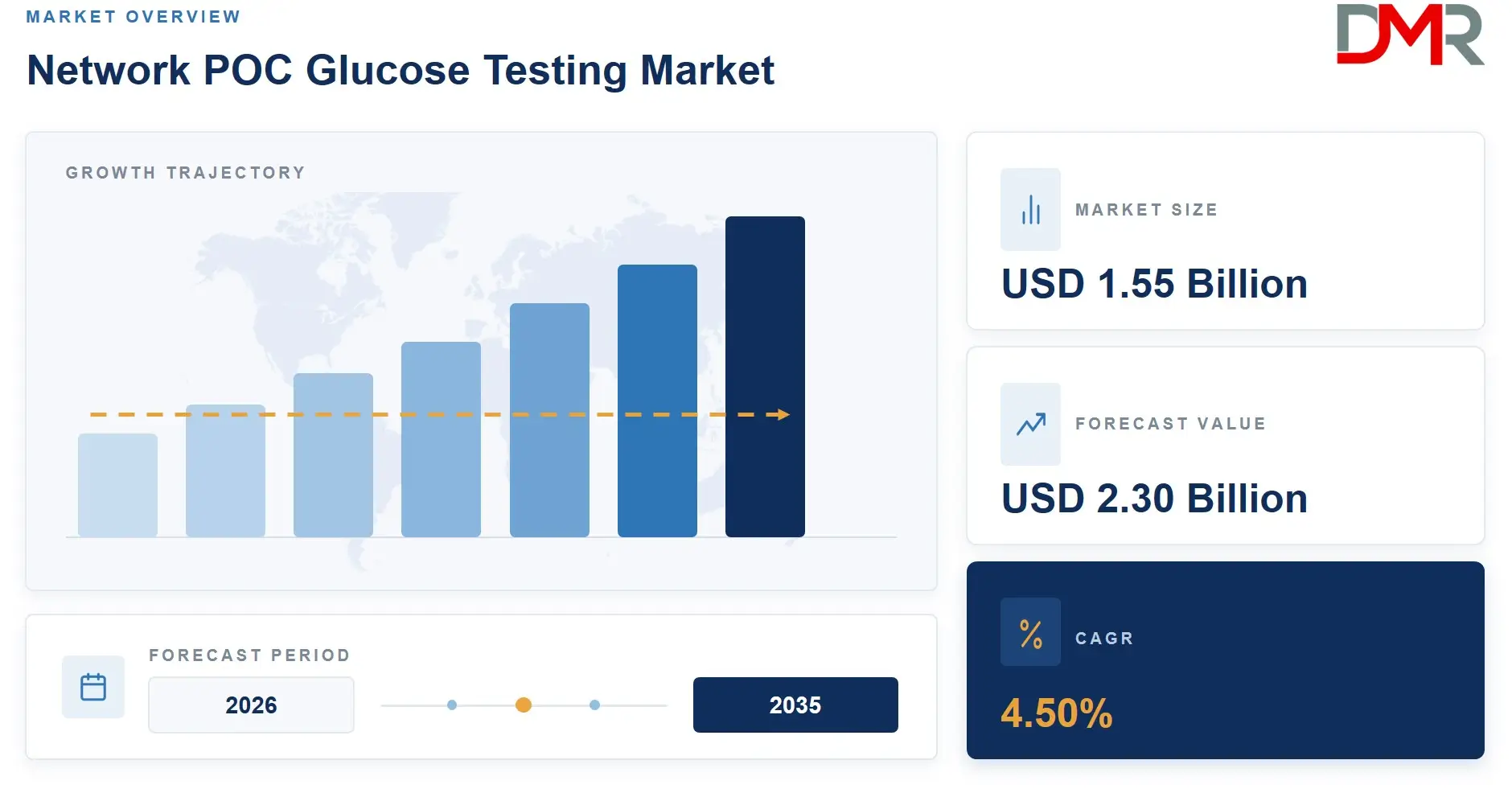
- The Global Network Point-of-Care Glucose Testing Market was valued at USD 1.48 Billion in 2025 and is projected to reach USD 2.30 Billion by 2035, at a CAGR of 4.50%.
- By Product Type, Accu-Chek Inform II led with a 48.40% share in 2025; CareSens Expert Plus is the fastest-growing product.
- By Distribution Channel, Offline Retail held a 45.45% share in 2025; Online Retail is the fastest-growing channel.
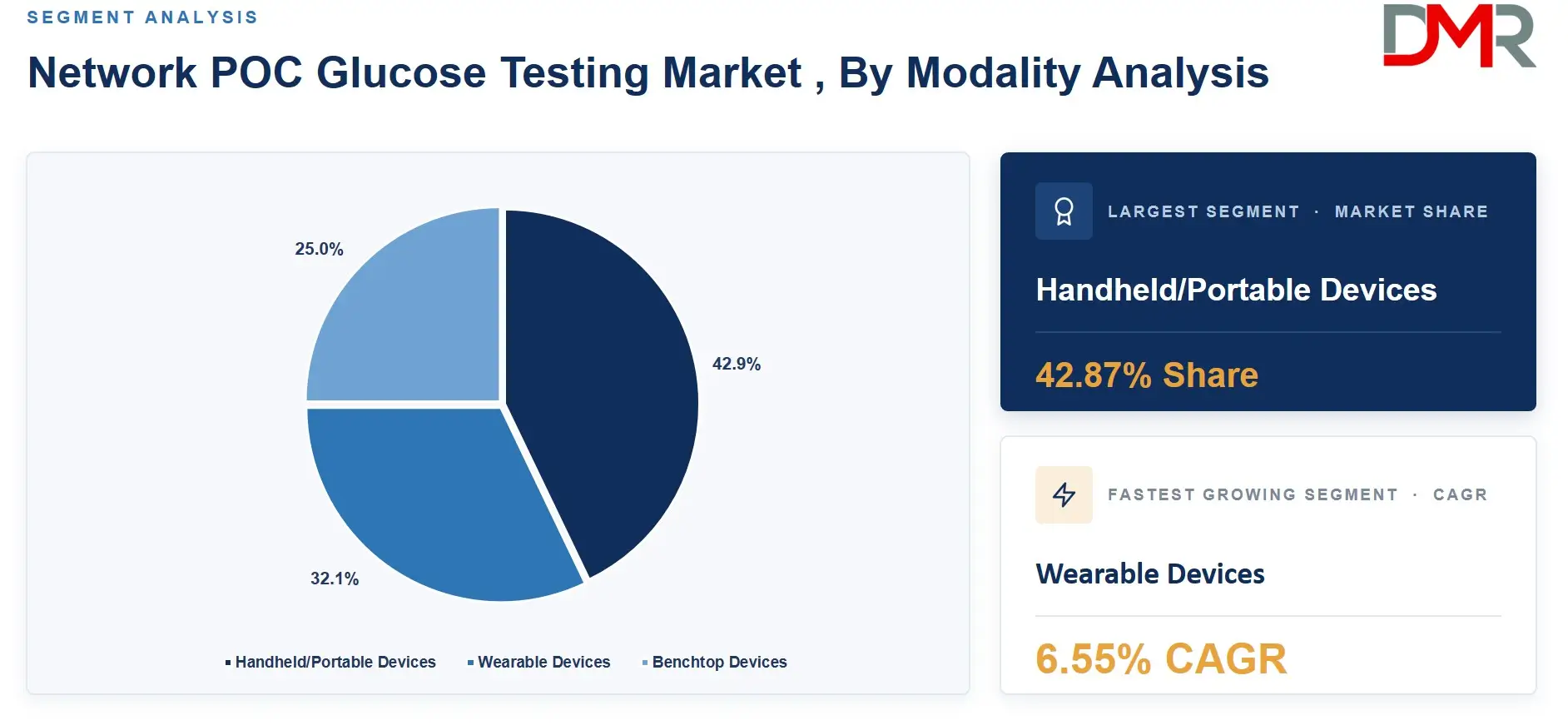
- By Modality, Handheld/Portable Devices captured a 42.87% share in 2025; Wearable Devices is the fastest-growing modality.
- North America commanded a 40.27% regional share in 2025; Asia-Pacific is the fastest-growing region at a 7.45% CAGR.
Market Overview
Network Point-of-Care (POC) glucose testing covers bedside and ward-level blood glucose measurement systems that transmit results electronically to hospital information systems, laboratory information systems (LIS), or electronic medical records (EMR). The market excludes standalone glucometers with no connectivity capability, continuous glucose monitoring (CGM) wearables sold into consumer channels, and central laboratory analyzers. Its defining characteristic is bidirectional data flow: operators log results, the device enforces compliance protocols, and glucose readings populate the patient record automatically.
A 2025 evaluation published by PubMed confirmed that network-capable POC glucometers achieve correlation coefficients of 0.982 (Cobas Pulse) and 0.959 (StatStrip) against a central laboratory analyzer, as reported by the study authors. This performance level validates networked bedside meters as clinically credible alternatives to laboratory testing for rapid inpatient decisions. Hospitals that accept this equivalence can consolidate glycemic data at the ward level without routing samples to the central lab, cutting turnaround time and nurse workload simultaneously.
The market sits inside the broader POC diagnostics industry, which is itself a sub-segment of in-vitro diagnostics (IVD). Hospital glycemic management programs supply the primary demand base; acute-care settings such as ICUs, surgical units, and neonatal wards account for the largest device volumes. Hospital-wide mandates requiring HL7/FHIR middleware integration between glucometers and EMR platforms have shifted procurement decisions from individual departments to central IT and supply chain functions, raising both the sales cycle length and the average contract value.
Market Size and Forecast
The Global Network Point-of-Care Glucose Testing Market size is estimated at USD 1.55 Billion in 2026 from USD 1.48 Billion in 2025, and is projected to reach USD 2.30 Billion by 2035, exhibiting a CAGR of 4.50% during the forecast period.
Precision data from a 2025 PubMed study reinforces the reliability basis for the forecast. Within-run coefficients of variation (CVs) of 2.4% for Cobas Pulse and 5.2% for StatStrip at glucose concentrations around 3.3 to 3.4 mmol/L, and between-run CVs of 2.1% and 3.2%, respectively, confirm stable analytical performance for connected bedside use, as reported by the authors. Hospitals purchasing networked meters can present these precision metrics to accreditation bodies, reducing compliance risk and accelerating capital approval cycles. This precision profile directly supports repeat procurement and multi-site rollout contracts, both of which sustain the 4.50% growth trajectory across the forecast window.
ℹ
To learn more about this report –
Download Your Free Sample Report Here
A 2025 hospital-wide study introduced a residual safety margin parameter r, anchored to ISO 15197, where meters with r greater than 0 retained over 95% of results inside ISO accuracy limits, as confirmed by PMC-published research. Regulatory bodies in North America and Europe are beginning to reference comparable safety-margin frameworks in procurement guidance, making analytical safety scoring a new axis of competitive differentiation. At the same time, F. Hoffmann-La Roche's August 2024 acquisition of POC testing technology from LumiraDx Ltd. signals that established manufacturers are accelerating portfolio consolidation rather than waiting for organic R&D timelines. The combined effect of tightening accuracy standards and acquisition-driven product consolidation compresses the window for smaller vendors to compete on specification alone.
Product Type Analysis
Accu-Chek Inform II led the Product Type segment with a 48.40% share in 2026.
Accu-Chek Inform II's near-majority share reflects Roche's early investment in hospital-grade connectivity features, including HL7 interface compatibility and operator lockout enforcement aligned with CLIA mandates. Hospitals running large inpatient glycemic programs favor a single validated platform that reduces training overhead and LIS integration costs. That institutional stickiness, reinforced by multi-year service agreements, makes Accu-Chek Inform II resistant to displacement even when competing meters offer marginal analytical improvements.
StatStrip and i-STAT address adjacent clinical niches. StatStrip targets critical-care wards requiring hematocrit-corrected glucose readings, while i-STAT integrates glucose into a multi-analyte cartridge for emergency departments. HemoCue and BAROzen H Expert Plus hold positions in point-of-care settings where simplicity and low-volume throughput outweigh connectivity sophistication. CareSens Expert Plus is the fastest-growing product, gaining adoption in cost-sensitive hospital systems across Asia-Pacific that prioritize affordable connectivity over brand premium. A 2026 accuracy evaluation of the Sinocare iCan i3 CGM system found an overall MARD of 17.2%, with 98.8% of paired data falling within prespecified error limits, as published by PMC, illustrating the performance baseline that newer connected glucose platforms must meet to compete against established products.
Distribution Channel Analysis
With a 45.45% share in 2026, Offline Retail outpaced all other Distribution Channel categories.
Offline channels command the largest share because hospital procurement of networked glucose meters runs through group purchasing organizations (GPOs), regional distributors, and direct manufacturer sales teams that require hands-on demonstrations, integration testing, and post-sale support. These processes cannot replicate digitally. A networked glucometer is a regulated medical device tied to an IT infrastructure contract, not a commodity purchase. The offline channel's dominance reflects buyer complexity rather than a structural market preference for physical retail.
Online Retail is the fastest-growing channel, driven by smaller clinics, ambulatory care centers, and emerging-market hospitals that lack established GPO relationships and buy smaller quantities through e-commerce platforms. Direct Sales remains strategically important for large multi-site hospital networks where manufacturers negotiate enterprise connectivity agreements bundled with software licenses and service-level commitments. The shift toward online procurement accelerates vendor exposure to markets previously blocked by distributor exclusivity arrangements.
Modality Analysis
Handheld/Portable Devices accounted for 42.87% of Modality demand in 2026, the highest of any category.
Handheld devices lead because they align with inpatient nursing workflows: nurses carry the meter to the bedside, test, and transmit results to the EMR without returning to a fixed station. The portability requirement is non-negotiable in acute-care settings where patients cannot come to the device. Manufacturers that have embedded wireless transmission, barcode scanning, and operator-ID enforcement into handheld form factors have effectively locked out benchtop competitors from the bedside workflow.
ℹ
To learn more about this report –
Download Your Free Sample Report Here
Wearable Devices represent the fastest-growing modality, carried by the expansion of hospital-based CGM programs and remote patient monitoring protocols. Benchtop Devices retain a role in outpatient clinic labs and pharmacy-based testing stations where throughput volume justifies a fixed installation. The long-term structural shift from benchtop toward wearable and handheld forms reduces average revenue per device but expands the addressable unit count significantly.
Key Market Segments
By Product Type
- Accu-Chek Inform II
- StatStrip
- HemoCue
- BAROzen H Expert Plus
- i-STAT
- CareSens Expert Plus
By Distribution Channel
- Offline Retail
- Online Retail
- Direct Sales
By Modality
- Handheld/Portable Devices
- Wearable Devices
- Benchtop Devices
Regional Analysis
North America led the Regional segment with a 40.27% share in 2026, representing approximately USD 0.60 Billion of the total market.
North America's leadership derives from the concentration of large acute-care hospital networks operating under CLIA regulations and Joint Commission accreditation standards that mandate electronically documented glycemic testing. U.S. hospitals face financial penalties under value-based care programs for avoidable hypoglycemic events, creating a direct economic incentive to deploy networked glucose systems with real-time alert capability. Canada's federal hospital digitization funding reinforces this demand base across the broader region.
.webp)
ℹ
To learn more about this report –
Download Your Free Sample Report Here
Asia-Pacific is the fastest-growing region at a 7.45% CAGR, anchored by government-funded hospital digitization programs in China, India, South Korea, and Australia that are introducing connected POC infrastructure into previously paper-based acute-care settings. Europe holds a significant share through Germany, France, and the UK, where national health systems are standardizing POC glucose connectivity as part of broader laboratory accreditation programs. Latin America and Middle East and Africa represent early-stage opportunities: Brazil and the GCC states are beginning to mandate EMR integration in public hospitals, creating Greenfield entry points for connectivity-enabled platforms at competitive price points.
Key Regions and Countries
North America
Europe
- Germany
- France
- The UK
- Spain
- Italy
- Rest of Europe
Asia Pacific
- China
- Japan
- South Korea
- India
- Australia
- Rest of APAC
Latin America
- Brazil
- Mexico
- Rest of Latin America
Middle East & Africa
- GCC
- South Africa
- Rest of MEA
Market Dynamics
EMR Connectivity Mandates and Diabetes Prevalence Drive Inpatient Testing Volume
Hospital-wide mandates requiring glucometer-to-EMR connectivity via HL7/FHIR middleware are eliminating manual transcription errors in inpatient glycemic records. A 2025 validation of the Cobas Pulse system, published by the University of Southern Denmark, confirmed a bias of just −0.01 mmol/L against the ABL800 Flex blood gas analyzer, with performance rated as clinically satisfactory. This combination of regulatory pressure and validated accuracy gives hospital administrators the clinical and compliance justification to commit capital to networked glucose infrastructure. Procurement cycles that previously stalled at IT integration approval are now completing because the accuracy argument is settled.
Escalating global diabetes prevalence is expanding inpatient bedside and critical-care glucose testing volumes across acute-care settings. Remote patient monitoring (RPM) programs built on connected glucose data reduced hemoglobin A1c by 0.55 percentage points compared with usual care, as reported in an AMA analysis. That clinical improvement translates into reimbursement advantage for hospitals operating under value-based contracts. Health systems in North America and Northern Europe are embedding networked glucose monitoring inside chronic disease management pathways, extending device utilization beyond the acute episode and creating recurring consumable revenue for manufacturers.
Interoperability Gaps and CLIA Reclassification Inflate Total Cost of Deployment
Fragmented LIS and EMR interoperability, combined with proprietary vendor lock-in, inflates integration costs and slows multi-site connected glucometer rollouts. ISO 15197 requires at least 99% of values from lay-user blood glucose systems to fall within defined accuracy limits, including within ±20% of the reference method for most glucose concentrations, as cited by FIND in its 2023 to 2025 regulatory profile. Smaller hospital networks lacking dedicated POC coordinators find it difficult to maintain compliance with this standard across diverse meter fleets. The operational burden of dual calibration, operator certification, and QC enforcement creates procurement inertia, particularly in facilities already stretched by nursing shortages.
CLIA reclassification of off-label meter use to high-complexity status imposes twice-yearly accuracy verification burdens on laboratory operators. Facilities that deploy meters outside their cleared indications face audit risk under CLIA inspections, which in practice freezes off-label use cases and prevents hospitals from extending existing meter fleets into new care settings without purchasing dedicated certified devices. This creates a hidden cost barrier that incumbents can absorb but new entrants cannot easily price around.
Middleware Neutrality, Decentralized Settings, and AI Analytics Open New Revenue Pools
Vendor-neutral middleware layers like EKF Link are capturing the mixed-device hospital fleets underserved by single-manufacturer data managers. A newly validated factory-calibrated CGM system reported overall mean absolute relative difference (MARD) values in the low double-digit percentage range, approximately 10 to 12%, depending on subgroup, as reported by SpringerMedicine in 2025. Middleware platforms that can ingest data from multiple meter brands at this accuracy level remove the interoperability barrier without requiring fleet standardization. Abbott's June 2024 FDA clearance for Libre Rio and Lingo confirmed regulatory appetite for novel connected glucose form factors across both clinical and wellness channels, signaling that the addressable boundary of networked glucose is expanding.
Embedding AI-driven glycemic decision-support analytics on top of existing connected glucose data streams creates a software revenue layer that did not exist in the previous device-centric market model. Hospitals that have already deployed networked meters own the data infrastructure; AI alert modules become an incremental upgrade rather than a full platform replacement. Emerging-market hospital digitization funding in Asia-Pacific is opening Greenfield demand for connected POC glucose systems in acute-care networks that are installing connectivity for the first time, bypassing the legacy upgrade cycle entirely.
Market Trends
CGM Growth Reshapes POC Glucose's Role Toward Confirmatory and Critical-Care Use
A CGM market CAGR of 16.3% is repositioning fingerstick POC glucose toward inpatient confirmatory and critical-care niches rather than routine monitoring. A 2026 Nature study of an IoMT smartwatch-based glucose monitoring system reported a prediction accuracy of 99% when estimating blood sugar from multimodal data, illustrating the analytical ceiling now visible for networked wearable platforms. Glucotrack completed its first human clinical study for a continuous blood glucose monitor inserted into the subclavian vein in February 2025, pointing toward an implantable inpatient CGM category that would further narrow the role of intermittent fingerstick testing. Early movers that embed real-time AI analytics into POC glucose platforms before CGM completes its hospital penetration will retain clinical relevance across both modalities.
Market Competition Overview
The network POC glucose testing market is moderately consolidated at the top and fragmented in the mid-tier. Four platforms, from Roche, Abbott, LifeScan, and Ascensia, together anchor the majority of hospital fleet installations in North America and Europe. Their advantage is not product specification alone: it is ecosystem depth, covering meters, middleware, LIS interface libraries, operator management software, and GPO contract coverage. These incumbents set the integration standard that mid-tier and regional vendors must match to enter enterprise accounts.
Among 25 healthcare organizations using RPM programs built on connected glucose data, 38% reported reductions in hospital admissions, 25% reported reductions in readmissions, and 25% reported reductions in emergency-room visits, as cited by an AMA survey. Vendors that can present equivalent outcome data from their specific platform gain a procurement differentiator in value-based-care hospital systems. Cybersecurity and patient-data-privacy hardening has become a new procurement gatekeeper: connected glucose platforms without certified encryption and audit-trail capabilities are being disqualified from hospital RFP shortlists regardless of analytical performance.
Company Profiles
Abbott Laboratories holds a structurally advantaged position across both the networked hospital glucose segment and the expanding CGM consumer channel. Abbott's hospital-facing platforms are integrated into Alinity POC management software, which provides HL7/FHIR connectivity and operator compliance enforcement at the enterprise level. The June 2024 FDA clearance for Libre Rio and Lingo expanded Abbott's connected glucose footprint into outpatient and wellness categories without cannibalizing its inpatient business. The risk is product line complexity: managing regulatory compliance across multiple cleared use cases in different markets requires disproportionate regulatory affairs resources compared with single-product competitors.
Nova Biomedical Corporation built its competitive position on critical-care accuracy and cybersecurity-hardened device architecture. In March 2024, Nova Biomedical launched its New Generation StatStrip Glucose Hospital Meter System following FDA 510(k) clearance, with enhanced cybersecurity, wireless charging, and RFID data entry designed for critically ill patients. That specification package directly addresses the procurement gatekeeping criteria now applied by hospital IT departments and security committees. Nova's narrow focus on hospital-grade performance, rather than consumer adjacency, positions it as a credible alternative to the broader platform vendors in ICU and step-down unit procurement decisions.
Key Players
- Abbott Laboratories
- Ascensia Diabetes Care Holdings AG
- F. Hoffmann-La Roche Ltd.
- Nova Biomedical Corporation
- Medtronic plc
- ACON Laboratories, Inc.
- AgaMatrix, Inc.
- ARKRAY, Inc.
- Becton, Dickinson and Company
- Bio-Rad Laboratories, Inc.
- DexCom, Inc.
- EKF Diagnostics Holdings plc
- LifeScan, Inc.
- Nipro Corporation
- PTS Diagnostics
- Siemens Healthineers AG
- Terumo Corporation
- Trividia Health, Inc.
- Ypsomed Holding AG
Recent Developments
- 2024 — DexCom introduced its real-time continuous glucose monitoring system, Dexcom ONE+, in Spain, Belgium, and Poland, with plans to expand into the Middle East, Africa, and additional European countries.
- October 2024 — A major diabetes care company launched the world's first FDA-approved continuous glucose monitoring system designed to operate for a full year on a single implanted sensor, setting a new durability benchmark for long-term networked glucose monitoring.
- November 2024 — Beurer India introduced the GL 22 Blood Glucose Monitor under its "Make in India" initiative, tailored specifically to local users and signaling growing domestic manufacturing intent in emerging markets.
- November 2024 — Prevounce Health launched the clinically validated Pylo GL1-LTE, its first remote blood glucose monitoring device, connecting to multiple cellular networks for reliable data transmission across the U.S.
- November 2026 — DexCom announced the upcoming U.S. launch of the Dexcom G7 15-Day Continuous Glucose Monitoring System, initially available through DME providers, extending sensor wear duration and reducing patient burden in connected monitoring programs.
Report Details
| Report Characteristics |
| Market Value (2025) |
USD 1.48 Billion |
| Market Value (2026) |
USD 1.55 Billion |
| Forecast Revenue (2035) |
USD 2.30 Billion |
| CAGR (2026–2035) |
4.50% |
| Base Year for Estimation |
2025 |
| Historic Period |
2020 – 2024 |
| Forecast Period |
2026 – 2035 |
| Report Coverage |
Revenue Forecast, Market Dynamics, Competitive Landscape, Recent Developments |
| Segments Covered |
By Product Type (Accu-Chek Inform II, StatStrip, HemoCue, BAROzen H Expert Plus, i-STAT, CareSens Expert Plus); By Distribution Channel (Offline Retail, Online Retail, Direct Sales); By Modality (Handheld/Portable Devices, Wearable Devices, Benchtop Devices) |
| Regional Analysis |
North America – US and Canada; Europe – Germany, France, The UK, Spain, Italy, and Rest of Europe; Asia Pacific – China, Japan, South Korea, India, Australia, and Rest of APAC; Latin America – Brazil, Mexico, and Rest of Latin America; Middle East & Africa – GCC, South Africa, and Rest of MEA |
| Competitive Landscape |
Abbott Laboratories, Ascensia Diabetes Care Holdings AG, F. Hoffmann-La Roche Ltd., Nova Biomedical Corporation, Medtronic plc, ACON Laboratories Inc., AgaMatrix Inc., ARKRAY Inc., Becton Dickinson and Company, Bio-Rad Laboratories Inc., DexCom Inc., EKF Diagnostics Holdings plc, LifeScan Inc., Nipro Corporation, PTS Diagnostics, Siemens Healthineers AG, Terumo Corporation, Trividia Health Inc., Ypsomed Holding AG |
| Customization Scope |
Customization for segments and region or country level will be provided. Additional customization can be done based on requirements. |
| Purchase Options |
Three license options: Single User License, Multi-User License (Up to 5 Users), and Corporate Use License (Unlimited Users and Printable PDF) |
Frequently Asked Questions
What is the biggest investment opportunity in Network POC Glucose Testing Market ?
▾ Vendor-neutral middleware platforms represent the clearest investment opportunity. Hospital fleets running multiple meter brands from different manufacturers require software that aggregates data across devices without locking procurement into a single vendor. Emerging-market hospital digitization programs in Asia-Pacific provide a secondary Greenfield opportunity, as governments are funding connected POC infrastructure for the first time.
Who are the top companies in Network POC Glucose Testing Market ?
▾ F. Hoffmann-La Roche Ltd., Abbott Laboratories, LifeScan Inc., and Ascensia Diabetes Care Holdings AG collectively anchor the enterprise hospital segment. Nova Biomedical Corporation, Siemens Healthineers AG, and EKF Diagnostics Holdings plc hold positions in specialized critical-care and middleware niches.
Which segment is growing fastest in Network POC Glucose Testing Market and why?
▾ Wearable Devices is the fastest-growing modality segment, and CareSens Expert Plus is the fastest-growing product. Both are gaining share as hospitals in Asia-Pacific and Latin America adopt connected glucose programs at lower average selling prices, and as hospital-based CGM protocols replace intermittent fingerstick testing in step-down and ambulatory settings.
Which region is growing fastest in Network POC Glucose Testing Market and why?
▾ Asia-Pacific is the fastest-growing region, expanding at a 7.45% CAGR through 2035. Government-funded hospital digitization programs across China, India, South Korea, and Australia are integrating connected POC glucose systems into acute-care networks that previously lacked electronic glycemic data infrastructure. That Greenfield demand drives volume growth faster than replacement cycles in mature markets.
What is the biggest challenge holding Network POC Glucose Testing Market back?
▾ Fragmented LIS and EMR interoperability is the primary constraint. Proprietary connectivity architectures from dominant vendors inflate integration costs and slow multi-site rollouts, especially for hospital networks operating mixed-brand meter fleets. CLIA reclassification pressure compounds this by adding verification requirements that smaller facilities lack the staffing to manage.