Market Overview
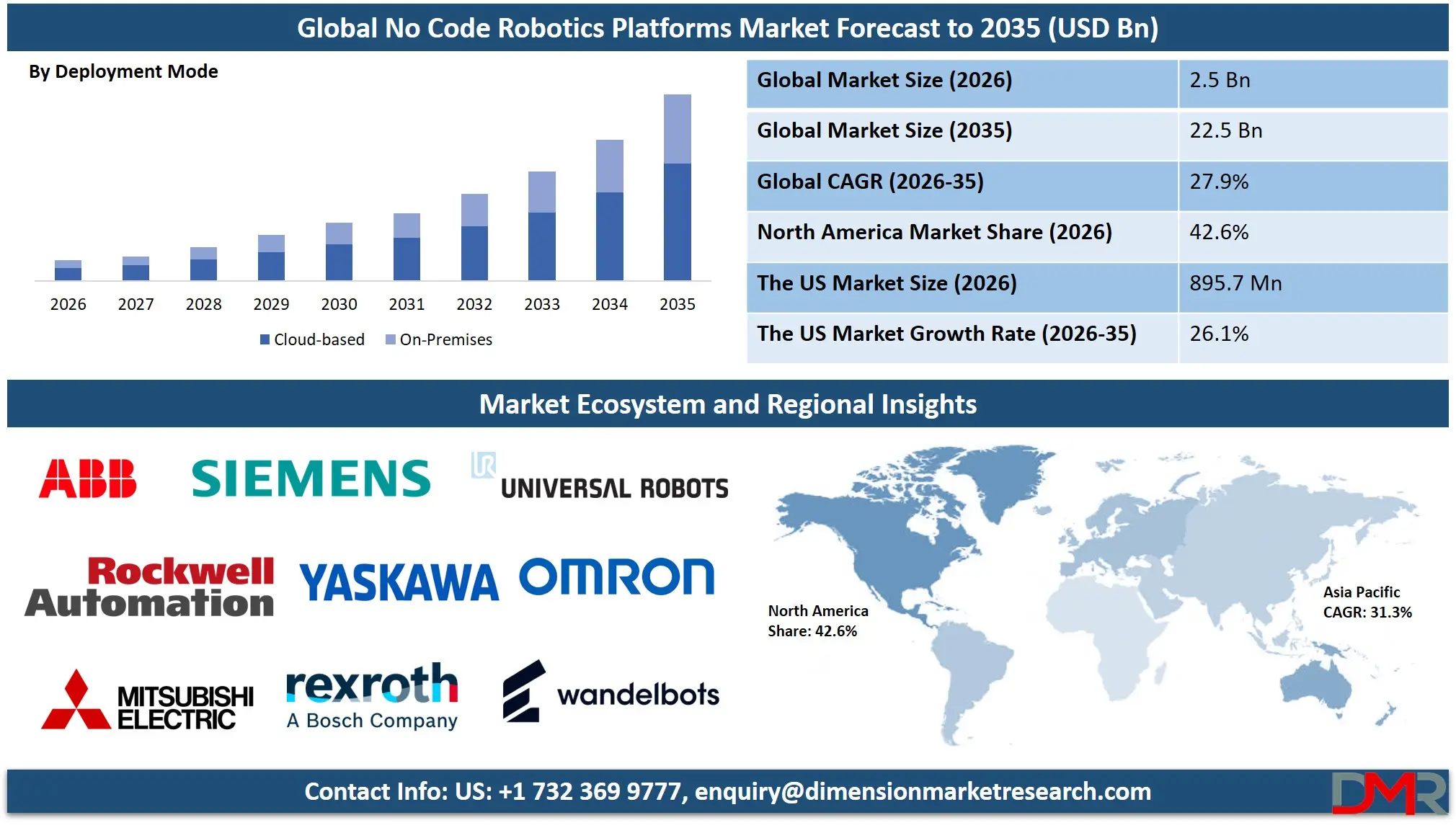
The Global No-Code Robotics Platforms market is expected to reach USD 2.5 billion in 2026 and expand at a CAGR of 27.9% through 2035, driven by the rising adoption of robotic process automation (RPA) and physical robotics in SMEs, the democratization of automation, and the increasing need for agile business solutions, ultimately reaching USD 22.5 billion by 2035.
ℹ
To learn more about this report –
Download Your Free Sample Report Here
A no-code robotics platform is a digital environment that enables users to design, deploy, and manage robotic systems, both software-based (RPA) and physical (robots), through intuitive graphical user interfaces, drag-and-drop functionality, and pre-built templates, eliminating the need for traditional programming. These platforms bridge the gap between complex robotics engineering and business users, allowing "citizen developers" to automate workflows, control robotic devices, and orchestrate complex tasks. The platform environment allows domain experts to build and customize automation solutions while enabling organizations to scale their robotics initiatives rapidly. As industries across the board seek to enhance efficiency and innovation, no-code platforms are standardizing robotics development and providing searchable libraries of pre-configured automation modules tailored for different tasks such as warehouse logistics, customer service, quality control, and data processing.
The global no-code robotics platforms market refers to the economic ecosystem surrounding platforms that facilitate the visual design, deployment, and management of robotics applications without hand-coding. This market includes specialized platform vendors, system integrators, and integrated development environments (IDEs) embedded within broader automation suites that enable organizations to build and customize robotic workflows. The market is expanding as businesses of all sizes increasingly rely on automation to improve productivity, reduce operational costs, and address labor shortages. Growth is also driven by the rising sophistication of low-code/no-code development tools, increasing demand for agile automation solutions, and the emergence of a new class of "citizen developers" who can now contribute to corporate automation strategies.
ℹ
To learn more about this report –
Download Your Free Sample Report Here
The market also encompasses a wide range of services including professional consulting for automation strategy, managed services for ongoing robot fleet management, training programs for citizen developers, and collaborative platforms where users share and refine automation templates. Enterprises, small businesses, educators, and system integrators are using these platforms to streamline manufacturing processes, enhance customer interactions, automate data collection, and manage repetitive tasks. Increasing integration of robotics into core business operations, combined with the growing demand for accessible and scalable automation frameworks, is further strengthening the development of the global no-code robotics platforms ecosystem across regions.
The US No Code Robotics Platforms Market
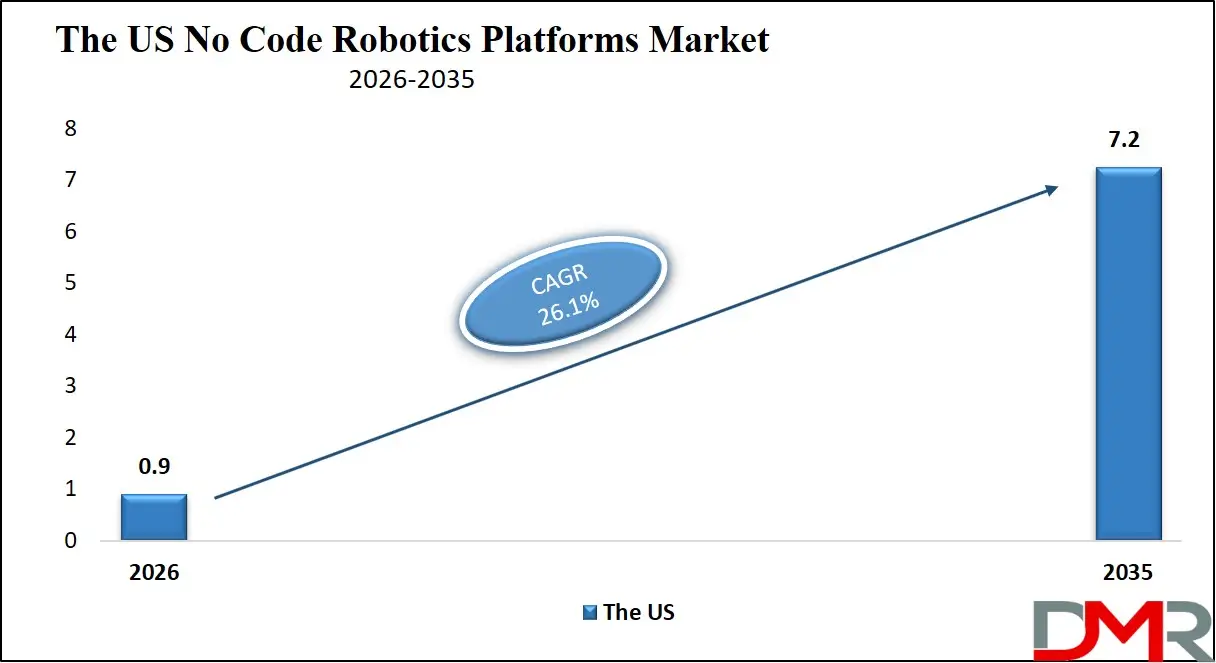
The US No Code Robotics Platforms Market size is expected to reach at USD 895.7 million in 2026. It is further expected to witness subsequent growth in the upcoming period, holding USD 7,242.2 million in 2035 at a CAGR of 26.1%.
The United States no-code robotics platforms market represents one of the most advanced segments of the global automation ecosystem, supported by a strong technology infrastructure and widespread adoption of automation tools across industries. Businesses, from logistics giants to small retailers, and a burgeoning community of citizen developers are increasingly relying on visual development tools to deploy robotic solutions for tasks ranging from warehouse picking to customer service automation. The growth of online communities sharing automation blueprints, along with increasing demand for accessible robotics tools for operational efficiency, is contributing significantly to the expansion of no-code platforms across the United States.
ℹ
To learn more about this report –
Download Your Free Sample Report Here
The market is also benefiting from the strong presence of leading technology companies, innovative startups, and a venture capital ecosystem that actively funds the democratization of automation. Organizations are integrating no-code robotics platforms into their broader digital transformation strategies to enhance agility and empower non-technical staff. Rising enterprise investments in artificial intelligence and automation, growing use of collaborative robots (cobots) in SMEs, and expanding adoption of RPA in back-office functions are accelerating market growth. Continuous innovation in visual workflow design and the increasing popularity of automation-as-a-service models are further strengthening the United States no-code robotics platforms market.
The Europe No Code Robotics Platforms Market
The Europe No-Code Robotics Platforms market is projected to reach approximately USD 650.1 million in 2026, reflecting strong adoption of automation solutions across the region's diverse industrial base. Growing demand for agile manufacturing, digital customer service tools, and efficient logistics is encouraging businesses to adopt no-code robotics solutions. Organizations across sectors such as automotive, e-commerce, healthcare, and public services are increasingly utilizing no-code platforms to deploy automation quickly and cost-effectively, enhancing the performance of both physical robots and software bots. This growing reliance on accessible automation tools is contributing to the steady expansion of the European market.
The market is expected to grow at a compound annual growth rate of 28.1% during the forecast period, supported by strong government initiatives for Industry 4.0, rising investments in digital innovation, and a robust manufacturing sector across key countries including Germany, the United Kingdom, France, and Italy. The presence of strong industrial automation traditions, expanding networks of system integrators, and increasing adoption of automation by SMEs are further accelerating demand for no-code platforms. Additionally, enterprises in Europe are focusing on reshoring and modernizing production capabilities, which is encouraging the use of visual programming and pre-built automation modules to improve operational efficiency and flexibility.
The Japan No Code Robotics Platforms Market
The Japan No Code Robotics Platforms Market is projected to be valued at USD 162.5 million in 2026. It is further expected to witness subsequent growth in the upcoming period, holding USD 1,499.2 million in 2035 at a CAGR of 27.9%, reflecting the country's global leadership in robotics and its rapid embrace of digital transformation tools. Businesses, technology developers, and manufacturers in Japan are increasingly using no-code robotics platforms to accelerate the deployment of automation, addressing labor shortages and enhancing productivity. Applications such as automated quality control, material handling, customer service robots, and data collection are gaining popularity, encouraging wider adoption of visual programming solutions across enterprises and small businesses.
The market is supported by Japan's strong focus on robotics innovation, "Society 5.0" initiatives, and advanced manufacturing technologies. Increasing investments in automation for SMEs, the expansion of startup ecosystems in cities like Tokyo and Osaka, and the growing integration of AI with robotics are accelerating demand for no-code development tools. In addition, Japanese companies are actively seeking ways to mitigate demographic challenges through automation, which is driving the need for accessible platforms that enable faster, more scalable, and cost-effective robotic deployments.
Global No Code Robotics Platforms Market: Key Takeaways
- Market Growth: The global no-code robotics platforms market is projected to reach USD 2.5 billion in 2026 and grow to USD 22.5 billion by 2035, registering a CAGR of 27.9%, driven by the democratization of automation and the rise of citizen developers.
- Regional Leadership: North America is expected to hold 42.6% of global revenue in 2026, supported by strong AI innovation, advanced digital ecosystems, and widespread enterprise adoption of AI driven productivity platforms.
- United States Market: The U.S. market is estimated at USD 895.7 million in 2026 and is projected to reach USD 7,242.2 million by 2035, growing at a CAGR of 26.1% due to strong AI startup activity and developer communities.
- Rapid Advancement in Platform Capabilities: Innovations including intuitive visual workflow designers for complex automation sequences, pre-built integration connectors for enterprise systems, AI-powered automation recommendations, and comprehensive robot fleet orchestration tools are significantly improving deployment speed and operational flexibility.
- Growing SME Automation Needs Boost Adoption: Rising demand from small and medium enterprises seeking cost-effective automation solutions, coupled with labor shortages across logistics and manufacturing sectors, is driving sustained adoption of accessible no-code robotics platforms that empower non-technical staff to build and manage robotic workflows.
Global No Code Robotics Platforms Market: Use Cases
- Inspection & Monitoring: No-code platforms enable quality assurance teams to program drones and robotic cameras for visual inspections in manufacturing, infrastructure, and agriculture. Pre-built workflows allow for automated defect detection, asset monitoring, and data collection without specialized coding skills.
- Customer Interaction & Service: Businesses use no-code tools to deploy and manage service robots in retail, hospitality, and healthcare settings. These platforms allow staff to easily update robot behaviors, greetings, and information delivery to enhance customer experience and operational efficiency.
- Data Collection & Mapping: Environmental scientists, urban planners, and logistics managers utilize no-code platforms to program autonomous mobile robots (AMRs) and drones for collecting spatial data, creating maps, and monitoring environmental conditions through simple drag-and-drop interfaces.
- Repetitive Manipulation Tasks: In warehouses and factories, no-code platforms empower operators to program robotic arms for tasks like pick-and-place, packing, and sorting. Visual workflow tools allow for quick reconfiguration of tasks in response to changing production needs.
Global No Code Robotics Platforms Market: Stats & Facts
- OECD (Organisation for Economic Co-operation and Development)
- In 2025, an estimated 45% of businesses across OECD countries were using or piloting some form of automation software, including RPA.
- The share of firms investing in robotics and intelligent automation is projected to increase by 15% annually.
- Among large firms in OECD countries, over 60% reported using automation for back-office functions in 2025.
- 78% of business leaders in OECD economies cited the democratization of automation (no-code/low-code) as a key priority for 2025.
- SME adoption of automation tools in OECD countries grew from 12% in 2023 to 22% in 2025.
- The skills gap in robotics programming remains a top barrier, with 55% of firms reporting difficulty in hiring traditional robotics engineers.
- The gender gap in roles related to creating and managing automation is narrowing with no-code tools, with a 5% increase in female "citizen developers" in 2025.
- The age gap in technology usage for automation design decreased as no-code tools enabled older, experienced workers to contribute to process automation.
- AI adoption by firms across OECD countries increased from 8.7% in 2023 to 14.2% in 2024, often integrated into no-code robotics platforms.
- By 2025, 20.2% of firms across OECD economies reported using AI technologies, frequently to enhance the capabilities of their robotic systems.
- 52.0% of large firms in OECD countries reported using some form of AI in 2025.
- Only 17.4% of small firms reported using AI, highlighting the opportunity for no-code platforms to bridge this gap.
- 57.3% of ICT sector firms across OECD countries used AI in 2025, the highest among industries, often for automating IT processes.
- 36.8% of firms in professional and scientific services used AI in 2025, frequently for data analysis and research automation.
- Eurostat (European Union Statistical Office)
- Adoption of cloud-based software for business process automation among SMEs ranged from 5% to 25% across EU countries in 2024.
- In 2023, the highest SME adoption of enterprise resource planning (ERP) software, a precursor to broader automation, reached about 40% in some EU countries.
- In Denmark, 25% of SMEs reported using cloud-based automation and analytics software in 2024.
- Across EU enterprise surveys, the use of robotic solutions remains significantly higher in large manufacturing companies compared with SMEs, but the gap is closing with no-code tools.
- U.S. Census Bureau
- 5.2% of U.S. businesses reported using advanced robotics or automation equipment in late 2023.
- The manufacturing sector showed the highest robotics adoption in 2023 with 18.5% of businesses using automation.
- 12.0% of firms in professional, scientific, and technical services used specialized automation software in 2023.
- 7.0% of U.S. businesses reported adopting new automation software in early 2024.
- Adoption of automation among businesses rose from about 5.0% to 7.0% between September 2023 and February 2024.
- Automation usage was projected to reach around 9.0% of U.S. businesses by late 2024.
- By May 2025, approximately 12% of U.S. businesses reported using some form of robotic or intelligent automation.
- 15% of U.S. businesses with more than 250 employees reported expanding their automation footprint in 2025.
- 8% of very small U.S. businesses with 1 to 4 employees reported using automation software-as-a-service in 2025.
Global No Code Robotics Platforms Market: Market Dynamic
Driving Factors in the Global No Code Robotics Platforms Market
Growing Adoption of Automation across Industries
The increasing adoption of automation, from software bots for data entry to physical robots for logistics, is a major driver for the no-code robotics platforms market. Business users, operations managers, and frontline employees are actively using visual tools to configure robotic systems for tasks like process optimization, customer service, and material handling. As organizations integrate automation into daily workflows, the demand for accessible development tools and pre-built automation modules is expanding rapidly, strengthening the growth of global no-code platforms.
Democratization of Automation and the Rise of Citizen Developers
The shortage of traditional software engineers and robotics programmers is encouraging organizations to empower non-technical staff, citizen developers, to build automation solutions. No-code platforms enable domain experts (e.g., warehouse managers, accountants) to create and modify robotic workflows themselves. This democratization not only accelerates automation initiatives but also fosters a culture of innovation, significantly expanding the user base for no-code robotics platforms.
Restraints in the Global No Code Robotics Platforms Market
Complexity of Integrating with Legacy Systems
One of the key restraints in the no-code robotics platforms market is the difficulty of integrating new robotic solutions with legacy enterprise systems (e.g., older ERPs, mainframes). While no-code platforms simplify the front-end development, ensuring seamless data flow and process orchestration with decades-old infrastructure can be complex and costly, potentially slowing down deployment for some enterprises.
Security and Governance Concerns
As more employees gain the ability to deploy automations, concerns regarding security, data privacy, and governance are limiting market growth. Without proper oversight, citizen developers might inadvertently create insecure bots or automate processes in violation of compliance standards. These issues may slow enterprise adoption until stronger built-in governance, version control, and security protocols are implemented within the platforms.
Opportunities in the Global No Code Robotics Platforms Market
Integration with AI and Advanced Analytics
A major opportunity lies in the deeper integration of AI capabilities, such as computer vision and natural language processing, into no-code robotics platforms. Enabling users to drag and drop AI models into their robotic workflows would open up advanced use cases in predictive maintenance, intelligent quality inspection, and sophisticated customer interaction, creating new value for platform providers and users.
Growth of Industry-Specific Automation Templates
Another key opportunity is the development of industry-specific solution bundles or templates tailored for sectors such as healthcare (e.g., for sanitizing robots), retail (inventory management), and agriculture (automated harvesting). These specialized collections can significantly lower the barrier to entry for organizations in those verticals, providing them with proven, ready-to-deploy automation frameworks and creating new growth avenues.
Trends in the Global No Code Robotics Platforms Market
Emergence of Robot Fleet Orchestration Tools
A significant trend is the increasing focus on tools for managing and orchestrating fleets of robots from a single no-code interface. As organizations deploy multiple robots (e.g., a mix of AMRs from different vendors), the ability to centrally monitor, manage, and coordinate their activities through a visual dashboard becomes critical. This trend is pushing platforms to expand beyond robot programming into comprehensive fleet management.
Rise of Community-Driven Automation Marketplaces
Community-driven platforms where users share, rate, and refine automation blueprints or "recipe" templates are becoming increasingly popular. These collaborative environments allow developers and business users to test automation workflows, share improvements, and build large, searchable repositories of pre-built robot behaviors. The growing participation of system integrators and technology enthusiasts in these communities is accelerating innovation and best-practice sharing in automation design.
Global No Code Robotics Platforms Market: Research Scope and Analysis
By Component Analysis
Platforms are anticipated to dominate the component segment, accounting for around 65.0% of the total market share in 2026. Within this, the Visual Workflow sub-segment is the primary driver due to its intuitive, drag-and-drop interface that allows non-programmers to design complex automation sequences. These platforms are widely used to guide both software bots and physical robots in tasks like order processing, equipment monitoring, and data entry. The increasing reliance on business users to create and adapt their own automation solutions is significantly strengthening the demand for these visual tools. As organizations continue to empower "citizen developers," the demand for sophisticated yet accessible visual workflow platforms is expected to remain strong.
Form-based platforms also represent a significant portion of this segment, particularly for simpler, rules-based automation tasks such as data collection forms that trigger robotic actions. These are popular in scenarios like digitizing paper trails or creating simple, structured inputs for RPA bots. They offer a low-effort entry point for automation. Services, including Professional Services (consulting, integration, training) and Managed Services (ongoing support, bot monitoring), hold the remaining 35% share, highlighting that while platforms are powerful, expert guidance remains crucial for successful, large-scale automation adoption.
By Deployment Type Analysis
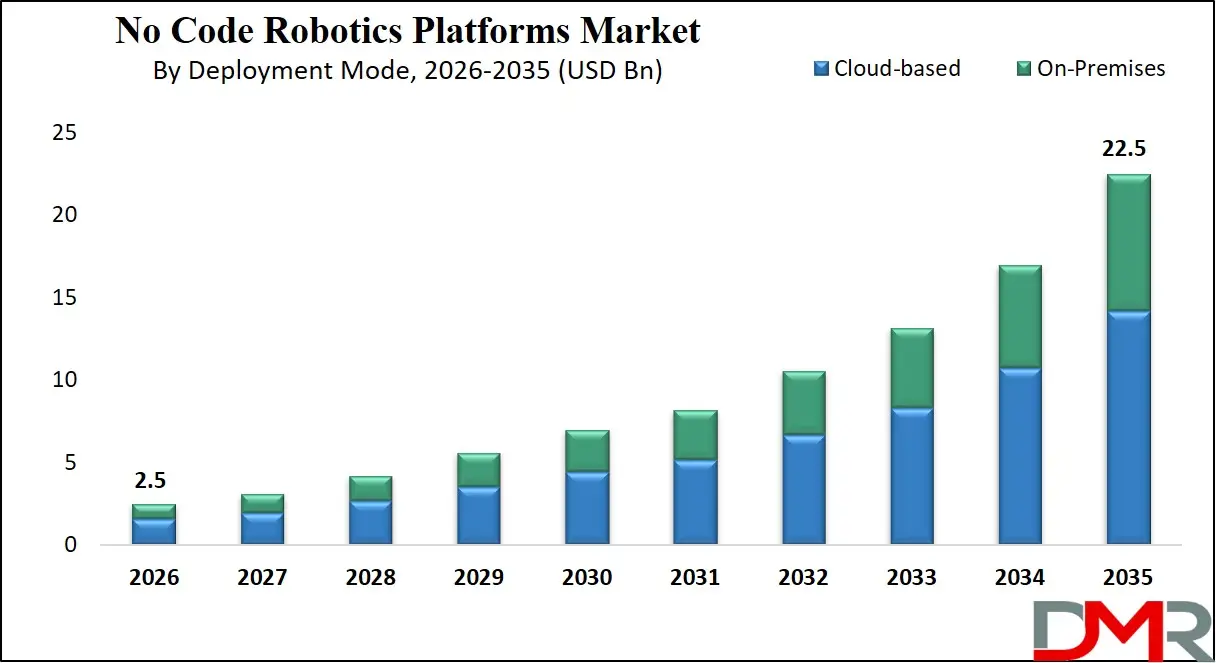
Cloud-based deployment is anticipated to dominate, accounting for about 63.1% of the total market share in 2026 due to its lower upfront costs, scalability, and ease of access. These platforms operate through web browsers and allow users to design, deploy, and manage robotic workflows from anywhere, without requiring significant on-premises infrastructure. SMEs and larger organizations with distributed operations prefer cloud-based deployment because it facilitates collaboration, automatic updates, and seamless integration with other cloud services. The rapid expansion of cloud computing and the increasing use of Software-as-a-Service (SaaS) models are further supporting the growth of cloud-based no-code robotics platforms globally.
On-Premises deployment, while smaller in share, remains critical for industries with strict data security, privacy, or latency requirements, such as defense, critical infrastructure, and some financial services. In this model, the entire platform and the data it processes reside behind the corporate firewall. This offers maximum control and is often preferred by large enterprises with mature IT departments that need to integrate robotics deeply with legacy, on-premises systems.
By Application Analysis
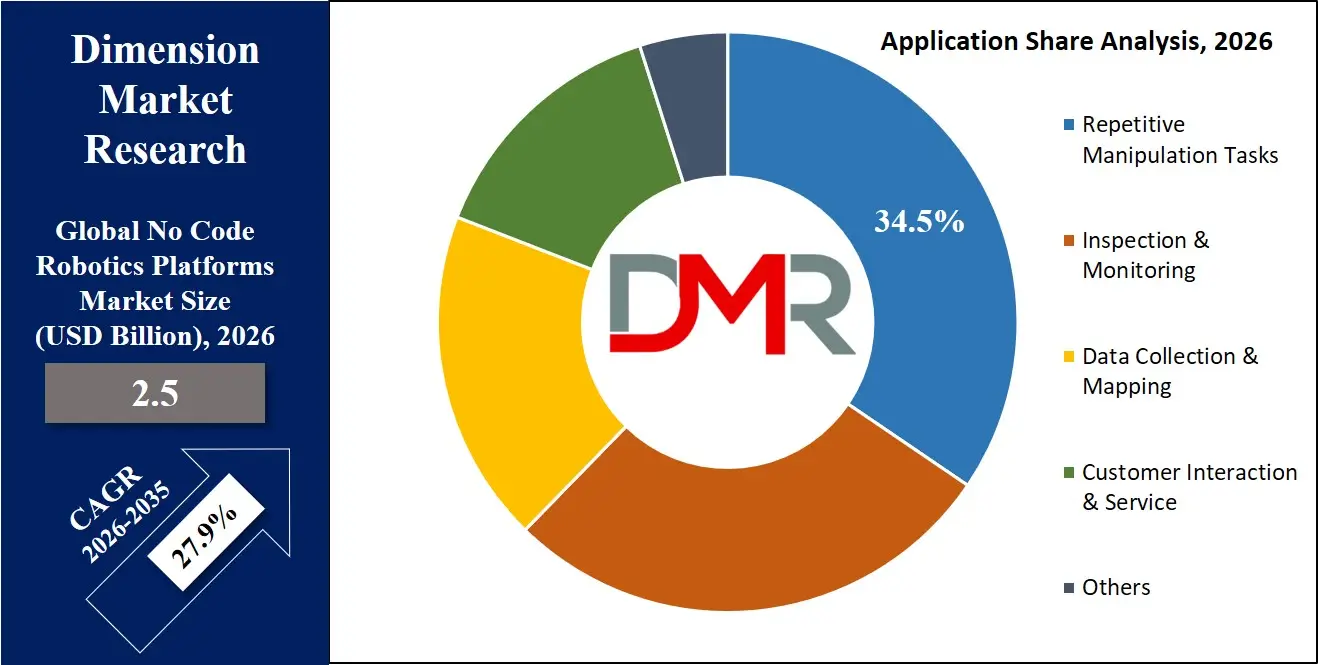
Inspection & Monitoring is anticipated to be a leading application, capturing a significant share due to its widespread use in manufacturing, energy, and infrastructure. No-code platforms enable domain experts to program drones and robotic cameras for automated visual inspections, detecting anomalies in equipment or structures without manual piloting or coding. Repetitive Manipulation Tasks is another dominant application, particularly in logistics and manufacturing, where no-code tools empower floor staff to quickly reprogram robotic arms for pick-and-place, packing, and assembly tasks, enabling rapid response to changing production needs.
ℹ
To learn more about this report –
Download Your Free Sample Report Here
Customer Interaction & Service represents a fast-growing application as retailers, hotels, and healthcare providers deploy service robots. No-code platforms allow non-technical staff to update robot scripts, greetings, and information flows to improve guest experience. Data Collection & Mapping is also a key application, used by surveyors, agricultural technicians, and urban planners to program autonomous vehicles and drones for environmental monitoring and spatial data gathering. The "Others" category includes emerging uses like collaborative human-robot tasks in R&D and education.
By Enterprise Size Analysis
Large Enterprises are anticipated to account for the larger share, due to their greater financial resources and complex operational needs that benefit most from automation. They use no-code platforms to standardize processes across global sites, integrate robotics into massive supply chains, and empower department-level experts to solve local automation challenges without central IT bottlenecks. The scale of their operations and the potential for ROI make them early and heavy adopters.
However, the Small & Medium Enterprises (SMEs) segment is expected to grow at a significantly higher CAGR. No-code platforms are a powerful enabler for SMEs, removing the primary barriers of high cost and lack of specialized programming staff. These platforms allow SMEs to automate specific, high-impact tasks, like inventory management or invoice processing, with existing personnel, leveling the playing field and allowing them to compete more effectively with larger rivals.
By End User Analysis
The Industrial end-user segment (including manufacturing, logistics, and energy) is anticipated to dominate, capturing the largest share in 2026. These sectors have the most established history with robotics and are rapidly adopting no-code platforms to make their automation more flexible and to involve factory-floor workers in continuous improvement. The demand for efficiency, quality control, and worker safety in these environments is a significant driver.
The Commercial sector (including retail, hospitality, healthcare, and offices) represents a rapidly growing segment. Here, no-code platforms are used to deploy service robots for cleaning, customer guidance, and prescription delivery. The ability to easily customize robot behavior for different commercial environments is key to adoption. The Educational sector is also an important end user, using no-code platforms to teach robotics, programming logic, and automation concepts to students without the barrier of complex coding. The "Others" category includes applications in agriculture, defense, and research institutions.
The Global No Code Robotics Platforms Market Report is segmented on the basis of the following:
By Component
- Platform
- Visual Workflow
- Form-based
- Others
- Services
- Professional Services
- Managed Services
By Deployment Mode
By Application
- Inspection & Monitoring
- Customer Interaction & Service
- Data Collection & Mapping
- Repetitive Manipulation Tasks
- Others
By Enterprise Size
- Small & Medium Enterprises
- Large Enterprises
By End User
- Industrial
- Commercial
- Educational
- Others
Impact of Artificial Intelligence in the Global No Code Robotics Platforms Market
- AI-Powered Workflow Recommendations: AI analyzes user behavior, historical automation patterns, and industry-specific requirements to suggest optimal automation sequences, pre-built templates, and integration configurations, enabling citizen developers to design complex robotic workflows with minimal trial and error.
- Computer Vision Integration for Visual Automation: Neural networks enable drag-and-drop vision capabilities into robotic workflows, allowing robots to recognize objects, detect defects, read barcodes, and navigate dynamic environments without coding, opening new application areas in quality control and inventory management.
- Natural Language Processing for Intuitive Robot Programming: AI translates natural language descriptions of desired robot behaviors directly into visual workflows or executable instructions, enabling non-technical staff to program service robots for hospitality and healthcare applications through simple conversational interfaces.
- Predictive Maintenance and Anomaly Detection: Machine learning models continuously monitor robot performance data to identify patterns preceding equipment failures, automatically alerting maintenance staff or initiating preventive actions through visual workflows designed by operations personnel without coding expertise.
- Intelligent Process Discovery and Mining: AI-powered tools automatically analyze human activities across software applications and physical environments to identify automation opportunities, generating visual workflow diagrams that can be directly implemented as robotic automations.
- Reinforcement Learning for Adaptive Robotics: AI systems enable robots to learn optimal strategies for tasks like picking items from bins or navigating crowded spaces through experience, with no-code interfaces allowing users to define goals and constraints while the underlying AI discovers most effective behaviors.
- AI-Generated Automation Templates: Generative AI creates, tests, and validates new automation templates based on successful deployments and emerging use cases, dramatically expanding pre-built automation libraries and accelerating marketplace growth across industries.
- Fleet Learning for Continuous Optimization: AI systems aggregate edge data from thousands of robotic deployments to continuously improve motion planning algorithms, object recognition models, and task execution strategies, building an automation intelligence knowledge base that enhances platform capabilities over time.
Global No Code Robotics Platforms Market: Regional Analysis
Region with the Largest Revenue Share
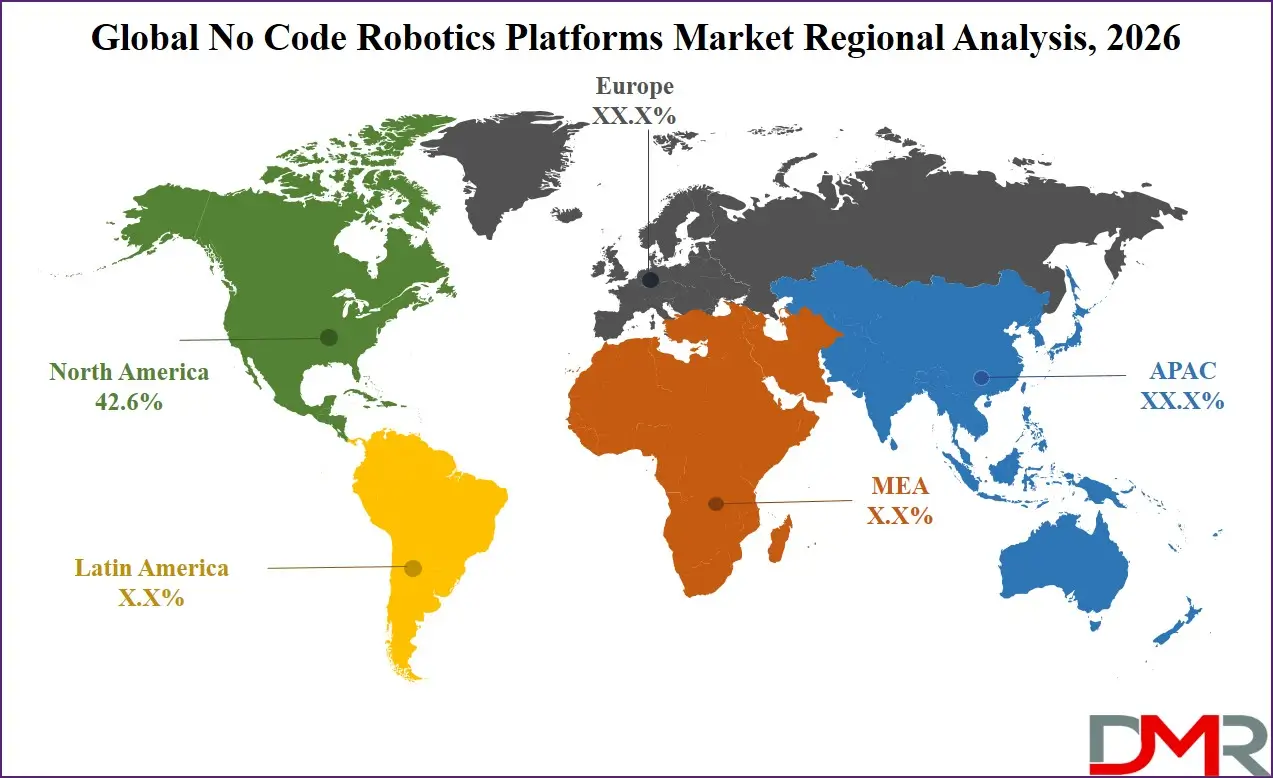
North America is anticipated to lead the global no-code robotics platforms market landscape, accounting for around 42.6% of the total global market revenue in 2026. The region's dominance is supported by the strong presence of advanced technology ecosystems, leading platform vendors, and a rapidly expanding community of citizen developers. Businesses across the United States and Canada, from logistics and e-commerce giants to innovative manufacturers, are increasingly adopting no-code tools to enhance automation agility, address labor shortages, and accelerate digital transformation. High investments in AI and robotics, early adoption of Industry 4.0 principles, and a vibrant venture capital scene are further strengthening the expansion of the no-code robotics platforms market across North America.
ℹ
To learn more about this report –
Download Your Free Sample Report Here
Region with the Highest CAGR
Asia Pacific is expected to register the highest CAGR in the global no-code robotics platforms market during the forecast period. This is due to the rapid expansion of manufacturing automation, growing startup ecosystems, and increasing digital transformation across major economies such as China, Japan, South Korea, and India. The region is witnessing strong growth in robotics adoption across sectors including electronics, automotive, e-commerce, and logistics. Rising investments in smart factories, government support for automation, expanding networks of system integrators, and the urgent need to address aging workforces are encouraging the adoption of accessible, no-code automation solutions. These factors are significantly accelerating market growth across the Asia Pacific region.
By Region
North America
Europe
- Germany
- The U.K.
- France
- Italy
- Russia
- Spain
- Benelux
- Nordic
- Rest of Europe
Asia-Pacific
- China
- Japan
- South Korea
- India
- ANZ
- ASEAN
- Rest of Asia-Pacific
Latin America
- Brazil
- Mexico
- Argentina
- Colombia
- Rest of Latin America
Middle East & Africa
- Saudi Arabia
- UAE
- South Africa
- Israel
- Egypt
- Rest of MEA
Global No Code Robotics Platforms Market: Competitive Landscape
The global no-code robotics platforms market is characterized by a dynamic and increasingly competitive landscape, with a mix of established automation vendors, specialized no-code startups, and open-source communities vying for market position. Vendors differentiate themselves through the intuitiveness of their visual workflow designers, the breadth of their pre-built template libraries, and the depth of their integrations with both enterprise software and popular hardware robots. Companies are increasingly investing in advanced features such as AI-powered workflow recommendations, robust governance and security controls for citizen developers, and comprehensive fleet management capabilities. Strategic partnerships with cloud providers (AWS, Azure, Google), hardware manufacturers (Universal Robots, Boston Dynamics), and system integrators are crucial for shaping competitive positioning. In addition, the entry of open-source projects and communities is intensifying competition by providing free, customizable alternatives and expanding the pool of automation talent.
Some of the prominent players in the Global No Code Robotics Platforms Market are:
- ABB Ltd.
- Siemens AG
- Universal Robots A/S
- KUKA AG
- FANUC Corporation
- Yaskawa Electric Corporation
- Rockwell Automation
- Mitsubishi Electric Corporation
- Omron Corporation
- Denso Robotics
- Festo
- Bosch Rexroth
- Schneider Electric
- Vention
- Ready Robotics
- Wandelbots GmbH
- Drag&Bot
- Robotiq Inc.
- Neura Robotics
- Flexiv
- Other Key Players
Recent Developments in the Global No Code Robotics Platforms Market
- June 2025: Wandelbots expanded its NOVA Cloud platform, introducing a cloud‑enabled environment for end‑to-end robot process planning, orchestration, and optimization without requiring traditional coding, showcased at Automatica 2025.
- June 2025: Automation Anywhere was named a leader in the Gartner Magic Quadrant for Robotic Process Automation (RPA) for the seventh consecutive year, highlighting continued innovation in AI-driven, no‑code/low‑code automation capabilities for enterprise workflows.
- May 2025: UiPath was recognized as a leader in the IDC MarketScape: Worldwide Business Automation Platforms 2025 Vendor Assessment, emphasizing its low‑code/no‑code automation, AI-assisted workflows, and enterprise governance features.
- October 2025: AgiBot introduced LinkCraft, a zero-code platform for robot content creation that converts human motion videos into precise robot actions, enabling users without programming skills to design and control robot behaviors.
Report Details
| Report Characteristics |
| Market Size (2026) |
USD 2.5 Bn |
| Forecast Value (2035) |
USD 22.5 Bn |
| CAGR (2026–2035) |
27.9% |
| The US Market Size (2026) |
USD 895.7 Mn |
| Historical Data |
2020 – 2025 |
| Forecast Data |
2027 – 2035 |
| Base Year |
2025 |
| Estimate Year |
2026 |
| Report Coverage |
Market Revenue Estimation, Market Dynamics, Competitive Landscape, Growth Factors and etc. |
| Segments Covered |
By Component (Platform and Services), By Deployment Mode (Cloud-based and On-Premises), By Application (Inspection & Monitoring, Customer Interaction & Service, Data Collection & Mapping, Repetitive Manipulation Tasks, and Others), By Enterprise Size (Small & Medium Enterprises and Large Enterprises), By End-User (Industrial, Commercial, Educational, and Others) |
| Regional Coverage |
North America – The US and Canada; Europe – Germany, The UK, France, Russia, Spain, Italy, Benelux, Nordic, & Rest of Europe; Asia-Pacific – China, Japan, South Korea, India, ANZ, ASEAN, Rest of APAC; Latin America – Brazil, Mexico, Argentina, Colombia, Rest of Latin America; Middle East & Africa – Saudi Arabia, UAE, South Africa, Turkey, Egypt, Israel, & Rest of MEA |
| Prominent Players |
ABB Ltd., Siemens AG, Universal Robots A/S, KUKA AG, FANUC Corporation, Yaskawa Electric Corporation, Rockwell Automation, Mitsubishi Electric Corporation, Omron Corporation, Denso Robotics, Festo, Bosch Rexroth, Schneider Electric, Vention, Ready Robotics, Wandelbots GmbH, Drag&Bot, Robotiq Inc., Neura Robotics, Flexiv, and Other Key Players |
| Purchase Options |
We have three licenses to opt for: Single User License (Limited to 1 user), Multi-User License (Up to 5 Users) and Corporate Use License (Unlimited User) along with free report customization equivalent to 0 analyst working days, 3 analysts working days and 5 analysts working days respectively. |
Frequently Asked Questions
How big is the Global No Code Robotics Platforms Market?
▾ The Global No Code Robotics Platforms Market size is estimated to have a value of USD 2.5 billion in 2026 and is expected to reach USD 22.5 billion by the end of 2035.
What is the growth rate in the Global No Code Robotics Platforms Market in 2026?
▾ The market is growing at a CAGR of 27.9% over the forecasted period of 2026.
What is the size of the US No Code Robotics Platforms Market?
▾ The US No Code Robotics Platforms Market is projected to be valued at USD 895.7 million in 2026. It is expected to witness subsequent growth in the upcoming period as it holds USD 7,242.2 million in 2035 at a CAGR of 26.1%.
Which region accounted for the largest Global No Code Robotics Platforms Market?
▾ North America is expected to have the largest market share in the Global No Code Robotics Platforms Market with a share of about 42.6% in 2026.
Who are the key players in the Global No Code Robotics Platforms Market?
▾ Some of the major key players in the Global No Code Robotics Platforms Market are Siemens AG, Universal Robots A/S, KUKA AG, FANUC Corporation, ABB Ltd., and many others.