Global Non-Destructive Testing in Power Generation Market Snapshot
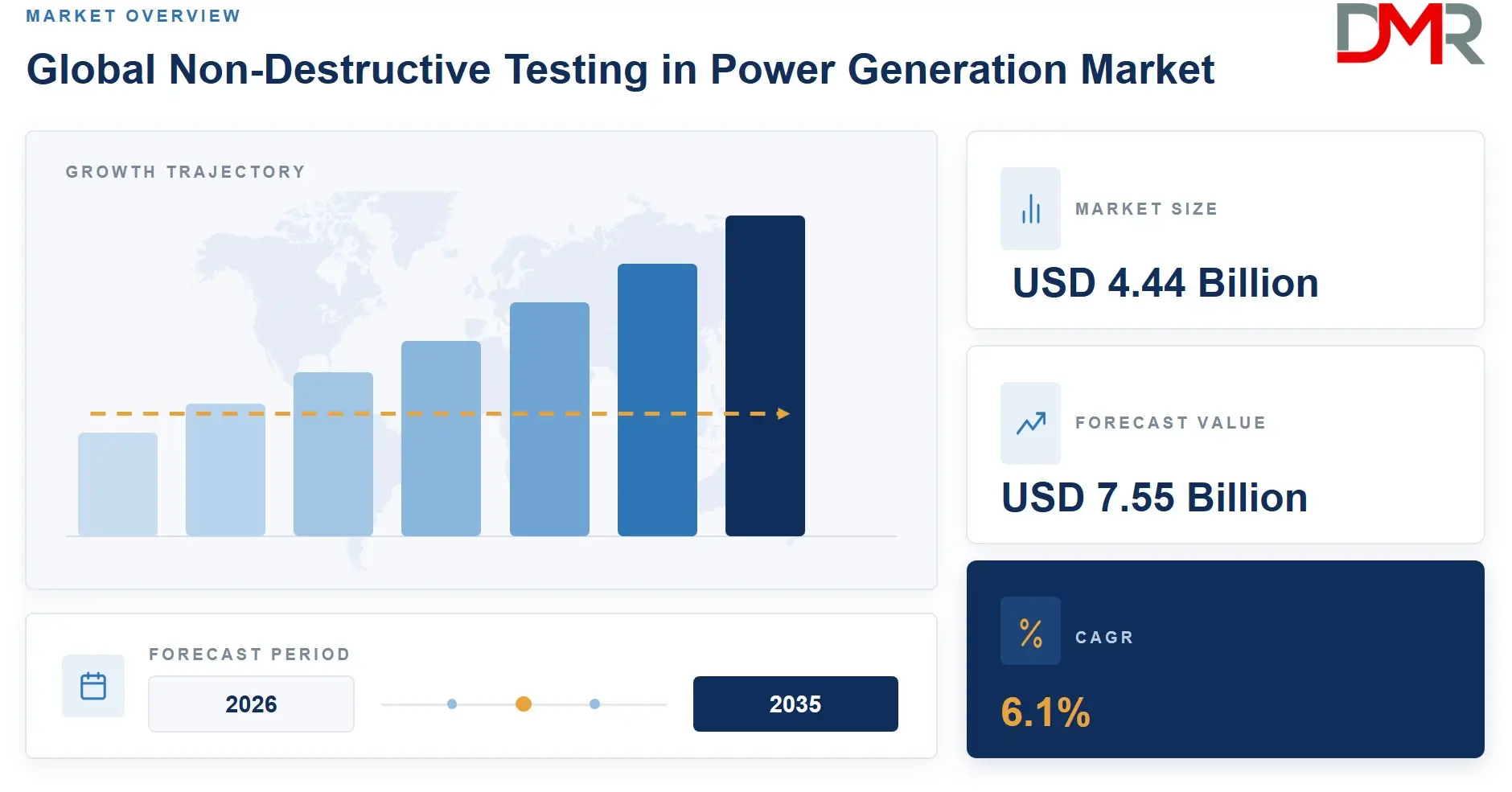
- Global Market Size, 2026: USD 4.44 billion
- Global Market Size, 2035: USD 7.55 billion
- Global CAGR, 2026–2035: 6.1%
- Leading Testing Method: Ultrasonic Testing (UT), 34.2%
- Leading Component Tested: Piping & Welds, 28%
- Leading Power Generation Source: Thermal Power, 61%
- Leading Application: In-Service Inspection, 42%
- Leading End User: Power Generation Utilities, 48%
- Fastest-Growing Segment: Advanced/AI-enabled NDT, 7.0% CAGR
- Leading Region: North America, 38%
- Fastest-Growing Region: Asia-Pacific, 6.7% CAGR
What is the Global Non-Destructive Testing in Power Generation and its Market Size?
The global Non-Destructive Testing in Power Generation Market is estimated at USD 4.44 billion in 2026 and is projected to reach approximately USD 7.55 billion by 2035, representing an estimated 6.1% CAGR. The underlying market trajectory is supported by aging thermal-generation fleets, nuclear life-extension and inspection programs, expansion of renewable generation, increasingly rigorous asset-integrity requirements and the transition from periodic inspection toward condition-based and predictive maintenance. The 2026 benchmark source forecasts the market at USD 5.98 billion by 2031 at 6.16% CAGR.
ℹ
To learn more about this report –
Download Your Free Sample Report Here
NDT demand is particularly resilient because inspection expenditure is closely tied to asset safety, regulatory compliance and plant availability. In-service inspection of boilers, turbines, pressure vessels, steam generators, welds, heat exchangers and piping creates recurring demand even when new power-plant construction slows.
Digitalization is also changing the economics of inspection. Utilities increasingly want inspection results that can be archived, compared over time and integrated with computerized maintenance-management systems, digital twins and asset-integrity platforms. Advanced UT, phased-array UT, TOFD, automated scanners and digital radiography therefore command increasing attention because they can improve inspection coverage while reducing outage time.
Use Cases
- Boiler and pressure-equipment inspection: Detecting cracks, creep, corrosion, wall thinning and weld defects in high-temperature equipment.
- Turbine inspection: Examining blades, rotors, casings and shafts for fatigue, cracking, erosion and manufacturing discontinuities.
- Piping and weld inspection: Identifying weld flaws, corrosion, stress cracking and dimensional degradation without component removal.
- Heat-exchanger inspection: Assessing tube-wall loss, pitting, cracking and erosion using eddy-current and ultrasonic techniques.
- Nuclear component inspection: Supporting periodic and in-service examination of safety-significant reactor components and systems.
- Renewable-energy inspection: Detecting defects in wind-turbine towers, blades, foundations, generators and hydroelectric penstocks.
Key Takeaways
- Market Size: The market is estimated at USD 4.44 billion in 2026, reaching approximately USD 7.55 billion by 2035.
- Growth: The market should expand at approximately 6.1% CAGR, broadly consistent with the 6.16% near-term benchmark.
- Primary Drivers: Aging power assets, nuclear life extension, renewable deployment and predictive maintenance.
- Dominant Method: Ultrasonic Testing, with approximately 34% share, remains the leading modality.
- Fastest Growth: Software, AI-assisted inspection and advanced automated techniques are expected to outpace conventional inspection.
- Regional Leadership: North America remains the largest market, while Asia-Pacific offers the strongest growth opportunity.
How AI/Gen AI is Transforming the Non-Destructive Testing in Power Generation Market?
AI and advanced data analytics are shifting NDT from isolated defect detection toward continuous asset-condition intelligence. Inspection images, ultrasonic A-scans, phased-array data, radiographs and video can increasingly be digitized, stored and analyzed using machine-learning algorithms. Automated defect recognition is particularly attractive for repetitive inspections of welds, turbine components and boiler systems.
Advanced ultrasonic techniques such as PAUT and TOFD improve coverage and defect characterization. Phased-array systems can electronically steer and focus beams, making them valuable for complex weld and corrosion inspections in power-generation applications.
Key Drivers in the Global Non-Destructive Testing in Power Generation Market
Aging Power-Generation Infrastructure
Aging thermal and nuclear assets are one of the strongest structural drivers of NDT spending. Older plants require increasingly detailed examinations because operators seek to extend economically useful operating lives rather than immediately replace high-value generation assets. Boiler tubes, steam headers, turbine components, pressure vessels, piping and welds accumulate fatigue, creep, corrosion and thermal damage over long operating periods. Mordor Intelligence identifies aging thermal-fossil fleets reaching end-of-life inspection cycles as a major market driver, particularly in North America and Europe.
Nuclear Life Extension and Regulatory Inspection
Nuclear power creates unusually strong demand for qualified inspection procedures because component integrity directly affects nuclear safety and operating licenses. Periodic safety reviews assess aging, operating experience, plant modifications and continued compliance over the operating lifetime. The IAEA describes periodic safety review as a comprehensive assessment typically performed at regular intervals, often around ten years.
Restraints in the Global Non-Destructive Testing in Power Generation Market
Shortage of Qualified NDT Personnel
NDT remains heavily dependent on qualified inspectors, particularly for complex power-generation applications. Personnel must understand inspection procedures, materials, component geometry, defect mechanisms and applicable acceptance criteria. Advanced inspection also requires higher technical capability. ISO 9712:2021 establishes an international framework for qualification and certification of NDT personnel.
Growth Opportunities in the Global Non-Destructive Testing in Power Generation Market
AI-Assisted and Automated Inspection
AI-supported inspection represents one of the clearest areas of white space. Utilities are generating increasingly large volumes of inspection data but often lack efficient mechanisms for converting historical images and signals into predictive insights.
NDT for Renewable Power Assets
Wind, hydro and other renewable-generation assets broaden the addressable market beyond conventional boilers and turbines. Applus+, for example, has recently undertaken NDT projects involving wind-turbine structures in Brazil and Mexico and penstock integrity at Malaysia's Sg. Perak hydroelectric facilities.
Trends in the Global Non-Destructive Testing in Power Generation Market
Shift from Conventional to Advanced Digital Inspection
Conventional UT, RT, MT, PT and VT will remain essential, but advanced methods are increasingly selected where inspection speed, repeatability or defect characterization matters. PAUT and TOFD offer digital records and improved weld assessment capabilities, while digital radiography eliminates some of the workflow limitations associated with film.
Integration of NDT with Asset-Integrity Platforms
NDT is increasingly becoming a data source for condition-based maintenance rather than a standalone testing activity. Inspection results can feed reliability models, maintenance planning, digital twins and remaining-life assessments.
Research Scope and Analysis
The market is segmented by Testing Method, Component Tested, Power Generation Source, Application and End User. The following detailed shares are modeled estimates for the requested taxonomy, calibrated against the published overall market benchmark and known industry deployment patterns. The benchmark source reports UT as the largest testing method at 34.15% in 2025.
ℹ
To learn more about this report –
Download Your Free Sample Report Here
By Testing Method Analysis
Ultrasonic Testing (UT) is expected to remain the dominant testing method, representing approximately 34.2% of 2026 revenue. Its leadership reflects broad applicability to welds, pressure equipment, piping, turbines, boiler tubes and structural components, combined with strong regulatory acceptance and the ability to perform volumetric inspection without ionizing radiation. Within UT, conventional UT remains widely deployed, while PAUT and TOFD are gaining share because they provide improved weld characterization, digital records and higher inspection productivity. PAUT is expected to be the fastest-growing major UT sub-segment at approximately 7.0% CAGR, supported by automation and complex weld inspection. Radiographic Testing, representing roughly 20%, remains the second-largest method because X-ray and gamma radiography provide permanent records and strong volumetric inspection capabilities. Eddy-current testing remains particularly important for heat-exchanger, condenser and steam-generator tubing. Industry service providers continue to deploy combinations of UT, RT, MT, PT and VT according to component geometry and applicable codes.
By Component Tested Analysis
Piping & Welds are modeled as the largest component category at approximately 28% of 2026 revenue, reflecting the enormous installed base of welded piping and the recurring need to identify cracking, corrosion, wall loss and weld discontinuities. Turbine Components represent approximately 23%, with blades, rotors, shafts and casings requiring inspections for fatigue, creep, erosion and cracking. The fastest-growing sub-segment is expected to be Turbine Blades and Rotors, at approximately 7.2% CAGR, driven by life-extension programs and increasingly sophisticated remaining-life assessment. Boilers & Pressure Equipment, at around 22%, remain the second-largest component group and include boiler tubes, drums, headers and pressure vessels. Heat exchangers and condensers represent another significant recurring inspection category because eddy-current and ultrasonic testing can identify corrosion, pitting and wall loss. Intertek specifically identifies eddy-current testing as widely used for heat exchangers, steam generators, condensers and feedwater heaters.
By Power Generation Source Analysis
Thermal Power is modeled as the dominant source category with approximately 61% share in 2026, reflecting the large installed base of coal- and gas-fired plants and their extensive requirements for boiler, turbine, pressure-equipment and piping inspection. Within thermal power, natural gas is expected to gain relative share as combined-cycle plants expand and existing facilities operate under flexible cycling regimes. Nuclear Power, at approximately 17%, is smaller in installed capacity terms but has disproportionately high NDT intensity because safety-significant components are subject to rigorous inspection and testing regimes. Renewable Power is the fastest-growing source category, with an estimated 9% CAGR, although from a smaller base. Wind-turbine towers, blades, generators and foundations are creating new inspection demand, while hydropower modernization creates opportunities in turbines, penstocks and pressure systems. Hydro represents approximately 11%, with the remaining share distributed among other generation technologies.
By Application Analysis
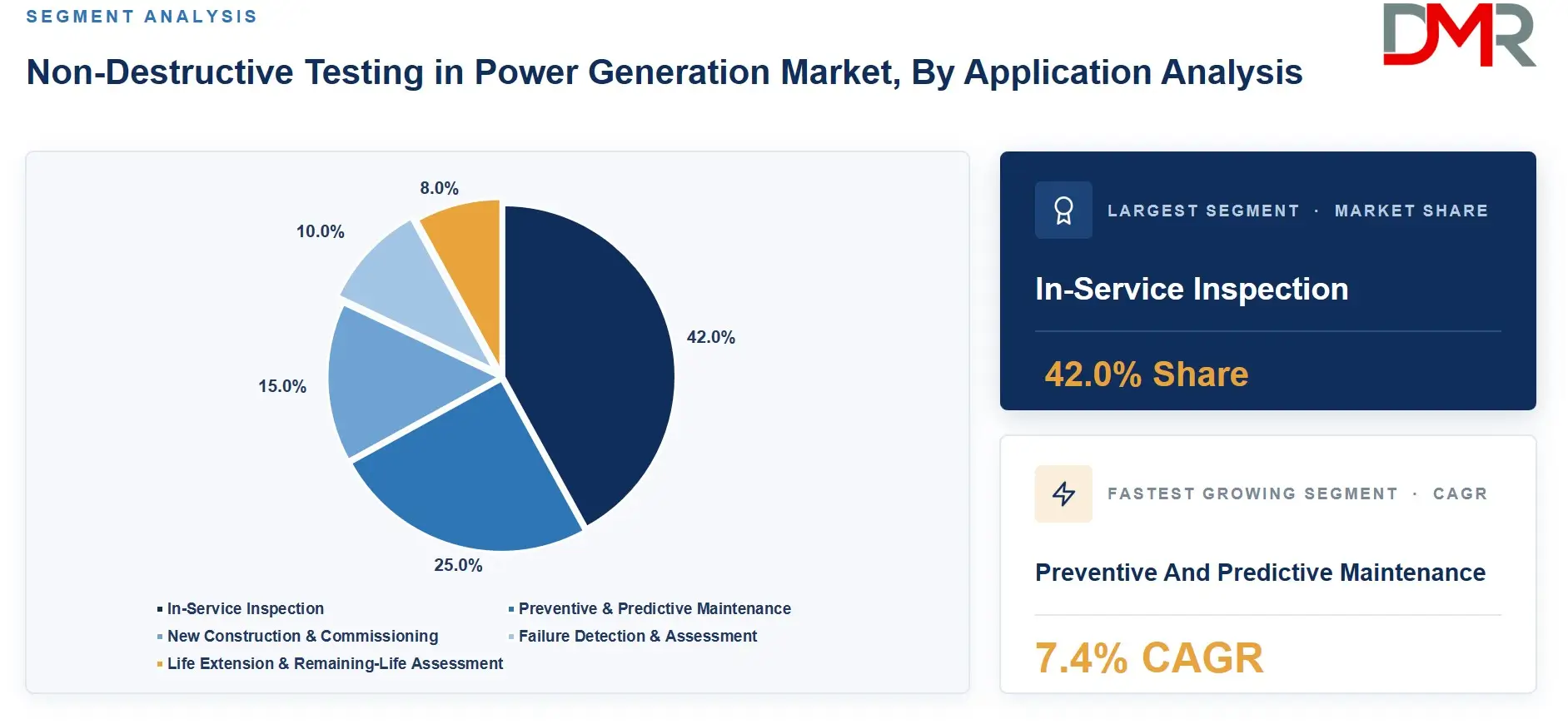
In-Service Inspection is estimated to dominate the market with approximately 42% share in 2026 because operational power assets require recurring integrity verification throughout their service lives. Preventive and predictive maintenance is the fastest-growing application at approximately 7.4% CAGR, supported by utilities' shift toward condition-based maintenance and data-driven reliability programs. Preventive & Predictive Maintenance currently represents roughly 25%, followed by New Construction & Commissioning at approximately 15%. Failure detection and assessment accounts for around 10%, while life-extension and remaining-life assessment represents approximately 8%. The latter is strategically important because older plants require quantitative evidence to justify continued operation. NDT providers increasingly combine inspection with metallurgy, engineering analysis and remaining-life assessment rather than selling isolated tests. This increases average contract value and strengthens recurring customer relationships.
By End User Analysis
Power Generation Utilities are the leading end-user group, accounting for approximately 48% of 2026 market revenue. Utilities directly control large installed asset bases and therefore purchase recurring inspection programs, outage services, equipment and asset-integrity solutions. Independent Power Producers (IPPs) account for approximately 21%, while Equipment Manufacturers & EPC Contractors represent roughly 19%. O&M contractors account for the remaining 12%. The fastest-growing end-user group is expected to be IPPs, at approximately 7.0% CAGR, as privately owned generation fleets increasingly adopt outsourced inspection and condition-monitoring services. EPC contractors remain important in new construction and commissioning, particularly for large thermal, nuclear, hydro and renewable projects. The service model is increasingly attractive because many operators prefer outsourcing specialist inspection rather than maintaining every NDT capability internally. SGS, for example, positions NDT alongside inspection, verification, auditing and training across the power-generation lifecycle.
The Global Non-Destructive Testing in Power Generation Market Report is segmented on the basis of the following:
By Testing Method
- Ultrasonic Testing (UT)
- Conventional UT
- Phased Array UT (PAUT)
- Time-of-Flight Diffraction (TOFD)
- Radiographic Testing (RT)
- X-Ray Radiography
- Gamma Radiography
- Magnetic Particle Testing (MPT)
- Liquid Penetrant Testing (LPT)
- Eddy Current Testing (ECT)
- Visual Testing (VT)
- Other Methods
- Acoustic Emission Testing
- Infrared Thermography
By Component Tested
- Turbine Components
- Blades
- Rotors & Shafts
- Casings
- Boilers & Pressure Equipment
- Boiler Tubes
- Drums & Headers
- Pressure Vessels
- Piping & Welds
- Heat Exchangers & Condensers
- Generators & Electrical Components
- Pumps & Valves
By Power Generation Source
- Thermal Power
- Nuclear Power
- Hydropower
- Renewable Power
By Application
- New Construction & Commissioning
- In-Service Inspection
- Preventive & Predictive Maintenance
- Failure Detection & Assessment
- Life Extension & Remaining-Life Assessment
By End User
- Power Generation Utilities
- Independent Power Producers (IPPs)
- Equipment Manufacturers & EPC Contractors
- Operation & Maintenance Contractors
Regional Analysis
North America is the Leading Region in the Global Non-Destructive Testing in Power Generation Market
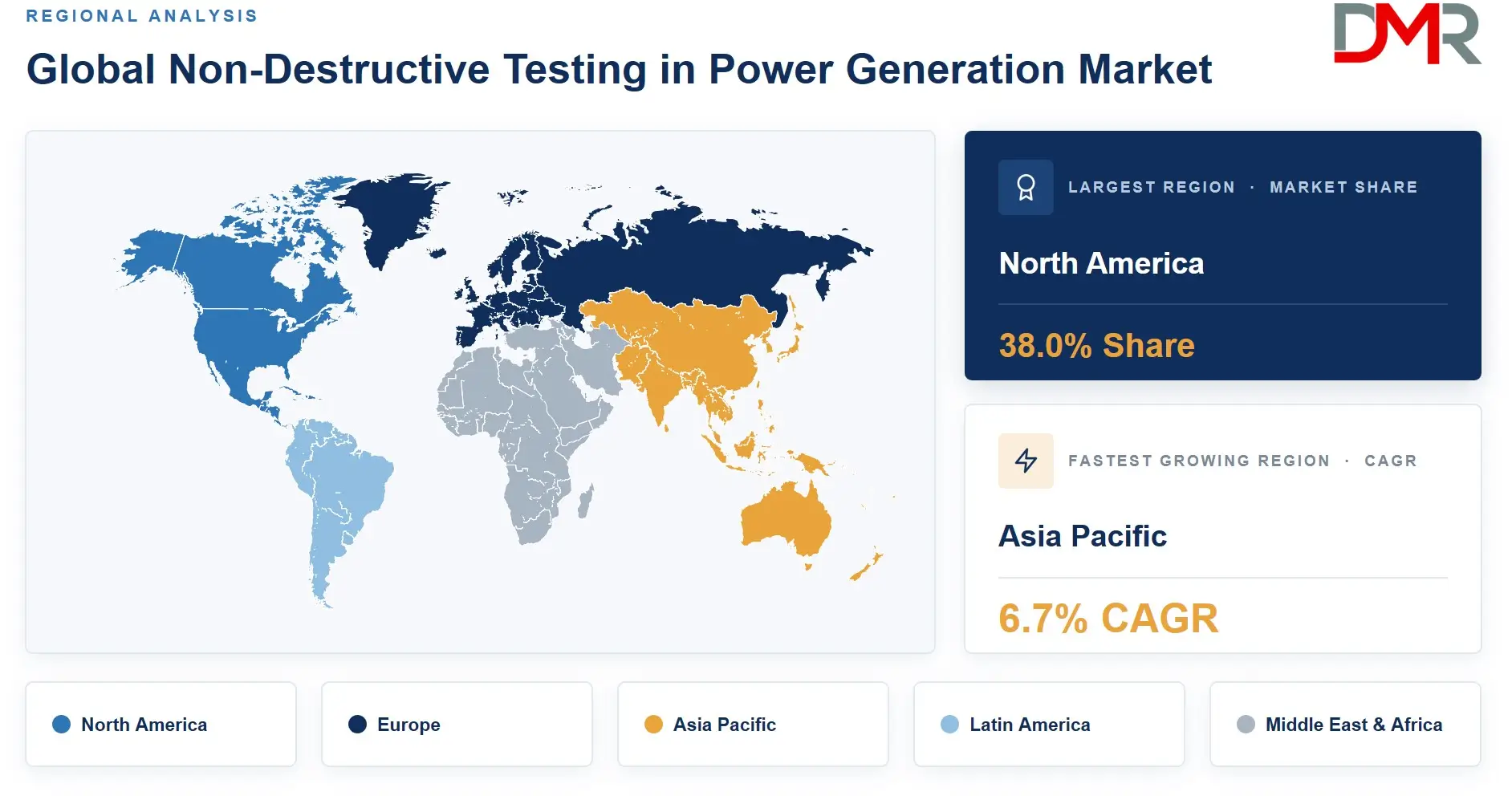
North America is expected to remain the leading regional market, with a modeled 2026 share of approximately 38%, equivalent to about USD 1.69 billion. The region's leadership reflects its large installed base of thermal and nuclear generation, mature inspection infrastructure, stringent safety requirements and extensive use of third-party NDT services. Nuclear life-extension and in-service inspection are particularly important demand generators. In the United States, NRC requirements link nuclear in-service inspection and testing to ASME codes, including Section XI requirements for applicable components. The region also has a mature ecosystem of NDT equipment manufacturers, engineering companies, inspection contractors and certified personnel. Aging fossil assets add further demand for boiler-tube, steam-piping, turbine and pressure-equipment inspection.
ℹ
To learn more about this report –
Download Your Free Sample Report Here
Asia Pacific is the Fastest-Growing Region in the Global Non-Destructive Testing in Power Generation Market
Asia-Pacific is expected to be the fastest-growing regional market, with an estimated 6.7% CAGR through 2035. Mordor Intelligence independently forecasts approximately 6.74% growth for the region over its 2025–2031 period. China, India, Japan, South Korea and Southeast Asia combine large generation fleets with continuing industrialization, nuclear investment, renewable deployment and infrastructure modernization. India and China are particularly important because large thermal fleets require ongoing inspection while new nuclear and renewable projects expand the installed asset base. Regional service providers are also building local capabilities, reducing dependence on imported equipment and overseas specialists.
The Europe Non-Destructive Testing in Power Generation Market
The European market is estimated at approximately USD 0.89 billion in 2026, increasing to around USD 1.46 billion by 2035, at approximately 5.6% CAGR. Stringent safety requirements, aging nuclear and thermal assets, offshore wind development and plant decommissioning support demand. EU pressure-equipment regulation is also important: the Pressure Equipment Directive 2014/68/EU applies to the design, manufacture and conformity assessment of specified stationary pressure equipment above 0.5 bar. Harmonized European standards and certification requirements support cross-border NDT service delivery.
Latin America Non-Destructive Testing in Power Generation Market
Latin America is estimated at approximately USD 0.22 billion in 2026, reaching about USD 0.36 billion by 2035, representing approximately 5.5% CAGR. Brazil is the principal opportunity, supported by hydropower, wind-energy expansion, thermal generation and industrial manufacturing. Recent Applus+ projects in Brazil demonstrate increasing NDT requirements for wind-turbine structures and renewable-energy manufacturing. Mexico is another important market due to industrialization and wind-power investment.
MEA Non-Destructive Testing in Power Generation Market
The Middle East & Africa market is estimated at approximately USD 0.24 billion in 2026, reaching about USD 0.43 billion by 2035, at approximately 6.7% CAGR. Saudi Arabia and the UAE are major demand centers, with large gas-fired generation fleets, infrastructure modernization and increasing renewable capacity. Africa adds opportunities through hydropower, gas generation and utility modernization. The region favors outsourced inspection providers because specialist NDT capabilities can be concentrated among qualified contractors serving multiple plants.
Major Countries Analysis
United States Non-Destructive Testing in Power Generation Market
The U.S. NDT-in-power-generation market is modeled at approximately USD 1.45 billion in 2026, increasing to around USD 2.30 billion in 2035, at approximately 5.3% CAGR. Nuclear in-service inspection, aging thermal plants, combined-cycle generation and asset-life extension are key drivers. NRC rules require applicable nuclear facilities to follow ASME-based in-service inspection and testing frameworks.
Japan Non-Destructive Testing in Power Generation Market
Japan is modeled at approximately USD 0.28 billion in 2026, reaching approximately USD 0.47 billion by 2035, at around 5.9% CAGR. Nuclear inspection, thermal-plant reliability, LNG generation, advanced manufacturing and industrial automation support demand. Japanese operators are also well positioned to adopt advanced robotics, automated UT and digital inspection workflows.
Saudi Arabia Non-Destructive Testing in Power Generation Market
Saudi Arabia is modeled at approximately USD 0.10 billion in 2026, reaching around USD 0.20 billion by 2035, representing approximately 8.2% CAGR. Large gas-fired assets, industrial diversification, power-sector investment and renewable deployment create demand for turbine, boiler, piping, weld and structural inspection. The strongest opportunity is expected in integrated inspection-and-maintenance contracts rather than standalone testing.
Regulatory Landscape
The regulatory environment is one of the strongest structural supports for NDT demand because inspection of critical power-generation assets is closely connected with safety and operating authorization. ASME BPVC Section V provides requirements for nondestructive examination methods, while nuclear applications additionally rely on ASME Section XI and related regulatory provisions. ASME currently lists the 2025 edition of Section V.
In the United States, NRC regulations incorporate ASME requirements for nuclear in-service inspection and testing, including requirements applicable to Class 1, 2 and 3 components. ISO 9712:2021 provides an internationally recognized framework for qualification and certification of NDT personnel. Europe is additionally influenced by the Pressure Equipment Directive 2014/68/EU. IAEA periodic-safety-review guidance further reinforces inspection and aging-management requirements for nuclear facilities.
Investment and White Space Analysis or Epidermatology based on the network
The highest-potential investment areas are AI-assisted inspection, automated PAUT/TOFD, robotic inspection, digital radiography, high-temperature inspection, renewable-energy NDT and cloud-based asset-integrity software. The largest white space is at the intersection of field inspection and data analytics: many operators possess large archives of inspection results but lack unified systems for longitudinal defect tracking and remaining-life prediction.
Renewable assets represent another underserved area, particularly offshore wind blades, towers, foundations and hydroelectric penstocks. Emerging Asia-Pacific and Middle Eastern markets also offer attractive opportunities for regional service centers, training academies and equipment localization. The strongest business models will combine equipment, qualified personnel, analytics and recurring inspection contracts.
By Region
North America
Europe
- Germany
- France
- The U.K.
- Italy
- Spain
- Rest of Europe
Asia-Pacific
- China
- Japan
- India
- Australia
- South Korea
- Rest of APAC
Latin America
- Mexico
- Brazil
- Rest of LATAM
Middle East & Africa
- Saudi Arabia
- The UAE
- South Africa
- Rest of MEA
Competitive Landscape
The global power-generation NDT market is moderately concentrated, combining large multinational equipment suppliers with global inspection and certification companies and specialist regional contractors. Competition is based on detection performance, regulatory qualification, inspection speed, technician availability, installed equipment base, software capabilities and total cost of ownership. Major participants include Baker Hughes / Waygate Technologies, MISTRAS Group, SGS, Intertek, Applus+ and Evident. The competitive model is shifting toward integrated hardware, software, services and asset-integrity contracts.
Some of the prominent players in the Global Non-Destructive Testing in Power Generation Market are:
- Baker Hughes
- Olympus Corporation
- Evident Scientific
- Waygate Technologies
- Mistras Group
- Intertek
- SGS
- Bureau Veritas
- TÜV SÜD
- TÜV Rheinland
- Applus+
- Team, Inc.
- Acuren
- Zetec
- Eddyfi Technologies
- Sonatest
- NDT Systems & Services
- Nikon Metrology
- YXLON International
- Comet Group
- Fujifilm
- Shimadzu Corporation
- Hitachi High-Tech
- Nikon
- Gradient Lens Corporation
- Magnaflux
- Parker Research Laboratories
- Ether NDE
- M2M
- Foerster Instruments
- Rohmann
- Proceq
- Sonotron NDT
- Newson Gale
- Russell Fraser Sales
- Applied Technical Services
- TEAM Industrial Services
- Applus+ Laboratories
- ROSEN Group
- Oceaneering International
- Other Key Players
Recent Developments
- In June 2026, Applus+ reported an NDT and corrosion-assessment project for the Sg. Perak hydroelectric stations in Malaysia. The work supports life extension and preparation for installation of heavier new generators, demonstrating expanding NDT demand in aging hydropower assets.
- In April 2026, Hexagon announced an agreement to acquire Waygate Technologies from Baker Hughes for approximately USD 1.45 billion. Waygate generated approximately USD 630 million in 2025 revenue and brings CT, radiography, remote visual inspection and ultrasonic capabilities to Hexagon.
- In February 2026, Applus+ reported a specialized NDT project for wind-turbine towers in northeastern Brazil. The project covers structural integrity and quality assurance during 2026 production, reflecting the expansion of NDT into renewable-generation supply chains.
- In July 2025, Applus+ announced an NDT contract for wind-tower manufacturing in Mexico. The program uses conventional UT, LPT, MPI, PAUT and visual inspection and runs from September 2025 through December 2026.
- In June 2025, Evident continued emphasizing phased-array ultrasonic applications in power generation, including weld inspection, crack detection and corrosion mapping; its application portfolio demonstrates the continuing migration from conventional UT toward digitally recorded advanced ultrasonic inspection.
Report Details
| Report Characteristics |
| Market Size (2026) |
USD 4.44 Bn |
| Forecast Value (2035) |
USD 7.55 Bn |
| CAGR (2026–2035) |
6.1% |
| The US Market Size (2026) |
USD 1.45 Bn |
| Historical Data |
2021 – 2025 |
| Forecast Data |
2026 – 2035 |
| Base Year |
2025 |
| Segments Covered |
By Testing Method, By Component Tested, By Power Generation Source, By Application, By End User |
| Regional Coverage |
North America – The US and Canada; Europe – Germany, France, The UK, Italy, Spain, Rest of Europe; Asia-Pacific – China, Japan, India, Australia, South Korea, Rest of APAC; Latin America – Mexico, Brazil, Colombia, Argentina, Rest of LATAM; Middle East & Africa – Saudi Arabia, The UAE, South Africa, Rest of MEA |
Frequently Asked Questions
What is the market size of the Non-Destructive Testing in Power Generation Market in 2026?
▾ The Non-Destructive Testing in Power Generation Market is estimated at USD 4.44 billion in 2026 and is projected to reach approximately USD 5.98 billion by 2031.
What is the forecast for the Non-Destructive Testing in Power Generation Market through 2035?
▾ The Non-Destructive Testing in Power Generation Market is projected to reach approximately USD 7.55 billion by 2035, expanding at an estimated 6.1% CAGR from 2026 to 2035.
What is the CAGR of the Non-Destructive Testing in Power Generation Market?
▾ The Non-Destructive Testing in Power Generation Market is expected to expand at approximately 6.1% CAGR from 2026 to 2035, supported by aging assets and advanced inspection adoption.
What are the key factors driving the Non-Destructive Testing in Power Generation Market?
▾ The Non-Destructive Testing in Power Generation Market is driven by aging power infrastructure, nuclear life-extension programs, predictive maintenance, renewable-energy expansion and stricter asset-integrity requirements.
Which region dominates the Non-Destructive Testing in Power Generation Market?
▾ North America dominates the Non-Destructive Testing in Power Generation Market, while Asia-Pacific is expected to be the fastest-growing regional market during the forecast period.
Which technology is shaping the Non-Destructive Testing in Power Generation Market?
▾ Advanced ultrasonic testing, AI-enabled analytics, digital radiography, automated inspection and digital twins are increasingly shaping the Non-Destructive Testing in Power Generation Market.
Who are the key players in the Non-Destructive Testing in Power Generation Market?
▾ Key participants in the Non-Destructive Testing in Power Generation Market include Hexagon/Waygate Technologies, MISTRAS Group, SGS, Intertek, Applus+, Evident and other specialized NDT providers.
How is the Non-Destructive Testing in Power Generation Market segmented?
▾ The Non-Destructive Testing in Power Generation Market is segmented by testing method, component tested, power generation source, application, end user and region, covering conventional and advanced NDT technologies.