What is the Non-Invasive BCI Market Size?
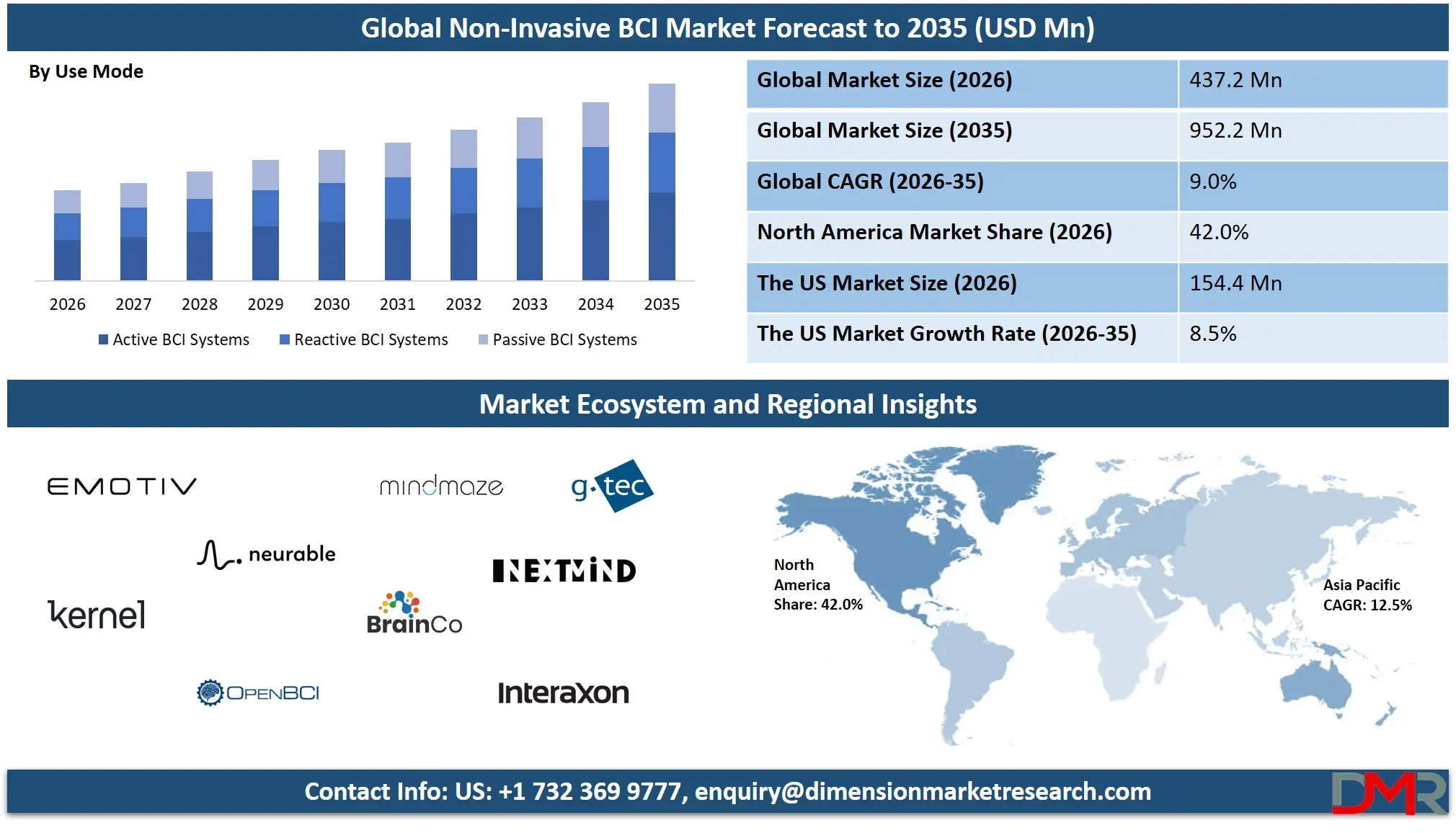
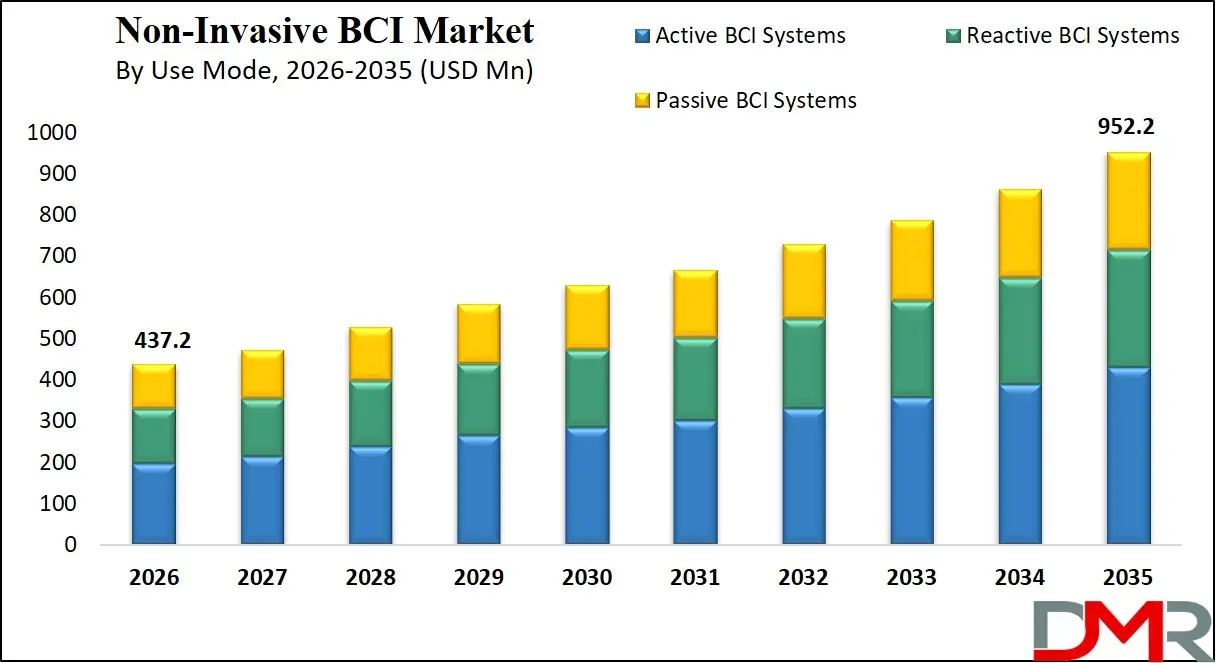
The Global Non-Invasive Brain-Computer Interface (BCI) Market size is projected to reach USD 437.2 million in 2026 and expand at a CAGR of 9.0%, attaining USD 952.2 million by 2035, driven by advancements in neurotechnology, EEG-based systems, brain signal decoding, wearable brain devices, and human–machine interface applications.
ℹ
To learn more about this report –
Download Your Free Sample Report Here
The Non-invasive (BCI) market is an expanding neurotechnology field that allows brain-to-device communication via external sensors such as EEG, which is currently utilized in healthcare and also in new consumer applications. The emerging trends in growth include the increase in the prevalence of neurological disorders, as World Health Organization (WHO) has pointed out the prevalence of such conditions in more than one third of the world population, and growing demand on safe and non-invasive solutions.
The development of AI, wearables, and government-sponsored digital health programs is increasing uptake. In the future, the links with real-time analytics and the introduction of gaming and human-machine interaction will also increase the market.
ℹ
To learn more about this report –
Download Your Free Sample Report Here
US Non-Invasive BCI Market
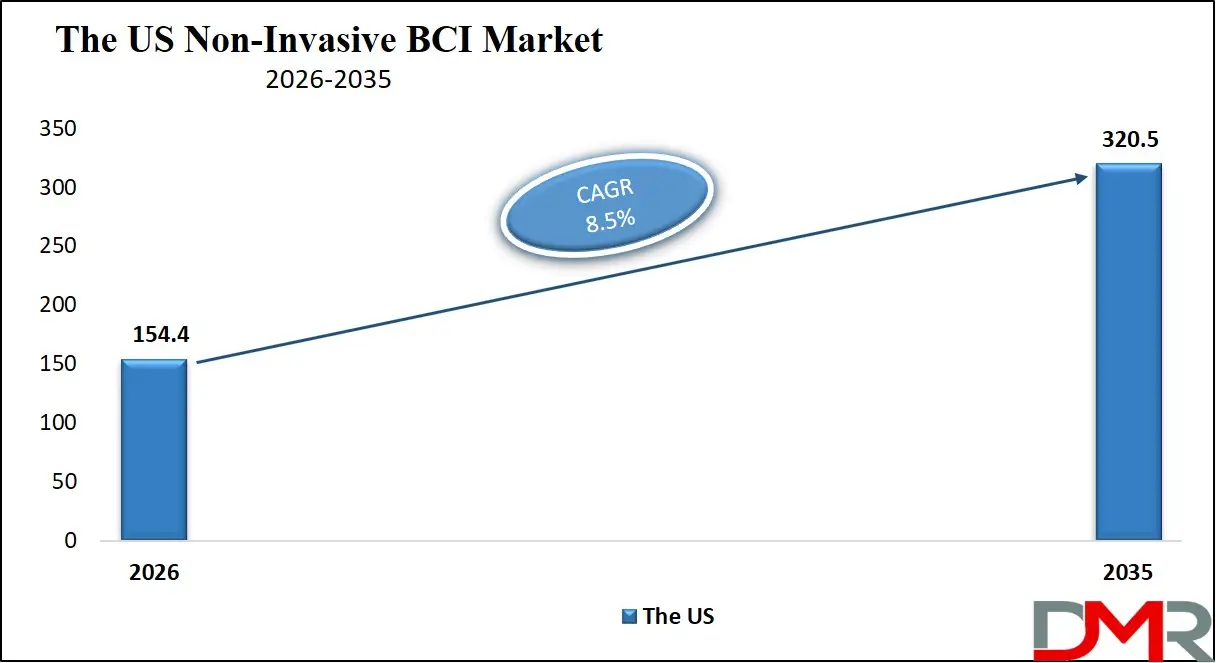
The US Non-Invasive Brain-Computer Interface (BCI) Market is anticipated to reach approximately USD 154.4 million in 2026 and grow at a CAGR of 8.5%, surpassing USD 320.5 million by 2035.
ℹ
To learn more about this report –
Download Your Free Sample Report Here
The U.S. Non-Invasive Brain-Computer Interface (BCI) market is highly advanced, which is supported by high levels of R&D, governmental investments, and an early penetration of neurotechnology. The burden of neurological disorders is high as neurorehabilitation and assistive communication solutions are in demand, encouraged by the Centers for Disease Control and Prevention (CDC). Agencies such as DARPA and the National Institutes of Health (NIH) have been making investments that are faster accelerating innovation, especially in such areas as EEG-based wearable devices and AI-driven brain signal processing. The market is likely to expand with more applications in healthcare, defense and human-machines interaction.
Europe Non-Invasive BCI Market
The Europe Non Invasive BCI market size is projected to reach USD 122.4 million in 2026, expanding at a CAGR of 8.8% over the forecast period. The region's growth is driven by strong government support for neuroscience research and increasing adoption of advanced medical technologies. Rising demand for neurorehabilitation and assistive communication solutions is further accelerating market expansion. Additionally, the presence of established research institutions and regulatory support is strengthening Europe's position in the global market.
Japan Non-Invasive BCI Market
Japan Non Invasive BCI market is expected to reach USD 34.9 million in 2026, growing at a CAGR of 10.6%, reflecting strong future potential. Growth is driven by the country's advanced robotics ecosystem and an increasing focus on human-machine interaction technologies. Rising demand for solutions addressing aging population challenges, particularly in healthcare and rehabilitation, is further supporting adoption. Additionally, continuous innovation and government support in neurotechnology are accelerating market development.
Key Takeaways
- Market Size: The Non-Invasive BCI Market is projected to reach USD 537.2 million in 2026 and grow to USD 952.2 million by 2035, reflecting steady expansion.
- Growth Rate and Outlook: The market is expected to register a CAGR of 9.0%, driven by increasing adoption across healthcare and emerging consumer applications.
- Primary Growth Drivers: Key drivers include rising neurological disorders, growing demand for non-invasive solutions, and advancements in AI driven brain signal processing and wearable devices.
- By Component Analysis: Hardware dominates the segment with around 55% share, supported by strong demand for EEG headsets, sensors, and signal acquisition systems.
- By Signal Acquisition Technology Analysis: EEG based BCI leads with approximately 60% share, owing to its cost effectiveness, portability, and real time signal processing capabilities.
- By Application Analysis: Healthcare and neurorehabilitation hold the largest share at around 58%, driven by increasing use in treating neurological conditions and assistive communication.
- Regional Leadership: North America leads the market with a 42.0% share, supported by strong R&D, advanced healthcare infrastructure, and early technology adoption.
What is Non-Invasive BCI?
A Non-Invasive Brain Computer Interface BCI is a technology that enables direct communication between the brain and external devices using sensors placed on the scalp without surgery. It captures brain signals, typically through electroencephalography, and converts them into commands to control computers or assistive devices. These systems are widely used in rehabilitation and communication for patients with neurological conditions. According to the Centers for Disease Control and Prevention CDC, millions of people are affected by stroke and brain injuries each year, increasing the need for such technologies. Non-invasive BCIs are preferred due to their safety, affordability, and ease of use. Advances in AI and signal processing are improving their accuracy and real-time performance. This technology is becoming important in future human-machine interaction.
Use Cases
- Neurorehabilitation: Non-invasive BCIs are widely used in stroke and paralysis rehabilitation to restore motor functions. They help patients regain control by translating brain signals into movement through external devices. This improves recovery outcomes and supports long-term therapy.
- Assistive Communication: These systems enable individuals with conditions like ALS or locked-in syndrome to communicate using brain signals. Users can control virtual keyboards or speech-generating devices without physical movement. This significantly enhances independence and quality of life.
- Gaming and Entertainment: BCIs are being integrated into gaming to enable brain-controlled interactions and immersive experiences. Players can control characters or environments using cognitive signals. This creates a more engaging and personalized user experience.
- Cognitive Monitoring and Training: Non-invasive BCIs are used to track attention, stress, and mental workload in real time. They support applications in education, workplaces, and wellness programs. This helps improve focus, productivity, and mental health management.
How AI is Transforming the Non-Invasive BCI Market
The Non Invasive BCI market is being reshaped by artificial intelligence that has allowed it to decode the brain signals more efficiently and enhance the precision of the real time interpretation. Machine learning algorithms improve the speed and reliability of communication between machines and the brain, improving the ability to recognize patterns. AI also aids in personalization as it helps to adapt systems to personal neural patterns, enhancing user experience and clinical outcomes. Moreover, the combination of AI and edge computing is enhancing scalable and viable deployment in the fields of healthcare and consumer use.
Market Dynamics
Key Drivers in the Global Non-Invasive BCI Market
Rising neurological disorder burden
Increasing cases of stroke, ALS, and brain injuries are driving demand for non-invasive neurotechnology solutions. Healthcare systems are adopting BCI for rehabilitation and assistive communication, boosting market growth. This trend is further supported by the growing aging population globally.
Advancements in AI and wearable neurotechnology
Continuous innovation in EEG sensors and AI-based signal processing is improving accuracy and usability. This is expanding adoption across both clinical and consumer applications. It is also enabling real-time brain signal interpretation and adaptive interfaces.
Restraints in the Global Non-Invasive BCI Market
Low signal accuracy and noise interference
Non-invasive systems face limitations in capturing precise brain signals due to external interference. This affects reliability compared to invasive alternatives. It also restricts their use in high-precision medical applications.
High cost of advanced systems
Despite being non-invasive, high-quality BCI devices and software remain expensive. This limits adoption in developing and cost-sensitive markets. High R and D and integration costs further increase overall pricing barriers.
Growth Opportunities in the Global Non-Invasive BCI Market
Expansion into consumer and gaming applications
Growing interest in brain-controlled gaming and AR VR experiences is opening new revenue streams. Consumer adoption is expected to accelerate with affordable wearable devices. This is encouraging new entrants and innovation in entertainment applications.
Integration with digital health ecosystems
BCI systems can be integrated with telehealth and remote monitoring platforms. This creates opportunities for personalized and continuous brain health management. It also supports data-driven decision-making in clinical environments.
Trends in the Global Non-Invasive BCI Market
Shift toward hybrid and multimodal BCI systems.
Companies are developing systems combining EEG with other sensing technologies for better accuracy. This enhances performance and broadens application scope. It also enables more reliable and context-aware brain signal interpretation.
Miniaturization and wearable device innovation
There is a strong trend toward compact, wireless, and user-friendly BCI devices. This is making the technology more accessible for everyday use. It is also supporting large-scale adoption in non-clinical environments.
Research Scope and Analysis
By Component Analysis
The component segment is likely to be dominated by hardware with approximately 55.0% share in 2026 due to the high demand of EEG headsets, sensors, and signal acquisition devices. This growth is further encouraged by the development of wearable and wireless hardware. Software, meanwhile, is important in signal processing, and AI-based decoding of brain signals. It enhances accuracy, real-time analysis, and user experience. Hardware is the biggest earner, but software is crucial to the complete system functionality. More and more AI-driven software is being integrated, which is further boosting innovation in this segment.
By Signal Acquisition Technology Analysis
Electroencephalography EEG based BCI is expected to dominate the signal acquisition technology segment with around 60.0% share in 2026, as it has been observed to be cost-effective, portable, and capable of recording real-time brain signals. It has extensive applications in healthcare, research, and consumer-related applications as it is easy to use and scalable. The use of wearable EEG devices is also being enhanced by the continuous developments. Functional near-infrared spectroscopy fNIRS based BCI is on the rise due to its capability to detect brain activity according to blood oxygen levels with increased spatial resolution. It is found to be increasingly applied in cognitive studies and hybrid BCIs. Even though fNIRS has a smaller share, it is likely to increase gradually as it has complementary capabilities.
By Device Type Analysis
The device type category is projected to be dominated by wearable BCI devices with approximately 70.0% share in 2026 due to increased demand of portable, user-friendly, and real-time brain monitoring devices. These wearables, such as headsets and headbands, are hugely embraced in healthcare, gaming, and wellness uses. Their adoption is also increasing with continuous developments in wireless connection and miniaturization. By comparison, non-wearable or lab-based systems are mainly utilized in clinical and research applications where precision is needed and controlled environments are necessary. They are used to provide high-quality data and are required in complicated neurological research.
By Degree of Mobility Analysis
The degree of mobility segment is projected to be dominated by portable systems which will have approximately 60.0% share in 2026 and this is due to the growing demand of flexible, wireless and easy to use BCI solutions. These systems facilitate real-time monitoring and are extensively used in home care, rehabilitation, and consumer applications. Their development is also being enhanced by the improvement in battery life and small size. Conversely, fixed systems are predominantly applied in hospitals and research laboratories where there is a need to have stable setups and high precision. They offer greater uniformity of data quality and would be instrumental in clinical diagnostics and neurological studies.
By Connectivity & Data Processing Analysis
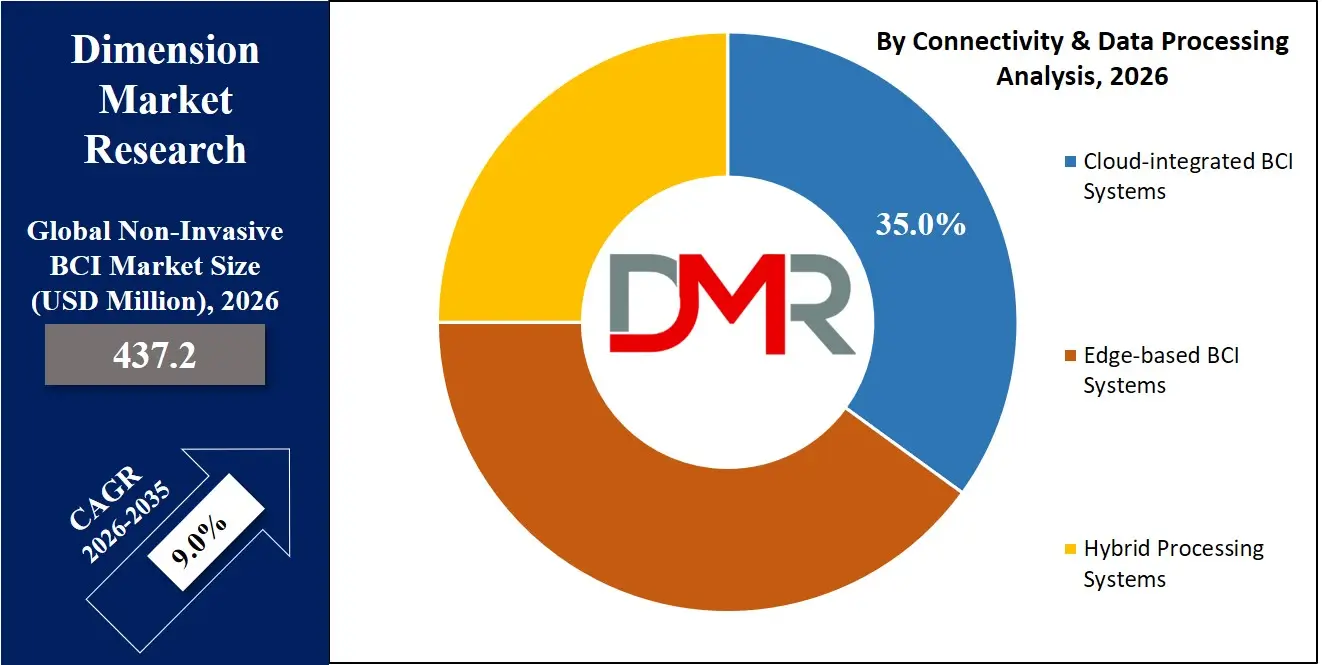
Edge-based BCI systems are expected to dominate the connectivity and data processing segment with around 40.0% share in 2026, driven by their ability to process brain signals in real time with low latency and improved data privacy. These systems are widely used in applications requiring instant response, such as rehabilitation and human-machine interaction.
ℹ
To learn more about this report –
Download Your Free Sample Report Here
Advancements in embedded AI and on-device processing are further strengthening their adoption. In contrast, cloud-integrated BCI systems enable large-scale data storage, remote monitoring, and advanced analytics. They support continuous learning models and are increasingly used in research and telehealth applications.
By Use Mode Analysis
It is predicted that active BCI systems will dominate the use mode segment with a market share of approximately 45.0% in the year 2026 due to their capability of converting deliberate brain signals into direct instructions to be used to control the device. Motor imagery, prosthetic control and assistive communication are some of the common uses of these systems. They are flexible and user driven and can be used in the clinical as well as the non-clinical setting. Reactive BCI systems, on the contrary, are systems that work in response to external stimuli like visual or auditory stimuli. They provide greater precision in some controlled settings, and are often employed in neurofeedback and communication interfaces.
By Application Analysis
The application segment is likely to be dominated by healthcare and neurorehabilitation with approximately 58.0% market share in 2026 due to the rising adoption of BCI systems in the treatment of neurological disorders like stroke, paralysis, and brain damage. These solutions facilitation of motor recovery, cognitive therapy and assistive communication, and they are essential in clinical practice. Adoption is also being accelerated by increasing investments in healthcare and the need to use non-invasive treatments. Comparatively, communication and control systems aim at providing users with an opportunity to communicate with devices through brain signals to perform tasks like typing, cursor control, and smart home operation. These are applications that are on the rise in assistive and consumer applications.
By End User Analysis
The end-user segment is projected to be dominated by healthcare institutions with an estimated share of 43.0% in 2026 as the use of BCI systems in hospitals, rehabilitation facilities, and neurology clinics increases with the aim of diagnosing and treating patients. Non-invasive BCI is employed in these institutions to provide neurorehabilitation, patient monitoring and assistive communication. The growing healthcare expenditure and clinical demand are also contributing to this domination. Comparatively, academic institutions and research laboratories are instrumental in the development of the BCI technology in terms of neuroscience research and testing. They are also concerned with innovation, development, and validation of the new applications, which will help to grow the market in the long term.
The Global Non-Invasive BCI Market Report is segmented on the basis of the following:
By Component
- Hardware
- Signal acquisition devices
- Amplifiers and processors
- Neurostimulation peripherals
- Software
- Signal processing software
- AI/ML decoding platforms
- Application interfaces and SDKs
- Services
- Integration and deployment
- Training and support
- Data analytics and customization
By Signal Acquisition Technology
- Electroencephalography (EEG)-based BCI
- Wet electrode EEG systems
- Dry electrode EEG systems
- Wearable EEG headsets
- Functional Near-Infrared Spectroscopy (fNIRS)-based BCI
- Continuous wave fNIRS
- Frequency-domain fNIRS
- Time-domain fNIRS
- Magnetoencephalography (MEG)-based BCI
- Superconducting MEG systems
- Optically pumped magnetometers
- Functional Magnetic Resonance Imaging (fMRI)-based BCI
- Real-time fMRI neurofeedback systems
- High-resolution imaging systems
- Hybrid Non-invasive BCI Systems
- EEG + fNIRS integrated systems
- EEG + eye-tracking systems
- Multimodal neuro-sensing platforms
By Device Type
- Wearable BCI Devices
- Non-wearable / Lab-based Systems
By Degree of Mobility
- Portable Systems
- Fixed Systems
By Connectivity & Data Processing
- Cloud-integrated BCI Systems
- Edge-based BCI Systems
- Hybrid Processing Systems
By Use Mode
- Active BCI Systems
- Reactive BCI Systems
- Passive BCI Systems
By Application
- Healthcare & Neurorehabilitation
- Communication & Control Systems
- Gaming, AR/VR & Entertainment
- Defense & Aerospace
- Education & Cognitive Enhancement
By End User
- Healthcare Institutions
- Research & Academic Institutes
- Individual Consumers
- Enterprise & Industrial Users
Regional Analysis
Leading Region by Market Share
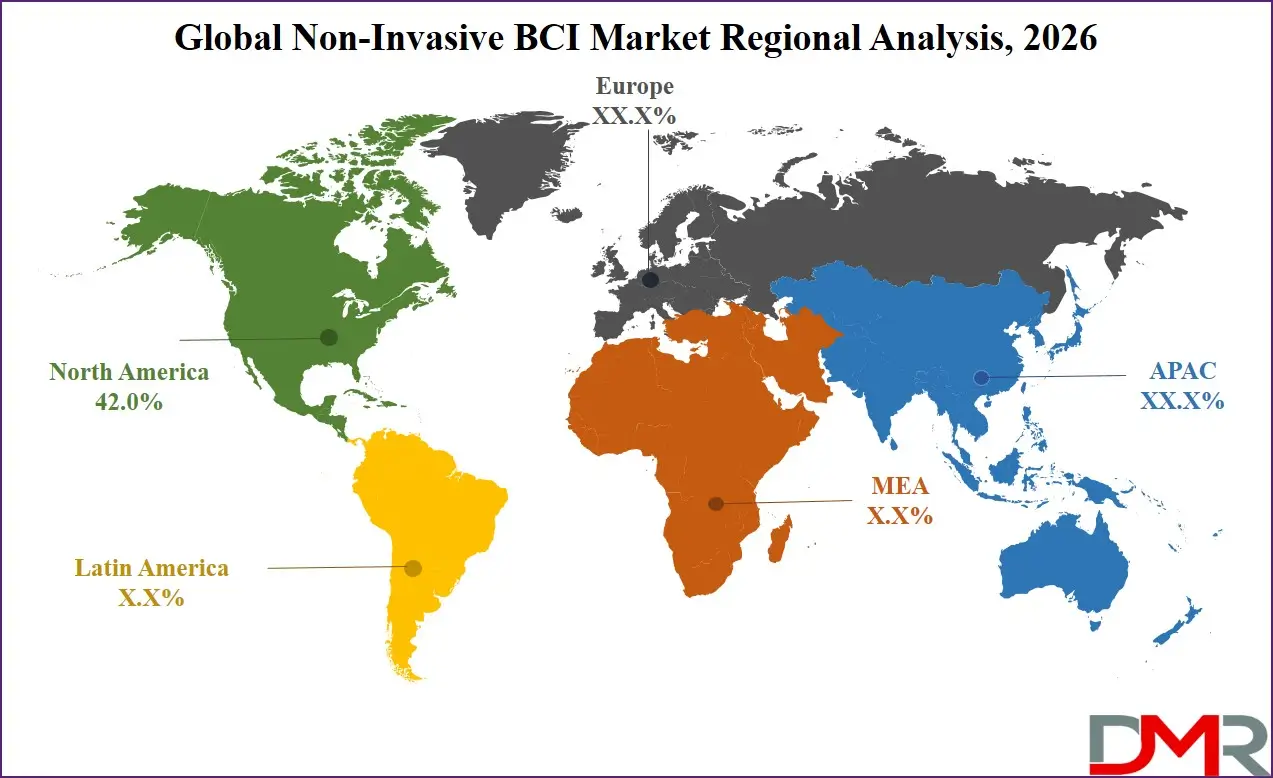
The Non Invasive BCI market is expected to be dominated by North America that holds 42.0% share in 2026 due to the high representation of neurotechnology firms and developed healthcare facilities. Innovation is being accelerated by high investments in brain research by government agencies and institutions. Early implementation of AI-based BCI systems in the clinical and commercial arena is also advantageous to the region. Moreover, the growing number of neurological disorders is advocating long-term need of non-invasive solutions.
ℹ
To learn more about this report –
Download Your Free Sample Report Here
Fastest-Growing Regional Market
The fastest region in Non-Invasive BCI is Asia Pacific due to the increasing investments in healthcare and the growth of neurotechnology research programs. The adoption of AI and digital health is increasing rapidly in countries such as China, Japan, and India due to strong government support. Market growth is further being enhanced by the growing need of inexpensive and wearable BCI solutions. The swift growth of consumer electronics and increased understanding of neurological well-being are also expanding.
By Region
North America
Europe
- Germany
- The U.K.
- France
- Italy
- Russia
- Spain
- Benelux
- Nordic
- Rest of Europe
Asia-Pacific
- China
- Japan
- South Korea
- India
- ANZ
- ASEAN
- Rest of Asia-Pacific
Latin America
- Brazil
- Mexico
- Argentina
- Colombia
- Rest of Latin America
Middle East & Africa
- Saudi Arabia
- UAE
- South Africa
- Israel
- Egypt
- Rest of MEA
Competitive Landscape
The competitive landscape of the Non-Invasive BCI market is driven by continuous innovation in signal accuracy, AI integration, and wearable technologies. Players are focusing on product development and real-time processing capabilities to stay competitive. Strategic partnerships and research collaborations are accelerating advancements. The market remains moderately fragmented, with both established firms and startups contributing to growth.
Some of the prominent players in the Global Non-Invasive BCI Market are:
- Emotiv
- Neurable
- Kernel
- OpenBCI
- MindMaze
- BrainCo
- g.tec medical engineering
- NextMind
- InteraXon
- ANT Neuro
- Neurosky
- Brain Products GmbH
- Compumedics Neuroscan
- Advanced Brain Monitoring
- Wearable Sensing
- Bitbrain
- Blackrock Neurotech
- Merge Labs
- BrainsWay
- Neuracle
- Other Key Players
Recent Developments
- March 2026: BrainCo advanced its commercialization strategy for non-invasive BCI solutions while progressing toward a public listing after raising significant capital to scale neurotechnology products
- February 2026: Multiple Chinese BCI startups accelerated product development and commercialization of non-invasive systems supported by strong government backing and expanding clinical trials
- January 2026: Precision Neuroscience entered a strategic partnership with Medtronic to co-develop advanced BCI systems integrating neuro interfaces with surgical navigation platforms.
Report Details
| Report Characteristics |
| Market Size (2026) |
USD 537.2 Mn |
| Forecast Value (2035) |
USD 952.2 Mn |
| CAGR (2026–2035) |
9.0% |
| Historical Data |
2021 – 2025 |
| Forecast Data |
2027 – 2035 |
| Base Year |
2025 |
| Estimate Year |
2026 |
| Segments Covered |
By Component (Hardware, Software, Services), By Signal Acquisition Technology (Electroencephalography EEG based BCI, Functional Near Infrared Spectroscopy fNIRS based BCI, Magnetoencephalography MEG based BCI, Functional Magnetic Resonance Imaging fMRI based BCI, Hybrid Non invasive BCI Systems), By Device Type (Wearable BCI Devices, Non wearable Lab based Systems), By Degree of Mobility (Portable Systems, Fixed Systems), By Connectivity and Data Processing (Cloud integrated BCI Systems, Edge based BCI Systems, Hybrid Processing Systems), By Use Mode (Active BCI Systems, Reactive BCI Systems, Passive BCI Systems), By Application (Healthcare and Neurorehabilitation, Communication and Control Systems, Gaming AR VR and Entertainment, Defense and Aerospace, Education and Cognitive Enhancement), By End User (Healthcare Institutions, Research and Academic Institutes, Individual Consumers, Enterprise and Industrial Users) |
| Regional Coverage |
North America – The US and Canada; Europe – Germany, The UK, France, Russia, Spain, Italy, Benelux, Nordic, & Rest of Europe; Asia-Pacific – China, Japan, South Korea, India, ANZ, ASEAN, Rest of APAC; Latin America – Brazil, Mexico, Argentina, Colombia, Rest of Latin America; Middle East & Africa – Saudi Arabia, UAE, South Africa, Turkey, Egypt, Israel, & Rest of MEA |
Frequently Asked Questions
How big is the Non-Invasive BCI Market?
▾ The Non-Invasive BCI Market is projected to reach USD 537.2 million in 2026 and grow to USD 952.2 million by 2035.
What is the CAGR of the Non-Invasive BCI Market from 2026 to 2035?
▾ The market is expected to grow at a CAGR of 9.0% during the forecast period.
What factors are driving the growth of the Non-Invasive BCI Market?
▾ Growth is driven by rising neurological disorders, increasing demand for non-invasive neurotechnology, advancements in AI based brain signal decoding, and growing adoption of wearable BCI devices.
What are the major trends in the Non-Invasive BCI Market?
▾ Key trends include integration of AI and machine learning, development of wearable and wireless devices, shift toward hybrid BCI systems, and expansion into consumer and gaming applications.
Which region held the largest share of the Non-Invasive BCI Market in 2026?
▾ North America held the largest share, accounting for 42.0% of the market.
Which region is expected to grow the fastest in the Non-Invasive BCI Market?
▾ Asia Pacific is expected to be the fastest growing region due to rising investments in healthcare and neurotechnology.
Who are the key players in the Non-Invasive BCI Market?
▾ Emotiv, Neurable, Kernel, OpenBCI, MindMaze, BrainCo, g.tec medical engineering, NextMind, InteraXon, ANT Neuro, Neurosky, Brain Products GmbH, Compumedics Neuroscan, Advanced Brain Monitoring, Wearable Sensing, Bitbrain, Blackrock Neurotech, Merge Labs, BrainsWay, Neuracle, and other key players.
How is the Non-Invasive BCI Market segmented?
▾ The market is segmented by Component, Signal Acquisition Technology, Device Type, Degree of Mobility, Connectivity and Data Processing, Use Mode, Application, and End User.