Market Snapshot
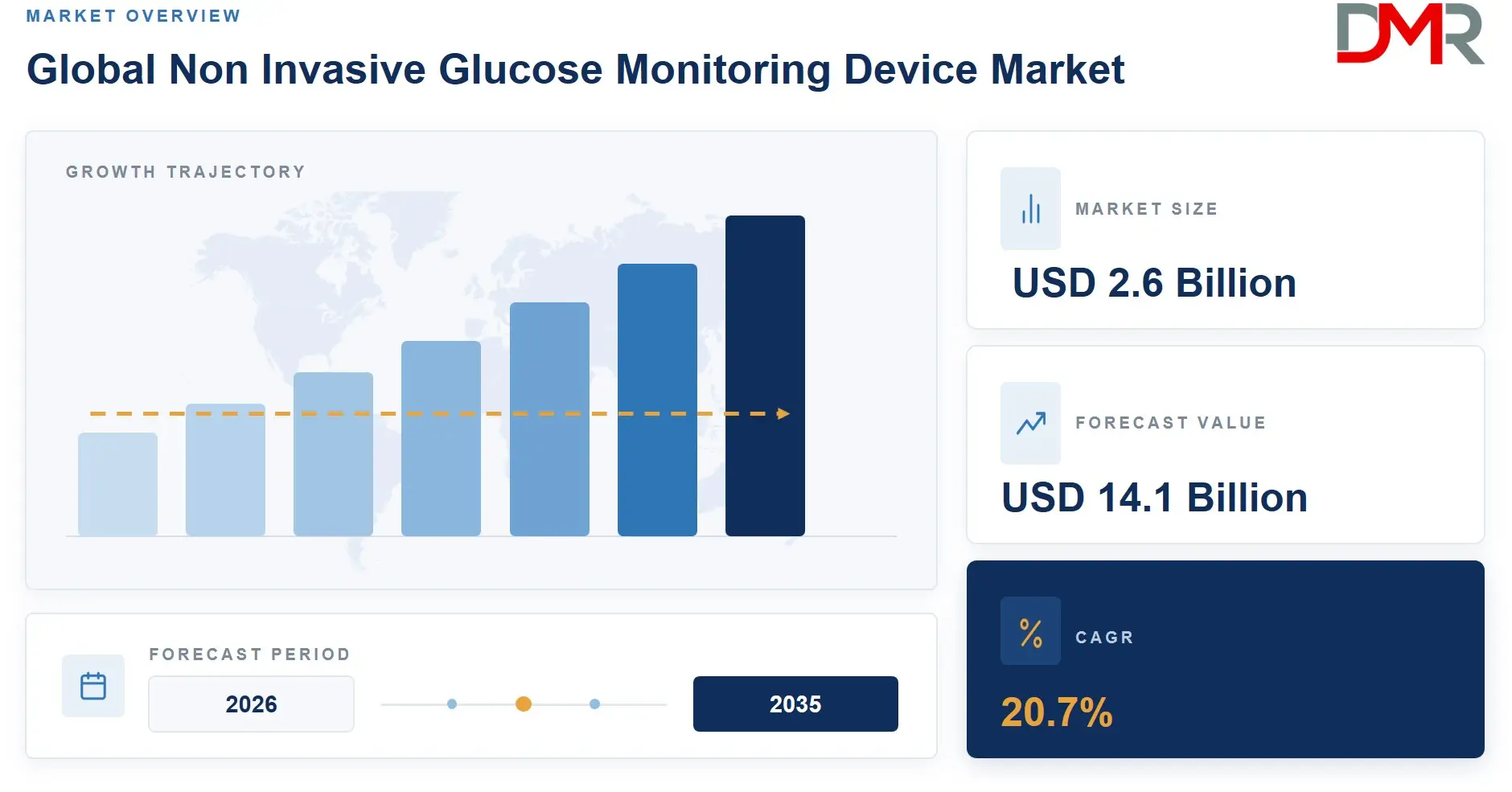
- Market Size (2026): USD 2.6 Bn
- Forecast Value (2035): USD 14.1 Bn
- CAGR (2026-2035): 20.7%
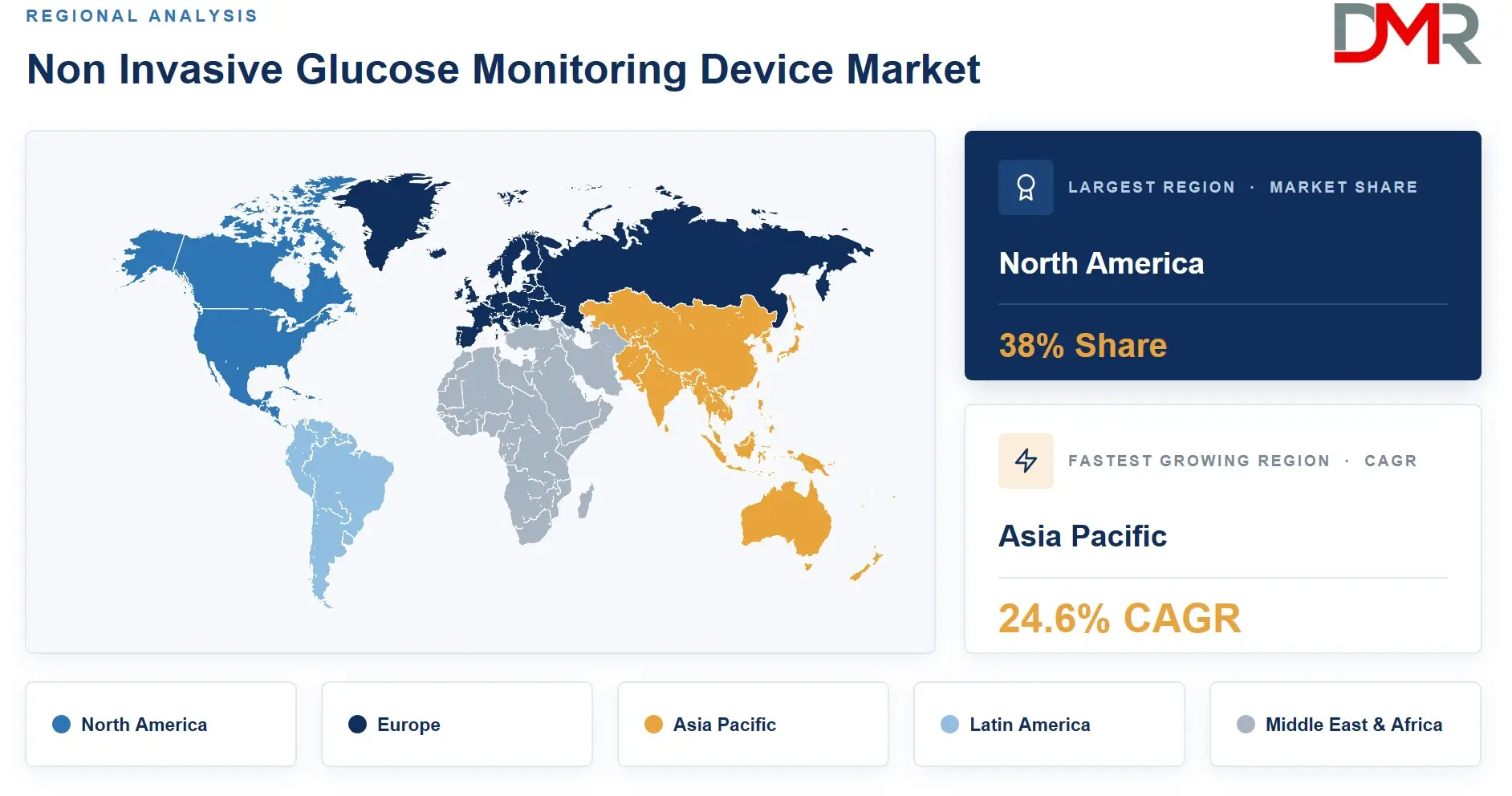
- Largest Region (2026): North America, approximately 38%
- Fastest-Growing Region: Asia-Pacific
- Leading Technology (2026): Optical Spectroscopy, around 41%
- Leading Product Type (2026): Wearable Continuous Monitors, close to 47%
- Key Players: Know Labs, DiaMonTech, RSP Systems and others
What is Non Invasive Glucose Monitoring Device Market and its Market Size?
Global Non Invasive Glucose Monitoring Device Market size is estimated to reach USD 2.6 Bn in 2026 and is further anticipated to reach USD 14.1 Bn by 2035, at a CAGR of 20.7%. Non invasive glucose monitoring devices estimate glucose without inserting a sensor filament into subcutaneous tissue and without routine finger-stick blood sampling. The commercial boundary includes optical, radiofrequency, microwave, electromagnetic, transdermal extraction and other needle-free sensing approaches intended for repeated or continuous glucose assessment.
ℹ
To learn more about this report –
Download Your Free Sample Report Here
The industry remains development-heavy rather than uniformly commercial. Buyers include people with diabetes, people with prediabetes, clinicians, diabetes programs, research centers, wellness platforms and consumer-device companies seeking metabolic sensing. Product value depends on analytical accuracy, calibration burden, measurement latency, skin-tone and motion robustness, battery consumption, form factor, software interpretation and a regulatory pathway that supports medical claims.
A central structural shift is the movement from laboratory spectroscopy toward compact wearable or handheld architectures. Raman, near-infrared, mid-infrared, photothermal, radiofrequency dielectric sensing and magnetohydrodynamic extraction are being paired with signal processing and machine learning to separate weak glucose signals from temperature, hydration, pressure, motion and tissue variability. This changes competition from a single-sensor race into a combined hardware, algorithm, clinical-validation and manufacturing challenge.
Commercial adoption is expected to broaden first where needle avoidance materially improves testing frequency and adherence. The addressable opportunity also extends beyond insulin-treated diabetes toward type 2 diabetes not using insulin, prediabetes, nutrition feedback and preventive metabolic care. However, medical-grade claims require repeatable performance across diverse users and real-world conditions, keeping clinical evidence and regulatory credibility central to market conversion.
Use Cases
- Daily Type 2 Diabetes Monitoring: Adults who need regular glucose visibility can use needle-free wearable or spot-check systems to observe post-meal and daily patterns without repeated skin puncture, potentially increasing testing frequency and giving clinicians a denser behavioral record for therapy and lifestyle discussions.
- Prediabetes and Metabolic Health Programs: Digital health providers can deploy non invasive sensors for short monitoring periods around diet, activity and sleep interventions, turning glucose response into an understandable feedback signal while avoiding the friction of prescribing and applying conventional sensor filaments.
- Outpatient Screening and Follow-Up: Primary care clinics, pharmacies and community programs can use portable devices to support repeated glucose assessment in people at elevated metabolic risk, particularly when a quick, painless measurement can improve participation and enable referral for confirmatory diagnostic testing.
- Sports and Nutrition Optimization: Performance teams and wellness users can track glucose response alongside training, meals and recovery. In this context, the device functions as a behavioral sensor rather than an insulin-dosing instrument, with convenience and repeatability determining whether users sustain measurement over time.
Key Takeaways
- Market Size & Share: The industry is modeled at USD 2.6 Bn in 2026, reflecting a category still weighted toward emerging systems, clinical programs and early commercialization.
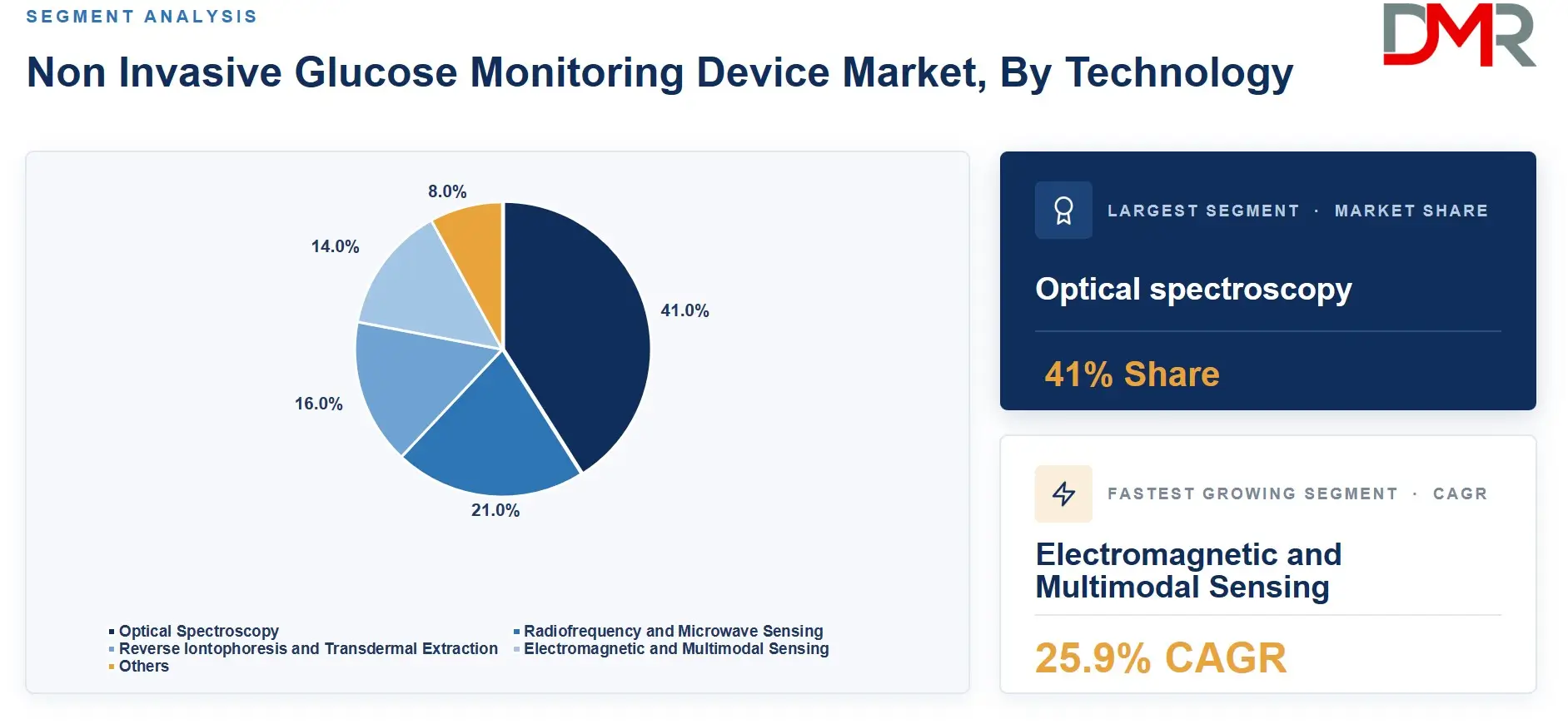
- Technology Analysis: Optical spectroscopy is expected to represent approximately 41% of 2026 revenue because multiple development programs use Raman, infrared or photothermal molecular sensing.
- Regional Analysis: North America is projected to account for roughly 38% of 2026 demand, supported by diabetes-device spending, venture funding and regulatory-development activity.
- Product Transition: Wearable continuous monitors are set to hold nearly 47% of 2026 product revenue as developers prioritize wrist, patch and accessory form factors.
- Clinical Channel: Home and self-monitoring is expected to capture about 52% of 2026 end-use demand as convenience is the core value proposition of needle-free sensing.
- Growth Pocket: Smartwatch and accessory-integrated devices are forecast to expand at a CAGR of 27.6% through 2035 as sensing modules shrink and consumer platforms add metabolic-health features.
How AI/Gen AI is Transforming the Non Invasive Glucose Monitoring Device Market?
AI is becoming part of the measurement stack because non invasive sensing produces weak, noisy signals affected by tissue composition, hydration, temperature, motion and device placement. Supervised learning can map multivariate optical or radiofrequency features to reference glucose values, while sensor-fusion models can use temperature, heart rate, activity and pressure signals to identify conditions in which a reading should be corrected or rejected. This is operational AI rather than a purely conversational Gen AI use case.
Generative AI has a secondary role in documentation, user education and software workflows. It can summarize glucose patterns for clinicians, generate structured trial documentation and translate technical trend data into consumer-facing explanations, but it should not substitute for validated measurement algorithms or regulated clinical decision logic.
- Signal Denoising: Machine learning separates glucose-related spectral or dielectric patterns from motion and tissue noise.
- Personalization: Adaptive models can account for individual physiology while reducing repeated calibration burden.
- Sensor Fusion: Algorithms combine glucose sensing with temperature, activity and cardiovascular signals to improve context awareness.
- Clinical Documentation: LLM-based tools can structure device logs and study notes for review without changing the underlying validated measurement output.
Key Drivers in the Global Non Invasive Glucose Monitoring Device Market
Demand is being pulled by a combination of monitoring burden and a widening metabolic-health user base. The strongest forces are behavioral convenience and technical miniaturization.
- Needle Avoidance Can Expand Monitoring Frequency: Wearable continuous monitors are projected to represent around 47% of product revenue in 2026 because the largest unmet need is not simply another glucose reading, but a lower-friction way to obtain repeated readings. Finger-stick testing creates pain and inconvenience, while conventional CGM still requires skin penetration. A credible needle-free device can therefore address adherence in type 2 diabetes, prediabetes and wellness populations that do not routinely use invasive sensors. More frequent measurement also creates richer trend data, which increases the value of companion apps, coaching and remote-care programs and can support recurring software and service revenue around the hardware.
- Miniaturized Photonics and RF Electronics Improve Wearability: Optical spectroscopy is expected to hold approximately 41% of 2026 technology revenue, while radiofrequency and microwave sensing is modeled to grow faster at 24.8% through 2035. Smaller lasers, photodetectors, RF front ends, low-power processors and better packaging are moving experimental systems from benchtop equipment toward wrist, patch and handheld formats. As component size and power demand decline, developers can run more frequent measurements and collect richer raw signals without making devices impractical. That improves the commercial feasibility of continuous or repeated monitoring and attracts consumer-electronics partners that can supply manufacturing scale.
Restraints in the Global Non Invasive Glucose Monitoring Device Market
The category faces unusually high proof requirements because convenience has little value if measurements cannot support safe decisions. Clinical reproducibility and regulatory evidence remain the main brakes.
- Accuracy Across Real-World Physiology Remains Difficult: Handheld and spot-check devices are expected to account for roughly 26% of product revenue in 2026, partly because intermittent measurements can be technically easier to control than continuous wear. Optical and electromagnetic signals vary with skin thickness, pigmentation, hydration, temperature, sweat, pressure, motion and sensor position. A model that performs well in a controlled cohort may lose accuracy across broader populations or daily environments. Developers therefore need diverse datasets, stable calibration strategies and rigorous comparator studies. These requirements lengthen development cycles, raise clinical costs and make premature consumer claims a reputational risk for the entire category.
- Regulatory Claims Create a High Commercial Threshold: Medical applications are modeled at about 74% of 2026 application revenue, placing most value behind regulated performance rather than general wellness positioning. Devices intended to guide diabetes management must demonstrate analytical and clinical performance, software controls, cybersecurity, usability and manufacturing quality. Regulators also distinguish glucose awareness from claims suitable for treatment decisions. This creates a difficult sequencing problem: companies need capital to complete validation before broad reimbursement or prescription demand is available. Firms that launch first as wellness products can gather usability data, but they must avoid blurring the boundary between informational trends and medically actionable glucose values.
Growth Opportunities in the Global Non Invasive Glucose Monitoring Device Market
White space is strongest where existing monitoring is underused because the burden of invasive sensing outweighs perceived benefit. Consumer metabolic health and emerging Asian device ecosystems offer two distinct routes.
- Prediabetes and Non-Insulin Type 2 Programs: Wellness and preventive applications are expected to represent around 26% of 2026 application revenue and can expand faster than traditional insulin-management use cases. Large populations with prediabetes or type 2 diabetes not using insulin often lack continuous feedback because conventional CGM can be costly or clinically unnecessary for routine use. Needle-free, short-duration or reusable devices could support nutrition experiments, weight-management programs and employer health services without committing users to invasive sensors. The opportunity favors business models combining hardware with coaching, analytics and periodic monitoring rather than permanent continuous wear, broadening the market beyond specialist diabetes channels.
- Asia-Pacific Manufacturing and Consumer Electronics Partnerships: Asia-Pacific is forecast to grow at a CAGR of 24.6% from 2026 to 2035, the fastest regional trajectory in the model. The region combines a large diabetes burden with dense supply chains for photonics, semiconductors, wearables and smartphones. Partnerships with smartwatch makers, sensor foundries and contract manufacturers can shorten the path from prototype to compact consumer-grade hardware. Localized clinical studies and distribution alliances can also reduce dependence on North American launch economics. The commercial opening is especially strong for modular sensing components that can be integrated into broader health platforms rather than sold only as stand-alone diabetes devices.
Trends in the Global Non Invasive Glucose Monitoring Device Market
Current development is shifting from single-sensor demonstrations toward multimodal systems and more flexible monitoring formats. The result is a broader range of device architectures than conventional CGM offers.
- Multimodal Sensing Is Replacing Single-Signal Dependence: Electromagnetic and multimodal sensing is expected to hold close to 12% of 2026 technology revenue but expand at a CAGR of 25.9% through 2035. Developers increasingly combine optical, RF, thermal, impedance or physiological context signals because each modality has different sensitivity to tissue and environmental interference. Sensor fusion can flag motion artifacts, compensate for temperature changes and improve confidence scoring. This trend also changes supplier relationships because a glucose platform may require photonics, analog front ends, wireless connectivity and algorithm expertise in one package. Integration capability is becoming as important as the nominal sensing principle.
- Short-Duration and Reusable Architectures Broaden Choice: Smartwatch and accessory-integrated devices are projected to grow at 27.6% through 2035, faster than the overall industry. Developers are exploring reusable readers, replaceable sensing elements, watch straps, rings and single-day systems instead of copying the multi-day disposable patch model. These formats can reduce recurring consumable burden and appeal to users who want periodic metabolic feedback rather than uninterrupted monitoring. The trend also creates new pricing structures, including hardware purchase plus software subscription, reusable transmitter plus low-cost sensor, and wellness bundles sold through digital channels. Product economics may therefore diverge significantly from established CGM reimbursement models.
Research Scope and Analysis
Segment performance is assessed across five axes: technology, product type, application, end user and distribution channel. Each axis identifies where 2026 revenue is concentrated and where growth is moving through 2035, linking share leadership to device architecture, buyer behavior, clinical requirements and route to market.
ℹ
To learn more about this report –
Download Your Free Sample Report Here
By Technology
Optical spectroscopy is projected to hold the largest share by technology in 2026, accounting for approximately 41% of revenue because Raman, near-infrared, mid-infrared and photothermal approaches directly interrogate molecular or tissue responses and have attracted sustained research investment. Their advantage is a path toward contactless or low-contact measurement, although miniaturization and signal strength remain difficult. Growth, however, is concentrated in electromagnetic and multimodal sensing, expanding at a CAGR of 25.9% between 2026 and 2035 as developers combine complementary sensor channels and contextual physiological data to improve robustness. Better RF integrated circuits, photodetectors and embedded processors support this convergence, while algorithmic sensor fusion helps manage interference that a single modality may not resolve consistently.
By Product Type
Wearable continuous monitors are expected to lead product revenue in 2026 with close to 47% share because the principal commercial promise of non invasive technology is repeated glucose visibility without needles. Wrist and patch-like formats also align with established consumer behavior around health wearables and allow software to build trends rather than isolated measurements. The steeper trajectory sits with smartwatch and accessory-integrated devices, which are forecast to grow at a CAGR of 27.6% from 2026 to 2035. Integration into straps, watches, rings or companion modules can lower user friction and place glucose alongside activity, sleep and cardiovascular metrics. Success depends on reducing power draw and sensor size while maintaining stable skin contact and clinically credible performance.
By Application
Diabetes management is projected to account for around 74% of application revenue in 2026 because regulated glucose measurement has its clearest economic value in people already managing diagnosed disease. Clinical programs, endocrinology pathways and self-monitoring behavior provide an established need against which needle-free systems can demonstrate convenience and adherence benefits. Growth, however, is concentrated in wellness and preventive metabolic monitoring, expanding at a CAGR of 25.2% through 2035. Prediabetes programs, nutrition services, weight-management platforms and sports applications can use glucose patterns as behavioral feedback without positioning every reading as an insulin-dosing input. This creates a larger consumer funnel, although companies must keep wellness claims clearly separated from regulated diagnostic or therapeutic claims.
By End User
Home and self-monitoring users are expected to represent approximately 52% of end-user revenue in 2026 because needle-free sensing derives most of its value from making repeated measurement easier outside clinical settings. Personal devices can connect readings with meals, activity and sleep while reducing the practical barriers associated with finger sticks or sensor insertion. Growth, however, is strongest in digital health and wellness programs, forecast at a CAGR of 26.3% between 2026 and 2035. These programs can distribute devices alongside coaching, remote monitoring and metabolic-health subscriptions, spreading hardware cost across a broader service relationship. Their scale also creates longitudinal datasets that can improve user engagement and support evidence generation, subject to consent, privacy and medical-device data controls.
By Distribution Channel
Direct-to-consumer and online channels are projected to hold roughly 36% of distribution revenue in 2026 because many emerging systems target self-monitoring, early adopters and wellness users before achieving broad prescription reimbursement. Digital channels also allow manufacturers to bundle devices with apps, subscriptions and education while maintaining a direct relationship with users. The faster-growth channel is consumer electronics and platform partnerships, expanding at a CAGR of 27.1% through 2035 as glucose sensing moves toward watches, accessories and multiparameter health devices. These partnerships provide hardware scale, retail reach and existing smartphone ecosystems, but they also raise the bar for component cost, battery life, industrial design and interoperability. Medical claims will still require regulated pathways even when distribution occurs through consumer brands.
The Global Non Invasive Glucose Monitoring Device Market Report is Segmented Based on the Following
By Technology
- Optical Spectroscopy
- Radiofrequency and Microwave Sensing
- Reverse Iontophoresis and Transdermal Extraction
- Electromagnetic and Multimodal Sensing
- Others
By Product Type
- Wearable Continuous Monitors
- Handheld and Spot-Check Devices
- Tabletop and Point-of-Care Systems
- Smartwatch and Accessory-Integrated Devices
- Others
By Application
- Diabetes Management
- Prediabetes Monitoring
- Wellness and Preventive Metabolic Health
- Sports and Nutrition Monitoring
- Others
By End User
- Home and Self-Monitoring Users
- Hospitals and Clinics
- Diagnostic and Research Centers
- Digital Health and Wellness Programs
- Others
By Distribution Channel
- Direct-to-Consumer and Online
- Hospitals and Clinical Channels
- Pharmacies and Medical Device Distributors
- Consumer Electronics and Platform Partnerships
- Others
Regional Analysis
Region with the Largest Revenue Share
North America is expected to remain the largest regional market in 2026, accounting for approximately 38% of global revenue. The region combines high diabetes technology spending, established remote-care infrastructure, venture funding and a deep medical-device regulatory ecosystem. US developers are active in radiofrequency, spectroscopy and digital glucose platforms, while large glucose-monitoring companies have trained consumers and clinicians to value continuous trend data. This installed behavior lowers the educational barrier for needle-free alternatives, although it does not reduce the evidence required for medical claims. Commercial leadership therefore depends on whether emerging devices can convert technical prototypes into reproducible clinical performance and scalable manufacturing.
ℹ
To learn more about this report –
Download Your Free Sample Report Here
Region with the Highest CAGR
Asia-Pacific is forecast to record the highest regional CAGR of 24.6% from 2026 to 2035. China, Japan, South Korea and other electronics-intensive markets provide photonics, semiconductor, display, battery and wearable-device capabilities that can accelerate miniaturization and lower component costs. The region also has a large population exposed to diabetes and prediabetes, creating demand for easier monitoring models. Consumer electronics companies can integrate metabolic sensing with broader health ecosystems, while local startups can target lower-cost devices for large domestic markets. Regulatory validation and cross-population accuracy remain important constraints, particularly when products move from wellness insights toward medical decision support.
By Region
North America
Europe
- Germany
- France
- The UK
- Italy
- Spain
- Rest of Europe
Asia-Pacific
- China
- Japan
- India
- Australia
- South Korea
- Rest of APAC
Latin America
- Mexico
- Brazil
- Colombia
- Argentina
- Rest of LATAM
Middle East & Africa
- Saudi Arabia
- The UAE
- South Africa
- Rest of MEA
Regulatory Landscape
Non invasive glucose devices sit at the intersection of medical-device hardware, software and increasingly AI-enabled signal processing. Regulators focus on intended use, analytical performance, clinical performance, calibration, human factors, cybersecurity and whether readings are suitable for treatment decisions or only general wellness. The current state favors staged development, with many systems still generating clinical evidence before broad medical commercialization. The opening lies in clearly defined claims that match demonstrated performance, including monitoring or trend-awareness use cases before insulin-dosing claims. The main risk is overextending consumer-facing claims ahead of validation, which can slow approvals and weaken clinician trust. Regulatory execution therefore directly affects launch timing, addressable users and achievable pricing.
Patent Analysis
Intellectual property is strategically important because competing approaches rely on different combinations of optical paths, RF architectures, skin interfaces, calibration routines, signal processing and wearable packaging. Patent positions can protect not only the sensing principle but also methods for compensating temperature, motion, hydration and user-specific variability. The field is shifting toward portfolios that connect sensor hardware with algorithms and compact form factors rather than isolated spectroscopy claims. Commercial white space remains in low-power multimodal designs, reusable architectures and calibration-light workflows that can be manufactured at consumer scale. The brake is freedom-to-operate complexity as adjacent photonics, wireless and medical-device patents overlap. Strong portfolios can improve partnership leverage, but clinical evidence ultimately determines whether protected technology becomes marketable demand.
Competitive Landscape
Competition is fragmented and technology-led, with no single non invasive architecture established as the clinical standard. Specialist developers compete on signal quality, calibration stability, real-world accuracy, wearability and the ability to finance clinical validation. Large glucose-monitoring and consumer-electronics companies contribute manufacturing scale, software ecosystems and regulatory experience, while photonics and semiconductor suppliers shape component economics. Partnerships are likely to increase as startups seek access to clinical channels and high-volume production. Competitive advantage will depend less on a laboratory accuracy claim in isolation and more on repeatability across diverse users, power-efficient hardware, defensible algorithms, intellectual property and a regulatory claim that supports a viable reimbursement or consumer business model.
Some of the Prominent Players in the Global Non Invasive Glucose Monitoring Device Market Are
- Abbott Laboratories
- Dexcom, Inc.
- Medtronic plc
- Roche Diabetes Care
- Ascensia Diabetes Care
- LifeScan, Inc.
- Samsung Electronics
- Apple Inc.
- Know Labs, Inc.
- DiaMonTech AG
- RSP Systems A/S
- Afon Technology Ltd.
- GlucoModicum Oy
- GlucoTrack, Inc.
- Nemaura Medical Inc.
- HAGAR Technology
- Occuity Ltd.
- BioSpex Inc.
- Woori IO
- Liom Health AG
- Synex Medical
- Apollon Inc.
- Photonic View Technology
- Cnoga Medical Ltd.
- PKvitality
- Quantum Operation Inc.
- MediWise Ltd.
- Light Touch Technology
- BOYDSense
- GWave
- Biolinq Incorporated
- Movano Health
- Hamamatsu Photonics K.K.
- ams OSRAM AG
- Coherent Corp.
- Analog Devices, Inc.
- STMicroelectronics N.V.
- Texas Instruments Incorporated
- Qualcomm Incorporated
- Thorlabs, Inc.
- Other Key Players
Recent Developments
- In July 2026, Dexcom became the first participant selected for the FDA TEMPO digital health devices pilot, supporting an AI-powered glucose health program that combines biosensor data with nutrition, activity, sleep and stress context.
- In June 2026, Afon Technology reported further recognition for Glucowear after clinical evaluation work in Germany and Wales, keeping its needle-free wrist-worn glucose program visible as it progresses toward broader diabetes use cases.
- In March 2026, Afon Technology reported results from an initial real-world Glucowear trial that compared its non invasive readings with a commercial reference sensor, providing additional field evidence for its microwave-based wearable approach.
- In December 2025, GlucoModicum introduced Sofio, a needle-free glucose monitoring system using magnetohydrodynamic extraction and established enzymatic sensing, positioning the product as a modular single-day alternative to longer-duration sensor commitments.
- In May 2025, Afon Technology disclosed more than EUR 2 million in Horizon Europe funding to accelerate Glucowear development, supporting clinical work and engineering for its ultra-low-power microwave glucose sensing platform.
Report Details
| Report Characteristics |
| Market Size (2026) |
USD 2.6 Bn |
| Forecast Value (2035) |
USD 14.1 Bn |
| CAGR (2026-2035) |
20.7% |
| The US Market Size (2026) |
USD 0.8 Bn |
| Historical Data |
2021 - 2025 |
| Forecast Data |
2026 - 2035 |
| Base Year |
2025 |
| Segments Covered |
By Technology, By Product Type, By Application, By End User and By Distribution Channel |
| Regional Coverage |
North America - The US and Canada; Europe - Germany, France, The UK, Italy, Spain, Rest of Europe; Asia-Pacific - China, Japan, India, Australia, South Korea, Rest of APAC; Latin America - Mexico, Brazil, Colombia, Argentina, Rest of LATAM; Middle East & Africa - Saudi Arabia, The UAE, South Africa, Rest of MEA |
Frequently Asked Questions
How big is the Global Non Invasive Glucose Monitoring Device Market?
▾ The market is estimated at USD 2.6 Bn in 2026. The figure covers devices and associated sensing systems designed to estimate glucose without routine skin penetration for measurement, including optical, radiofrequency, electromagnetic and transdermal extraction approaches across medical and preventive monitoring applications.
What is the growth rate of the Global Non Invasive Glucose Monitoring Device Market?
▾ The industry is forecast to expand at a CAGR of 20.7% from 2026 to 2035. Growth is supported by demand for painless monitoring, miniaturized photonics and RF electronics, stronger signal-processing algorithms and broader interest in glucose feedback among people with type 2 diabetes, prediabetes and metabolic-health users.
Which region holds the largest share in the Global Non Invasive Glucose Monitoring Device Market?
▾ North America is expected to hold the largest regional position, with roughly 38% of global revenue in 2026. Its lead reflects high spending on diabetes technology, clinical research infrastructure, digital-health adoption and a concentration of device developers, although Asia-Pacific is expected to expand faster through the forecast period.
Which technology holds the largest share of the market?
▾ Optical spectroscopy is projected to lead the technology mix with around 41% share in 2026. Raman, infrared and photothermal approaches have attracted sustained development because they seek glucose-related molecular information through light-tissue interactions, although commercial performance still depends on miniaturization, calibration stability and resistance to physiological interference.
What is the fastest-growing product type?
▾ Smartwatch and accessory-integrated devices are expected to post the fastest product growth, with a CAGR of 27.6% from 2026 to 2035. Their appeal comes from placing glucose sensing inside familiar wearable ecosystems and combining metabolic information with activity, sleep and cardiovascular signals, provided power consumption and measurement reliability can be controlled.
What are the main barriers to commercialization?
▾ The largest barriers are repeatable accuracy across diverse users, real-world interference, calibration burden, clinical validation cost and the regulatory threshold for medical claims. A device that is painless but inconsistent cannot replace established monitoring methods, so developers must demonstrate performance across skin characteristics, motion, hydration, temperature and changing glucose ranges.
Who are the key players in the Global Non Invasive Glucose Monitoring Device Market?
▾ Key participants in the Non Invasive Glucose Monitoring Device Market include Know Labs, DiaMonTech, RSP Systems, Afon Technology, GlucoModicum, GlucoTrack and Occuity. The competitive field also includes large glucose-monitoring, consumer-electronics, photonics and semiconductor companies whose components, software platforms or distribution capabilities can support future commercial systems.