Market Snapshot
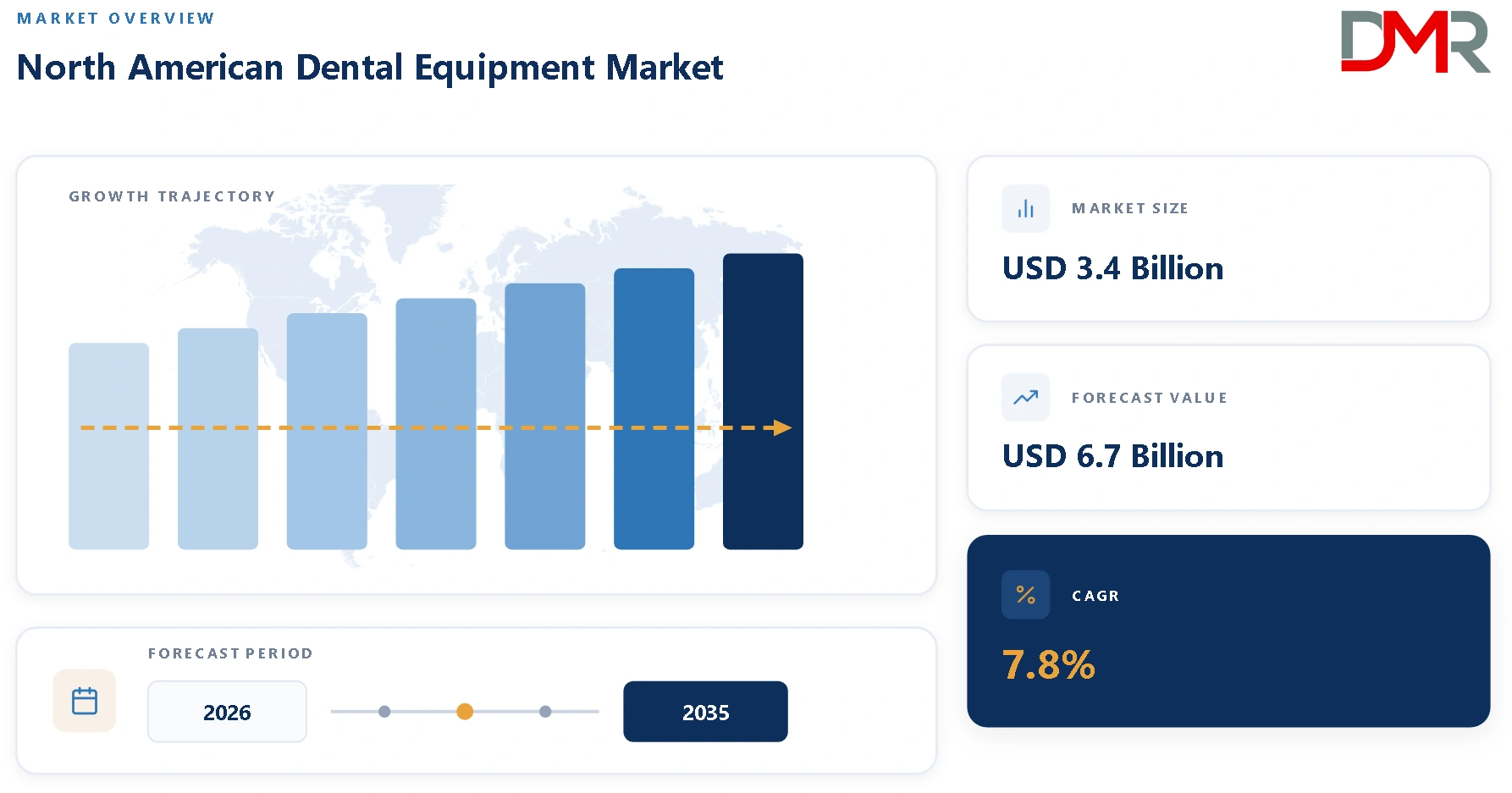
- Market Size (2026): USD 3.4 Bn
- Forecast Value (2035): USD 6.7 Bn
- CAGR (2026-2035): 7.8%
- Leading Product Type (2026): Dental Chairs & Equipment, around 28%
- Leading Application (2026): General & Preventive Dentistry, close to 26%
- Key Players: Dentsply Sirona, Envista Holdings, Align Technology and others
What is North American Dental Equipment Market and its Market Size?
The North American Dental Equipment Market size is estimated to reach USD 3.4 Bn in 2026 and is further anticipated to reach USD 6.7 Bn by 2035, at a CAGR of 7.8%. The market covers capital equipment used inside dental practices, laboratories and academic clinics across the United States and Canada, spanning dental chairs and delivery units, diagnostic and imaging systems, CAD/CAM design and milling systems, laboratory devices and hygiene and sterilization equipment. Consumables, implants and orthodontic appliances sit outside this definition unless they are dispensed through an equipment platform counted here.
ℹ
To learn more about this report –
Download Your Free Sample Report Here
Figures throughout this report describe equipment demand generated inside North America rather than the worldwide revenue booked by manufacturers headquartered in the United States or Canada. A company selling most of its output in Europe or Asia Pacific contributes to this market only through the units it places with dentists, group practices and laboratories located in the two countries covered here.
Buyers range from single-doctor general practices to multi-site dental service organizations, hospital-based oral surgery departments and dental schools building out simulation labs. Purchase decisions weigh equipment cost against patient throughput, insurance reimbursement cycles and the reduced chair time that digital workflows make possible, which keeps replacement cycles tied to practice cash flow rather than pure technology obsolescence.
What is changing structurally is who signs the purchase order. Group practices and dental service organizations increasingly centralize procurement across dozens of locations, trading single-unit list prices for standardized fleets and service contracts, while intraoral scanning and same-day CAD/CAM milling shift spend away from analog impression trays toward connected chairside systems. Regulatory clearance from the Food and Drug Administration and Health Canada continues to gate new equipment categories, particularly imaging systems, and shapes how quickly digital tools move from early adopters into mainstream general practice.
Use Cases
- Multi-Site DSO Fleet Standardization: Dental service organizations managing dozens of clinics standardize on a single chair, sensor and CAD/CAM platform across every location, which lets a central biomedical team negotiate service contracts, cuts technician travel time for repairs and lets patient records move between sites without re-calibrating imaging equipment.
- Same-Day Restorative Workflows: General practices install chairside CAD/CAM milling alongside intraoral scanners so a crown can be designed and milled during a single visit, removing the temporary restoration step and the second appointment that conventional impression-based lab workflows require.
- Academic Simulation Labs: Dental schools equip preclinical simulation labs with networked manikin units and digital radiography stations so first-year students practice procedures under instructor observation before treating patients, shortening the gap between classroom instruction and supervised clinical work.
- Rural and Community Health Center Screening: Federally qualified health centers deploy portable intraoral X-ray units and compact hygiene equipment to reach patients in underserved counties, extending preventive screening into communities where the nearest specialist office can be a two hour drive away.
Key Takeaways
- Market Size & Share: The market is estimated at USD 3.4 Bn in 2026, rising to USD 6.7 Bn by 2035.
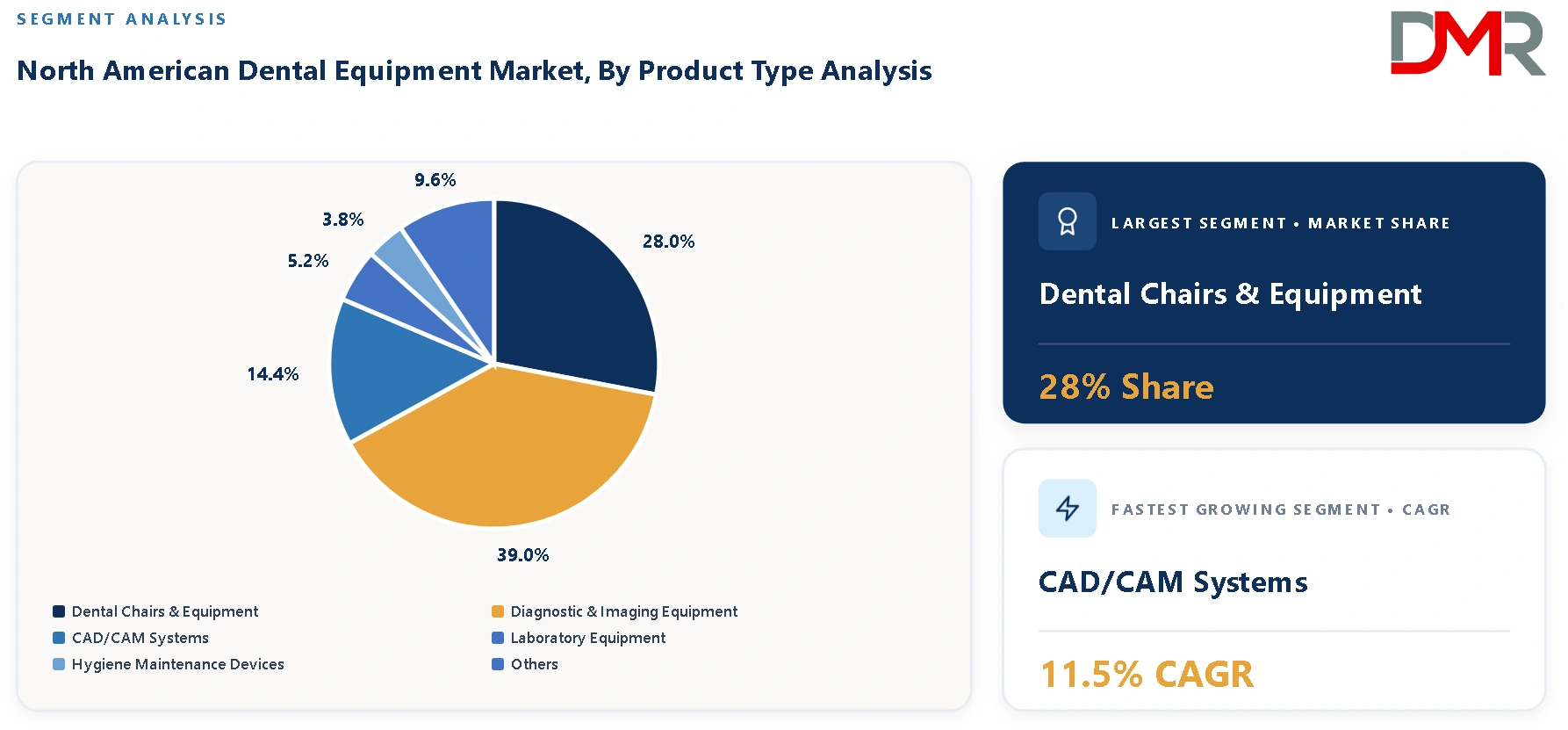
- Product Type Analysis: Dental Chairs & Equipment holds around 28% of 2026 revenue, the largest single category.
- Demand Concentration: The United States is expected to account for approximately 88% of regional demand in 2026, with Canada holding the balance.
- Consolidation Is Reshaping Procurement: Group Practices & DSOs, already close to 34% of end-user demand, are also the fastest-expanding buyer group at a 12.8% CAGR.
- Digital Migration Is Accelerating: CAD/CAM Systems are forecast to grow at 11.5% annually through 2035 as chairside milling displaces lab-sent impressions.
How AI/Gen AI is Transforming the North American Dental Equipment Market?
Artificial intelligence is entering dental equipment mainly through the imaging and design software layer bundled with hardware rather than as a standalone product. Computer vision models trained on intraoral scans and radiographs now flag caries, bone loss and margin errors during the scan itself, turning a five-minute capture into a chairside diagnostic step rather than a file sent off for later review.
The more operational shift is in scheduling and equipment uptime. Machine-learning based maintenance flags a compressor or sterilizer trending toward failure before it stops a clinic's day, and CAD/CAM design software increasingly proposes a first-pass crown or aligner geometry that a technician edits rather than builds from a blank canvas, cutting design time per case.
- AI-Assisted Diagnostic Imaging: computer vision overlays flag caries, periodontal bone loss and fracture lines directly on the intraoral scan or radiograph during the same visit.
- Predictive Equipment Maintenance: sensor data from compressors, sterilizers and handpieces feeds failure-prediction models that schedule service before a breakdown interrupts patient flow.
- Generative CAD Design: milling and 3D printing software proposes an initial crown, bridge or aligner geometry from a scan, leaving a technician to refine rather than model from scratch.
- Automated Practice Scheduling: AI-based scheduling tools match equipment and chair availability to procedure type, reducing idle chair time across multi-operatory practices.
Key Drivers in the North American Dental Equipment Market
Two forces are pulling North American dental practices toward newer equipment fleets faster than the replacement cycle alone would require.
- Dental Service Organization Consolidation: Dental service organizations now negotiate equipment purchases across portfolios that can exceed one hundred locations, which gives them leverage to standardize on a single chair, imaging and CAD/CAM platform rather than let each acquired practice keep its legacy fleet. Group Practices & DSOs already represent close to 34% of end-user demand in 2026 and are expanding at 12.8% annually, a pace tied directly to how quickly consolidators integrate newly acquired offices onto their preferred equipment stack. Every roll-up adds not just patient volume but a fleet replacement order, since acquirers rarely keep mismatched legacy hardware once a location joins the network.
- Digital Impression and Same-Day Restoration Adoption: Intraoral scanners have displaced enough conventional impression trays that laboratories now receive a majority of North American cases as digital files rather than physical molds, and that shift pulls chairside CAD/CAM milling units into practices that previously outsourced every crown. CAD/CAM Systems are forecast to grow at 11.5% annually through 2035, faster than the market overall, as same-day restoration removes a temporary-crown visit that patients and insurers alike would rather avoid. Falling scanner prices below the threshold that once limited the technology to specialist prosthodontists have widened the buyer base to general practice.
Restraints in the North American Dental Equipment Market
Two brakes slow how fast the fleet actually turns over, regardless of how compelling the newer equipment looks on paper.
- High Upfront Capital Cost for Independent Practices: A fully equipped operatory with a digital sensor, intraoral scanner and networked chair can cost several times what a single dentist earns in take-home pay over a comparable period, which pushes independent, non-DSO owners toward financing or toward delaying a purchase until a competitor's newer equipment visibly pulls patients away. Practices outside metropolitan markets often lack the patient volume to justify chairside CAD/CAM milling at all, keeping analog impression workflows in place well past the point where DSO-owned peers have already converted.
- Reimbursement Lag for Digital Workflows: Insurance coding and reimbursement schedules were built around conventional impressions and film radiography, and many payers still reimburse a digital scan or CBCT volume at rates that do not fully credit the chair time it saves, which weakens the return-on-investment case that a practice owner presents to a lender. Until coding catches up with the workflow, some purchases get justified on competitive necessity rather than on a clean payback calculation, which slows adoption among practices that need the numbers to work on paper first.
Growth Opportunities in the North American Dental Equipment Market
Two pockets of unmet demand stand out inside a market that already looks mature on the surface.
- Group Purchasing Organization Contracts for Mid-Size Practices: Independent practices with three to ten operatories are too small to negotiate DSO-scale pricing on their own but are increasingly banding together through group purchasing organizations, which today handle close to 14% of distribution channel volume. Equipment makers that build tiered pricing and financing programs around these buying groups can reach thousands of otherwise fragmented practices through a handful of contracts rather than a direct sales force calling on each office individually. That channel is also where online configuration and ordering tools are gaining the fastest traction, since group-purchasing members already compare list prices across members before committing to a supplier.
- Teledentistry-Linked Equipment for Underserved Counties: Federally qualified health centers and rural clinics are adding portable imaging and intraoral cameras that pair with remote specialist review, letting a hygienist capture diagnostic images locally while an off-site dentist or specialist reads them the same day. Equipment vendors that package compact, ruggedized hardware with a connectivity layer built for intermittent rural broadband are positioned to win contracts that a conventional, clinic-bound imaging suite cannot fulfill, particularly as public health funding for rural dental access continues to target diagnostic capacity ahead of chairside treatment capacity.
Trends in the North American Dental Equipment Market
Two shifts in buyer behavior are visible in how equipment gets specified and paid for right now.
- Equipment-as-a-Service Financing: Manufacturers and distributors are increasingly bundling hardware, software updates and service visits into a single monthly subscription rather than a one-time capital sale, mirroring how imaging and CAD/CAM software already price by seat or by scan. This shift lowers the barrier for a single-doctor practice to adopt a full digital workflow at once instead of phasing in a scanner one year and a mill the next, and it gives vendors recurring revenue that a one-time equipment sale never provided.
- Open File Formats Across the Digital Chain: Buyers are pushing back against closed scanner-to-mill ecosystems and favoring equipment that exports standard file formats a laboratory or a competing CAD system can open directly, which is changing how vendors compete. Interoperability is becoming a selling point on its own rather than an afterthought disclosed only when a customer asks, and distributors report that this single specification now eliminates entire product lines from a shortlist before price is even discussed, particularly at multi-location DSOs where a single closed system would otherwise lock every acquired practice onto one vendor indefinitely.
Research Scope and Analysis
Segment performance is assessed across four axes: product type, application, end user and distribution channel. Each axis identifies the sub-segment holding the largest share of 2026 revenue and the one expanding fastest through 2035, along with the commercial reason behind each position.
ℹ
To learn more about this report –
Download Your Free Sample Report Here
By Product Type
Dental Chairs & Equipment holds the largest share of 2026 revenue at close to 28%, reflecting the simple fact that every operatory, whether newly built or under renovation, needs a delivery unit and chair before any diagnostic or laboratory equipment gets installed around it, and replacement cycles on this hardware run long enough that installed base alone keeps the category ahead of newer digital lines. Growth, however, is concentrated in CAD/CAM Systems, expanding at a CAGR of 11.5% between 2026 and 2035 as falling scanner and mill prices bring chairside restoration workflows within reach of general practices that previously sent every case to an outside laboratory, converting what used to be a specialist purchase into a mainstream one.
By Application
General & Preventive Dentistry accounts for approximately 26% of 2026 revenue, the largest application segment, because routine cleanings, exams and basic restorative work happen at a volume that dwarfs any single specialty and because nearly every practice, regardless of what else it offers, performs preventive care as its baseline service line. The steeper trajectory sits with Orthodontics, forecast to grow at 10.2% annually through 2035, pulled by clear aligner treatment expanding beyond specialist orthodontic offices into general practices that now offer in-house scanning and monitoring equipment to capture a treatment category they previously referred out entirely.
By End User
Group Practices & DSOs represent the largest end-user segment at around 34% of 2026 demand, a position built on centralized procurement budgets that independent solo practices cannot match and on a steady stream of newly acquired locations that get standardized onto the parent organization's preferred equipment fleet. This same segment also posts the fastest growth, expanding at 12.8% annually through 2035, since consolidation itself is the growth driver: each new acquisition converts a previously independent, slower-replacing practice into part of a fleet that upgrades on a fixed, centrally managed schedule rather than waiting for individual equipment to fail.
By Distribution Channel
Third-Party Distributors move the largest share of equipment at close to 42% of 2026 volume, since dealer networks bundle installation, financing and service contracts that a manufacturer selling direct cannot easily replicate across thousands of individually owned practices. Online Retail & E-commerce Platforms are the fastest-growing channel, projected at a 13.6% CAGR between 2026 and 2035, as smaller consumables and lower-cost instrumentation increasingly get reordered through configured online catalogs rather than a dealer sales call, a shift spreading from disposables into entry-level hygiene and diagnostic hardware as buyers grow comfortable configuring larger purchases without an in-person visit.
The North American Dental Equipment Market Report is Segmented Based on the Following
By Product Type
- Dental Chairs & Equipment
- Diagnostic & Imaging Equipment
- CAD/CAM Systems
- Laboratory Equipment
- Hygiene Maintenance Devices
- Others
By Application
- General & Preventive Dentistry
- Orthodontics
- Prosthodontics
- Endodontics
- Oral & Maxillofacial Surgery
- Periodontics
- Others
By End User
- Group Practices & DSOs
- Independent Dental Clinics
- Dental Laboratories
- Academic & Research Institutes
- Others
By Distribution Channel
- Third-Party Distributors
- Direct Sales
- Group Purchasing Organizations
- Online Retail & E-commerce Platforms
- Others
Regulatory Landscape
Equipment sold into United States practices needs Food and Drug Administration clearance, most often through the 510(k) pathway, while Canadian sales run through Health Canada's medical device licensing, and imaging hardware carries added radiation-safety review in both countries. What is shifting now is scrutiny of software embedded in imaging and CAD/CAM systems, as regulators increasingly treat diagnostic algorithms as part of the device rather than an accessory, which is lengthening review timelines for anything marketed with an AI-assisted claim. The opening this creates favors vendors who build regulatory and clinical validation into product development early rather than bolt software features on after clearance, while smaller manufacturers without in-house regulatory staff risk delayed launches that let better-resourced competitors claim shelf space first.
Technology Analysis
Intraoral scanning and CBCT imaging have moved from specialist to general-practice standard equipment over the past decade, and CAD/CAM milling is following the same path as unit prices fall and file formats standardize across vendors. What is shifting now is the addition of a software layer, diagnostic overlays, predictive maintenance and design automation, on top of hardware that used to compete purely on optics and mechanics. The commercial opening sits with vendors who can sell an upgrade path rather than a single sale, since a scanner or mill purchased today increasingly comes bundled with software features added after installation. The risk is fragmentation, since a practice locked into one vendor's closed ecosystem faces high switching costs once a competitor's open-format system pulls ahead.
Competitive Landscape
Competition centers on three fronts: hardware reliability and service network reach, the breadth of a connected software ecosystem across imaging, design and practice management, and the strength of distributor relationships that reach independent practices a manufacturer's own sales force cannot cover economically. Global majors compete primarily on ecosystem lock-in, bundling scanners, mills and imaging under a shared software license that raises switching costs once a practice commits. Mid-size specialists compete on service responsiveness and price within a single product category, often winning DSO fleet contracts by beating a major's bundled price on the specific hardware line a buyer needs most. Consolidation among distributors is narrowing the number of relationships a manufacturer needs to reach the independent practice segment, while direct online ordering is starting to erode that intermediary's role at the margin.
Some of the Prominent Players in the North American Dental Equipment Market Are
- Dentsply Sirona
- Envista Holdings Corporation
- Align Technology
- Straumann Group
- Planmeca Oy
- A-dec Inc.
- Midmark Corporation
- Danaher Corporation
- Solventum Corporation
- Ivoclar Vivadent AG
- Carestream Dental LLC
- Henry Schein Inc.
- Patterson Companies Inc.
- Vatech Co. Ltd.
- J. Morita Corporation
- Biolase Inc.
- Zimmer Biomet Dental
- NSK Ltd.
- W&H Dentalwerk Burmoos GmbH
- DentalEZ Group
- Takara Belmont Corporation
- Air Techniques Inc.
- Acteon Group
- Owandy Radiology
- Cefla Dental Group
- Anthogyr SAS
- Ultradent Products Inc.
- Panthera Dental Inc.
- Dentium Co. Ltd.
- Osstem Implant Co. Ltd.
- Runyes Medical Instrument Co. Ltd.
- Guilin Woodpecker Medical Instrument Co. Ltd.
- Sinclair Dental Co. Ltd.
- Clinical Research Dental
- Medicom Group Inc.
- Apteryx Imaging Inc.
- Handler Manufacturing Company
- Gnatus Equipamentos Medico-Odontologicos Ltda.
- Sable Industries Inc.
- Great Lakes Dental Technologies
- Other Key Players
Recent Developments
- In February 2026, Envista Holdings expanded its Ormco digital orthodontics line with a new intraoral scanner tuned for North American clear aligner workflows, extending its footprint into general practices that previously outsourced aligner scanning to specialists.
- In September 2025, Dentsply Sirona opened a new equipment training and demonstration center in the United States aimed at group practices standardizing chairside CAD/CAM across multi-location fleets.
- In April 2025, Planmeca introduced an updated CBCT imaging platform to United States distributors, targeting oral surgery practices upgrading from earlier generation cone-beam units.
- In November 2024, Patterson Companies expanded its equipment financing program for independent practices across the United States and Canada, pairing hardware purchases with bundled service contracts.
- In June 2024, Midmark Corporation launched a new digital delivery unit line manufactured in Ohio, aimed at practices replacing analog chairs as part of broader operatory renovations.
Report Details
| Report Characteristics |
| Market Size (2026) |
USD 3.4 Bn |
| Forecast Value (2035) |
USD 6.7 Bn |
| CAGR (2026–2035) |
7.8% |
| Historical Data |
2021 – 2025 |
| Forecast Data |
2026 – 2035 |
| Base Year |
2025 |
| Segments Covered |
By Product Type, By Application, By End User, and By Distribution Channel |
| Regional Coverage |
North America – The US, Canada |
Frequently Asked Questions
How big is the North American Dental Equipment Market?
▾ The North American Dental Equipment Market is estimated at USD 3.4 Bn in 2026 and is projected to reach USD 6.7 Bn by 2035, growing at a CAGR of 7.8% across the United States and Canada as digital imaging, CAD/CAM systems and group practice consolidation reshape equipment purchasing over the forecast period.
What is the growth rate of the North American Dental Equipment Market?
▾ The market is forecast to expand at a CAGR of 7.8% between 2026 and 2035, moving from an estimated USD 3.4 Bn in 2026 to USD 6.7 Bn by 2035. Growth is led by digital workflow adoption and dental service organization consolidation, both of which are pulling equipment replacement cycles forward across the United States and Canada.
Which country holds the largest share in the North American Dental Equipment Market?
▾ The United States is expected to account for the large majority of regional demand in 2026, with Canada holding a smaller but steadily growing share. The gap reflects the United States' far larger population of practicing dentists and dental service organizations, which together drive most of the region's equipment purchasing volume relative to Canada's smaller, more fragmented practice base.
Who are the key players in the North American Dental Equipment Market?
▾ Key players include Dentsply Sirona, Envista Holdings, Align Technology, Straumann Group, Planmeca, A-dec and Midmark Corporation, among other manufacturers and distributors serving the United States and Canada. Competition spans hardware, imaging and CAD/CAM software, with distributor relationships and service network reach shaping how effectively each vendor reaches independent practices outside major metropolitan markets.
Which product type leads the North American Dental Equipment Market?
▾ Dental Chairs & Equipment leads the market, accounting for around 28% of 2026 revenue, since every operatory requires a delivery unit and chair before diagnostic or laboratory equipment is installed around it. Long replacement cycles on this hardware keep the category ahead of faster-growing digital lines such as CAD/CAM systems, even as those newer categories expand more quickly in percentage terms.
What is driving demand for digital dental equipment in North America?
▾ Falling intraoral scanner and CAD/CAM mill prices have brought same-day restoration workflows within reach of general practices that once outsourced every crown to an outside laboratory. Dental service organizations are accelerating this shift further by standardizing newly acquired practices onto a single digital platform rather than retaining mismatched legacy equipment inherited through acquisition.
Which end-user segment is expected to grow fastest through 2035?
▾ Group Practices & DSOs are expected to grow fastest among end users in the North American Dental Equipment Market, expanding at a CAGR of approximately 12.8% through 2035 as consolidators continue acquiring independent practices and standardizing them onto centrally managed equipment fleets. This segment already represents around 34% of 2026 demand and is set to extend its lead over independent, non-DSO owned practices.