Global NRw Smart Leak Management Market Snapshot
- Global NRw Smart Leak Management Market Size in 2026: USD 1.85 Billion
- Global NRw Smart Leak Management Market Size in 2035: USD 5.42 Billion
- Global CAGR from 2026 to 2035: 12.7%
- Leading Solution Segment: Leak Detection & Localization, 31%
- Leading Network Type: Distribution Networks, 62%
- Leading End User: Municipal Water Utilities, 64%
- Fastest-Growing Segment: AI-Based / Predictive Leak Analytics, 16.8% CAGR
- Leading Region: North America, 34%
What is the Global NRw Smart Leak Management and its Market Size?
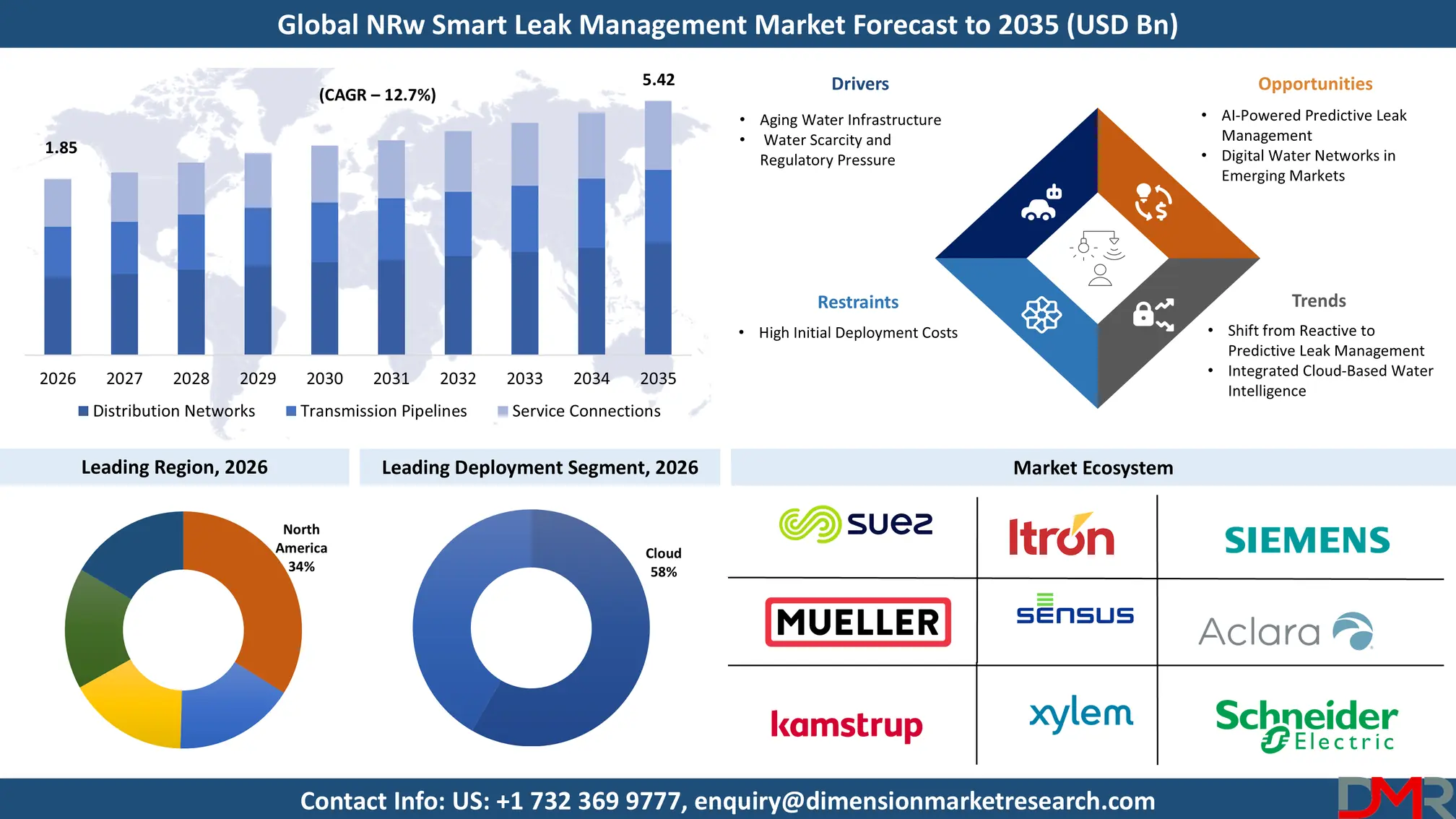
The Global NRw Smart Leak Management Market is projected to reach USD 1.85 billion in 2026 and grow at a compound annual growth rate of 12.7% from there until 2035 to reach a value of USD 5.42 billion.
ℹ
To learn more about this report –
Download Your Free Sample Report Here
Growth is being supported by aging distribution infrastructure, water scarcity, urbanization, regulatory pressure, smart-meter deployment, and utility digital transformation. Water utilities are increasingly moving from periodic manual leak surveys toward continuous monitoring and predictive intervention. For example, Ofwat's 2025-30 framework includes a further 17% leakage-reduction expectation and £1.7 billion in allowances for 10.4 million smart meters, demonstrating how regulation and technology investment can reinforce each other.
Use Cases
- Acoustic Leak Detection: Identifies underground leakage from acoustic signatures and prioritizes locations for field investigation.
- Real-Time Network Monitoring: Continuously tracks pressure, flow, consumption, and abnormal network behavior.
- Predictive Leak Analytics: Uses historical and real-time data to identify probable failures before major leakage occurs.
- Pressure Management: Optimizes network pressure to reduce leakage rates, pipe stress, and burst frequency.
- Smart Metering & Water Balance: Improves consumption measurement and helps utilities identify discrepancies between supplied and billed water.
- DMA Optimization: Monitors District Metered Areas to identify abnormal minimum-night flows and emerging leakage.
Key Takeaways
- Market Growth: The modeled market expands from USD 1.85 billion in 2026 to USD 5.42 billion by 2035, a 12.7% CAGR.
- Primary Driver: Aging water infrastructure combined with rising water scarcity is creating a strong economic case for loss reduction.
- Technology Shift: Utilities are moving from reactive leak repair toward continuous sensing, AI analytics, predictive maintenance, and automated alerts.
- Segment Leadership: Leak Detection & Localization is the largest solution category, while distribution networks represent the dominant network application.
- Fastest Growth: AI-based analytics and predictive leak-management solutions are expected to grow fastest as utilities accumulate larger sensor and meter datasets.
- Regional Leadership: North America leads in current market value, while Asia-Pacific is expected to record the fastest growth through 2035.
- Regulatory Catalyst: Leakage-reduction targets and infrastructure funding are increasingly turning NRW reduction into a measurable utility-performance requirement.
How AI/Gen AI is Transforming the NRw Smart Leak Management Market?
AI and machine learning are increasingly being applied to acoustic signals, pressure patterns, flow data, smart-meter readings, hydraulic models, GIS information, and historical repair records. IoT sensors provide continuous measurements, while cloud platforms aggregate information from previously disconnected network assets. AI models can then identify anomalies, rank probable leak locations, distinguish genuine leaks from normal demand fluctuations, and recommend field interventions.
The major benefit is a shift from finding leaks after they become visible to identifying abnormal network behavior earlier. SUEZ, for example, reports that its IAcoustique solution uses AI to analyze acoustic and network data and can detect substantially more leaks with the same sensor base.
Key Drivers in the Global NRw Smart Leak Management Market
Aging Water Infrastructure
Aging water infrastructure is one of the strongest structural drivers of smart leak-management demand. Water networks constructed decades ago are experiencing increasing pipe deterioration, corrosion, joint failure, ground movement, pressure-related stress, and burst events. Replacement of entire networks is expensive and slow, encouraging utilities to deploy monitoring technologies that allow them to prioritize the highest-risk sections. The U.S. EPA identifies aging infrastructure, regulatory requirements, resource constraints, and water-loss concerns among the challenges facing public water systems. Its water-loss-control guidance specifically identifies flow monitoring and acoustic, thermal, electromagnetic, and tracer-based leak-detection methods as tools utilities can use to locate losses.
Water Scarcity and Regulatory Pressure
Water scarcity is increasingly turning leakage reduction from an operational issue into a strategic water-supply measure. Utilities facing population growth, drought, climate variability, and constrained new water sources can often recover supply more quickly by reducing losses than by constructing new production capacity. The World Bank estimates substantial global freshwater losses and has increasingly emphasized improved water management and investment.
Restraints in the Global NRw Smart Leak Management Market
High Initial Deployment Costs
Smart NRW programs can require significant upfront spending on sensors, acoustic monitoring equipment, smart meters, pressure-management equipment, communications infrastructure, software licenses, installation, GIS integration, and workforce training. Small and medium-sized utilities may struggle to justify large deployments when water tariffs or public budgets limit available capital. The economic case also varies according to leakage levels: deploying sophisticated sensing on a relatively low-loss network may generate lower incremental returns than deploying it in a high-loss system.
Growth Opportunities in the Global NRw Smart Leak Management Market
AI-Powered Predictive Leak Management
The most significant technology opportunity is the migration from detection toward prediction. Conventional systems typically identify abnormal pressure, flow, or acoustic signatures and then trigger investigation. Advanced analytics can incorporate historical leakage, pipe characteristics, weather, pressure, consumption, repair history, and hydraulic behavior to estimate the probability of future failures.
Digital Water Networks in Emerging Markets
Emerging economies offer significant white space because many networks have high physical losses but comparatively low penetration of continuous monitoring. Rapid urbanization creates an opportunity to build digital infrastructure alongside network expansion rather than retrofitting systems later. Asia-Pacific, the Middle East, Latin America, and parts of Africa are particularly attractive where water scarcity and urban growth coincide.
Trends in the Global NRw Smart Leak Management Market
Shift from Reactive to Predictive Leak Management
The industry is moving from manual listening surveys and reactive burst repair toward continuous monitoring and predictive intervention. Utilities increasingly use acoustic sensors, smart meters, pressure sensors, satellite imagery, and analytics together. UK utilities, for example, are using satellite imaging, drones, acoustic sensors, in-pipe monitoring, and smart metering to locate leaks.
Integrated Cloud-Based Water Intelligence
The competitive market is moving toward integrated platforms that consolidate meter data, sensor alarms, GIS, hydraulic models, asset information, and field-work management. This reduces "alarm overload" and allows utilities to prioritize the most economically significant interventions. Xylem's work with Yorkshire Water illustrates this trend, with its platform integrating meter analytics and operational information for NRW management.
Research Scope and Analysis
The market is segmented by solution, network type, deployment, and end user. The analysis distinguishes physical leak detection and localization from monitoring/analytics, pressure management, and smart metering. Distribution networks dominate because they contain extensive pipe length and numerous potential leakage points.
ℹ
To learn more about this report –
Download Your Free Sample Report Here
By Solution Analysis
Leak Detection & Localization is estimated to represent approximately 31% of the global market in 2026, making it the largest solution category. Acoustic detection remains particularly important because it can identify underground leaks without excavating large portions of the network. Pressure- and flow-based approaches complement acoustic technologies by identifying abnormal hydraulic behavior at network and DMA levels. Smart Monitoring & Analytics represents approximately 29%, supported by rapid IoT deployment and growing demand for centralized visibility. Within this category, AI-based and predictive analytics is expected to be the fastest-growing sub-segment at approximately 16.8% CAGR, as utilities move beyond basic alerts toward probability-based intervention. Pressure management accounts for approximately 21%, reflecting its ability to reduce leakage volume and pipe stress simultaneously, while Smart Metering & Data Management represents approximately 19%. The latter is becoming increasingly important as utilities seek more accurate water balances and customer-side leakage visibility. The combination of metering and network analytics is particularly powerful because it helps utilities distinguish physical distribution losses from apparent losses.
By Network Type Analysis
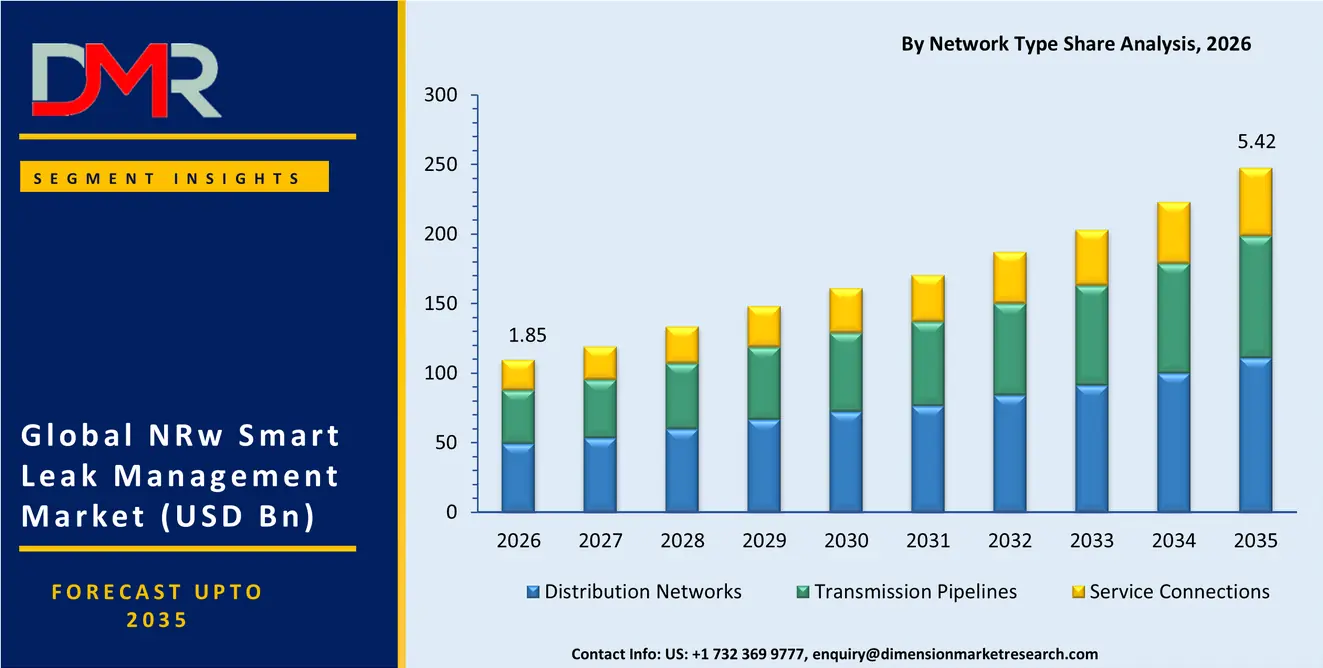
Distribution Networks are estimated to account for approximately 62% of 2026 market revenue, making them the dominant network category. Distribution networks contain extensive lengths of buried pipe, numerous service connections, variable pressure zones, and complex demand patterns, making continuous monitoring economically attractive.
ℹ
To learn more about this report –
Download Your Free Sample Report Here
Transmission Pipelines represent an estimated 23%, with demand concentrated around critical trunk infrastructure where a single failure can result in substantial water loss and service disruption. Service Connections account for approximately 15% but are expected to expand rapidly as smart meters provide greater visibility into customer-side leakage. Distribution-network monitoring benefits particularly from DMA structures, where inflow and consumption can be compared to identify unexplained losses. Research into DMA-supported leakage detection also demonstrates the industry's continuing move toward combining pressure measurements, network modeling, and anomaly detection to reduce inspection costs.
By Deployment Analysis
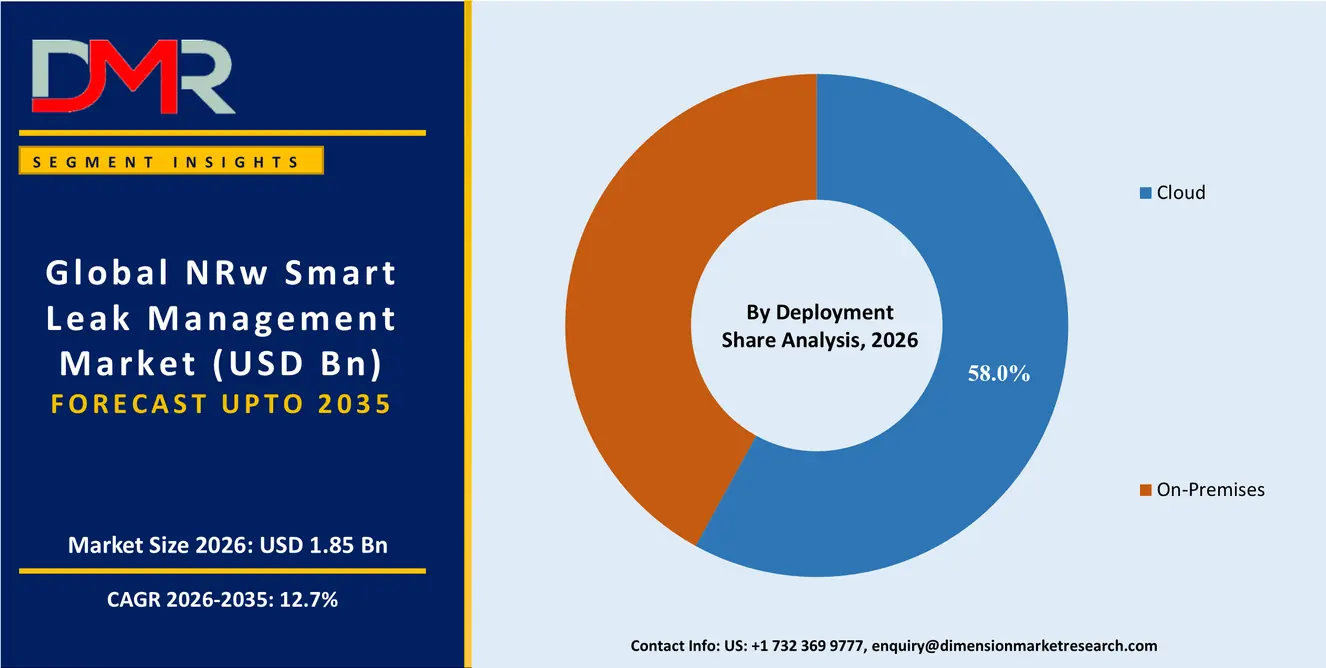
Cloud-Based solutions are estimated to hold approximately 58% of the 2026 market, versus 42% for on-premises deployments. Cloud adoption is being driven by scalability, remote accessibility, lower infrastructure requirements, easier software updates, and the ability to combine information from distributed sensors and meters. Cloud platforms are especially attractive to utilities that want to expand from pilot projects to citywide deployments without building large internal IT environments. Cloud-based deployment is also expected to be the faster-growing category, at roughly 14.5% CAGR, as AI workloads and cross-system data integration become more important. On-premises systems remain relevant to large utilities with established SCADA environments, stringent cybersecurity requirements, or policies requiring greater control over operational data. Hybrid architectures are likely to remain important through 2035 because utilities often need cloud analytics while retaining operational controls within local infrastructure.
By End User Analysis
Municipal Water Utilities are estimated to represent approximately 64% of 2026 market revenue. Municipal utilities have the largest installed base of distribution infrastructure and face strong pressure to reduce physical water losses while maintaining affordable services. Private Water Utilities account for approximately 21%, with demand influenced by regulatory performance targets, operating efficiency, customer service, and contractual obligations. Industrial Water Networks represent approximately 15%, but this segment is expected to grow faster than the overall market because manufacturers, mining companies, energy operators, data centers, and other industrial facilities increasingly monitor water efficiency as part of operational resilience and sustainability programs. Municipal utilities remain dominant because NRW is directly tied to public water-supply efficiency. However, industrial customers can have attractive economics because leakage may disrupt production or represent a high-value treated-water loss.
The Global NRw Smart Leak Management Market Report is segmented on the basis of the following:
By Solution
- Leak Detection & Localization
- Acoustic Leak Detection
- Pressure-Based Detection
- Flow-Based Detection
- Smart Monitoring & Analytics
- IoT Sensors & Monitoring
- AI-Based Analytics
- Predictive Leak Analytics
- Pressure Management
- Smart Metering & Data Management
By Network Type
- Transmission Pipelines
- Distribution Networks
- Service Connections
By Deployment
By End User
- Municipal Water Utilities
- Private Water Utilities
- Industrial Water Networks
Regional Analysis
North America is the Leading Region in the Global NRw Smart Leak Management Market
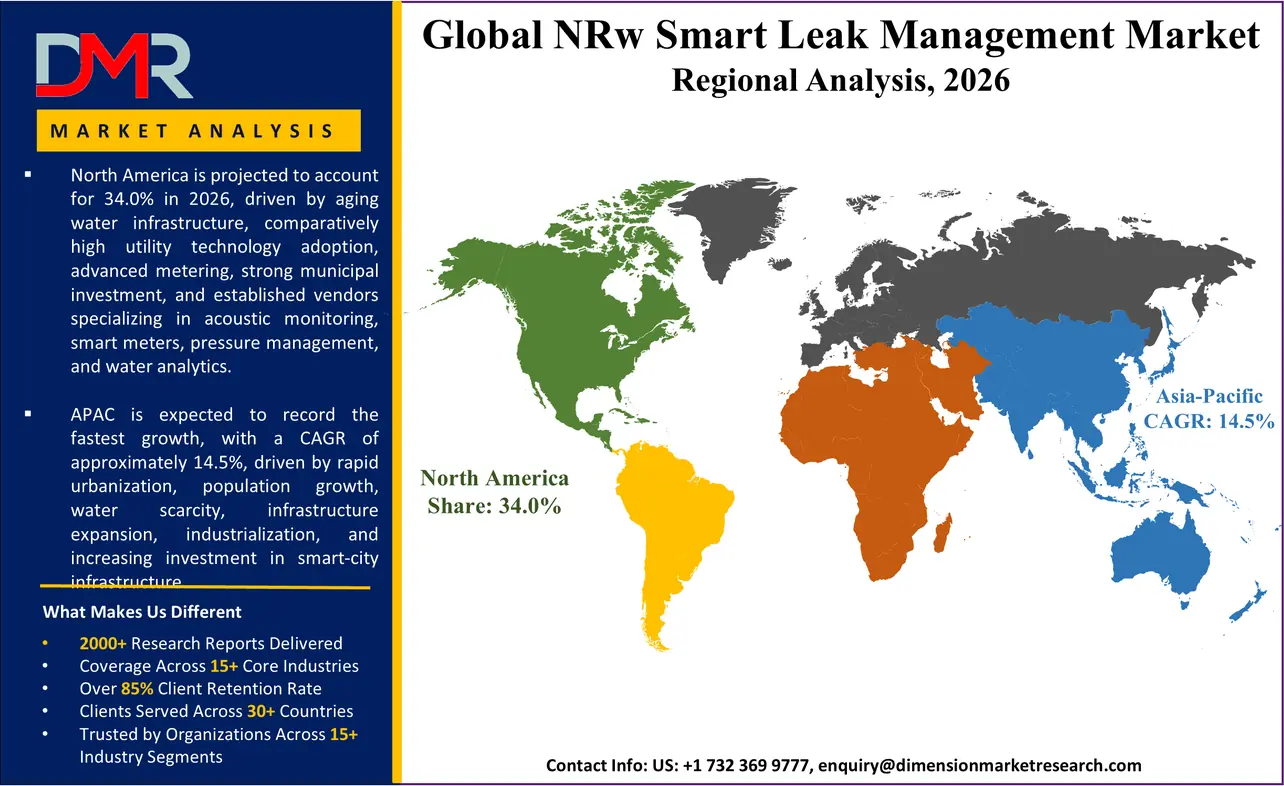
North America is estimated to hold approximately 34% of the global market in 2026, making it the leading region. Its position is supported by aging water infrastructure, comparatively high utility technology adoption, advanced metering, strong municipal investment, and established vendors specializing in acoustic monitoring, smart meters, pressure management, and water analytics. U.S. infrastructure-financing programs provide an additional catalyst. The EPA's WIFIA program provides long-term financing for drinking-water, wastewater, and stormwater infrastructure, while $6.5 billion in WIFIA funding plus USD 550 million for states was announced as available in November 2025.
ℹ
To learn more about this report –
Download Your Free Sample Report Here
North American utilities are increasingly combining smart meters, acoustic sensors, cloud analytics, and asset-management tools. The technology is shifting from individual leak-detection projects toward broader digital water-network programs.
Asia Pacific is the Fastest-Growing Region in the Global NRw Smart Leak Management Market
Asia-Pacific is projected to be the fastest-growing regional market, with an estimated 14.5% CAGR from 2026-2035. Growth is supported by rapid urbanization, population growth, water scarcity, infrastructure expansion, industrialization, and increasing investment in smart-city infrastructure. China, India, Japan, Australia, Singapore, and Southeast Asian economies represent different but complementary adoption opportunities. Developed Asian markets are strong users of advanced sensing and predictive analytics, while emerging markets offer large-scale opportunities for basic metering, pressure management, DMA monitoring, and cloud-based utility systems. Industry evidence shows increasing deployment of smart metering and AI-based leakage technologies across Asian utilities.
The Europe NRw Smart Leak Management Market
The European market is estimated at approximately USD 500 million in 2026 and is projected to reach approximately USD 1.00 billion by 2032, representing a CAGR of roughly 12.2%. Regulatory pressure, aging infrastructure, water scarcity, climate change, and digital utility investment are major drivers. The UK is particularly significant because Ofwat has established leakage-performance requirements and approved substantial expenditure for pressure management, mains replacement, and smart meters. European utilities are also adopting satellite-based leak detection, acoustic sensors, smart metering, and AI analytics. SUEZ reported that satellite programs across the UK had identified nearly 25,000 leaks and saved more than 400 million cubic meters of treated water cumulatively.
Latin America NRw Smart Leak Management Market
Latin America is estimated at approximately USD 130 million in 2026 and could reach approximately USD 270 million by 2032, representing an estimated 12.9% CAGR. High physical losses, water scarcity, aging distribution systems, urban population growth, and infrastructure-modernization programs create substantial demand. Brazil and Mexico represent the largest opportunities, while Colombia, Argentina, Chile, and other markets offer targeted projects. Adoption is likely to favor scalable cloud platforms, DMA monitoring, pressure management, smart metering, and performance-based NRW contracts.
MEA NRw Smart Leak Management Market
The MEA market is estimated at approximately USD 150 million in 2026 and could reach around USD 330 million by 2032, representing an estimated 14.0% CAGR. Water scarcity is the defining market catalyst. Gulf states are investing in smart cities, desalination, digital utilities, and network optimization, while African markets increasingly need affordable approaches to reduce physical losses. Saudi Arabia and the UAE are expected to remain technology leaders, while Egypt and South Africa provide substantial infrastructure-modernization opportunities.
Major Countries Analysis
United States NRw Smart Leak Management Market
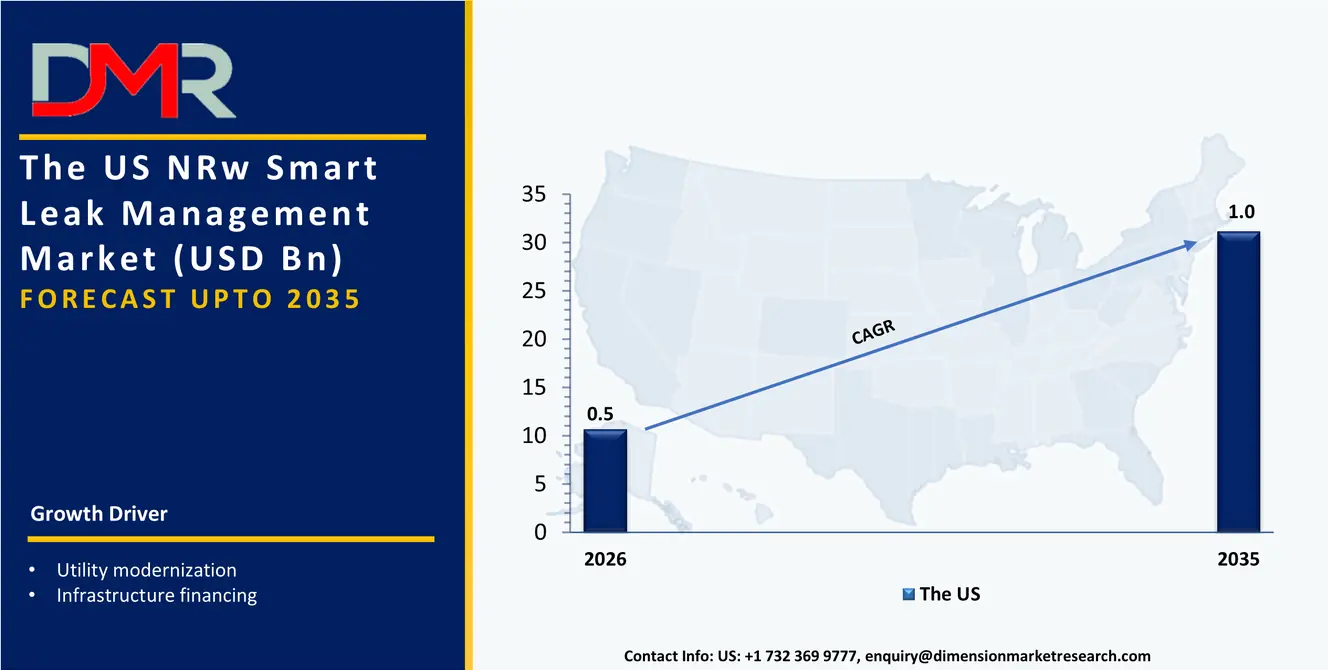
The U.S. NRw Smart Leak Management Market is estimated at approximately USD 520 million in 2026, increasing to around USD 1.00 billion by 2032, representing approximately 11.5% CAGR. Aging pipelines, utility modernization, smart metering, acoustic monitoring, AI analytics, and infrastructure financing are the major drivers. Federal financing through WIFIA supports modernization projects, while utilities increasingly seek technology that can demonstrate measurable reductions in water losses and emergency repairs.
ℹ
To learn more about this report –
Download Your Free Sample Report Here
Japan NRw Smart Leak Management Market
Japan's market is estimated at approximately USD 95 million in 2026, reaching approximately USD 170 million by 2032, representing about 10.2% CAGR. Japan's aging infrastructure, high technology capability, advanced sensing ecosystem, and strong focus on network efficiency support adoption. Japanese utilities are also among the more advanced users of predictive maintenance and data-driven infrastructure management.
Saudi Arabia NRw Smart Leak Management Market
Saudi Arabia's market is estimated at approximately USD 45 million in 2026, reaching approximately USD 105 million by 2032, representing roughly 14.8% CAGR. Extreme water scarcity, dependence on desalinated water, smart-city development, utility digitization, and national infrastructure programs create a strong market environment. Leakage reduction is particularly valuable because reducing losses can reduce the energy and treatment burden associated with water production.
Regulatory Landscape
Regulation is becoming a major catalyst for NRW technology adoption. In the U.S., EPA water-loss-control guidance encourages utilities to conduct water audits and use flow monitoring and leak-detection technologies to identify real and apparent losses.
In England and Wales, Ofwat has established measurable leakage targets and provided more than GBP 700 million in allowances for leakage-related interventions, alongside GBP 1.7 billion for 10.4 million smart meters during 2025-30. UK government policy additionally establishes targets for reducing leakage by 20% by 2027 and 30% by 2032 against the 2017-18 baseline.
Across Europe, North America, Asia-Pacific, and the Middle East, regulatory priorities increasingly include water conservation, infrastructure resilience, measurement accuracy, cybersecurity, and digital utility performance. These requirements encourage utilities to adopt technologies that produce auditable, measurable reductions in water losses.
Investment and White Space Analysis
The largest investment opportunities lie in AI-powered predictive analytics, low-cost IoT sensing, smart metering, pressure optimization, cloud-based NRW platforms, satellite detection, and integrated DMA management. Emerging-market utilities represent particularly attractive white space because leakage can be high while continuous monitoring penetration remains low.
Another opportunity lies in integrating leak management with broader asset-management and capital-planning platforms so utilities can use leakage probability to prioritize pipe replacement. Industrial water networks are another underserved segment, particularly where water is critical to production. The combination of performance-based contracts and digital monitoring is also attractive because it can reduce the upfront financing barrier for utilities.
The World Bank has highlighted performance-based NRW programs as an avenue for accelerating water-loss reduction, while its 2026 Water Forward initiative is emphasizing leakage reduction and data-driven water infrastructure investment.
By Region
North America
Europe
- Germany
- France
- The U.K.
- Italy
- Spain
- Rest of Europe
Asia-Pacific
- China
- Japan
- India
- Australia
- South Korea
- Rest of APAC
Latin America
- Mexico
- Brazil
- Rest of LATAM
Middle East & Africa
- Saudi Arabia
- The UAE
- South Africa
- Rest of MEA
Competitive Landscape
The NRW Smart Leak Management Market remains moderately fragmented, with competition spanning specialized acoustic-leak companies, smart-meter manufacturers, water-infrastructure companies, engineering/service providers, and large digital-water platforms. Competition is increasingly moving toward integrated solutions rather than individual hardware products. Leading providers differentiate through sensor accuracy, network coverage, analytics capabilities, AI models, smart-meter integration, hydraulic modeling, cloud platforms, installation expertise, and the ability to demonstrate measurable reductions in NRW. Strategic partnerships with utilities are particularly important because water-network deployments often require long sales cycles, field integration, regulatory approval, and ongoing service contracts.
Some of the prominent players in the Global NRw Smart Leak Management Market are:
- SUEZ
- Xylem Inc.
- Mueller Water Products
- Badger Meter
- Itron
- Aclara
- Kamstrup
- Diehl Metering
- Sensus
- A. O. Smith
- TaKaDu
- Syrinix
- FIDO Tech
- Fracta
- Gutermann
- HWM Global
- Ovarro
- WaterWise
- Ayyeka
- Hydro-Logic
- Qatium
- Innovyze
- Bentley Systems
- Siemens
- Schneider Electric
- Honeywell
- ABB
- Emerson Electric
- Yokogawa Electric
- Trimble
- Esri
- Itron Smart Networks
- Kamstrup Water Metering
- Arad Group
- Metron-Farnier
- Zenner
- Master Meter
- Neptune Technology Group
- Landis+Gyr
- Elster
- Other Key Players
Recent Developments
- June 2026: Itron announced a collaboration with Watercare Services for 100,000 Intelis wSource digital water meters as part of Auckland's broader plan to connect almost half a million smart meters, improving network visibility and leak detection.
- November 2025: Itron announced a collaboration with Northumbrian Water to deploy 330,000 water endpoints by 2029, supporting improved network data collection and leak detection.
- August 2025: Mueller Water Products reported that its EchoShore leak-detection technology had identified an estimated 7.7 billion gallons of water-loss savings for clients since 2020 and raised its target to 18 billion gallons by 2029.
- April 2025: Xylem reported that Hot Springs, Arkansas, reduced NRW from 44% to 24% through digital leak detection, advanced metering, acoustic monitoring, and Xylem Vue analytics.
- February 2025: Itron announced its collaboration with Publiacqua in Tuscany to deploy Intelis wSource ultrasonic meters designed to improve water-loss management and provide advanced leak detection across a system serving approximately 1.3 million residents.
- January 2025: Badger Meter announced its $185 million acquisition of SmartCover, extending its BlueEdge portfolio into real-time utility monitoring and strengthening its broader connected-water strategy.
Report Details
| Report Characteristics |
| Market Size (2026) |
USD 1.85 Bn |
| Forecast Value (2035) |
USD 5.42 Bn |
| CAGR (2026–2035) |
12.7% |
| Historical Period |
2021 – 2025 |
| Forecast Period |
2027 – 2035 |
| Base Year |
2025 |
| Estimate Year |
2026 |
| Segments Covered |
By Solution, By Network Type, By Deployment, By End User |
| Regional Coverage |
North America – The US and Canada; Europe – Germany, The UK, France, Spain, Italy, & Rest of Europe; Asia-Pacific – China, Japan, South Korea, India, Australia, Rest of APAC; Latin America – Brazil, Mexico, Argentina, Colombia, Rest of Latin America; Middle East & Africa – Saudi Arabia, The UAE, South Africa, & Rest of MEA |
Frequently Asked Questions
What is the NRW Smart Leak Management market size in 2026?
▾ The modeled global market is estimated at approximately USD 1.85 billion in 2026, covering leak detection, analytics, pressure management, and smart metering.
What will the market reach by 2035?
▾ The market is forecast to reach approximately USD 5.42 billion by 2035, reflecting growing utility digitization and water-loss reduction investment.
What is the expected CAGR in NRW Smart Leak Management market ?
▾ The modeled global CAGR is approximately 12.7% between 2026 and 2035, with AI analytics and cloud solutions growing faster than the overall market.
What are the main growth drivers in NRW Smart Leak Management market?
▾ Aging infrastructure, water scarcity, regulatory leakage targets, smart-meter deployment, IoT sensing, and demand for predictive utility management are the principal drivers.
What technology trend is most important in NRW Smart Leak Management market?
▾ The market is shifting toward integrated AI, IoT, cloud analytics, digital twins, smart meters, acoustic sensors, and predictive maintenance platforms.
Which region leads the NRW Smart Leak Management market ?
▾ North America is estimated to lead in 2026 with approximately 34% share, supported by infrastructure investment and mature utility technology adoption.
Which region is growing fastest in NRW Smart Leak Management market ?
▾ Asia-Pacific is expected to be the fastest-growing region, with approximately 14.5% CAGR, driven by urbanization, water scarcity, and infrastructure modernization.
Who are the major players in NRW Smart Leak Management market ?
▾ Major participants include Xylem, SUEZ, Itron, Mueller Water Products, Badger Meter, ABB, Honeywell, Arad, and other specialist digital-water providers.