What is the OEM Electronics Assembly Market Size in 2026?
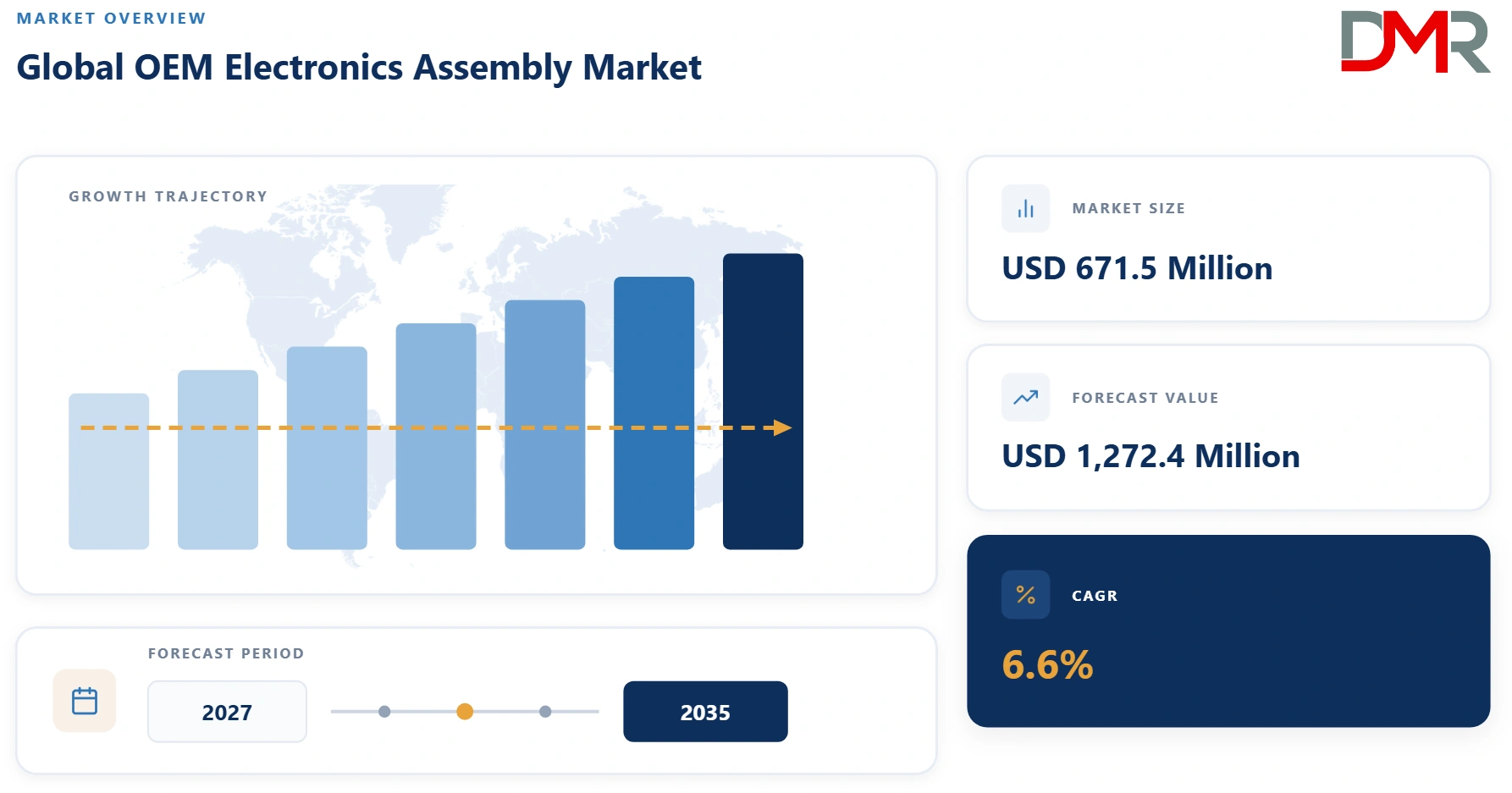
The global OEM electronics assembly market is valued at USD 671.5 billion in 2026 and is projected to reach USD 1,272.4 billion by 2035, growing at a CAGR of 6.6% from 2027 to 2035. Growth is driven by rising electronic content in electric vehicles, 5G infrastructure buildout, medical device miniaturization, and OEMs increasingly outsourcing complex assembly to specialized partners.
ℹ
To learn more about this report –
Download Your Free Sample Report Here
OEM electronics assembly encompasses the contract manufacturing and design services that original equipment manufacturers outsource to specialized providers. This includes printed circuit board assembly, electromechanical integration, box build, cable and wire harness production, and complete system assembly. The market serves OEMs across consumer electronics, automotive, healthcare, industrial, and aerospace sectors, enabling scalable production, access to advanced manufacturing technologies, and supply chain flexibility without requiring in-house capital investment.
The report covers the full spectrum of assembly services from prototype and new product introduction through volume manufacturing and aftermarket support. Coverage spans surface mount and through-hole technologies, mixed-technology boards, and advanced packaging. Enterprise-size segmentation captures the distinct needs of large multinational OEMs and smaller regional brands. Regional analysis addresses manufacturing hubs, emerging assembly destinations, and the shifting geography of electronics production shaped by supply chain diversification and government incentive programs.
OEM Electronics Assembly Market Snapshot
OEM Electronics Assembly Market Snapshot, 2027-2035
| Metric |
Value |
| Market Size (2026) |
USD 671.5 Billion |
| Forecast Value (2035) |
USD 1,272.4 Billion |
| CAGR (2027-2035) |
6.6% |
| Largest Region (2026) |
Asia Pacific, 47.1% share |
| Fastest-Growing Region (2027-2035) |
Asia Pacific, 7.8% CAGR |
| Leading Service Type (2026) |
Electronics Manufacturing Services, 47.2% share |
| Leading End-Use Industry (2026) |
Consumer Electronics, 23.8% share |
| Key Players |
Foxconn (Hon Hai), Jabil, Flex, Pegatron, Wistron, Sanmina, Celestica, Benchmark Electronics |
Key Takeaways
- Market growth: USD 671.5 billion in 2026 expanding to USD 1,272.4 billion by 2035 at 6.6% CAGR.
- Service Type leader: Electronics Manufacturing Services holds 47.2% share in 2026, led by end-to-end assembly and test requirements from OEMs seeking supply chain simplification.
- Fastest Service Type: Engineering and Design Services set to grow at 9.2% CAGR through 2035, ahead of the overall market as OEMs push design responsibility downstream.
- End-Use leader: Consumer Electronics accounts for 23.8% of 2026 demand, as smartphone, wearable, and smart home volumes sustain high-volume assembly contract.
- Fastest End-Use: Automotive and Transportation projected to grow at 7.8% CAGR, supported by EV power electronics and ADAS sensor assembly complexity.
- Regional picture: Asia Pacific leads with 47.1% share in 2026, while Asia Pacific remains fastest-growing at 7.8% CAGR driven by India and Vietnam capacity expansion.
What are the Key Use Cases of OEM Electronics Assembly?
- EV power module assembly: High-reliability PCB and thermal management for inverters and onboard chargers.
- Smartphone and wearable production: Miniaturized SMT and flex assembly at consumer scale.
- Medical device electronics: FDA-compliant assembly for diagnostic and monitoring equipment.
- Industrial automation controllers: Ruggedized box build for factory-floor environments.
How are Foundation Models and Generative AI Transforming the OEM Electronics Assembly Market?
Foundation models and generative AI are reshaping OEM electronics assembly across design, production, and quality functions. In design, AI-assisted tools accelerate PCB layout, component selection, and design-for-manufacturability validation, reducing engineering cycles that traditionally consumed weeks of specialist time. On the factory floor, machine vision models trained on defect libraries perform automated optical inspection with accuracy exceeding human operators, while predictive models optimize reflow profiles and placement parameters in real time.
Adoption is accelerating among large EMS providers seeking margin protection through yield improvement and labor efficiency. Generative AI is also transforming quoting, BOM analysis, and new product introduction workflows, compressing the quotation-to-production timeline. The market impact is twofold: AI lowers the cost barrier for complex assembly, expanding the addressable market for outsourced services, while simultaneously raising the technical bar for smaller assemblers unable to invest in these capabilities, driving consolidation.
OEM Electronics Assembly Market Dynamics at a Glance
Drivers, Restraints, Opportunities and Trends in the OEM Electronics Assembly Market
| Type |
Factor |
Impact |
| Driver |
Rising electronics content in electric vehicles |
High |
| Driver |
OEM supply chain diversification and outsourcing |
High |
| Restraint |
Component price volatility and allocation risk |
Medium |
| Restraint |
Geopolitical trade barriers and export controls |
High |
| Opportunity |
AI-enabled inspection and process optimization |
Medium |
| Opportunity |
Nearshoring capacity in Mexico, India, and Eastern Europe |
High |
| Trend |
Shift from contract manufacturing to design-led ODM engagements |
Medium |
| Trend |
Circular economy and aftermarket service expansion |
High |
What is Driving the Growth of the OEM Electronics Assembly Market?
Rising Electronics Content in Electric Vehicles
Electric vehicles contain roughly twice the semiconductor content of comparable internal combustion vehicles, with power electronics, battery management systems, ADAS sensors, and infotainment modules requiring specialized assembly expertise. Automotive OEMs are increasingly partnering with EMS providers for high-reliability manufacturing rather than building in-house capacity. The automotive segment, driven by EV production scaling and the proliferation of electronic control units. Foxconn’s agreement to acquire a 50% stake in ZF Chassis Modules, targeting USD 9.4 billion in annual EV component sales by 2029, illustrates the crossover between electronics assemblers and automotive tier suppliers. This shift expands the addressable market for assembly services well beyond traditional consumer electronics volumes.
OEM Supply Chain Diversification and Outsourcing
Geopolitical tensions, pandemic-era disruptions, and tariff uncertainty have pushed OEMs to reduce dependence on single-region manufacturing. The “China plus one” strategy has accelerated EMS capacity expansion in Vietnam, India, Mexico, and Eastern Europe. India’s production-linked incentive scheme has drawn smartphone and wearables assembly programs, while Vietnam attracted USD 8.9 billion in electronics FDI in 2025 despite port congestion challenges. North American OEMs are increasingly sourcing from Mexican industrial corridors to satisfy local-content requirements and shorten freight lead times. This geographic diversification creates new assembly capacity demand while fragmenting volume across more locations, benefiting mid-tier EMS providers with regional footprints.
What are the Key Restraints in the OEM Electronics Assembly Market?
Component Price Volatility and Allocation Risk
Memory and power semiconductor prices swung by double-digit percentages during 2024, exposing EMS firms with fixed-price BOM contracts to margin compression. High-bandwidth memory faced acute shortages that strained AI server builds, forcing large providers to prepay chipmakers or secure consignment arrangements while smaller assemblers absorbed the impact. The complexity of strategic sourcing has increased as component lifecycles shorten and obsolescence risk rises, making inventory buffers more expensive and riskier to hold. While prices moderated in early 2025, the structural challenge of managing BOM exposure across multi-quarter contracts remains a persistent restraint on profitability, particularly for small and medium-sized assembly providers lacking scale-based purchasing leverage.
Geopolitical Trade Barriers and Export Controls
Export restrictions on advanced semiconductors and manufacturing equipment, coupled with tariff escalation between major economies, complicate supply chain planning for OEM electronics assembly. Aerospace and defense assembly faces heightened IP protection requirements and domestic content rules that limit sourcing options. Russia’s EMS environment remains constrained by sanctions and restricted component access. The U.S. CHIPS Act’s USD 50 billion allocation to domestic semiconductor manufacturing indirectly benefits EMS providers supporting chip production infrastructure, but the broader landscape of trade controls creates uncertainty that discourages long-cycle capital investment in cross-border assembly capacity.
What are the Key Opportunities in the OEM Electronics Assembly Market?
Nearshoring Capacity Expansion
The gap between Asian manufacturing concentration and Western demand is creating a structural opportunity for assembly capacity in Mexico, Eastern Europe, and select U.S. locations. North American OEMs requiring localized printed circuit capacity for EV and defense programs are driving plant builds in Arizona, Texas, and Mexican industrial corridors. Europe prioritizes compliance-heavy medical and industrial programs leveraging proximity to OEM design centers. The nearshoring trend does not replace Asia-Pacific volume but creates a higher-value, faster-turnaround segment where assemblers with regional presence can command premium pricing. Firms that establish multi-region footprints ahead of demand will capture OEM contracts requiring supply chain resilience guarantees.
Circular Economy and Aftermarket Services
EU circular-economy directives have made component harvest and refurbishment viable revenue streams, outpacing the broader market. Leading EMS operators are embedding digital twins to predict board-level failures and pre-stage spares, while expanding repair hubs on each major continent to reduce turnaround times and lower e-waste. As hardware subscription models spread in industrial automation and consumer devices, post-sale services become central to contract renewals. Competitive differentiation will hinge on global depot density and data-driven failure analytics, creating an opportunity for assemblers to build recurring revenue streams that stabilize margins against cyclical new-product volumes.
What are the Latest Trends in the OEM Electronics Assembly Market?
Shift from Contract Manufacturing to Design-Led Engagements
Original design manufacturing is growing faster than conventional contract manufacturing as brands seek one-stop solutions encompassing design, sourcing, and fulfillment. Taiwan-based providers are blurring lines by offering white-box platforms pre-certified for global markets, with Foxconn and Wistron introducing reference designs customers can brand, accelerating launch timelines. Contract manufacturers lacking design capabilities risk margin compression in an increasingly commoditized assembly landscape. This trend favors larger providers with engineering depth but also creates acquisition opportunities for design consultancies seeking manufacturing partners.
AI-Enabled Inspection and Process Optimization
Machine vision and deep learning models are being deployed at production scale for automated optical inspection, reflow profile optimization, and placement correction. Taiwanese EMS providers including Pegatron and New Han have implemented AI-driven SMT correction that reduces misplacement and offset rates in real time, while AI algorithms optimize soldering temperature curves to prevent cold joints and overheating. The technology is moving from pilot programs to standard deployment, with large providers building proprietary models trained on years of defect data. Smaller assemblers face a capability gap, as general-purpose AI tools produce unreliable results in specialized manufacturing contexts, reinforcing scale advantages for early adopters.
Research Scope and Analysis
The report segments the OEM electronics assembly market by service type, product type, manufacturing process, end-use industry, and enterprise size, with revenue forecasts from 2027 to 2035. Each segment is analyzed for current share, growth trajectory, and underlying demand drivers across five regions.
ℹ
To learn more about this report –
Download Your Free Sample Report Here
By Service Type Analysis
Electronics Manufacturing Services leads with 47.2% share in 2026, reflecting OEM preference for end-to-end assembly, test, and fulfillment contracts that simplify supply chain management. Engineering and Design Services is the fastest-growing sub-segment at 9.2% CAGR, driven by OEMs pushing design responsibility to partners to accelerate product cycles and access specialized expertise in RF, power, and high-speed digital domains.
By Product Type Analysis
Printed Circuit Board Assemblies holds the leading share at approximately 62% of assembly revenue in 2026, as the PCB remains the fundamental building block across all end markets. Box Build Assembly is the fastest-growing product sub-segment at 7.9% CAGR, reflecting OEM demand for complete system integration including enclosures, wiring, and final test rather than component-level delivery.
By Manufacturing Process Analysis
Surface Mount Technology dominates with over 70% share in 2026, as the primary process for high-density, miniaturized boards across consumer and automotive applications. Advanced Packaging and Integration is the fastest-growing process segment at 8.4% CAGR, driven by AI server, medical implant, and RF module requirements for heterogeneous integration and chiplet packaging.
By End-Use Industry Analysis
Consumer Electronics leads with 23.8% share in 2026, sustained by smartphone, wearable, and smart home volumes. Automotive and Transportation is the fastest-growing end-use segment at 7.8% CAGR, as EV power electronics, ADAS sensors, and infotainment systems increase per-vehicle assembly content and drive OEM partnerships with specialized automotive EMS providers.
By Enterprise Size Analysis
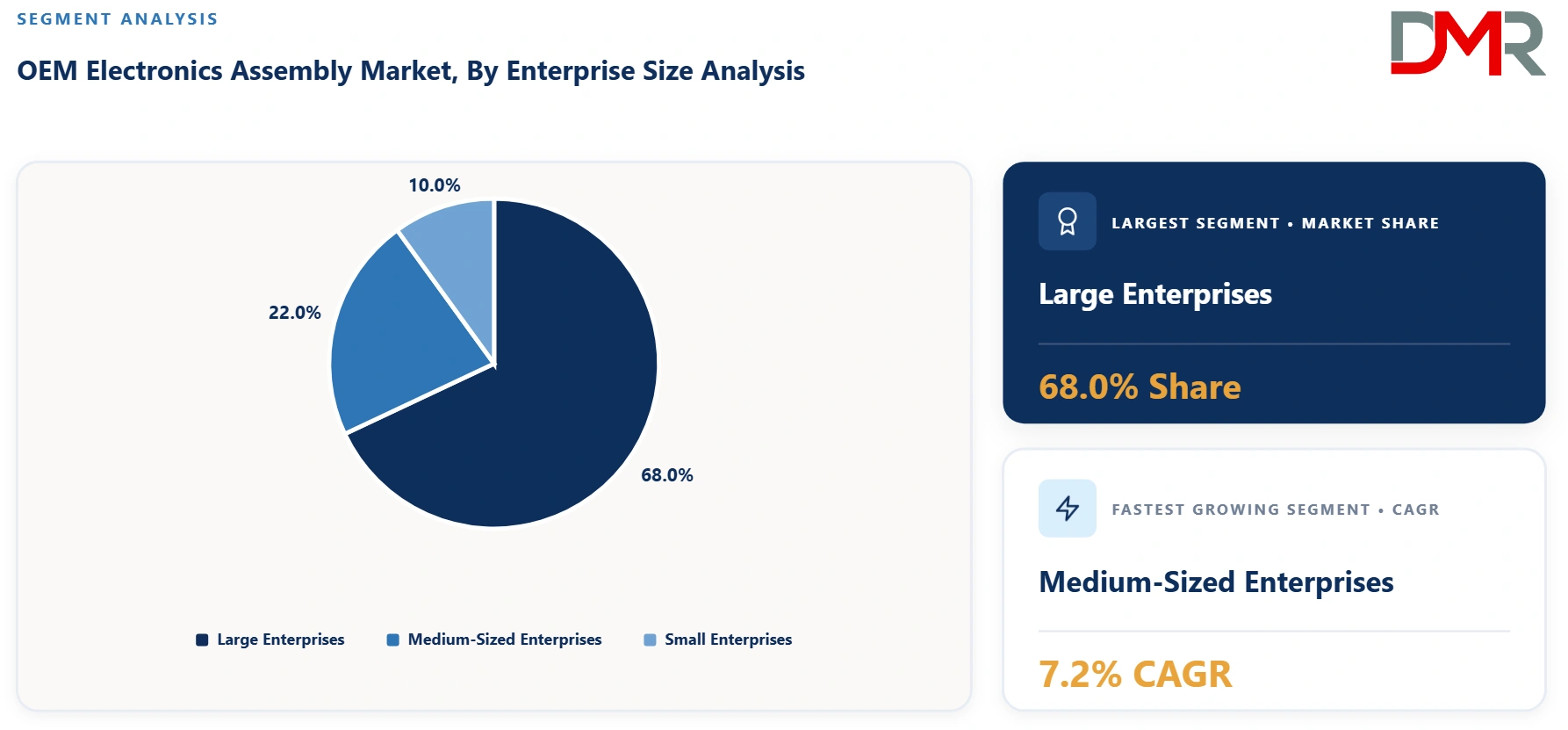
Large Enterprises account for approximately 68% of assembly spend in 2026, as multinational OEMs concentrate volume with providers capable of multi-region footprints and advanced quality systems. Medium-Sized Enterprises represent the fastest-growing tier at 7.2% CAGR, benefiting from OEM diversification strategies that favor regional providers with design flexibility and lower minimum order quantities.
How is the OEM Electronics Assembly Market Segmented?
By Service Type
- Electronics Manufacturing Services (EMS)
- Original Design Manufacturing (ODM)
- Original Design Assembly (ODA)
- Engineering and Design Services
- Testing, Repair, and Aftermarket Services
By Product Type
- Printed Circuit Board Assemblies (PCBA)
- Integrated Circuit Assemblies
- Electromechanical Assemblies
- Cable and Wire Harness Assemblies
- Complete Electronic Systems
By Manufacturing Process
- Surface Mount Technology (SMT)
- Through-Hole Technology (THT)
- Mixed Technology Assembly
- Box Build Assembly
- Advanced Packaging and Integration
By End-Use Industry
- Consumer Electronics
- Automotive and Transportation
- Healthcare and Medical Devices
- Industrial Electronics
- Aerospace and Defense
By Enterprise Size
- Large Enterprises
- Medium-Sized Enterprises
- Small Enterprises
Which Region Leads the OEM Electronics Assembly Market?
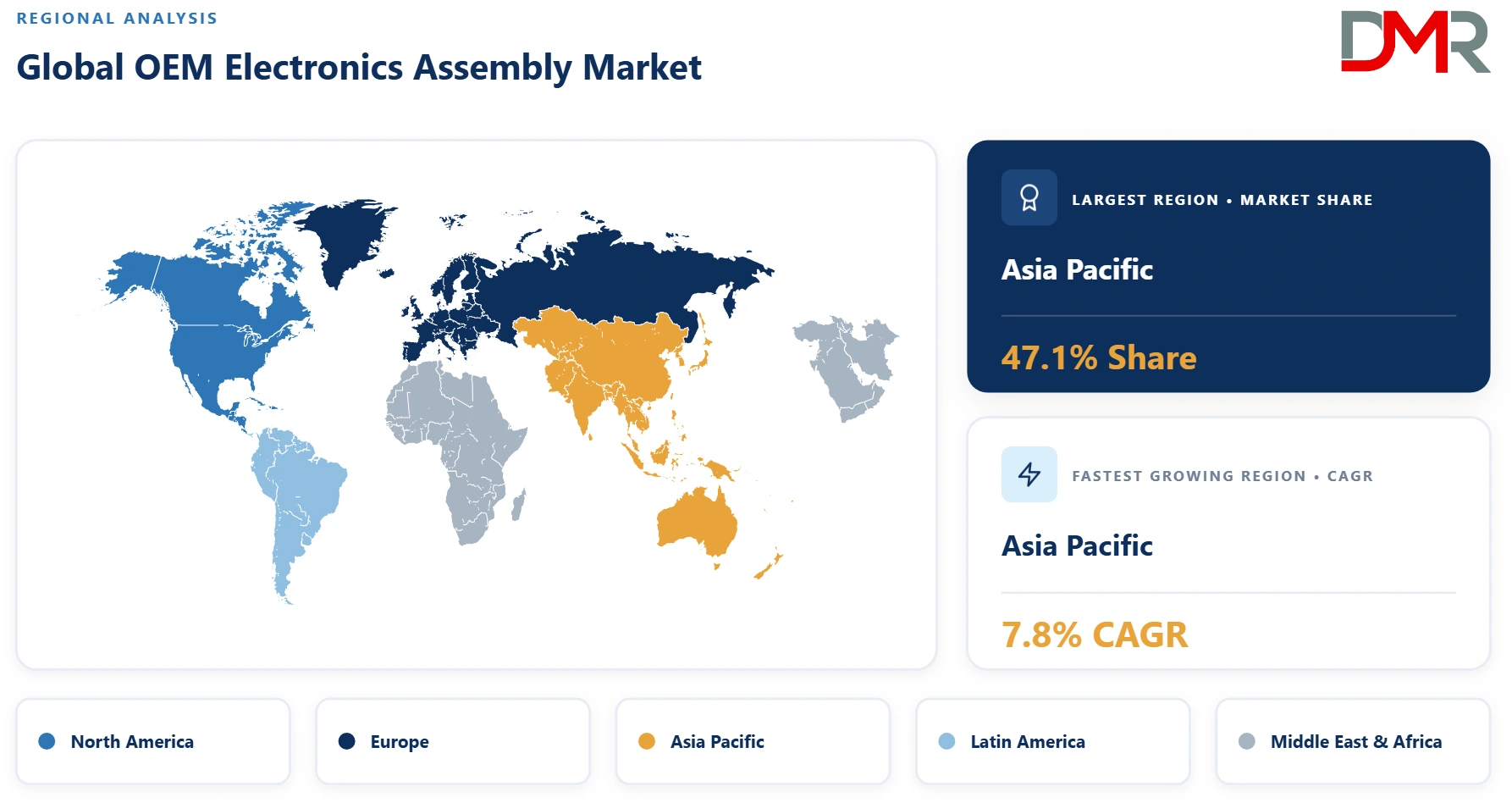
Asia Pacific leads with 47.1% share in 2026, while Asia Pacific is also projected to grow at 7.8% CAGR from 2027 to 2035.
ℹ
To learn more about this report –
Download Your Free Sample Report Here
Region with the Largest Revenue Share
Asia Pacific commands 47.1% of global assembly revenue in 2026, anchored by China’s integrated electronics ecosystem, Taiwan’s advanced packaging and server assembly concentration, and South Korea’s memory and display module production. India and Vietnam are the fastest-growing country markets within the region, with India’s PLI scheme driving smartphone assembly expansion and Vietnam attracting high-layer PCB and wearables programs. The region’s cost advantages, dense component supplier networks, and supportive industrial policies sustain its dominance through the forecast period despite rising labor costs in coastal China.
Region with the Highest CAGR
Asia Pacific is also the fastest-growing region at 7.8% CAGR, as supply chain diversification benefits multiple countries simultaneously rather than displacing China’s volume. Vietnam’s electronics FDI reached USD 8.9 billion in 2025, India’s smartphone production hit 340 million units with 58% export share, and Malaysia’s Kulim corridor deepened test and packaging capabilities. The region’s growth is broad-based across end markets, with automotive electronics assembly in Thailand and India adding to traditional consumer electronics strength.
Regional Analysis
North America OEM Electronics Assembly Market
Growth is concentrated in Mexico’s industrial corridors and select U.S. locations driven by defense and EV localization requirements. U.S. domestic content rules for defense electronics have secured new plant builds in Arizona and Texas, while Mexican assembly benefits from proximity to U.S. OEM design centers and tariff advantages under USMCA. Automotive electronics assembly for EV power modules and ADAS sensors represents the fastest-growing application, though the region’s share of global volume remains modest relative to Asia Pacific.
Europe OEM Electronics Assembly Market
Germany anchors automotive and industrial electronics assembly, with powertrain control units, sensor modules, and automation controllers representing core demand. France contributes aerospace and defense assembly requiring high-reliability processes and IP protection. Italy and Spain serve machinery, renewable energy, and transport electronics applications. The region prioritizes compliance-heavy medical and industrial programs where proximity to OEM design teams and regulatory expertise justify higher labor costs. Eastern European locations including Poland and Czechia attract mid-volume assembly seeking EU-based production.
Latin America OEM Electronics Assembly Market
Brazil and Mexico are the primary assembly markets, with Mexico tightly integrated into North American automotive and consumer electronics supply chains. Brazil’s electronics production serves domestic consumption, industrial policy, and telecom modernization, with consumer and enterprise technology assembly representing the largest volume. The region benefits from trade agreements and proximity to U.S. markets but faces infrastructure and logistics constraints that limit scale expansion beyond automotive-adjacent corridors.
Middle East & Africa OEM Electronics Assembly Market
The region represents an emerging assembly market with initial investments in smart metering, renewable energy controllers, and telecom equipment often bundled with training and localization initiatives. Saudi Arabia and the UAE are developing electronics manufacturing as part of economic diversification programs, while South Africa serves as a hub for industrial and mining technology electronics. Low labor costs and government incentives create long-term potential, but the current volume base remains small and component ecosystems underdeveloped.
By Region
North America
Europe
- Germany
- France
- The U.K.
- Italy
- Spain
- Rest of Europe
Asia-Pacific
- China
- Japan
- India
- Australia
- South Korea
- Rest of APAC
Latin America
- Mexico
- Brazil
- Rest of LATAM
Middle East & Africa
- Saudi Arabia
- The UAE
- South Africa
- Rest of MEA
Pricing Analysis
OEM electronics assembly pricing reflects a bifurcated market. High-volume consumer and smartphone assembly operates on thin margins of 5–8%, with competition centered on scale, yield, and component purchasing leverage. Complex automotive, medical, and aerospace programs command premiums of 12–20% for reliability certifications, traceability, and low-volume/high-mix flexibility. Component cost pass-through mechanisms vary by contract structure, with turnkey agreements shifting BOM risk to the assembler while consignment arrangements preserve OEM exposure. Pricing pressure is most acute in standard PCB assembly, where Asian providers with dense supplier ecosystems maintain cost advantages. Advanced packaging and box build services face less price erosion due to technical barriers and qualification requirements. The trend toward design-led engagements is gradually shifting pricing power toward providers offering differentiated engineering value rather than pure assembly capacity.
Investment and White Space Analysis
Capital flows are directed toward three primary white spaces. First, nearshoring capacity in Mexico, India, and Eastern Europe addresses OEM demand for supply chain resilience, with greenfield plants and acquisitions of regional providers representing the fastest route to presence. Second, advanced packaging for AI servers, medical implants, and RF modules requires cleanroom investment and specialized expertise that few mid-tier assemblers possess. Third, aftermarket services including repair, refurbishment, and component harvesting benefit from circular economy incentives and offer recurring revenue with higher margins than new assembly. Government incentives including India’s PLI scheme, the U.S. CHIPS Act’s downstream effects, and EU sustainability directives shape investment location decisions. The risk of overcapacity in standard assembly coexists with persistent scarcity in high-reliability and advanced packaging segments.
Who are the Leading Companies in the OEM Electronics Assembly Market?
The OEM electronics assembly market is concentrated at the top, with Foxconn, Jabil, Flex, and Pegatron collectively holding an estimated 40% of global revenue. These leaders compete on scale, geographic breadth, and increasingly on design and engineering capabilities. Mid-tier providers including Sanmina, Celestica, and Benchmark differentiate through specialized end-market focus in medical, defense, and industrial segments. Strategic developments center on automotive qualification, nearshoring footprint expansion, and AI-enabled manufacturing investments.
- Foxconn / Hon Hai Precision Industry (Taiwan): The largest global EMS provider, with dominant share in consumer electronics assembly and expanding automotive electronics presence through EV partnerships. Broad manufacturing footprint across China, India, Vietnam, Mexico, and the U.S.
- Jabil Inc. (USA): Diversified across healthcare, automotive, industrial, and consumer segments, with strengths in complex electromechanical assembly, precision injection molding, and supply chain services. Significant medical device and packaging capabilities.
- Flex Ltd. (Singapore/USA): End-to-end design and manufacturing services spanning cloud infrastructure, automotive, industrial, and health solutions. Strong in advanced manufacturing automation and sketch-to-scale engagements.
- Pegatron Corp. (Taiwan): Major consumer electronics assembler with growing automotive and communications infrastructure segments. Expanding production in India, Vietnam, and Mexico alongside China operations.
- Wistron Corp. (Taiwan): Focused on consumer electronics, medical devices, and industrial applications, with growing presence in India and Vietnam. Active in reference design platforms for accelerated customer launches.
- Sanmina Corp. (USA): Specialized in high-reliability assembly for medical, defense, aerospace, and industrial markets, with strengths in complex box build and precision electromechanical integration.
- Celestica Inc. (Canada): Focused on enterprise hardware, networking, and aerospace/defense, with design and manufacturing services for high-complexity systems.
- Benchmark Electronics (USA): Medical, industrial, and aerospace-focused provider with regional manufacturing footprint serving high-mix, low-volume production requirements.
Some of the prominent players in the Global OEM Electronics Assembly Market are:
- Foxconn (Hon Hai Precision Industry)
- Jabil Inc.
- Flex Ltd.
- Pegatron Corp.
- Wistron Corp.
- Sanmina Corp.
- Celestica Inc.
- Benchmark Electronics Inc.
- Quanta Computer Inc.
- Compal Electronics Inc.
- Inventec Corp.
- Lite-On Technology Corp.
- USI (Universal Scientific Industrial)
- Plexus Corp.
- Kimball Electronics
- Zollner Elektronik
- Neways Electronics
- Scanfil
- Note AB
- Hanwha Precision Machinery
- Samsung Electro-Mechanics (EMS division)
- Venture Corp.
- Hi-P International
- SMT Technologies
- Integrated Micro-Electronics Inc.
- Kaynes Technology
- Dixon Technologies
- Syrma SGS Technology
- Cicor Group
- Elcoteq (successor entities)
- Selcom Electronics
- SVI Public Company
- SMT Global
- Asteelflash
- Creation Technologies
- Key Tronic
- SigmaTron International
- Nortech Systems
- IEC Electronics
- Other Key Players
Recent Developments
- In January 2026, Foxconn announced expanded EV electronics assembly capacity in Mexico, targeting North American automotive OEM contracts for power modules and ADAS controllers.
- In November 2025, Jabil opened a medical device assembly facility in Ireland, expanding EU-based high-reliability production for diagnostic and surgical equipment customers.
- In September 2025, Pegatron commenced iPhone assembly at its expanded Chennai, India facility, supporting Apple’s supply chain diversification away from China concentration.
- In July 2025, Sanmina acquired a defense electronics assembly specialist in Arizona, adding cleared-facility capacity for U.S. aerospace and defense programs.
- In May 2025, Wistron launched a reference design platform for industrial IoT gateways, enabling customers to brand and customize pre-certified hardware for accelerated market entry.
Report Scope and Research Methodology
Market definition: OEM electronics assembly covers outsourced manufacturing and design services for printed circuit boards, electromechanical assemblies, cable harnesses, and complete electronic systems. The market spans prototype through volume production and aftermarket services across consumer, automotive, medical, industrial, and aerospace end markets, delivered by contract manufacturers, design houses, and integrated EMS providers.
Methodology: Dimension Market Research built the estimate bottom-up from company revenues, shipment data, and assembly value per unit for each product and end-user segment, then checked it top-down against global electronics production spending totals. Primary interviews with EMS executives, OEM supply chain managers, and component suppliers validated adoption rates and pricing. Forecasts apply segment-level growth assumptions for 2027–2035 and are reviewed at each report update.
Report Details
| Report Characteristics |
Details |
| Market Size (2026) |
USD 671.5 Billion |
| Forecast Value (2035) |
USD 1,272.4 Billion |
| CAGR (2027-2035) |
6.6% |
| Historical Data |
2021–2026 |
| Forecast Data |
2027–2035 |
| Base Year |
2026 |
| Estimate Year |
2027 |
| Segments Covered |
By Service Type, By Product Type, By Manufacturing Process, By End-Use Industry, By Enterprise Size |
| Regional Coverage |
North America (The US, Canada); Europe (Germany, France, The UK, Italy, Spain, Rest of Europe); Asia Pacific (China, Japan, India, Australia, South Korea, Rest of APAC); Latin America (Mexico, Brazil, Rest of LATAM); Middle East & Africa (Saudi Arabia, The UAE, South Africa, Rest of MEA) |
Frequently Asked Questions
How big is the OEM Electronics Assembly Market in 2026?
▾ The global OEM electronics assembly market is valued at USD 671.5 billion in 2026.
What is the growth rate of the OEM Electronics Assembly Market?
▾ The market is projected to grow at a CAGR of 6.6% from 2027 to 2035.
Which region leads the OEM Electronics Assembly Market?
▾ Asia Pacific leads with about 47.1% share in 2026, driven by China, Taiwan, South Korea, India, and Vietnam.
Which product segment dominates the OEM Electronics Assembly Market?
▾ Printed Circuit Board Assemblies hold the largest share at approximately 62% of assembly revenue in 2026.
Which end user is growing fastest in the OEM Electronics Assembly Market?
▾ Automotive and Transportation is the fastest-growing end-use segment at 7.8% CAGR, driven by EV power electronics and ADAS sensor assembly.
Who are the key players in the OEM Electronics Assembly Market?
▾ Key players include Foxconn (Hon Hai), Jabil, Flex, Pegatron, Wistron, Sanmina, Celestica, and Benchmark Electronics.
What are the main challenges facing the OEM Electronics Assembly Market?
▾ Component price volatility, geopolitical trade barriers, export controls on advanced semiconductors, and margin pressure in commoditized standard assembly segments represent the primary challenges.