Market Overview
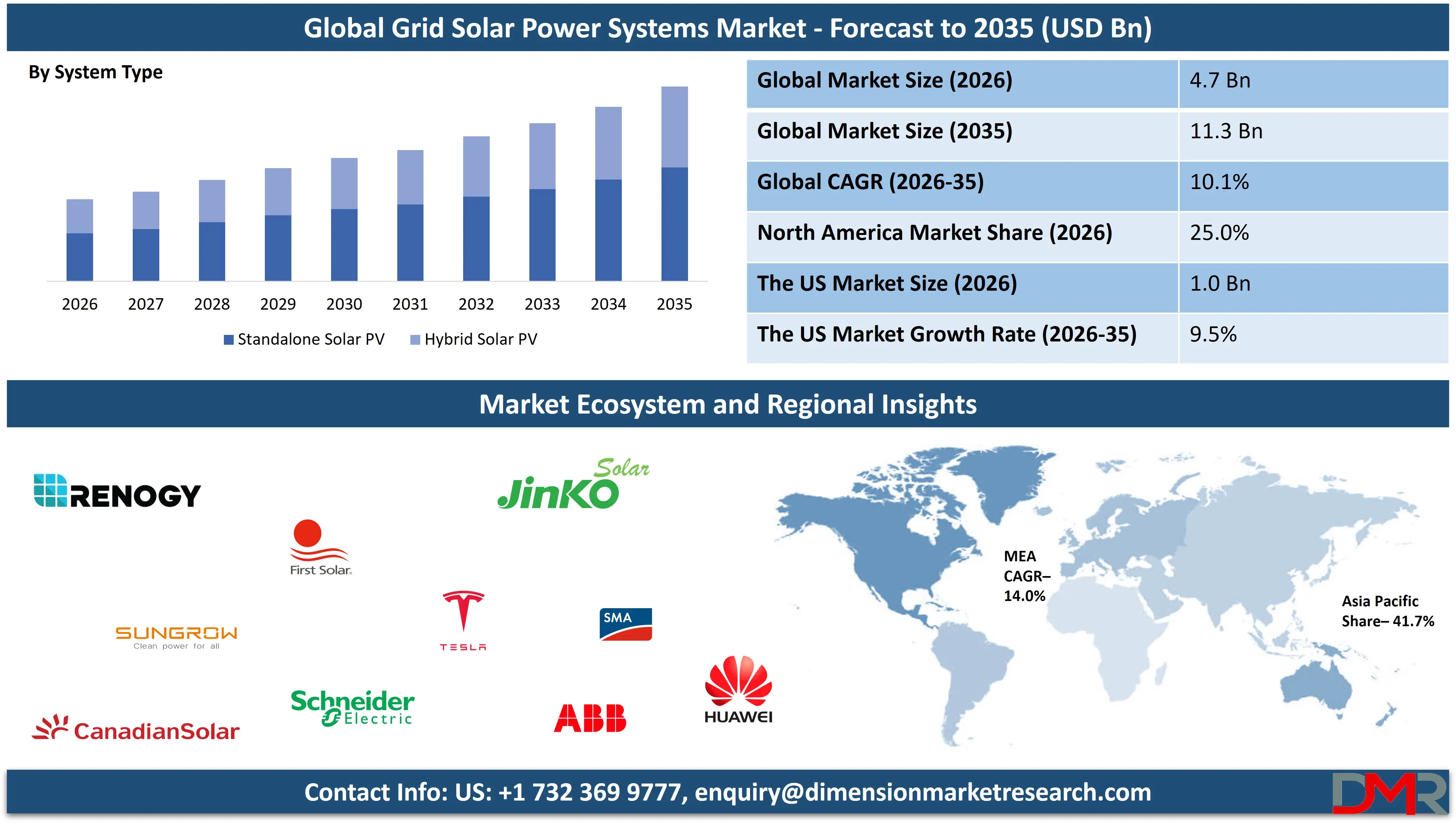
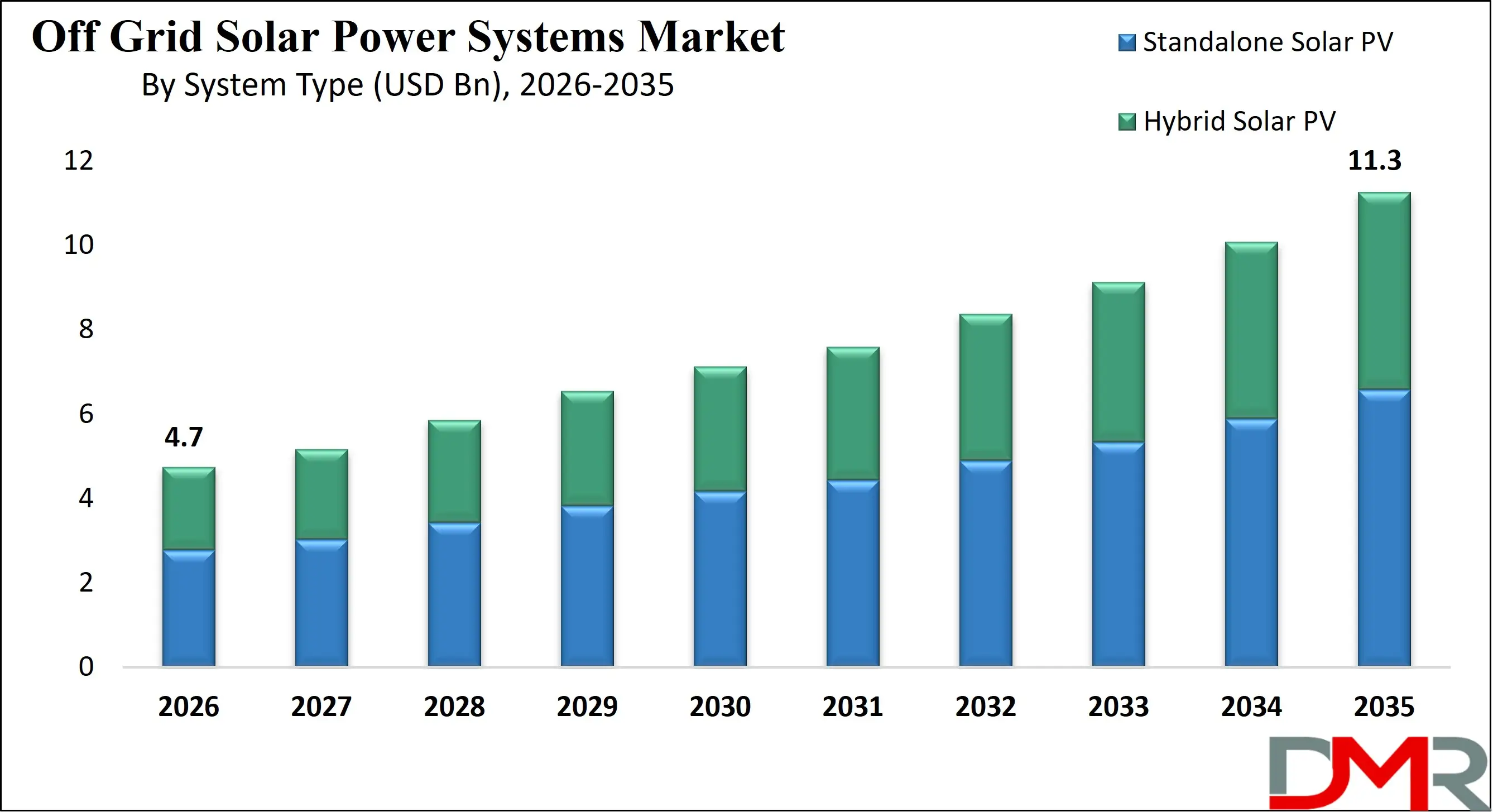
The Global Off Grid Solar Power Systems Market size is projected to reach USD 4.7 billion in 2026 and grow at a compound annual growth rate of 10.1% to reach a value of USD 11.3 billion in 2035.
Off Grid Solar Power Systems refer to decentralized solar energy solutions that operate independently from the main utility grid. These systems typically consist of photovoltaic (PV) panels, battery storage units, charge controllers, inverters, and balance of system components that collectively generate, store, and distribute electricity in remote or underserved locations. They are designed to provide reliable power in areas where grid connectivity is unavailable, unreliable, or economically unfeasible. Off-grid systems range from small household kits to large hybrid installations powering commercial or industrial facilities.
ℹ
To learn more about this report –
Download Your Free Sample Report Here
These systems play a critical role in advancing global electrification, particularly in rural and remote regions across developing economies. They support energy access, reduce dependence on diesel generators, and contribute to decarbonization goals. The growing emphasis on distributed energy resources and resilience against grid outages has elevated their importance within the broader renewable energy landscape.
ℹ
To learn more about this report –
Download Your Free Sample Report Here
Emerging shifts such as falling solar module prices, improvements in lithium-ion battery efficiency, digital monitoring platforms, and hybrid system integration are accelerating adoption. Increased focus on climate adaptation, disaster recovery energy solutions, and rural development programs is further reshaping the sector’s long-term growth trajectory.
The US Off Grid Solar Power Systems Market
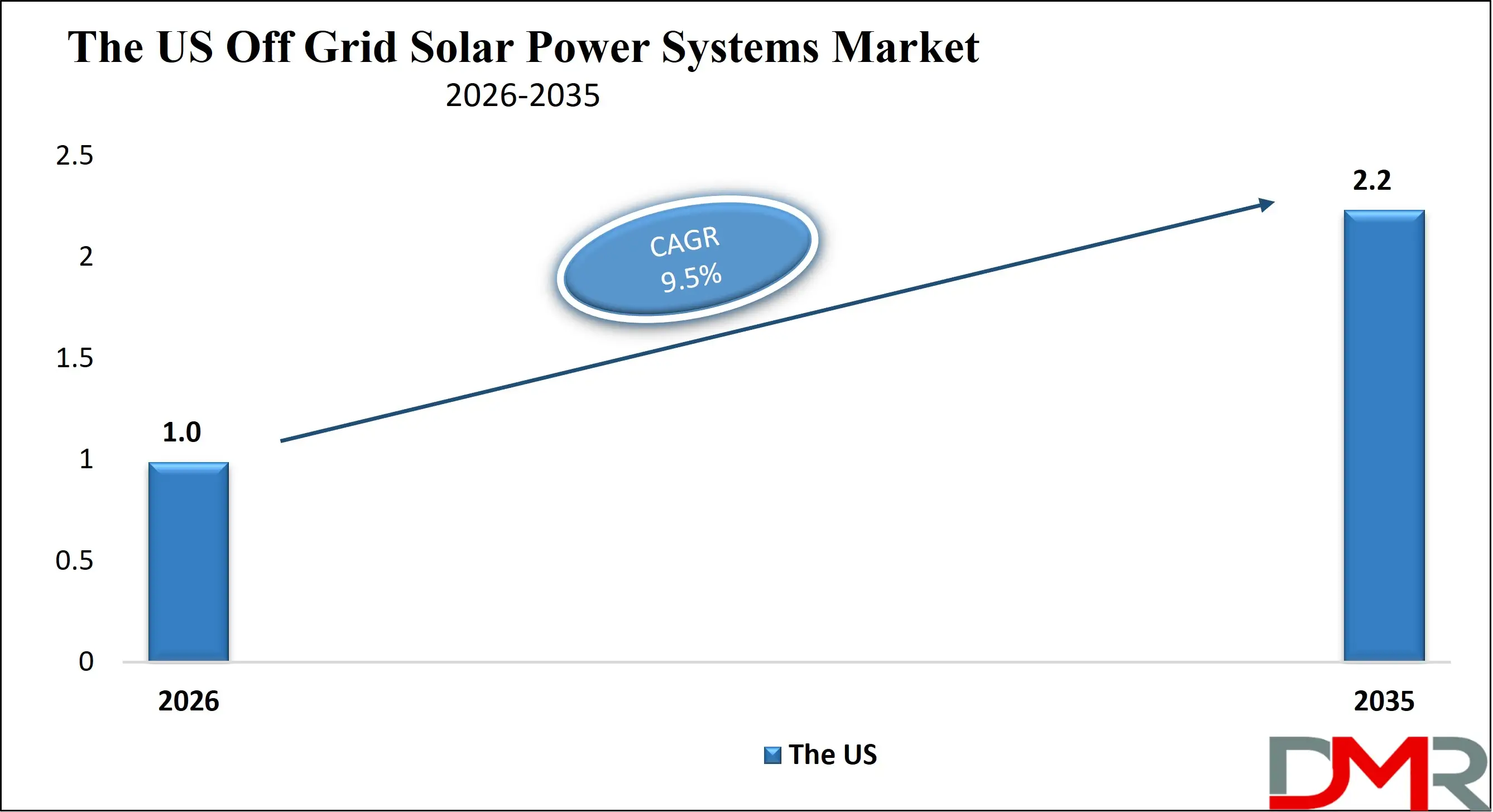
The US Off Grid Solar Power Systems Market size is projected to reach USD 1.0 billion in 2026 at a compound annual growth rate of 9.5% over its forecast period.
ℹ
To learn more about this report –
Download Your Free Sample Report Here
The US market is driven by rising demand for energy resilience, particularly in wildfire and hurricane-prone states such as California and Florida. Federal incentives under clean energy programs, along with state-level net metering policies and tax credits, encourage off-grid and hybrid installations. Rural electrification in Alaska and remote agricultural zones also contributes to demand. Technological leadership in battery innovation and smart inverters strengthens domestic deployment. Increasing interest in energy independence among homeowners and small businesses further supports market expansion, with hybrid solar-plus-storage systems gaining significant traction.
Europe Off Grid Solar Power Systems Market
Europe Off Grid Solar Power Systems Market size is projected to reach USD 940 million in 2026 at a compound annual growth rate of 9.8% over its forecast period.
Europe’s market growth is influenced by strong decarbonization targets under the European Green Deal and regional commitments to energy security. Countries such as Germany, Spain, and Italy are promoting distributed renewable installations to reduce reliance on imported fossil fuels. Off-grid systems are particularly relevant for remote communities, islands, and agricultural applications. Technological innovation, especially in advanced battery storage and microgrid integration, is accelerating deployment. Regulatory support for renewable self-consumption and carbon neutrality goals is enhancing adoption rates across both residential and commercial sectors.
Japan Off Grid Solar Power Systems Market
Japan Off Grid Solar Power Systems Market size is projected to reach USD 423 million in 2026 at a compound annual growth rate of 9.0% over its forecast period.
Japan’s market is shaped by energy security concerns and disaster preparedness following past grid vulnerabilities. Remote islands and mountainous regions drive demand for decentralized solar solutions. Government incentives supporting renewable deployment and battery storage integration foster market growth. Technological sophistication in high-efficiency PV modules and compact storage systems enhances system performance. Urban resilience planning and industrial backup power requirements further stimulate adoption. However, land constraints and high installation costs remain structural challenges, encouraging innovation in space-efficient and hybrid configurations.
Off Grid Solar Power Systems Market: Key Takeaways
- Market Growth: The Off Grid Solar Power Systems Market size is expected to grow by USD 6.1 billion, at a CAGR of 10.1%, during the forecasted period of 2027 to 2035.
- By System Type: The standalone solar PV segment is anticipated to get the majority share of the Off Grid Solar Power Systems market in 2026.
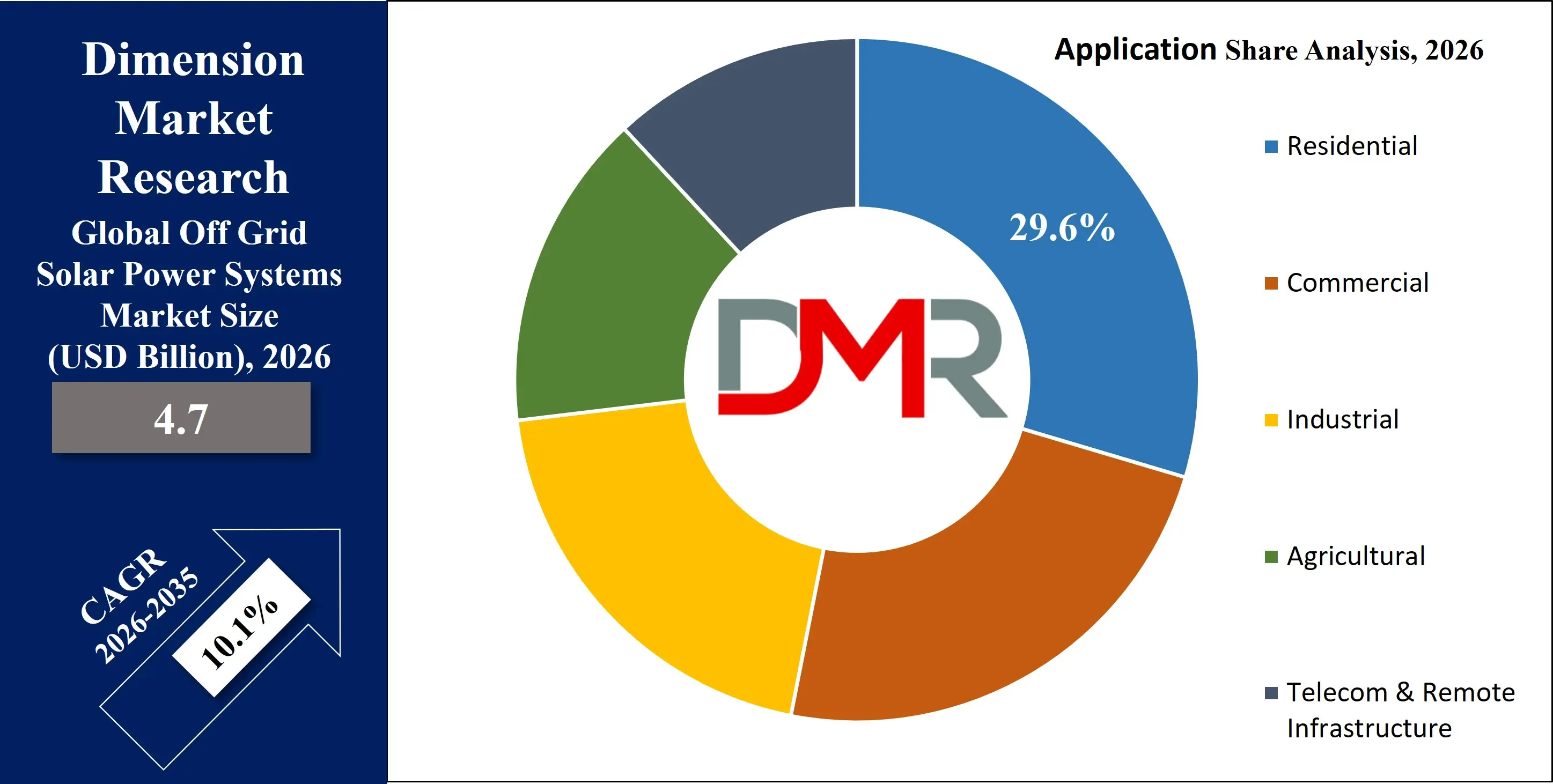
- By Application: The residential segment is expected to get the largest revenue share in 2026 in the Off Grid Solar Power Systems market.
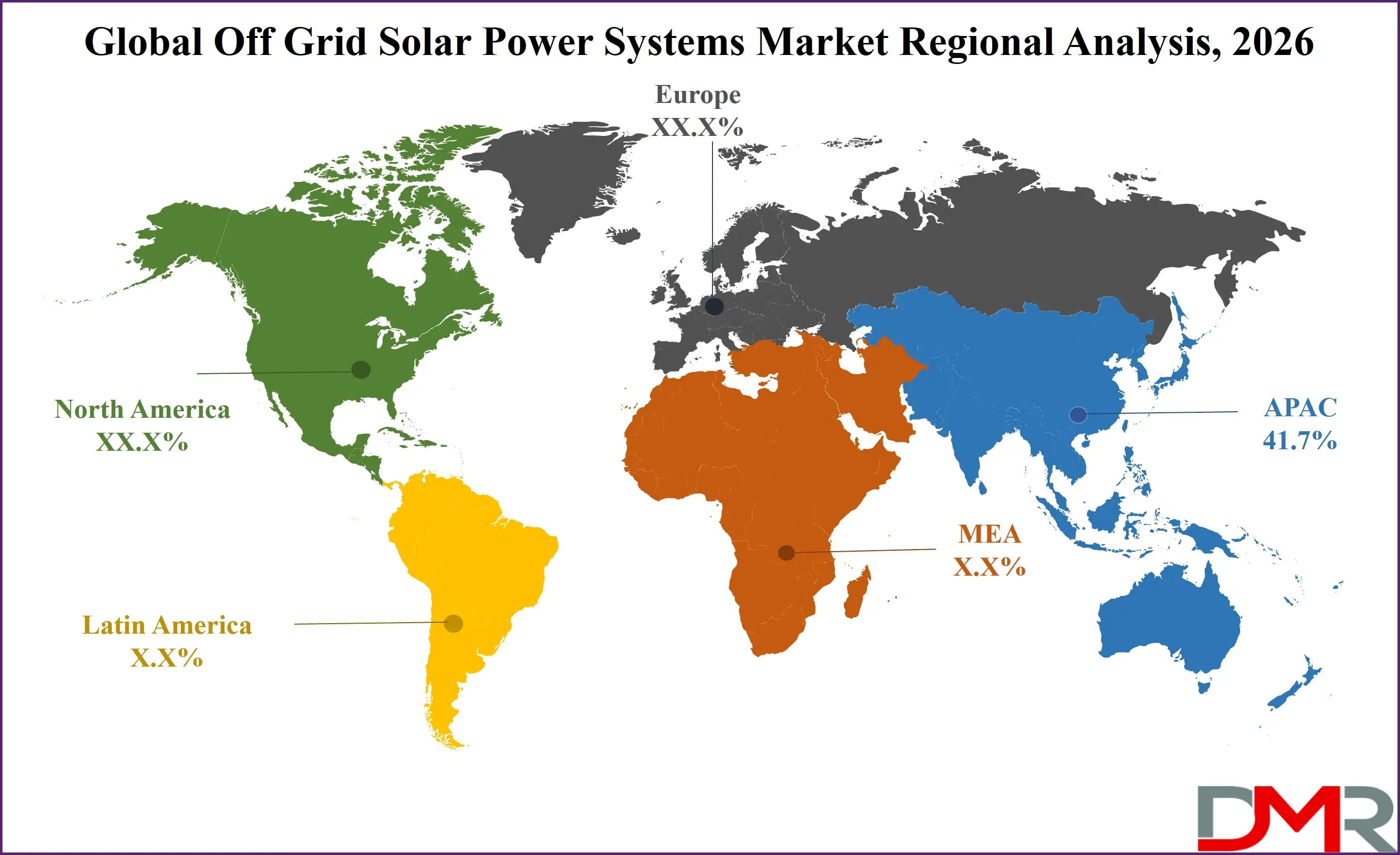
- Regional Insight: Asia Pacific is expected to hold a 41.7% share of revenue in the global Off Grid Solar Power Systems market in 2026.
- Use Cases: Some of the use cases of Off Grid Solar Power Systems include rural electrification, telecom towers, and more.
Off Grid Solar Power Systems Market: Use Cases
- Rural Electrification: Provides first-time electricity access to off-grid villages, improving living standards, healthcare, and education.
- Agricultural Operations: Powers irrigation pumps, cold storage units, and processing equipment in remote farming areas.
- Telecom Towers: Ensures uninterrupted power supply for telecom infrastructure in isolated regions.
- Mining & Construction Sites: Supplies temporary yet reliable power for remote industrial operations.
- Residential Energy Independence: Enables households to operate independently from unreliable grids.
- Disaster Relief & Emergency Response: Delivers rapid-deployment electricity in post-disaster scenarios.
- Remote Monitoring Stations: Supports scientific research stations and environmental monitoring facilities.
Stats & Facts
- International Energy Agency stated that global renewable power capacity additions reached 507 GW in 2023, marking nearly 50% growth over 2022 levels.
- International Renewable Energy Agency reported that global solar PV capacity exceeded 1,400 GW in 2023.
- World Bank indicated that around 675 million people remained without electricity access in 2023.
- U.S. Energy Information Administration reported that solar accounted for 53% of new electricity-generating capacity added in the US in 2023.
- European Commission stated that renewables contributed approximately 44% of EU electricity generation in 2023.
- Ministry of New and Renewable Energy (India) announced that India surpassed 73 GW of installed solar capacity in 2023.
- International Energy Agency projected renewables to account for over 42% of global electricity generation by 2028.
- U.S. Department of Energy reported a 70% decline in lithium-ion battery pack prices between 2015 and 2023.
- International Renewable Energy Agency noted that solar PV costs declined by nearly 89% between 2010 and 2022.
- United Nations reported that achieving universal energy access by 2030 requires annual investments exceeding USD 35 billion.
Market Dynamic
Driving Factors in the Off Grid Solar Power Systems Market
Declining Solar and Battery Costs
The continuous reduction in solar module and lithium-ion battery prices remains a primary growth catalyst. Economies of scale, technological advancements in monocrystalline cells, and improved battery chemistry have significantly lowered total system costs. This cost competitiveness makes off-grid solar solutions more viable than diesel generators in remote locations. Additionally, improved energy density and longer battery life enhance reliability and reduce lifecycle costs. As financing models such as pay-as-you-go and micro-leasing expand, affordability barriers decline further, accelerating adoption across rural and semi-urban communities worldwide.
Rising Demand for Energy Independence and Grid Resilience
Increasing grid instability due to extreme weather events, aging infrastructure, and cyber risks has intensified the demand for decentralized energy systems. Off-grid solar installations provide autonomy and protection against outages, particularly for critical infrastructure such as telecom towers and healthcare centers. Businesses in remote industrial operations also prefer hybrid solar systems to mitigate fuel transportation costs and volatility. Governments are encouraging distributed generation to reduce transmission losses and enhance national energy security, reinforcing long-term market expansion.
Restraints in the Off Grid Solar Power Systems Market
High Initial Capital Investment
Despite cost reductions, upfront installation expenses for high-capacity systems with advanced lithium-ion storage remain substantial. Remote deployments also incur transportation and logistics costs. Limited access to financing in developing regions restricts scalability. Small enterprises and low-income households often struggle to secure capital without subsidies or microfinance options. These financial constraints can slow adoption, particularly in regions where policy support mechanisms are weak or inconsistent.
Technical and Maintenance Challenges
Off-grid systems require proper sizing, battery management, and periodic maintenance to ensure reliability. In rural or underdeveloped regions, a shortage of trained technicians can lead to performance inefficiencies or system failures. Battery disposal and recycling infrastructure remain limited in some markets, raising sustainability concerns. Climatic variations such as prolonged cloudy seasons also impact system output, necessitating hybridization or oversizing, which increases costs.
Opportunities in the Off Grid Solar Power Systems Market
Expansion in Emerging Economies
Sub-Saharan Africa, Southeast Asia, and parts of Latin America represent significant untapped potential due to limited grid penetration. Government-backed electrification programs and international funding initiatives are creating favorable deployment environments. Rapid population growth and rural development plans further stimulate demand. Off-grid systems offer faster and more cost-effective alternatives to grid extension, positioning manufacturers and service providers to capture substantial growth opportunities.
Integration with Smart Technologies and Microgrids
The integration of digital monitoring, IoT-enabled controllers, and smart meters enhances system efficiency and remote diagnostics. Hybrid microgrids combining solar, storage, and backup generators are gaining traction in remote industrial clusters and island communities. Advanced software platforms allow predictive maintenance and load optimization, increasing system reliability and investor confidence. This digital transformation unlocks higher-value service-based revenue models.
Trends in the Off Grid Solar Power Systems Market
Hybridization and Energy Storage Integration
Hybrid solar systems combining PV with battery storage or diesel generators are becoming standard in commercial and telecom applications. This approach ensures consistent power supply while reducing fuel consumption. Lithium-ion batteries dominate due to high efficiency and compact design. Modular hybrid systems allow scalability, enabling users to expand capacity as energy demand increases.
Digitalization and Remote Monitoring
Cloud-based energy management systems are transforming operational efficiency. Real-time performance tracking, predictive analytics, and AI-driven diagnostics reduce downtime and maintenance costs. Remote monitoring is particularly valuable in geographically isolated installations, enabling centralized management of multiple sites. Data-driven insights support optimized load distribution and extended battery life.
Impact of Artificial Intelligence in Off Grid Solar Power Systems Market
- Predictive Maintenance: AI analyzes performance data to detect faults early, minimizing downtime and maintenance costs.
- Load Forecasting: Machine learning predicts consumption patterns, optimizing battery storage and system sizing.
- Energy Optimization: AI algorithms balance solar generation and storage usage to maximize efficiency.
- Remote Diagnostics: Smart monitoring platforms provide automated alerts and system health analysis.
- Battery Lifecycle Management: AI enhances charging cycles to extend battery lifespan.
- Demand Response Automation: Intelligent controllers adjust loads based on generation levels.
- Site Assessment & Design: AI-powered modeling tools improve feasibility studies and system configuration.
- Fraud Detection in PAYG Models: AI monitors payment behaviors and usage anomalies.
Research Scope and Analysis
By System Type Analysis
Standalone solar PV systems are projected to hold approximately 58.4% market share by 2026, driven by their simplicity, affordability, and suitability for rural electrification initiatives. These systems function independently without auxiliary generation, making them highly practical for individual households, remote clinics, schools, and monitoring stations. Their lower installation complexity and reduced component requirements contribute to faster deployment and minimal maintenance needs. Government-supported energy access programs across emerging economies strongly favor standalone solutions for basic electricity services. Additionally, continuous declines in battery and module prices enhance affordability, reinforcing this segment’s leadership across decentralized energy markets globally.
Hybrid solar PV systems represent the fastest-growing segment due to rising demand for uninterrupted and reliable power supply in commercial, telecom, and industrial sectors. By integrating solar panels with battery storage, diesel generators, or wind systems, hybrid configurations ensure operational continuity during low sunlight periods. Businesses in remote locations increasingly adopt these systems to reduce fuel transportation costs and carbon emissions. Growing awareness of sustainability goals and energy resilience further accelerates adoption. Technological advancements in smart controllers and modular battery systems enhance performance efficiency, making hybrid installations an attractive long-term investment solution.
By Component Analysis
Solar panels are expected to account for approximately 36.7% market share by 2026, supported by continuous efficiency improvements and strong global production capacity. Monocrystalline modules dominate this segment due to their higher conversion efficiency, compact size, and better performance in limited space installations. Technological innovations such as bifacial modules and high-efficiency cell architectures are further strengthening their market presence. Replacement demand, coupled with expanding off-grid electrification projects, sustains growth momentum. Declining manufacturing costs and advancements in durability enhance the economic viability of panel deployment across residential, commercial, and industrial off-grid applications worldwide.
Battery storage is the fastest-growing component segment, fueled by declining lithium-ion prices and increasing demand for reliable energy backup. Advanced chemistries provide higher energy density, longer lifecycle performance, and improved safety standards compared to traditional alternatives. As hybrid systems gain popularity, storage capacity becomes critical for ensuring uninterrupted power during low-generation periods. Expanding telecom networks, rural electrification initiatives, and industrial microgrid installations significantly contribute to rising battery adoption. Additionally, innovations in battery management systems and recycling processes enhance efficiency and sustainability, strengthening long-term growth prospects for this segment.
By Power Capacity Analysis
The 1–10 kW segment is projected to account for approximately 34.9% of the market share by 2026, positioning it as the dominant capacity range. This segment is widely utilized across rural households, small commercial establishments, telecom towers, and agricultural pumping systems requiring moderate yet reliable electricity supply. Its optimal balance between affordability and adequate power output makes it highly suitable for decentralized energy applications. Government-backed rural development programs and small enterprise initiatives further support growth. Integration with lithium-ion storage enhances reliability, strengthening adoption across both developing and developed markets.
The Above 50 kW segment is anticipated to be the fastest-growing category, largely driven by industrial operations, mining activities, remote construction sites, and large microgrid installations. High-capacity systems offer substantial fuel cost savings compared to conventional diesel generators, particularly in isolated regions where fuel logistics are expensive. Enterprises increasingly prioritize emission reduction targets and long-term operational efficiency, supporting investment in large hybrid solar systems. Technological advancements in high-capacity inverters, modular battery banks, and digital energy management solutions further improve scalability and performance, enabling sustained growth in this segment.
By Application Analysis
The residential segment is expected to hold approximately 29.6% market share by 2026, supported by expanding rural electrification initiatives and increasing consumer preference for energy independence. Off-grid households rely on these systems for essential services such as lighting, refrigeration, communication, and small appliances. Pay-as-you-go financing models and community-based solar programs significantly improve affordability in developing regions. Additionally, concerns regarding grid instability and rising electricity tariffs in certain markets encourage homeowners to invest in hybrid backup systems. Continuous reductions in component prices further enhance residential adoption across global off-grid communities.
ℹ
To learn more about this report –
Download Your Free Sample Report Here
The industrial segment is projected to be the fastest-growing application category, driven by increasing deployment across mining, oil exploration, manufacturing, and remote construction sites. These operations require continuous and high-load electricity supply, making hybrid solar-diesel systems an efficient alternative to conventional fuel-dependent generators. Companies are actively pursuing sustainability targets, carbon reduction strategies, and fuel cost optimization, accelerating investment in large-capacity off-grid systems. Advancements in modular system design and energy storage integration improve scalability and reliability, strengthening the industrial sector’s contribution to overall market expansion.
The Off Grid Solar Power Systems Market Report is segmented on the basis of the following
By System Type
- Standalone Solar PV Systems
- Hybrid Solar PV Systems
- Solar + Battery
- Solar + Diesel Generator (DG)
- Solar + Wind Hybrid
By Component
- Solar Panels
- Monocrystalline
- Polycrystalline
- Thin-Film
- Battery Storage
- Lead-Acid
- Lithium-Ion
- Other Advanced Batteries
- Inverters
- Balance of System (BoS)
By Power Capacity
- Up to 1 kW
- 1–10 kW
- 10–50 kW
- Above 50 kW
By Application
- Residential
- Rural Electrification
- Individual Households
- Commercial
- Small & Medium Enterprises
- Retail & Hospitality
- Industrial
- Remote Operations
- Mining & Construction Sites
- Agricultural
- Solar Water Pumps
- Cold Storage
- Telecom & Remote Infrastructure
- Telecom Towers
- Remote Monitoring Stations
Regional Analysis
Leading Region in the Off Grid Solar Power Systems Market
Asia-Pacific is anticipated to account for approximately 41.7% of the global market share by 2026, maintaining its dominant position in the off-grid solar power systems industry. Rapid rural electrification programs, large underserved populations, and expanding telecom infrastructure are major growth drivers across the region. Countries such as India, Indonesia, the Philippines, and Bangladesh continue investing heavily in decentralized solar initiatives to address energy access challenges.
ℹ
To learn more about this report –
Download Your Free Sample Report Here
Favorable government subsidies, declining photovoltaic module costs, and strong local manufacturing ecosystems further reinforce regional leadership. Increasing industrialization, agricultural mechanization, and microgrid deployment also contribute to sustained demand across diverse application sectors.
Fastest Growing Region in the Off Grid Solar Power Systems Market
The Middle East & Africa region is projected to be the fastest-growing market for off-grid solar power systems. Low grid penetration rates across Sub-Saharan African nations and remote desert areas in the Middle East create substantial demand for decentralized energy solutions. Governments are prioritizing off-grid electrification as a cost-effective alternative to expanding traditional grid infrastructure. Pay-as-you-go solar business models are improving affordability for rural households and small enterprises. Additionally, rising international climate financing, foreign direct investments, telecom tower expansion, and agricultural modernization initiatives are accelerating adoption and strengthening long-term regional growth prospects.
By Region
North America
Europe
- Germany
- The U.K.
- France
- Italy
- Russia
- Spain
- Benelux
- Nordic
- Rest of Europe
Asia-Pacific
- China
- Japan
- South Korea
- India
- ANZ
- ASEAN
- Rest of Asia-Pacific
Latin America
- Brazil
- Mexico
- Argentina
- Colombia
- Rest of Latin America
Middle East & Africa
- Saudi Arabia
- UAE
- South Africa
- Israel
- Egypt
- Rest of MEA
Competitive Landscape
The Off Grid Solar Power Systems Market is moderately fragmented, with participants competing primarily on technological innovation, pricing strategies, and service-based business models. Companies emphasize vertical integration to control manufacturing expenses, streamline procurement, and strengthen supply chain resilience amid fluctuating raw material costs. Strategic collaborations with telecom operators, rural electrification agencies, non-governmental organizations, and financial institutions enhance distribution networks and customer penetration. Significant investment in research and development focuses on improving battery efficiency, extending system lifespan, and advancing smart monitoring platforms. High initial capital requirements, specialized technical expertise, and regulatory compliance create notable entry barriers. Competitive differentiation increasingly depends on hybrid system customization, digital energy management capabilities, flexible financing models, and long-term service agreements that ensure operational reliability and customer retention.
Some of the prominent players in the global Off Grid Solar Power Systems are
- SMA Solar Technology AG
- Schneider Electric SE
- Tesla, Inc.
- Sungrow Power Supply Co., Ltd.
- Huawei Technologies Co., Ltd.
- ABB Ltd.
- Canadian Solar Inc.
- Jinko Solar Holding Co., Ltd.
- Trina Solar Limited
- First Solar, Inc.
- Victron Energy B.V.
- OutBack Power Technologies, Inc.
- Renogy
- Enphase Energy, Inc.
- Delta Electronics, Inc.
- Phocos AG
- M-KOPA Solar
- Azuri Technologies Ltd.
- SolaX Power Co., Ltd.
- Goal Zero LLC
- Other Key Players
Recent Developments
- In February 2026, WattPower unveiled that the company has delivered over 5 GW of solar capacity under the Government of India’s PM-KUSUM initiative, driving decentralized clean energy adoption in rural regions. With strong execution across Rajasthan, Gujarat, and Maharashtra, the company supports farmers through reliable solar infrastructure while enhancing distributed energy networks in Tier 2 and Tier 3 markets. Its “Wired for Good” philosophy integrates innovation with social responsibility to ensure sustainable, community-focused growth.
- In October 2025, Enphase Energy, Inc. announced support for fully integrated off-grid system configurations capable of operating independently from the utility grid. The solution combines IQ® Battery 5P with grid-forming microinverters, IQ8™ Series Microinverters featuring Sunlight JumpStart™, and a third-party AC generator to reliably power homes. Intelligent software optimizes battery charging and generator usage, while a new Off-Grid profile ensures seamless operation and prevents back-feeding during generator-supported performance.
Report Details
| Report Characteristics |
| Market Size (2026) |
USD 4.7 Bn |
| Forecast Value (2035) |
USD 11.3 Bn |
| CAGR (2026–2035) |
10.1% |
| The US Market Size (2026) |
USD 1.0 Bn |
| Historical Data |
2021 – 2025 |
| Forecast Data |
2027 – 2035 |
| Base Year |
2025 |
| Estimate Year |
2026 |
| Report Coverage |
Market Revenue Estimation, Market Dynamics, Competitive Landscape, Growth Factors, etc. |
| Segments Covered |
By System Type (Standalone Solar PV Systems, Hybrid Solar PV Systems), By Component (Solar Panels, Battery Storage, Inverters, Balance of System (BoS)), By Power Capacity (Up to 1 kW, 1–10 kW, 10–50 kW, Above 50 kW), By Application (Residential, Commercial, Industrial, Agricultural, Telecom & Remote Infrastructure) |
| Regional Coverage |
North America – US, Canada; Europe – Germany, UK, France, Russia, Spain, Italy, Benelux, Nordic, Rest of Europe; Asia-Pacific – China, Japan, South Korea, India, ANZ, ASEAN, Rest of APAC; Latin America – Brazil, Mexico, Argentina, Colombia, Rest of Latin America; Middle East & Africa – Saudi Arabia, UAE, South Africa, Turkey, Egypt, Israel, Rest of MEA |
| Prominent Players |
Prominent Players SMA Solar Technology AG, Schneider Electric SE, Tesla, Inc., Sungrow Power Supply Co., Ltd., Huawei Technologies Co., Ltd., ABB Ltd., Canadian Solar Inc., JinkoSolar Holding Co., Ltd., Trina Solar Limited, First Solar, Inc., Victron Energy B.V., OutBack Power Technologies, Inc., Renogy, Enphase Energy, Inc., Delta Electronics, Inc., Phocos AG, M-KOPA Solar, Azuri Technologies Ltd., SolaX Power Co., Ltd., Goal Zero LLC, and Other Key Players |
| Purchase Options |
We have three licenses to opt for: Single User License (Limited to 1 user), Multi-User License (Up to 5 Users), and Corporate Use License (Unlimited User) along with free report customization equivalent to 0 analyst working days, 3 analysts working days, and 5 analysts working days respectively. |
Frequently Asked Questions
How big is the Global Off Grid Solar Power Systems Market?
▾ The Global Off Grid Solar Power Systems Market size is expected to reach USD 4.7 billion by 2026 and is projected to reach USD 11.3 billion by the end of 2035
Which region accounted for the largest Global Off Grid Solar Power Systems Market?
▾ Asia Pacific is expected to have the largest market share in the Global Off Grid Solar Power Systems Market, with a share of about 41.7% in 2026.
How big is the Off Grid Solar Power Systems Market in the US?
▾ The US Off Grid Solar Power Systems market is expected to reach USD 1.0 billion by 2026.
Who are the key players in the Off Grid Solar Power Systems Market?
▾ Some of the major key players in the Global Off Grid Solar Power Systems Market include SMA Solar, ABB, Tesla and others
What is the growth rate in the Global Off Grid Solar Power Systems Market?
▾ The market is growing at a CAGR of 10.1 percent over the forecasted period.