Offshore Maintenance, Repair, and Overhaul (MRO) Market Snapshot
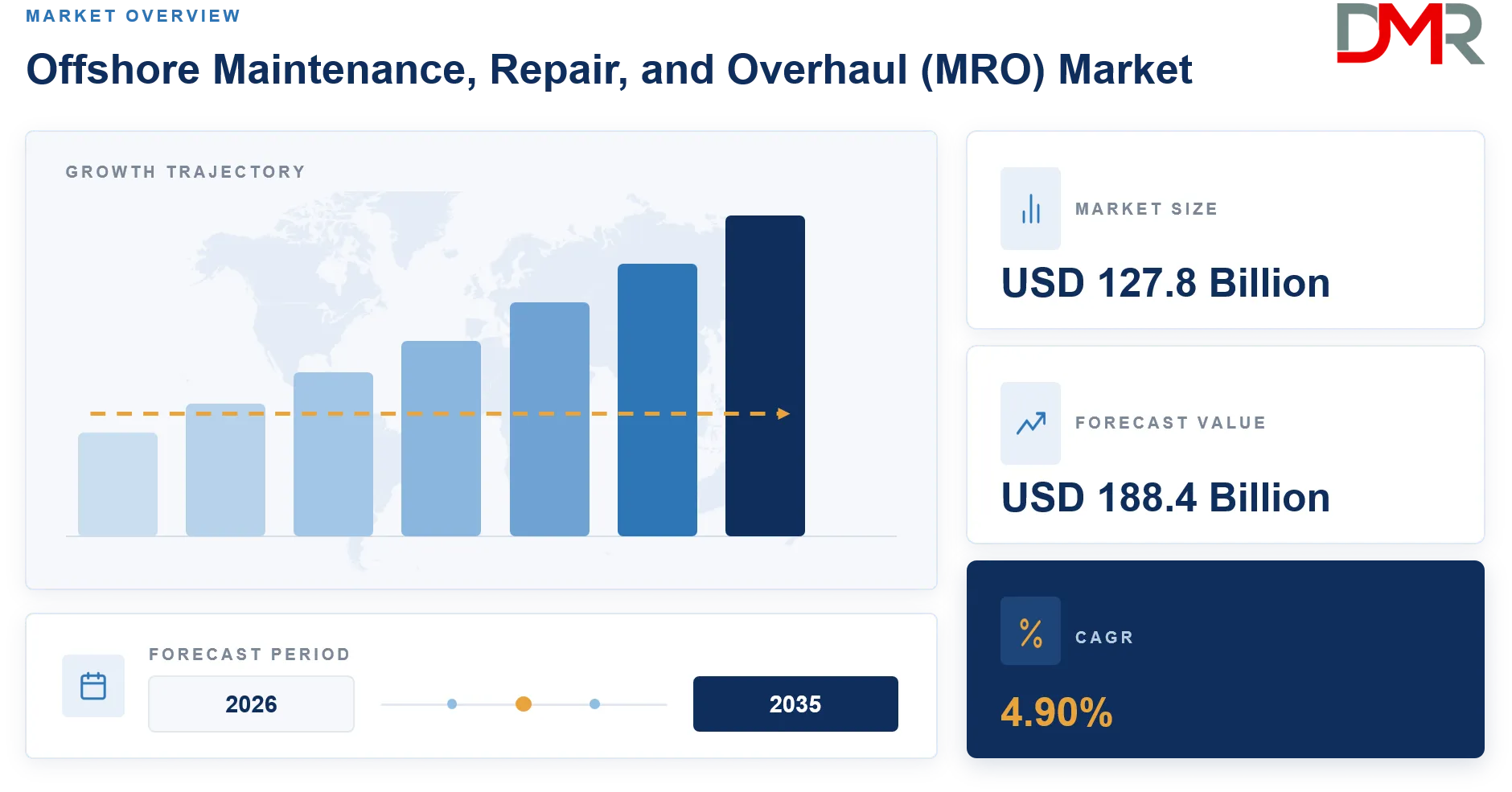
- Market Value: The Offshore Maintenance, Repair, and Overhaul (MRO) Market is valued at USD 127.8 billion in 2026 and is projected to reach USD 188.4 billion by 2035.
- CAGR: The Offshore Maintenance, Repair, and Overhaul (MRO) Market is expected to grow at a CAGR of 4.9% from 2026 to 2035.
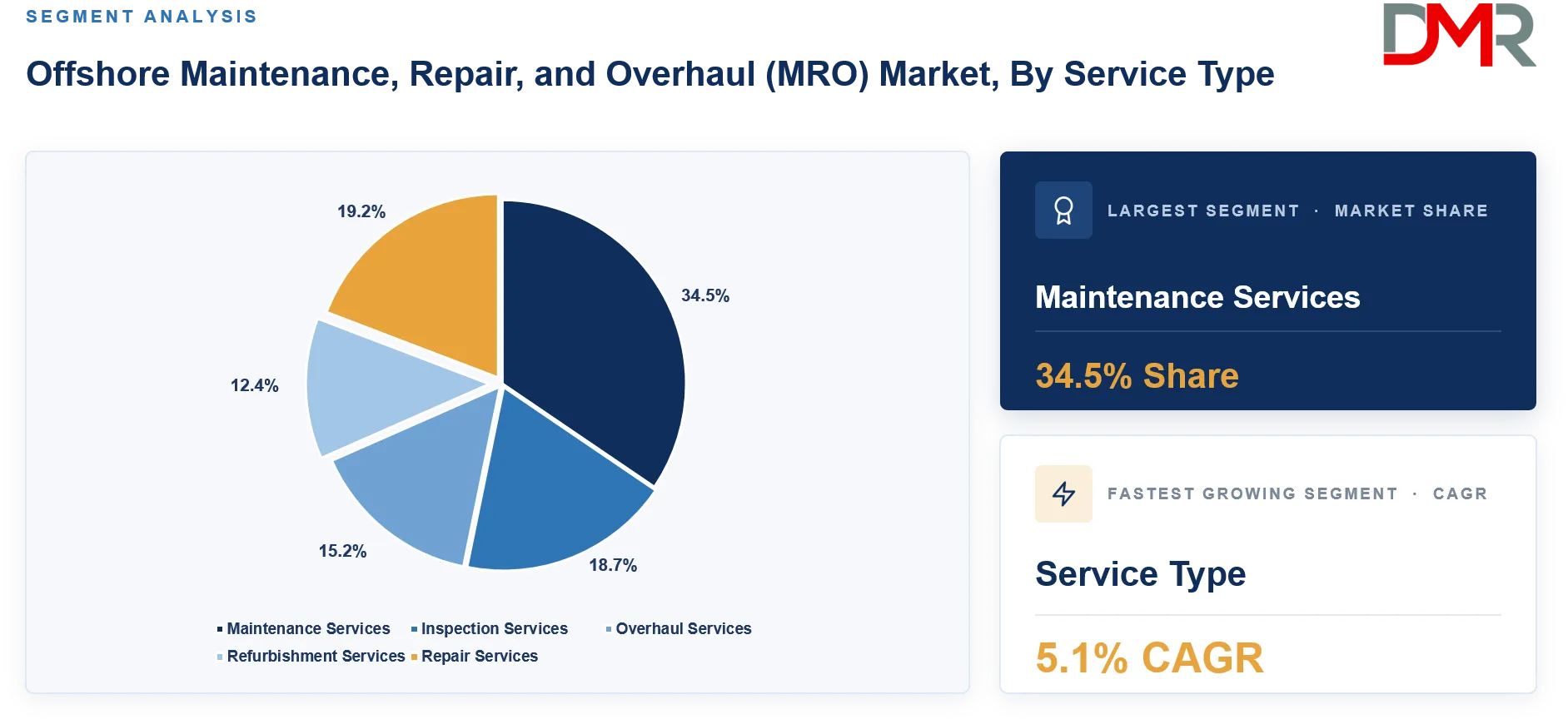
- By Service Type Analysis: Maintenance Services dominated the service type segment with a 34.5% share in 2026.
- By Asset Type Segment Analysis: Offshore Platforms led the asset type segment with a 29.0% share in 2026.
- By Maintenance Type Industry Segment Analysis: Preventive Maintenance held a 36.0% share in 2026.
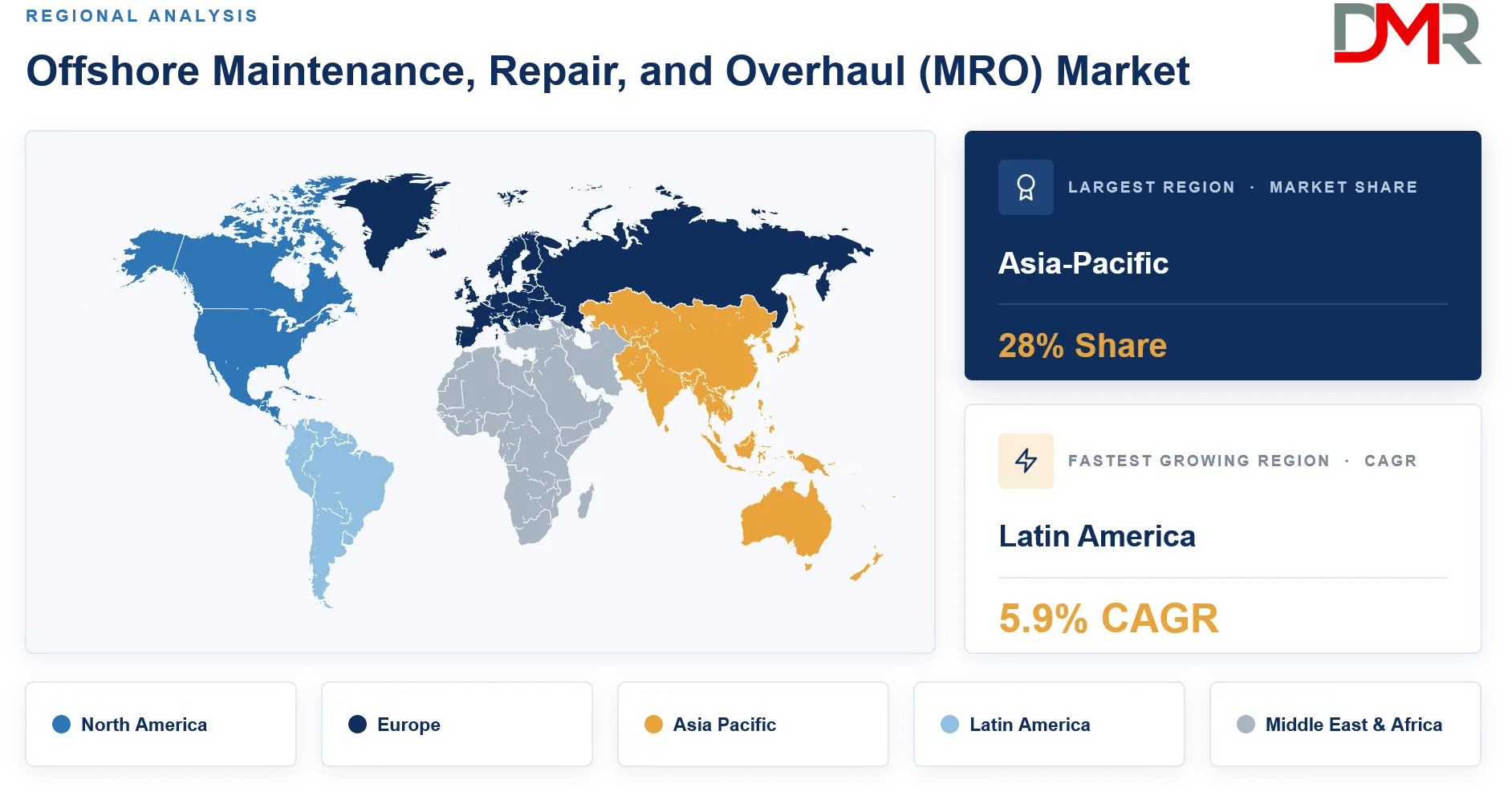
- Regional Analysis: Asia-Pacific led the Global Market with a 28.0% revenue share in 2026.
- Major Players: Vestas Wind Systems A/S, Halliburton Company, Fugro N.V., Baker Hughes Company, and TechnipFMC plc.
What is the Offshore Maintenance, Repair, and Overhaul (MRO) Market and its Market Size?
The Global Offshore Maintenance, Repair, and Overhaul (MRO) Market size is projected to be valued at USD 127.8 billion in 2026 and is expected to reach USD 188.4 billion by 2035, expanding at a CAGR of 4.9% during the forecast period. Offshore MRO covers scheduled maintenance, inspection, repair, component replacement, refurbishment, integrity management, equipment overhaul, and condition monitoring across offshore platforms, drilling rigs, floating production systems, subsea infrastructure, support vessels, and offshore wind assets..
ℹ
To learn more about this report –
Download Your Free Sample Report Here
Demand is tied deeply to the growing value and complexity of offshore assets. Operators must maintain production availability while managing corrosion, fatigue, rotating equipment wear, subsea failures, harsh marine conditions, safety rules, and costly unplanned shutdowns. This creates recurring expenditure throughout the operating life of offshore infrastructure. In 2025, around 40% of global upstream oil and gas investment was directed toward slowing production declines at existing fields, highlighting the commercial importance of maintaining mature producing assets.
Use Cases
- Offshore Platform Asset Integrity: MRO providers inspect structural members, piping, pressure systems, electrical installations, cranes, safety equipment, and rotating machinery on fixed and floating platforms. Integrity programs help operators identify corrosion, fatigue, leaks, and equipment degradation before failures interrupt production or create safety risks.
- Subsea Inspection and Intervention: Operators use ROVs, remotely controlled systems, subsea tooling, sonar, imaging, and condition monitoring to inspect pipelines, manifolds, risers, wellheads, and subsea production equipment. Remote inspection can reduce offshore personnel exposure while supplying near real-time data for repair and intervention planning.
- Offshore Wind Turbine Maintenance: Wind operators require blade inspection, gearbox and generator servicing, foundation inspection, cable monitoring, corrosion control, electrical maintenance, and component replacement. Global offshore wind installations reached 92.5 GW by the end of 2025, increasing the installed asset base requiring long-term operations and maintenance services.
- Production Equipment Overhaul: Offshore oil and gas operators overhaul compressors, pumps, turbines, drilling systems, valves, generators, and production equipment to restore performance and extend service life. Planned overhaul programs reduce the risk of expensive equipment failures and allow operators to coordinate maintenance with scheduled production shutdowns.
- Decommissioning and Life Extension: Aging offshore assets require inspection and engineering studies to determine whether platforms can remain operational, be upgraded, or enter decommissioning. MRO contractors support structural assessment, equipment removal, subsea disconnection, well abandonment preparation, and maintenance activities required to keep assets safe during late-life operations.
How AI/Gen AI is Transforming the Global Offshore Maintenance, Repair, and Overhaul (MRO) Market?
AI-enabled analytics are changing offshore maintenance from fixed schedules toward condition-led decision making. Operators can combine vibration, temperature, pressure, acoustic, corrosion, production, and inspection data to detect abnormal equipment behavior and prioritize intervention. Machine learning can support predictive maintenance for pumps, compressors, turbines, generators, and other rotating equipment where unplanned failure can cause costly downtime. Digital inspection systems also help engineering teams process large volumes of images and sensor data more quickly.
Generative AI is emerging as a support layer for maintenance knowledge management. It can help technicians retrieve procedures, interpret equipment histories, summarize inspection findings, and organize troubleshooting information using approved technical records. The larger transformation, however, comes from combining analytics with remote operations, robotics, ROVs, and uncrewed systems. Fugro, for example, has expanded remote operations capabilities that allow offshore survey and inspection work to be controlled from onshore centers, illustrating how digital workflows are reducing offshore exposure and accelerating access to operational data.
Key Drivers in the Global Offshore Maintenance, Repair, and Overhaul (MRO) Market
Aging Offshore Infrastructure and Asset Life Extension
A large installed base of producing platforms, subsea systems, pipelines, vessels, and drilling assets requires recurring integrity work as equipment ages. Corrosion, structural fatigue, seal degradation, rotating equipment wear, and marine growth increase maintenance requirements over time. Operators seeking to extend field life must invest in inspection, preventive maintenance, replacement parts, repair, and overhaul rather than accept declining reliability. This supports recurring offshore MRO demand across mature producing basins.
Expansion of Offshore Energy Assets
New offshore oil, gas, and wind infrastructure is steadily enlarging the future maintenance base. Global offshore wind capacity reached 92.5 GW at the end of 2025, while more than 50 GW was under construction. GWEC expects approximately 327 GW of additional offshore wind capacity during the following decade. Each new turbine, foundation, cable system, substation, floating structure, and support asset creates recurring inspection and maintenance requirements across a multi-decade operating life.
Restraints in the Global Offshore Maintenance, Repair, and Overhaul (MRO) Market
High Offshore Service and Mobilization Costs
Offshore MRO can require specialist vessels, helicopters, certified technicians, diving teams, ROVs, lifting systems, subsea tools, replacement equipment, and shore-based logistics. Weather windows can delay access and increase vessel days, while deepwater locations add complexity to intervention. These costs encourage operators to bundle maintenance scopes and extend service intervals where technically acceptable, creating pricing pressure for contractors and raising the importance of efficient planning.
Shortage of Specialized Offshore Personnel
Complex offshore assets require technicians with mechanical, electrical, subsea, inspection, marine, wind, and safety qualifications. Competition for experienced personnel can constrain service capacity, particularly as offshore wind and conventional energy projects draw from overlapping technical skill pools. Remote operations can ease some staffing pressure, but field intervention still requires qualified crews. Fugro has noted that remote operations also help address workforce challenges by moving selected offshore roles to onshore centers.
Growth Opportunities in the Global Offshore Maintenance, Repair, and Overhaul (MRO) Market
Remote and Autonomous Inspection Services
Uncrewed surface vessels, electric ROVs, robotics, remote operations centers, and automated inspection tools create a strong opportunity for MRO providers. These systems can reduce vessel size, offshore staffing, mobilization requirements, and personnel exposure while improving access to inspection data. Fugro has demonstrated fully remote subsea inspection programs and states that its Blue Essence and Blue Volta approach can reduce inspection carbon emissions by up to 95% compared with conventional vessel operations.
Offshore Wind Operations and Maintenance
Offshore wind creates a long-duration service opportunity because turbines require regular inspection and maintenance throughout operating life. GWEC forecasts global offshore wind capacity could reach around 420 GW by the end of 2035. Larger turbines and projects farther from shore will increase demand for specialized vessels, remote monitoring, blade services, subsea cable inspection, foundation integrity services, electrical maintenance, and long-term availability agreements.
Trends in the Global Offshore Maintenance, Repair, and Overhaul (MRO) Market
Shift Toward Predictive and Condition-Based Maintenance
Operators are increasingly combining equipment sensors, inspection records, asset history, and operating data to determine maintenance timing. Condition-based maintenance can identify degradation before functional failure, while predictive analytics can estimate when intervention is likely to be required. This approach allows operators to focus labor and spare parts on equipment showing actual risk, improving asset availability and reducing unnecessary scheduled work across remote offshore installations.
Integrated Offshore Service Contracts
Customers are increasingly seeking contractors able to combine inspection, engineering, intervention, subsea support, digital monitoring, repair, and lifecycle services. Integrated contracts reduce interfaces between vendors and give operators clearer accountability for asset performance. Recent activity illustrates this trend. Oceaneering secured a four-year Petrobras contract for two work-class ROV systems, specialized tooling, monitoring, and positioning services offshore Brazil, with operations expected to begin in 2027.
Research Scope and Analysis
The study evaluates the Global Offshore Maintenance, Repair, and Overhaul (MRO) Market across the offshore energy asset lifecycle. It assesses recurring maintenance requirements, inspection and integrity management, equipment repair, refurbishment, overhaul, subsea intervention, digital maintenance technologies, remote operations, vessel-supported services, and late-life asset management. Market demand is examined across conventional offshore oil and gas infrastructure and the expanding offshore wind installed base.
ℹ
To learn more about this report –
Download Your Free Sample Report Here
By Service Type;
Maintenance Services led the service type segment with a 34.5% share in 2026. The segment benefits from recurring scheduled activities required to keep offshore equipment within safe operating limits. Operators routinely service mechanical systems, electrical equipment, production machinery, safety systems, structural components, cranes, pumps, compressors, and auxiliary systems. Maintenance contracts also provide recurring revenue compared with one-time repair work. Growing use of condition monitoring is expanding the segment from calendar-based servicing toward targeted intervention based on equipment health and operating risk.
By Asset Type;
Offshore Platforms led the asset type segment with a 29.0% share in 2026. Platforms contain dense concentrations of production equipment, power systems, structural components, safety equipment, piping, rotating machinery, and accommodation infrastructure that require continuous inspection and servicing. Mature fixed installations add life-extension demand, while floating production assets require marine and production maintenance simultaneously. Offshore platforms also have high downtime costs, making planned integrity programs commercially important for operators seeking production reliability and regulatory compliance.
The Global Offshore Maintenance, Repair, and Overhaul (MRO) Market Report is segmented on the basis of the following:
By Service Type
- Refurbishment Services
- Inspection Services
- Overhaul Services
- Maintenance Services
- Repair Services
By Asset Type
- Offshore Wind Turbines
- Floating Production Systems
- Subsea Equipment
- Offshore Support Vessels
- Offshore Platforms
By Equipment Type
- Safety Equipment
- Rotating Equipment
- Drilling Equipment
- Subsea Equipment
- Electrical Equipment
- Production Equipment
By Maintenance Type
- Condition-Based Maintenance
- Corrective Maintenance
- Preventive Maintenance
- Predictive Maintenance
By Platform Type
- Semi-Submersible Platforms
- Fixed Platforms
- Drillships
- Jack-Up Platforms
- Floating Platforms
By End User
- Energy Service Providers
- Offshore Contractors
- Oil Gas Operators
- Vessel Operators
- Equipment Manufacturers
- Offshore Wind Operators
By Application
- Marine Operations
- Offshore Drilling
- Decommissioning Activities
- Subsea Operations
- Offshore Wind Energy
- Oil Gas Production
Regional Analysis
Asia-Pacific is the Leading Region in the Offshore Maintenance, Repair, and Overhaul (MRO) Market
Asia-Pacific accounted for 28.0% of global revenue in 2026. The region combines mature offshore production infrastructure with expanding deepwater developments and the world's largest offshore wind market. China alone had 48.4 GW of installed offshore wind capacity by the end of 2025 after adding 6.6 GW during the year. Southeast Asia is also advancing deepwater gas projects across Indonesia, Malaysia, and Brunei, increasing future demand for platform, subsea, equipment, and vessel maintenance services.
Latin America is the Fastest-Growing Region in the Global Offshore Maintenance, Repair, and Overhaul (MRO) Market
Latin America offers strong offshore MRO growth potential as Brazil expands pre-salt activity and Guyana develops a rapidly growing deepwater production base. Petrobras invested USD 4.1 billion during the first quarter of 2025, with spending concentrated on pre-salt developments including Búzios and Atapu. Guyana's production is expected to exceed 1.3 million barrels per day by 2027, expanding the regional base of FPSOs, subsea systems, wells, and related assets requiring lifecycle support.
By Region
North America
Europe
- Germany
- France
- The UK
- Italy
- Spain
- Rest of Europe
Asia-Pacific
- China
- Japan
- India
- Australia
- South Korea
- Rest of APAC
Latin America
- Mexico
- Brazil
- Colombia
- Argentina
- Rest of LATAM
Middle East & Africa
- Saudi Arabia
- The UAE
- South Africa
- Rest of MEA
ℹ
To learn more about this report –
Download Your Free Sample Report Here
Major Countries Analysis
China Offshore Maintenance, Repair, and Overhaul (MRO) Market
The China Offshore Maintenance, Repair, and Overhaul (MRO) Market size is projected to be valued at USD 13.4 billion in 2026 and is expected to reach USD 20.8 billion by 2035, expanding at a CAGR of 5.0% during the forecast period.
China represents a major MRO demand center because of its extensive offshore wind fleet and offshore oil and gas infrastructure. The country commissioned 6.6 GW of offshore wind capacity in 2025, taking cumulative capacity to 48.4 GW and approximately 52% of the global offshore wind market. This installed fleet creates recurring demand for turbine servicing, blade inspection, cable monitoring, electrical maintenance, foundation integrity work, support vessels, remote diagnostics, and component replacement throughout project operating life.
Brazil Offshore Maintenance, Repair, and Overhaul (MRO) Market
The Brazil Offshore Maintenance, Repair, and Overhaul (MRO) Market size is projected to be valued at USD 7.8 billion in 2026 and is expected to reach USD 12.1 billion by 2035, expanding at a CAGR of 5.0% during the forecast period.
Brazil is an important offshore MRO market due to its large deepwater and pre-salt production system. Petrobras continues to invest in Santos Basin projects, creating service requirements across FPSOs, subsea production systems, risers, wells, pipelines, ROV operations, and production equipment. Technology adoption is also advancing. Petrobras has contracted remote subsea inspection services from Fugro and a four-year ROV service program from Oceaneering, highlighting demand for digitally enabled inspection and intervention capabilities.
Competitive Landscape
The Global Offshore Maintenance, Repair, and Overhaul (MRO) Market has a diverse competitive structure spanning integrated oilfield service companies, subsea engineering specialists, marine contractors, inspection companies, wind turbine manufacturers, equipment service providers, and regional maintenance firms. Halliburton, Baker Hughes, SLB, TechnipFMC, Subsea7, Saipem, Aker Solutions, Oceaneering, and Weatherford compete around offshore engineering, equipment support, subsea services, intervention, and production optimization. Fugro has differentiated its position through remote operations, uncrewed inspection systems, Geo-data, and asset integrity services.
Vestas, Siemens Gamesa, and GE Vernova bring turbine OEM expertise into offshore wind maintenance. Competitive advantage increasingly depends on installed technical capability, regional vessel access, qualified personnel, digital monitoring, subsea robotics, long-term operator relationships, safety performance, response time, and the ability to deliver integrated lifecycle services rather than individual maintenance tasks.
Some of the prominent players in the Global Offshore Maintenance, Repair, and Overhaul (MRO) Industry are:
- Vestas Wind Systems A/S
- JOME Engineering L.L.C.
- Halliburton Company
- Crystal Offshore Pte. Ltd.
- Fugro N.V.
- Siemens Gamesa Renewable Energy, S.A.
- EnerMech Ltd
- Baker Hughes Company
- Middle East Maritime Repair
- TechnipFMC plc
- Allrig Group
- Subsea7 S.A.
- GE Vernova Inc.
- OCS Services Pte. Ltd.
- Weatherford International plc
- Aker Solutions ASA
- International Maritime Industries
- SLB
- Oceaneering International, Inc.
- Saipem S.p.A.
- Others
Regulatory Landscape
The regulatory landscape of the Global Offshore Maintenance, Repair, and Overhaul (MRO) Market is shaped by strict requirements for asset integrity, worker safety, environmental protection, equipment certification, and offshore operational reliability. In the United States, offshore operators must comply with Bureau of Safety and Environmental Enforcement requirements covering production safety systems, inspections, well operations, and facility integrity. European offshore operations are influenced by national safety regulators and the EU Offshore Safety Directive, while the United Kingdom applies goal-setting offshore safety rules through the Health and Safety Executive.
Classification organizations such as DNV and ABS also establish technical standards for offshore structures, vessels, machinery, electrical systems, and floating assets. These requirements support recurring demand for certified inspections, preventive maintenance, corrosion management, equipment testing, repair, and integrity verification. As offshore wind, deepwater production, and aging infrastructure expand, compliance is becoming a larger component of lifecycle MRO planning and contractor selection.
Technology Analysis
Technology adoption in the Global Offshore Maintenance, Repair, and Overhaul (MRO) Market is shifting maintenance from labor-intensive scheduled work toward connected, condition-based, and remotely supported operations. Operators increasingly deploy vibration sensors, acoustic monitoring, thermal imaging, corrosion sensors, digital twins, ROVs, drones, uncrewed surface vessels, and equipment analytics to identify degradation before critical assets fail. Fugro's remote operations model demonstrates this transition by combining onshore control centers with remotely operated offshore inspection assets, reducing the need to place personnel offshore for selected activities.
Predictive maintenance platforms can analyze equipment condition across pumps, compressors, turbines, generators, electrical systems, and subsea assets, allowing intervention to be prioritized around actual operating risk. Robotics and remote inspection are particularly valuable for subsea infrastructure and offshore wind assets where physical access is expensive. These technologies are expanding demand for data-led MRO services while helping operators improve uptime, safety, maintenance planning, and asset lifecycle performance.
Recent Developments
- July 2026: Fugro N.V. secured a contract from Saipem to provide integrated marine survey and inspection services for the UK's Northern Endurance Partnership, the country's first offshore CO₂ transportation and storage infrastructure project.
- March 2026: Baker Hughes Company signed a 60-month strategic service agreement with Petrobras to deliver maintenance, repairs, and engineering advisory services for up to 64 aeroderivative gas turbines supporting Brazil's offshore FPSO vessels and refinery operations.
- January 2026: Oceaneering International, Inc. secured a four-year extension to its inspection support contract for multiple Equinor assets in Norway, covering in-service inspection, NDT, advanced NDT, and rope access services beginning January 1, 2026.
| Report Characteristics |
| Market Size (2026) |
USD 127.8 Bn |
| Forecast Value (2035) |
USD 188.4 Bn |
| CAGR (2026-2035) |
4.9% |
| The US Market Size (2026) |
USD 25.7 Bn |
| Historical Data |
2021 - 2025 |
| Forecast Data |
2026 - 2035 |
| Base Year |
2025 |
| Segments Covered |
By Service Type, By Asset Type, By Equipment Type, By Maintenance Type, By Platform Type, By End User and By Application |
| Regional Coverage |
North America - The US and Canada; Europe - Germany, France, The UK, Italy, Spain, Norway, Rest of Europe; Asia-Pacific - China, Japan, India, Australia, South Korea, Singapore, Rest of APAC; Latin America - Mexico, Brazil, Colombia, Argentina, Guyana, Rest of LATAM; Middle East & Africa - Saudi Arabia, The UAE, Qatar, Nigeria, Angola, South Africa, Rest of MEA |
Frequently Asked Questions
What is the current size of the Offshore Maintenance, Repair, and Overhaul (MRO) Market?
▾ The Offshore MRO Market size is valued at USD 127.8 billion in 2026 and is forecast to reach USD 188.4 billion by 2035.
What is the growth rate of the Offshore Maintenance, Repair, and Overhaul (MRO) Market during?
▾ The Offshore MRO Market is expected to grow at a CAGR of 4.9% during the forecast period from 2026 to 2035.
Which region dominates the Global Offshore Maintenance, Repair, and Overhaul (MRO) Market?
▾ Asia-Pacific leads the Global Offshore MRO Market with a 28.0% revenue share in 2026, supported by offshore assets.
What factors are driving the growth of the Offshore Maintenance, Repair, and Overhaul (MRO) Market?
▾ Aging offshore assets, offshore wind expansion, and preventive maintenance are driving Offshore MRO Market growth.
What are the major challenges restraining the Offshore Maintenance, Repair, and Overhaul (MRO) Market?
▾ High service costs, weather risks, skilled labor shortages, and complex logistics restrain Offshore MRO Market growth.
Which segment holds the largest share of the Offshore Maintenance, Repair, and Overhaul (MRO) Market?
▾ Maintenance Services lead the Offshore MRO Market service type segment with a 34.5% revenue share during 2026.
Who are the leading companies in the Offshore Maintenance, Repair, and Overhaul (MRO) Market?
▾ Vestas Wind Systems A/S, JOME Engineering L.L.C., Halliburton Company, Crystal Offshore Pte. Ltd., Fugro N.V., Siemens Gamesa Renewable Energy, S.A., EnerMech Ltd, Baker Hughes Company, Middle East Maritime Repair, TechnipFMC plc, Allrig Group, Subsea7 S.A., GE Vernova Inc., OCS Services Pte. Ltd., Weatherford International plc, Aker Solutions ASA, International Maritime Industries, SLB, Oceaneering International, Inc., and Saipem S.p.A. are leading companies in the Offshore MRO Market.
How is AI influencing the Offshore Maintenance, Repair, and Overhaul (MRO) Market?
▾ AI supports predictive maintenance, fault detection, remote inspection, and asset monitoring across the Offshore MRO Market.
What are the future opportunities and trends in the Offshore Maintenance, Repair, and Overhaul (MRO) Market?
▾ Offshore wind, robotics, remote inspection, digital twins, and predictive services offer Offshore MRO Market opportunities.