Global Offshore Oil & Gas Communication Market Snapshot
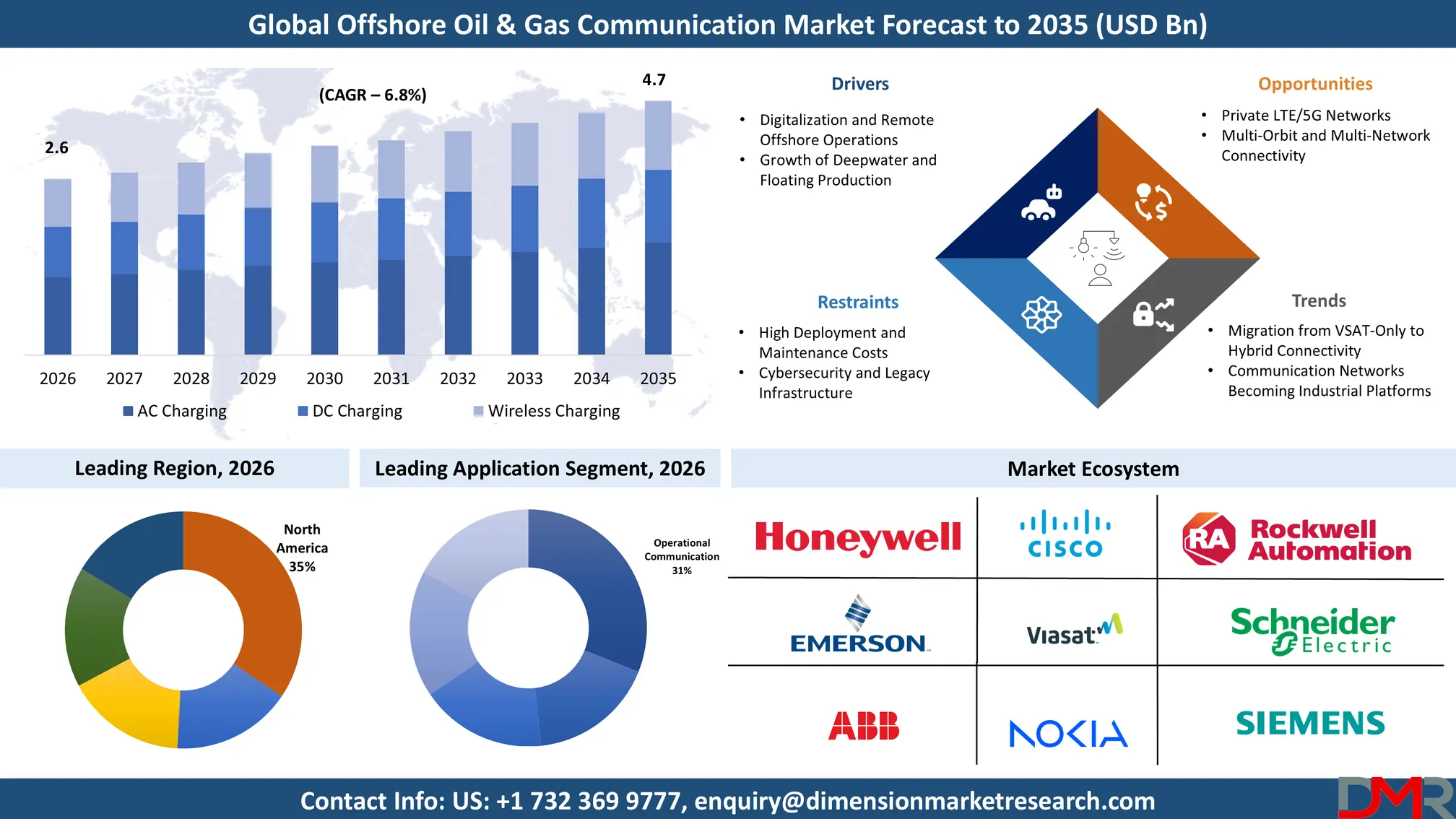
- Global Offshore Oil & Gas Communication Market Size in 2026: USD 2.6 Billion
- Global Offshore Oil & Gas Communication Market Size in 2035: USD 4.7 Billion
- Global CAGR from 2026 to 2035: 6.8%
- Leading Offering Segment: Hardware, 55%
- Leading Communication Technology: VSAT / Satellite Communication, 40%
- Leading Offshore Asset: Fixed Platforms, 41%
- Fastest-Growing Segment: Private LTE/5G, 8.5% CAGR
- Leading Region: North America, 35%
- Fastest-Growing Region: Asia-Pacific, 8.0% CAGR
What is the Global Offshore Oil & Gas Communication and its Market Size?
The global Offshore Oil & Gas Communication Market encompasses the hardware, software, connectivity networks and managed services required to maintain reliable voice, data, video, safety and operational communications between offshore assets and onshore control centers. It includes satellite communication, VSAT, radio, microwave, fiber-optic links, cellular connectivity, private LTE/5G, communication gateways, antennas, modems, network-management software, cybersecurity and integration services.
ℹ
To learn more about this report –
Download Your Free Sample Report Here
The Offshore Oil & Gas Communication Market is estimated at approximately USD 2.6 billion in 2026 and is projected to reach about USD 4.7 billion by 2035, representing a CAGR of approximately 6.8%. The forecast reflects continuing digitalization of offshore operations, greater use of real-time monitoring, remote-control systems, industrial IoT, predictive maintenance and increasingly connected offshore workforces.
The market is transitioning from standalone voice and VSAT systems toward hybrid communication architectures. Offshore operators increasingly combine satellite links with private cellular networks, fiber, microwave and other terrestrial or near-terrestrial technologies to improve resilience and support bandwidth-intensive applications. Current deployments demonstrate this shift: Nokia and Tampnet are expanding private 5G capabilities across offshore infrastructure in the Gulf of Mexico, while SES is providing satellite connectivity for new Petrobras FPSOs in Brazil.
Use Cases
- Operational Communication: Connects offshore personnel with onshore control centers for daily production and engineering activities.
- Safety & Emergency Communication: Provides resilient voice, alarm, distress and emergency communications during incidents.
- Remote Monitoring & Surveillance: Transmits video, sensor and equipment data for centralized monitoring and diagnostics.
- Industrial IoT Connectivity: Connects thousands of sensors supporting predictive maintenance and production optimization.
- Crew Welfare Communication: Provides internet, voice, video and entertainment connectivity for offshore personnel.
- Remote Operations: Enables engineers and specialists to supervise or control equipment without being physically offshore.
Key Takeaways
- Market Growth: The market is estimated at approximately USD 2.6 billion in 2026 and is forecast to approach USD 4.7 billion by 2035.
- Primary Drivers: Offshore digitalization, deepwater development, remote operations, industrial IoT, safety requirements and cybersecurity are the principal growth engines.
- Segment Leadership: Hardware remains the largest offering category, while satellite/VSAT continues to provide the broadest offshore coverage.
- Fastest Growth: Private LTE/5G is expected to be among the fastest-growing communication technologies as operators seek low-latency, deterministic connectivity.
- Regional Leadership: North America remains the largest market because of its extensive Gulf of Mexico offshore infrastructure, while Asia-Pacific offers stronger incremental growth potential.
- Technology Direction: The market is moving toward multi-network architectures combining GEO/MEO/LEO satellite, fiber, microwave and private cellular connectivity.
How 5G, IoT, Edge Computing and LEO Satellite Technology are Transforming Offshore Oil & Gas Communication Market?
Private 5G and LTE are transforming offshore networks by providing dedicated, controlled wireless connectivity for production equipment, workers, sensors, autonomous systems and video applications. Nokia and Tampnet are extending private 5G infrastructure across offshore platforms, rigs, FPSOs and vessels, demonstrating the transition from conventional offshore wireless networks toward industrial-grade cellular connectivity.
LEO/MEO satellite systems and multi-orbit architectures are improving bandwidth, latency and resilience. SES, for example, is deploying O3b mPOWER connectivity for Petrobras FPSOs, while its offshore energy offering combines high-performance satellite connectivity with managed network services.
The competitive impact is significant. Communications are increasingly becoming a digital infrastructure layer rather than a standalone utility. Vendors compete on latency, uptime, cybersecurity, interoperability, managed-service capabilities and integration with cloud, edge computing, SCADA and industrial IoT platforms.
Key Drivers in the Global Offshore Oil & Gas Communication Market
Digitalization and Remote Offshore Operations
Offshore operators are increasingly using digital technologies to increase production efficiency while reducing unnecessary offshore intervention. Communication networks have consequently become essential infrastructure for transmitting equipment telemetry, video, SCADA information, environmental data and production intelligence to centralized control rooms. Remote engineering and predictive maintenance depend on continuous connectivity, particularly as operators seek to minimize helicopter trips, vessel visits and offshore personnel requirements.
Growth of Deepwater and Floating Production
The continued development of deepwater resources in Brazil, Guyana, the Gulf of Mexico and other offshore basins supports demand for communication infrastructure. FPSOs and other floating assets require highly resilient communications because their location, orientation and operating conditions can change continuously.
Restraints in the Global Offshore Oil & Gas Communication Market
High Deployment and Maintenance Costs
Offshore communication equipment must withstand saltwater, vibration, extreme weather, hazardous areas and difficult maintenance conditions. Installing fiber, microwave links, satellite terminals or private cellular infrastructure can therefore involve significant engineering, transportation and certification costs. Equipment failures may also require helicopter or vessel intervention, substantially increasing lifecycle costs.
Cybersecurity and Legacy Infrastructure
Offshore operators frequently maintain a mixture of legacy radios, proprietary networks, industrial control systems and modern IP-based networks. Connecting these environments increases cybersecurity exposure and complicates network management. Operators must protect safety-critical OT networks without interrupting production.
Growth Opportunities in the Global Offshore Oil & Gas Communication Market
Private LTE/5G Networks
Private cellular networks represent one of the strongest long-term opportunities. They can provide deterministic performance, network segmentation, mobility and better control than conventional Wi-Fi systems. Applications include connected workers, industrial cameras, autonomous vehicles, sensors, drones and remote-control systems.
Multi-Orbit and Multi-Network Connectivity
A major white space is the integration of GEO, MEO and LEO satellites with fiber, microwave and cellular networks. Instead of relying on a single communication path, operators can dynamically select the best available connection based on latency, cost, bandwidth and reliability
Trends in the Global Offshore Oil & Gas Communication Market
Migration from VSAT-Only to Hybrid Connectivity
Traditional VSAT remains important because satellite coverage is essential beyond terrestrial infrastructure. However, operators increasingly supplement VSAT with LEO, MEO, fiber, microwave and private cellular networks. The objective is not simply higher bandwidth but greater redundancy and application-specific performance.
Communication Networks Becoming Industrial Platforms
Communication infrastructure is increasingly being integrated with edge computing, cloud applications, digital twins, AI and industrial IoT. This changes procurement from buying radios or terminals to buying an integrated connectivity-and-digitalization platform.
Research Scope and Analysis
The market is analyzed by Offering, Communication Technology, Offshore Asset, Application and End User. The segmentation captures both physical communication infrastructure and recurring connectivity/managed-service revenue across fixed, floating and mobile offshore oil and gas assets.
ℹ
To learn more about this report –
Download Your Free Sample Report Here
By Offering Analysis
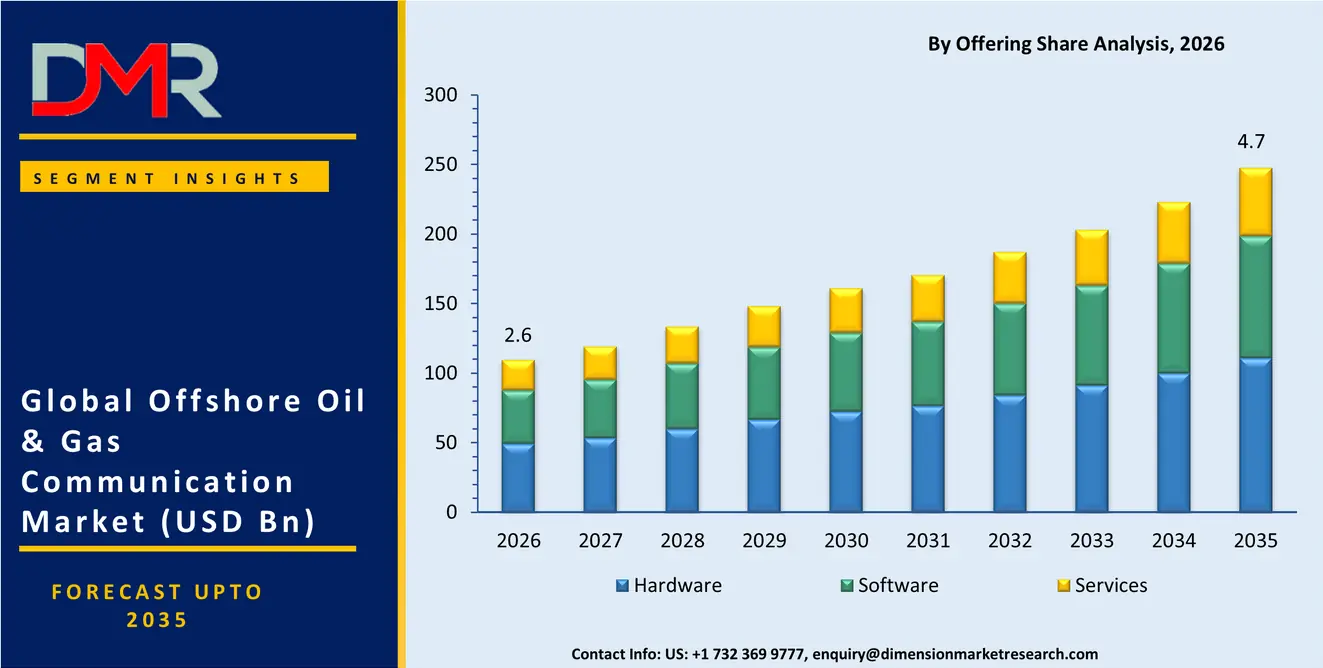
Hardware is estimated to remain the dominant offering in 2026, representing approximately 55% of market revenue. Hardware includes radios, antennas, satellite terminals, modems, gateways and communication infrastructure and benefits from replacement cycles, new offshore developments and modernization projects. Services represent the second-largest category at approximately 28%, supported by installation, systems integration, maintenance and managed communication services. Software accounts for roughly 17%, but is expected to be the fastest-growing component at approximately 8% CAGR, as network management, cybersecurity, analytics and orchestration become increasingly important. The shift toward software-defined networks and managed connectivity should gradually increase recurring revenue relative to one-time equipment sales. Managed services are particularly attractive where offshore operators lack specialist communications personnel and want vendors to assume responsibility for network availability, monitoring and optimization.
ℹ
To learn more about this report –
Download Your Free Sample Report Here
By Communication Technology Analysis
Satellite/VSAT communication remains the largest technology category, accounting for approximately 40% of the 2026 market. Its dominance reflects the geographic isolation of offshore platforms and the ability of satellite networks to provide connectivity where terrestrial infrastructure is unavailable. Radio communication represents approximately 18%, particularly for voice, emergency and operational communication. Microwave contributes approximately 14% and remains important where multiple offshore assets are geographically clustered. Fiber-optic communication represents approximately 15%, with demand concentrated around connected offshore fields and platforms with feasible subsea cable infrastructure. Cellular and private LTE/5G account for approximately 13% but represent the fastest-growing category, with an estimated 8.5% CAGR. Private cellular networks are gaining momentum because they provide controlled coverage, mobility, low latency and support for industrial IoT and automation.
By Offshore Asset Analysis
Fixed platforms remain the largest asset category, representing approximately 41% of 2026 market revenue. Their installed base, long operating lives and recurring equipment-replacement requirements create stable communication demand. Floating production systems/FPSOs represent approximately 25% and are expected to record the fastest growth at approximately 8% CAGR, supported by deepwater developments in Brazil, Guyana and other emerging offshore regions. Drilling rigs account for around 16%, while offshore support vessels contribute about 12%. Subsea infrastructure represents the remaining approximately 6% but has attractive long-term potential as subsea sensors, autonomous systems and fiber-optic monitoring become more widely adopted. The growing number of FPSOs is particularly important because floating assets require resilient communications that can accommodate mobility, changing vessel orientation and remote locations.
By Application Analysis
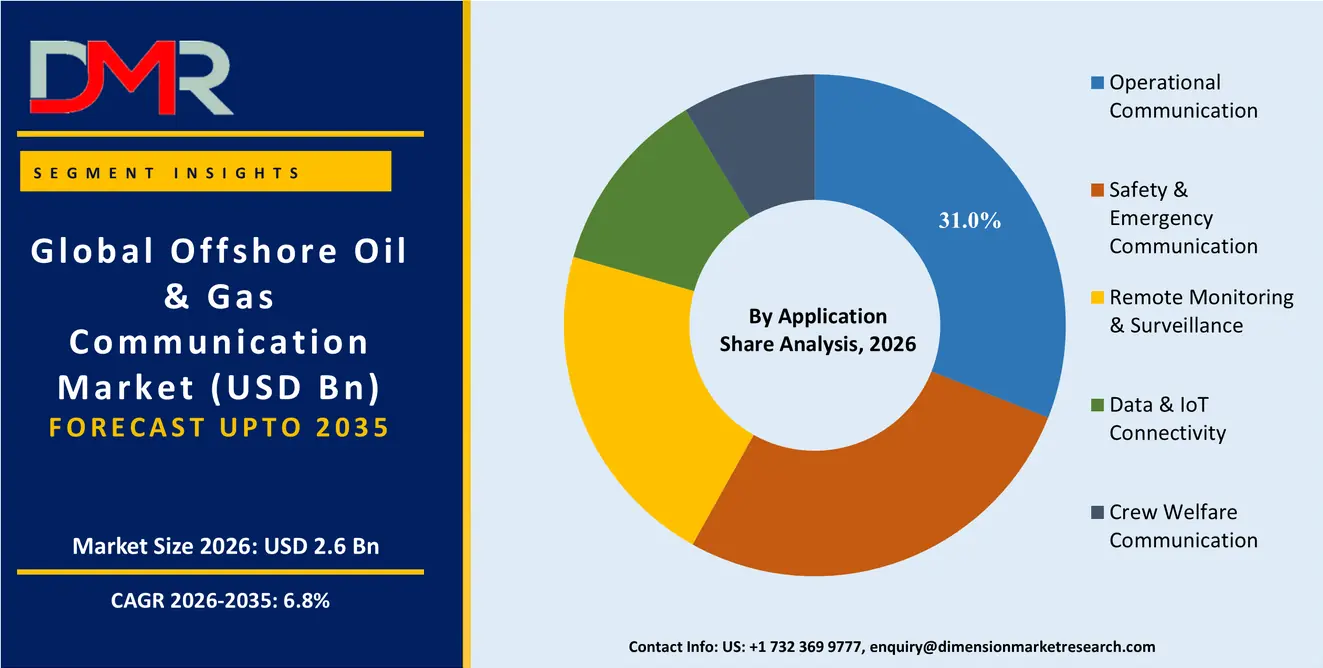
Operational communication is estimated to hold the largest share at approximately 31%, encompassing production coordination, engineering, logistics and communication between offshore and onshore teams. Safety and emergency communication follows at around 23%, reflecting mandatory requirements for reliable emergency voice, alarms, distress systems and personnel communications. Remote monitoring and surveillance represents approximately 19% and is growing rapidly as video analytics, drones and remote inspections become more prevalent. Data and IoT connectivity accounts for approximately 17% and is expected to achieve the highest growth rate, around 9% CAGR, because sensors and connected equipment are expanding across offshore installations. Crew welfare communication contributes roughly 10%, but remains strategically important because operators increasingly regard reliable connectivity as a workforce-retention and employee-welfare benefit.
By End User Analysis
Oil & Gas Exploration & Production Companies represent the largest end-user category, with approximately 48% of spending. These operators control large offshore portfolios and therefore require integrated communications across platforms, FPSOs, drilling units and onshore control centers. Offshore drilling contractors account for roughly 21%, driven by rig communication requirements and contracts that increasingly include digital monitoring. Offshore support and marine service providers represent around 17%, with demand for fleet connectivity, vessel tracking and crew communications. Oilfield service companies contribute approximately 14% and use communications for remote equipment monitoring, subsea operations, field services and data transfer. Across all end users, the purchasing model is gradually moving from individual equipment procurement toward integrated connectivity contracts covering hardware, bandwidth, cybersecurity, monitoring and maintenance.
The Global Offshore Oil & Gas Communication Market Report is segmented on the basis of the following:
By Offering
- Hardware
- Radios & Walkie-Talkies
- Antennas & Communication Equipment
- Satellite Communication Terminals
- Modems & Gateways
- Software
- Services
- Installation & Integration
- Maintenance & Support
- Managed Communication Services
By Communication Technology
- Satellite Communication
- Radio Communication
- Microwave Communication
- Fiber Optic Communication
- Cellular & Private LTE/5G
By Offshore Asset
- Fixed Platforms
- Floating Production Systems
- Drilling Rigs
- Offshore Support Vessels
- Subsea Infrastructure
By Application
- Operational Communication
- Safety & Emergency Communication
- Remote Monitoring & Surveillance
- Data & IoT Connectivity
- Crew Welfare Communication
By End User
- Oil & Gas Exploration & Production Companies
- Offshore Drilling Contractors
- Offshore Support & Marine Service Providers
- Oilfield Service Companies
Regional Analysis
North America is the Leading Region in the Global Offshore Oil & Gas Communication Market
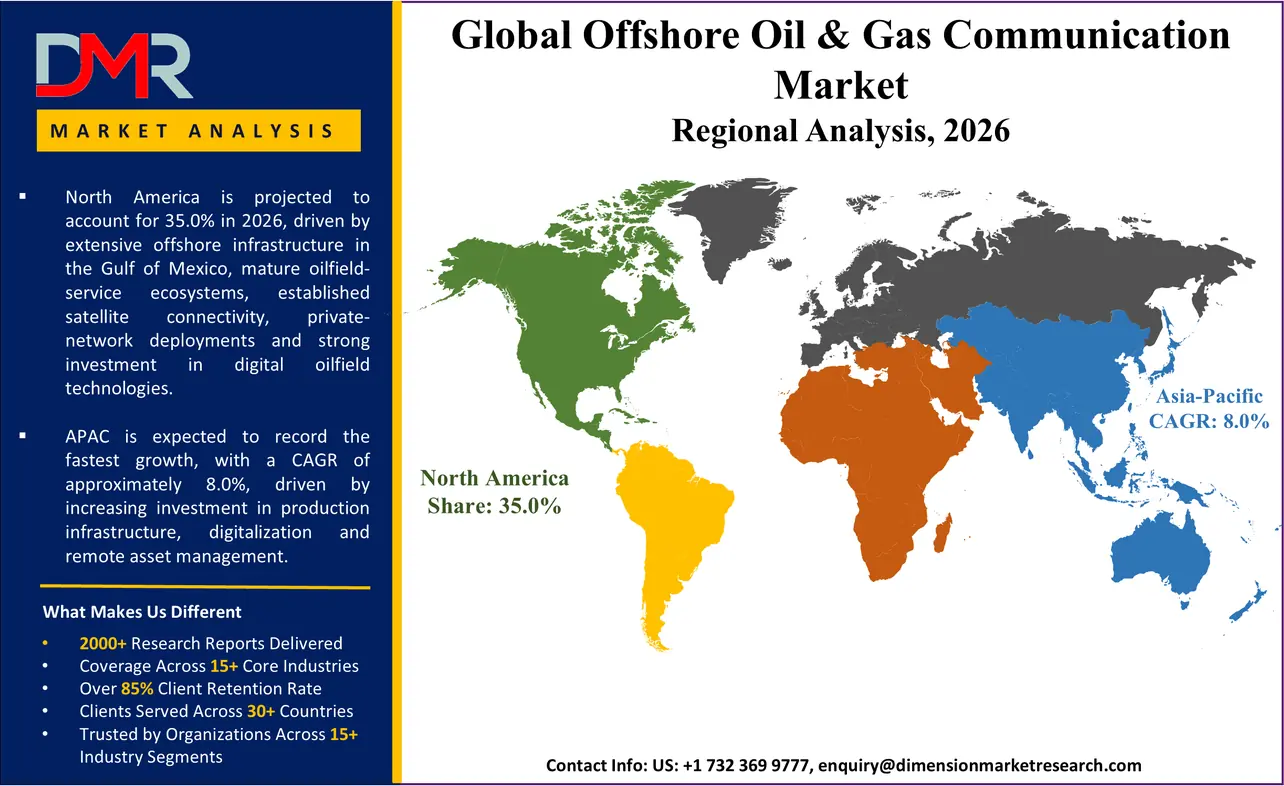
North America is estimated to lead the global market in 2026 with approximately 35% share, equivalent to around USD 0.9 billion. The region benefits from extensive offshore infrastructure in the Gulf of Mexico, mature oilfield-service ecosystems, established satellite connectivity, private-network deployments and strong investment in digital oilfield technologies. North American operators have substantial experience integrating offshore assets with centralized control systems, making them early adopters of higher-bandwidth connectivity, industrial IoT and remote monitoring. Technavio also identifies North America as the leading contributor to market growth in its offshore communication analysis.
ℹ
To learn more about this report –
Download Your Free Sample Report Here
Asia Pacific is the Fastest-Growing Region in the Global Offshore Oil & Gas Communication Market
Asia-Pacific is projected to be the fastest-growing regional market, with an estimated 8.0% CAGR through 2035. China, Southeast Asia, India, Australia and other offshore-producing markets are increasing investment in production infrastructure, digitalization and remote asset management. Offshore platforms in geographically dispersed locations require satellite and hybrid connectivity, while newer facilities provide opportunities to deploy private LTE/5G from the outset.
The Europe Offshore Oil & Gas Communication Market
The European market is estimated at approximately USD 0.55 billion in 2026 and could reach approximately USD 0.82 billion by 2035, representing a CAGR of about 4.5%. Norway and the North Sea remain important centers of offshore technology development. European operators are increasingly combining private wireless, subsea fiber, satellite connectivity and automation. Norway's NORSOK standards include specific telecommunications requirements for offshore installations, including NORSOK T-101:2023 and T-003:2019.
Latin America Offshore Oil & Gas Communication Market
Latin America is estimated at approximately USD 0.38 billion in 2026 and is projected to reach around USD 0.72 billion by 2035, representing approximately 7.3% CAGR. Brazil is the principal growth engine because of deepwater and pre-salt development. Petrobras' planned FPSO expansion is creating direct demand for satellite and managed connectivity solutions. SES's 2026 agreement to connect seven Petrobras FPSOs illustrates the scale of future connectivity requirements
MEA Offshore Oil & Gas Communication Market
MEA is estimated at approximately USD 0.40 billion in 2026 and could reach approximately USD 0.76 billion by 2035, representing approximately 7.4% CAGR. Saudi Arabia, the UAE, Qatar and offshore African producers are investing in production capacity, digital oilfields and connected infrastructure. Offshore Africa also creates demand for resilient satellite communications where terrestrial infrastructure is limited. Current oilfield spending expectations indicate continued growth in offshore Africa even as some other producing regions experience more cautious capital allocation.
Major Countries Analysis
United States Offshore Oil & Gas Communication Market
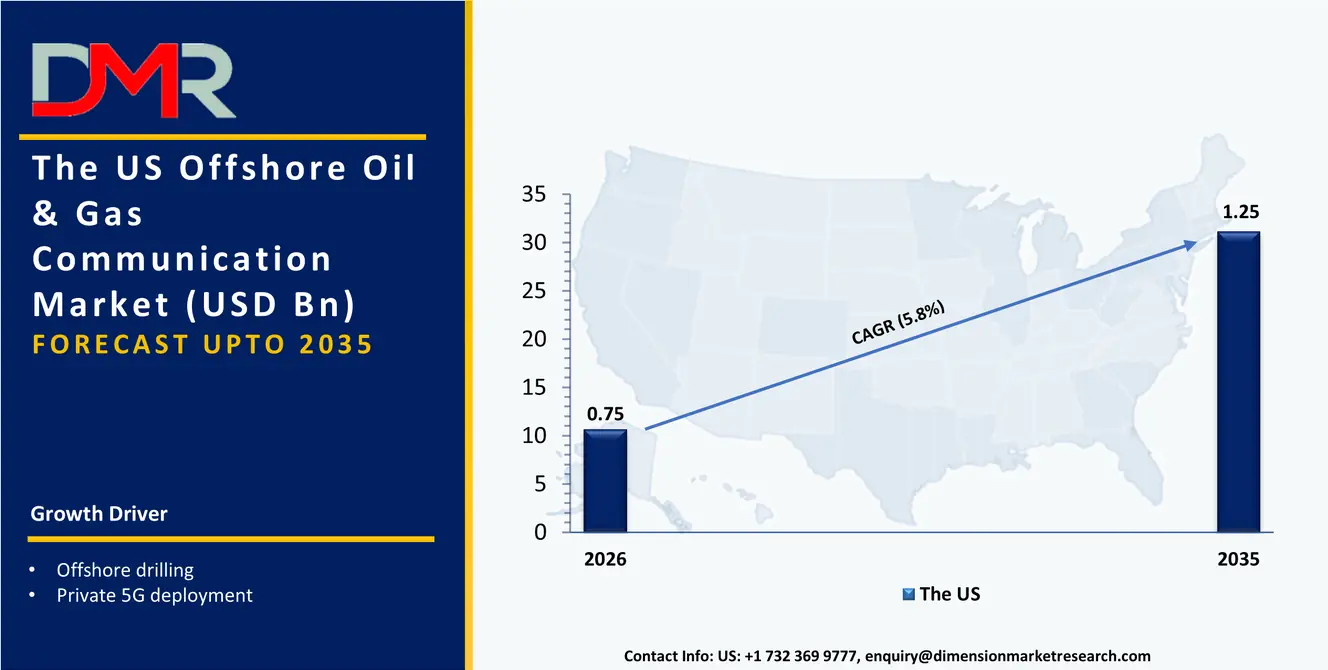
The U.S. offshore oil and gas communications market is estimated at approximately USD 0.75 billion in 2026 and is projected to reach about USD 1.25 billion by 2035, representing approximately 5.8% CAGR. Gulf of Mexico production, offshore drilling, private 5G deployment and digitalization support demand. Nokia and Tampnet's offshore 5G expansion demonstrates increasing adoption of industrial cellular technology across Gulf assets.
ℹ
To learn more about this report –
Download Your Free Sample Report Here
Japan Offshore Oil & Gas Communication Market
Japan's market is comparatively smaller and is estimated at approximately USD 0.10 billion in 2026, reaching around USD 0.14 billion by 2035, or roughly 4.0% CAGR. Demand is supported by offshore energy infrastructure, maritime communications, advanced monitoring, disaster resilience and technology-intensive engineering. Japan's industrial capabilities also support adoption of advanced sensors, satellite communications and remote monitoring technologies.
Saudi Arabia Offshore Oil & Gas Communication Market
Saudi Arabia's offshore communication market is estimated at approximately USD 0.13 billion in 2026 and is projected to approach USD 0.27 billion by 2035, representing roughly 8.2% CAGR. Expansion of offshore gas and oil infrastructure, digital transformation initiatives, private wireless networks and modernization of industrial communications should support growth. Saudi Arabia is also emerging as an important market for private cellular connectivity across energy infrastructure.
Regulatory Landscape
Offshore communication systems operate within a complex combination of telecommunications, maritime, electrical, cybersecurity and hazardous-area regulations. Equipment installed on offshore petroleum facilities must account for hazardous-area requirements, with IEC 61892-7 providing requirements for hazardous-area classification and electrical equipment on mobile and fixed offshore petroleum units.
Norway's NORSOK telecommunications standards provide another important regional framework for offshore installations. Spectrum licensing, satellite regulations, radio standards, maritime safety requirements and national cybersecurity rules also influence network architecture. As offshore OT systems become increasingly connected, cybersecurity requirements are becoming more influential in equipment selection, network segmentation, monitoring and managed-service procurement.
Investment and White Space Analysis
The strongest investment opportunities are emerging in private LTE/5G, multi-orbit satellite connectivity, managed cybersecurity, edge computing and communication-as-a-service. Asia-Pacific, Brazil, Guyana, offshore Africa and the Middle East represent attractive geographic opportunities because new offshore developments can incorporate modern communication architectures without being constrained by legacy infrastructure.
FPSOs are particularly attractive because they require mobile, resilient connectivity and often operate far from terrestrial networks. Additional white spaces include low-power communication for subsea sensors, autonomous offshore vehicles, drone communications, AI-enabled network management and integrated communication/cybersecurity services.
By Region
North America
Europe
- Germany
- France
- The U.K.
- Italy
- Spain
- Rest of Europe
Asia-Pacific
- China
- Japan
- India
- Australia
- South Korea
- Rest of APAC
Latin America
- Mexico
- Brazil
- Rest of LATAM
Middle East & Africa
- Saudi Arabia
- The UAE
- South Africa
- Rest of MEA
Competitive Landscape
The Offshore Oil & Gas Communication Market is moderately fragmented, combining large telecommunications and satellite companies with specialist offshore network operators, equipment manufacturers, system integrators and managed-service providers. Competition is based on network availability, bandwidth, latency, cybersecurity, geographical coverage, integration capability, lifecycle cost and ability to operate in hazardous environments. Major vendors increasingly pursue partnerships rather than competing solely through individual products. Nokia and Tampnet's offshore 5G collaboration illustrates the partnership model, while satellite providers are expanding managed multi-orbit services and integrating connectivity under a single commercial offering.
Some of the prominent players in the Global Offshore Oil & Gas Communication Market are:
- Siemens
- ABB
- Honeywell
- Emerson Electric
- Schneider Electric
- Rockwell Automation
- Yokogawa Electric
- Cisco Systems
- Nokia
- Motorola Solutions
- Huawei
- Kongsberg Gruppen
- Saab
- Thales Group
- Rohde & Schwarz
- Harris Corporation
- Viasat
- Inmarsat
- Iridium Communications
- KVH Industries
- Marlink
- Speedcast
- NSSLGlobal
- SES
- Eutelsat Group
- Intelsat
- Hughes Network Systems
- Teledyne Technologies
- L3Harris Technologies
- Baker Hughes
- SLB
- Halliburton
- Weatherford International
- TechnipFMC
- Saipem
- Subsea 7
- Aker Solutions
- Oceaneering International
- Fugro
- Kongsberg Digital
- Other Key Players
Recent Developments
- May 2026: SES announced an agreement to provide O3b mPOWER satellite connectivity to seven new Petrobras FPSOs scheduled to enter operation in Brazil between 2026 and 2030, supporting high-performance offshore communications.
- December 2025: Nokia and Tampnet announced a partnership to expand private 5G offshore connectivity across the Gulf of Mexico, targeting platforms, rigs, FPSOs, vessels and other offshore infrastructure.
- December 2025: Inmarsat Maritime announced the next phase of its NexusWave connectivity service, incorporating the expected capacity of ViaSat-3 satellites and a new-generation maritime terminal to increase bandwidth and performance.
- December 2025: Inmarsat Maritime demonstrated the capabilities of its NexusWave bonded connectivity service, achieving maximum download speeds of approximately 330–340 Mbps and network availability above 99.99% during real-world testing.
- February 2025: SES announced the deployment of O3b mPOWER connectivity for a Viasat Energy Services customer operating an FPSO in Asia-Pacific, marking the first Viasat Energy adoption of MEO satellite technology in the region.
Report Details
| Report Characteristics |
| Market Size (2026) |
USD 2.6 Bn |
| Forecast Value (2035) |
USD 4.7 Bn |
| CAGR (2026–2035) |
6.8% |
| Historical Period |
2021 – 2025 |
| Forecast Period |
2027 – 2035 |
| Base Year |
2025 |
| Estimate Year |
2026 |
| Segments Covered |
By Offering, By Communication Technology, By Offshore Asset, By Application, By End User |
| Regional Coverage |
North America – The US and Canada; Europe – Germany, The UK, France, Spain, Italy, & Rest of Europe; Asia-Pacific – China, Japan, South Korea, India, Australia, Rest of APAC; Latin America – Brazil, Mexico, Argentina, Colombia, Rest of Latin America; Middle East & Africa – Saudi Arabia, The UAE, South Africa, & Rest of MEA |
Frequently Asked Questions
What is the Offshore Oil & Gas Communication Market size in 2026?
▾ The modeled global market is approximately USD 2.6 billion in 2026, with scope focused specifically on offshore oil and gas communication infrastructure and services.
What is the expected market size by 2035?
▾ The market is projected to reach approximately USD 4.7 billion by 2035, supported by digitalization, offshore production and connectivity modernization.
What is the market CAGR from 2026 to 2035?
▾ The modeled CAGR is approximately 6.8%, although published estimates vary because market definitions differ substantially.
What is the primary market growth driver?
▾ Offshore digital transformation is the principal driver, particularly remote monitoring, industrial IoT, predictive maintenance, automation and centralized operations.
Which communication technology is growing fastest?
▾ Private LTE/5G is expected to be among the fastest-growing technologies because it provides controlled coverage, low latency, mobility and industrial IoT capabilities.
Which region currently leads the market?
▾ North America is estimated to lead in 2026, supported by Gulf of Mexico infrastructure, mature offshore operations and technology adoption.
Which region is expected to grow fastest in Offshore Oil & Gas Communication Market ?
▾ Asia-Pacific is projected to achieve the fastest growth, supported by offshore development, industrialization and increasing investment in digital infrastructure.
Who are the key market players in Offshore Oil & Gas Communication Market ?
▾ Major participants include Nokia, Ericsson, Viasat/Inmarsat, SES, Iridium, Hughes, Tampnet, ABB, Speedcast, Marlink and other specialist communication integrators.