Market Overview
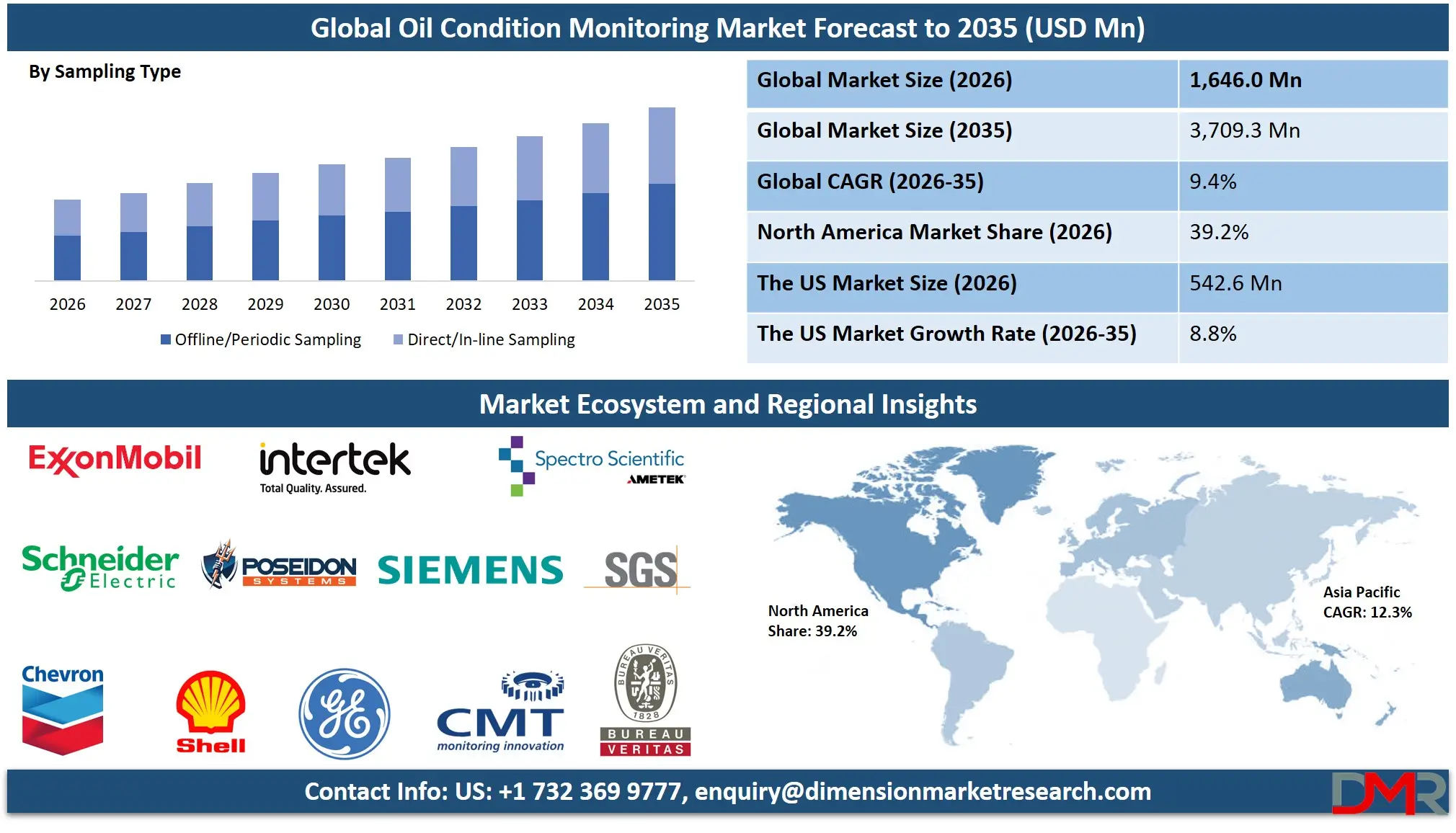
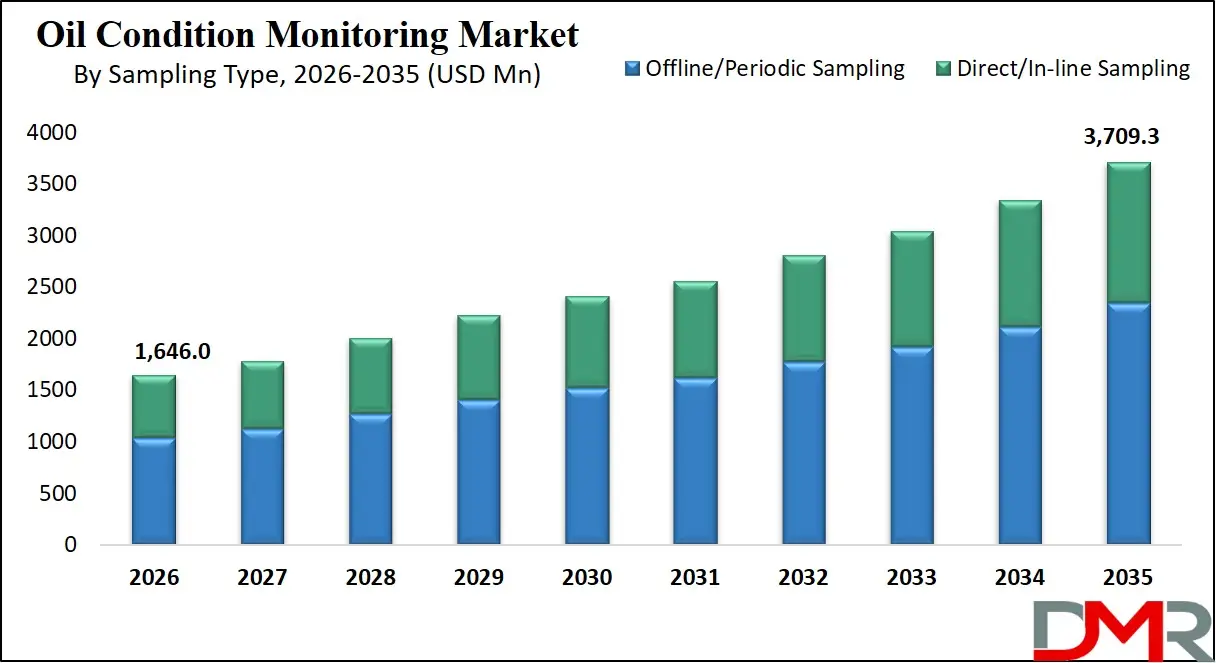
The Global Oil Condition Monitoring Market is projected to reach USD 1,646.0 million in 2026 and is expected to grow at a CAGR of 9.4% from 2026 to 2035, attaining a value of USD 3,709.3 million by 2035. The market's steady growth is driven by the increasing emphasis on predictive maintenance, rising operational costs of machinery, stringent regulatory standards for equipment reliability and emissions, and the accelerated adoption of Industrial Internet of Things (IIoT) and digitalization in asset management.
ℹ
To learn more about this report –
Download Your Free Sample Report Here
Oil condition monitoring enables precise, continuous, and proactive assessment of lubricant health and machine wear through advanced sensor technology, real-time data analytics, and AI-driven diagnostics. The model addresses critical industry challenges related to unplanned downtime, component failure, optimized oil change intervals, and operational safety, supporting industries in achieving higher equipment reliability and reduced maintenance costs.
Technological advancements, including spectroscopy sensors, online viscosity and dielectric constant measurement, AI-powered trend analysis, cloud-based data management platforms, and fully integrated predictive maintenance systems, are transforming the market into a scalable and highly efficient ecosystem. Integration of machine learning algorithms for anomaly detection, remaining useful life (RUL) prediction, and adaptive alerting is reshaping maintenance strategies and operational efficiency.
ℹ
To learn more about this report –
Download Your Free Sample Report Here
Growing government and industry initiatives promoting industrial automation, sustainable operations, and smart factory integration further accelerate global adoption. However, barriers such as high initial investment for advanced systems, lack of standardization, limited technical expertise among workforce, and data security concerns remain. Despite these limitations, the convergence of sensor technology, AI, and IIoT positions oil condition monitoring as a central driver of global industrial maintenance transformation through 2035.
The US Oil Condition Monitoring Market
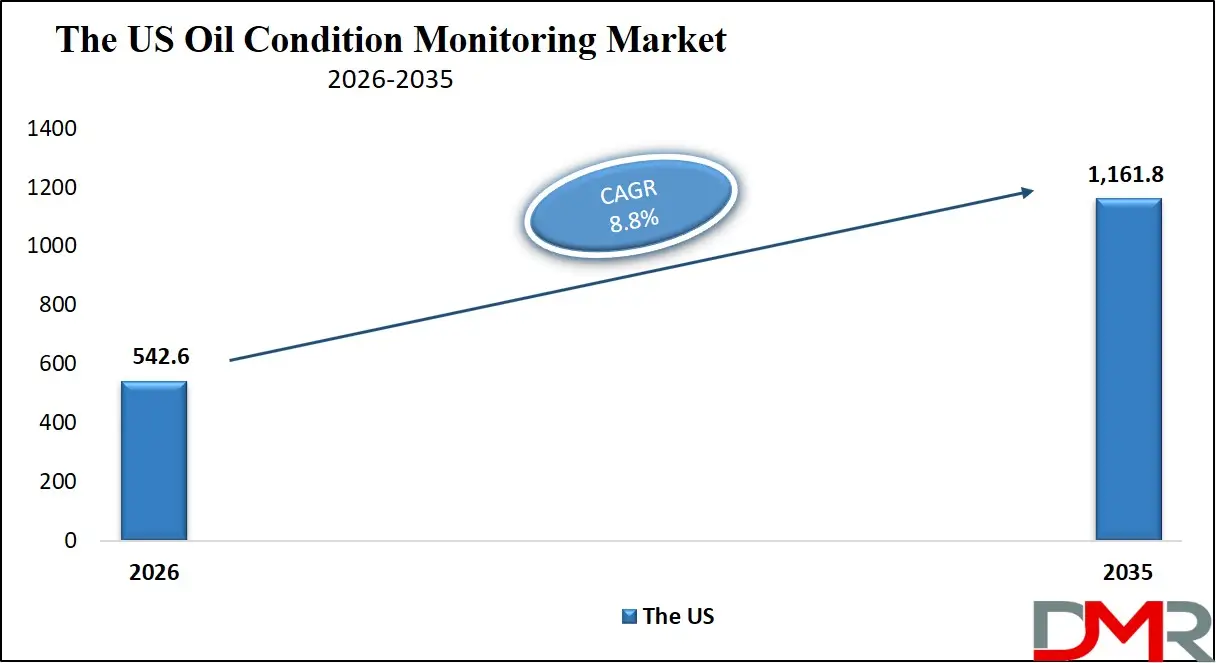
The U.S. Oil Condition Monitoring Market is projected to reach USD 542.6 million in 2026 and grow at a CAGR of 8.8%, reaching USD 1,161.8 million by 2035. The U.S. leads global adoption due to its mature industrial and energy sectors, high focus on operational efficiency, and strong regulatory framework for equipment safety and environmental compliance.
The pressing need to maximize asset uptime in critical industries like manufacturing, power generation, and transportation, coupled with rising labor and downtime costs, fuels demand for advanced monitoring solutions. Major industrial firms, fleet operators, and energy companies are integrating continuous and portable monitoring systems to transition from preventive to predictive maintenance paradigms. Companies such as Caterpillar, General Electric, and Chevron are piloting and deploying IIoT-enabled oil condition monitoring across their assets.
ℹ
To learn more about this report –
Download Your Free Sample Report Here
U.S. regulatory support for emission controls and machinery safety, alongside incentives for technology adoption under various industrial modernization initiatives, encourages investment. Training programs and partnerships with technical institutes are emerging to develop data analysis expertise, ensuring smooth integration into existing maintenance workflows.
The rapid rise of wireless sensor networks, real-time cloud analytics, and integration with Enterprise Asset Management (EAM) and CMMS platforms continues to redefine the U.S. industrial landscape, positioning the country as a global leader in predictive maintenance technologies.
The Europe Oil Condition Monitoring Market
The Europe Oil Condition Monitoring Market is projected to be valued at approximately USD 460.9 million in 2026 and is projected to reach around USD 1,038.6 million by 2035, growing at a CAGR of about 9.4% from 2026 to 2035. Europe's leadership is anchored by strong regulatory emphasis on industrial safety, machine efficiency, and environmental sustainability.
Countries such as Germany, the U.K., France, the Nordic region, and Italy are widely adopting oil condition monitoring, driven by stringent machinery directives, high costs of unplanned downtime, and government-backed initiatives like the EU's Green Deal and Industry 4.0 strategy. The German Mittelstand of specialized engineering and manufacturing firms is particularly active in developing and deploying advanced integrated monitoring solutions.
Europe's aging industrial infrastructure, demand for precision in high-value manufacturing, and push for sustainable resource usage further drive adoption. Funding through Horizon Europe and national digital industry funds supports R&D in smart sensors, AI diagnostics, and cyber-physical systems.
Heavy industries, transportation networks, and renewable energy projects increasingly deploy cloud-connected monitoring fleets, automated oil sampling systems, and condition-based maintenance via embedded sensors. With strong technical standards, digital twin integration, and emphasis on circular economy principles, Europe remains one of the most advanced regions in oil condition monitoring penetration.
The Japan Oil Condition Monitoring Market
The Japan Oil Condition Monitoring Market is anticipated to be valued at approximately USD 98 million in 2026 and is expected to attain nearly USD 250 million by 2035, expanding at a CAGR of about 10.5% during the forecast period. Japan's focus on precision manufacturing, exceptional equipment reliability, and severe skilled maintenance technician shortage drives high demand for automation in predictive maintenance.
The Ministry of Economy, Trade and Industry (METI) actively supports industrial IoT and predictive maintenance through national productivity campaigns, subsidies for SME adoption, and integration of monitoring into public infrastructure projects. Japan's leadership in precision sensors, robotics, and compact automation accelerates innovation in miniaturized, highly accurate on-site and portable analyzers suitable for dense industrial plants.
Japan's concept of "Society 5.0", driven by companies like Mitsubishi Heavy Industries, Hitachi, and Yokogawa, integrates IoT, AI, and robotics into seamless maintenance workflows. Oil condition monitoring systems are being deployed in automotive manufacturing, semiconductor fabrication plants, and regional power generation projects. Japan's cultural emphasis on zero-defect production and operational excellence, combined with advanced diagnostics, positions the country as a high-growth innovator in predictive maintenance.
Global Oil Condition Monitoring Market: Key Takeaways
- Steady Global Market Growth Outlook: The Global Oil Condition Monitoring Market is expected to be valued at USD 1,646.0 million in 2026 and is projected to reach USD 3,709.3 million by 2035, showcasing consistent expansion supported by rising demand for predictive maintenance and operational cost savings.
- Healthy CAGR Driven by Digitalization: The market is expected to grow at a CAGR of 9.4% from 2026 to 2035, fueled by accelerating IIoT integration, AI-driven diagnostic optimization, cloud-based data management, and increasing regulatory pressures worldwide.
- Strong Growth Trajectory in the United States: The U.S. Oil Condition Monitoring Market stands at USD 542.6 million in 2026 and is projected to reach USD 1,161.8 million by 2035, expanding at a CAGR of 8.8% due to robust industrial activity, high downtime costs, and advanced technology adoption.
- North America Maintains Regional Dominance: North America is expected to capture approximately 39.2% of the global market share in 2026, supported by mature industrial technology infrastructure, significant R&D investment, and early adoption of fully integrated predictive maintenance systems.
- Rapid Advancement in Monitoring Technologies: Innovations including miniaturized sensor arrays, AI-based wear debris analysis, real-time viscosity and TBN measurement, and cloud-integrated fleet analytics are significantly accelerating the accuracy, reliability, and scalability of oil condition monitoring services.
- Growing Focus on Predictive Maintenance Boosts Adoption: Rising global pressure to reduce operational costs and prevent catastrophic failures, coupled with aging industrial assets and complexity of modern machinery, is driving sustained demand for automated, data-driven, and proactive maintenance solutions.
Global Oil Condition Monitoring Market: Use Cases
- Fleet Management & Transportation: Monitoring systems track engine, transmission, and hydraulic oil health in real-time across trucking, shipping, and rail fleets, scheduling maintenance only when needed, reducing downtime and extending component life.
- Power Generation Plants: Continuous online monitoring of turbine, transformer, and generator oils ensures reliability, prevents failures, and complies with stringent safety and environmental regulations in nuclear, thermal, and renewable energy facilities.
- Heavy Manufacturing & Automotive: In automotive assembly and heavy equipment manufacturing, on-site analyzers and portable kits monitor hydraulic and coolant systems on production lines, preventing defects and maintaining consistent quality.
- Mining & Construction Equipment: Robust, portable monitoring solutions are used in remote and harsh environments to assess the condition of lubricants in excavators, haul trucks, and drills, optimizing maintenance schedules and preventing costly field failures.
- Marine & Offshore Operations: Integrated monitoring systems on vessels and offshore platforms analyze engine and system oils, providing early warnings of saltwater ingress, fuel dilution, or abnormal wear in critical propulsion and power systems.
Global Oil Condition Monitoring Market: Stats & Facts
- The International Organization for Standardization (ISO) reports that predictive maintenance adoption is growing at over 15% annually, with oil and lubricant condition monitoring representing one of the most critical and fastest-growing segments due to its direct impact on asset lifecycle.
- The U.S. Department of Energy projects that predictive maintenance can reduce maintenance costs by up to 30% and downtime by up to 45%, reinforcing how oil condition monitoring through automation, consistency, and early detection can maintain operational integrity, especially where over 70% of industrial failures are linked to lubrication issues.
- Society of Tribologists and Lubrication Engineers (STLE) data indicates advanced oil condition monitoring systems can extend oil drain intervals by 25-50% and reduce unscheduled downtime by up to 50% compared to time-based maintenance, validating monitoring as essential for cost-effective and reliable operations.
- The European Machinery Directive notes that continuous condition monitoring improves plant safety by reducing the risk of catastrophic machinery failures and associated hazards; unplanned outages currently account for significant financial losses and safety incidents in process industries.
- According to Global Industrial IoT Surveys, adoption of AI-enhanced oil monitoring platforms is growing over 20% annually in emerging markets, as systems become more affordable and adaptable to diverse machinery and operational environments.
- The World Economic Forum reports over 65% of industrial firms are investing in predictive maintenance technologies to address productivity gaps; oil condition monitoring mitigates reliability risks by enabling remote diagnostics, trend analysis, and integrated maintenance planning.
Global Oil Condition Monitoring Market: Market Dynamic
Driving Factors in the Global Oil Condition Monitoring Market
Rising Cost of Unplanned Downtime and Equipment Failure
The escalating financial and operational impact of unscheduled machinery breakdowns across industries is a major driver for oil condition monitoring adoption. The need to ensure maximum asset availability, optimize maintenance budgets, and prevent safety incidents significantly increases reliance on predictive data. Monitoring systems provide early fault detection, enable condition-based maintenance, and reduce dependency on reactive repairs. This allows industrial firms to improve overall equipment effectiveness (OEE) and meet production targets, especially in capital-intensive sectors.
Technology Innovation and IIoT Integration
Oil condition monitoring benefits heavily from rapid progress in sensor miniaturization, wireless connectivity, AI-powered analytics, and cloud-based data integration. Advanced systems feature real-time measurement of viscosity, water content, particle count, and dielectric constant, with automated trend analysis and alerting. These innovations enable continuous monitoring in dynamic operational environments, adjust to varying load conditions, and optimize lubricant life. The convergence of monitoring with digital twin technology and predictive maintenance platforms further enhances diagnostic accuracy and maintenance scheduling, making oil condition monitoring a cornerstone of modern industrial asset management.
Restraints in the Global Oil Condition Monitoring Market
High Initial Capital Investment and Integration Complexity
The significant upfront cost of advanced online monitoring systems, including sensors, data infrastructure, software, and training, limits adoption among small and medium-sized enterprises. Many firms face financing challenges and require clear, demonstrable ROI timelines. Additionally, integration into existing legacy machinery and maintenance workflows can require further investment in retrofitting and IT infrastructure, creating adoption friction.
Lack of Standardization and Technical Expertise
Monitoring technologies, data interpretation protocols, and alarm thresholds vary widely across OEMs and service providers, creating uncertainty in system deployment and data comparability. Issues include variability in sensor accuracy, proprietary data formats, and a shortage of skilled personnel capable of interpreting complex diagnostic data. Furthermore, not all industrial environments, especially those with extreme temperatures or contamination risks, are easily adaptable to sensitive monitoring equipment without significant customization and protection.
Opportunities in the Global Oil Condition Monitoring Market
Expansion into Emerging Economies and Renewable Energy
Emerging markets represent major growth opportunities due to rapid industrialization, large-scale infrastructure development, and increasing government focus on operational efficiency. Countries in Asia-Pacific, the Middle East, and Latin America are launching smart factory and infrastructure programs where oil condition monitoring can ensure reliability and longevity. Local service partnerships, monitoring-as-a-service models, and government mandates can improve accessibility. Furthermore, the growing wind and solar power sectors present new applications for monitoring gearbox and hydraulic oils in remote, hard-to-service locations.
AI-Driven Predictive Analytics and Integration with Digital Twins
The integration of AI not only for diagnostics but for predictive failure modeling, remaining useful life (RUL) estimation, and prescriptive maintenance recommendations creates new value streams. AI can analyze multivariate sensor data to preempt failures, optimize oil selection for different operating conditions, and continuously improve maintenance strategies based on historical fleet data. Integration with digital twins allows for virtual simulation and optimization of maintenance interventions, transforming monitoring systems from data providers into intelligent, decision-support assets.
Trends in the Global Oil Condition Monitoring Market
Shift to Portable and On-Site Analysis Kits
The rise of user-friendly, portable analyzers and on-site test kits is gaining traction, especially among smaller operators and for field service applications. These systems provide rapid, cost-effective results for key parameters like viscosity, acidity, and contamination, enabling quick decision-making without sending samples to a lab. This trend lowers the barrier to entry, improves monitoring frequency, and empowers maintenance teams with immediate data.
Cloud-Based Analytics and Fleet-Wide Management
Centralized cloud platforms are enabling remote monitoring, benchmarking, and performance analytics for multiple assets across different sites or entire fleets. Maintenance managers can track oil health trends, contamination levels, and machine condition in real time, optimizing lubricant inventory and maintenance planning. This trend supports the scalable deployment of condition monitoring across large corporations with geographically dispersed operations.
Global Oil Condition Monitoring Market: Research Scope and Analysis
By Product Type Analysis
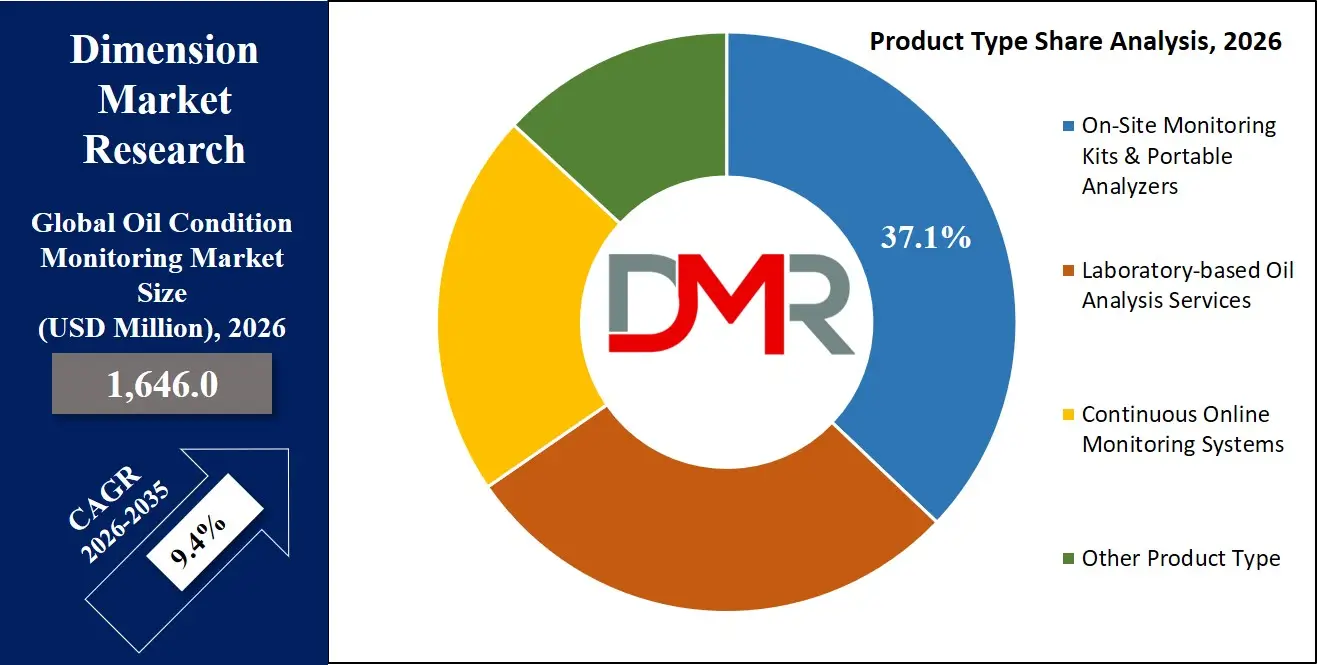
Continuous Online Monitoring Systems are projected to dominate the Product Type segment of the Global Oil Condition Monitoring Market. This dominance is driven by the critical need for real-time, uninterrupted data in high-value, high-risk assets such as power generation turbines, large manufacturing process lines, and critical marine engines. Online systems provide instantaneous detection of abnormal conditions like water ingress, fuel dilution, or sudden wear, enabling immediate corrective action to prevent catastrophic failure.
ℹ
To learn more about this report –
Download Your Free Sample Report Here
The technology for continuous measurement of key parameters (viscosity, dielectric constant, particle count) has matured, offering proven reliability and a clear return on investment through avoided downtime. While Portable Analyzers and On-Site Kits address the need for flexibility and lower upfront cost in multi-asset or field service scenarios, their adoption is for periodic checks rather than continuous protection. Laboratory-based Services offer the highest accuracy and comprehensive analysis but involve turnaround time, making them complementary rather than primary for time-critical decisions. Therefore, the imperative for real-time protection of critical capital equipment, coupled with advancements in sensor durability and IIoT connectivity, secures Continuous Online Monitoring Systems' leading market position throughout the forecast period.
By Sampling Type Analysis
Direct/In-line Sampling for continuous online systems is projected to dominate the global market, as it represents the most proactive and integrated approach to condition monitoring. Its dominance stems from the ability to provide a continuous stream of representative data without human intervention, eliminating sampling errors and delays. By integrating sensors directly into the lubrication system, these systems offer unparalleled insight into real-time oil health and machine condition, forming the backbone of a true predictive maintenance strategy. The driving forces are the decreasing cost of robust sensors, the increasing reliability of wireless data transmission, and the growing value placed on real-time operational intelligence. As industries strive for autonomy and zero unplanned downtime, the economic and operational case for direct, continuous sampling becomes compelling.
Offline/Periodic Sampling remains a crucial and substantial segment, effectively serving the vast majority of assets where continuous monitoring is not economically justified. This method, involving manual extraction of oil samples for lab or on-site analysis, caters to less critical equipment, fleets of similar assets, and operations with established time-based maintenance schedules. Its strength lies in lower initial cost and flexibility, making it ideal for baseline analysis, trend monitoring over time, and diagnostic investigations. By providing detailed, periodic snapshots of oil condition, it allows for planned maintenance interventions and helps optimize drain intervals. This balance of cost-effectiveness and valuable insight makes it a widespread and enduring practice, addressing the reality that not every machine warrants a capital-intensive online system.
By Measurement Type Analysis
Viscosity, Density & Temperature Monitoring forms a fundamental and dominant measurement segment, as these are primary indicators of oil degradation, contamination, and correct application. Monitoring these physical properties is essential for ensuring lubricant performance and detecting issues like fuel dilution, oxidation, or incorrect oil selection.
Wear Debris & Particle Counting is another critical and high-growth segment, directly correlating to mechanical component health. Analysis of particle size, distribution, and composition provides early warning of abnormal wear in gears, bearings, and other tribological contacts.
Chemical Property Analysis (including TAN/TBN, Oxidation, Nitration, Additive Depletion) is essential for assessing the lubricant's chemical health and its ability to continue protecting equipment. This segment is vital for optimizing drain intervals and ensuring compliance with performance specifications.
By Industry Vertical Analysis
Transportation is poised to be the largest and most dominant vertical, encompassing automotive, aviation, marine, and rail. The high density of moving parts, critical safety requirements, and stringent operational schedules create a perfect use case for continuous or frequent oil condition monitoring to ensure reliability and safety.
Energy & Power Generation ranks as the second-largest vertical, fueled by the extreme cost of failure and stringent regulatory environment. This includes traditional thermal and nuclear power, as well as the rapidly growing wind and solar sectors where monitoring gearbox oils is critical.
Industrial Manufacturing is a major adopter, driven by the need to maintain continuous production processes and protect expensive CNC machinery, hydraulics, and compressors. The push towards smart factories and Industry 4.0 directly integrates oil condition data into the production management system.
Mining & Construction represents a high-growth vertical due to the harsh operating conditions, remote locations, and extremely high cost of equipment downtime. Robust, portable, and satellite-connected monitoring solutions are key growth areas here.
The Global Oil Condition Monitoring Market Report is segmented on the basis of the following:
By Product Type
- On-Site Monitoring Kits & Portable Analyzers
- Laboratory-based Oil Analysis Services
- Continuous Online Monitoring Systems
- Other Product Type
By Sampling Type
- Offline/Periodic Sampling
- Direct/In-line Sampling
By Measurement Type
- Physical Properties
- Viscosity
- Density
- Temperature
- Wear & Contamination Monitoring
- Wear Debris Analysis
- Particle Counting
- Ferrous Density Measurement
- Fluid Contamination Analysis
- Water Content
- Fuel Dilution
- Soot & Insolubles
- Chemical Property Analysis
- Total Acid Number (TAN)
- Total Base Number (TBN)
- Oxidation & Nitration
- Additive Depletion
- Spectrometric Analysis
- Other Measurement Parameters
By Industry Vertical
- Transportation
- Automotive (Passenger & Commercial Vehicles)
- Aviation
- Marine
- Railways
- Energy & Power Generation
- Conventional Power (Coal, Gas, Nuclear)
- Renewable Energy (Wind Turbines, Hydropower)
- Industrial Manufacturing
- Heavy Machinery
- Process Industries
- Food & Beverage Equipment
- Mining & Construction Equipment
- Oil & Gas (Upstream, Midstream, Downstream)
- Other Industry Verticals
Impact of Artificial Intelligence in the Global Oil Condition Monitoring Market
- AI for Anomaly Detection & Early Fault Prediction: AI analyzes continuous streams of sensor data to identify subtle deviations from normal baselines that may indicate impending failure, such as abnormal wear patterns or additive depletion, long before traditional alarms are triggered.
- AI-Driven Diagnostic Reasoning & Root Cause Analysis: Advanced algorithms correlate multiple oil parameters (e.g., rising particle count with decreasing viscosity) and cross-reference with operational data (load, temperature) to suggest the most probable root cause of a condition change, accelerating troubleshooting.
- Predictive Maintenance Scheduling & RUL Estimation: AI models use historical failure data and real-time condition trends to predict the remaining useful life of both the lubricant and the monitored component, enabling optimized, just-in-time maintenance planning.
- AI-Based Fleet-Wide Benchmarking & Optimization: AI analyzes data across an entire fleet of similar assets to identify performance outliers, benchmark health metrics, and recommend best practices for lubrication and maintenance, driving efficiency at scale.
- Learning from Historical Failure Data: AI systems aggregate data across failures and interventions to continuously improve diagnostic models and prediction accuracy for specific equipment types and operating contexts, building a proprietary knowledge base.
Global Oil Condition Monitoring Market: Regional Analysis
Region with the Largest Revenue Share
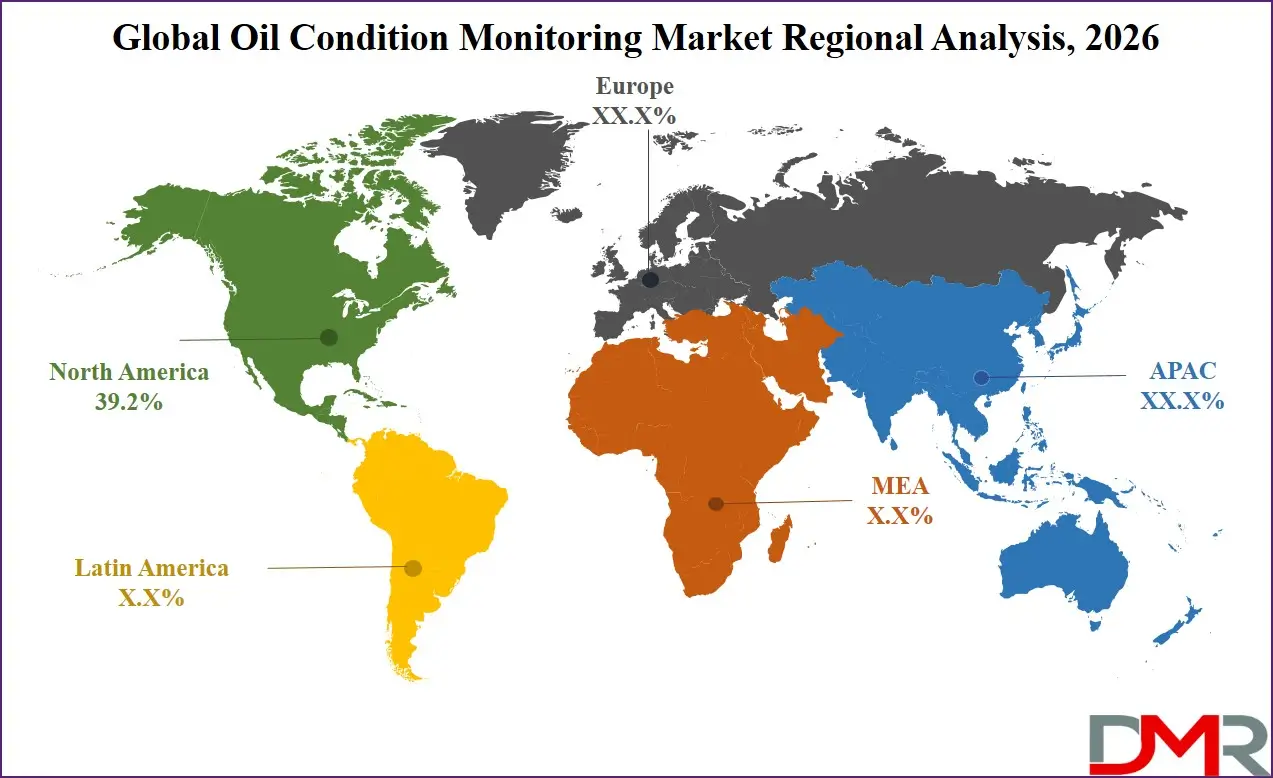
North America is projected to dominate the Global Oil Condition Monitoring Market with 39.2% of market share by the end of 2026, owing to a powerful combination of mature and extensive industrial and transportation sectors, high focus on predictive maintenance, strong technology investment, and the presence of leading monitoring solution providers. The United States and Canada have rapidly integrated IIoT and condition-based monitoring into asset management strategies, supported by a culture of operational excellence and risk mitigation. Major industrials and fleet operators are institutionalizing oil condition monitoring to maintain competitive advantage and operational reliability.
ℹ
To learn more about this report –
Download Your Free Sample Report Here
The region's stringent environmental and safety regulations, coupled with high labor and downtime costs, create a compelling economic case for advanced monitoring. Supportive industry consortia and a well-established service provider network further solidify North America's leadership position.
Region with the Highest CAGR
Asia-Pacific holds the highest CAGR and is poised to achieve rapid market share growth due to its massive industrialization, expanding manufacturing base, government-led infrastructure push, and growing awareness of predictive maintenance benefits. Countries like China, India, Japan, and South Korea are investing heavily in industrial modernization and smart technology to improve productivity. China's "Made in China 2025" initiative in advanced manufacturing and India's push for domestic manufacturing are creating fertile ground for adoption. The region's cost sensitivity is being addressed through local manufacturing, monitoring-as-a-service models, and partnerships between global tech firms and local industrial players. This, combined with an immense and growing asset base, positions APAC as the fastest-growing market for oil condition monitoring systems.
By Region
North America
Europe
- Germany
- The U.K.
- France
- Italy
- Russia
- Spain
- Benelux
- Nordic
- Rest of Europe
Asia-Pacific
- China
- Japan
- South Korea
- India
- ANZ
- ASEAN
- Rest of Asia-Pacific
Latin America
- Brazil
- Mexico
- Argentina
- Colombia
- Rest of Latin America
Middle East & Africa
- Saudi Arabia
- UAE
- South Africa
- Israel
- Egypt
- Rest of MEA
Global Oil Condition Monitoring Market: Competitive Landscape
The Global Oil Condition Monitoring Market is moderately fragmented, featuring a mix of established specialty chemical and sensor companies, industrial equipment manufacturers, dedicated instrumentation firms, and technology companies diversifying into IIoT analytics. Leading diagnostic players Parker Hannifin, Spectro Scientific (AMETEK), and Bureau Veritas leverage their expertise in fluid analysis and sensors. Pure-play monitoring innovators such as Condition Monitoring Technologies (CMT) and Poseidon Systems are driving market dynamics with agile, software-centric systems.
Industrial IoT and software specialists like IBM (for analytics platforms), Siemens (for integrated plant solutions), and Schneider Electric play increasingly influential roles as enablers and partners. Major oil companies and lubricant suppliers are also entering the space through strategic service offerings, aiming to provide value-added data alongside their products.
Some of the prominent players in the Global Oil Condition Monitoring Market are:
- Parker Hannifin Corporation
- Spectro Scientific (AMETEK Inc.)
- Bureau Veritas SA
- Intertek Group plc
- SGS SA
- Condition Monitoring Technologies (CMT)
- Poseidon Systems, LLC
- General Electric Company
- Siemens AG
- Schneider Electric SE
- Shell plc
- Chevron Corporation
- ExxonMobil Corporation
- Castrol (BP plc)
- Teledyne Technologies Incorporated
- Honeywell International Inc.
- Emerson Electric Co.
- ABB Ltd.
- Rockwell Automation, Inc.
- Other Key Players
Recent Developments in the Global Oil Condition Monitoring Market
- November 2025: Parker introduced its Generation 3 wireless, battery-powered oil condition sensor nodes, featuring enhanced multi-parameter measurement (viscosity, water, temperature) and 5-year battery life for harsh industrial environments, with seamless integration into major IIoT platforms.
- October 2025: Siemens presented its integrated solution combining continuous oil condition data with a digital twin of critical machinery, enabling simulation of wear progression and optimization of maintenance windows in real-time.
- September 2025: Bureau Veritas announced a multi-year agreement with a leading international shipping conglomerate to deploy its remote oil analysis and diagnostic service across its entire fleet, signaling mainstream acceptance of outsourced, data-driven maintenance.
- August 2025: Spectro Scientific completed the acquisition of a specialist AI firm to enhance its lab and portable analyzer software's ability to provide prescriptive maintenance recommendations from complex oil analysis data.
- July 2025: A Horizon Europe grant was awarded to a consortium developing smart sensor systems to accurately determine the end-of-life and recyclability of industrial oils, linking condition monitoring with sustainable resource management.
- June 2025: Shell partnered with a major IIoT platform provider to integrate real-time oil condition data from Shell's lubricants directly into customers' enterprise asset management systems, creating a closed-loop data service.
Report Details
| Report Characteristics |
| Market Size (2026) |
USD 1,646.0 Mn |
| Forecast Value (2035) |
USD 3,709.3 Mn |
| CAGR (2026–2035) |
9.4% |
| The US Market Size (2026) |
USD 542.6 Mn |
| Historical Data |
2021 – 2025 |
| Forecast Data |
2027 – 2035 |
| Base Year |
2025 |
| Estimate Year |
2026 |
| Report Coverage |
Market Revenue Estimation, Market Dynamics, Competitive Landscape, Growth Factors and etc. |
| Segments Covered |
By Product Type (On-Site Monitoring Kits & Portable Analyzers, Laboratory-based Oil Analysis Services, Continuous Online Monitoring Systems, Other Product Types), By Sampling Type (Offline/Periodic Sampling, Direct/In-line Sampling), By Measurement Type (Physical Properties, Wear & Contamination Monitoring, Fluid Contamination Analysis, Chemical Property Analysis, Other Measurement Parameters), By Industry Vertical (Transportation, Energy & Power Generation, Industrial Manufacturing, Mining & Construction Equipment, Oil & Gas, Other Industry Verticals) |
| Regional Coverage |
North America – The US and Canada; Europe – Germany, The UK, France, Russia, Spain, Italy, Benelux, Nordic, & Rest of Europe; Asia-Pacific – China, Japan, South Korea, India, ANZ, ASEAN, Rest of APAC; Latin America – Brazil, Mexico, Argentina, Colombia, Rest of Latin America; Middle East & Africa – Saudi Arabia, UAE, South Africa, Turkey, Egypt, Israel, & Rest of MEA |
| Prominent Players |
Parker Hannifin Corporation, Spectro Scientific (AMETEK Inc.), Bureau Veritas SA, Intertek Group plc, SGS SA, Condition Monitoring Technologies (CMT), Poseidon Systems, LLC, General Electric Company, Siemens AG, Schneider Electric SE, Shell plc, Chevron Corporation, ExxonMobil Corporation, Castrol (BP plc), Teledyne Technologies Incorporated, Honeywell International Inc., Emerson Electric Co., ABB Ltd., Rockwell Automation, Inc., and Other Key Players |
| Purchase Options |
We have three licenses to opt for (Single User License (Limited to 1 user), Multi-User License (Up to 5 Users) and Corporate Use License (Unlimited User) along with free report customization equivalent to 0 analyst working days, 3 analysts working days and 5 analysts working days respectively. |
Frequently Asked Questions
How big is the Global Oil Condition Monitoring Market?
▾ The Global Oil Condition Monitoring Market size is estimated to have a value of USD 1,646.0 million in 2026 and is expected to reach USD 3,709.3 million by the end of 2035.
What is the growth rate in the Global Oil Condition Monitoring Market?
▾ The market is growing at a CAGR of 9.4 percent over the forecasted period of 2026-2035.
What is the size of the US Oil Condition Monitoring Market?
▾ The US Oil Condition Monitoring Market is projected to be valued at USD 542.6 million in 2026. It is expected to witness subsequent growth in the upcoming period as it holds USD 1,161.8 million in 2035 at a CAGR of 8.8%.
Which region accounted for the largest Global Oil Condition Monitoring Market?
▾ North America is expected to have the largest market share in the Global Oil Condition Monitoring Market with a share of about 39.2% in 2026.
Who are the key players in the Global Oil Condition Monitoring Market?
▾ Some of the major key players in the Global Oil Condition Monitoring Market are Parker Hannifin Corporation, Spectro Scientific (AMETEK Inc.), Bureau Veritas SA, Intertek Group plc, SGS SA, and many others.