Market Snapshot
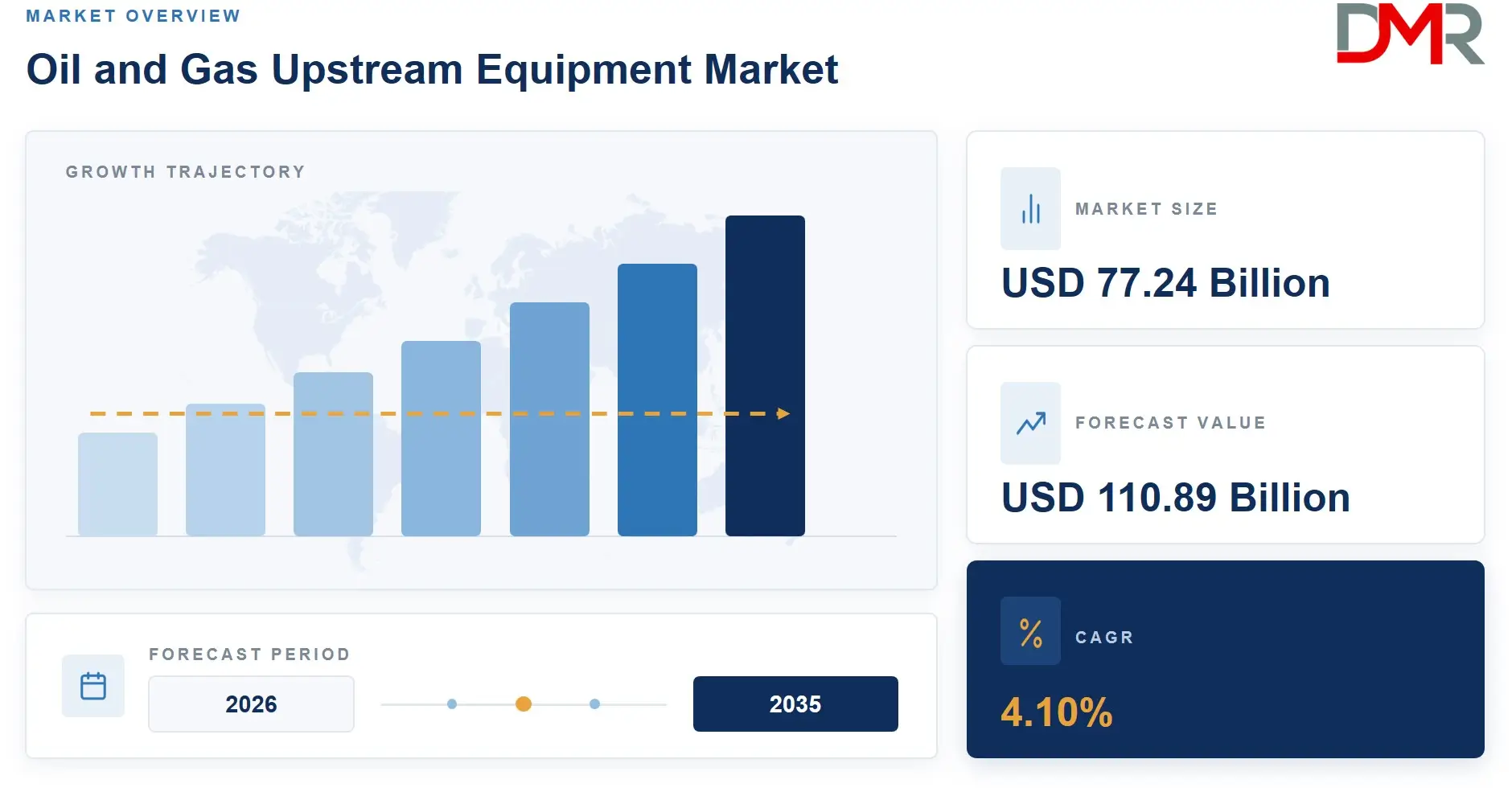
- The Global Oil and Gas Upstream Equipment Market was valued at USD 74.2 Billion in 2025 and is projected to reach USD 110.89 Billion by 2035, at a CAGR of 4.10%.
- By Equipment Type, Drilling Equipment led with a 40.2% share in 2025.
- By Application, Onshore held the dominant position at 65.6% share in 2025.
- By Well Type, Conventional Wells accounted for the largest share at 59.8% in 2025.
- By Equipment Category, Surface Equipment led with a 57.8% share in 2025.
- By End-Use Operation, Drilling captured the highest share at 44.7% in 2025.
- North America held the dominant regional position with a 40.8% share in 2025.
- Asia Pacific is the fastest-growing regional market through the forecast period.
Market Overview
The oil and gas upstream equipment market covers hardware deployed across exploration, drilling, completion, and production operations — from rotary drilling systems and wellheads to separation, pressure control, and subsea production infrastructure. It excludes midstream pipelines, refining equipment, and downstream processing assets. The market connects directly to global capital expenditure cycles set by national oil companies, international oil companies, and independent producers, making it acutely sensitive to crude price trajectories and energy security mandates.
Efficiency gains now define how operators measure equipment value. As reported by the U.S. Energy Information Administration, active upstream drilling rigs in the U.S. Lower 48 fell from a peak of 750 in December 2022 to 517 rigs by October 2025 — a 31% decline — while crude production simultaneously set a monthly record of 11.4 million barrels per day in July 2025. Fewer rigs producing more barrels per unit signals that operators are buying fewer but more capable assets. Vendors supplying commodity-grade equipment face structural volume compression, while those offering high-efficiency, digitally integrated systems capture a disproportionate share of replacement and upgrade budgets.
Digitization has moved from pilot programs to capital allocation decisions across the upstream equipment stack. Operators now evaluate hardware procurement alongside software integration, remote monitoring capability, and predictive maintenance compatibility. Vendors unable to deliver sensorized, connected equipment face displacement from procurement shortlists even when their mechanical specifications remain competitive. The market no longer separates iron from intelligence.
Market Size and Forecast
The Global Oil and Gas Upstream Equipment Market size is estimated at USD 77.24 Billion in 2026 from USD 74.2 Billion in 2025, and is projected to reach USD 110.89 Billion by 2035, exhibiting a CAGR of 4.10% during the forecast period.
Upstream production records underpin the demand baseline for the forecast. As reported by the Society of Petroleum Engineers, total U.S. energy production reached a record 107 quadrillion British thermal units in 2025 — a 3.4% increase from 2024 and the fourth consecutive annual record — with crude oil output setting a new annual record of 13.6 million barrels per day, up 3% from 2024. Record production at sustained rig efficiency levels indicates operators are not pulling back equipment fleets. Investment continues flowing into proven plays and established producing basins, sustaining baseline equipment procurement volumes.
In July 2025, Baker Hughes announced the acquisition of Chart Industries for approximately USD 13.6 billion, extending its upstream equipment capabilities into energy infrastructure and industrial technology. Consolidation at this scale reshapes procurement relationships: operators dealing with fewer, larger vendors face different contract dynamics, and smaller equipment suppliers lose adjacency to tier-one project budgets. The CAGR of 4.10% reflects steady but measured growth, constrained by capital discipline while supported by productivity-driven replacement cycles.
ℹ
To learn more about this report –
Download Your Free Sample Report Here
As published by the IEA's World Energy Investment 2026 report, global upstream natural gas spending is forecast to reach USD 330 billion in 2026 — an 8% increase above 2025 levels and the highest in a decade. Upstream oil investment, by contrast, is expected to fall for a third consecutive year, remaining below USD 500 billion in 2026. Gas-directed equipment categories, including compression, processing, and stimulation hardware for unconventional gas fields, will outpace oil-directed segments over the forecast window. Vendors with gas-capable product lines carry a structural advantage.
According to a January 2025 peer-reviewed study in the World Journal of Advanced Research and Reviews, predictive maintenance systems using machine learning and IoT sensor analytics can reduce unplanned equipment downtime by up to 83%. Upstream operators applying these systems cut repair-driven capital expenditure and extend equipment service life, compressing replacement purchase cycles. Over a ten-year forecast horizon, widespread adoption of predictive maintenance could moderate new equipment procurement growth while elevating aftermarket services revenue.
Equipment Type Analysis
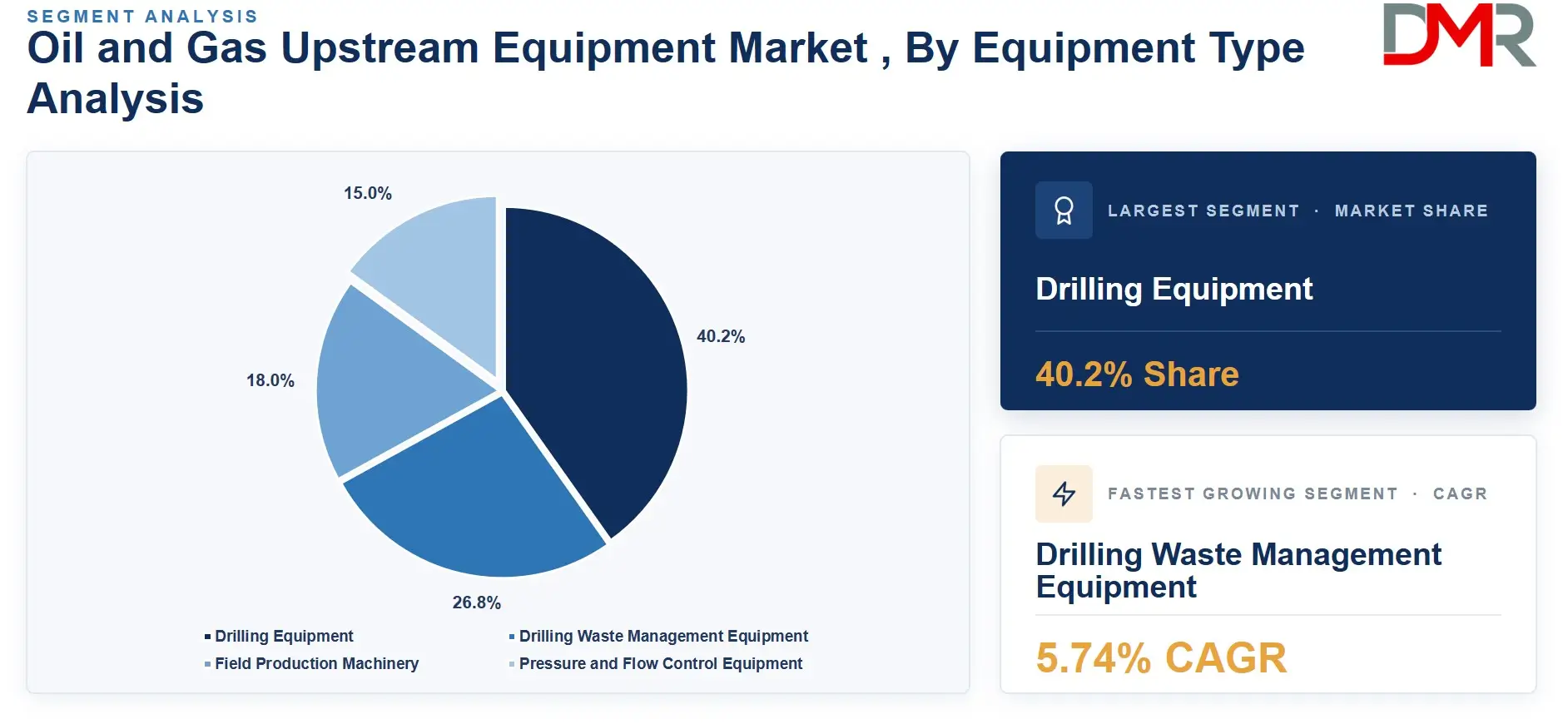
Drilling Equipment led the equipment type segment with a 40.2% share in 2026.
Drilling equipment commands the largest share because it anchors every upstream project cycle. No production begins without a completed wellbore, and every new well, workover, and recompletion event requires drilling hardware. Rotary assemblies, drill strings, drill bits, and associated bottomhole components see repeat procurement across short-cycle shale campaigns and long-cycle deepwater programs alike. As reported in a 2025 peer-reviewed study published in the International Journal of Science and Research Archive, an automated robotic rig improved drilling connection times by 28% and casing running performance by approximately 43% compared to conventional rigs, achieving consistent output without human interaction in the mast or on the rig floor. Operators sourcing next-generation drilling systems now evaluate automation compatibility as a primary procurement criterion, lifting average selling prices and margin potential for leading OEMs.
Field Production Machinery and Pressure and Flow Control Equipment collectively serve the production phase, sustaining revenue across equipment lifecycles long after drilling is complete. Drilling Waste Management Equipment is the fastest-growing sub-category within this segment, driven by tightening environmental regulations around cuttings disposal and produced water handling. Operators in North America and the Middle East are allocating dedicated line items to waste management hardware, a procurement shift that was marginal three years ago. For vendors, waste management equipment now represents a repeatable revenue stream tied to mandatory compliance rather than discretionary capital spending.
Application Analysis
With a 65.6% share in 2026, Onshore outpaced all other application categories.
Onshore applications dominate because the sheer volume of active wells, short-cycle drilling programs, and brownfield workovers creates sustained, high-frequency equipment demand. The Permian Basin, Haynesville, and Middle Eastern supergiant fields all sit onshore, and their combined production output represents a consistent procurement base for surface drilling rigs, wellhead systems, and production separation equipment. Vendors serving onshore operators benefit from shorter decision cycles and higher procurement repeatability relative to offshore counterparts.
Offshore is the faster-growing application category, supported by deepwater sanctioning activity in Guyana, Brazil pre-salt, and West Africa. Offshore projects require specialized subsea wellheads, risers, and blowout preventers that carry significantly higher unit values than onshore equivalents. A single deepwater project can generate equipment orders worth multiples of an equivalent onshore campaign. Vendors willing to invest in subsea-rated product certification and qualification will access contracts with longer tenors and higher margin profiles than onshore commodity hardware.
Well Type Analysis
Conventional Wells accounted for 59.8% of well type demand in 2026, the highest of any category.
Conventional wells maintain the largest share because they support the majority of global production from Middle Eastern, Russian, and African fields. These wells require simpler mechanical completions but generate sustained aftermarket demand for artificial lift, wellhead maintenance, and production optimization hardware over multi-decade operational lives. Unconventional Wells, representing the remaining balance, are the higher-growth category. North American shale plays and emerging unconventional basins in Argentina, China, and Algeria drive procurement for multistage fracturing equipment, horizontal drilling assemblies, and high-pressure pump systems. Unconventional completions are equipment-intensive per well, making them disproportionately valuable per unit of production to equipment vendors.
Equipment Category Analysis
A 57.8% share made Surface Equipment the clear leader across equipment category segments in 2026.
ℹ
To learn more about this report –
Download Your Free Sample Report Here
Surface equipment covers the broadest installed base of any category, including wellheads, Christmas trees, separators, manifolds, and production control systems across every active producing field globally. Replacement cycles for surface equipment in mature basins generate recurring revenue independent of new well drilling activity. Subsea Equipment, while smaller in volume, carries the highest per-unit value and is growing faster as deepwater sanctioning activity accelerates. Subsea systems require engineering customization, extended lead times, and specialized installation vessels, creating higher barriers to entry and stronger vendor pricing power than surface hardware.
End-Use Operation Analysis
Drilling captured 44.7% of the end-use operation segment in 2026, ahead of all rivals.
Drilling operations consume the widest variety of equipment categories across the shortest time window, from rig systems and bits to mud management and casing hardware. Its dominance reflects both the capital intensity of new well construction and the ongoing workover activity sustaining production from aging wells. Well Production and Completion operations together represent the remaining share and are gaining relative weight as operators optimize existing well inventories rather than drilling exclusively for new reserves. Completion equipment, particularly for multistage hydraulic fracturing, is the fastest-growing sub-operation as unconventional development scales across new geographies.
Key Market Segments
By Equipment Type
- Drilling Equipment
- Rotary and Automated Drilling Systems
- Bits, Strings, and Bottomhole Assemblies
- Field Production Machinery
- Drilling Waste Management Equipment
- Pressure and Flow Control Equipment
By Application
By Well Type
- Conventional Wells
- Unconventional Wells
By Equipment Category
- Surface Equipment
- Subsea Equipment
By End-Use Operation
- Drilling
- Well Production
- Completion
Regional Analysis
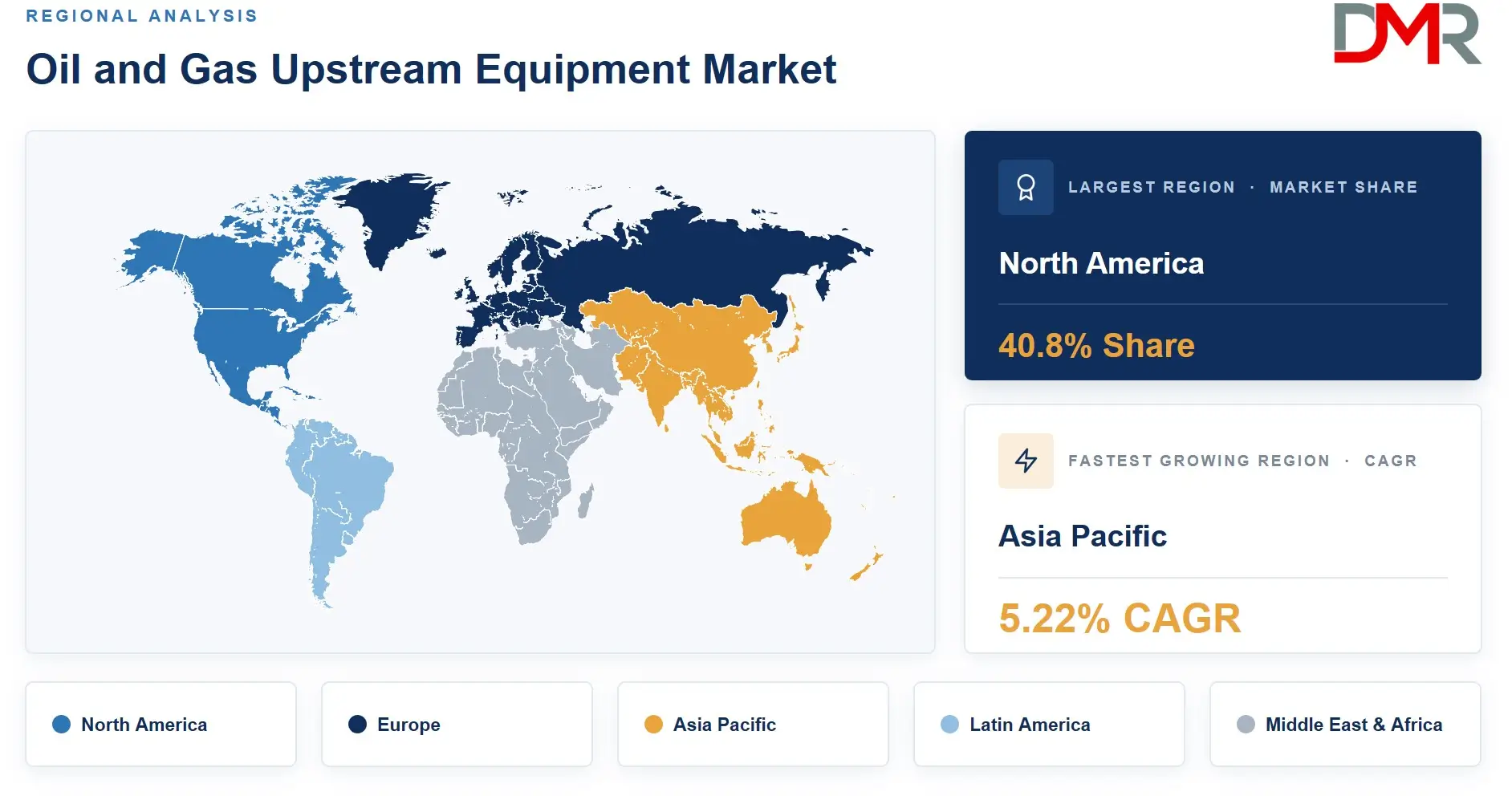
North America led all regions with a 40.8% share in 2026, equivalent to approximately USD 30.27 Billion.
North America's leadership reflects the scale and velocity of unconventional resource development. The Permian Basin, Eagle Ford, Haynesville, and Marcellus plays collectively sustain one of the highest active rig counts in the world, generating continuous procurement of drilling rigs, completion equipment, wellhead systems, and production machinery. U.S. operators set consecutive production records through 2025, and their capital allocation decisions drive the majority of North American equipment spend. Canada's oil sands and deepwater Atlantic plays add further volume to the region's equipment demand base.
ℹ
To learn more about this report –
Download Your Free Sample Report Here
Asia Pacific is the fastest-growing regional market, driven by offshore gas sanctioning in Australia, deepwater exploration in Malaysia and Indonesia, and China's aggressive push into unconventional shale gas at scale. Unlike North America, where efficiency gains compress rig counts, Asia Pacific is in an earlier phase of upstream development and requires broader fleet expansion. Latin America benefits from Guyana's deepwater ramp-up and Brazil's pre-salt FPSOs, sustaining demand for subsea equipment and offshore drilling systems. The Middle East and Africa region, anchored by national oil company investment programs in Saudi Arabia, UAE, and Iraq, sustains large conventional equipment procurement volumes with long-term visibility. Europe's North Sea mature basin workover activity supports a stable but non-growing equipment services and hardware market.
Key Regions and Countries
North America
Europe
- Germany
- France
- The UK
- Spain
- Italy
- Rest of Europe
Asia Pacific
- China
- Japan
- South Korea
- India
- Australia
- Rest of APAC
Latin America
- Brazil
- Mexico
- Rest of Latin America
Middle East & Africa
- GCC
- South Africa
- Rest of MEA
Market Dynamics
Per-Rig Efficiency Gains and Gas Investment Drive Hardware Renewal
Operators across North American shale plays extracted more output from fewer rigs between 2022 and 2025, but the productivity ceiling is approaching. As per the EIA, oil-directed upstream drilling rigs fell 33% to 397 rigs by October 2025, while the Permian Basin grew its oil output by 18% (1.0 million barrels per day) over the same period despite a 29% reduction in its rig count. Equipment suppliers serving this environment must offer drilling systems capable of sustaining production gains even as per-rig incremental output improvement flattens.
Shale productivity growth is now at near-stall speed. Deloitte's 2026 Oil and Gas Industry Outlook confirms that new well oil production per rig in U.S. shale plays grew less than 2% between June 2024 and June 2025 — a sharp deceleration after years of rapid improvement. Operators facing a hardware efficiency ceiling are redirecting capital toward digital integration and AI-enabled control systems as the next productivity lever. Vendors supplying conventional mechanical drilling systems without digital retrofit pathways are competing on price alone in a narrowing addressable market.
In December 2025, Aramco awarded SLB a long-term contract supporting the Kingdom's gas growth program, including a five-year unconventional gas stimulation services agreement. Saudi Arabia's commitment to gas field development at scale creates a multi-year equipment demand anchor across the Middle East. National oil company programs of this scope generate procurement visibility that private-sector operators rarely offer, making them high-priority revenue targets for equipment OEMs and integrated services providers.
SLB's completion of the ChampionX acquisition in July 2025 combined production chemicals, artificial lift, and digital production optimization into a single vendor offering. Operators dealing with integrated suppliers face changed contract structures: bundled solutions replacing component-level procurement. Independent equipment vendors must now demonstrate a capability to integrate within or alongside these platform offerings, or accept displacement from tier-one operator shortlists.
Capital Discipline and Emissions Compliance Limit Procurement Volumes
International oil companies maintained strict capital discipline through 2025, prioritizing returns over volume growth. Large-scale new upstream equipment installations require multi-year budget commitments, and volatile crude price cycles create persistent procurement hesitation among private-sector operators. The IEA confirms upstream oil investment will fall for a third consecutive year in 2026, remaining below USD 500 billion. Equipment vendors dependent on new installation orders rather than brownfield replacement and services revenue face sustained top-line pressure.
Emissions compliance adds a second cost layer that directly affects equipment approval timelines. OGCI's 12 member companies — including major upstream operators — reduced aggregate upstream methane emissions by 63% and routine flaring by 72% since 2017, with upstream methane intensity reaching 0.12% in 2024. Achieving and maintaining these thresholds requires certified low-emission equipment and continuous monitoring hardware. New upstream hardware now must clear longer regulatory review periods before field deployment, extending procurement lead times and compressing vendor revenue recognition cycles.
Brownfield Modernization and AI Integration Open High-Value Entry Points
Mature producing basins in North America, the North Sea, and the Middle East hold aging mechanical infrastructure that operators are systematically replacing with digital-ready, energy-efficient hardware. Brownfield programs do not require exploration success or greenfield development approval — they draw on existing production cash flows and deliver measurable return on investment within shorter payback periods. Equipment vendors with proven retrofit and upgrade product lines for existing wellbore and surface configurations have a structurally lower sales cycle than greenfield suppliers.
AI-enabled equipment ecosystems are shifting from cost-reduction tools to revenue-generating assets. As per Deloitte's 2026 Oil and Gas Industry Outlook, AI predictive algorithms deployed on upstream process equipment prevented more than 140 hours of downtime and protected 1.6% of uptime at one major operator. Vendors offering performance-based service contracts tied to uptime guarantees rather than time-and-materials billing are differentiating on outcome rather than specification, a commercial model that raises switching costs and improves contract retention.
Machine learning maintenance systems have demonstrated measurable field results. Research published in the Global Journal of Engineering and Technology Advances in 2025 confirmed that ML-based predictive maintenance achieved 93% model accuracy and 90% failure prediction precision, reducing unplanned downtime by 25% and improving production efficiency by 10%. Operators adopting these systems as standard infrastructure will require equipment manufacturers to ship sensor-ready hardware as a baseline specification, not an optional upgrade. OEMs that embed predictive monitoring capability in new equipment before operators demand it will set procurement standards rather than respond to them.
In September 2025, SLB announced a definitive agreement to acquire RESMAN Energy Technology, a global leader in wireless reservoir surveillance. Wireless surveillance expands the equipment ecosystem beyond the wellbore into the reservoir itself. Operators deploying integrated surveillance and completion hardware will demand suppliers capable of connecting hardware-level data with reservoir-level decision making, an integration gap that currently represents an underpenetrated and high-margin commercial opportunity.
Market Trends
Electrification, Autonomy, and Vendor Consolidation Reshape the Equipment Stack
Upstream equipment vendors are converging on three simultaneous structural shifts: electrification of drilling and production power systems aligned with Scope 1 reduction commitments; deployment of remote operations centers and semi-autonomous control architectures that reduce onsite headcount while requiring networked hardware platforms; and OEM-service company alliances that bundle equipment, monitoring, and lifecycle services into single procurement contracts. As reported by Deloitte's 2026 Oil and Gas Industry Outlook, early adopters of AI-enabled asset performance systems recorded up to 40% fewer equipment failures and annual savings of USD 10 million per operator. Vendors that lead on electrified, connected, and autonomy-ready equipment lines will define the next procurement standard rather than respond to it.
Market Competition Overview
The upstream equipment market is moderately consolidated at the top tier, with a small number of integrated service and equipment providers controlling the largest share of new installation and retrofit budgets at major operator sites. Scale advantages in R&D, global supply chains, and field service networks create significant barriers for mid-tier vendors seeking to move up in project scope. Consolidation activity has accelerated through 2025 and into 2026, with multiple billion-dollar acquisitions reshaping the competitive boundary between pure-play equipment OEMs and integrated energy technology companies. The largest players are absorbing adjacencies in artificial lift, production chemicals, subsea surveillance, and energy infrastructure, steadily broadening their scope of supply.
In March 2025, Nabors Industries closed the acquisition of Parker Wellbore, adding approximately USD 190 million in estimated full-year normalized EBITDA including USD 40 million in synergies. Portfolio restructuring alongside acquisition has become the defining competitive move: companies are simultaneously adding capabilities in high-growth segments while divesting lower-margin hardware businesses. Mid-tier and regional vendors face a compressing window to establish defensible positions in specialized niches before integrated majors absorb their addressable markets through bundled solution strategies.
Company Profiles
SLB has repositioned itself as an integrated energy technology company rather than a conventional oilfield services provider. Its acquisition of ChampionX and its agreement to acquire RESMAN Energy Technology extend its portfolio from drilling and completions into production optimization, reservoir surveillance, and digital operations. As reported by SLB's investor relations, SLB's upstream digital annual recurring revenue surpassed USD 1 billion in full-year 2025, growing 15% year-on-year as operators adopted AI-driven production optimization and agentic AI tools. The digital ARR milestone signals that software and data services are becoming a structurally material revenue line alongside hardware, creating a revenue mix that is less cyclical than equipment sales alone and more defensible against commodity price downturns.
Hunting PLC has pursued contract growth in specialized and geographically demanding upstream environments. In March 2025, Hunting announced new Subsea Technologies contract wins totalling USD 38 million, reflecting its positioning in high-complexity, high-specification subsea hardware where competition from generalist vendors is limited. Hunting's focus on precision-engineered tubular and subsea components gives it exposure to deepwater and ultradeepwater project growth without requiring the scale investment of an integrated major. The risk is concentration: a slowdown in deepwater sanctioning or a contraction in Gulf of Mexico or West Africa project activity would compress Hunting's order book more quickly than a diversified competitor's.
[Stat 9 USED — already used above, Dev 8 USED here]
Key Players
- Schlumberger (SLB)
- Oceaneering International
- Cameron International
- Hunting PLC
- Forum Energy Technologies
- Superior Energy Services
- Nabors Industries
- Aker Solutions
- DrilQuip
- Tenaris
- Halliburton
- Baker Hughes
- National Oilwell Varco
- Weatherford International
- TechnipFMC
Supply Chain and Value Chain Analysis
The upstream equipment supply chain runs from raw material suppliers — steel mills, specialty alloy producers, and elastomer manufacturers — through component fabricators, sub-assembly specialists, and OEM integration facilities, before reaching field deployment via operator-owned or contracted installation and commissioning services. Maximum value concentration sits at the OEM and integrated systems level, where proprietary engineering, testing certifications, and field service networks command the highest margins. The most acute bottleneck is in deepwater-certified and HPHT-rated components, where qualified supplier pools are narrow and lead times for specialized materials exceed 18 months. Operators in frontier environments face supply constraints that independent of their capital budget levels, creating involuntary project schedule risk.
Regulatory Landscape
Upstream equipment regulations span safety certification, emissions control, and environmental compliance across multiple jurisdictions. In the U.S., the Bureau of Safety and Environmental Enforcement sets well control, blowout preventer, and offshore facility standards that directly govern equipment design and certification requirements. Europe's offshore regulators, particularly the UK's North Sea Transition Authority, have embedded emissions performance criteria into license conditions, effectively mandating low-methane and low-flaring equipment at the hardware specification level. Across the Middle East, national oil company technical specifications operate as de facto regulatory requirements that global OEMs must satisfy to qualify for procurement programs.
Escalating Scope 1 emissions compliance requirements are lengthening equipment approval timelines. New upstream hardware entering service in regulated jurisdictions must demonstrate emissions performance before deployment, not after. Vendors building compliance documentation and third-party certification into their product development process earlier in the design cycle gain a procurement timeline advantage over competitors who treat regulatory approval as a post-development step.
Investment and White Space Analysis
Investment in the upstream equipment market is bifurcating between gas-directed and oil-directed categories. The IEA's World Energy Investment 2026 report confirms gas upstream spending is rising while oil upstream investment contracts for the third consecutive year. Vendors with dual-capable product lines covering both oil production and gas compression, processing, and stimulation hardware are positioned to capture share from both spending pools simultaneously. Underserved segments include modular factory-assembled wellhead and separation packages for marginal and short-cycle projects, where standard large-scale hardware configurations are economically impractical.
Asia Pacific represents the highest-growth region with structurally lower competitive density than North America. China's unconventional gas push, Australian offshore gas sanctioning, and Southeast Asian deepwater exploration collectively represent a demand block where established North American and European OEMs have uneven local presence. Equipment vendors willing to invest in regional warehousing, field service capabilities, and local content partnerships in Asia Pacific will access a market segment growing faster than the global average, with less entrenched competition at the project level than in mature North American basins.
Recent Developments
- April 2024 — SLB announced an agreement to acquire ChampionX in an all-stock transaction valued at approximately USD 7.75 billion, targeting production technologies, artificial lift, and digital upstream capabilities.
- May 2026 — Oceaneering was awarded an integrated installation contract for an offshore Egypt project, expected to generate meaningful revenue through 2026.
- October 2025 — Hunting PLC executed a USD 20 million contract to deliver Oil Country Tubular Goods accessories supporting deepwater drilling operations offshore Guyana.
- August 2025 — Nabors Industries sold its Quail Tools business to Superior Energy Services for USD 600 million, reflecting active portfolio restructuring toward higher-margin drilling technology assets.
- January 2026 — Superior Energy Services announced a definitive agreement to acquire Abaco Energy Technologies, a provider of proprietary power section technologies for downhole drilling, completion, and remediation operations; the transaction was expected to close in Q1 2026.
- January 2024 — Forum Energy Technologies completed the acquisition of Variperm Energy Services for USD 150 million cash plus 2 million shares, adding customized downhole sand and flow control products for heavy oil applications.
Report Details
| Report Characteristics |
| Market Value (2025) |
USD 74.2 Billion |
| Market Value (2026) |
USD 77.24 Billion |
| Forecast Revenue (2035) |
USD 110.89 Billion |
| CAGR (2026–2035) |
4.10% |
| Base Year for Estimation |
2025 |
| Historic Period |
2020 – 2024 |
| Forecast Period |
2026 – 2035 |
| Report Coverage |
Revenue Forecast, Market Dynamics, Competitive Landscape, Recent Developments |
| Segments Covered |
By Equipment Type (Drilling Equipment, Field Production Machinery, Drilling Waste Management Equipment, Pressure and Flow Control Equipment), By Application (Onshore, Offshore), By Well Type (Conventional Wells, Unconventional Wells), By Equipment Category (Surface Equipment, Subsea Equipment), By End-Use Operation (Drilling, Well Production, Completion) |
| Regional Analysis |
North America – US, Canada; Europe – Germany, France, The UK, Spain, Italy, Rest of Europe; Asia Pacific – China, Japan, South Korea, India, Australia, Rest of APAC; Latin America – Brazil, Mexico, Rest of Latin America; Middle East & Africa – GCC, South Africa, Rest of MEA |
| Competitive Landscape |
Schlumberger (SLB), Oceaneering International, Cameron International, Hunting PLC, Forum Energy Technologies, Superior Energy Services, Nabors Industries, Aker Solutions, DrilQuip, Tenaris, Halliburton, Baker Hughes, National Oilwell Varco, Weatherford International, TechnipFMC |
| Customization Scope |
Customization for segments and region or country level will be provided. Additional customization can be done based on requirements. |
| Purchase Options |
Three license options: Single User License, Multi-User License (Up to 5 Users), and Corporate Use License (Unlimited Users and Printable PDF) |
Frequently Asked Questions
What is the biggest investment opportunity in Oil and Gas Upstream Equipment Market ?
▾ Brownfield modernization programs in mature basins represent the most capital-efficient entry point. Operators in North America, the North Sea, and the Middle East are replacing aging mechanical infrastructure with digital-ready hardware using existing production cash flows rather than exploration-dependent budgets. Vendors supplying retrofit-compatible, sensor-embedded equipment for existing wellbore configurations can generate recurring revenues tied to mandatory upgrade cycles rather than discretionary greenfield decisions.
Who are the top companies in Oil and Gas Upstream Equipment Market ?
▾ SLB, Halliburton, Baker Hughes, National Oilwell Varco, and TechnipFMC are the leading integrated players by revenue scale and global project footprint. Hunting PLC, Nabors Industries, Forum Energy Technologies, and Superior Energy Services compete effectively in specialized equipment categories. Oceaneering International leads in deepwater installation and subsea engineering services alongside its hardware portfolio.
Which segment is growing fastest in Oil and Gas Upstream Equipment Market and why?
▾ Unconventional Wells and Offshore applications are the two fastest-growing categories. Unconventional development in emerging shale plays across Argentina, China, and Algeria requires high-intensity fracturing and horizontal drilling equipment fleets, driving above-average procurement per well. Offshore deepwater sanctioning in Guyana, Brazil, and West Africa is accelerating subsea equipment procurement where per-unit values are multiples of onshore equivalents.
Which region is growing fastest in Oil and Gas Upstream Equipment Market and why?
▾ Asia Pacific is the fastest-growing regional market because it combines offshore gas project sanctioning in Australia with China's unconventional gas scale-up and Southeast Asian deepwater exploration programs. Unlike North America, where efficiency gains compress rig counts and equipment volumes, Asia Pacific operators are in fleet expansion mode. Lower competitive density among global OEMs in this region amplifies the opportunity for vendors willing to establish local service and supply infrastructure.
What is the biggest challenge holding Oil and Gas Upstream Equipment Market back?
▾ Capital discipline among international oil companies is the primary constraint. Upstream oil investment is expected to decline for a third consecutive year in 2026, remaining below USD 500 billion globally according to the IEA's World Energy Investment 2026 report. Volatile crude price cycles prevent operators from committing to multi-year large-scale equipment procurement programs, keeping new installation order volumes below what underlying production growth rates would otherwise require.