What is the OPC Server Software Market Size in 2026?
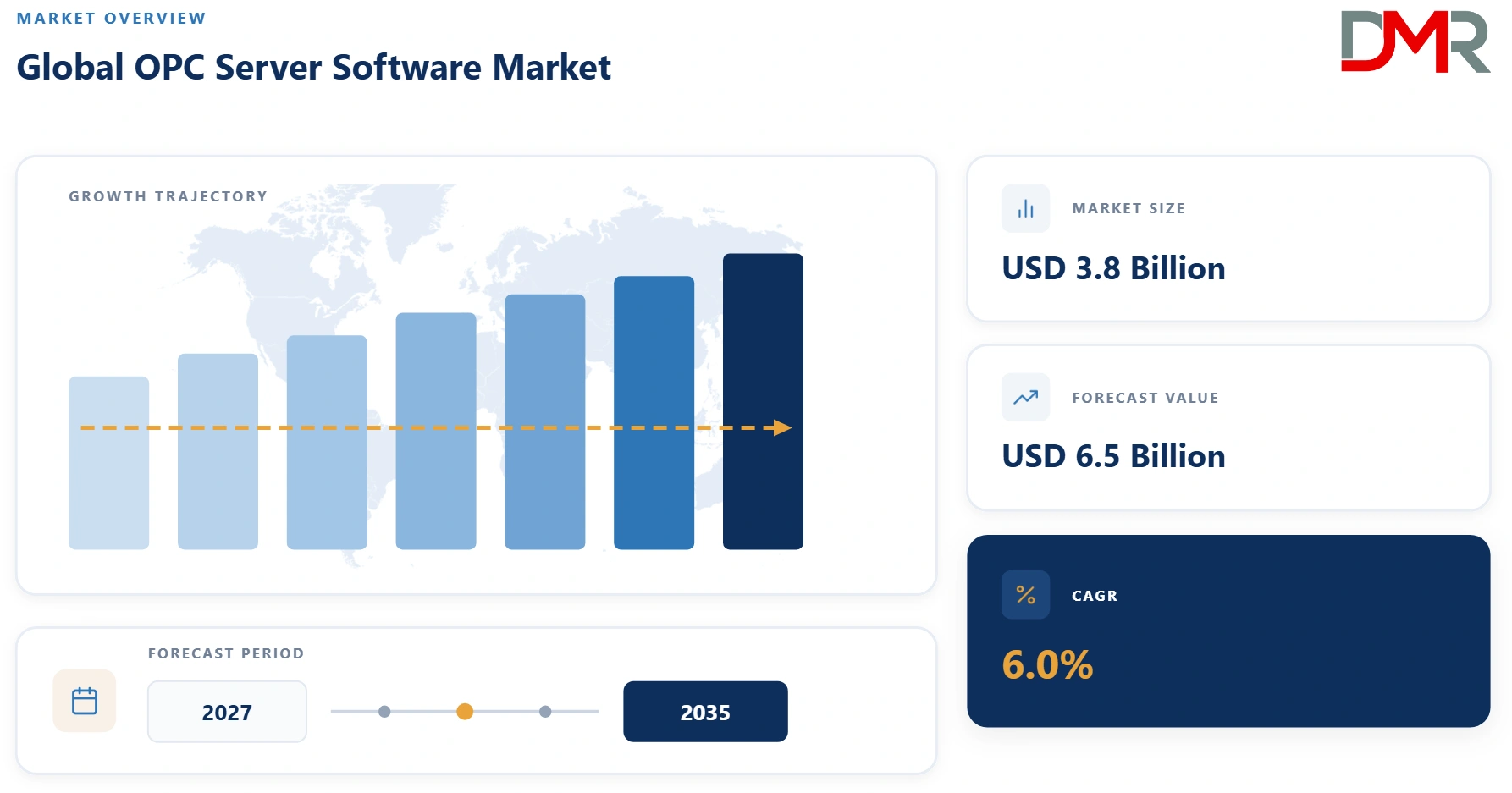
The global OPC server software market is valued at USD 3.8 billion in 2026 and is projected to reach USD 6.5 billion by 2035, growing at a CAGR of 6.0% from 2027 to 2035. Growth is driven by the spread of industrial IoT and automation, the shift from OPC Classic to OPC UA, rising demand for vendor-neutral data connectivity between plant floors and enterprise systems, and growing use of standardized industrial data for analytics and artificial intelligence.
ℹ
To learn more about this report –
Download Your Free Sample Report Here
The OPC server software market comprises software that exposes data from programmable logic controllers, drives, sensors, instruments and other automation devices through the OPC standards, so that SCADA, MES, historians, analytics and cloud applications can read and write that data without custom drivers. It spans OPC Unified Architecture (OPC UA) servers and legacy OPC Classic servers (Data Access, Historical Data Access and Alarms and Events), including standalone connectivity suites, gateways and aggregators, and embedded server stacks licensed to device makers. Revenue includes perpetual and subscription licenses, maintenance and support, and software development kits.
The OPC server software market in this report measures the value of server software and related licenses, rather than the underlying controllers, networks or the SCADA and analytics applications that consume the data. Demand comes from system integrators building plant connectivity, equipment makers embedding OPC UA in machines, and manufacturers, energy and water utilities, and process industries modernizing legacy control systems. The report covers five segments across five regions, including major national markets in each.
OPC Server Software Market Snapshot
OPC Server Software Market Snapshot, 2027-2035
| Metric |
Value |
| Market Size (2026) |
USD 3.8 Billion |
| Forecast Value (2035) |
USD 6.5 Billion |
| CAGR (2027-2035) |
6.0% |
| Largest Region (2026) |
North America, 42.5% share |
| Fastest-Growing Region (2027-2035) |
Asia Pacific, 9.0% CAGR |
| Leading Server Type (2026) |
OPC UA Servers, 72.5% share |
| Leading Application (2026) |
Data Connectivity and Integration, 35.0% share |
| Key Players |
Kepware, Siemens, Schneider Electric, AVEVA, Rockwell Automation, ABB, Honeywell, Softing, Prosys OPC |
OPC Server Software Market: Key Takeaways
- Market growth: The market is valued at USD 3.8 billion in 2026 and is expected to reach USD 6.5 billion by 2035, expanding at a 6.0% CAGR from 2027 to 2035.
- Server type leader: OPC UA Servers hold a 72.5% share of the market in 2026 and are also the fastest-growing type at an 8.0% CAGR through 2035, as buyers retire OPC Classic servers that depend on Microsoft DCOM and choose a secure, platform-independent standard.
- Fastest deployment: Cloud Hosted deployment is set to grow at an 11.5% CAGR through 2035, ahead of the overall market, as companies move industrial data into cloud analytics, although On-Premises still holds 54.0% of 2026 revenue.
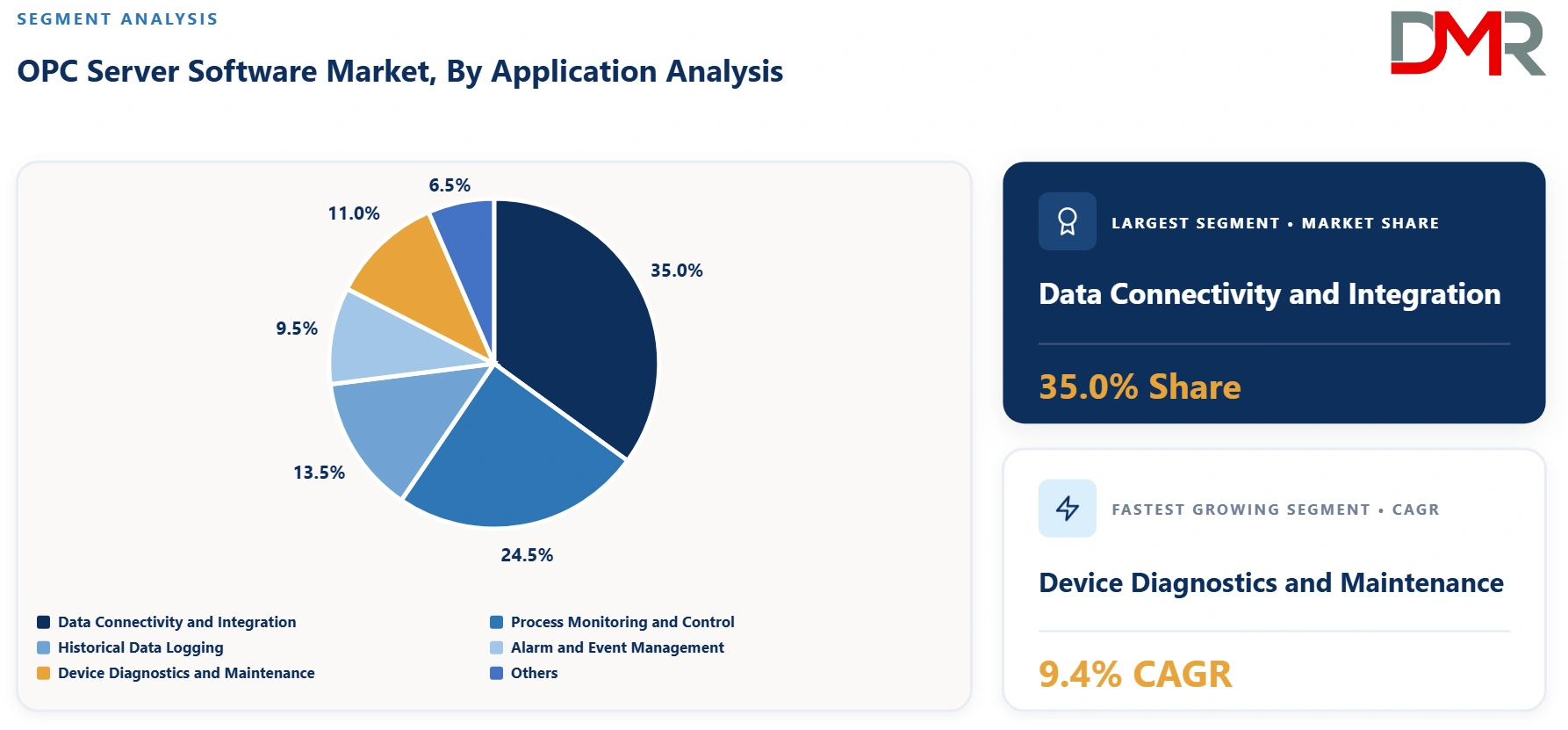
- Application leader: Data Connectivity and Integration accounts for 35.0% of 2026 demand, as plants link controllers, SCADA, MES and historians through a common interface.
- Fastest application: Device Diagnostics and Maintenance is projected to grow at a 9.4% CAGR, supported by predictive maintenance and AI models that need clean, labeled equipment data.
- Regional picture: North America leads with a 42.5% share in 2026, while Asia Pacific is the fastest-growing region at a 9.0% CAGR.
What are the Key Use Cases of OPC Server Software?
- Plant Floor to Enterprise Data Connectivity: OPC servers expose controller and device data to SCADA, MES, historians and analytics tools through one standard interface, replacing custom drivers and cutting integration time for manufacturers and system integrators.
- Legacy OPC Classic Migration and Protocol Bridging: Wrappers, gateways and aggregators let plants keep older equipment running while moving applications to OPC UA, removing dependence on DCOM and reducing security exposure.
- Edge to Cloud Industrial Data Pipelines: OPC UA servers feed edge gateways, MQTT brokers and cloud platforms with modeled equipment data, supporting remote monitoring, enterprise dashboards and unified namespace architectures.
- Predictive Maintenance and AI Ready Data: Standardized information models from OPC UA companion specifications give analytics and AI tools consistent, labeled data from pumps, drives, packaging lines and machine tools, supporting condition monitoring and quality analysis.
How are AI and Edge Computing Transforming the OPC Server Software Market?
Artificial intelligence is making the meaning of industrial data as important as the connection itself. OPC UA already carries meaning with the data through information models, and in April 2026 the OPC Foundation announced that it would convert more than 430 industry information models into AI-ready assets for engineering copilots, semantic search and intelligent automation. Vendors are following: Prosys added a Model Context Protocol interface to its OPC UA Forge 2026.1 release so that AI agents can query OPC UA data directly. At the same time, edge platforms combine OPC UA with MQTT, container deployment and store-and-forward buffering, so data is filtered and modeled near the machine before it reaches the cloud. Server vendors bundle AI, edge and cloud modules into subscription tiers, which raises revenue per site and moves competition toward model libraries, security features and ease of deployment.
OPC Server Software Market Dynamics at a Glance
Drivers, Restraints, Opportunities and Trends in the OPC Server Software Market
| Type |
Factor |
Impact |
| Driver |
Industrial IoT and Automation Expansion |
High |
| Driver |
Demand for Vendor-Neutral Interoperability |
High |
| Restraint |
Cybersecurity and Compliance Burden |
High |
| Restraint |
Legacy Integration and Pricing Pressure |
Medium |
| Opportunity |
OPC Classic to OPC UA Migration |
High |
| Opportunity |
AI-Ready and Cloud-Connected Industrial Data |
High |
| Trend |
OPC UA over MQTT and Edge Gateways |
High |
| Trend |
Embedded Stacks and Open Source Availability |
Medium |
What is Driving the Growth of the OPC Server Software Market?
Industrial IoT and Automation Expansion
Factories, utilities and process plants are connecting more machines, sensors and drives to monitoring and analytics systems as they pursue Industry 4.0 programs, and each connection needs a reliable way to move data out of controllers that speak different protocols. OPC servers provide that translation layer for SCADA, MES, historians and cloud applications. Growth in automation spending, robotics and smart manufacturing therefore lifts demand for connectivity software, while falling sensor and gateway costs let smaller plants join in. Real-time data needs in manufacturing, energy and water systems keep spending on server licenses, support and upgrades growing across all major regions.
Demand for Vendor Neutral Interoperability
Plants typically run controllers, drives and instruments from many suppliers, and buyers no longer accept proprietary drivers that lock data into one vendor. OPC UA is an international standard, IEC 62541, with built-in security, platform independence and information models developed with industry groups, which makes it the default choice in tenders and equipment specifications. Machine builders increasingly ship OPC UA as a standard interface, and system integrators rely on it to shorten commissioning. Cross-industry initiatives, such as the OPC Foundation’s 2026 liaison agreement with European standards bodies on digital product passports, add new reasons to adopt a common data layer.
What are the Key Restraints in the OPC Server Software Market?
Cybersecurity and Compliance Burden
Connecting operational technology to enterprise networks and the cloud widens the attack surface, and OPC servers sit at that boundary. Vendors must harden products, manage certificates and patch quickly, and customers in regulated sectors demand evidence of secure development. In the European Union, the Cyber Resilience Act has required manufacturers to report actively exploited vulnerabilities and severe incidents since 11 September 2026, with the wider product requirements applying from December 2027. Compliance adds engineering and legal cost, favors vendors with security teams and certification experience, and can slow releases for smaller specialists. Plant operators also delay upgrades on production lines where downtime is costly, which prolongs the life of older, less secure installations.
Legacy Integration and Pricing Pressure
Many plants still run OPC Classic servers on older Windows systems and controllers, and migrating them takes engineering effort, testing windows and skilled staff that are in short supply. At the same time, controller makers increasingly build OPC UA servers into PLC firmware, and software development kits and open-source stacks let equipment makers embed a server at low cost. These alternatives compress prices for basic connectivity and push standalone vendors to differentiate through broader driver libraries, aggregation, redundancy, security and support. Smaller plants often choose bundled or free options, which limits revenue growth even where data connectivity use is expanding.
What are the Key Opportunities in the OPC Server Software Market?
OPC Classic to OPC UA Migration
A large installed base of OPC Classic servers, built on Microsoft DCOM, is reaching the end of its useful and secure life. Plants want to modernize without replacing working controllers, which creates demand for wrappers, proxies and UA-native servers that bridge old and new systems. Vendors offer adapters that remove DCOM dependence and add security and redundancy, and integrators package migration as a project followed by a support subscription. Regulated industries such as pharmaceuticals, power and water, where downtime and audit risk are high, offer large, recurring migration contracts for suppliers with proven reliability.
AI Ready and Cloud Connected Industrial Data
Companies want to use machine data for analytics, predictive maintenance and AI assistants, but they need it modeled, labeled and delivered securely. OPC UA servers that support companion specifications, MQTT publishing, cloud libraries and AI interfaces turn raw tags into usable information, and they can be sold as premium modules. Cloud and hybrid deployments reduce the effort of connecting many sites, while edge servers filter data locally to control bandwidth cost. Vendors that combine data modeling, edge processing and strong security can expand from connectivity into broader industrial data platforms, particularly in fast-growing Asia Pacific manufacturing.
What are the Latest Trends in the OPC Server Software Market?
OPC UA over MQTT and Edge Gateways
Vendors are combining OPC UA with MQTT, REST and container-based edge software in single platforms, so one product can read from controllers, model the data and publish it to brokers and cloud services. Softing launched its SDEX Suite in 2026 to unify OPC UA, MQTT and edge functions, and Matrikon has released an enterprise data broker with built-in redundancy. The OPC Foundation continues to extend the standard into field-level communication with OPC UA FX, with certification programs and plug-fests for controllers and field devices under way. Expect connectivity, messaging and edge functions to merge into subscription platforms.
Embedded Stacks and Open Source Availability
Device makers increasingly embed OPC UA servers directly in controllers, drives and sensors, using licensed software development kits or open-source stacks. This shifts value from basic server licenses toward information models, tools, certification and long-term support. Specialists such as Prosys, Unified Automation and Matrikon supply toolkits to equipment makers, while large automation companies bundle servers with their hardware. Vendors that offer certified, well-maintained stacks and strong test tooling gain trust as security and compliance rules tighten.
Research Scope and Analysis
The report segments the OPC server software market by server type, deployment mode, end user, application, and industry vertical across five regions and key countries.
ℹ
To learn more about this report –
Download Your Free Sample Report Here
By Server Type Analysis
OPC UA Servers lead the server type segment with a 72.5% share in 2026 and are also the fastest-growing, expanding at an 8.0% CAGR from 2027 to 2035. The standard offers built-in encryption and authentication, runs on Windows, Linux and embedded systems, and carries rich information models through companion specifications, so new projects and upgrades overwhelmingly specify it. OPC Classic Servers, covering Data Access, Historical Data Access, and Alarms and Events, decline gradually as plants retire DCOM-based installations, although a long tail of legacy systems in process industries keeps maintenance and wrapper revenue alive.
By Deployment Mode Analysis
On-premises deployment accounts for 54.0% of 2026 revenue, as plants keep connectivity software close to controllers for speed, reliability and control over operational networks. Cloud-hosted deployment grows fastest at an 11.5% CAGR through 2035, helped by remote monitoring, multi-site management and cloud analytics services that consume OPC UA data. Hybrid deployment holds 28.0% of 2026 revenue, combining on-site servers with cloud management and analytics, and suits regulated and multi-plant operators.
By End User Analysis
System Integrators lead the end user segment with a 38.5% share in 2026 because they select, configure and support OPC servers inside automation and digitalization projects for manufacturers and utilities. End Users, mainly plant operators buying licenses directly, follow with 35.5%. OEMs are the fastest-growing group at an 8.0% CAGR between 2027 and 2035, as machine and equipment builders embed OPC UA servers in their products to meet customer specifications and new data-sharing requirements.
By Application Analysis
Data Connectivity and Integration leads the application segment with a 35.0% share in 2026 because moving controller data to SCADA, MES, historians and enterprise systems is the core job of an OPC server and the first project in most digitalization programs. Process Monitoring and Control follows as plants stream real-time values to operators and supervisory systems. Device Diagnostics and Maintenance is the fastest-growing application, expanding at a 9.4% CAGR from 2027 to 2035 as predictive maintenance and AI tools need standardized equipment data. Historical Data Logging and Alarm and Event Management add steady demand.
By Industry Vertical Analysis
Manufacturing holds the largest share of industry demand at 31.0% in 2026, driven by discrete and process factories connecting machines, lines and quality systems. Oil and Gas follows, led by pipeline, refinery and upstream monitoring. Power and Utilities is the fastest-growing vertical at an 8.9% CAGR from 2027 to 2035, as grid modernization, renewable plants and substation automation need standards-based data exchange. Water and Wastewater, Pharmaceuticals and Life Sciences, Food and Beverage, and Transportation and Infrastructure add steady demand.
How is the OPC Server Software Market Segmented?
By Server Type
- OPC UA Servers
- OPC Classic Servers
By Deployment Mode
- On Premises
- Cloud Hosted
- Hybrid
By End User
- System Integrators
- End Users
- OEMs
By Application
- Data Connectivity and Integration
- Process Monitoring and Control
- Historical Data Logging
- Alarm and Event Management
- Device Diagnostics and Maintenance
- Others
By Industry Vertical
- Manufacturing
- Oil and Gas
- Power and Utilities
- Water and Wastewater
- Pharmaceuticals and Life Sciences
- Food and Beverage
- Transportation and Infrastructure
- Others
Which Region Leads the OPC Server Software Market?
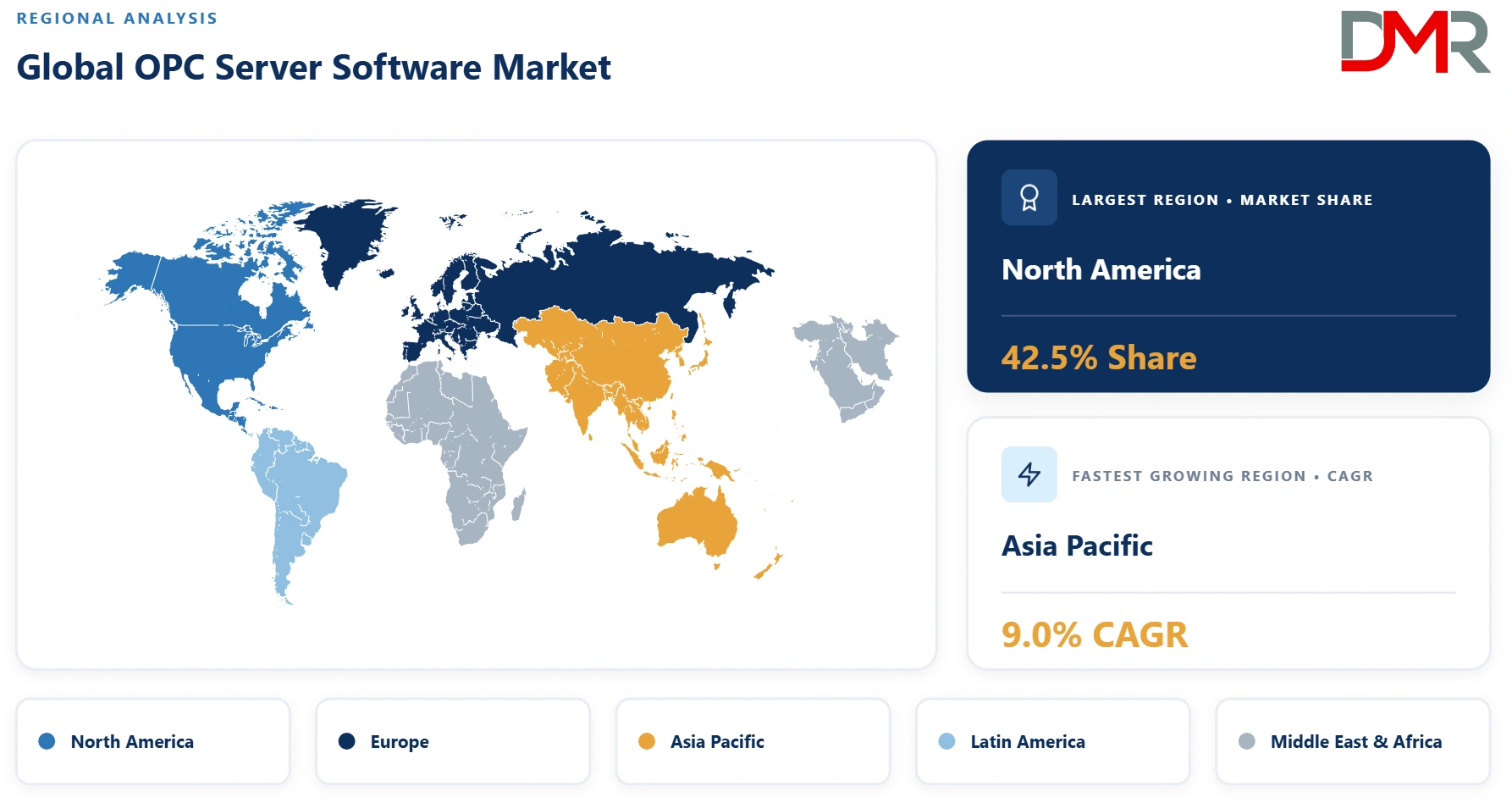
North America leads the OPC server software market with a 42.5% share in 2026, while Asia Pacific is projected to grow at a 9.0% CAGR from 2027 to 2035.
ℹ
To learn more about this report –
Download Your Free Sample Report Here
Region with the Largest Revenue Share
North America accounted for 42.5% of global revenue in 2026, supported by a large installed base of automated plants, the home markets of leading connectivity vendors such as Kepware and Inductive Automation, and strong demand from manufacturing, oil and gas, and power utilities. The United States dominates regional sales, while Canada adds steady demand from energy, mining and manufacturing, and is home to Matrikon. Industrial cybersecurity expectations and factory modernization programs sustain upgrade demand. The region should keep the largest share despite slower growth than Asia Pacific.
Region with the Highest CAGR
Asia Pacific is projected to grow at a 9.0% CAGR from 2027 to 2035, the fastest of any region. China leads regional demand through its large manufacturing base and smart factory programs, while Japan and South Korea add demand from machine builders, electronics and automotive plants that embed OPC UA in equipment. India and Australia are expanding quickly as manufacturing, power and mining operations digitalize. New factory investment, government industrial upgrade policies and the spread of machines with built-in OPC UA support adoption through 2035.
Regional Analysis
Europe OPC Server Software Market
Europe is a mature, standards-driven market led by Germany, France, the United Kingdom, Italy and Spain. The region hosts leading suppliers such as Siemens, Schneider Electric, Softing, Beckhoff and Unified Automation, and German machine builders routinely specify OPC UA in equipment. Industry 4.0 programs, the NIS2 Directive and the Cyber Resilience Act raise security expectations and favor certified, well-supported products. Growth is steady, driven by machine-builder adoption, OPC UA FX field-level communication, and digital product passport and battery passport projects.
Latin America OPC Server Software Market
Latin America is an emerging market where mining, oil and gas, food processing, and power and water utilities drive demand for plant connectivity. Brazil and Mexico generate most regional revenue, supported by automotive and manufacturing plants and nearshoring investment, with Chile, Colombia and Argentina contributing smaller volumes. Global automation suppliers and local system integrators lead sales, and most purchases come through integrator-led projects. Budget limits, currency volatility and a shortage of skilled automation staff slow upgrades, yet modernization of mines, utilities and factories supports healthy growth from a small base.
Middle East & Africa OPC Server Software Market
Middle East and Africa is a smaller but steadily modernizing market led by Saudi Arabia, the UAE and South Africa. Oil and gas, power and water utilities, and mining are the main buyers, and national industrial diversification and smart infrastructure programs add new projects in the Gulf. South Africa has a developed mining and manufacturing base adopting standards-based connectivity. Sales run mainly through international suppliers and integrators, and a shortage of local engineering skills shapes deployments. Large process plants and utilities in the Gulf create opportunities for secure, long-life server software.
By Region
North America
Europe
- Germany
- France
- The U.K.
- Italy
- Spain
- Rest of Europe
Asia-Pacific
- China
- Japan
- India
- Australia
- South Korea
- Rest of APAC
Latin America
- Mexico
- Brazil
- Rest of LATAM
Middle East & Africa
- Saudi Arabia
- The UAE
- South Africa
- Rest of MEA
Regulatory Landscape
Regulation shapes how connectivity software is built, secured and sold. OPC UA is standardized internationally as IEC 62541, and the OPC Foundation runs a certification program with a compliance test tool that has been extended to OPC UA FX and companion specifications. IEC 62443 sets security requirements for industrial automation and control systems and is widely used in procurement. In the European Union, the Cyber Resilience Act requires manufacturers of products with digital elements to report actively exploited vulnerabilities and severe incidents through a single reporting platform from 11 September 2026, with the main product requirements applying from 11 December 2027. The NIS2 Directive adds security duties for operators of essential and important services, and pharmaceutical users follow data integrity rules such as the US FDA’s 21 CFR Part 11. Vendors that certify early and document secure development can turn compliance into a sales advantage.
Investment and White Space Analysis
Capital is moving toward industrial connectivity assets as buyers see them as the entry point to industrial data platforms. TPG completed its purchase of PTC’s Kepware industrial connectivity and ThingWorx IoT businesses on 16 March 2026, and industry analysts note that it is assembling a wider industrial software portfolio that also includes Proficy. Softing, a German connectivity specialist, bought Delta Logic in 2025 to add OPC UA server products for Siemens controllers. White space remains in migration of OPC Classic installations, AI-ready information models, cloud and edge managed services, OPC UA FX field-level products, and fast-growing manufacturing markets in Asia Pacific, Latin America and the Gulf. Risks include free servers bundled with controllers, open-source alternatives, cybersecurity incidents, compliance costs, and integration of acquired products. Investors should favor assets with certified products, recurring subscription revenue, and a large installed base.
Who are the Leading Companies in the OPC Server Software Market?
The OPC server software market is moderately fragmented, with industrial automation majors, dedicated connectivity specialists, SCADA and HMI platform vendors, embedded stack suppliers and cloud providers all competing. Siemens, Schneider Electric, Rockwell Automation, ABB, Honeywell and Emerson offer OPC servers alongside their control systems, while Kepware, Softing, Matrikon, Prosys OPC, Unified Automation and Integration Objects focus on connectivity software and toolkits. Inductive Automation, AVEVA, ICONICS and COPA-DATA bundle OPC UA with SCADA and industrial IoT platforms, and Microsoft and Amazon Web Services connect OPC UA data to their cloud services.
- Kepware Technologies (Portland, US): Industrial connectivity software provider with a broad driver library and OPC UA server, owned by PTC until TPG completed its purchase of the business in March 2026.
- Siemens AG (Munich, Germany): Automation and software leader whose SIMATIC controllers, WinCC SCADA and edge products support OPC UA, giving it a large installed base across European and Asian factories.
- Schneider Electric SE (Rueil-Malmaison, France): Energy management and automation group that owns the AVEVA software business, supplying communication drivers, SCADA and historian products with OPC UA connectivity for process and power industries.
- Softing Industrial Automation GmbH (Haar, Germany): Connectivity specialist with the dataFEED OPC Suite and SDEX Suite, strengthened by the 2025 acquisition of Delta Logic and a January 2026 release that added FANUC CNC connectivity.
- Inductive Automation, LLC (Folsom, US): Developer of the Ignition platform, which includes OPC UA server and client modules and is widely used by system integrators for plant data connectivity and SCADA.
Some of the prominent players in the Global OPC Server Software Market are:
- Kepware Technologies (TPG)
- Siemens AG
- Schneider Electric SE
- AVEVA Group Limited
- Rockwell Automation, Inc.
- ABB Ltd.
- Honeywell International Inc.
- Emerson Electric Co.
- Inductive Automation, LLC
- Softing Industrial Automation GmbH
- Prosys OPC Ltd.
- Unified Automation GmbH
- Integration Objects
- Cimetrics Inc.
- Software Toolbox, Inc.
- Mitsubishi Electric Corporation (ICONICS)
- COPA-DATA GmbH
- CODESYS Group
- Beckhoff Automation GmbH & Co. KG
- Yokogawa Electric Corporation
- Omron Corporation
- Phoenix Contact GmbH & Co. KG
- Microsoft Corporation
- Amazon Web Services, Inc.
- Litmus Automation, Inc.
- Cybus GmbH
- Advantech Co., Ltd.
- Moxa Inc.
- Technosoftware AG
- Other Key Players
Recent Developments
- In March 2026, PTC completed the sale of its Kepware industrial connectivity and ThingWorx IoT businesses to TPG, moving a leading OPC server software brand to private equity ownership after the agreement announced in November 2025.
- In March 2026, Softing Industrial Automation announced the market launch of its SDEX Suite, a unified platform that combines OPC UA, MQTT and edge technologies to connect PLCs, CNC machines and IoT devices to enterprise systems.
- In April 2026, the OPC Foundation announced it would turn more than 430 industry information models into AI-ready assets for engineering copilots, semantic search and intelligent automation, extending OPC UA for agentic AI use.
- In September 2026, reporting obligations under the EU Cyber Resilience Act began to apply, requiring manufacturers of products with digital elements to report actively exploited vulnerabilities and severe incidents through a single EU reporting platform.
Report Scope and Research Methodology
Market definition: OPC server software covers software that exposes data from automation devices through the OPC standards, including OPC UA and OPC Classic servers, gateways, aggregators and embedded server stacks. It excludes controller and edge hardware, free server functions bundled in controller firmware, and general middleware not based on OPC.
Methodology: Dimension Market Research estimates the OPC Server Software Market through a combination of top-down and bottom-up research approaches, supported by published industry research, vendor revenues, product portfolios, and technology adoption patterns. Market estimates and segment-level assessments consider server type, deployment mode, end user, application, industry vertical, and regional demand. The findings are cross-validated against broader industrial software, SCADA, and industrial IoT spending patterns.
Report Details
| Report Characteristics |
Details |
| Market Size (2026) |
USD 3.8 Billion |
| Forecast Value (2035) |
USD 6.5 Billion |
| CAGR (2027-2035) |
6.0% |
| Historical Data |
2021–2026 |
| Forecast Data |
2027–2035 |
| Base Year |
2026 |
| Estimate Year |
2027 |
| Segments Covered |
By Server Type, By Deployment Mode, By End User, By Application, By Industry Vertical |
| Regional Coverage |
North America (The US, Canada); Europe (Germany, France, The UK, Italy, Spain, Rest of Europe); Asia Pacific (China, Japan, India, Australia, South Korea, Rest of APAC); Latin America (Mexico, Brazil, Rest of LATAM); Middle East & Africa (Saudi Arabia, The UAE, South Africa, Rest of MEA) |
Frequently Asked Questions
How big is the OPC Server Software Market in 2026?
▾ The global OPC server software market is valued at about USD 3.8 billion in 2026 and is projected to reach USD 6.5 billion by 2035.
What is the growth rate of the OPC Server Software Market?
▾ The market is expected to grow at a CAGR of 6.0% from 2027 to 2035, driven by industrial IoT and automation, migration to OPC UA, demand for vendor-neutral interoperability and AI-ready industrial data.
Which region leads the OPC Server Software Market?
▾ North America leads with a 42.5% share in 2026, while Asia Pacific is the fastest-growing region at a 9.0% CAGR over 2027 to 2035.
Which server type dominates the OPC Server Software Market?
▾ OPC UA Servers dominate the server type segment with a 72.5% share in 2026.
Which application is growing fastest in the OPC Server Software Market?
▾ Device Diagnostics and Maintenance is the fastest-growing application at a 9.4% CAGR from 2027 to 2035, as predictive maintenance and AI tools need standardized equipment data.
Who are the key players in the OPC Server Software Market?
▾ Key players include Kepware, Siemens, Schneider Electric, AVEVA, Rockwell Automation, ABB, Honeywell, Softing, Inductive Automation and Prosys OPC.
What are the main challenges facing the OPC Server Software Market?
▾ Main challenges include cybersecurity and regulatory compliance, migration of legacy OPC Classic installations, price pressure from free bundled and open-source servers, and a shortage of industrial automation and software skills.