Global Operations Advisory Service Market Snapshot
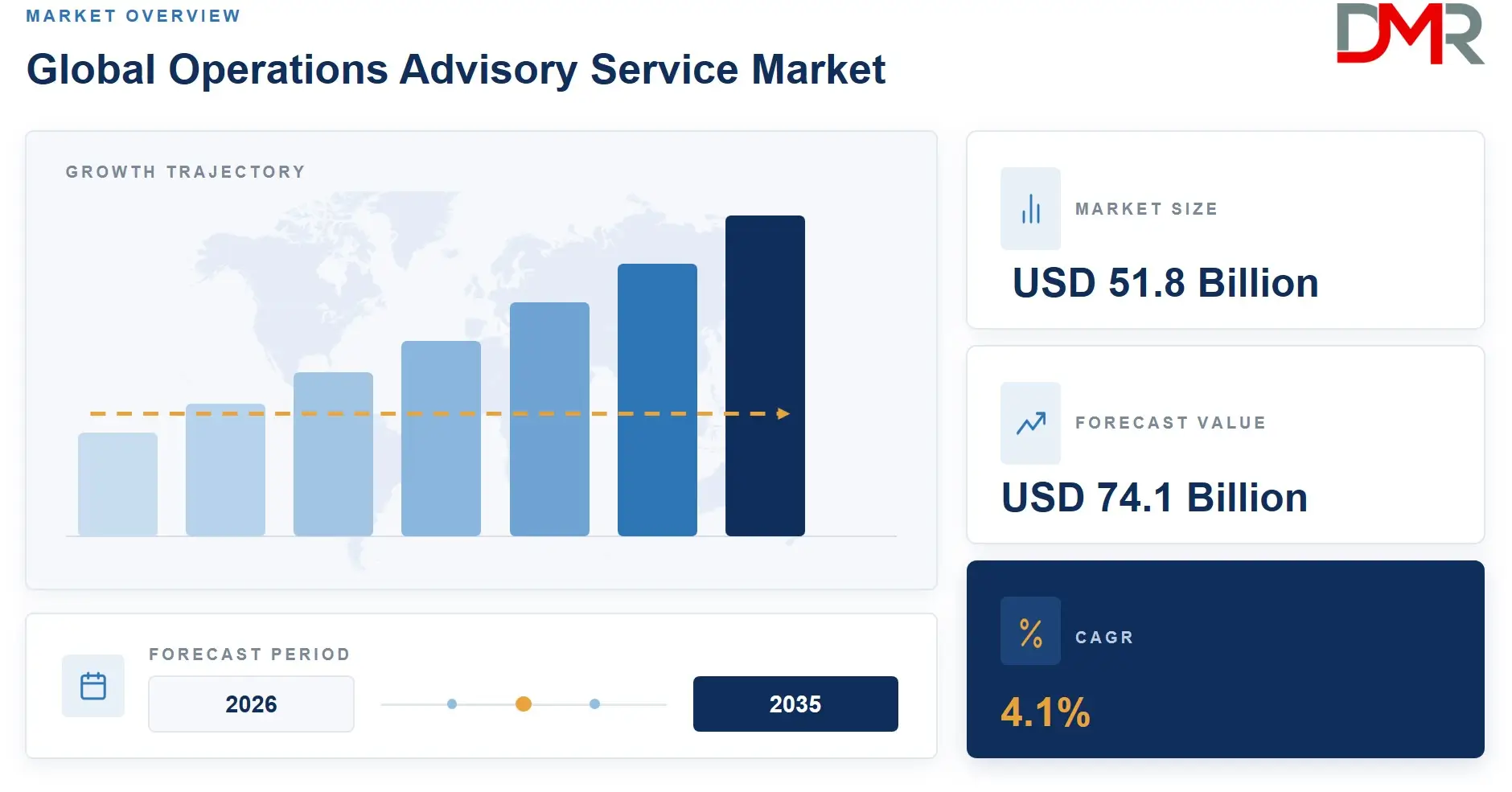
- Global Operations Advisory Service Market Size in 2026: USD 51.8 Billion
- Global Operations Advisory Service Market Size in 2035: USD 74.1 Billion
- Global CAGR, 2026-2035: 4.1%
- Leading Service Type: Process Optimization & Improvement, 27%
- Leading Organization Size: Large Enterprises, 69%
- Leading Industry: Manufacturing, 24%
- Fastest-Growing Service Type: Technology & Digital Operations Advisory, 6.8% CAGR
- Leading Region: North America, 35%
- Fastest-Growing Region: Asia-Pacific, 6.0% CAGR
What is the Global Operations Advisory Service and its Market Size?
Operations advisory services comprise professional consulting and transformation support designed to improve how organizations plan, source, manufacture, distribute, govern, and continuously optimize their business operations. Services typically span operating-model design, process optimization, supply-chain and procurement advisory, productivity improvement, workforce transformation, digital operations, risk and resilience, and performance management.
ℹ
To learn more about this report –
Download Your Free Sample Report Here
The global operations advisory service market is estimated at approximately USD 51.8 billion in 2026, increasing to around USD 74.1 billion by 2035, representing approximately 4.1% CAGR over the forecast period. This outlook is consistent with published estimates placing the market at $49.77 billion in 2025 and $74.09 billion in 2035.
Growth is being supported by persistent pressure to reduce operating costs while simultaneously improving resilience, customer experience, speed, and regulatory compliance. Digital transformation is shifting advisory engagements away from static recommendations toward implementation-oriented operating-model redesign. AI, advanced analytics, automation, cloud platforms, digital twins, and real-time supply-chain intelligence are increasingly embedded into operations transformation programs.
Use Cases
- Process Optimization: Redesigning workflows, eliminating bottlenecks, reducing cycle times, and improving operating productivity.
- Supply Chain Transformation: Optimizing networks, inventory, procurement, logistics, planning, and supplier relationships.
- Digital Operations: Integrating AI, automation, analytics, cloud platforms, and digital twins into operating processes.
- Operating Model Design: Aligning organizational structures, governance, processes, technology, and performance-management systems.
- Risk & Resilience: Preparing organizations for geopolitical disruption, supplier failures, cyber risks, tariffs, and operational shocks.
- Workforce Transformation: Redesigning jobs, capabilities, incentives, and workforce structures around increasingly automated operations.
Key Takeaways
- The global operations advisory service market is estimated at USD 51.8 billion in 2026 and is projected to reach approximately USD 74.1 billion by 2035.
- Process optimization and improvement remains the largest service category because cost reduction and productivity remain universal executive priorities.
- Technology and digital operations advisory is expected to grow fastest as companies move from AI experimentation toward enterprise-scale deployment.
- Large enterprises remain the principal buyers because complex global operations create greater demand for specialized transformation expertise.
- Manufacturing is the largest industry application, supported by supply-chain complexity, automation, reshoring, quality, and Industry 4.0 investments.
- North America remains the largest regional market, while Asia-Pacific is expected to grow fastest because of industrialization, digitalization, and supply-chain investment.
How AI/Gen AI is Transforming the Operations Advisory Service Market?
AI is changing operations advisory from periodic diagnostic consulting toward continuous, data-driven decision support. Consultants increasingly deploy predictive analytics, generative AI, agentic AI, process mining, digital twins, intelligent automation, and supply-chain control towers to identify inefficiencies and simulate operational changes. McKinsey describes GenAI and agentic AI as major forces reshaping productivity, resilience, supply chains, and operational work.
The primary benefits are faster decision-making, improved forecasting, lower manual workload, better resource allocation, enhanced visibility, and potentially lower operating costs. KPMG highlights AI-enabled scenario modeling, real-time decision-making, automated execution, and redesigned workforce roles as emerging characteristics of intelligent supply chains.
Technology is also changing competitive differentiation. Advisory firms increasingly compete on proprietary platforms, data assets, AI accelerators, ecosystem partnerships, and measurable implementation outcomes rather than traditional strategy expertise alone. This favors large multidisciplinary firms capable of combining consulting, technology implementation, managed services, and industry specialization.
Key Drivers in the Global Operations Advisory Service Market
Accelerating Digital Transformation and AI Adoption
Organizations are under increasing pressure to translate investments in cloud, automation, AI, analytics, and enterprise software into measurable operational improvements. Technology deployments frequently expose process weaknesses, fragmented data, inconsistent governance, and organizational barriers that require specialized advisory intervention.
Rising Need for Resilient and Cost-Efficient Operations
Global supply-chain disruption, tariffs, geopolitical fragmentation, labor shortages, inflation, and changing customer expectations are forcing companies to reconsider traditional operating models. Organizations increasingly seek external expertise to redesign supply networks, optimize working capital, diversify suppliers, improve manufacturing footprints, and develop scenario-based resilience strategies.
Restraints in the Global Operations Advisory Service Market
High Consulting Costs and Availability of Internal Capabilities
Large-scale operations transformation programs can require substantial advisory fees, technology investments, implementation resources, and management attention. Enterprises with mature internal strategy, transformation, procurement, or operational-excellence teams may choose to conduct projects internally, limiting external consulting spend.
Growth Opportunities in the Global Operations Advisory Service Market
AI-Enabled and Autonomous Operations Advisory
The transition from conventional analytics to GenAI and agentic AI creates one of the largest opportunities in the market. Organizations require assistance defining AI use cases, redesigning workflows, establishing governance, preparing data, evaluating ROI, and managing workforce impacts.
Resilient Supply Chains and Sustainable Operations
Companies increasingly require integrated approaches covering supply-chain resilience, sustainability, energy efficiency, procurement risk, network design, and operational continuity. The combination of geopolitical volatility and decarbonization requirements creates demand for scenario modeling and network optimization.
Trends in the Global Operations Advisory Service Market
From Project-Based Consulting Toward Continuous Operations Transformation
Operations advisory is increasingly shifting from isolated diagnostic studies toward multi-year transformation programs and continuous-improvement relationships. Clients want consultants to remain involved through implementation, measurement, technology adoption, and capability building.
Convergence of Operations Consulting and Technology
The historical distinction between management consulting and technology consulting is becoming less pronounced. Leading firms increasingly combine strategy, operating-model redesign, software implementation, AI, data engineering, and managed services.
Research Scope and Analysis
The market is segmented By Service Type, By Organization Size, By Industry, By Engagement Model, and By End User. The estimates below are analyst-derived within the published operations-advisory market definition and should be treated as directional rather than audited market shares.
ℹ
To learn more about this report –
Download Your Free Sample Report Here
By Service Type Analysis
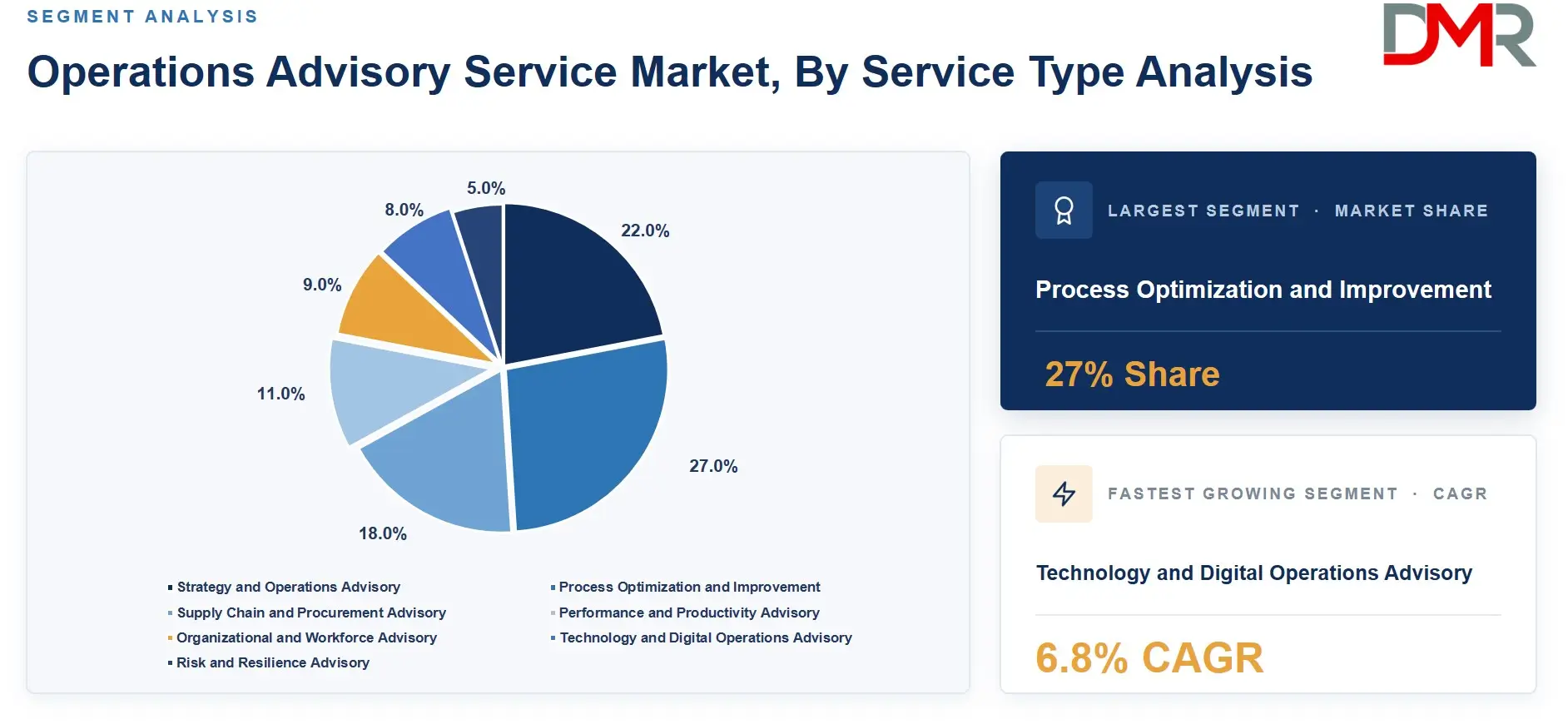
Process Optimization and Improvement is estimated to remain the dominant service category in 2026, accounting for approximately 27% of global revenue. Its leadership reflects persistent demand for lean management, process redesign, productivity improvement, and cost reduction across virtually every industry. Strategy and Operations Advisory represents the second-largest category at approximately 22%, as organizations increasingly integrate corporate strategy with operating-model decisions. Technology and Digital Operations Advisory is expected to be the fastest-growing service category, with an estimated 6.8% CAGR, supported by AI, cloud modernization, automation, process mining, digital twins, and data-driven operations. Supply Chain and Procurement Advisory represents approximately 18%, while Performance and Productivity Advisory, Organizational and Workforce Advisory, and Risk and Resilience Advisory account for the remainder. The service mix is increasingly converging as clients expect advisory firms to connect operational redesign with technology deployment and measurable business outcomes.
By Organization Size Analysis
Large Enterprises are estimated to account for approximately 69% of the market in 2026, making them the dominant customer segment. Multinational corporations face greater operational complexity across geographies, business units, suppliers, regulatory regimes, and technology environments, increasing the need for specialist external expertise. Large enterprises also possess the budgets required for multi-year transformation programs and enterprise-wide operating-model redesign. Small and Medium-sized Enterprises account for approximately 31% but represent a significant long-term growth opportunity. SMEs increasingly need access to affordable digital operations, supply-chain optimization, procurement, and process-improvement capabilities. SME demand is expected to grow as advisory firms productize services using AI diagnostics, standardized benchmarking, cloud tools, and subscription-based consulting. The increasing availability of remote consulting and technology-enabled advisory delivery should further reduce the historical cost barrier for smaller organizations.
By Industry Analysis
Manufacturing is estimated to lead the industry segmentation with approximately 24% of 2026 market revenue. Manufacturing companies have extensive requirements for production optimization, supply-chain redesign, procurement, quality management, workforce productivity, automation, and digital-factory transformation. Financial Services represents the second-largest segment at roughly 16%, driven by process modernization, regulatory requirements, operating-model redesign, cost optimization, and digital banking transformation. Healthcare and Life Sciences is expected to be among the fastest-growing industries, with demand supported by complex supply chains, cost pressures, digital health adoption, workforce constraints, and regulatory requirements. Retail and Consumer Goods, Energy and Utilities, IT and Telecommunications, Government and Public Sector, and Transportation and Logistics also represent substantial demand pools. Digital operations and AI adoption are reducing industry boundaries because similar technologies automation, predictive analytics, AI agents, and process intelligence can be applied across sectors.
By Engagement Model Analysis
Project-Based Advisory is estimated to account for approximately 72% of 2026 market revenue and remains the dominant engagement model. Project-based contracts are suitable for discrete activities such as supply-chain redesign, operating-model transformation, procurement optimization, restructuring, process improvement, and technology-readiness assessments. Retainer-Based Advisory accounts for approximately 28% but is expected to expand more quickly as clients seek continuous performance monitoring and transformation support. Retainers are particularly attractive for organizations that require ongoing benchmarking, risk monitoring, AI governance, operational analytics, or supply-chain intelligence. The gradual shift toward recurring advisory relationships reflects the transition from one-time strategy projects toward continuous improvement. Advisory firms that can combine recurring analytics with periodic transformation projects are positioned to increase client lifetime value while reducing revenue volatility.
By End User Analysis
Corporate Enterprises represent the dominant end-user category, estimated at approximately 71% of 2026 revenue. Corporate buyers use operations advisory services to improve productivity, reduce costs, redesign supply chains, integrate technology, and improve resilience. Government Agencies account for an estimated 17%, supported by public-sector modernization, procurement transformation, digital government, infrastructure programs, and pressure to improve service efficiency. Private Equity and Investment Firms represent approximately 12% and are an important high-value customer group because operational due diligence and post-acquisition value creation can generate significant advisory demand. Private-equity-backed companies frequently require rapid procurement improvement, working-capital optimization, supply-chain redesign, operating-model restructuring, and performance management. Over the forecast period, investment firms are expected to increasingly use operations advisors before acquisitions as well as during portfolio-company transformation.
The Global Operations Advisory Service Market Report is segmented on the basis of the following:
By Service Type
- Strategy and Operations Advisory
- Process Optimization and Improvement
- Supply Chain and Procurement Advisory
- Performance and Productivity Advisory
- Organizational and Workforce Advisory
- Technology and Digital Operations Advisory
- Risk and Resilience Advisory
By Organization Size
- Large Enterprises
- Small and Medium-sized Enterprises
By Industry
- Financial Services
- Healthcare and Life Sciences
- Manufacturing
- Retail and Consumer Goods
- Energy and Utilities
- IT and Telecommunications
- Government and Public Sector
- Transportation and Logistics
- Other Industries
By Engagement Model
- Project-Based Advisory
- Retainer-Based Advisory
By End User
- Corporate Enterprises
- Government Agencies
- Private Equity and Investment Firms
Regional Analysis
North America is the Leading Region in the Global Operations Advisory Service Market
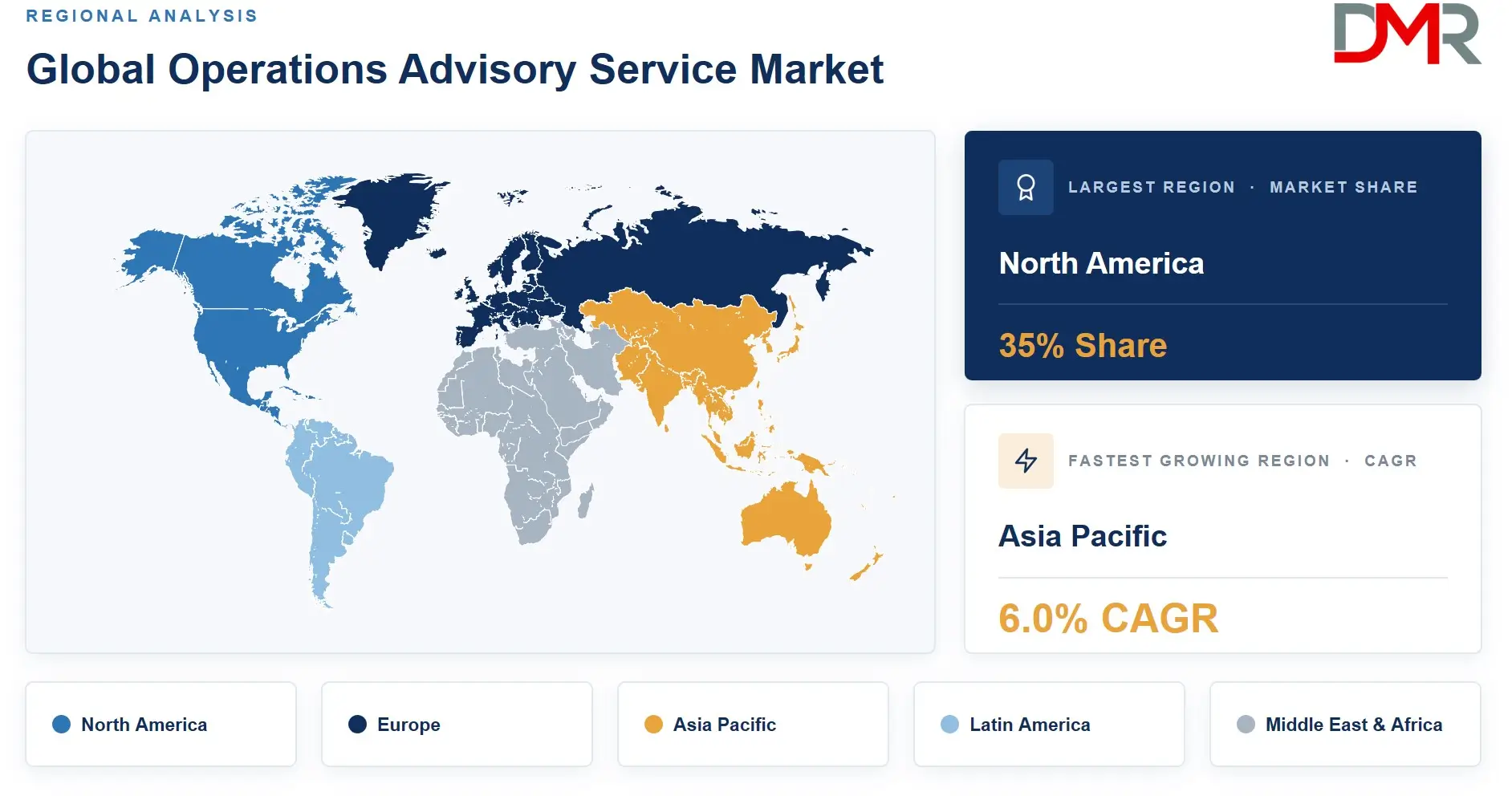
North America is expected to remain the leading regional market, representing approximately 35% of global revenue in 2026, or about USD 18.1 billion. The region benefits from a high concentration of multinational enterprises, advanced technology adoption, sophisticated capital markets, mature consulting ecosystems, and strong demand for AI-enabled transformation. The United States accounts for the majority of regional spending. Operations advisory demand is particularly strong in technology, financial services, healthcare, manufacturing, retail, logistics, and energy. Supply-chain restructuring, AI adoption, cost optimization, workforce transformation, and regulatory complexity are major demand drivers. Published operations-consulting research likewise identifies North America as the largest regional market.
ℹ
To learn more about this report –
Download Your Free Sample Report Here
Asia Pacific is the Fastest-Growing Region in the Global Operations Advisory Service Market
Asia-Pacific is projected to be the fastest-growing region, with an estimated 6.0% CAGR through 2035. Growth is being driven by industrialization, expanding manufacturing ecosystems, supply-chain diversification, digital transformation, infrastructure investment, and increasing adoption of cloud and AI technologies. China, India, Japan, South Korea, ASEAN economies, and Australia are important demand centers. India is particularly attractive for operations advisory because enterprises are simultaneously investing in global capability centers, digital transformation, supply-chain modernization, and productivity improvement. Published operations-consulting research also identifies Asia-Pacific as the fastest-growing region.
The Europe Operations Advisory Service Market
The European operations advisory service market is estimated at approximately USD 14.0 billion in 2026, rising to approximately USD 18.6 billion by 2035, representing an estimated 3.3% CAGR. Demand is shaped by industrial competitiveness, energy costs, sustainability requirements, supply-chain resilience, AI adoption, manufacturing modernization, and increasingly complex digital regulation. Germany, the U.K., France, Italy, Spain, Benelux, and Nordic economies are major markets. Europe's regulatory environment is also creating demand for AI governance, data management, process controls, and compliance-oriented operating-model advisory.
Latin America Operations Advisory Service Market
Latin America is estimated at approximately USD 3.0 billion in 2026 and is projected to reach around USD 4.3 billion by 2035, representing approximately 4.1% CAGR. Brazil and Mexico are the largest markets, supported by manufacturing, consumer goods, financial services, energy, mining, logistics, and infrastructure activity. Nearshoring and supply-chain diversification are particularly important opportunities for Mexico, while Brazil provides a broad market for procurement, operational efficiency, technology modernization, and productivity advisory.
MEA Operations Advisory Service Market
The Middle East and Africa market is estimated at approximately USD 2.4 billion in 2026, increasing to roughly USD 3.8 billion by 2035, representing approximately 5.2% CAGR. Saudi Arabia and the UAE lead regional demand, supported by economic diversification, infrastructure investment, digital transformation, energy transition, tourism, logistics, and public-sector modernization. Africa presents longer-term opportunities in financial services, telecommunications, manufacturing, logistics, healthcare, and public-sector transformation.
Major Countries Analysis
United States Operations Advisory Service Market
The U.S. market is estimated at approximately USD 15.8 billion in 2026 and is projected to reach approximately USD 22.6 billion by 2035, implying around 4.1% CAGR. AI adoption, supply-chain restructuring, manufacturing investment, technology modernization, healthcare transformation, and productivity pressure are major demand drivers. AI-enabled operations is becoming a central competitive differentiator among advisory firms.
Japan Operations Advisory Service Market
Japan is estimated at approximately USD 2.7 billion in 2026, reaching about USD 3.9 billion by 2035, or approximately 4.2% CAGR. Demand is supported by labor shortages, automation, robotics, manufacturing modernization, supply-chain resilience, and digital transformation. Japan's industrial base makes manufacturing and technology-enabled operations particularly important advisory segments.
Saudi Arabia Operations Advisory Service Market
Saudi Arabia is estimated at approximately USD 0.7 billion in 2026, rising to around USD 1.3 billion by 2035, representing approximately 7.0% CAGR. Vision-led economic diversification, large infrastructure programs, tourism, logistics, energy transformation, public-sector modernization, and development of new industries are creating significant demand for operating-model, procurement, supply-chain, workforce, and digital operations advisory.
Regulatory Landscape
Operations advisory firms generally face fewer sector-specific restrictions than regulated financial or healthcare providers, but their work increasingly intersects with privacy, cybersecurity, AI governance, employment, sustainability, procurement, and industry-specific regulation. The EU AI Act is especially important because major provisions and enforcement began applying from 2 August 2026, while high-risk-system obligations have subsequent application dates. India's Digital Personal Data Protection Rules 2025, notified on 14 November 2025, establish an increasingly important framework for handling personal data in digitally enabled transformation programs. Consultants therefore increasingly need capabilities covering AI governance, data lineage, model risk, privacy, cybersecurity, third-party risk, and regulatory operating models.
Investment and White Space Analysis
The strongest investment opportunities are concentrated in AI-enabled operations, supply-chain intelligence, procurement transformation, autonomous planning, digital twins, operational resilience, and mid-market advisory platforms. The market remains relatively fragmented beneath the largest global firms, creating opportunities for specialist providers with deep vertical expertise and technology assets. Asia-Pacific, the Middle East, and selected Latin American markets provide attractive geographic white spaces. Productized advisory combining standardized diagnostics, benchmarking, AI analytics, and human consulting could unlock underserved SME demand. Private-equity portfolio operations, healthcare supply chains, industrial automation, and climate-resilient operations are additional high-potential niches.
By Region
North America
Europe
- Germany
- France
- The U.K.
- Italy
- Spain
- Rest of Europe
Asia-Pacific
- China
- Japan
- India
- Australia
- South Korea
- Rest of APAC
Latin America
- Mexico
- Brazil
- Rest of LATAM
Middle East & Africa
- Saudi Arabia
- The UAE
- South Africa
- Rest of MEA
Competitive Landscape
The operations advisory market is moderately consolidated at the global tier but highly fragmented overall, with large multidisciplinary professional-services firms competing alongside strategy firms, technology consultancies, specialist operations boutiques, and independent advisors. Key players include Accenture, Deloitte, PwC, EY, KPMG, McKinsey & Company, Boston Consulting Group, Bain & Company, Kearney, Oliver Wyman, IBM, Capgemini, Cognizant, Infosys, and TCS.
Competition is increasingly based on a combination of industry expertise, measurable operational outcomes, AI capabilities, proprietary assets, implementation capacity, global delivery networks, and technology partnerships. M&A and alliances are becoming important because firms want to combine traditional operational-excellence capabilities with AI, automation, data, cloud, and software expertise.
Some of the prominent players in the Global Operations Advisory Service Market are:
- Accenture
- Deloitte
- PwC
- EY
- KPMG
- McKinsey & Company
- Boston Consulting Group
- Bain & Company
- Oliver Wyman
- Roland Berger
- Kearney
- Capgemini
- IBM Consulting
- Cognizant
- Infosys Consulting
- Tata Consultancy Services
- Wipro
- HCLTech
- NTT DATA
- CGI
- Booz Allen Hamilton
- Alvarez & Marsal
- Arthur D. Little
- FTI Consulting
- Protiviti
- Mercer
- Korn Ferry
- Guidehouse
- West Monroe
- Slalom
- Grant Thornton
- RSM International
- BDO
- BearingPoint
- PA Consulting
- Hitachi Consulting
- L.E.K. Consulting
- Simon-Kucher
- A.T. Kearney
- Other Key Players
Recent Developments
- In July 2026, EY US expanded its strategic alliance with SymphonyAI into manufacturing and supply-chain intelligence, integrating industrial AI capabilities into EY's operations-transformation offering and reinforcing the shift toward AI-native enterprise operations.
- In June 2026, Accenture agreed to acquire Industries eXcellence Group from Engineering Group, strengthening its software, automation, data and AI capabilities for manufacturing, product development, production and supply-chain operations.
- In May 2026, Accenture invested in Aera Technology, combining Aera's agentic decision intelligence with Accenture's supply-chain capabilities to enable AI-led real-time decision-making across complex global supply chains.
- In April 2026, EY advanced its autonomous supply-chain planning proposition, emphasizing integrated AI-driven planning across demand, supply, inventory, capacity and execution rather than isolated planning automation.
- In June 2025, Accenture reorganized its growth model around Reinvention Services, integrating Strategy, Consulting, Technology and Operations capabilities to deliver more integrated AI-enabled enterprise transformation.
- In February 2025, Accenture agreed to acquire Staufen AG, strengthening operational-excellence and manufacturing/supply-chain transformation capabilities, particularly across European industrial sectors.
Report Details
| Report Characteristics |
| Market Size (2026) |
USD 51.8 Bn |
| Forecast Value (2035) |
USD 74.1 Bn |
| CAGR (2026–2035) |
4.1% |
| The US Market Size (2026) |
USD 15.8 Bn |
| Historical Data |
2021 – 2025 |
| Forecast Data |
2026 – 2035 |
| Base Year |
2025 |
| Segments Covered |
By Service Type, By Organization Size, By Industry, By Engagement Model, By End User |
| Regional Coverage |
North America – The US and Canada; Europe – Germany, France, The UK, Italy, Spain, Rest of Europe; Asia-Pacific – China, Japan, India, Australia, South Korea, Rest of APAC; Latin America – Mexico, Brazil, Colombia, Argentina, Rest of LATAM; Middle East & Africa – Saudi Arabia, The UAE, South Africa, Rest of MEA |
Frequently Asked Questions
What is the global Operations Advisory Service Market size in 2026?
▾ The global Operations Advisory Service Market is estimated to reach approximately USD 51.8 billion in 2026, supported by demand for process optimization, digital transformation, and operational resilience.
What will be the Operations Advisory Service Market size by 2035?
▾ The global Operations Advisory Service Market is projected to reach approximately USD 74.1 billion by 2035, reflecting sustained demand for operational transformation and technology-enabled advisory services.
What is the CAGR of the Operations Advisory Service Market from 2026 to 2035?
▾ The global Operations Advisory Service Market is expected to expand at approximately 4.1% CAGR from 2026 to 2035, driven by digitalization, AI adoption, and supply-chain transformation.
What are the key factors driving the Operations Advisory Service Market?
▾ The Operations Advisory Service Market is driven by AI adoption, digital transformation, cost optimization, supply-chain disruption, workforce shortages, regulatory complexity, and growing demand for resilient operating models.
What are the major trends shaping the Operations Advisory Service Market?
▾ Major Operations Advisory Service Market trends include AI-enabled operations, autonomous decision-making, digital twins, intelligent automation, continuous transformation, predictive analytics, and the integration of consulting with technology implementation.
Which region dominates the global Operations Advisory Service Market?
▾ North America dominates the global Operations Advisory Service Market, accounting for approximately 35% of the global market in 2026, supported by advanced technology adoption and high enterprise consulting expenditure.
Which region is expected to be the fastest-growing in the Operations Advisory Service Market?
▾ Asia-Pacific is expected to be the fastest-growing region in the Operations Advisory Service Market, with an estimated 6.0% CAGR, driven by industrialization, digital transformation, and supply-chain investment.
Who are the key players in the Operations Advisory Service Market?
▾ Key players in the Operations Advisory Service Market include Accenture, Deloitte, PwC, EY, KPMG, McKinsey & Company, BCG, Bain & Company, Kearney, IBM, Capgemini, Cognizant, Infosys, and TCS.