Market Snapshot
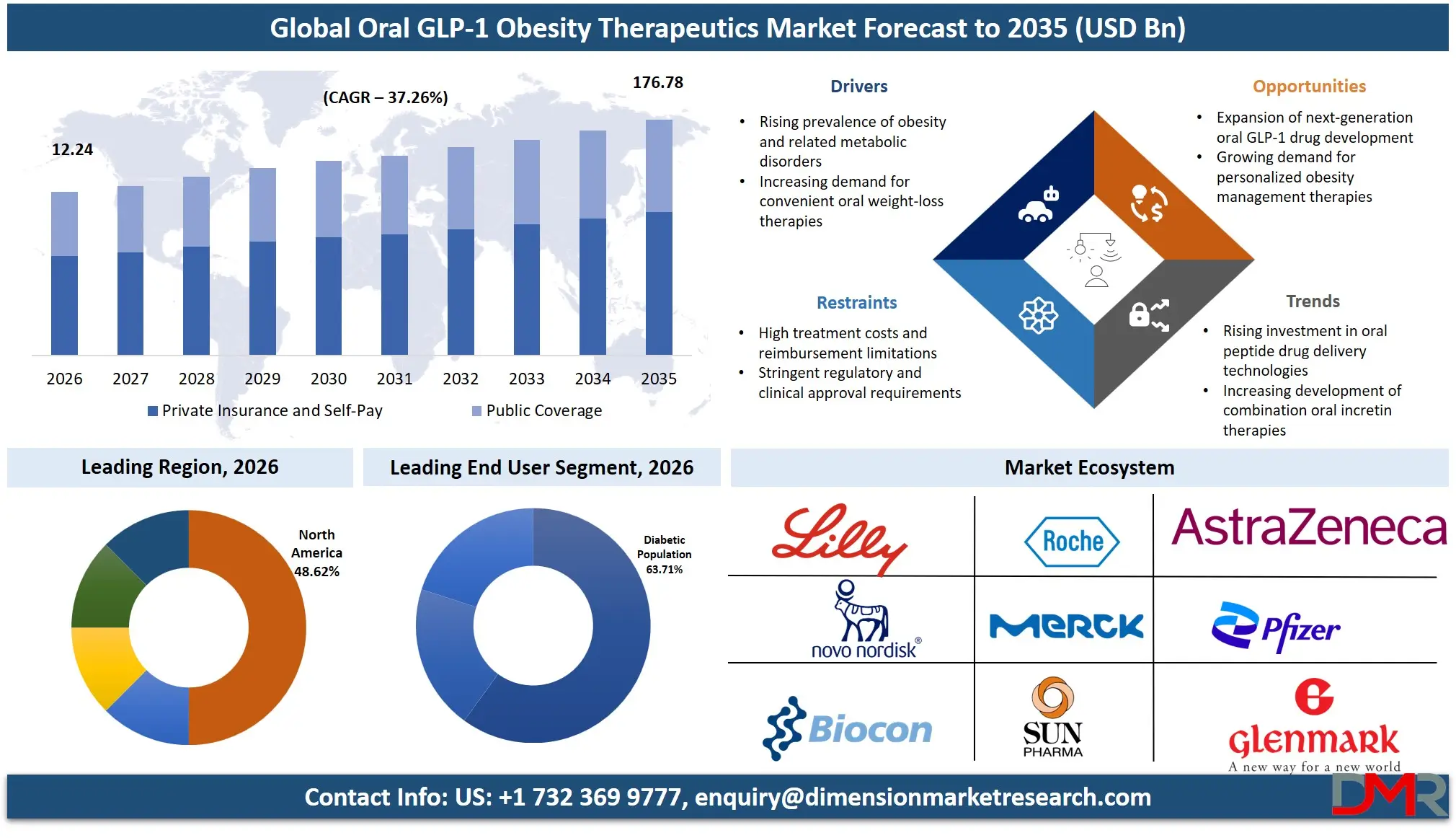
- The Oral GLP-1 Obesity Therapeutics Market size is USD 8.92 Billion in 2025, reached USD 12.24 Billion in 2026, and is projected to hit USD 176.78 Billion by 2035 at a CAGR of 37.26%.
- Oral Peptide GLP-1 Agonists held the dominant drug type position with a 68.5% share in 2026.
- Semaglutide (Oral Formulation) led the By Molecule segment with a 70.62% share in 2026.
- North America dominated regionally with a 48.62% share in 2026.
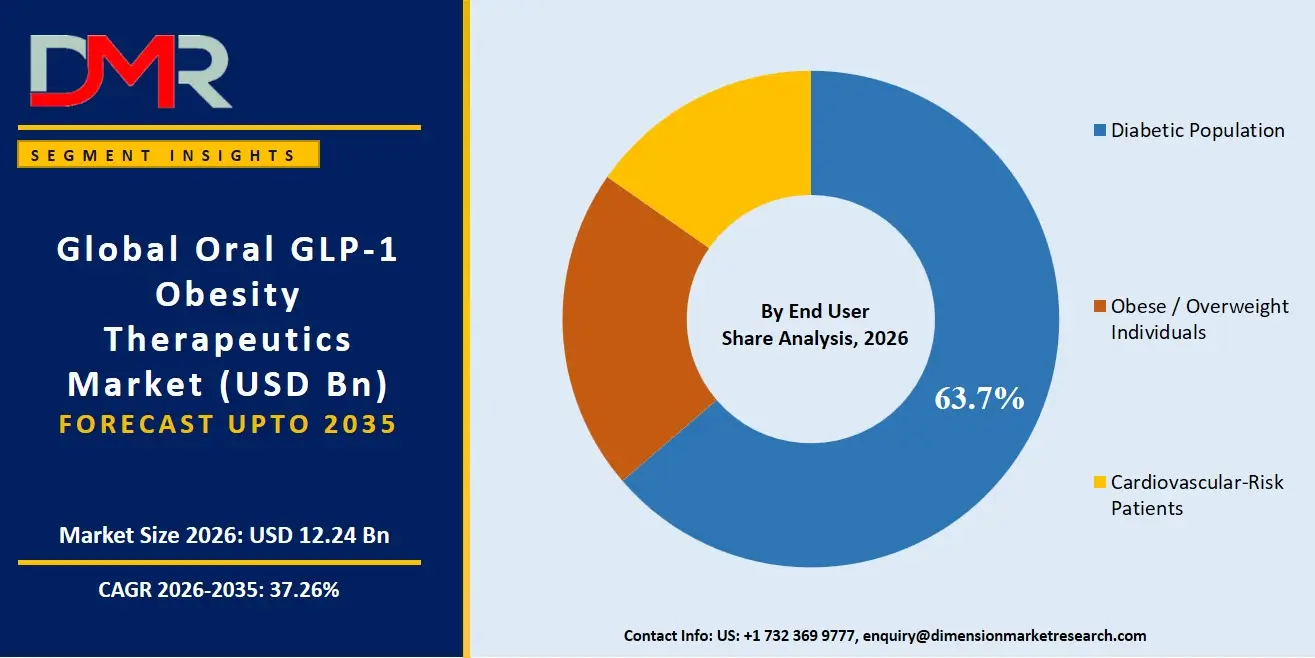
- The Diabetic Population end-user segment held a 63.71% share, while Weight Management use-case framing accounted for 86.54% of demand.
- Private Insurance and Self-Pay payers represented 72.9% of the payer mix in 2026.
- Hospital and Specialty Clinics led distribution with a 54.82% share.
Market Overview
The Global Oral GLP-1 Obesity Therapeutics Market covers prescription glucagon-like peptide-1 receptor agonists delivered orally for chronic weight management and metabolic disease treatment. Oral peptide formulations such as semaglutide tablets and small-molecule non-peptide candidates such as orforglipron define the product scope. The market excludes injectable GLP-1 products, combination biologics without a primary oral delivery mechanism, and surgical or device-based obesity interventions. That boundary matters commercially: injectable exclusion means Oral GLP-1 Obesity Therapeutics Market captures the incremental patient cohort that the broader GLP-1 category has historically failed to reach.
ℹ
To learn more about this report –
Download Your Free Sample Report Here
As reported by J.P. Morgan, GLP-1 therapies reached only about 7% of diabetes patients and 2% of the obese population globally as of 2025. Oral delivery removes the injection and cold-chain requirements that contained adoption within specialist settings. Roche's December 2023 acquisition of Carmot Therapeutics for $2.7 Billion signaled how early strategic capital recognized the oral delivery layer as a distinct and high-value sub-market within the broader GLP-1 space. The depth of that penetration gap is the commercial opportunity that justifies both the market's starting valuation and the volume of pipeline entrants now competing for position.
The oral format serves a structural connectivity role between the broader obesity therapeutics industry and the GLP-1 drug class. Bariatric surgery volumes, behavioral therapy programs, and anti-obesity medication categories all converge on the same patient population. Oral GLP-1 candidates occupy the compliance-friendly middle ground that surgery bypasses and injectable therapy complicates. Manufacturers building out oral pipelines are not simply substituting one delivery route for another; they are expanding the accessible patient base by an order of magnitude.
Market Size and Forecast
The Global Oral GLP-1 Obesity Therapeutics Market size is estimated at USD 12.24 Billion in 2026 from USD 8.92 Billion in 2025, and is projected to reach USD 176.78 Billion by 2035, exhibiting a CAGR of 37.26% during the forecast period.
Two commercial events in early 2026 moved Oral GLP-1 Obesity Therapeutics Market from clinical validation to mass deployment within a single quarter. Novo Nordisk's WEGOVY pill achieved wide U.S. availability in January 2026 as the first oral GLP-1 approved specifically for weight loss in adults. The FDA then approved Eli Lilly's FOUNDAYO (orforglipron) on April 1, 2026, making it the first small-molecule oral GLP-1 cleared for obesity, ending the injectable category's monopoly on GLP-1 weight management at once. These back-to-back launches compressed what might otherwise have been a three-year ramp into a single calendar-year step-change in prescription volume.
Clinical efficacy data provides the patient-volume floor for the forecast. As reported by the New England Journal of Medicine, 85% of OASIS 1 participants on oral semaglutide 50 mg achieved at least 5% weight loss, compared to 26% in the placebo group. Data published by IQVIA confirmed over 193 obesity drug assets in active development as of October 2025, up from 181 in May 2025, a pipeline density that sustains label expansions and new approvals well into the 2030 horizon. The forecast is anchored on payer coverage expansion, pipeline conversion rates, and ex-U.S. commercialization acceleration rather than any single product assumption.
The downside scenario centers on payer contraction, not clinical performance. Prior-authorization restrictions have already tightened across commercial plans in response to budget pressure, and any broad retreat from employer GLP-1 coverage would compress volume growth below the base case. The upside scenario rests on multiple oral pipeline candidates from Roche, Viking Therapeutics, and Structure Therapeutics reaching approval before 2030, which would accelerate new patient starts and expand the addressable population faster than the base forecast assumes.
Drug Type Analysis
Oral Peptide GLP-1 Agonists led the By Drug Type segment with a 68.5% share in 2026.
Peptide formulations entered commercial use years ahead of small-molecule alternatives, giving them a compounding prescription volume advantage before the obesity indication scaled. Oral semaglutide already carried phase 3 weight-loss data, FDA approval history in diabetes, and an established prescriber base. Physician familiarity and existing payer contracts translated directly into formulary placement and patient-start volume that early share figures reflect.
Small-Molecule Non-Peptide GLP-1 Agonists held the remaining 31.5% in 2026, but the April 2026 approval of orforglipron reframes that position entirely. Small-molecule candidates carry no fasted-state administration requirement, no cold-chain constraint, and a synthesis pathway that scales without biologic manufacturing infrastructure. The sub-segment's 2025 share materially understates its forward trajectory. Prescribers evaluating tolerability, convenience, and supply reliability will increasingly route new patient starts toward small-molecule options as post-approval real-world data accumulates.
Molecule Analysis
With a 70.62% share in 2026, Semaglutide (Oral Formulation) outpaced all other By Molecule categories.
First-mover regulatory status and phase 3 efficacy data built that lead. As reported by the New England Journal of Medicine, the OASIS 1 trial showed oral semaglutide 50 mg produced average body weight loss of 15.1% at week 68, versus 2.4% in the placebo group. That data advantage translated directly into formulary placement and physician familiarity that no competing oral molecule could match at the time of initial obesity-indication scale-up.
Orforglipron, Danuglipron, and Lotiglipron held the remaining share in 2026, but the competitive weight shifts materially from 2026 onward. Orforglipron's FDA approval in April 2026 ends Semaglutide's monopoly on oral GLP-1 obesity prescriptions. The molecule segment is entering a multi-brand competitive phase where differentiation on tolerability, dosing convenience, and payer-negotiated net price will determine share redistribution, not efficacy alone.
Distribution Channel Analysis
Hospital and Specialty Clinics accounted for 54.82% of distribution demand in 2026, the highest of any channel category.
Endocrinologists and bariatric specialists control the majority of GLP-1 initiations, and those initiations flow through institutional channels with prior-authorization support infrastructure that retail settings lack. Chronic obesity management concentrates in specialist settings where the clinical monitoring and dose-titration protocols that GLP-1 therapy requires are already embedded in standard care pathways.
Retail Pharmacies and Online Pharmacies held the remaining share, but the channel mix is under active disruption. The Novo Nordisk and Hims and Hers distribution partnership for the oral Wegovy formulation specifically targets the online channel as a patient acquisition layer outside traditional clinical gatekeeping. As telehealth platforms shift from compounded semaglutide to branded oral tablets, online pharmacy volume will capture a structurally growing share of new patient starts, particularly among commercially insured and self-pay patients who bypass hospital-based specialist referrals.
End User Analysis
The Diabetic Population captured 63.71% of end-user demand in 2026, ahead of all rival categories.
ℹ
To learn more about this report –
Download Your Free Sample Report Here
Physicians already managing glycemic control with oral semaglutide in diabetes patients face minimal clinical or administrative friction when extending those patients to the obesity dose. Prescriber familiarity, existing prior-authorization pathways, and the dual-indication label gave the diabetic end-user segment a first-mover volume base that competing categories cannot match at current penetration levels.
Obese and Overweight Individuals without diabetes and Cardiovascular-Risk Patients represent the expansion frontier. The CMS Medicare GLP-1 Bridge launching July 1, 2026 at a $50 monthly copay explicitly targets the senior obese population, a cohort with high cardiovascular comorbidity. As dual-indication lifecycle expansion moves oral GLP-1 candidates into cardiovascular risk reduction, the cardiovascular-risk end-user segment will absorb a meaningful share of incremental volume that currently routes entirely to the diabetic population category.
Use-Case Framing Analysis
A 86.54% share made Weight Management the clear leader across Use-Case Framing categories in 2026.
FDA labeling, payer coverage criteria, and DTC marketing all anchor on weight reduction as the primary outcome. That framing drives prescription intent, patient demand, and reimbursement eligibility in a single direction. Every oral GLP-1 product currently on market or in late-stage development positions weight reduction as the headline clinical outcome.
Cardiovascular Risk Anchored use-case framing held the remaining 13.46% but carries disproportionate strategic value. Cardiovascular outcomes data extends reimbursement eligibility beyond weight-loss indications, unlocks cardiologist prescribing channels, and strengthens payer cost-justification arguments for long-term coverage. Companies investing in cardiovascular outcome trials for their oral candidates are building a reimbursement moat that weight-management-only positioning cannot provide.
Payer Type Analysis
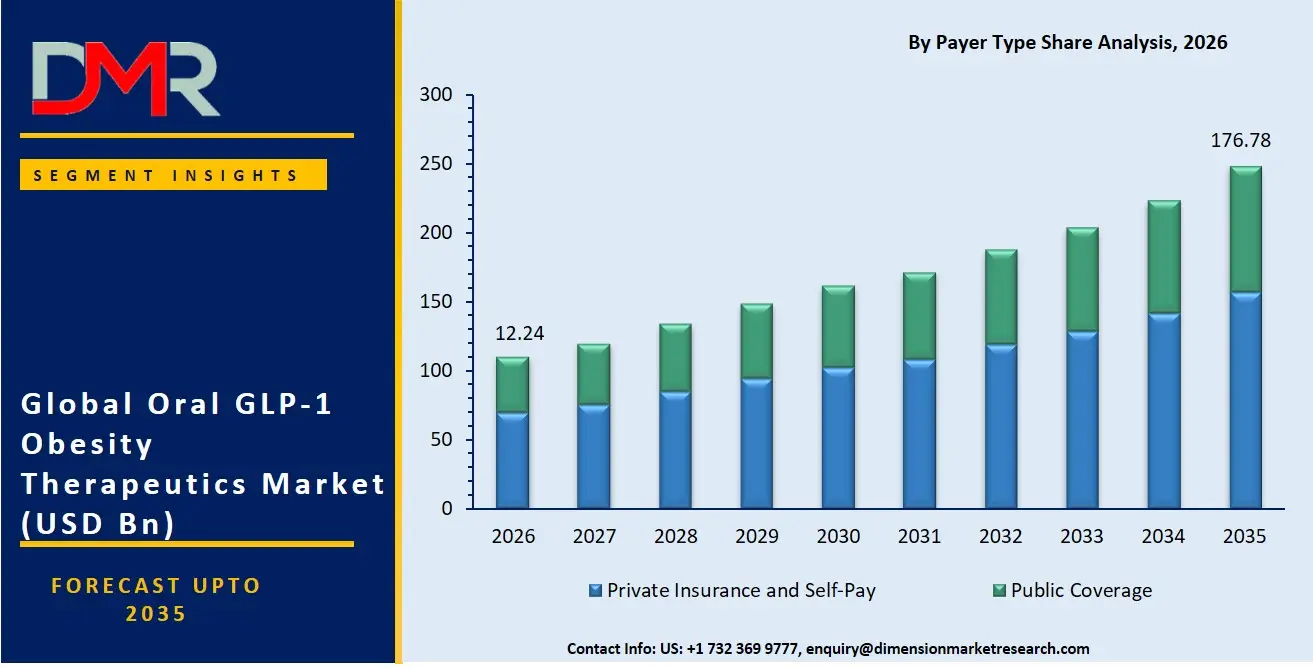
Private Insurance and Self-Pay payers accounted for 72.9% of the payer mix in 2026, the dominant financing channel.
ℹ
To learn more about this report –
Download Your Free Sample Report Here
Self-pay demand at monthly list prices exceeding USD 1,000 per patient is structurally constrained to high-income cohorts, as reported by My American Nurse. Commercial insurance drove initial GLP-1 obesity adoption before federal programs scaled, creating a payer-mix skew that the 2025 data reflects. The commercially insured patient base generates the highest per-script revenue but also faces the most immediate budget-review pressure from plan administrators.
Public Coverage held the remaining 27.1% in 2025, with the CMS Medicare GLP-1 Bridge set to expand that share from July 2026. The BALANCE model's five-year Medicaid-plus-Medicare coverage window through December 2031 creates a defined public-payer runway that manufacturers can build formulary strategies around. Public coverage growth will shift the payer mix toward lower net prices but higher patient volumes, a trade-off that favors manufacturers with manufacturing-scalable, low-cost-to-produce small-molecule assets.
Key Market Segments
By Drug Type
- Oral Peptide GLP-1 Agonists
- Small-Molecule Non-Peptide GLP-1 Agonists
By Molecule
- Semaglutide (Oral Formulation)
- Orforglipron
- Danuglipron
- Lotiglipron
By Distribution Channel
- Hospital & Specialty Clinics
- Retail Pharmacies
- Online Pharmacies
By End User
- Diabetic Population
- Obese / Overweight Individuals
- Cardiovascular-Risk Patients
By Use-Case Framing
- Weight Management
- Cardiovascular Risk Anchored
By Payer Type
- Private Insurance and Self-Pay
- Public Coverage
Regional Analysis
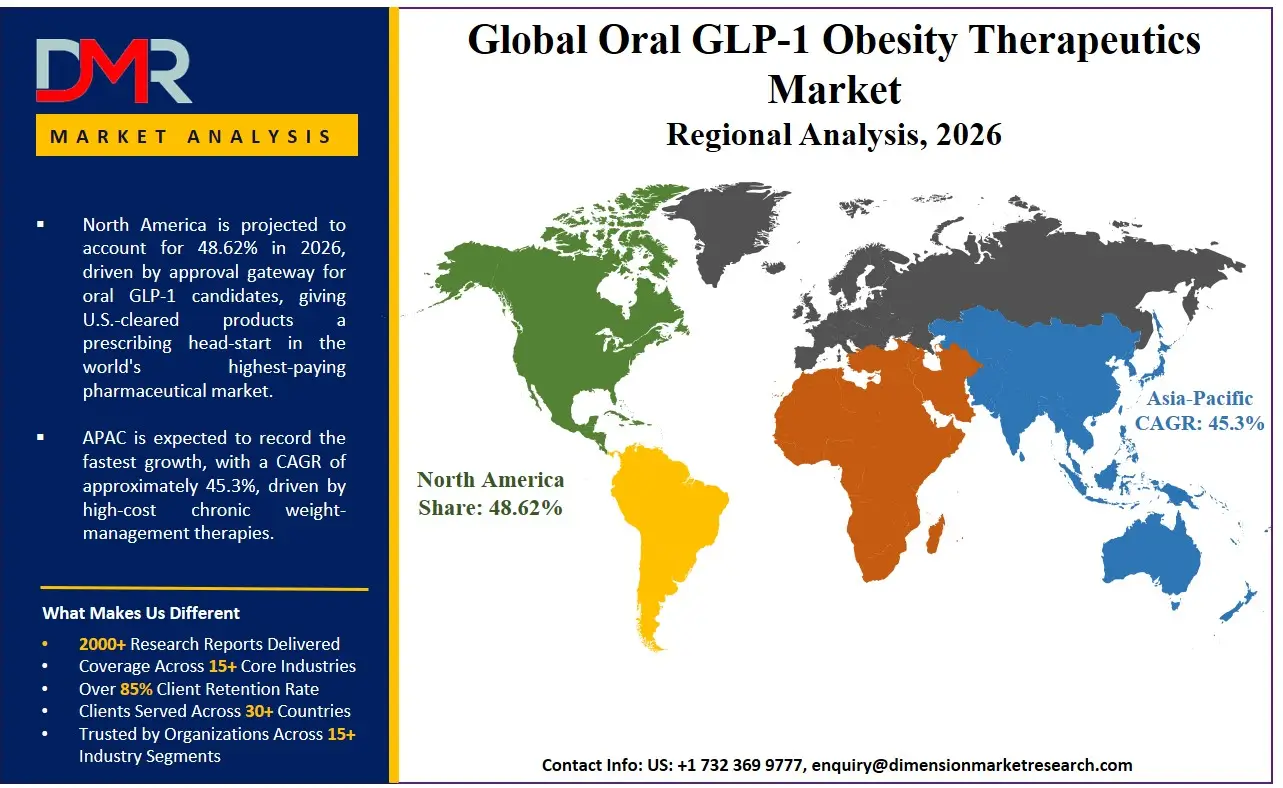
North America held a 48.62% share of global demand in 2026, generating the largest regional revenue base of any geography.
ℹ
To learn more about this report –
Download Your Free Sample Report Here
Three compounding advantages explain North America's lead. The FDA functions as the primary approval gateway for oral GLP-1 candidates, giving U.S.-cleared products a prescribing head-start in the world's highest-paying pharmaceutical market. Commercial insurance coverage, concentrated among the highest GLP-1 prescribing populations globally, created per-patient revenue economics that no other region matched. Novo Nordisk and Eli Lilly maintain their primary commercial infrastructure on U.S. soil, making North America the default launch geography for every new oral GLP-1 entrant.
The remaining regions present a tiered opportunity structure. Europe benefits from EMA reciprocal review pathways that accelerate approval timelines for FDA-cleared molecules, and established national health systems create formulary access at scale once approvals land. Asia Pacific carries the highest long-term patient volume potential: the World Obesity Atlas 2025 projected adult obesity to surpass 1.13 billion adults globally by 2030, and the region holds the largest share of that trajectory, yet reimbursement infrastructure in most APAC markets remains underdeveloped for high-cost chronic weight-management therapies. Latin America and Middle East and Africa represent early-entry windows for small-molecule oral candidates specifically, where manufacturing-scalable synthesis economics allow competitive pricing without the peptide cold-chain cost structure that historically excluded these regions from GLP-1 access.
Key Regions and Countries
North America
Europe
- Germany
- France
- The UK
- Spain
- Italy
- Rest of Europe
Asia Pacific
- China
- Japan
- South Korea
- India
- Australia
- Rest of APAC
Latin America
- Brazil
- Mexico
- Rest of Latin America
Middle East & Africa
- GCC
- South Africa
- Rest of MEA
Market Dynamics
FDA Approval and Federal Access Programs Break Two Structural Barriers
Eli Lilly's FOUNDAYO approval ended injectable dependency for GLP-1 weight management. Small-molecule oral synthesis bypasses the cold-chain and peptide production constraints that limited supply in injectable categories. Pricing agreements reduced monthly GLP-1 weight-loss drug costs from over USD 1,000 to as low as USD 245 for eligible federal-program patients, as reported by IQVIA, making the therapy accessible to patient cohorts that list-price economics had previously excluded.
The CMS Medicare GLP-1 Bridge launching July 1, 2026 at a $245 net price and $50 monthly copay is the single most consequential access event in Oral GLP-1 Obesity Therapeutics Market's history. The senior obesity population was previously locked out of GLP-1 coverage. Novo Nordisk submitted a New Drug Application to the FDA for once-weekly CagriSema in December 2025, confirming the pipeline behind current approvals is moving through the regulatory queue at a pace that will sustain new product launches through the late 2020s.
Adherence Complexity and Payer Budget Pressure Cap Volume Growth
Oral semaglutide's fasted-state, single-glass-of-water administration protocol imposes a daily behavioral requirement that once-weekly injectable alternatives do not. Real-world adherence has underperformed relative to clinical trial rates for precisely this reason. Competing small-molecule candidates carry no such restrictions, and tolerability differentiation is now a primary switching driver as oral GLP-1 prescriptions shift from specialist-initiated to primary-care-initiated.
Payer budget pressure functions as a near-term ceiling on volume growth. GLP-1s consumed over $300 Million and 20% of one U.S. insurer's total drug spend in 2024, triggering prior-authorization restrictions across commercial plans. About 55% of commercial U.S. employers covered GLP-1s for obesity in 2025, but 15% subsequently dropped that coverage due to cost pressure, as reported by J.P. Morgan. Prior-authorization gatekeeping now slows new patient starts across commercial channels at a rate that constrains volume growth below what clinical demand alone would support.
Small-Molecule Scale and Telehealth Channels Open New Commercial Pathways
Orforglipron's small-molecule synthesis pathway eliminates the supply problem that peptide-based semaglutide demand exposed. Filings across more than 40 countries simultaneously are feasible without biologic manufacturing constraints. Roche's $1.65 Billion licensing deal with Zealand Pharma in March 2025 for petrelintide, with total potential value up to $5.3 Billion, confirmed that pipeline investment at the oral and next-generation incretin layer continues to accelerate even after the first commercial launches. J.P. Morgan projected a $200 Billion incretin market by 2030, establishing the capital return horizon drawing institutional rotation into oral weight-loss assets.
The Novo Nordisk distribution partnership with Hims and Hers for a 25 mg Wegovy pill validated the DTC telehealth model for oral GLP-1 delivery at scale. Telehealth platforms are repositioning from compounded semaglutide toward branded oral formulations, creating a recurring-subscription access layer that traditional pharmacy channels cannot replicate at the same patient acquisition speed. Any oral GLP-1 brand establishing formulary positioning within these platforms before the 2027-2029 payer contracting cycles consolidate will carry a customer acquisition cost advantage that late entrants cannot close quickly.
Market Trends
Pipeline Crowding and Expanding Indications Accelerate Competitive Positioning
Structure Therapeutics reported Phase 2 results in March 2026 showing aleniglipron achieved up to 15% body weight loss over 44 weeks, with analysts citing a lower discontinuation rate and best-in-class potential among oral candidates at that stage. Beyond weight reduction, nearly 50% of alcohol-consuming patients who started GLP-1 therapy reduced alcohol intake, with a 20–50% lower risk of alcohol use disorder noted in a 2025 cohort, as reported by My American Nurse. That evidence shifts the clinical conversation toward systemic metabolic and behavioral indications, creating a label-expansion runway that early movers with long-term outcomes data will exploit before the pipeline crowd reaches approval.
Market Competition Overview
The market is consolidating around two anchor players with commercial oral GLP-1 obesity approvals and a broader field of pipeline challengers at various clinical stages. Competitive differentiation currently runs on molecule type, administration convenience, and manufacturing scalability rather than list price alone, because federal pricing agreements are narrowing the cost spread between branded options. As reported by My American Nurse, tirzepatide produced 20.2% average weight loss versus 13.7% with semaglutide across obesity trials, establishing the efficacy benchmark that oral GLP-1 entrants must credibly approach to achieve formulary parity with top injectable alternatives.
Share redistribution is already underway at the pipeline level. Structure Therapeutics' aleniglipron reached up to 15% body weight loss over 44 weeks in Phase 2, positioning it as a credible third commercial entrant behind semaglutide and orforglipron. The competitive window for gaining formulary position before market consolidation narrows runs approximately 2026 to 2029, after which multi-year payer contracting cycles will entrench incumbents. Challengers that cannot demonstrate tolerability advantages, convenience differentiation, or supply-chain cost benefits within that window will face structural formulary exclusion from the largest commercial channels.
Company Profiles
Novo Nordisk entered 2026 as the only company with a commercially available oral GLP-1 approved for weight loss in adults, with the WEGOVY pill achieving wide U.S. availability in January 2026. The company holds both the leading oral obesity brand and an expanding manufacturing infrastructure built on its Novo Holdings acquisition of Catalent for $16.5 Billion, a fill-finish capacity move designed to prevent the supply constraints that compressed injectable Wegovy access from recurring at the oral scale. That dual position creates a supply-side advantage that pipeline competitors cannot access without equivalent capital deployment.
Eli Lilly and Company achieved the first FDA approval of a small-molecule oral GLP-1 for weight loss with FOUNDAYO (orforglipron) on April 1, 2026, structurally differentiating its oral asset from peptide-based competitors. The ATTAIN-1 study, published in the New England Journal of Medicine in September 2025, showed significant weight loss and cardiometabolic benefits, providing the clinical foundation for a broad prescriber rollout across primary care and specialist channels. Pre-launch inventory stockpiling confirmed Lilly's expectation of high immediate demand, while the small-molecule synthesis pathway enables filing across more than 40 countries simultaneously, giving Lilly a faster ex-U.S. commercialization trajectory than any peptide-based oral competitor can currently match.
Key Players
- Novo Nordisk
- Eli Lilly and Company
- AstraZeneca
- Pfizer
- Roche
- Viking Therapeutics
- Merck
- Structure Therapeutics
- Verdiva Bio
- Sun Pharma
- Zealand Pharma
- Rani Therapeutics
- Hengrui Medicine
- Altimmune
- Eccogene
- Amgen
- Boehringer Ingelheim
- Huadong Medicine
- Innovent Biologics
- Biocon
- Cipla
- Dr. Reddy's Laboratories
- Glenmark
Supply Chain and Value Chain Analysis
The oral GLP-1 supply chain flows from active pharmaceutical ingredient synthesis through formulation, fill-finish manufacturing, cold-chain or ambient distribution, and dispensing via specialty clinics, retail pharmacies, or telehealth-linked online channels. Peptide-based formulations such as oral semaglutide require specialized biologic API production capacity, with fill-finish as the documented bottleneck that constrained injectable Wegovy supply and that Novo Nordisk preemptively addressed through the Catalent acquisition. Small-molecule candidates bypass biologic API constraints entirely, enabling manufacturing through standard pharmaceutical synthesis infrastructure at lower per-unit cost and higher scalability.
Maximum value creation concentrates at the formulation layer, where proprietary absorption-enhancing technologies such as Novo Nordisk's SNAC co-formulation differentiate otherwise chemically similar molecules. The biggest supply-side risk sits at API production for peptide formulations: any capacity constraint at a contract manufacturing organization translates directly to patient access delays, as injectable semaglutide shortages demonstrated. Small-molecule oral candidates that eliminate biologic API dependency carry a structural supply-chain advantage that compounds as ex-U.S. market entry scales.
Regulatory Landscape
The FDA's Priority Voucher Program is compressing application review windows for oral incretin candidates, accelerating time from filing to commercial launch. The April 1, 2026 FOUNDAYO approval under this framework set a precedent for expedited review of small-molecule oral GLP-1 assets, signaling that the agency treats this drug class as a public health priority. Novo Nordisk's December 2025 NDA submission for once-weekly CagriSema confirms the regulatory queue behind current approvals will sustain new product launches through the late 2020s.
The CMS Medicare GLP-1 Bridge and the BALANCE Model together define the public coverage architecture for Oral GLP-1 Obesity Therapeutics Market through December 2031. The BALANCE Model's Medicaid-plus-Medicare coverage window creates a defined reimbursement runway that manufacturers use to anchor formulary strategy and long-term pricing negotiations. Companies that fail to secure dual coverage under both programs face a structural revenue ceiling regardless of clinical performance, making regulatory-to-reimbursement alignment a core commercial competency in Oral GLP-1 Obesity Therapeutics Market.
Investment and White Space Analysis
Institutional capital is rotating into oral weight-loss assets ahead of the projected $200 Billion incretin market threshold. Global weight-loss drug sales projections were revised upward to USD 150 Billion by 2035, a 43% increase from the prior USD 105 Billion estimate, attributed in part to oral GLP-1 emergence, as cited in published investment research. Pfizer agreed to acquire Metsera for up to $7.3 Billion in September 2025, re-entering the obesity space and confirming that both strategic and financial capital are concentrating at the oral delivery layer of the GLP-1 value chain.
The clearest white space sits at the intersection of small-molecule synthesis and underserved geographies. Orforglipron's filing across more than 40 countries exploits a manufacturing cost advantage that peptide-based competitors cannot match in supply-constrained markets. The BALANCE Model's coverage window through December 2031 is a defined entry point for manufacturers seeking Medicaid and Medicare formulary positioning before that window closes. Telehealth subscription bundling, validated by the Novo Nordisk and Hims and Hers distribution model, represents an underserved channel for any oral GLP-1 brand willing to bypass traditional specialty clinic gatekeeping and reach commercially insured patients directly.
Recent Developments
- February 2026, Pfizer reported Phase 2 data for a Metsera-acquired obesity injectable showing up to 11% weight reduction over 28 weeks, with a doubled dose planned for Phase 3 evaluation.
- November 2025, Pfizer completed its acquisition of Metsera, Inc. for $65.60 per share in cash, representing an enterprise value of approximately $7.0 Billion, plus a contingent value right of up to $20.65 per share.
- November 2025, Structure Therapeutics confirmed it was on schedule to deliver topline data from the ACCESS and ACCESS II studies of once-daily oral aleniglipron by year-end 2025.
- September 2025, Regeneron reported interim Phase 2 COURAGE results combining semaglutide with trevogrumab to preserve lean mass and enhance fat loss in obesity patients.
- May 2026, Ascletis Pharma announced it would present clinical and preclinical data on novel small-molecule oral obesity candidates at the 33rd European Congress on Obesity.
Report Details
| Report Characteristics |
| Market Value (2025) |
USD 8.92 Billion |
| Market Value (2026) |
USD 12.24 Billion |
| Forecast Revenue (2035) |
USD 176.78 Billion |
| CAGR (2026 to 2035) |
37.26% |
| Base Year for Estimation |
2025 |
| Historic Period |
2020 to 2024 |
| Forecast Period |
2026 to 2035 |
| Report Coverage |
Revenue Forecast, Market Dynamics, Competitive Landscape, Recent Developments |
| Segments Covered |
By Drug Type (Oral Peptide GLP-1 Agonists, Small-Molecule Non-Peptide GLP-1 Agonists), By Molecule (Semaglutide, Orforglipron, Danuglipron, Lotiglipron), By Distribution Channel (Hospital and Specialty Clinics, Retail Pharmacies, Online Pharmacies), By End User (Diabetic Population, Obese/Overweight Individuals, Cardiovascular-Risk Patients), By Use-Case Framing (Weight Management, Cardiovascular Risk Anchored), By Payer Type (Private Insurance and Self-Pay, Public Coverage) |
| Regional Analysis |
North America – US and Canada; Europe – Germany, France, The UK, Spain, Italy, and Rest of Europe; Asia Pacific – China, Japan, South Korea, India, Australia, and Rest of APAC; Latin America – Brazil, Mexico, and Rest of Latin America; Middle East & Africa – GCC, South Africa, and Rest of MEA |
| Competitive Landscape |
Novo Nordisk, Eli Lilly and Company, AstraZeneca, Pfizer, Roche, Viking Therapeutics, Merck, Structure Therapeutics, Verdiva Bio, Sun Pharma, Zealand Pharma, Rani Therapeutics, Hengrui Medicine, Altimmune, Eccogene, Amgen, Boehringer Ingelheim, Huadong Medicine, Innovent Biologics, Biocon, Cipla, Dr. Reddy's Laboratories, Glenmark |
| Customization Scope |
Customization for segments and region or country level will be provided. Additional customization can be done based on requirements. |
| Purchase Options |
Three license options: Single User License, Multi-User License (Up to 5 Users), Corporate Use License (Unlimited Users and Printable PDF) |
Frequently Asked Questions
What is the biggest investment opportunity in Oral GLP-1 Obesity Therapeutics Market?
▾ The clearest opportunity sits in small-molecule oral GLP-1 manufacturing and ex-U.S. commercialization, where synthesis cost advantages give small-molecule candidates a structural pricing edge over peptide competitors in supply-constrained markets. Global weight-loss drug sales projections were revised to USD 150 Billion by 2035, a 43% increase from prior estimates, defining the capital return horizon drawing institutional rotation into oral weight-loss assets. The BALANCE Model's public coverage window through December 2031 creates an entry point for manufacturers seeking Medicare and Medicaid formulary positioning before the window closes.
Who are the top companies in Oral GLP-1 Obesity Therapeutics Market?
▾ Novo Nordisk and Eli Lilly lead with the only two commercially available oral GLP-1 obesity approvals as of mid-2026: the WEGOVY pill and FOUNDAYO (orforglipron), respectively. Structure Therapeutics, Roche, Viking Therapeutics, and Pfizer are the most advanced pipeline challengers, with Phase 2 efficacy data and licensing deals signaling near-term commercialization intent.
Which segment is growing fastest in Oral GLP-1 Obesity Therapeutics Market and why?
▾ Small-Molecule Non-Peptide GLP-1 Agonists will grow fastest from 2026 onward, following orforglipron's April 2026 FDA approval as the first of its class cleared for obesity. Small-molecule candidates carry no fasted-state administration requirement and scale through standard pharmaceutical synthesis without biologic manufacturing infrastructure, combining clinical convenience with supply-chain simplicity. That combination positions the sub-segment to capture the majority of new patient starts as the prescriber base expands beyond specialist clinics into primary care.
Which region is growing fastest in Oral GLP-1 Obesity Therapeutics Market and why?
▾ Asia Pacific carries the highest growth trajectory outside North America, anchored by a large and structurally underserved patient base that injectable GLP-1 cold-chain economics historically could not reach. Small-molecule oral candidates filing across supply-constrained ex-U.S. markets find Asia Pacific as their primary volume expansion geography over the forecast period. Reimbursement infrastructure remains underdeveloped across most APAC markets, but its build-out over the next five years will unlock a patient volume that no other region can match.
What is the biggest challenge holding Oral GLP-1 Obesity Therapeutics Market back?
▾ Payer cost-containment is the primary constraint, with GLP-1s having consumed over $300 Million and 20% of one U.S. insurer's total drug spend in 2024, prompting commercial employers to restrict or drop obesity coverage. Prior-authorization gatekeeping now slows new patient starts across commercial channels, capping volume growth at a rate below what clinical demand and pipeline breadth would otherwise support. Any broad retreat from employer GLP-1 coverage would compress the accessible patient population materially and extend the timeline to mass commercial penetration.