What is the Global Organ-on-a-Chip Market Size?
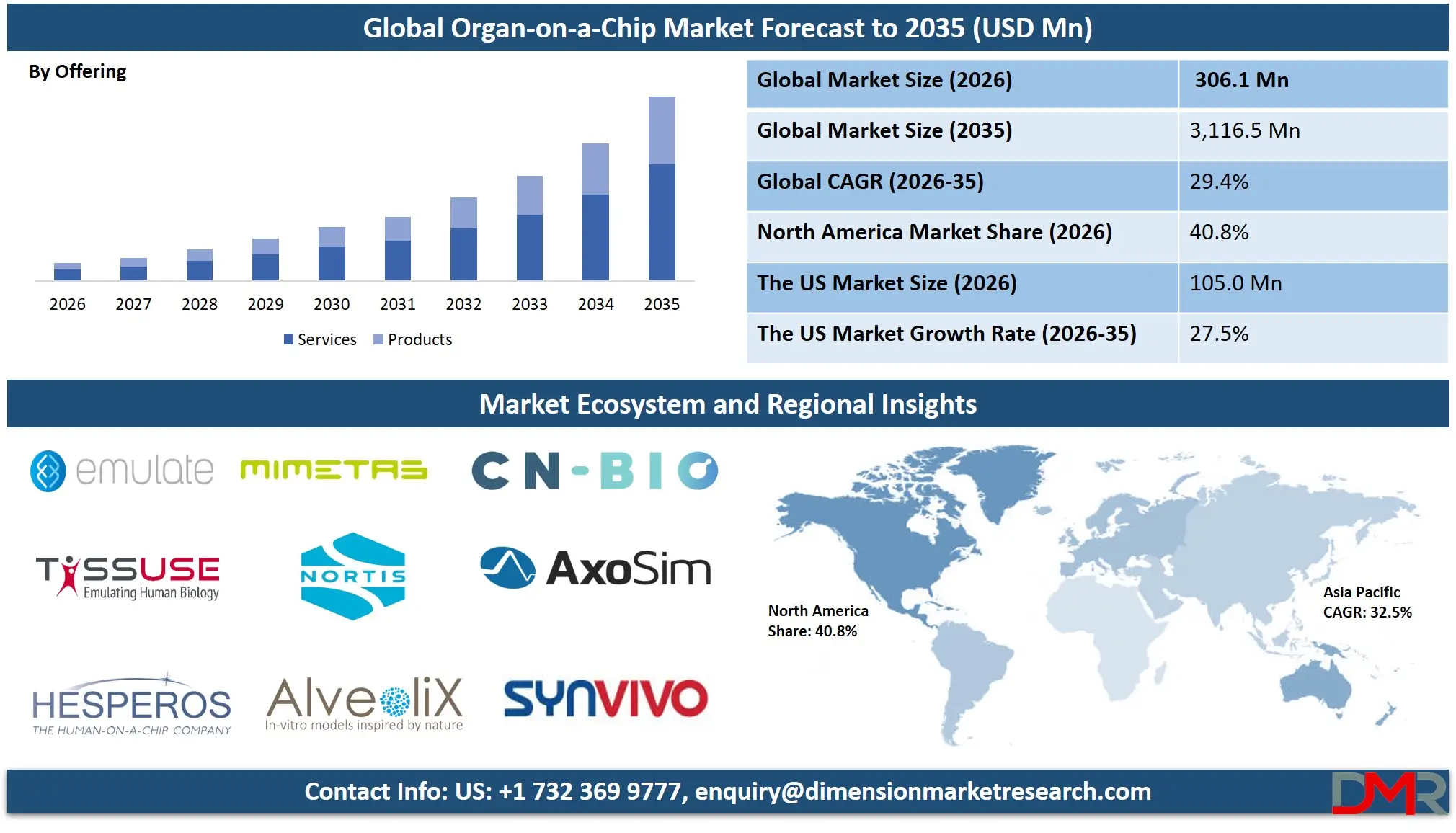
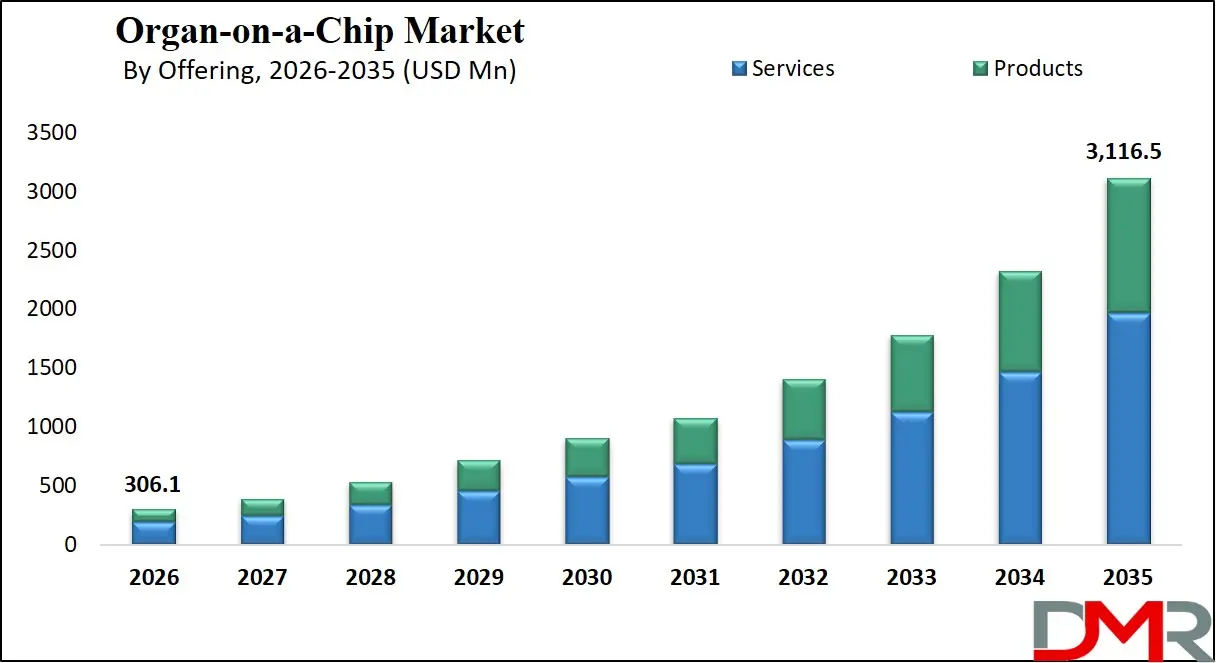
The Global Organ-on-a-Chip Market is estimated to be valued at USD 306.1 million in 2026 and is projected to reach USD 3,116.5 million by 2035, growing at a compound annual growth rate (CAGR) of 29.4% during the forecast period. The market will witness strong growth attributed to advancements in micro-physiological systems, increasing usage of disease models related to humans and real-time bio-sensing, along with the adoption of high content imaging in pre-clinical testing.
ℹ
To learn more about this report –
Download Your Free Sample Report Here
The Organ-on-a-Chip Market has gained traction over time due to the rapid rise in the use of multi-organ systems, regulatory interest in alternatives to animal testing, and increased investments by government bodies and businesses in preclinical research laboratories and pharmaceutical R&D facilities across the globe. It also covers such new technologies as real-time barrier integrity monitoring, microfluidic flow control, and automated cell culture integration used in organ-chip deployment projects.
Modernization is a significant investment that biotech firms, CROs, and cosmetic companies are pursuing to allow efficient recapitulation of human organ function, reduce the risk of clinical trial failures, and increase predictive validity per assay. The move towards automation, predictive scaling of chip-based testing, and smart workload splitting (in vitro + in silico) is increasing adoption. Moreover, the need to operationalize non-animal testing strategies and the importance of sustainable, human-relevant models are driving digital changes in preclinical R&D, and organ-on-a-chip has become an essential part of the future precision medicine landscape on a global scale.
ℹ
To learn more about this report –
Download Your Free Sample Report Here
The US Organ-on-a-Chip Market
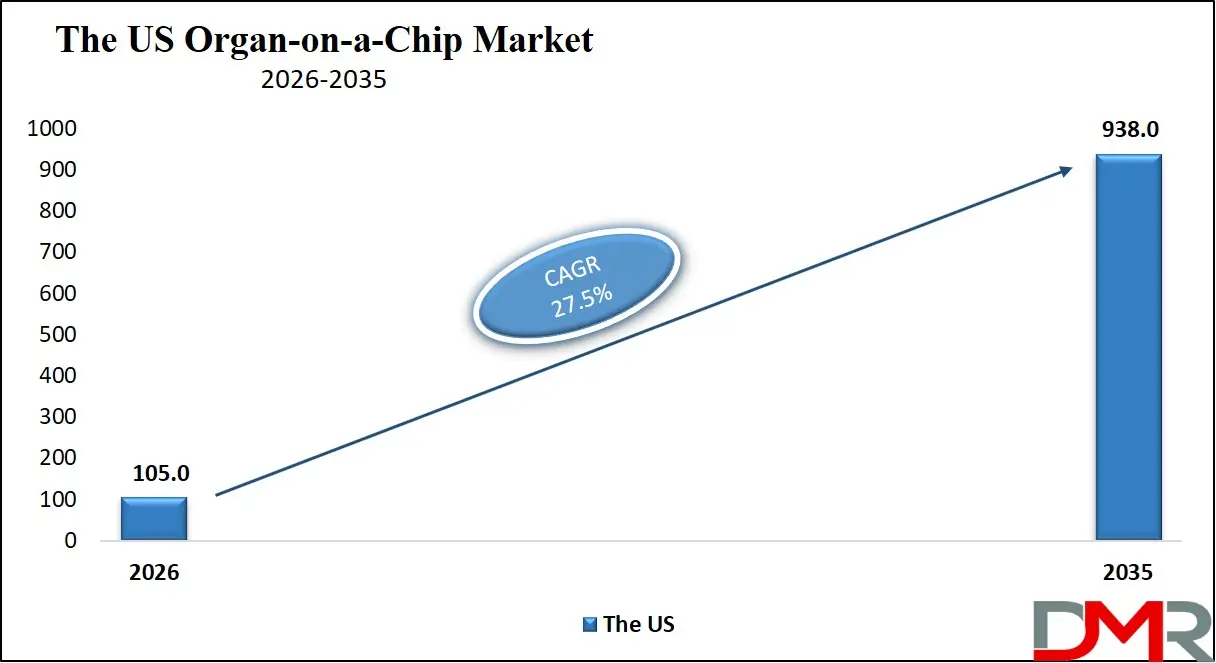
The US Organ-on-a-Chip Market is estimated to reach USD 105.0 million in 2026, growing at a compound annual growth rate (CAGR) of 27.5% during the forecast period.
ℹ
To learn more about this report –
Download Your Free Sample Report Here
The US market is mainly driven by strong pharmaceutical research and development, and availability of major players in the industry including Pfizer, Merck and Co., Inc., and Johnson and Johnson. Moreover, growing regulatory backing by agencies, such as the U.S. Food and Drug Administration and the United States Environmental Protection Agency is hastening the uptake of New Approach Methodologies (NAMs). The current trend to replace the traditional 2D cell culture systems and animal-based tests with more predictive and human-relevant micro-physiological systems is also driving market growth. In addition, some federal funding programs such as the National Center for Advancing Translational Sciences Tissue Chip Initiative, and regulatory innovations, such as the FDA Modernization Act 2.0 are facilitating adoption. The most targeted areas are pharmaceutical and academic research, but increased investments in combined sensor technologies and digital modeling tools are enhancing the performance, reliability, and scalability of organ-on-a-chip systems.
Europe Organ-on-a-Chip Market
The Europe Organ-on-a-Chip Market is estimated at USD 68.6 million in 2026 and is expected to grow at a compound annual growth rate (CAGR) of 29.0% during the forecast period.
Europe has a well-established organ-on-a-chip market which has significant implications on regulatory needs and European policy, such as the EU Animal Testing Ban, European Partnership on Alternative Approaches to Animal Testing, and national sovereignty initiatives (e.g. the micro-physiological research infrastructure in France and the multi-organ spin-off of the German multi-organ platform). Countries are also striving for smart organ-chip modularization to harmonize commercial and institutional workload requirements and interoperability of the cross-border supply chain. Advanced manufacturing, like hydrogel-based 3D tissue integration and optical sensors for real-time metabolite detection, and high-reliability culture chips with in-built viability-prediction algorithms, drives innovation. Public-private partnerships and harmonization of organ-chip validation standards facilitate adoption. Technologies like real-time pH monitoring and smart contract-based data sharing are commonly practiced as research-centric programs, and Europe is a frontrunner in terms of the digital transformation of predictive and human-relevant organ-on-a-chip models.
Japan Organ-on-a-Chip Market
The Japan Organ-on-a-Chip Market is projected to be valued at USD 12.4 million in 2026, progressing at a CAGR of 27.6%, during the period spanning from 2026 to 2035.
Japan has a developed organ-on-a-chip market that is backed by precision engineering (microfabrication know-how), sophisticated cell culture methods and a broad array of pharmaceutical AI innovations. The priorities in the country are automation, precision and data integrity, which are fulfilled through real-time prediction of barrier functions models and predictive media management systems of organ-chip assets. The government stimulates growth through the Moonshot Research and Development Program, and inexhaustible investment in next-generation preclinical infrastructure. The substantial number of drug discovery programs, regenerative medicine programs and cosmetic safety testing demands effective organ-chips to perform toxicity screening in humans. Challenges include expensive cost of high validation of new chip architectures and compatibility with existing screening systems, but the opportunities lie in exporting developed organ-chip technologies to Asian and Pacific markets.
Key Takeaways
- Market Size & Forecast: The Global Organ-on-a-Chip Market is estimated to be valued at USD 306.1 million in 2026 and is projected to reach USD 3,116.5 million by 2035.
- Growth Rate & Outlook: The market is expected to grow at a compound annual growth rate (CAGR) of 29.4% during the forecast period.
- Primary Growth Drivers: Some of the major growth drivers in the market include technological advances of multi-organ micro-physiological systems, regulatory needs of animal testing substitutes and pharmaceutical research and development using human-relevant preclinical models.
- Key Market Trends: The adoption of real-time monitoring of barrier integrity, automated cell culture scheduling, and cloud-based organ-chip telemetry and fleet management systems are some of the main market trends.
- By Offering: The services segment is expected to account for the largest share in 2026, while products (devices and consumables) are projected to witness the fastest growth.
- By Organ Model: The liver-on-a-chip segment is expected to get the largest revenue share in 2026 in the Organ-on-a-Chip market.
- By Application: The drug discovery & development segment is expected to dominate the market in 2026.
- Regional Leadership: With a high pharmaceutical R&D investment and regulatory approval of alternatives to animal testing, North America is expected to take the lead in the market with an estimated 40.8% share in 2026.
What is an Organ-on-a-Chip?
An organ-on-a-chip is a microfluidic cell culture system that recapitulates both the tissue architecture and physiological response of human organs to speed up drug discovery, toxicity assays, and disease modeling applications, such as liver metabolism, lung barrier function, kidney filtration, cardiac contractility, and neurotoxicity screening. It applies parallel microfluidic, porous membranes and mechanical strain to provide high physiological relevance, and predictive accuracy. To ensure reproducibility, efficiency, and reliability, the new systems are real-time biosensors, automated media perfusion, and image analysis using AI. These organ-chips can support effective drug efficacy studies, sustainable non-animal research studies, and facilitate the channeling of funds of commercial, government and research stakeholders toward scalable and human-relevant preclinical infrastructure. They also enable accountability through ensuring that the data on organ functions is quantified, monitored and aligned with global 3Rs (Replacement, Reduction, Refinement) targets.
Use Cases
- Drug-Induced Liver Injury Screening: Organ-on-a-chip systems enable the real-time measurement of hepatotoxicity, bile acid deposition, and mitochondrial dysfunction with high sensitivity, which is orders of magnitude lower than the conventional 2D cultures.
- Barrier Integrity & Permeability Modeling (Toxicology Risk): Mission data, such as transepithelial electrical resistance (TEER) or endothelial leakage, is modeled to give safety margins and predict organ failure without human experimentation to ensure long-term stability of operation and investor confidence.
- Personalized Medicine & Patient-on-a-Chip: Multi-organ platforms are used to conduct on-chip patient stratification, model rare diseases and predict efficacy with quantifiable and proven clinical translatability.
- Cosmetics Safety & Regulatory Compliance: More efficient organ-chip models contribute to the success of non-animal safety testing, facilitate global regulatory adoption, contribute to testing reliability, and help implement policies, such as the EU cosmetics animal testing ban and FDA Modernization Act 2.0.
How AI Is Transforming the Global Organ-on-a-Chip Market
Artificial intelligence is transforming organ-on-a-chip by enabling predictive modeling of tissue viability, automatic identification of anomalies in biomarker data, and real-time optimization of media flow rates per organ compartment. Telemetry and image data can be analyzed with AI algorithms to determine any degradation or functional drift and scale-optimize experimental outcomes. This saves time, is verifiable and cheaper than manual data analysis.
Moreover, AI enhances assay assurance through offering adaptive fluidic scheduling, anticipating metabolic threats to organ models, and intelligent prioritization of chip-based health monitoring. It is also involved in reducing the cost of baseline testing and ongoing performance tracking, allowing lab operators to reduce the cost and physical footprint of on-prem validation campaigns and improve the reliability of organ-chip studies and their financial returns.
Market Dynamics
Key Drivers of the Global Organ-on-a-Chip Market
Rapid developments in Multi-Organ Systems and Physiologically Relevant Testing
The market is being pushed by a fast uptake of human-relevant micro-physiological systems, high-content imaging integration, membrane-based tissue interfaces, and real-time biosensing analytics. These technologies will allow monitoring of organ model health in real-time, identify functional anomalies early, predict loss of viability, and simplify the process of ground verification. Consequently, experimental reproducibility and predictive accuracy are highly enhanced as well as minimizing the expenses of manual microscopy analysis. The growth of multi-organ platform models like liver-kidney and gut-brain axes, in particular, is also accelerating the need for intelligent organ-chips as pharmaceutical operators are more inclined towards automation and assay optimization based on real-time physiological data.
Growing Focus on Animal Testing Alternatives and Regulatory Mandates
The world is becoming more and more involved in policies for non-animal methodologies, with governments and international bodies proposing chemical safety policies, like the EU Chemicals Strategy for Sustainability's animal testing reduction provisions and the US FDA Modernization Act 2.0. These structures are driving a high demand for predictive organ-chips that can be used to perform human-relevant toxicity testing and efficacy prediction. In parallel, global initiatives such as the ICCVAM (NICEATM) are encouraging the adoption of micro-physiological systems. The increasing calls on transparency in preclinical data and ethical responsibility are also enhancing the necessity of verifiable and human-relevant organ-chips in both commercial and government research centers.
Restraints in the Global Organ-on-a-Chip Market
High Costs of Design and Specialized Cell Culture
Organ-chips are costly and time-consuming to develop, requiring extensive validation in physiological environments, testing of long-term cell viability, and long-term stability analysis of microfluidic components. Additionally, regulatory qualification and standardization hurdles for novel chip-based assays further increase development complexity and cost. These factors create barriers for new entrants, extend deployment timelines, and increase upfront capital requirements.
Limited Standardization Across Organ-on-a-Chip Platforms
The industry continues to rely on multiple organ-chip architectures, including PDMS-based, polymer-based, glass-based, and emerging hydrogel-integrated systems. However, the lack of standardized validation protocols beyond basic barrier function remains a key challenge. Organ-chip systems lack universal plug-and-play standards compared to traditional well plates or transwell assays, making integration complex and limiting interoperability of multi-organ platforms.
Growth Opportunities in the Global Organ-on-a-Chip Market
Expansion of Emerging Biopharma Markets
Emerging biopharma markets like Brazil, Indonesia, Nigeria, the UAE, and Vietnam are making investments in R&D infrastructure and advanced preclinical facilities. These areas have high growth opportunities because of the rising need in human-relevant toxicology screening, disease modeling, and personalized medicine uses. They have minimal legacy animal testing facilities, allowing the implementation of state-of-the-art organ-chip technologies that can be optimized to meet regulatory requirements.
Rising Demand for Multi-Organ and Body-on-a-Chip Systems
The demand for more sophisticated organ-chips is being driven by the expansion of systemic disease modeling, ADME (absorption, distribution, metabolism, excretion) testing and the testing of complex drug-drug interactions. The technologies are crucial in the research of rare diseases, screening of oncology immunotherapy, and chronic toxicity screening. With the rising importance of human-specific responses as a major industry concern, multi-organ chip capabilities are likely to be fundamental to future pharmaceutical R&D infrastructure.
Global Organ-on-a-Chip Market Trends
Real-Time Functional Monitoring and Predictive Analytics
Organ-chips are being monitored, and tissue viability anomalies are detected in real time, and organ-specific functional wear is predicted using on-chip biosensors. The use of digital twin models and machine learning algorithms is enhancing assay scheduling, system lifespan, and deployment reliability. This shift is transforming organ-chip management from manual endpoint analysis to a fully automated, continuously optimized system monitoring.
Cloud-Based Telemetry and Fleet Management Systems
Cloud computing and digital twin technologies are taking centre stage in the operations of organ-chip clusters. These platforms enable real-time storage and analysis of physiological performance data, centralized fleet management, as well as remote monitoring of organ-chip health. Cloud-based systems enhance transparency, lower on-prem infrastructure expenses, and provide quicker responses to experimental changes across distributed lab nodes, as experienced by operators of large organ-chip fleets.
Research Scope and Analysis
By Offering Analysis
The services segment is expected to remain the largest in 2026, accounting for about 53.5% of the global organ-on-a-chip market, driven by its dominant use in contract-based drug screening, high-throughput toxicology testing, and flexibility across diverse micro-physiological frameworks where specialized expertise and regulatory support are essential. Meanwhile, the products segment (including devices and consumables) is witnessing strong growth, driven by rising demand for standardized chip platforms, personalized medicine testing, and scalable assay development, where fabrication consistency and integration capabilities are critical. Adoption is further supported by AI-assisted data interpretation, real-time quality diagnostics, and modular service contracts that integrate multiple organ model types for improved experimental flexibility and reproducibility.
By Organ Model Analysis
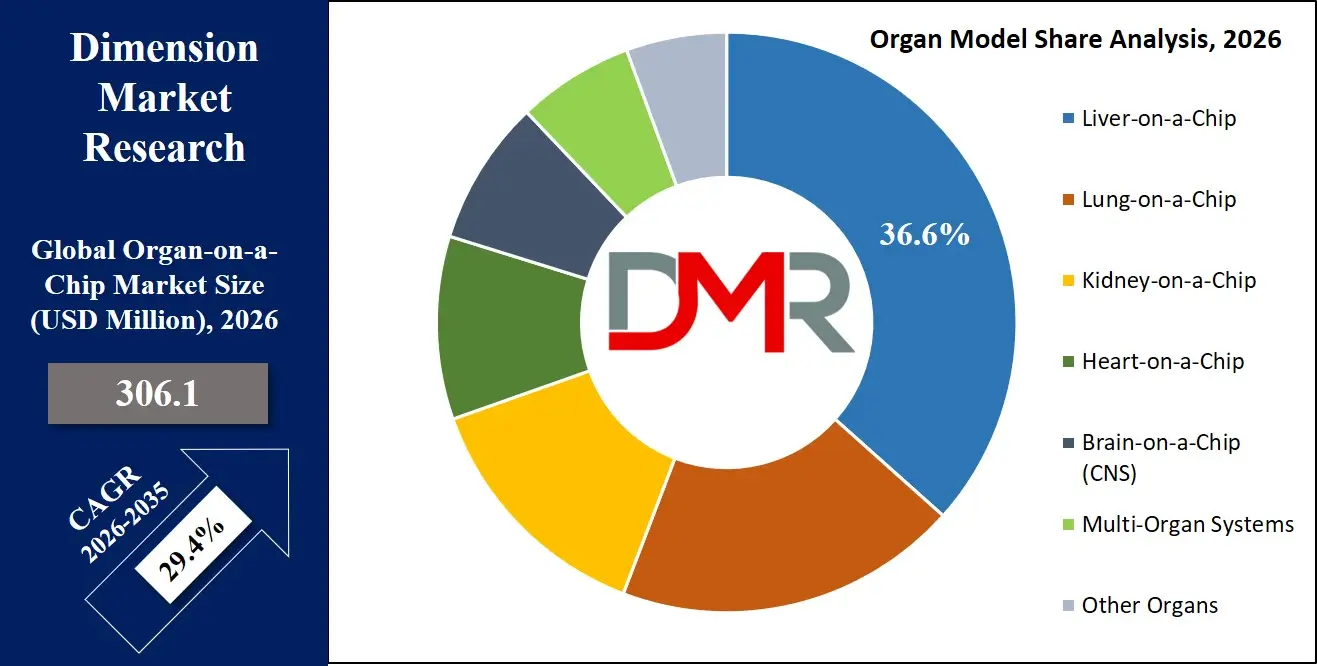
The liver-on-a-chip segment is expected to dominate with approximately 36.6% market share in the year 2026, owing to its critical role in hosting drug metabolism studies, hepatotoxicity screening, and ADME operations. Commercial and regulatory buyers are shifting to higher-performance liver models in order to have greater predictive accuracy and improve drug safety assessment.
ℹ
To learn more about this report –
Download Your Free Sample Report Here
Liver-on-a-chip solutions are adaptable, making it easy to deploy and integrate with other organ models. Kidney-on-a-chip models can still be used, though, in places where nephrotoxicity is a primary concern (e.g., antibiotic development). Multi-organ systems with liver-kidney or gut-liver axes simultaneously have the fastest development, and organ-chip portfolios are more flexible to different disease contexts and drug classes.
By Material Analysis
The polydimethylsiloxane (PDMS) segment is expected to dominate with approximately 51.8% market share in 2026, driven by the critical need for optical clarity, gas permeability, and ease of prototyping in academic and pharmaceutical research. PDMS chips excel at live-cell imaging scenarios due to their biocompatibility, delivering high-resolution microscopy while maintaining physiological conditions. The polymers segment (e.g., thermoplastics), while smaller, is witnessing steady growth, driven by scalability, reduced drug absorption, and commercial manufacturing requirements. The glass segment, though niche, is used for high-end imaging and specific barrier studies where non-absorption is critical. The fusion of PDMS and polymer hybrid chips has the fastest development.
By Model Type Analysis
The single-organ models segment is expected to hold the largest share in 2026, accounting for approximately 67.5% of the market, driven by widespread adoption in target-specific toxicity screening, mechanistic studies, and ease of operation. Meanwhile, the multi-organ models segment is witnessing the fastest growth, driven by the ability to study organ-organ interactions, systemic drug effects, and ADME profiling in a single integrated platform, enabling true human-relevant pharmacology. The multi-organ segment, while smaller, is emerging in specialized pharmaceutical and regulatory submissions with significant long-term potential.
By Application Analysis
The drug discovery & development segment is expected to dominate in 2026, accounting for approximately 61.2% share, driven by the central role of efficacy screening, lead optimization, and preclinical safety assessment. The toxicology research segment forms the second-largest category, as organ-chips heavily rely on human-relevant toxicity endpoints. The disease modeling segment is growing rapidly, driven by the need for recapitulating complex pathologies like fibrosis, inflammation, and cancer metastasis. The personalized / precision medicine segment, while smaller in revenue, is critical for future growth, including patient-on-a-chip platforms and rare disease models.
By End-User Analysis
The pharmaceutical & biotechnology companies segment is predicted to have the highest share of around 71.8% in 2026, hosting single-organ and multi-organ chips for drug screening, toxicity profiling, and lead candidate selection. The academic & research institutes segment enables fundamental mechanistic studies and platform development. The contract research organizations (CROs) segment is witnessing strong growth for outsourced safety testing and regulatory submissions. The fastest growing area is cosmetics & personal care companies for non-animal safety testing. The fusion of organ-chip functional integration and assay scheduling is generating smarter preclinical R&D markets.
The Global Organ-on-a-Chip Market Report is segmented based on the following:
By Offering
- Products
- Instruments
- Devices
- Consumables & Accessories
- Services
By Organ Model
- Liver-on-a-Chip
- Lung-on-a-Chip
- Kidney-on-a-Chip
- Heart-on-a-Chip
- Brain-on-a-Chip
- Multi-Organ Systems
- Other Organs
By Material
- Polydimethylsiloxane (PDMS)
- Polymers
- Glass
- Other Materials
By Model Type
- Single-Organ Models
- Multi-Organ Models
By Application
- Drug Discovery & Development
- Toxicology Research
- Disease Modeling
- Personalized / Precision Medicine
- Regenerative Medicine
- Others
By End-User
- Pharmaceutical & Biotechnology Companies
- Academic & Research Institutes
- Contract Research Organizations (CROs)
- Cosmetics & Personal Care Companies
- Others
Regional Analysis
Leading Region in the Organ-on-a-Chip Market
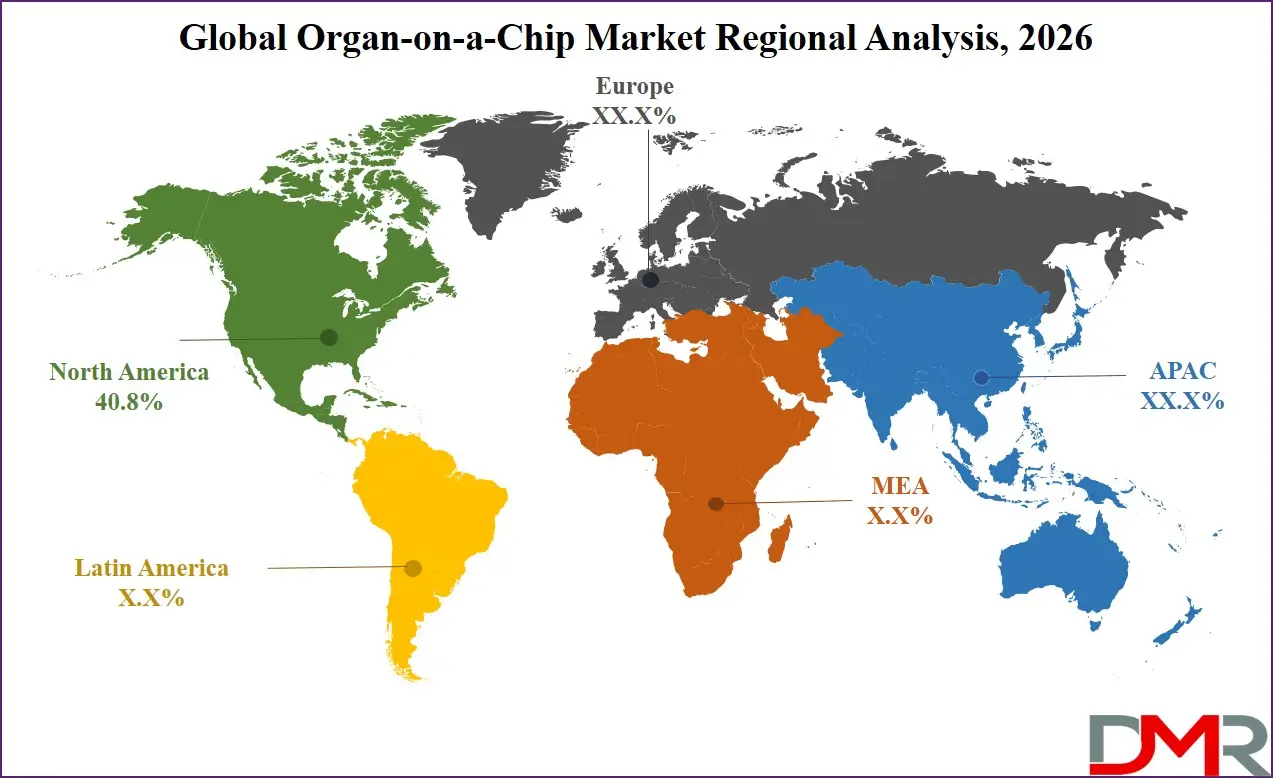
It is projected that North America will take the lead in the global organ-on-a-chip market (by value), covering a market share of about 40.8% in the year 2026. The region's dominance is driven by strong pharmaceutical R&D spending (US-based FDA Modernization Act), high organ-chip prices relative to other regions, a mature supply chain for microfluidic fabrication and high-content imaging, and the presence of key chip designers and research labs. The widespread adoption of advanced single-organ and multi-organ chips for drug discovery, toxicity screening, and regulatory submissions further strengthens North America's leading position in the market. Additionally, continuous investments in AI-enabled chip health monitoring and automated cell culture manufacturing capabilities are further reinforcing regional technological leadership.
ℹ
To learn more about this report –
Download Your Free Sample Report Here
Fastest-Growing Region in the Organ-on-a-Chip Market
Asia-Pacific is the fastest-growing region, supported by strong pharmaceutical outsourcing targets (China, India, Japan), increasing CRO capabilities, rising investments in domestic micro-physiological R&D, and growing adoption of non-animal testing systems. The region benefits from well-established manufacturing capacity, increasing commercial participation, and alignment with national preclinical roadmaps. Countries across the region are actively deploying organ-chips to enhance predictive accuracy and strengthen drug development infrastructure. Growing emphasis on organ-chip R&D and structured assay development further accelerates market expansion in the region. Moreover, increasing government support and commercial biopharma commitments are expected to sustain high growth momentum.
By Region
North America
Europe
- Germany
- The U.K.
- France
- Italy
- Russia
- Spain
- Benelux
- Nordic
- Rest of Europe
Asia-Pacific
- China
- Japan
- South Korea
- India
- ANZ
- ASEAN
- Rest of Asia-Pacific
Latin America
- Brazil
- Mexico
- Argentina
- Colombia
- Rest of Latin America
Middle East & Africa
- Saudi Arabia
- UAE
- South Africa
- Israel
- Egypt
- Rest of MEA
Competitive Landscape
The organ-on-a-chip market is very competitive, with innovation and strategic alliances being the order of the day. In order to achieve a competitive advantage, companies and research labs are oriented towards the creation of new advanced chip architectures (e.g., multi-organ, patient-derived, high-throughput), AI-powered assay telemetry, and digital twin-enabled viability monitoring platforms. There are high barriers to entry because of capital-intensive fabrication infrastructure, technical micro-physiological design know-how, and the need for biological validation maturity and regulatory certifications.
Strategic approaches in the market to increase market presence include partnerships with pharmaceutical manufacturers, mergers between chip designers and CROs, and long-term organ-chip supply contracts with drug developers and cosmetic safety labs. Moreover, research and development in advanced hydrogel scaffolding and automated media management systems are important factors in staying competitive and meeting the changing needs of the pharmaceutical industry.
Some of the prominent players in the Global Organ-on-a-Chip Market are:
- Emulate, Inc.
- MIMETAS B.V.
- CN Bio Innovations Limited
- TissUse GmbH
- Nortis, Inc.
- AxoSim, Inc.
- Hesperos, Inc.
- AlveoliX AG
- SynVivo, Inc.
- InSphero AG
- Altis Biosystems, Inc.
- BiomimX S.r.l.
- Netri SAS
- Kirkstall Ltd.
- Valo Health, Inc.
- BICO Group AB
- The Charles Stark Draper Laboratory, Inc.
- Elvesys SAS
- Bi/ond Solutions B.V.
- Organovo Holdings, Inc.
- Other Key Players
Recent Developments
- February 2025: Emulate, Inc. expanded its collaboration with the U.S. Food and Drug Administration to evaluate organ-on-a-chip systems for regulatory drug testing and reduce reliance on animal models, strengthening its position in regulatory validation and accelerating adoption of human-relevant preclinical platforms across pharmaceutical pipelines.
- October 2024: MIMETAS B.V. enhanced its OrganoPlate platform with improved throughput and imaging compatibility to support large-scale drug screening, enabling pharmaceutical partners to scale high-content assays and improve efficiency in toxicity and efficacy testing workflows.
- June 2024: CN Bio Innovations Limited launched next-generation PhysioMimix liver-on-a-chip systems for better prediction of drug-induced liver injury (DILI), supporting more accurate hepatotoxicity assessment and strengthening its portfolio in preclinical safety testing solutions for drug development.
- March 2024: TissUse GmbH advanced its HUMIMIC multi-organ platform through collaborations with pharmaceutical companies for systemic toxicity studies, enabling integrated multi-organ interaction analysis and supporting the transition toward more predictive and scalable human-relevant testing models.
Report Details
| Report Characteristics |
| Market Size (2026) |
USD 306.1 Mn |
| Forecast Value (2035) |
USD 3,116.5 Mn |
| CAGR (2026–2035) |
29.4% |
| The US Market Size (2026) |
USD 105.0 Mn |
| Historical Period |
2021 – 2025 |
| Forecast Period |
2027 – 2035 |
| Base Year |
2025 |
| Estimated Year |
2026 |
| Segments Covered |
By Offering (Products, Services), By Organ Model (Liver-on-a-Chip, Lung-on-a-Chip, Kidney-on-a-Chip, Heart-on-a-Chip, Brain-on-a-Chip, Multi-Organ Systems, Other Organs), By Material (Polydimethylsiloxane, Polymers, Glass, Other Materials), By Model Type (Single-Organ Models, Multi-Organ Models), By Application (Drug Discovery & Development, Toxicology Research, Disease Modeling, Personalized/Precision Medicine, Regenerative Medicine, Others), By End-User (Pharmaceutical & Biotechnology Companies, Academic & Research Institutes, Contract Research Organizations, Cosmetics & Personal Care Companies, Others) |
| Regional Coverage |
North America – The US and Canada; Europe – Germany, The UK, France, Russia, Spain, Italy, Benelux, Nordic, & Rest of Europe; Asia-Pacific – China, Japan, South Korea, India, ANZ, ASEAN, Rest of APAC; Latin America – Brazil, Mexico, Argentina, Colombia, Rest of Latin America; Middle East & Africa – Saudi Arabia, UAE, South Africa, Turkey, Egypt, Israel, & Rest of MEA |
Frequently Asked Questions
How big is the Global Organ-on-a-Chip Market?
▾ The Global Organ-on-a-Chip Market size is estimated to have a value of USD 306.1 million in 2026 and is expected to reach USD 3,116.5 million by the end of 2035.
What is the CAGR of the Global Organ-on-a-Chip Market from 2026 to 2035?
▾ The market is growing at a CAGR of 29.4% over the forecasted period.
What factors are driving the growth of the Global Organ-on-a-Chip Market?
▾ Technological advancements in multi-organ micro-physiological systems, regulatory mandates for animal testing alternatives, and government funding for human-relevant preclinical infrastructure are the factors driving the growth of the organ-on-a-chip market, globally.
What are the major trends in the Global Organ-on-a-Chip Market?
▾ Adoption of real-time barrier integrity monitoring and automated cell culture scheduling, and a shift toward cloud-based organ-chip telemetry and fleet management platforms are the major trends in the market.
Which region held the largest share of the Global Organ-on-a-Chip Market in 2026?
▾ North America is expected to account for the largest market share in 2026, with a share of about 40.8%.
Which region is expected to grow the fastest in the Global Organ-on-a-Chip Market?
▾ Asia Pacific is the fastest-growing region in the market during the forecast period.
Who are the key players in the Global Organ-on-a-Chip Market?
▾ Some of the major key players in the Global Organ-on-a-Chip Market are Emulate, Inc., Mimetas B.V., TissUse GmbH, CN Bio Innovations Ltd., Organovo Holdings, Inc., Hesperos, Inc., AlveoliX AG, and many others.
How is the Global Organ-on-a-Chip Market segmented?
▾ The market is segmented by offering, organ model, material, model type, application, and end-user.