Global Organic Waste Management Solution Market Snapshot
- Market Size in 2026: USD 45.8 billion
- Market Size in 2035: USD 83.0 billion
- Global CAGR, 2026–2035: 6.8%
- Leading Solution Type: Anaerobic Digestion, 32.8% share
- Leading Waste Source: Food Waste, 38.5% share
- Leading Technology: Biological Treatment, 63.5% share
- Fastest-Growing Segment: Biogas & Biomethane Production, 9.1% CAGR
- Leading Region: Europe, 35.5% share
What is the Global Organic Waste Management Solution and its Market Size?
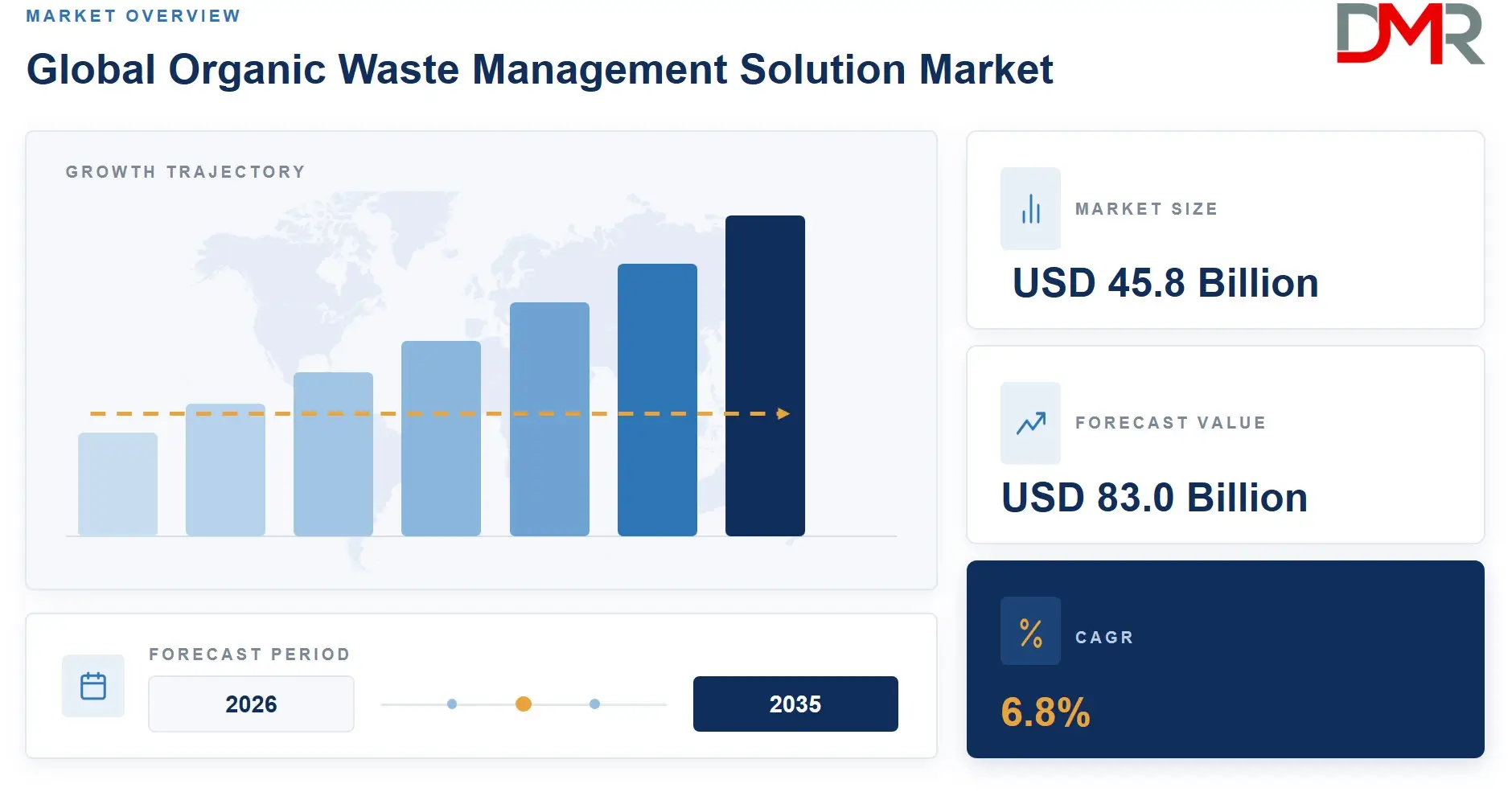
The global market is estimated at USD 45.8 billion in 2026 and is projected to reach approximately USD 83.0 billion by 2035, representing a 6.8% CAGR. Growth is being supported by urbanization, rising food consumption, landfill-diversion policies, source-segregation requirements, renewable-gas investment and the transition from disposal-oriented waste management toward circular resource recovery.
ℹ
To learn more about this report –
Download Your Free Sample Report Here
The Organic Waste Management Solution Market encompasses technologies, equipment, software and services used to collect, transport, sort, process, biologically treat, recycle and recover value from biodegradable waste. Feedstocks include food waste, agricultural residues, livestock manure, municipal green waste, industrial organic residues and sewage sludge. The solutions convert these materials into compost, soil amendments, biogas, biomethane, renewable electricity, heat and other recovered resources.
Use Cases
- Municipal food-waste diversion: Separate collection and biological treatment reduce landfill dependency while producing compost or renewable energy.
- Commercial food-waste recovery: Restaurants, supermarkets and institutions process organic residues through centralized or decentralized treatment systems.
- Agricultural waste valorization: Crop residues and livestock manure are converted into biogas, biomethane, fertilizer and soil amendments.
- Industrial organic-waste treatment: Food processors and manufacturers treat high-strength organic effluents and residues while recovering energy.
- Sewage-sludge resource recovery: Wastewater facilities use digestion and nutrient recovery to reduce sludge volumes and generate renewable energy.
- Organic waste-to-energy: Digesters and upgrading systems convert biodegradable feedstocks into grid-quality biomethane or electricity.
Key Takeaways
- Market Size: The market is estimated at USD 45.8 billion in 2026, reaching approximately USD 83.0 billion by 2035.
- Growth: The normalized global CAGR is estimated at 6.8% during 2026–2035.
- Growth Drivers: Landfill diversion, food-waste reduction, renewable-energy demand, urbanization and circular-economy regulation are the principal drivers.
- Segment Leadership: Anaerobic digestion leads solution technologies with an estimated 32.8% share, while food waste is the largest feedstock category.
- Fastest Growth: Biogas and biomethane production is expected to grow fastest as renewable-gas markets mature.
- Regional Leadership: Europe leads with approximately 35.5% share, supported by mature source-separation infrastructure and strong circular-economy policies.
How AI, IoT and Cloud Technologies are Transforming the Organic Waste Management Market?
AI, IoT and cloud platforms are shifting organic-waste management from schedule-based operations toward data-driven resource optimization. Connected collection vehicles, smart bins, weighbridge systems, facility sensors and methane/process monitors generate continuous operational data. AI can analyze waste volumes, contamination patterns, route requirements, digester performance and equipment conditions, while cloud platforms consolidate information across municipalities and treatment sites.
The principal benefits are improved collection efficiency, reduced fuel consumption, lower contamination, better asset utilization and predictive maintenance. At treatment facilities, sensors can optimize temperature, moisture, loading rates and retention conditions, increasing biogas yield and reducing process interruptions. Digital traceability also helps operators demonstrate compliance with source-segregation and environmental requirements.
Technology is consequently becoming a competitive differentiator rather than a supporting function. Providers increasingly combine physical infrastructure with software, analytics, remote monitoring and performance guarantees. This favors integrated companies capable of offering collection-to-recovery platforms and creates opportunities for specialist AI, sensor, routing and facility-analytics providers.
Key Drivers in the Global Organic Waste Management Solution Market
Tightening landfill-diversion and source-segregation requirements
Governments are increasingly treating organic waste separately because its high moisture content makes conventional disposal inefficient and its decomposition in landfills can generate methane. Regulations are therefore creating structural demand for dedicated collection, treatment and recovery infrastructure. The European Union's waste framework recognizes separately collected bio-waste within municipal waste streams, while countries and cities increasingly require source separation.
Increasing value of organic waste as an energy and resource feedstock
Organic waste is increasingly viewed as a source of renewable energy and agricultural inputs rather than a disposal liability. Anaerobic digestion can produce biogas that is upgraded into biomethane, while digestate can become an agricultural amendment. This creates multiple revenue streams and improves the economics of treatment projects.
Restraints in the Global Organic Waste Management Solution Market
High capital requirements and project economics
Organic-waste infrastructure is capital intensive. Collection systems, digesters, composting facilities, depackaging units, gas-upgrading systems and environmental controls require substantial upfront investment. Project economics can be difficult where tipping fees, renewable-energy credits, biomethane prices or compost revenues are insufficient to support financing.
Growth Opportunities in the Global Organic Waste Management Solution Market
Biomethane, renewable natural gas and bioenergy
The strongest opportunity lies in converting food waste, agricultural residues, manure and wastewater organics into renewable gas. Biomethane can enter existing gas networks or be used in transport, while biogas can support combined heat and power applications. Long-term offtake contracts are improving project bankability.
Digitalized decentralized organic-waste treatment
Decentralized composters, small digesters, smart collection systems and modular treatment plants represent an underserved opportunity in dense cities, institutions, food markets, hotels and agricultural clusters. Smaller systems reduce transportation distances and can improve economics where centralized facilities are unavailable.
Trends in the Global Organic Waste Management Solution Market
Shift from waste disposal to resource recovery
The industry is moving from a “collect-and-dispose” model toward integrated recovery of energy, nutrients, carbon and soil products. Modern facilities increasingly combine sorting, digestion, gas upgrading, digestate management and carbon recovery.
Increasing automation and contamination control
Automated depackaging, optical sorting, process sensors and AI-supported quality control are becoming increasingly important. Operators are attempting to extract organics from mixed waste streams while reducing manual sorting requirements and protecting downstream digesters and composting systems.
Research Scope and Analysis
The market is analyzed across Solution Type, Waste Source, Technology and Offering, with additional consideration of end-user demand. The segmentation captures the complete value chain from collection and preprocessing to biological treatment, energy recovery, digital management, equipment supply and outsourced services.
ℹ
To learn more about this report –
Download Your Free Sample Report Here
By Solution Type Analysis
Anaerobic Digestion is estimated to be the dominant solution segment in 2026, accounting for approximately 32.8% of market revenue. Its leadership reflects the ability to solve two problems simultaneously: organic-waste treatment and renewable-energy generation. Municipal food waste, agricultural residues, manure, industrial organic waste and sewage sludge can all serve as feedstocks. Anaerobic digestion also creates multiple monetizable outputs, including biogas, biomethane, electricity, heat and digestate. Biogas & Biomethane Production is expected to be the fastest-growing solution sub-segment, with an estimated 9.1% CAGR, driven by renewable-gas mandates, corporate decarbonization and grid-injection opportunities. Collection & Transportation is the second-largest solution category at approximately 24.5% share, reflecting the continuing importance of physical logistics. Composting remains highly relevant, particularly in municipalities with mature source-separation systems, while organic waste-to-energy expands where renewable electricity and thermal recovery economics are attractive.
By Waste Source Analysis
Food Waste is projected to remain the largest waste-source segment in 2026, with approximately 38.5% share. Food waste is generated continuously across households, restaurants, supermarkets, institutional kitchens and food-processing facilities, creating a large and geographically distributed feedstock base. UNEP's estimate of 1.05 billion tonnes of food waste in 2022 demonstrates the enormous underlying resource pool. Agricultural Waste is expected to be the fastest-growing source category, at approximately 8.0% CAGR, supported by increasing utilization of manure, crop residues and agro-processing waste for biomethane and biofertilizer production. Municipal Green Waste, with an estimated 21.0% share, represents the second-largest category because yard trimmings and landscaping residues are comparatively easy to collect and compost. Industrial organic waste and sewage sludge provide additional high-value opportunities where large, concentrated feedstocks enable economies of scale.
By Technology Analysis
Biological Treatment is expected to dominate technology revenue with approximately 63.5% share in 2026, encompassing aerobic and anaerobic treatment. Its leadership results from the biological compatibility of food, agricultural and municipal organic waste and from the ability to generate useful outputs while reducing landfill disposal. Anaerobic Treatment is the fastest-growing technology sub-segment, estimated at approximately 8.8% CAGR, because it provides an energy-recovery pathway in addition to waste stabilization. Aerobic treatment remains important for compost production, especially for green waste and relatively dry organic material. Mechanical-Biological Treatment accounts for approximately 25% of technology revenue and remains relevant where mixed municipal waste streams require mechanical extraction followed by biological stabilization. Thermal treatment has a smaller role because high moisture content reduces the attractiveness of conventional thermal processing for many organic feedstocks.
By Offering Analysis
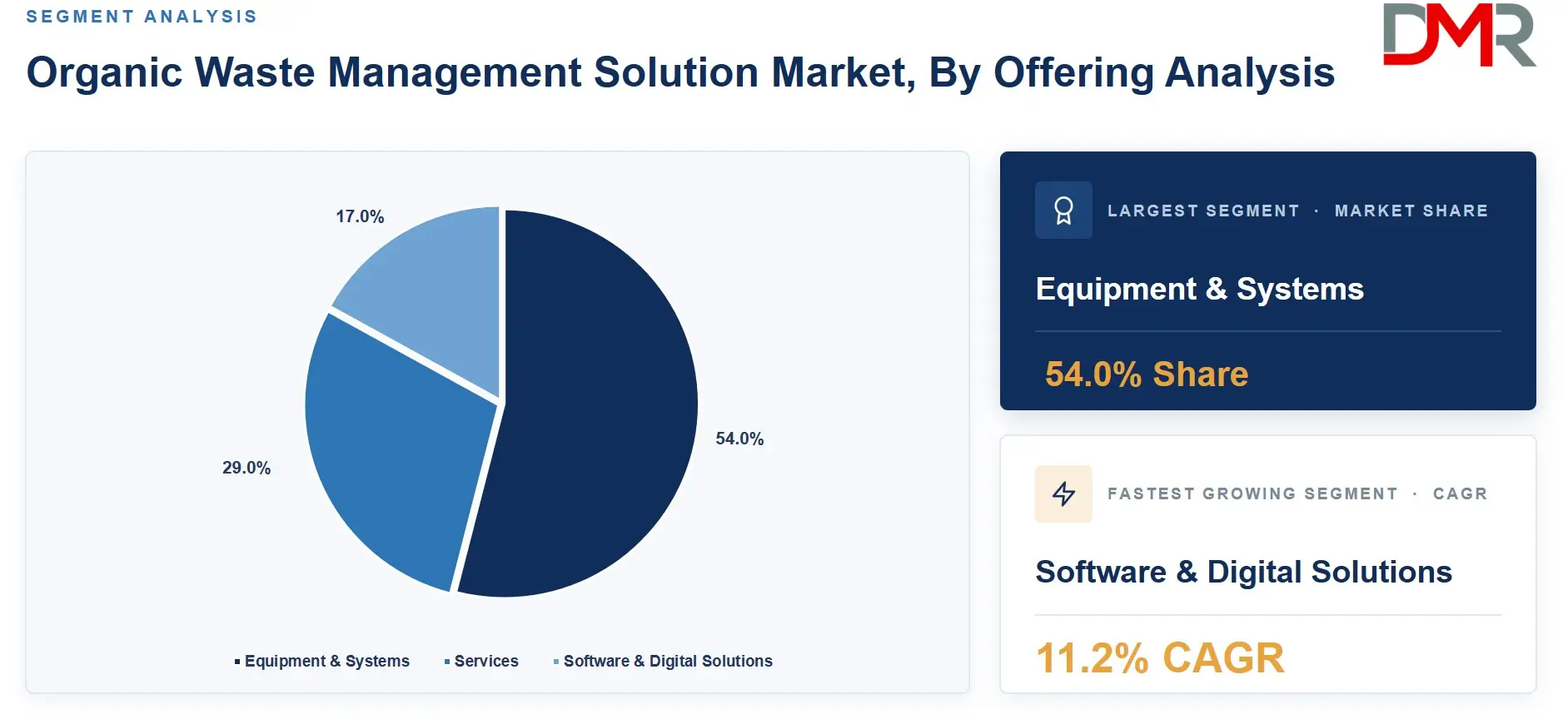
Equipment & Systems is estimated to lead the offering structure with approximately 54% share in 2026, reflecting demand for collection equipment, composting systems, digesters, sorting equipment, depackaging systems and gas-upgrading infrastructure. Software & Digital Solutions is the fastest-growing offering, projected at approximately 11.2% CAGR, albeit from a smaller base. The segment benefits from increasing demand for route optimization, facility analytics, digital weighbridge systems, contamination monitoring and regulatory traceability. Services represent approximately 29% of market revenue, covering collection, treatment, operations and maintenance. Service models are particularly attractive for municipalities and commercial generators that prefer predictable operating costs rather than direct ownership of complex infrastructure. The industry is gradually moving toward integrated “equipment-plus-service-plus-software” contracts, creating recurring revenue streams and increasing customer retention.
By End User Analysis
Municipalities & Local Authorities are expected to remain the dominant end-user segment in 2026, accounting for approximately 30.5% market share. Municipalities are responsible for large-scale household organic-waste collection, source segregation, green-waste management, composting and treatment infrastructure, making them the largest buyers of integrated organic-waste solutions. Waste Management Companies represent the second-largest end-user group at approximately 23.5% share, as private operators increasingly invest in transfer stations, preprocessing facilities, composting sites and anaerobic-digestion assets. Food & Beverage Industry is expected to be the fastest-growing end-user segment, with an estimated 8.8% CAGR, because supermarkets, processors, restaurants and food manufacturers face increasing pressure to reduce food waste and Scope 1/2 emissions while capturing economic value from organic residues. Agriculture & Agribusiness remains a major opportunity for manure and crop-residue digestion, while retail, hospitality and industrial facilities increasingly adopt decentralized collection and treatment. Wastewater Treatment Facilities also represent an important application because anaerobic digestion can convert sewage sludge into biogas and reduce sludge-management costs.
The Global Organic Waste Management Solution Market Report is segmented on the basis of the following:
By Solution Type
- Collection & Transportation
- Processing & Treatment
- Composting
- Windrow Composting
- In-Vessel Composting
- Aerated Static Pile Composting
- Anaerobic Digestion
- Wet Anaerobic Digestion
- Dry Anaerobic Digestion
- Biogas & Biomethane Production
- Organic Waste-to-Energy
By Waste Source
- Food Waste
- Residential Food Waste
- Commercial & Institutional Food Waste
- Food Processing Waste
- Agricultural Waste
- Crop Residues
- Livestock Manure
- Agricultural Processing Waste
- Municipal Green Waste
- Industrial Organic Waste
- Sewage Sludge & Biosolids
By Technology
- Biological Treatment
- Aerobic Treatment
- Anaerobic Treatment
- Mechanical-Biological Treatment
- Thermal Treatment
By Offering
- Equipment & Systems
- Collection & Handling Equipment
- Composting Systems
- Anaerobic Digesters
- Sorting & Processing Equipment
- Biogas Upgrading Systems
- Software & Digital Solutions
- Waste Tracking & Monitoring
- Route Optimization
- Facility Management & Analytics
- Services
- Collection Services
- Processing & Treatment Services
- Facility Operation & Maintenance
By End User
- Municipalities & Local Authorities
- Waste Management Companies
- Food & Beverage Industry
- Agriculture & Agribusiness
- Retail & Supermarkets
- Hospitality & Commercial Establishments
- Industrial Facilities
- Wastewater Treatment Facilities
Regional Analysis
Europe is the Leading Region in the Global Organic Waste Management Solution Market
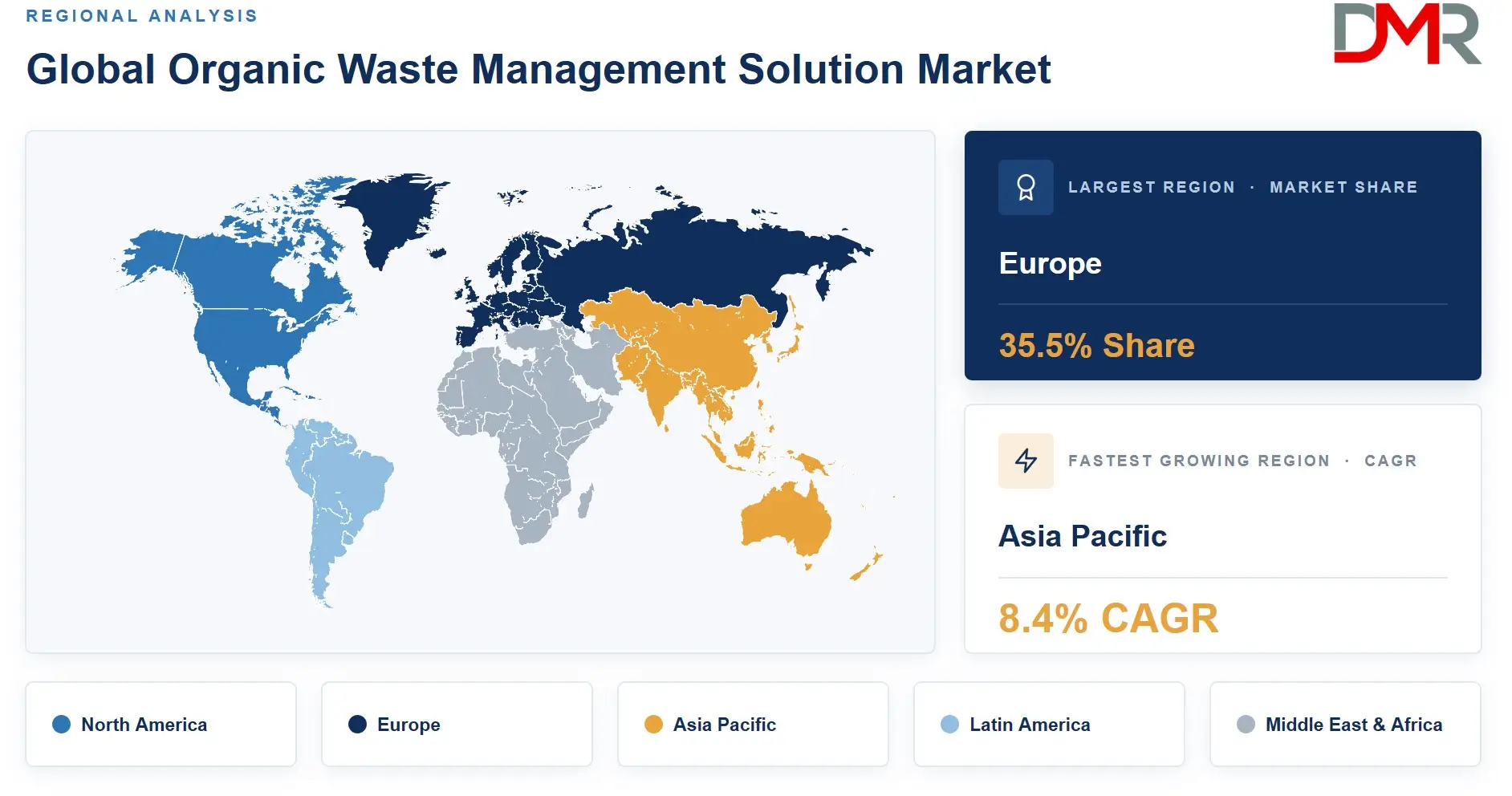
Europe is expected to maintain its leading position in the Global Organic Waste Management Solution Market, accounting for approximately 35.5% of global revenue in 2026, equivalent to roughly USD 16.3 billion. Europe's leadership is supported by mature municipal waste infrastructure, source-separation programs, landfill-diversion policies, renewable-energy targets and sophisticated anaerobic-digestion markets. EU waste legislation recognizes separately collected bio-waste, while national policies increasingly encourage biological recovery and renewable gas. Germany, France, the U.K., Italy and the Nordic countries represent particularly attractive markets. Increasing demand for biomethane, digestate certification, biogenic CO₂ and nutrient recovery is also pushing the region beyond basic composting toward higher-value biorefinery models.
ℹ
To learn more about this report –
Download Your Free Sample Report Here
Asia Pacific is the Fastest-Growing Region in the Global Organic Waste Management Solution Market
Asia-Pacific is projected to be the fastest-growing regional market, with an estimated 8.4% CAGR from 2026 to 2035. Rapid urbanization, population growth, increasing food consumption, agricultural activity and infrastructure investment are expanding the volume of organic waste requiring treatment. China and India are major contributors, while Japan, South Korea, Australia and Southeast Asian economies are developing more sophisticated circular-economy systems. India's policy environment is particularly supportive: the country's 2026 Solid Waste Management Rules introduce mandatory four-stream segregation, while the GOBARdhan ecosystem continues to expand biogas and compressed-biogas infrastructure.
North America Organic Waste Management Solution Market
The North America Organic Waste Management Solution Market is estimated at approximately USD 11.0 billion in 2026 and is projected to reach approximately USD 18.7 billion by 2035, representing an estimated 6.1% CAGR. The United States accounts for the majority of regional demand, followed by Canada. Growth is supported by state-level organic-waste diversion regulations, commercial food-waste programs, municipal composting, anaerobic digestion, renewable natural gas development and increasing corporate demand for low-carbon energy. California remains an important market because of its organic-waste diversion framework. Major operators are investing in large-scale composting, preprocessing and digestion infrastructure. Republic Services, for example, began construction of the San Bernardino Sustainability Park in June 2026, with initial capacity exceeding 300,000 tons of yard and food waste annually and planned scalability to 600,000 tons.
Latin America Organic Waste Management Solution Market
Latin America is estimated at USD 3.0 billion in 2026 and is projected to reach approximately USD 5.4 billion by 2035, corresponding to a 6.8% CAGR. Brazil and Mexico are the largest opportunities because of their large populations, agricultural sectors and growing urban waste streams. Organic waste-to-energy, landfill-gas reduction, composting and agricultural anaerobic digestion are expanding, although project development remains constrained by financing availability and inconsistent municipal infrastructure. Agricultural residues and livestock manure represent particularly attractive feedstocks for distributed biomethane projects.
MEA Organic Waste Management Solution Market
The Middle East & Africa market is estimated at approximately USD 2.7 billion in 2026, reaching USD 5.1 billion by 2035 at an estimated 7.3% CAGR. Urbanization, tourism, food-processing activity, agricultural modernization and national sustainability strategies are driving investment. Gulf markets are particularly attractive for smart collection, food-waste processing, composting and controlled-environment agriculture applications. Saudi Arabia and the UAE are expected to lead regional investment, while South Africa provides a more mature waste-management ecosystem.
Major Countries Analysis
United States Organic Waste Management Solution Market
The U.S. market is estimated at USD 9.8 billion in 2026 and is projected to reach approximately USD 17.3 billion by 2035, representing a 6.5% CAGR. California's organic-waste diversion requirements, renewable-natural-gas development, municipal composting and commercial food-waste programs support demand. Investments increasingly focus on depackaging, organics transfer infrastructure, anaerobic digestion and high-throughput composting. In June 2026, Republic Services began construction of a next-generation organics processing facility in San Bernardino County designed to expand Southern California composting capacity.
Japan Organic Waste Management Solution Market
Japan's market is estimated at USD 1.9 billion in 2026, reaching approximately USD 3.2 billion by 2035, at a 6.0% CAGR. High urban density, limited landfill capacity, sophisticated municipal infrastructure and strong waste-reduction culture support technology adoption. Food-waste recycling, biogas, composting, wastewater digestion and energy recovery are key applications. Automation, compact treatment equipment and high-efficiency biological systems are particularly attractive in land-constrained urban environments.
Saudi Arabia Organic Waste Management Solution Market
Saudi Arabia is estimated at USD 0.65 billion in 2026, reaching approximately USD 1.25 billion by 2035, representing an estimated 7.5% CAGR. Vision 2030 sustainability programs, rapid urban development, tourism, food consumption and municipal infrastructure investment are supporting demand. Key opportunities include smart waste collection, food-waste treatment, composting, anaerobic digestion and resource recovery around major metropolitan and tourism developments.s
Regulatory Landscape
Regulation is becoming a central demand generator. In the EU, bio-waste is recognized within the municipal-waste framework, supporting separate collection and biological recovery. In the U.S., state-level programs such as California's SB 1383 accelerate organic-waste diversion from landfills. In India, the Solid Waste Management Rules 2026, effective April 1, 2026, mandate four-stream source segregation, establish responsibilities for bulk waste generators, introduce online tracking and apply environmental compensation for violations. Renewable-gas projects must additionally comply with environmental permitting, gas-quality, grid-injection and renewable-energy requirements applicable in each jurisdiction.
Investment and White Space Analysis
The largest investment white spaces are distributed anaerobic digestion, food-waste depackaging, biomethane upgrading, digital waste traceability, nutrient recovery and small-scale treatment for commercial generators. Asia-Pacific offers the greatest greenfield potential because infrastructure is expanding from a relatively low base. India is particularly notable: its GOBARdhan ecosystem currently lists more than 1,200 registered compressed-biogas plants and more than 1,700 registered biogas plants, demonstrating a growing project pipeline. Europe offers lower infrastructure risk but strong opportunities in upgrading existing plants, digestate quality, biogenic CO₂ recovery and efficiency improvements. Corporate renewable-gas offtake agreements are another attractive investment structure because they can provide long-term revenue visibility.
By Region
North America
Europe
- Germany
- France
- The U.K.
- Italy
- Spain
- Rest of Europe
Asia-Pacific
- China
- Japan
- India
- Australia
- South Korea
- Rest of APAC
Latin America
- Mexico
- Brazil
- Rest of LATAM
Middle East & Africa
- Saudi Arabia
- The UAE
- South Africa
- Rest of MEA
Competitive Landscape
The Global Organic Waste Management Solution Market is moderately fragmented, with large environmental-service companies competing alongside specialized anaerobic-digestion technology providers, equipment manufacturers, renewable-energy developers and regional waste contractors. Competition increasingly centers on integrated capabilities rather than individual equipment.
Leading companies seek differentiation through proprietary digestion technology, high-throughput preprocessing, contamination control, renewable-gas upgrading, digital monitoring, project financing and long-term operations contracts. M&A, public-private partnerships and strategic energy offtake agreements are becoming important growth strategies. Large integrated providers such as Veolia and SUEZ compete with specialist technology companies such as Anaergia, while regional waste companies expand organics infrastructure to secure feedstock and municipal contracts. Veolia reports recovering more than 3 million tonnes of organic waste annually, illustrating the scale advantages available to established infrastructure operators.
Some of the prominent players in the Global Organic Waste Management Solution Market are:
- Veolia
- SUEZ
- Waste Management
- Republic Services
- Cleanaway Waste Management
- Stericycle
- Covanta
- Waste Connections
- Biffa
- FCC Environment
- Renewi
- REMONDIS
- Recology
- Casella Waste Systems
- GFL Environmental
- Hitachi Zosen
- Keppel Seghers
- BioBag International
- Novamont
- Tetra Pak
- TOMRA
- Eggersmann Group
- Komptech
- Green Mountain Technologies
- Harvest Power
- Divert
- Denali
- Agri-Cycle Energy
- Atlas Organics
- Anaergia
- PlanET Biogas
- WELTEC BIOPOWER
- BTS Biogas
- EnviTec Biogas
- AD4Energy
- DMT Environmental Technology
- SEAB Energy
- Bioenergy DevCo
- Vanguard Renewables
- Clean Energy Fuels
- Other Key Players
Recent Developments
- In July 2026, SUEZ reported continued investment in food-waste anaerobic-digestion optimization, including innovations designed to increase biogas production as part of its broader 2026 innovation program and circular-economy strategy.
- In June 2026, Republic Services began construction of the San Bernardino Sustainability Park in California. The next-generation facility is designed to initially process more than 300,000 tons of food and yard waste annually, with planned scalability to 600,000 tons.
- In May 2026, SUEZ announced construction of a new anaerobic-digestion plant near Ellington, Northumberland, following mandatory weekly food-waste collections for councils in England. The facility is expected to process up to 50,000 tonnes annually.
- In April 2026, SUEZ launched Digelis FoodWaste, a biowaste-preparation technology designed to improve anaerobic-digestion performance, reduce water and energy requirements and generate up to 5% more biogas.
- In January 2026, ENGIE signed a 10-year biomethane purchase agreement with PepsiCo UK, covering 60 GWh of biomethane annually from a new anaerobic-digestion facility in Northern England backed by approximately £70 million of investment.
- In June 2025, SUEZ inaugurated a biogenic CO₂ recovery unit in France, designed to recover up to 3,500 tonnes of biogenic CO₂ annually from anaerobic-digestion operations, adding another value stream to organic-waste treatment.
Report Details
| Report Characteristics |
| Market Size (2026) |
USD 45.8 Bn |
| Forecast Value (2035) |
USD 83.0 Bn |
| CAGR (2026–2035) |
6.8% |
| The US Market Size (2026) |
USD 9.8 Bn |
| Historical Data |
2021 – 2025 |
| Forecast Data |
2026 – 2035 |
| Base Year |
2025 |
| Segments Covered |
By Solution Type, By Waste Source, By Technology, By Offering, By End User |
| Regional Coverage |
North America – The US and Canada; Europe – Germany, France, The UK, Italy, Spain, Rest of Europe; Asia-Pacific – China, Japan, India, Australia, South Korea, Rest of APAC; Latin America – Mexico, Brazil, Colombia, Argentina, Rest of LATAM; Middle East & Africa – Saudi Arabia, The UAE, South Africa, Rest of MEA |
Frequently Asked Questions
What is the size of the Organic Waste Management Solution Market in 2026?
▾ The Organic Waste Management Solution Market is estimated at approximately USD 45.8 billion in 2026, covering organic-waste collection, treatment, recovery technologies, equipment, software and services.
What will the Organic Waste Management Solution Market be worth by 2035?
▾ The Organic Waste Management Solution Market is projected to reach approximately USD 72.45 billion by 2035, based on a reported 6.8% CAGR for 2026–2035.
What is the CAGR of the Organic Waste Management Solution Market?
▾ The Organic Waste Management Solution Market is expected to grow at approximately 6.8% CAGR from 2026 to 2035, driven by landfill diversion, source segregation and resource recovery.
What are the key drivers of the Organic Waste Management Solution Market?
▾ The Organic Waste Management Solution Market is driven by organic-waste generation, landfill-diversion mandates, anaerobic digestion, renewable-gas demand, circular-economy policies and municipal collection expansion.
Which segment dominates the Organic Waste Management Solution Market?
▾ Anaerobic Digestion is the leading solution segment in the Organic Waste Management Solution Market, accounting for approximately 32.5% share, according to published market estimates.
Which region leads the Organic Waste Management Solution Market?
▾ Europe leads the Organic Waste Management Solution Market, accounting for approximately 35.8% share, supported by mature infrastructure, source segregation and strong resource-recovery policies.
Which region is growing fastest in the Organic Waste Management Solution Market?
▾ Asia-Pacific is expected to be among the fastest-growing regions in the Organic Waste Management Solution Market, supported by urbanization, infrastructure investment and increasing adoption of biological treatment.
Who are the major players in the Organic Waste Management Solution Market?
▾ Major participants in the Organic Waste Management Solution Market include Veolia, SUEZ, Anaergia, Republic Services, ENGIE and numerous specialized equipment, digestion, composting and renewable-energy companies.
Which end-user segment leads the Organic Waste Management Solution Market?
▾ Municipalities & Local Authorities are estimated to be the largest end-user segment, followed by waste-management companies, because municipalities control large-scale household organic-waste collection and treatment programs.