What is the Data Center Market Size?
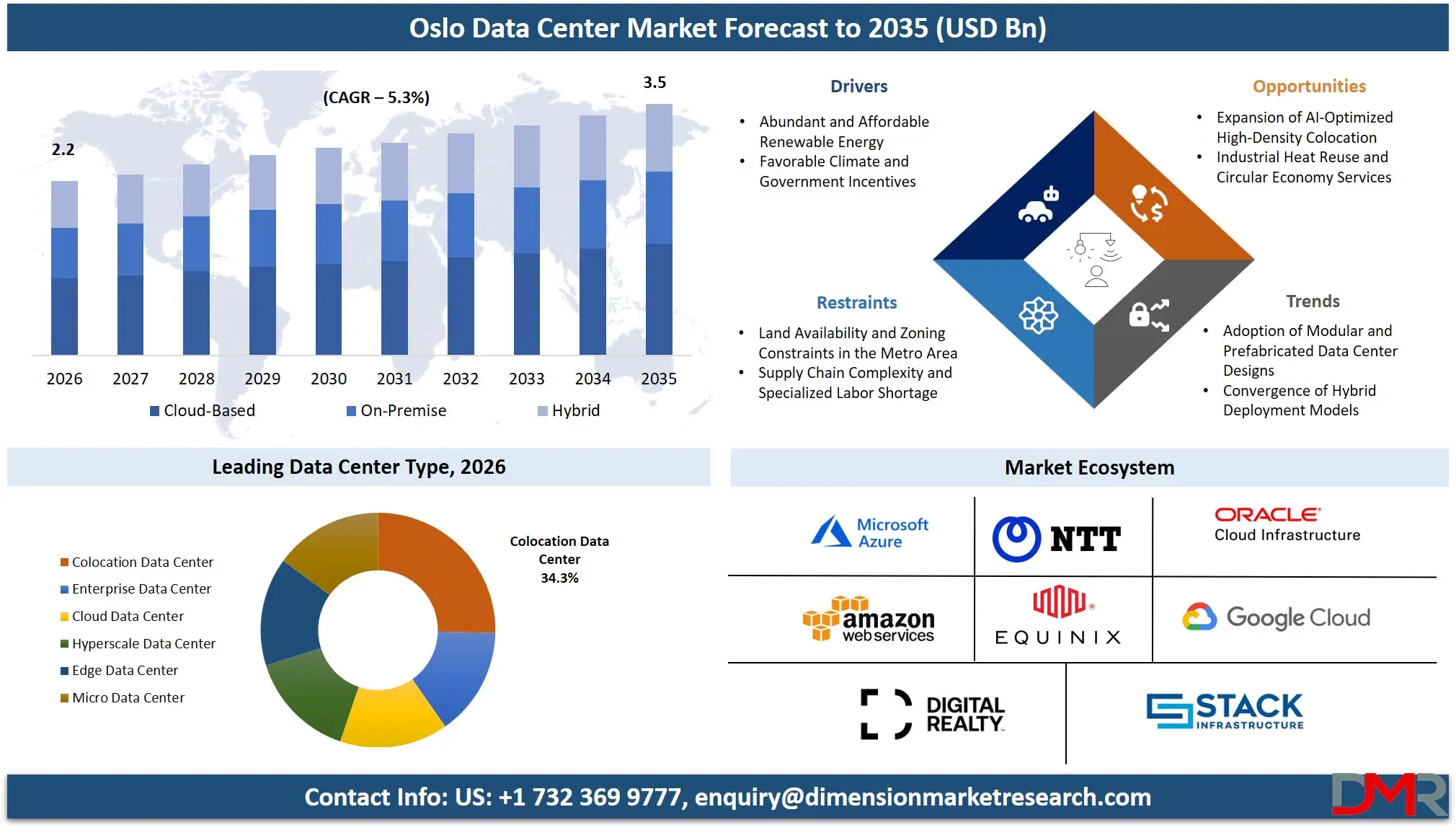
The Oslo Data Center Market is expected to reach a value of USD 2.2 billion in 2026, and it is further anticipated to grow to USD 3.5 billion at a CAGR of 5.3% during the forecast period 2026-2035.
ℹ
To learn more about this report –
Download Your Free Sample Report Here
The data center market in Oslo has witnessed impressive growth, driven by Norway's strategic focus on becoming a leading hub for sustainable, high-availability digital infrastructure in Europe. The market consists of a diverse range of solutions, including advanced hardware, sophisticated software, and comprehensive services designed to house, power, cool, and connect mission-critical IT workloads. The surge in demand for low-latency services, the exponential growth of data from IoT and media applications, and a national commitment to renewable energy are key drivers. Hyperscale cloud providers and colocation operators are the major catalysts, with liquid cooling and modular infrastructure solutions becoming dominant due to their efficiency and alignment with Norway's green ethos.
Key Takeaways
- Market Size & Forecast: Based on forecasts, the Oslo data center market will maintain a valuation of USD 2.2 billion in 2026 and expand considerably by 2035, propelled by the influx of hyperscale investments and the region's unique access to cost-competitive, 100% renewable hydropower.
- Growth Rate & Outlook: It is predicted that the market will register a CAGR of 5.3%, attributed to critical growth factors such as the proliferation of AI and high-performance computing (HPC) workloads demanding advanced cooling and the increased emphasis on data sovereignty, which necessitates local cloud regions within Norway.
- Primary Growth Drivers: Important growth factors include tax incentives for large-scale data center investments, a robust and green municipal power grid in the Oslo region, and a technologically skilled workforce that supports a growing ecosystem of managed service providers and system integrators.
- Key Market Trends: The market trends are mainly related to the transition from air-based cooling to direct-to-chip and immersion liquid cooling for AI clusters; the deployment of edge data centers to support 5G and autonomous systems; and increased adoption of modular, prefabricated data center designs to accelerate speed-to-market for colocation and hyperscale tenants.
- By Offerings Analysis: The Oslo data center market is driven by the hardware segment, specifically power and cooling modules, as operators invest heavily in next-generation UPS and liquid cooling systems to meet the density demands of AI. On the services side, managed data center services are growing as enterprises look to outsource complex IT infrastructure management to local experts.
- By Data Center Type Analysis: The Oslo market is projected to be dominated by hyperscale and colocation data centers, as global cloud service providers build availability zones in the region, while local enterprises increasingly migrate from on-premise legacy server rooms to outsourced, carrier-neutral colocation facilities.
What is the Data Center?
The data center market can be described as the ecosystem of specialized facilities and their component supply chains dedicated to housing critical compute, network, and storage systems. Unlike generic commercial real estate, these facilities provide a highly engineered environment focused on uninterrupted power, precision cooling, and multi-layered physical security. This is achieved through two primary deployment models: on-premise enterprise data centers for sensitive sovereign workloads and outsourced colocation/hyperscale facilities that provide scalable, cloud-adjacent capacity. Considering Norway's advanced sustainability agenda and cold climate, the Oslo market is a global pioneer in green data center design, requiring market authorization for novel liquid cooling deployments and participating in circular economy initiatives like heat reuse for district heating.
Use Cases
- Hyperscale Cloud Region Enablement: A global technology provider constructs a 100MW campus in the Oslo area, utilizing wholesale colocation shells, renewable energy PPAs, and deploying modular liquid-cooled IT modules to support its latest AI training and inference cloud services.
- Financial Services Hybrid Cloud: A Norwegian bank uses a hybrid model, maintaining an on-premise Tier IV data center for core banking systems to meet strict regulatory requirements while using a nearby carrier-neutral colocation facility for its latency-sensitive digital banking platforms.
- Telecom 5G & Far Edge Rollout: A telecommunications operator deploys a network of micro and regional edge data centers in Oslo and surrounding municipalities, integrating directly with centralized cloud data centers to support the ultra-low latency requirements of autonomous port logistics and advanced media applications.
- Colocation-Driven Enterprise Migration: A large Norwegian enterprise in the energy sector sells its legacy on-premise data center and leases a dedicated cage within a Tier III colocation facility near Oslo, where a managed services provider integrates and deploys a new software-defined, hybrid-cloud architecture.
How AI is Transforming the Data Center Market?
The impact of AI on the Oslo data center market centers on fundamentally reshaping the demand profile for power and cooling infrastructure. AI-driven predictive tools are being used by design and consulting services to simulate airflow and thermal dynamics, enabling the development of novel precision cooling systems that can support GPU clusters with rack densities exceeding 50kW without costly retrofits. AI-based automation and orchestration software analyzes real-time power distribution data to prevent outages and optimize energy consumption across the campus.
Furthermore, the role of AI in operational management is quite important. While monitoring the health of thousands of servers and storage systems, machine learning algorithms help identify anomalous patterns that predict component failure, triggering proactive support and maintenance workflows. Last but not least, AI-driven analytics platforms assist colocation providers with capacity planning by simulating client growth and optimizing the deployment of backup power resources, providing a clear view of infrastructure sustainability and efficacy.
Market Dynamics
Key Drivers in the Oslo Data Center Market
Abundant and Affordable Renewable Energy
The availability of low-cost, 100% renewable hydroelectric power is one of the most compelling reasons for the increased demand for data center capacity in Oslo. Norway's stable grid provides a long-term hedge against the energy price volatility seen in other European markets. For hyperscale and colocation operators, this access to green energy is not just a sustainability credential but a core component of a competitive total cost of ownership, directly driving site selection decisions and long-term investments in new campus developments.
Favorable Climate and Government Incentives
Oslo's naturally cool climate provides a free cooling advantage, reducing the mechanical energy load required for precision cooling systems for a significant part of the year. This, combined with proactive government support through tax incentives on electrical power for large data centers and a streamlined process for industrial construction permits, creates a highly attractive investment environment. The close collaboration between the municipality, state-owned grid operator Statnett, and foreign investors accelerates the time-to-market for new builds, reinforcing Oslo's position as a premier Nordic hub.
Restraints in the Oslo Data Center Market
Land Availability and Zoning Constraints in the Metro Area
The development of large-scale data center campuses remains challenged by limited land availability and strict municipal zoning regulations within the immediate Oslo metropolitan area. Securing large, contiguous plots with the necessary high-voltage power connectivity and fiber duct access is increasingly difficult. The competition for industrial land from logistics and residential developers, combined with local opposition to visual impact and noise, can lead to protracted approval times and higher capital expenditures for site acquisition and preparation.
Supply Chain Complexity and Specialized Labor Shortage
The complexity involved in procuring and deploying specialized hardware—specifically long-lead-time items like backup power generators, UPS systems, and liquid cooling distribution modules—poses a significant restraint. There is also a pronounced shortage of technically skilled labor in Norway for the design, commissioning, and maintenance of mission-critical facilities. The demand for certified data center engineers and technicians far outstrips supply, creating bottlenecks during commissioning phases and escalating costs for specialized support and maintenance services across the industry.
Growth Opportunities in the Oslo Data Center Market
Expansion of AI-Optimized High-Density Colocation
The increasing enterprise focus on deploying private AI and HPC clusters is providing immense opportunities for the colocation segment in Oslo. Companies are unable to house liquid-cooled infrastructure in their legacy on-premise facilities and are turning to new colocation builds designed specifically for high-density racks. This is creating a premium service layer for colocation operators, where advanced cooling modules and power distribution units become key competitive differentiators for attracting large enterprise and SaaS clients.
Industrial Heat Reuse and Circular Economy Services
There is a significant growth opportunity for data centers to become integrated energy providers within Oslo's municipal ecosystem. By investing in heat exchange and pump infrastructure, operators can capture and export waste thermal energy from liquid cooling systems into the city's extensive district heating networks. This creates a new revenue stream and fundamentally transforms the data center from a pure energy consumer into a cogeneration asset, which aligns perfectly with Norway's ambitious climate neutrality goals and strengthens community relations.
Trends in the Oslo Data Center Market
Adoption of Modular and Prefabricated Data Center Designs
The usage of prefabricated IT, power, and cooling modules is a rising trend in the Oslo market. Colocation developers and hyperscale operators are using factory-built, skid-mounted systems to compress construction timelines by up to 50% and ensure a consistent quality of deployment regardless of on-site weather conditions. This approach allows for phased, pay-as-you-grow capital investment and is particularly well-suited for the rapid deployment of edge data centers and expanding existing campus footprints with minimal on-site disruption.
Convergence of Hybrid Deployment Models
As observed in recent times, there has been an increasing focus by Norwegian enterprises on a hybrid deployment model that seamlessly integrates on-premise sensitive workloads, colocation for high-performance computing, and multiple public cloud regions. This is driving demand for cloud-adjacent colocation facilities in Oslo that offer direct, low-latency on-ramps to major cloud service providers via software-defined networking. This trend is fostering strategic partnerships between colocation operators, network equipment vendors, and cloud software providers to deliver a unified, orchestrated hybrid architecture
Research Scope and Analysis
The Oslo Data Center Market is segmented by offerings into hardware (IT, power, and cooling modules), software, and services, by deployment model, by data center type, by Tier Standard level, by enterprise size, and by end-user including cloud service providers, technology providers, telecom, BFSI, healthcare, and energy & utilities.
ℹ
To learn more about this report –
Download Your Free Sample Report Here
By Offerings Analysis
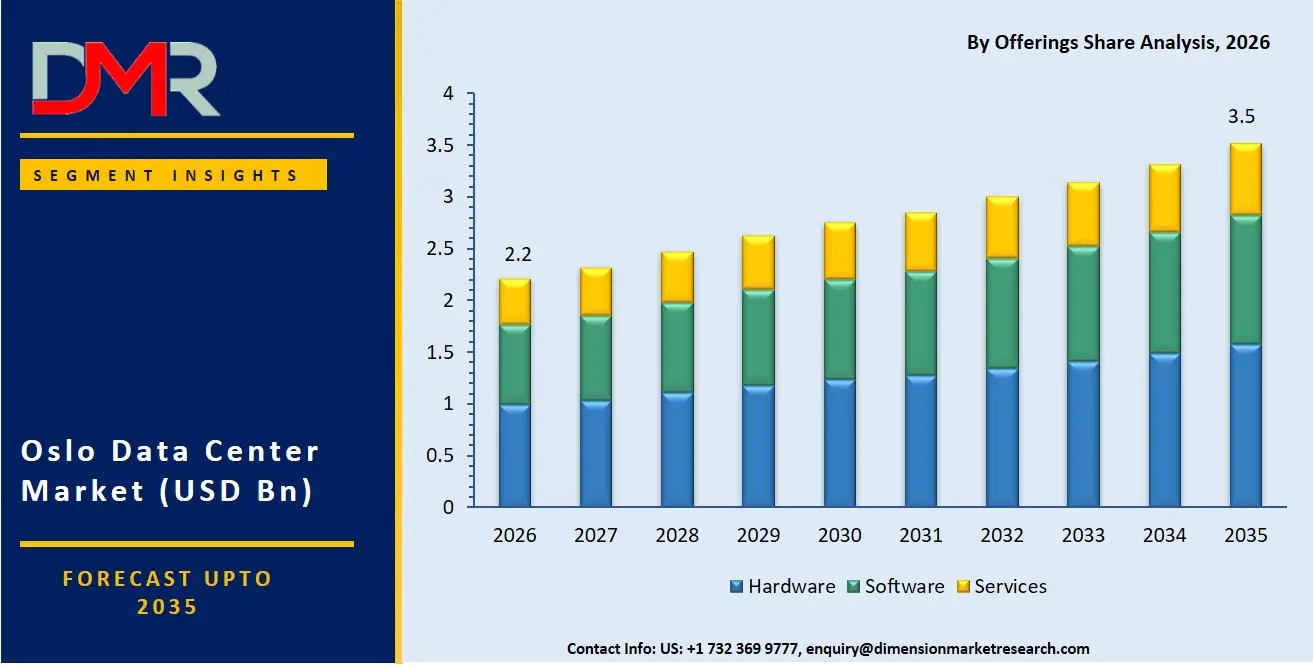
Hardware is poised to dominate the Oslo Data Center Market because substantial capital investments are directed toward building energy-efficient, high-performance facilities that support cloud computing, AI, and enterprise digital transformation.
ℹ
To learn more about this report –
Download Your Free Sample Report Here
Servers, storage systems, networking equipment, power distribution units, UPS systems, and advanced cooling technologies account for the largest share of infrastructure spending during both new developments and facility upgrades. Norway's abundant renewable hydropower and naturally cool climate encourage the construction of hyperscale and colocation facilities equipped with next-generation hardware. As operators continue increasing rack density and computing capacity, demand for reliable, energy-efficient hardware remains significantly higher than spending on software and services.
By Deployment Model Analysis
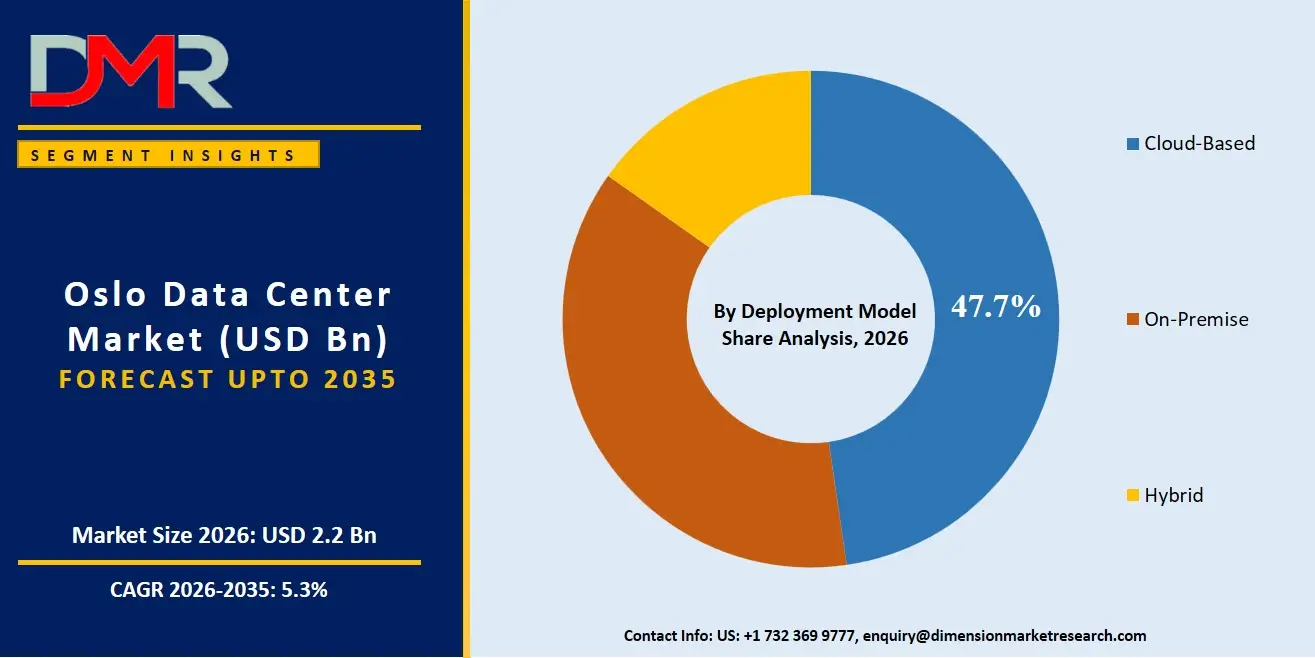
Cloud-based deployment is anticipated to dominate the Oslo Data Center Market as enterprises increasingly migrate mission-critical applications and workloads to scalable cloud platforms. Norway's strong digital infrastructure, renewable energy availability, strict data privacy regulations, and excellent international connectivity make Oslo an attractive location for cloud infrastructure expansion. Major cloud providers and enterprises continue investing in regional cloud capacity to support AI, analytics, SaaS, and high-performance computing workloads. Organizations also prefer cloud deployment because it offers operational flexibility, lower infrastructure management costs, rapid scalability, and enhanced disaster recovery capabilities. These advantages ensure cloud-based deployments account for the largest share of market demand.
By Data Center Type Analysis
Colocation data centers is poised to dominate the Oslo Data Center Market because enterprises increasingly prefer leasing secure, energy-efficient infrastructure instead of investing in privately owned facilities. Norway's renewable energy resources, favorable climate for free cooling, political stability, and reliable connectivity attract both domestic and international businesses seeking sustainable hosting solutions. Colocation providers offer scalable infrastructure, high availability, regulatory compliance, and carrier-neutral connectivity, making them the preferred option for financial institutions, cloud providers, and technology companies. Growing demand for digital services, hybrid IT environments, and cost-efficient expansion continues to position colocation facilities as the leading data center type across the Oslo market.
By Level (Tier Standard) Analysis
Tier 3 data centers is anticipated to dominate the Oslo Data Center Market because they provide the optimal combination of reliability, redundancy, operational efficiency, and cost-effectiveness. Enterprises, cloud providers, telecom operators, and government organizations require infrastructure capable of supporting uninterrupted operations while allowing concurrent maintenance without downtime. Tier 3 facilities satisfy these requirements at significantly lower costs than Tier 4 infrastructure, making them the preferred choice for commercial deployments. Oslo's growing colocation and cloud ecosystem increasingly relies on Tier 3-certified facilities to deliver high service availability while maintaining operational efficiency, ensuring this tier remains the largest contributor to overall market revenue.
By Enterprise Size Analysis
Large enterprises are expected to dominate the Oslo Data Center Market due to their extensive investments in digital infrastructure, cloud migration, cybersecurity, AI applications, and regulatory compliance. Multinational corporations, financial institutions, telecom operators, healthcare organizations, and technology companies generate substantial demand for scalable computing capacity and secure data storage. These organizations possess significant IT budgets and continuously expand their use of colocation services, cloud platforms, and disaster recovery infrastructure. Their need for high-performance computing, advanced analytics, and sustainable digital operations drives considerably higher spending than small and medium-sized enterprises, allowing large enterprises to maintain the dominant market position.
By End User Analysis
Cloud service providers is projected to dominate the Oslo Data Center Market by accounting for the largest share of infrastructure investments and new capacity additions. Increasing enterprise adoption of cloud-native applications, artificial intelligence, machine learning, and digital transformation services continues to fuel demand for hyperscale and colocation infrastructure. Oslo's abundant renewable hydropower, cool climate, strong fiber connectivity, and commitment to sustainability make it an ideal location for expanding cloud infrastructure. Major providers continue developing energy-efficient facilities capable of supporting high-density computing workloads while meeting stringent environmental objectives. Consequently, cloud service providers remain the leading end-user segment in the Oslo data center market.
The Oslo Data Center Market Report is segmented on the basis of the following:
By Offerings
- Hardware
- IT Modules
- Servers
- Storage Systems
- Networking Equipment
- Power Modules
- UPS Systems
- Power Distribution Units
- Backup Power Systems
- Cooling Modules
- Air-Based Cooling
- Liquid Cooling
- Precision Cooling Systems
- Software
- Monitoring & Management Tools
- Automation & Orchestration Software
- Backup & Disaster Recovery Software
- Security Software
- Virtualization Software
- Analytics & Optimization Software
- Services
- Design & Consulting
- Integration & Deployment
- Support & Maintenance
- Managed Data Center Services
By Deployment Model
- Hybrid
- Cloud-Based
- On-Premise
By Data Center Type
- Colocation Data Center
- Retail Colocation
- Wholesale Colocation
- Enterprise Data Center
- Cloud Data Center
- Hyperscale Data Center
- Edge Data Center
- Micro Data Center
By Level (Tier Standard)
- Tier 1
- Tier 2
- Tier 3
- Tier 4
By Enterprise Size
- Large Enterprises
- Small & Medium Enterprises (SMEs)
By End User
- Technology Providers
- Cloud Service Providers
- Telecom
- BFSI
- Healthcare
- Retail & E-commerce
- Entertainment & Media
- Energy & Utilities
Competitive Landscape
The nature of competition in the Oslo data center market has become very dynamic, characterized by a mix of global hyperscalers building self-built campuses, pan-European colocation giants expanding aggressively, and specialized Nordic operators focusing on sustainability-led services. Strategic alliances with local power utilities, fiber network owners, and municipal heating companies are crucial, as they help colocation operators gain access to power and a social license to operate by creating circular economy value. The trend of consolidation is growing as global infrastructure funds and real estate investment trusts acquire platforms of local Norwegian data center operators to gain an immediate, scaled foothold in the market. IP differentiators such as proprietary liquid cooling designs, a proven record of heat reuse export, and deep expertise in navigating local zoning are playing an increasingly significant role compared to a traditional focus on mere square footage or power capacity.
Some of the prominent players in the Oslo Data Center Market are:
- Green Mountain AS
- Bulk Infrastructure
- STACK Infrastructure
- DigiPlex (PGIM Real Estate)
- Lefdal Mine Datacenter
- Orange Business Services
- GlobalConnect
- Equinix
- AtlasEdge
- Basefarm (Orange Business)
- Microsoft Azure
- Google Cloud
- Amazon Web Services (AWS)
- Oracle Cloud Infrastructure (OCI)
- IBM Cloud
- Telenor Group
- Eviny Data Center
- AQ Compute
- NTT Global Data Centers
- Digital Realty Trust
- Other Key Players
Recent Developments
- January 2026: Green Mountain AS announced the expansion of its Oslo-region data center capacity with new AI-ready infrastructure featuring high-density liquid cooling and renewable hydropower integration to support hyperscale and enterprise customers.
- July 2025: DigiPlex (PGIM Real Estate) upgraded its Oslo-area data center facilities with advanced energy-efficient cooling systems and increased power capacity, strengthening support for cloud service providers and sustainability-focused enterprises.
- March 2025: Microsoft announced additional investments in its Norway cloud infrastructure, expanding Azure capacity and AI computing capabilities while leveraging the country's renewable energy resources and low-carbon data center ecosystem.
Report Details
| Report Characteristics |
| Market Size (2026) |
USD 2.2 Bn |
| Forecast Value (2035) |
USD 3.5 Bn |
| CAGR (2026–2035) |
5.3% |
| Historical Data |
2021 – 2025 |
| Forecast Data |
2027 – 2035 |
| Base Year |
2025 |
| Estimate Year |
2026 |
| Segments Covered |
By Offerings, By Deployment Model, By Data Center Type, By Level, By Enterprise Size, By End User |
| Country Coverage |
Oslo |
Frequently Asked Questions
How big is the Oslo Data Center Market?
▾ The Oslo Data Center Market is valued at USD 2.2 billion in 2026 and is projected to grow significantly by 2035, driven by the universal need for sustainable, secure, and low-latency digital infrastructure to support an increasingly data-centric and AI-powered European economy.
What is the CAGR of the Oslo Data Center Market from 2026 to 2035?
▾ The market is expected to grow at a CAGR of 5.3% from 2026 to 2035, reflecting the steady influx of hyperscale investments, enterprise cloud migrations, and the premium value placed on the region’s unique, renewable-powered ecosystem.
What factors are driving the growth of the Oslo Data Center Market?
▾ Key drivers include Oslo’s unmatched access to affordable, 100% renewable hydropower, a cold climate enabling free cooling solutions, and a supportive regulatory and tax framework that accelerates the development of green, industrial-scale infrastructure.
What are the major trends in the Oslo Data Center Market?
▾ Major trends include the mass adoption of liquid cooling to support high-density AI training clusters, the monetization of waste heat through district heating networks, and the rise of modular, prefabricated builds to drastically compress development timelines for hyperscale and edge deployments.
Who are the key players in the Oslo Data Center Market?
▾ Key players in the Oslo Data Center Market include global colocation and cloud operators like Equinix, Digital Realty, and AWS; Nordic specialists like Green Mountain and Bulk Infrastructure; and hardware OEMs like Schneider Electric and Vertiv, all driving innovation in sustainable design, power management, and cooling technology.
How is the Oslo Data Center Market segmented?
▾ The market is segmented by Offerings, Deployment Model, Data Center Type, Level (Tier Standard), Enterprise Size, and End User.