Market Overview
The global parcel sortation robots market covers automated systems that identify, route, and physically convey parcels across induction, transport, and destination functions inside fulfillment centers, postal hubs, courier depots, and airport cargo facilities. The market excludes manual conveyor belts, human-operated sorting lines, and general-purpose warehouse management software not integrated with robotic hardware. Parcel sortation robots sit at the intersection of logistics automation, computer vision, and fleet orchestration software, and their adoption reflects structural pressures in carrier networks rather than incremental operational upgrades.
Supply chain interdependencies connect Parcel Sortation Robots Market directly to global trade volumes. As reported by UNCTAD, more than 80% of global international goods-trade volume moves by sea, and fluctuations in that volume translate almost immediately into parcel-flow density at inland sortation hubs. Carriers that cannot scale throughput during volume spikes absorb service failures and contract penalties. Robotic sortation systems directly address that vulnerability by enabling throughput increases without proportional headcount additions.
Amazon committed more than €10 billion to expand and modernize European fulfillment centers, including robotics-enabled operations, a signal that the largest operators are treating sortation robotics as permanent infrastructure rather than discretionary capital. Smaller carriers and regional 3PLs now face a structural disadvantage if they defer automation decisions.
Key Takeaways
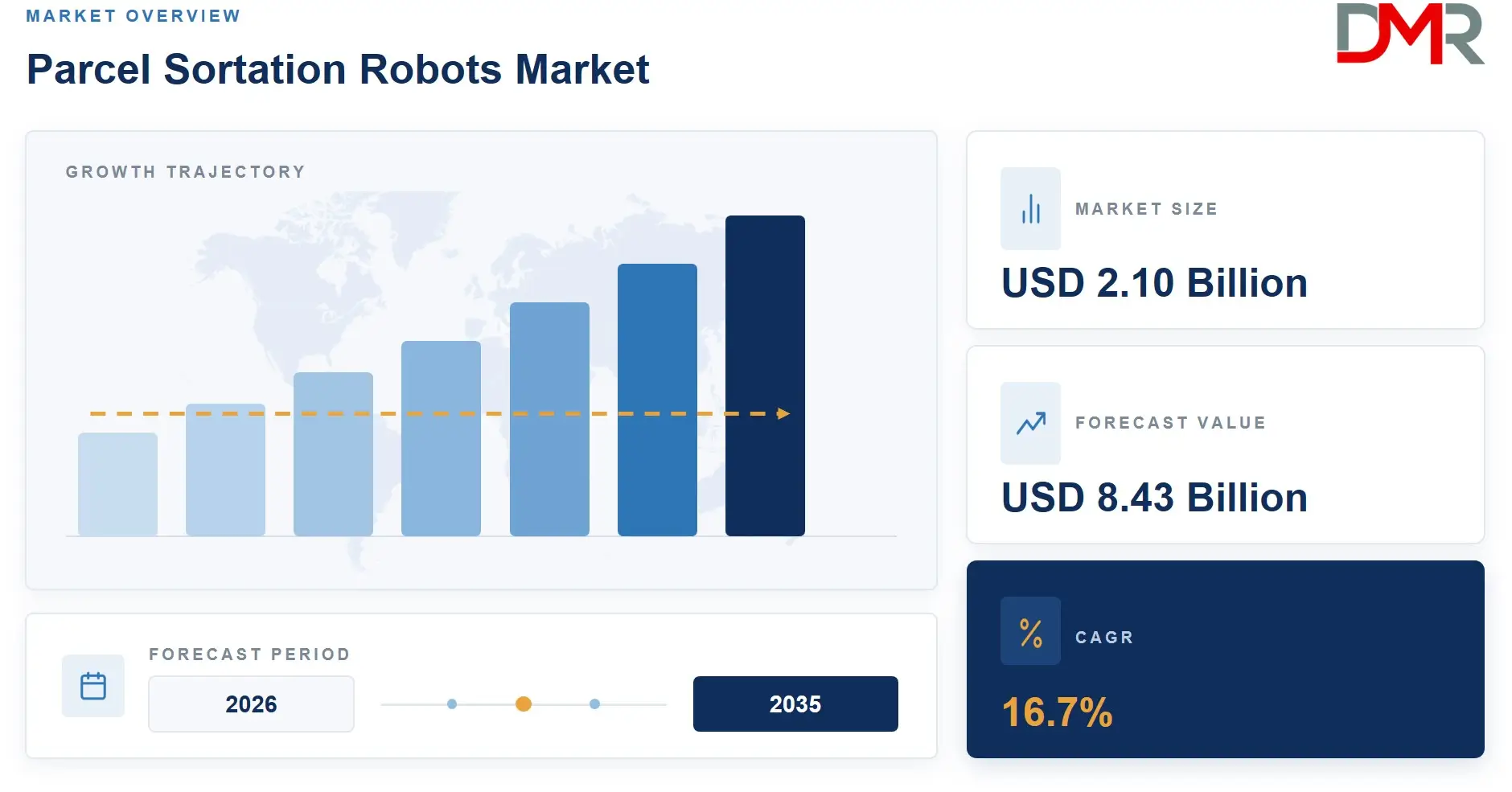
- The market size is USD 2.10 Billion in 2026, and is projected to hit USD 8.43 Billion by 2035 at a CAGR of 16.7%.
- By Robot Type: Automated Guided Vehicles (AGVs) led as the largest category in 2026.
- By Automation Level: Fully Automated led as the largest category in 2026.
- By Payload Capacity: Up to 50 kg led as the largest category in 2026.
- By Sort Type: Cross-Belt Sortation led as the largest category in 2026.
- By Component: Hardware led with a 68.7% share in 2026.
- By End User: Logistics led with a 49.4% share in 2026.
- By Region: North America led with a 41.6% share in 2026.
- Asia-Pacific is the fastest-growing region, posting the highest CAGR across all regions.
- Autonomous Mobile Robots (AMRs) are the fastest-growing robot type, displacing fixed conveyor dependence with reconfigurable routing architectures.
Market Size and Forecast
The Global Parcel Sortation Robots Market size is estimated at USD 2.10 Billion in 2026, and is projected to reach USD 8.43 Billion by 2035, exhibiting a CAGR of 16.7% during the forecast period.
Historical growth from 2020 to 2024 was shaped by two compounding forces: the structural acceleration of e-commerce parcel volumes and the collapse of available warehouse labor in major logistics corridors. Carriers that invested early in robotic sortation captured throughput advantages that manual operators could not recover through hiring alone. The forecast assumes that e-commerce parcel density continues to outpace capacity additions in human-led sortation, and that hardware costs decline gradually as robot production scales.
ℹ
To learn more about this report –
Download Your Free Sample Report Here
Interroll's 2025 order intake reached CHF 545.3 million, a 5.1% increase from CHF 519.5 million in the prior year, as reported by Interroll, confirming that equipment demand from fulfillment operators is recovering alongside e-commerce volumes. Order intake is a leading indicator of installation activity roughly six to eighteen months ahead. Sustained order growth at a bellwether supplier signals that the forecast trajectory carries credible demand-side support through the near-term horizon.
Robot Type Analysis
Automated Guided Vehicles (AGVs) led the Robot Type segment as the largest category in 2026.
AGVs dominate because they match the operational reality of large, established sortation facilities built around fixed floor paths and predictable parcel routes. Mature reliability records, established integration protocols with warehouse control systems, and lower per-unit cost relative to fully autonomous alternatives make AGVs the default specification for high-volume postal and logistics operators expanding existing infrastructure.
Autonomous Mobile Robots are the fastest-growing sub-category, and their trajectory reflects a fundamental shift in how operators prioritize flexibility over throughput predictability. Unlike AGVs, AMRs reroute dynamically when parcel-flow patterns change, enabling facilities to reconfigure sortation logic without physical infrastructure changes. Zebra Technologies completed a USD 350 million acquisition of Photoneo, integrating 3D vision and perception directly into its Fetch Robotics AMR platform, accelerating the sensor capability gap between AMRs and fixed-path systems. Collaborative Robots occupy a specialist niche at exception-handling stations where human-robot cooperation on irregular or fragile parcels remains operationally necessary.
Automation Level Analysis
Fully Automated led the Automation Level segment as the largest category in 2026.
Fully automated sortation carries the largest share because high-volume operators running double-shift or continuous operations cannot tolerate the throughput variability that human-assisted sorting introduces. Facilities processing hundreds of thousands of parcels per shift require systems that maintain consistent induction rates, error detection, and destination accuracy without dependency on shift changes, breaks, or absenteeism.
Semi-automated configurations attract mid-market operators making first-generation automation investments who need to retain some operator flexibility during the transition period. Manual sortation retains a presence only in micro-hubs, rural depots, and facilities where parcel volumes do not justify the capital outlay for robotic systems. Vanderlande's installed base sorts more than 52 million parcels per day, according to Vanderlande, demonstrating the throughput ceiling that full automation unlocks at scale. As automation costs decline, the semi-automated tier will compress as operators migrate directly to full automation rather than pausing at intermediate configurations.
Payload Capacity Analysis
Up to 50 kg captured the Payload Capacity segment as the largest category in 2026, ahead of all rivals.
E-commerce parcel flows are dominated by consumer goods, apparel, electronics, and household products that fall well within the sub-50 kg threshold. The vast majority of B2C parcels handled by logistics operators, courier networks, and postal services require no specialized heavy-lift capability, making the sub-50 kg class the natural fit for the highest-volume sortation environments. Hardware designed for this range is also more compact, lower cost, and deployable in tighter facility footprints.
The 51–200 kg segment addresses B2B freight, bulky consumer goods, and industrial distribution requirements. Growth in that tier is driven by omnichannel retail operators managing large-format returns alongside standard parcel flows. The above-200 kg category serves airport cargo and specialist freight applications where volume is lower but unit value and sortation accuracy requirements are high.
Sort Type Analysis
With Cross-Belt Sortation as the largest Sort Type category in 2026, it outpaced all other sort type categories.
Cross-belt sorters dominate because they handle the widest range of parcel sizes, surface textures, and weights with minimal damage risk. Carriers managing mixed-parcel streams across B2C and B2B flows require a sortation mechanism that does not require pre-sorting by size, and cross-belt systems deliver that without sacrificing speed or accuracy. The technology's compatibility with high-speed induction systems makes it the preferred choice for large national carrier hubs.
Induction sortation addresses high-density parallel-stream environments where multiple induction points must feed a single sort matrix simultaneously. Sliding shoe sortation holds share in mid-speed, flat-item-dominant facilities such as postal letter-packet operations. Both alternatives are growing but remain constrained by narrower parcel-mix compatibility relative to cross-belt configurations.
Component Analysis
Hardware accounted for 68.7% of Component demand in 2026, the highest of any category.
Hardware dominance reflects the capital-intensive nature of robotic sortation deployments, where robots, conveyors, sensors, safety infrastructure, and support frames represent the majority of project cost. Software and services are growing faster as a proportion of lifetime contract value, with operators increasingly purchasing multi-year software support and maintenance agreements alongside initial hardware. The shift toward software recurring revenue will compress hardware's share over the forecast period without reducing hardware absolute demand.
End User Analysis
Logistics led the End User segment with a 49.4% share in 2026.
Logistics operators represent the largest buyer group because they operate the highest-density sortation environments at national and regional distribution scale. Third-party logistics providers and integrated carriers face volume commitments from retail and e-commerce clients that require consistent throughput regardless of seasonal peaks, and robotic sortation is now the primary mechanism for honoring those commitments. Contract renewals increasingly include throughput guarantees that manual operations cannot reliably meet.
.webp)
ℹ
To learn more about this report –
Download Your Free Sample Report Here
E-commerce operators are the fastest-growing sub-segment within end users, driven by the direct link between order volume growth and sortation demand. Postal services continue investing to defend parcel market share against private carriers. The Courier, Express and Parcel segment prioritizes speed over scale, favoring modular AMR-based sortation that supports rapid reconfiguration as delivery zone structures change. Airports represent a specialized buyer class where parcel sortation intersects with regulated cargo handling requirements and airside security constraints.
Key Market Segments
By Robot Type
- Automated Guided Vehicles (AGVs)
- Autonomous Mobile Robots (AMRs)
- Collaborative Robots (Cobots)
By Automation Level
- Fully Automated
- Semi-Automated
- Manual Sortation
By Payload Capacity
- Up to 50 kg
- 51 to 200 kg
- Above 200 kg
By Sort Type
- Cross-Belt Sortation
- Induction Sortation
- Sliding Shoe Sortation
By Component
- Hardware
- Software
- Services
By End User
- Logistics
- E-commerce
- Postal Services
- Courier, Express & Parcel (CEP)
- Airports
- Others
Regional Analysis
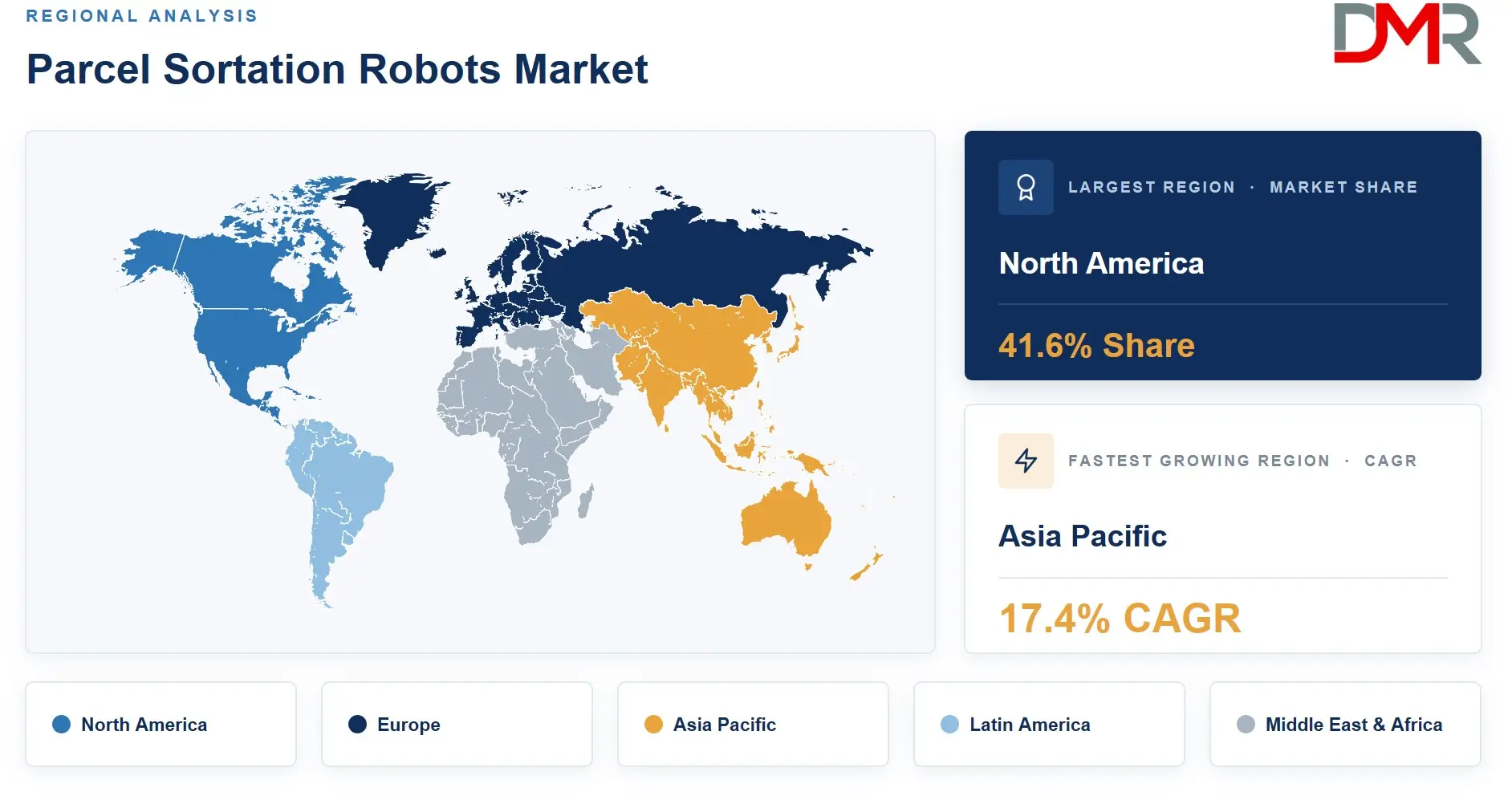
North America led the global parcel sortation robots market with a 41.6% share in 2026
North America
North America's lead position is anchored by the scale and automation maturity of its two largest e-commerce operators. Amazon alone operated more than one million robots across its fulfillment network in 2026, as confirmed by Amazon, setting a throughput benchmark that competitors and 3PL clients now treat as the service standard. Carrier networks built around same-day and next-day delivery commitments require sortation capacity that scales dynamically with peak-period demand spikes, and robotic systems are now the only viable mechanism for that scaling.
Asia-Pacific
Asia-Pacific posts the highest regional CAGR, driven by e-commerce penetration in China, India, and Southeast Asia outpacing the physical logistics infrastructure that supports it. China's domestic courier networks handle parcel volumes that rival the entire European market, and competitive pressure among carriers forces investment in throughput efficiency. Beumer Group finalized a USD 50 million commercial contract to deploy high-volume parcel sorting robots at a major distribution center in Dubai, with that Middle East activity reflecting the broader Asia-Pacific and adjacent region investment wave extending into new geography.
ℹ
To learn more about this report –
Download Your Free Sample Report Here
Europe
European demand is shaped by fragmented national carrier networks, high labor costs, and stringent energy efficiency requirements that make robotic sortation both an economic and a regulatory imperative. Germany, France, and the UK represent the largest individual country markets, each operating national postal operators alongside multiple private express carriers investing in automation to defend margin.
Latin America
Latin America is an emerging market for parcel sortation robots, with Brazil and Mexico leading adoption as domestic e-commerce volumes build toward a scale that justifies automation capital. Infrastructure gaps and currency volatility constrain deployment timelines, but regional carrier consolidation is gradually creating larger operator balance sheets that can absorb robotics investment.
Middle East & Africa
The Gulf Cooperation Council states are active early adopters, particularly in airport cargo and luxury goods distribution, where service precision and throughput reliability carry premium value. South Africa represents the most developed sub-Saharan market, though the broader MEA region remains constrained by infrastructure maturity and limited local robotics service ecosystems.
Key Regions and Countries
North America
Europe
- Germany
- France
- The UK
- Spain
- Italy
- Rest of Europe
Asia Pacific
- China
- Japan
- South Korea
- India
- Australia
- Rest of APAC
Latin America
- Brazil
- Mexico
- Rest of Latin America
Middle East & Africa
- GCC
- South Africa
- Rest of MEA
Macroeconomic Impact
Global GDP growth was projected at 3.2% in 2025 and 3.1% in 2026, down from 3.3% in 2024, per IMF data, reflecting a moderating global expansion that narrows capital budgets for logistics infrastructure. World merchandise trade volume was projected to grow 2.4% in 2025 but slow to 0.5% in 2026, as reported by the WTO, compressing the parcel-volume tailwind that has historically driven sortation investment cycles. Carriers facing slower volume growth will defer large-scale automation projects, concentrating near-term demand among operators locked into service-level commitments that require throughput maintenance regardless of volume softness.
Maritime trade grew 2.2% in 2024 but was forecast to expand only 0.5% in 2025, according to UNCTAD, while geopolitical shipping-route rerouting pushed seaborne trade ton-miles up nearly 6% in the same year. Longer transit routes increase supply chain unpredictability, which forces inland sortation hubs to absorb arrival variability. Operators managing irregular inbound parcel flows find robotic sortation's dynamic routing capability more valuable than fixed conveyor systems under these conditions.
Market Dynamics
Driver: E-Commerce Volume and Labor Economics Make Automation Unavoidable
Transportation-and-logistics professional service robots recorded global sales of 102,900 units in 2024, up 14% year over year, as reported by the International Federation of Robotics. That rate of deployment confirms that operators are replacing manual sorting workflows at a pace that tracks parcel-volume growth rather than waiting for complete labor shortages. Facilities that invested in robotic induction before the 2024 peak season absorbed demand spikes that competitors managed through costly temporary staffing.
Dematic confirmed a high-throughput sortation deployment capable of processing up to 50,000 shipments per hour, per Dematic, illustrating the ceiling that robotic systems unlock relative to human-led operations. Wage inflation in warehouse-dense markets including the US, Germany, and Australia has pushed the payback period for robotic sortation below five years for high-volume operators, converting capital expenditure decisions into straightforward return-on-investment calculations.
Restraint: Integration Complexity and Capital Barriers Slow Deployment
Brownfield facilities built around legacy conveyor systems and proprietary warehouse control software present the most persistent constraint on deployment velocity. Robotics vendors must interface with multiple legacy systems, navigate facility layout constraints, and maintain operations continuity during installation, often extending project timelines by six to eighteen months beyond initial estimates. SME operators face the compounded problem of limited engineering resources to manage integration alongside core operations.
High upfront capital requirements for robots, safety infrastructure, and software integration place full-scale sortation automation beyond the financial reach of regional carriers and independent 3PLs operating on thin margin. A single high-throughput sortation cell can require multi-million-dollar commitments before generating any throughput return, and lenders serving logistics SMEs have not yet developed standardized financing structures for robotics assets.
Opportunity: RaaS Models and Modular Hubs Expand the Addressable Market
Amazon delivered more than 13 billion items to Prime members on the same or next day during 2025, as confirmed by Amazon, establishing a delivery speed expectation that mid-market operators must now attempt to match or accept permanent share loss. Robotics-as-a-Service commercial models convert capital expenditure into operating expenditure, removing the single largest financial barrier for regional carriers and mid-market fulfillment operators who cannot raise debt for hardware assets.
AutoStore formalized a USD 200 million framework agreement with a major US 3PL provider to deploy fifty high-density robotic fulfillment systems across twenty-five hubs by 2026 under its RaaS model, signaling that the financing structure now exists at commercial scale. Dematic announced a nearly USD 50 million integrated warehouse-automation showcase facility in North America, giving mid-market buyers hands-on exposure to sortation technology before committing capital. Cross-border e-commerce parcel flows and reverse-logistics processing for high-volume returns each represent demand pools where the RaaS model enables entry that would otherwise require prohibitive upfront investment.
Porter's Five Forces
The World Bank's 2025 logistics evidence framework covers shipment-tracking data representing more than 80% of global goods trade, per World Bank findings, illustrating the scale of infrastructure through which parcel sortation systems must integrate, and the data dependency that creates supplier lock-in. Competitive rivalry among established vendors is intense but structured around differentiated technology layers: hardware leaders compete on throughput and reliability while software orchestration providers compete on fleet optimization and exception-handling intelligence.
Barriers to new entrant scale are high because certifications, track records with Tier 1 carriers, and service network depth take years to establish. Buyer bargaining power is moderate at the enterprise level, where long procurement cycles and multi-year service agreements limit switching, but rising among mid-market operators as RaaS models reduce switching costs. The threat of substitutes is low in the near term because no non-robotic sortation mechanism can match the throughput, accuracy, and labor-cost profile of robotic systems at commercial scale. Supplier concentration in precision motors, sensors, and safety components gives key component vendors meaningful pricing leverage over robot manufacturers, a risk that intensifies as deployment volumes increase.
AI and Gen AI Impact
Artificial intelligence reshapes parcel sortation robots most visibly at the perception and routing layers. Computer-vision models trained on millions of parcel images now identify irregular shapes, damaged labels, and barcode-deficient items with accuracy that exceeds human sorters under high-throughput conditions. Early movers who embedded AI-powered optical character recognition into their induction systems before 2024 reduced exception-rate backlogs that previously required dedicated manual workstations.
Edge-based fleet orchestration applies machine learning inference directly at the robot control layer, eliminating the latency that cloud-only architectures introduce into real-time traffic balancing. Operators who have not yet deployed edge AI face compounding inefficiency as fleet sizes grow. Laggards running rule-based routing logic will encounter throughput ceilings that their competitors have already removed by shifting to model-driven induction balancing and real-time exception prioritization.
Market Trends
AMR Architectures and Edge Intelligence Replace Fixed Conveyor Logic
Autonomous Mobile Robot-based sortation architectures are replacing fixed conveyor systems because they allow operators to change routing logic through software rather than physical reconfiguration. In March 2025, Dematic launched an upgraded Warehouse Execution System embedding real-time machine learning algorithms for dynamic sorter routing optimization, confirming that the intelligence layer is now a competitive differentiator rather than a commodity feature. Operators adopting reconfigurable AMR architectures today are building a structural flexibility advantage over competitors locked into fixed conveyor capital commitments that depreciate slowly and adapt poorly to changing parcel-mix profiles.
Market Competition Overview
Global industrial robot installations reached 542,000 units in 2024, more than double the installed level of a decade earlier, as reported by the International Federation of Robotics. That installed-base growth has attracted a large number of vendors across hardware, software, and full-system integration, creating a competitive landscape that is moderately fragmented at the global level but concentrated at the national and regional level where service ecosystems matter more than product specifications. Large-system integrators with established carrier relationships hold durable share because switching costs in live sortation environments are operationally prohibitive.
Toyota Industries planned to form Toyota Automated Logistics in April 2026 by combining Bastian Solutions, Vanderlande's warehousing business, and viastore into a single entity, creating a competitor with global integration capability across multiple sortation and fulfillment technology layers. Consolidation among vendors of this scale forces mid-tier competitors to specialize narrowly or accept subcontractor positions within larger system integrator ecosystems.
Pricing Analysis
Parcel sortation robot pricing varies substantially by system scale, automation level, and deployment model. Fully automated cross-belt sortation systems for Tier 1 carrier hubs carry multi-million-dollar price points that reflect custom engineering, safety infrastructure, and long-term service contract components. AMR-based modular systems for mid-market operators price significantly lower per unit but require software licensing, fleet management subscriptions, and periodic sensor calibration costs that compound over deployment life.
RaaS commercial models are reshaping price discovery by converting system cost into monthly operating fees indexed to throughput volume. Challengers use RaaS pricing to enter accounts that established vendors hold through capital-sale relationships, accepting lower near-term margin in exchange for multi-year recurring revenue. Market leaders are responding by bundling predictive maintenance and performance guarantees into service agreements, making total cost of ownership comparisons more complex for buyers evaluating bids.
Company Profiles
Geekplus has established the clearest financial proof of commercial-scale AMR sortation profitability among pure-play robotics vendors. As reported by Geekplus, H1 2025 revenue reached RMB 1.025 billion, representing 31.0% year-over-year growth, while gross profit of RMB 360 million rose 43.1%, expanding gross margin to 35.1%. Adjusted EBITDA turned positive at RMB 11.62 million against a negative RMB 169.83 million in the corresponding prior-year period, confirming the operating leverage that scale creates in software-intensive robotics businesses. With more than 72,000 robots delivered across more than 40 countries by end of 2025, Geekplus has built a global installed base that generates recurring service revenue and field data for continuous model improvement.
Vanderlande Industries competes from a position built on decades of large-system integration experience across airports, postal networks, and warehousing environments. Vanderlande's installed base sorts more than 52 million parcels per day across its global client portfolio, providing a throughput reference that few competitors can match. Its absorption into what will become Toyota Automated Logistics in 2026 adds balance sheet depth and cross-selling access across Bastian Solutions' North American fulfillment client base and viastore's European software relationships. That structural combination positions Vanderlande to compete for integrated end-to-end automation contracts that stand-alone hardware vendors cannot address.
Key Players
- Amazon Robotics
- Vanderlande Industries
- KUKA (Swisslog)
- Daifuku Co. Ltd.
- Dematic
- Geek+
- GreyOrange
- Knapp AG
- BEUMER Group
- Siemens Logistics
- Fetch Robotics (Zebra Technologies)
- Hitachi
- Omron Adept Technologies
- Hi-tech Robotic Systemz
- Zhejiang Libiao Robotics
- Hangzhou Hikrobot Technology
- Bastian Solutions
- ABB
- Interroll Group
- Tompkins Robotics
Supply Chain and Value Chain Analysis
The parcel sortation robot supply chain opens at precision component manufacturers supplying servo motors, LiDAR sensors, machine vision cameras, and safety-rated control hardware. Robot OEMs integrate those components into standard platforms before system integrators customize configurations for specific facility layouts and parcel-flow profiles. Maximum value creation occurs at the software and integration layer, where fleet orchestration platforms, warehouse execution systems, and predictive maintenance contracts generate recurring revenue that hardware margins cannot match.
The biggest supply-chain risk sits in sensor and semiconductor concentration. LiDAR and 3D vision components rely on a narrow supplier base, and demand surges from automotive and consumer electronics compete directly with robotics manufacturers for allocation. Integrators managing multi-site rollouts have begun requiring minimum inventory buffers from component suppliers as a contract condition, adding cost that ultimately passes through to end-user pricing.
Regulatory Landscape
Parcel sortation robot deployments operate within layered regulatory frameworks covering machine safety, electromagnetic compatibility, and data privacy. In Europe, the Machinery Regulation (EU) 2023/1230 replaced the previous Machinery Directive, raising safety assessment requirements for autonomous systems operating in proximity to humans. Compliance with the new regulation extends validation timelines for AMR deployments in mixed human-robot environments and raises certification costs for vendors entering EU markets.
North American operators follow ANSI/RIA R15.08 for industrial mobile robots and OSHA general duty standards for workplace safety. Regulatory divergence between the US and EU creates additional compliance cost for vendors selling standardized platforms globally. Operators in Asia-Pacific navigate national standards that vary significantly by country, with China's GB standards and Japan's JIS frameworks each requiring localized certification pathways that slow market entry for non-domestic vendors.
Investment and White Space Analysis
Investment concentration in 2025 and 2026 favored large-system integrators and pure-play AMR vendors with proven carrier references. RaaS financing structures are drawing private equity interest because they generate predictable recurring revenue with high switching costs, a combination that supports premium valuation multiples. White space exists most visibly in the reverse-logistics automation segment, where returns processing for apparel, electronics, and marketplace fulfillment generates irregular parcel flows that fixed-conveyor sortation handles poorly but AMR-based systems can address with software reconfiguration.
Modular micro-sortation hubs serving urban last-mile networks represent an underserved segment where no vendor has achieved dominant share. Regional carriers and retail chains operating urban backrooms need sortation systems priced and sized for sub-10,000-square-foot footprints. Mid-market operators in Southeast Asia, Latin America, and Eastern Europe represent high-growth buyer pools where automation penetration remains low and RaaS pricing removes the capital barrier that previously excluded them from vendor pipelines.
Recent Developments
- April 2025: Vanderlande Industries introduced the CROSSORTER 1500, featuring AI-powered predictive maintenance and a 30% reduction in energy consumption compared with its predecessor system.
- March 2025: Amazon confirmed plans to expand the STARK robotic tote-handling system to 15 European fulfillment sites by 2027, scaling a platform already operating across multiple North American centers.
- January 2025: Honeywell Intelligrated unveiled next-generation sliding shoe sortation technology delivering up to 25% higher throughput for sorting operations compared with prior-generation configurations.
- November 2025: AutoStore formalized a USD 200 million framework agreement with a major US 3PL provider to deploy fifty high-density robotic fulfillment systems across twenty-five commercial hubs by 2026 under its RaaS model.
- August 2025: Swisslog expanded its Rexel automation partnership through an AutoStore system designed for up to 50,000 bins, more than 70 robots, 13 picking ports, and six receiving ports, and signed a five-year maintenance agreement in connection with the deployment.
- 2026: Amazon introduced Blue Jay, a multi-arm robotics system integrating work previously performed across three assembly lines into a single system, reducing footprint and improving induction consistency.
- December 2025: Daifuku completed a EUR 80 million transaction to acquire 60% of a European software company to scale its cloud-native warehouse execution system and robotic sortation platform portfolios.
- December 2024: Siemens Logistics closed the acquisition of a specialized industrial software firm to augment the digital twin capabilities of its physical parcel sortation systems.
- December 2024: Zebra Technologies completed a USD 350 million acquisition of Photoneo, integrating 3D vision and perception technology into its Fetch Robotics AMR sortation infrastructure.
- February 2024: Daifuku demonstrated fully automated warehouse systems featuring automated storage, retrieval systems, and robotic sorting transfer vehicles at LogiMAT India 2024.
- 2025: Geekplus introduced RoboShuttle Hyper, whose scheduling system coordinates up to 5,000 robots across 50,000 square meters and three million storage locations in a single deployment.
- 2025: Soccer.com scaled its Geekplus warehouse deployment from 42 robots and six workstations in 2023 to 125 robots and 13 workstations, demonstrating modular AMR expansion without facility reconfiguration.
Report Details
| Report Characteristics |
| Market Value (2026) |
USD 2.10 Billion |
| Forecast Revenue (2035) |
USD 8.43 Billion |
| CAGR (2026–2035) |
16.7% |
| Historical Data |
2020 – 2024 |
| Forecast Data |
2026 – 2035 |
| Base Year |
2025 |
| Report Coverage |
Revenue Forecast, Market Dynamics, Competitive Landscape, Recent Developments |
| Segments Covered |
By Robot Type (AGVs, AMRs, Cobots), By Automation Level (Fully Automated, Semi-Automated, Manual Sortation), By Payload Capacity (Up to 50 kg, 51–200 kg, Above 200 kg), By Sort Type (Cross-Belt, Induction, Sliding Shoe), By Component (Hardware, Software, Services), By End User (Logistics, E-commerce, Postal Services, CEP, Airports, Others) |
| Regional Coverage |
North America – US, Canada; Europe – Germany, France, UK, Spain, Italy, Rest of Europe; Asia-Pacific – China, Japan, South Korea, India, Australia, Rest of APAC; Latin America – Brazil, Mexico, Rest of Latin America; Middle East & Africa – GCC, South Africa, Rest of MEA |
| Prominent Players |
Amazon Robotics, Vanderlande Industries, KUKA (Swisslog), Daifuku Co. Ltd., Dematic, Geek+, GreyOrange, Knapp AG, BEUMER Group, Siemens Logistics, Fetch Robotics (Zebra Technologies), Hitachi, Omron Adept Technologies, Hi-tech Robotic Systemz, Zhejiang Libiao Robotics, Hangzhou Hikrobot Technology, Bastian Solutions, ABB, Interroll Group, Tompkins Robotics, and Other Key Players |
| Customization Scope |
Customization for segments and region or country level will be provided. Additional customization can be done based on requirements. |
| Purchase Options |
We have three licenses to opt for: Single User License, Multi-User License (Up to 5 Users), and Corporate Use License (Unlimited Users and Printable PDF). |
Frequently Asked Questions
What is the biggest investment opportunity in the Parcel Sortation Robots market?
▾ Robotics-as-a-Service commercial models represent the largest near-term opportunity by unlocking automation for the mid-market segment that capital constraints have historically excluded. Regional carriers and independent 3PLs that adopt RaaS financing gain throughput capacity competitive with Tier 1 operators without multi-million-dollar upfront commitments. Reverse-logistics automation for high-volume returns processing is the fastest-emerging white space within that addressable pool.
Who are the top companies in the Parcel Sortation Robots market?
▾ Leading companies include Amazon Robotics, Vanderlande Industries, Dematic, KUKA (Swisslog), Daifuku Co. Ltd., Geek+, GreyOrange, Knapp AG, BEUMER Group, Siemens Logistics, and Fetch Robotics (Zebra Technologies), among others. Geekplus delivered more than 72,000 robots across more than 40 countries by the end of 2025, establishing one of the largest AMR installed bases among pure-play sortation vendors. The competitive field is broadening as Chinese vendors including Zhejiang Libiao Robotics and Hangzhou Hikrobot expand internationally.
Which segment is growing fastest in the Parcel Sortation Robots market and why?
▾ Autonomous Mobile Robots are the fastest-growing robot type because they allow operators to reconfigure sortation logic through software rather than physical conveyor changes. That flexibility is operationally critical for carriers managing shifting parcel-mix profiles and seasonal volume variability without incurring capital expenditure for each layout change. The RaaS financing model accelerates AMR adoption further by removing the upfront cost barrier for mid-market operators.
Which region is growing fastest in the Parcel Sortation Robots market and why?
▾ Asia-Pacific posts the highest regional CAGR, driven by e-commerce parcel volume in China, India, and Southeast Asia outpacing the physical logistics infrastructure that supports it. Competitive pressure among domestic carriers in China forces investment in throughput efficiency at a pace faster than in more mature Western markets. Government logistics modernization programs in India and Southeast Asia are accelerating infrastructure investment that creates natural demand for automated sortation systems.
What is the biggest challenge holding Parcel Sortation Robots Market back?
▾ Brownfield integration complexity is the most persistent constraint, as legacy conveyor systems and proprietary warehouse control software extend deployment timelines and inflate project risk beyond initial estimates. SME operators face the compounded problem of limited technical resources alongside the capital demands of integration. High upfront costs and uncertain ROI timelines continue to delay decisions for the large mid-market operator segment that represents the next major growth wave for the industry.