What is the Parking Meter Apps Market Size in 2026?
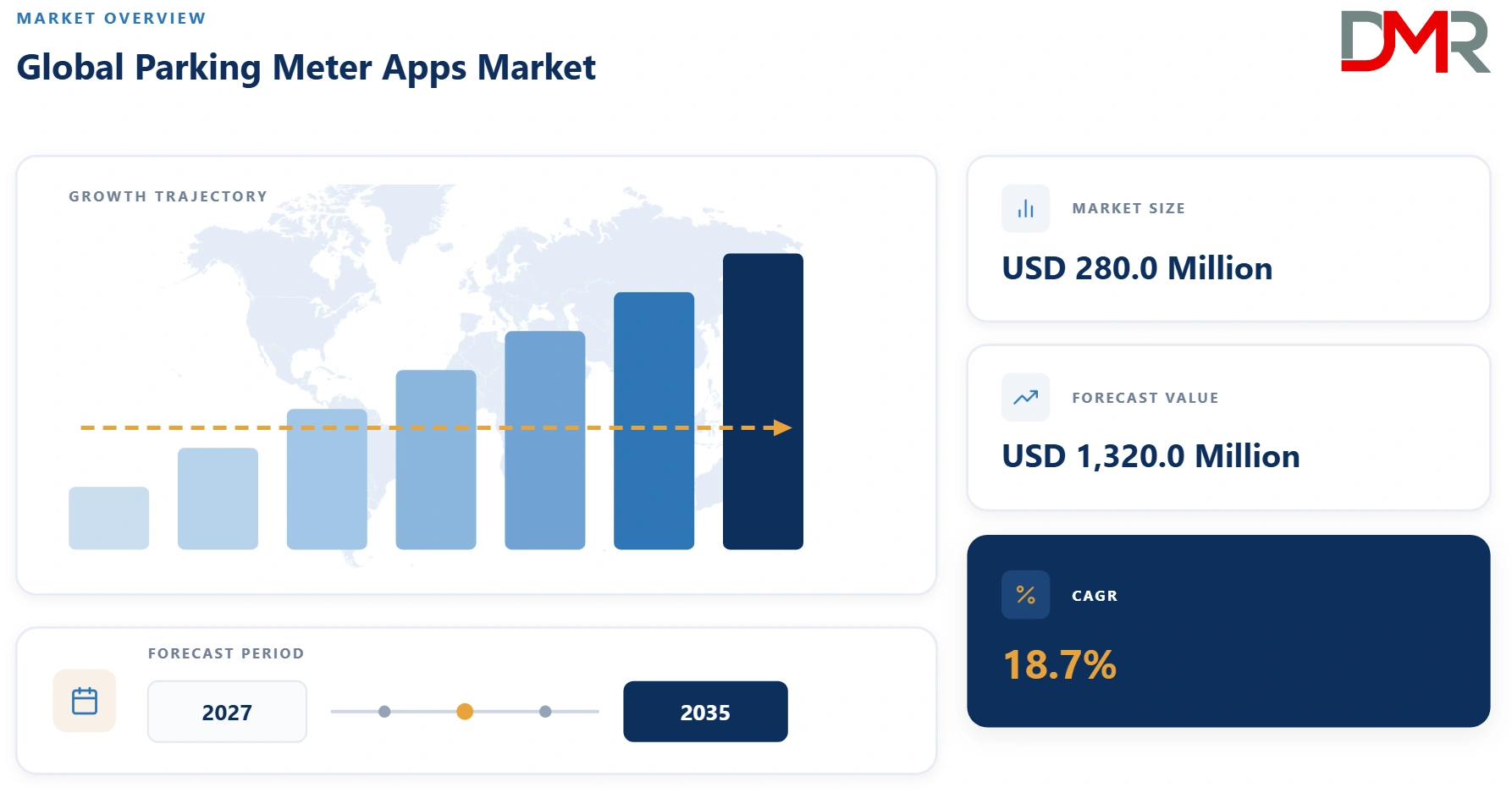
The global parking meter apps market is valued at USD 280 million in 2026 and is projected to reach USD 1,320 million by 2035, growing at a CAGR of 18.7% from 2027 to 2035. Smartphone penetration, cashless payment mandates, smart city initiatives, and rising demand for frictionless curb management drive growth.
ℹ
To learn more about this report –
Download Your Free Sample Report Here
Parking meter apps are mobile and web-based platforms that enable drivers to locate, reserve, and pay for on-street and off-street parking sessions digitally. These applications integrate payment processing, real-time availability data, digital permits, and enforcement workflows, replacing or supplementing traditional coin-operated meters. They serve individual drivers, municipal authorities, private parking operators, commercial property owners, and fleet operators, forming a critical layer in the broader smart mobility and curb management ecosystem.
The report covers the global parking meter apps market across five regions and twenty countries. It analyzes platform preferences, payment method adoption, application segments, feature differentiation, and end-user demand patterns. Competitive positioning, recent developments, regulatory shifts, and technology trends are examined to provide a comprehensive view of market evolution from historical data through the forecast horizon.
Parking Meter Apps Market Snapshot
Parking Meter Apps Market Snapshot, 2027-2035
| Metric |
Value |
| Market Size (2026) |
USD 280.0 Million |
| Forecast Value (2035) |
USD 1,320.0 Million |
| CAGR (2027-2035) |
18.7% |
| Largest Region (2026) |
North America, 38.2% share |
| Fastest-Growing Region (2027-2035) |
Asia Pacific, 22.4% CAGR |
| Leading Platform (2026) |
Android, 54.6% share |
| Leading Application (2026) |
On-Street Parking, 47.3% share |
| Key Players |
Arrive, Corpay, Passport Labs, SpotHero, INRIX |
Key Takeaways
- Market growth: The market expands from USD 280.0 million in 2026 to USD 1,320.0 million by 2035, registering an 18.7% CAGR.
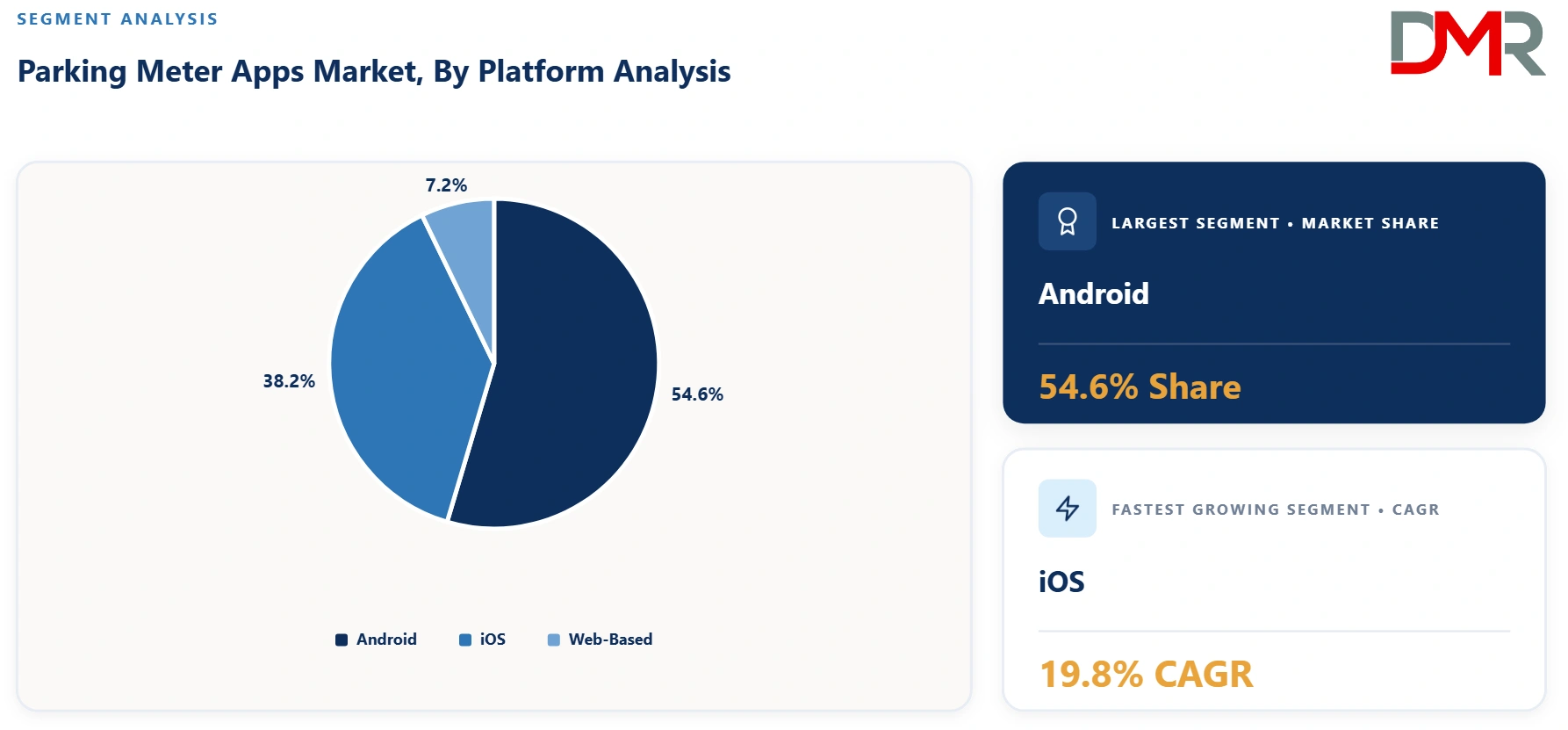
- Platform leader: Android holds 54.6% share in 2026, led by broad device penetration across both mature and emerging markets.
- Fastest platform: iOS is set to grow at 19.8% CAGR through 2035, ahead of the overall market, supported by higher in-app transaction values.
- Application leader: On-street parking accounts for 47.3% of 2026 demand, as municipalities digitize legacy meter infrastructure.
- Fastest application: Commercial parking is projected to grow at 21.2% CAGR, supported by private operator adoption of session-based billing.
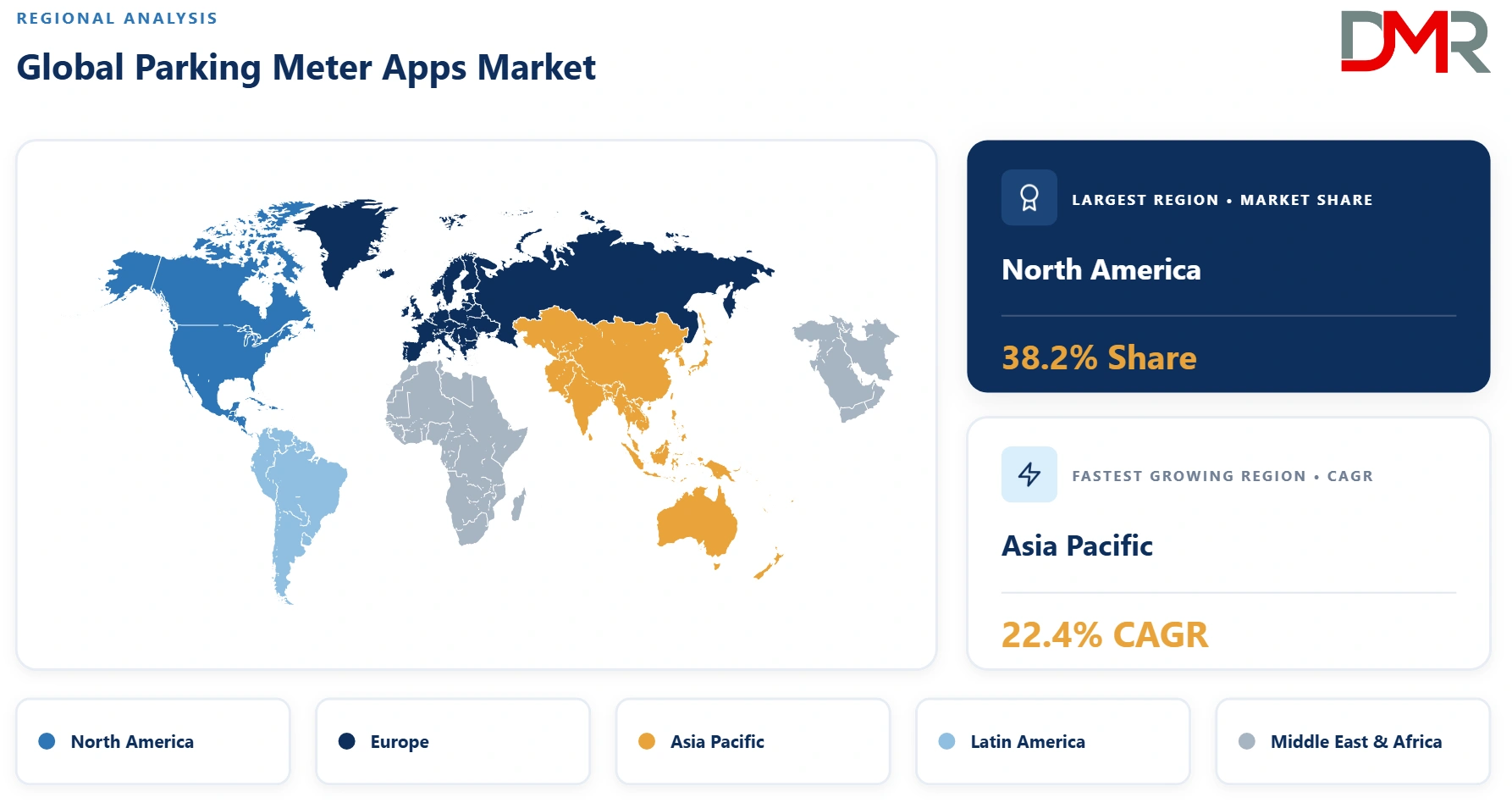
- Regional picture: North America leads with 38.2% share in 2026, while Asia Pacific is fastest-growing at 22.4% CAGR.
What are the Key Use Cases of Parking Meter Apps?
- On-street session payment: Drivers pay for curb parking via app, eliminating coin handling and reducing meter theft.
- Digital permit management: Residents and businesses obtain and renew virtual parking permits through municipal portals.
- Pre-booked commercial parking: Commuters reserve guaranteed spaces in private lots during peak hours.
- Fleet parking compliance: Operators track and pay for multiple vehicles, automating violation avoidance and expense reconciliation.
How are Foundation Models and Generative AI Transforming the Parking Meter Apps Market?
Foundation models and generative AI are reshaping parking apps from passive payment tools into proactive mobility assistants. On-device AI, such as Gemini Nano deployed by Kakao Mobility, now enables real-time parking compliance checks through photo analysis, eliminating cloud processing costs and privacy risks while delivering instant guidance to users. This shift toward edge intelligence allows apps to verify parking legality, interpret complex signage rules, and notify drivers before violations occur.
Operationally, generative AI streamlines entity extraction and customer support. Parking operators deploy large language models to parse unstructured user inputs, automate dispute resolution, and generate dynamic pricing recommendations based on occupancy patterns. Adoption is accelerating as municipalities seek to reduce enforcement costs and improve compliance rates. The market impact is tangible: AI-enhanced apps command higher engagement, reduce churn, and open new revenue streams through premium features and data services sold to cities and commercial operators.
Parking Meter Apps Market Dynamics at a Glance
Drivers, Restraints, Opportunities and Trends in the Parking Meter Apps Market
| Type |
Factor |
Impact |
| Driver |
Smart city and cashless payment mandates |
High |
| Driver |
Rising smartphone and mobile wallet penetration |
High |
| Restraint |
Data privacy and cybersecurity concerns |
Medium |
| Restraint |
Fragmented municipal procurement cycles |
High |
| Opportunity |
Integration with EV charging and MaaS platforms |
Medium |
| Opportunity |
AI-driven dynamic pricing and demand forecasting |
High |
| Trend |
On-device AI for parking compliance verification |
Medium |
| Trend |
Consolidation among parking technology providers |
High |
What is Driving the Growth of the Parking Meter Apps Market?
Smart City Mandates and Cashless Transition
Municipalities worldwide are mandating digital payment options for curb parking to reduce cash handling costs, improve revenue capture, and enhance user convenience. Cities including New York, London, and Singapore have implemented or proposed regulations requiring parking apps to display restrictions and provide location-specific information at the point of payment. This regulatory push creates captive demand for compliant, feature-rich applications. Operators that fail to modernize face revenue leakage and enforcement inefficiencies, while certified app providers gain preferential access to municipal contracts. The cashless transition also generates granular transaction data that cities use for curb management policy, reinforcing the cycle of digital adoption.
Proliferation of Mobile Wallets and Super-Apps
The integration of parking payments into broader super-app ecosystems is removing friction and expanding reach. Kakao Mobility in South Korea serves over 30 million users through its Kakao T app, embedding parking assistance alongside navigation, taxi-hailing, and delivery services. In China, platforms like JieShun Technology’s JieTingChe connect parking reservations with in-car systems and major payment ecosystems including WeChat and Alipay. This embedded distribution model lowers customer acquisition costs for app providers and accelerates adoption among users who may never download a standalone parking app. The result is a expanding addressable market that extends beyond dedicated parking applications to encompass any mobility platform with payment capabilities.
What are the Key Restraints in the Parking Meter Apps Market?
Fragmented Municipal Procurement and Standards
Parking regulation remains a local prerogative in most countries, creating a patchwork of technical requirements, payment protocols, and data-sharing rules. An app that integrates seamlessly with one city’s enforcement system may require substantial customization for the next municipality. New York’s proposed legislation, for example, imposes specific display and notification requirements on digital payment applications that differ from neighboring jurisdictions. This fragmentation inflates development and compliance costs, slows market entry, and disadvantages smaller providers lacking the resources to navigate dozens of distinct regulatory regimes. Consolidation among larger players partially mitigates this challenge but does not eliminate the underlying structural barrier.
Data Privacy and Cybersecurity Vulnerabilities
Parking apps collect sensitive information including location history, payment credentials, and vehicle identifiers. High-profile breaches in adjacent mobility sectors have heightened scrutiny from regulators and consumers. The Kakao Mobility case illustrates the privacy calculus: the company chose on-device AI processing specifically to avoid transmitting users’ parking location photos to cloud servers. While this approach addresses one vulnerability, it requires investment in device-side processing capabilities that smaller developers may struggle to afford. Cybersecurity concerns also slow municipal adoption, as procurement processes increasingly require security audits and compliance certifications that extend sales cycles and increase costs for app providers.
What are the Key Opportunities in the Parking Meter Apps Market?
Integration with EV Charging and Multimodal Journeys
The rapid growth of electric vehicle fleets global EV stock reached 55.8 million units in 2024 creates demand for parking solutions that integrate charging availability, reservation, and payment. Drivers of EVs seek unified experiences where they can locate a space with a charger, pre-book it, and pay for both parking and electricity in a single transaction. Parking apps that add EV charging integration can differentiate in crowded markets and capture higher-value transactions. This opportunity extends to fleet operators managing mixed EV and internal combustion vehicles, who require consolidated billing and charging scheduling. Providers that establish early partnerships with charging networks will secure durable competitive advantage.
AI-Powered Dynamic Pricing and Demand Forecasting
Generative AI and predictive analytics enable parking operators to optimize pricing in real time based on occupancy, events, weather, and historical patterns. Municipalities facing budget constraints are receptive to revenue-enhancing tools that also reduce congestion by smoothing demand peaks. Dynamic pricing algorithms can adjust rates by block, hour, and day type, maximizing utilization without deterring essential trips. For app providers, this capability transforms the value proposition from payment processing to revenue optimization, justifying higher subscription fees and deeper integration into municipal operations. Early movers are already piloting AI-driven pricing modules, and adoption is expected to accelerate as case studies demonstrate measurable revenue gains.
What are the Latest Trends in the Parking Meter Apps Market?
Consolidation Reshapes Competitive Landscape
The parking technology sector is undergoing significant consolidation as players seek scale, geographic reach, and integrated capabilities. EasyPark Group completed its acquisition of Parkopedia in February 2025, creating an end-to-end platform spanning data, payments, and in-car services, and subsequently rebranded the combined entity as Arrive. This consolidation pressures smaller competitors to specialize or seek acquisition. For municipalities and operators, consolidation promises simpler procurement but raises concerns about vendor lock-in and pricing power. The trend is likely to continue as private equity and strategic buyers recognize the recurring revenue potential of parking platforms with entrenched municipal relationships.
On-Device AI Transforms Compliance and User Assistance
The deployment of on-device foundation models represents a paradigm shift in how parking apps verify compliance and assist users. Kakao Mobility’s implementation of Gemini Nano via ML Kit’s GenAI Prompt API enables users to photograph their parked vehicle and receive instant feedback on whether it violates local rules, all without transmitting location data to external servers. This approach reduces cloud costs, eliminates privacy risks, and delivers sub-second response times. Other providers are expected to follow, creating a new competitive dimension centered on edge intelligence. The trend favors platforms with strong device-side engineering capabilities and could disadvantage cloud-dependent legacy systems.
Research Scope and Analysis
The report analyzes revenue streams from app subscriptions, transaction fees, municipal licensing, and value-added services across five platform types, five payment methods, five applications, five feature categories, five end-user segments, and twenty countries. Historical data from 2021 to 2026 provides context for forecast projections through 2035.
ℹ
To learn more about this report –
Download Your Free Sample Report Here
By Platform Analysis
Android dominates with 54.6% share in 2026, reflecting its global device ubiquity and strong presence in price-sensitive emerging markets where parking apps represent a first digital payment experience for many users. iOS is the fastest-growing platform at 19.8% CAGR, driven by higher in-app transaction values and greater willingness among iPhone users to pay for premium features such as reservation and digital permits.
By Payment Method Analysis
Digital wallets hold the leading position with 36.8% share in 2026, as consumers increasingly prefer stored payment credentials over manual card entry. Credit and debit cards remain significant at 28.4%, particularly in markets with mature banking infrastructure. Mobile payment apps represent the fastest-growing method at 21.5% CAGR, supported by super-app integration and QR code adoption in Asia Pacific.
By Application Analysis
On-street parking accounts for 47.3% of 2026 revenue, as municipalities prioritize digitization of legacy meter infrastructure and cashless mandates accelerate adoption. Commercial parking is the fastest-growing application at 21.2% CAGR, driven by private operators seeking yield management tools and consumers demanding guaranteed spaces in congested districts.
By Feature Analysis
Parking session management is the most widely adopted feature, embedded in 89% of active apps and generating 41.2% of feature-related revenue in 2026. Parking reservation is the fastest-growing feature at 23.7% CAGR, as drivers increasingly value certainty over price and operators recognize reservation premiums as a margin enhancer.
By End User Analysis
Individual drivers represent the largest end-user segment at 61.4% share in 2026, reflecting the consumer-facing nature of most parking apps. Municipal authorities are the fastest-growing end user at 20.9% CAGR, as cities modernize enforcement and seek data-driven curb management tools.
How is the Parking Meter Apps Market Segmented?
By Platform
By Payment Method
- Credit and Debit Cards
- Digital Wallets
- Mobile Payment Apps
- Contactless Payments
- Prepaid Parking Accounts
By Application
- On-Street Parking
- Off-Street Parking
- Residential Parking
- Commercial Parking
- Event Parking
By Feature
- Parking Session Management
- Parking Availability and Location
- Parking Reservation
- Parking Notifications and Reminders
- Digital Permits and Enforcement
By End User
- Individual Drivers
- Municipal Authorities
- Private Parking Operators
- Commercial Property Owners
- Fleet Operators
Which Region Leads the Parking Meter Apps Market?
North America leads with 38.2% share in 2026, while Asia Pacific is projected to grow at 22.4% CAGR from 2027 to 2035.
ℹ
To learn more about this report –
Download Your Free Sample Report Here
Region with the Largest Revenue Share
North America commands 38.2% of global revenue in 2026, with the United States contributing over 80% of regional value. High smartphone penetration, mature cashless infrastructure, and progressive municipal digitization programs drive adoption. Key cities including New York, San Francisco, and Chicago have deployed app-based payment systems across extensive on-street networks. The region is projected to grow at 16.8% CAGR through 2035, maintaining leadership despite Asia Pacific’s faster expansion.
Region with the Highest CAGR
Asia Pacific is the fastest-growing region at 22.4% CAGR, propelled by rapid urbanization, expanding middle-class vehicle ownership, and government smart city initiatives. China leads regional revenue, with platforms like JieTingChe integrating parking with in-car systems and major payment ecosystems. India and Southeast Asia offer substantial headroom as smartphone adoption rises and municipalities modernize legacy parking operations. The region is expected to overtake Europe in absolute revenue by the early 2030s.
Regional Analysis
Europe Parking Meter Apps Market
Europe holds a substantial share of global revenue, with Germany, France, and the United Kingdom representing the largest national markets. Strong municipal adoption of cashless parking mandates underpins demand, while EU green mobility directives accelerate app-based solutions that reduce idling and emissions. Nordic countries lead in digital permit integration, and cross-border interoperability initiatives are gradually harmonizing payment standards across member states. The region's outlook remains positive, supported by dense urban centers, high smartphone penetration, and progressive curb-management policies.
Latin America Parking Meter Apps Market
Latin America accounts for an increasing share of global revenue, with Brazil and Mexico as the primary markets. Rising smartphone penetration and private operator investment drive adoption, while urban congestion creates strong demand for digital curb management. Regulatory fragmentation and currency volatility temper growth, and payment infrastructure varies widely between major cities and secondary urban areas. Despite these constraints, the region's outlook is favorable as municipalities modernize parking operations and consumers increasingly embrace mobile payments.
Middle East & Africa Parking Meter Apps Market
The region accounts for a modest but expanding share of global revenue. The UAE and Saudi Arabia lead adoption through smart city programs, while South Africa shows strong private operator activity. Infrastructure gaps and low digital payment penetration outside major cities constrain faster expansion. Nevertheless, government-backed digitization initiatives and growing vehicle ownership support a positive outlook, with Gulf economies expected to remain the primary growth engines for parking app adoption across the region.
By Region
North America
Europe
- Germany
- France
- The U.K.
- Italy
- Spain
- Rest of Europe
Asia-Pacific
- China
- Japan
- India
- Australia
- South Korea
- Rest of APAC
Latin America
- Mexico
- Brazil
- Rest of LATAM
Middle East & Africa
- Saudi Arabia
- The UAE
- South Africa
- Rest of MEA
Regulatory Landscape
Parking app regulation is shifting from permissive to prescriptive, particularly regarding consumer protection and data disclosure. New York’s proposed legislation requiring apps to display parking restrictions prominently before payment represents a template that other jurisdictions may follow. European cities are integrating parking apps into broader low-emission zone and congestion charging frameworks, demanding interoperability that many legacy systems cannot provide. The regulatory trend favors compliant, well-resourced providers while creating compliance burdens for smaller competitors. Municipalities increasingly view parking data as public infrastructure, requiring open APIs and data-sharing agreements that reshape vendor relationships and create opportunities for data-driven services.
Investment and White Space Analysis
Private capital continues to flow into parking technology, attracted by recurring revenue models and municipal contract durability. The EasyPark-Parkopedia combination and subsequent Arrive rebranding signal consolidation appetite among strategic buyers. White space exists in three areas: AI-powered compliance verification for enforcement agencies, integrated EV charging and parking reservation platforms, and emerging market municipal digitization projects where incumbent penetration remains low. Investors should prioritize platforms with proprietary data assets, strong municipal relationships, and demonstrable unit economics in competitive markets.
Who are the Leading Companies in the Parking Meter Apps Market?
The market is moderately concentrated, with the top five providers accounting for majority of global revenue. Competition centers on municipal contract wins, platform breadth, and integration capabilities. Differentiation increasingly depends on AI features, data quality, and the ability to serve as a unified curb management layer rather than a standalone payment tool.
- Arrive (United Kingdom): Global urban mobility platform formed from the consolidation of Flowbird Group, EasyPark Group, and Parkopedia; offers smart payments, optimized parking, traffic reduction data, and reinvestment tools for public transport and green space across numerous countries.
- Corpay (United States): Global corporate payments company operating in vehicle payments, corporate payments, and lodging payments; provides fuel cards, toll management, AP automation, and expense control tools for businesses rather than consumer-facing parking apps.
- Passport Labs (United States): Mobility software company specializing in parking management, enforcement, permitting, and transit solutions; trusted by nearly 800 cities, universities, and agencies, with AI integration for back-office insights and compliance with PCI DSS, SOC 1, and SOC 2 standards.
- SpotHero (United States): Leading North American parking reservation marketplace operating in over 13,000 locations across 400+ cities; has sold over $2 billion in parking reservations and was acquired by Uber to integrate parking booking into its app.
- INRIX (United States): Mobility analytics and connected car services company transforming data from connected devices and vehicles into traffic, safety, and urban planning insights; provides parking intelligence and curb data that powers other apps and supports smart city decision-making.
Some of the prominent players in the Global Parking Meter Apps Market are:
- Arrive
- Corpay
- Passport Labs
- SpotHero
- INRIX
- APCOA Group
- IEM SA
- ParkMate
- Parkster
- Parclick
- SI.GE.RI.CO. S.p.A.
- Parklio
- Blinkay Mobility
- Pango
- JustPark
- Flash
- HONK
- Smart Parking Limited
- Kakao Mobility
- Republic Parking System
- Green P
- Precise ParkLink
- Premium Parking
- ParkNYC
- PayStay
- HotSpot Parking
- mPay2Park
- Strada Mobile
- Other Key Players
Recent Developments
- In September 2025, IPS Group Inc. launched the MSX Multi-Space Parking Kiosk, integrating contactless payments and future-ready API connectivity to support app-based session management.
- In March 2025, PayByPhone launched its "Meters for Trees" sustainability program, planting trees for every meter decommissioned, aligning parking digitization with municipal environmental goals.
- In February 2025, EasyPark Group completed its acquisition of Parkopedia, creating an end-to-end platform spanning parking data, payments, and connected car services.
- In January 2025, EasyPark Group announced its rebranding as Arrive, consolidating consumer brands including EasyPark, Flowbird, ParkMobile, and Parkopedia under a unified corporate identity.
- In September 2024, Flowbird Group signed a 10-year contract with the City of Warsaw to deploy and maintain 1,910 Strada S5 parking machines integrated with digital payment systems.
Report Scope and Research Methodology
Market definition: Parking meter apps are digital platforms enabling users to locate, reserve, and pay for parking sessions, manage permits, and receive enforcement notifications through mobile or web interfaces, serving drivers, municipalities, operators, and fleets.
Methodology: Dimension Market Research built the estimate bottom-up from company revenues, transaction volumes, and take rates for each platform, application, and end-user segment, then checked it top-down against municipal parking revenue and smart mobility spending totals. Primary interviews with parking operators, municipal transportation officials, and app developers validated adoption rates, pricing, and feature penetration. Forecasts apply segment-level growth assumptions for 2027–2035 and are reviewed at each report update.
Report Details
| Report Characteristics |
Details |
| Market Size (2026) |
USD 280.0 Million |
| Forecast Value (2035) |
USD 1,320.0 Million |
| CAGR (2027-2035) |
18.7% |
| Historical Data |
2021–2026 |
| Forecast Data |
2027–2035 |
| Base Year |
2026 |
| Estimate Year |
2027 |
| Segments Covered |
By Platform, By Payment Method, By Application, By Feature, By End User |
| Regional Coverage |
North America (The US, Canada); Europe (Germany, France, The UK, Italy, Spain, Rest of Europe); Asia Pacific (China, Japan, India, Australia, South Korea, Rest of APAC); Latin America (Mexico, Brazil, Rest of LATAM); Middle East & Africa (Saudi Arabia, The UAE, South Africa, Rest of MEA) |
Frequently Asked Questions
How big is the Parking Meter Apps Market in 2026?
▾ The global parking meter apps market is valued at USD 280.0 million in 2026.
What is the growth rate of the Parking Meter Apps Market?
▾ The market is projected to grow at an 18.7% CAGR from 2027 to 2035.
Which region leads the Parking Meter Apps Market?
▾ North America leads with 38.2% share in 2026.
Which product segment dominates the Parking Meter Apps Market?
▾ Android holds the largest platform share at 54.6% in 2026.
Which end user is growing fastest in the Parking Meter Apps Market?
▾ Municipal authorities represent the fastest-growing end-user segment at 20.9% CAGR.
Who are the key players in the Parking Meter Apps Market?
▾ Key players include Arrive, Corpay, Passport Labs, SpotHero, INRIX, among others.
What are the main challenges facing the Parking Meter Apps Market?
▾ Fragmented municipal procurement standards and data privacy/cybersecurity concerns are the primary challenges constraining faster adoption.