Market Overview
The global Passive RF Analyzers, RF Sensing, and SIGINT market covers hardware and software systems that intercept, monitor, classify, and geolocate electromagnetic signals without transmitting energy. Core product categories include passive RF analyzers, RF sensing nodes, and signals intelligence systems spanning communication intelligence, electronic intelligence, and foreign instrumentation signals intelligence. Border security platforms, counter-UAS detection packages, and maritime surveillance solutions extend the market into non-defense verticals. Active radar, jamming systems, and electronic attack platforms fall outside Passive RF & SIGINT Market 's scope.
Defense electronics modernization programs anchor demand across all major geographies. National militaries treat electromagnetic-spectrum superiority as a prerequisite for multi-domain operations, which pulls passive RF and SIGINT procurement into long-cycle platform upgrade budgets. Fraunhofer research published in 2025 showed that a four-Yagi-antenna passive-radar array successfully tracked a drone flying at approximately 30 m altitude and 10 m/s using only ambient LTE450 signals. Passive architectures require no dedicated illuminator, which removes a fundamental detectability risk that active systems carry.
Software intelligence increasingly determines system value. In August 2025, CRFS RFeye Nodes were selected as the RF-sensing backbone for the JOINER National Spectrum Facility, a University of Bristol-led initiative advancing spectrum and 6G communications research in the UK. Commercial operators and academic institutions now procure the same sensor-and-software stacks that defense customers use, accelerating platform maturity and compressing the gap between laboratory performance and field-deployable capability.
Key Takeaways
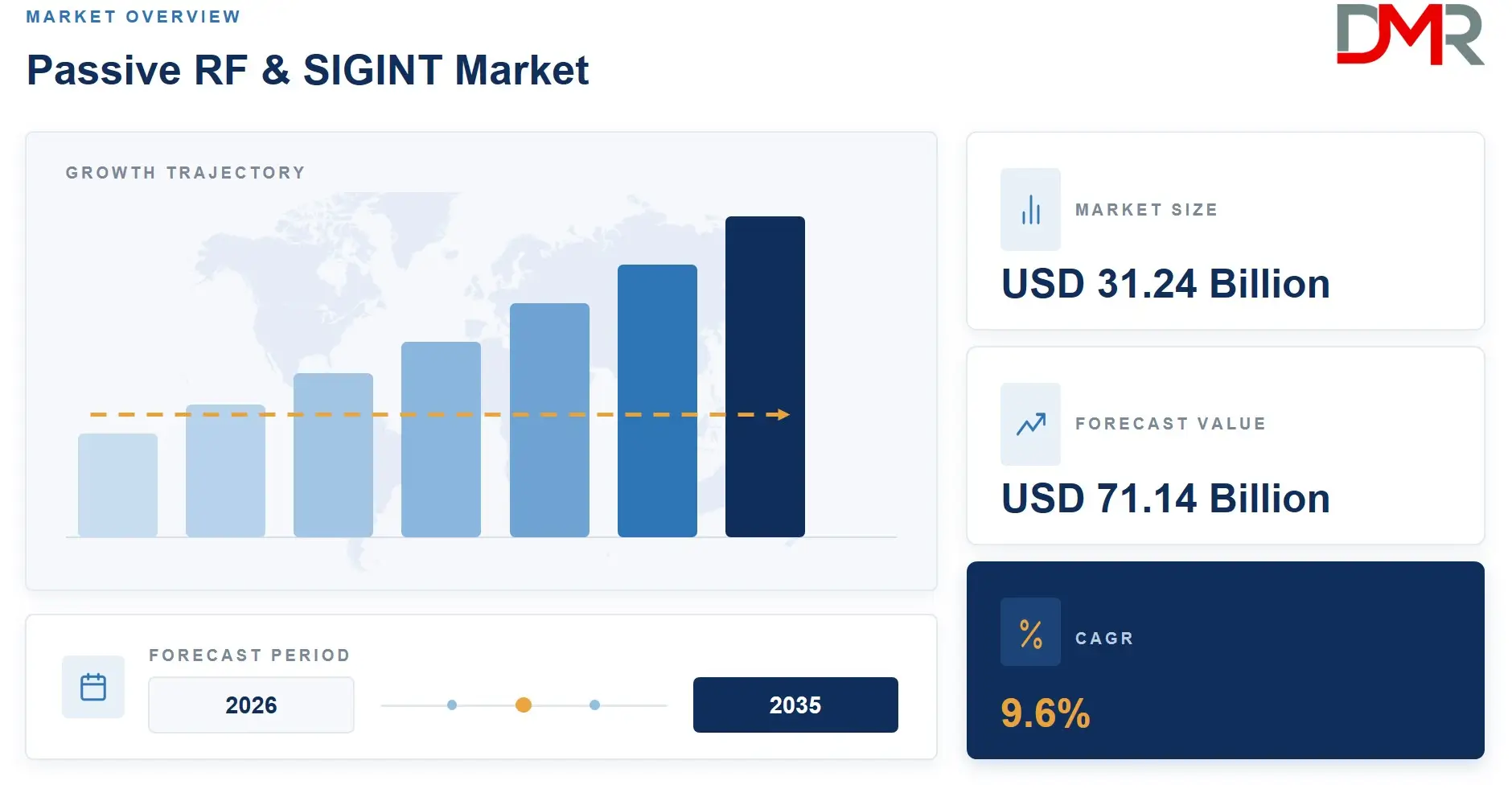
- The market size is USD 31.24 Billion in 2026, and is projected to hit USD 71.14 Billion by 2035 at a CAGR of 9.6%.
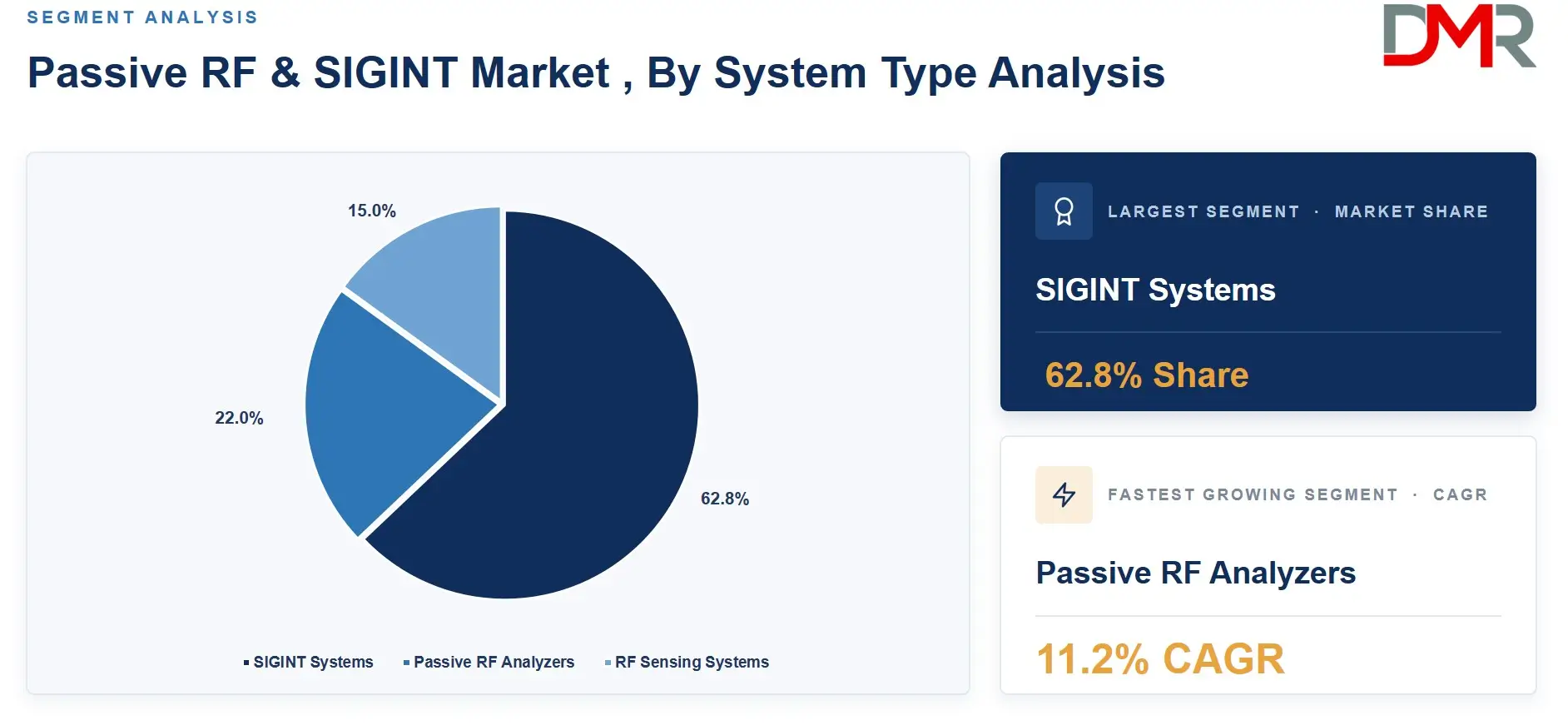
- By System Type: SIGINT Systems led with a 62.8% share in 2026.
- By Component: Software held the highest CAGR at 11.2%, while Hardware led as the largest category in 2026.
- By Platform: Ground-based led as the largest category in 2026.
- By Frequency: UHF held the highest CAGR at 10.2%, while HF led as the largest category in 2026.
- By Application: Military led with a 46.8% share in 2026.
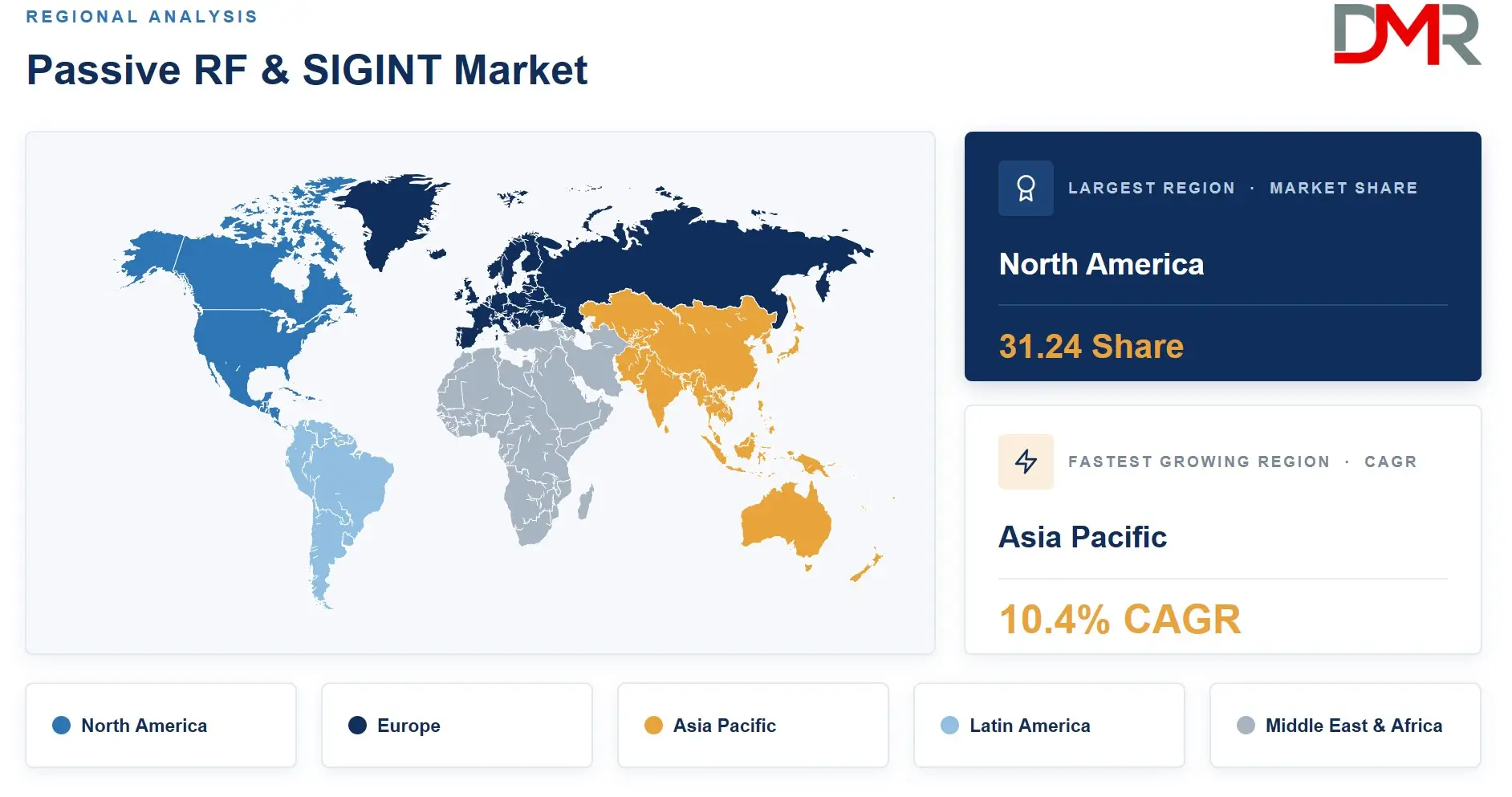
- By Region: North America led with the largest revenue share, valued at a dominant portion of the USD 31.24 Billion global market, in 2026.
- Asia Pacific represents the fastest-growing regional market, driven by defense modernization investment across China, India, South Korea, and Japan.
Market Size and Forecast
ℹ
To learn more about this report –
Download Your Free Sample Report Here
The Global Passive RF Analyzers, RF Sensing, and SIGINT Market size is estimated at USD 31.24 Billion in 2026, and is projected to reach USD 71.14 Billion by 2035, exhibiting a CAGR of 9.6% during the forecast period.
Sustained procurement from NATO member states, Indo-Pacific defense modernization budgets, and expanding non-defense verticals collectively underpin the forecast trajectory. The LTE450 passive-radar receiver documented in 2025 Fraunhofer trials digitized at 200/6 MHz and recorded 26,666,640 samples per channel within each 0.8-second coherent-integration scan. That level of data throughput demands purpose-built signal processing infrastructure, creating durable hardware and software co-procurement cycles that strengthen revenue visibility across the forecast window.
In May 2026, Infleqtion accelerated its Quantum Spectrum RF-sensing platform in response to growing customer demand, citing multiple new programs focused on trusted signals and resilient communications in contested environments. Atom-based sensing architectures entering field-trial stages signal a technology inflection that could expand total addressable demand beyond conventional RF receiver categories before 2035.
System Type Analysis
SIGINT Systems led the System Type segment with a 62.8% share in 2026.
ℹ
To learn more about this report –
Download Your Free Sample Report Here
SIGINT systems command the dominant position because military and intelligence customers buy integrated capability stacks rather than discrete components. A single SIGINT program bundles COMINT, ELINT, and FISINT collection into a unified architecture, concentrating procurement spend within this sub-segment. The Node Plus platform from CRFS delivers 100 MHz full-bandwidth I/Q streaming at 550 MB/s over a 10 Gigabit Ethernet SFP interface, illustrating the data-throughput requirements that push buyers toward purpose-engineered SIGINT hardware rather than general-purpose alternatives.
Passive RF Analyzers and RF Sensing Systems represent the complementary categories that feed raw signal data into SIGINT processing chains. Analyzer platforms increasingly embed AI-classification layers at the edge, reducing reliance on centralized processing and enabling forward-deployed units to act on RF intelligence without network connectivity. Vendors that position passive analyzers as SIGINT front-ends rather than standalone instruments capture a larger share of integrated program budgets.
Component Analysis
With an 11.2% CAGR in 2026, Software outpaced all other Component categories.
Hardware retains the largest absolute revenue share, but software is the segment where vendor differentiation concentrates. The CRFS RFeye Node 100-18 covers 9 kHz to 18 GHz, sustains 390 GHz/s sweep speed, and delivers 120 dB dynamic range. Those hardware specifications create a performance ceiling that software unlocks through AI-enabled signal classification, signal processing pipelines, spectrum visualization, and analytics layers. Buyers purchasing hardware that can be upgraded through software releases extend platform lifecycles and reduce total lifecycle cost.
AI-enabled signal classification sub-segments drive the software CAGR premium. Customers running persistent spectrum surveillance across wide-area environments cannot process signal volumes manually. Software that autonomously classifies emitters, flags anomalies, and triggers operator alerts converts raw RF data into actionable intelligence at timescales no human-in-the-loop workflow can match. Vendors that control both the hardware platform and the classification software stack capture recurring revenue from model updates and capability refreshes.
Platform Analysis
Ground-based led the Platform segment as the largest category in 2026.
Fixed site installations, tactical vehicle-mounted systems, and distributed sensor networks give ground-based platforms their volume advantage. Persistent coverage of fixed borders, critical infrastructure, and urban environments requires continuous operation that airborne or maritime platforms cannot sustain cost-effectively. The RFeye Node Plus with 16 TB SSD storage records 100 MHz I/Q data locally for up to 8 hours, while an 8 TB UAV-payload configuration sustains recording for up to 4 hours. Ground-based nodes eliminate the endurance constraint that limits airborne alternatives in long-duration surveillance missions.
Airborne platforms, including manned aircraft and UAS, represent the fastest-growing platform sub-segment because they provide geometric flexibility that ground nodes cannot replicate. Naval and maritime platforms are gaining procurement attention as vessel dark-activity detection and coastal security programs expand. Space-based RF sensing remains nascent but attracts investment from customers needing global coverage with zero local infrastructure.
Frequency Analysis
UHF (Ultra High Frequency) captured the highest CAGR at 10.2% in the Frequency segment, ahead of all rivals.
Counter-UAS proliferation is the primary UHF demand driver. Commercial drones overwhelmingly operate control links and video downlinks in UHF and adjacent bands, making UHF monitoring a prerequisite for any counter-UAS detection package. Airport operators, energy facility owners, and mass-gathering venue managers all require UHF-band coverage to detect unauthorized drone activity before a physical or data security incident occurs. HF retains the largest historical share because long-range military communications monitoring has been a core SIGINT mission for decades.
VHF and SHF bands serve distinct mission profiles. VHF supports tactical communications monitoring and border surveillance applications. SHF and EHF monitoring addresses satellite communications intercept and advanced military waveform collection, markets that carry high per-unit system values but smaller addressable customer pools. Vendors with multi-band simultaneous coverage capabilities avoid the zero-sum tradeoff between frequency segments and compete for integrated spectrum dominance contracts rather than single-band procurements.
Application Analysis
Military accounted for 46.8% of Application demand in 2026, the highest of any category.
Battlefield awareness, threat detection and emitter identification, and electronic support measures form the core mission set that drives military dominance within this segment. Defense customers allocate RF sensing and SIGINT budgets through multi-year platform programs, which insulates the military sub-segment from annual budget volatility that affects commercial buyers. Countries investing in electronic warfare modernization treat passive RF capability as a non-negotiable requirement rather than an optional enhancement.
Border Security and Critical Infrastructure Protection, Counter-UAS, Maritime Surveillance, and Public Safety collectively represent the civilian and dual-use market. Counter-UAS is the fastest-growing application sub-segment, pulled by a wave of commercial drone incidents at airports, prisons, and public events that have made passive RF detection a standard requirement in physical security frameworks. Maritime surveillance operators prioritize vessel dark-activity detection, where passive RF intelligence catches ships that disable AIS transponders to evade tracking.
Key Market Segments
By System Type
- SIGINT Systems
- Communication Intelligence (COMINT)
- Electronic Intelligence (ELINT)
- Foreign Instrumentation Signals Intelligence (FISINT)
- Passive RF Analyzers
- RF Sensing Systems
By Component
- Hardware
- Software
- AI-enabled signal classification
- Signal processing
- Spectrum visualization
- Analytics
By Platform
- Ground-based
- Fixed site installations
- Tactical vehicle-mounted
- Distributed sensor networks
- Airborne
- Manned aircraft
- Unmanned aerial systems (UAS)
- Naval / Maritime
- Space-based
By Frequency
- HF (High Frequency)
- VHF (Very High Frequency)
- UHF (Ultra High Frequency)
- SHF (Super High Frequency)
- EHF (Extremely High Frequency)
By Application
- Military
- Battlefield awareness
- Threat detection and emitter identification
- Electronic support measures (ESM)
- Border Security & Critical Infrastructure Protection
- Border surveillance
- Critical infrastructure monitoring
- Counter-UAS
- Maritime Surveillance
- Public Safety
Regional Analysis
North America led the Regional segment as the largest revenue market, within the global market valued at USD 31.24 Billion in 2026.
ℹ
To learn more about this report –
Download Your Free Sample Report Here
North America
The United States drives North American dominance through the scale and continuity of Department of Defense and intelligence community SIGINT procurement. Multi-year platform modernization programs, combined with classified contracts that do not appear in public procurement records, create a revenue base that no other region can replicate in the near term. Canada contributes through Five Eyes intelligence-sharing commitments that require domestic RF collection capability investments.
Asia Pacific
Asia Pacific ranks as the fastest-growing region because China, India, South Korea, Japan, and Australia are each running concurrent defense modernization programs that include electronic warfare and spectrum monitoring upgrades. Territorial disputes across the South China Sea and the Taiwan Strait sustain procurement urgency. India's indigenization mandates pull domestic RF sensing manufacturers into government programs, creating local production investment alongside import procurement.
Europe
NATO commitments following the 2022 Russia-Ukraine conflict reshaped European defense budgets. Germany, France, and the UK all increased electronic warfare and ISR investment as a direct response to demonstrated EW effectiveness in that conflict. European vendors such as Rohde & Schwarz, Thales, and BAE Systems benefit from home-country procurement preferences while competing for NATO common-funded programs across the alliance.
Latin America
Brazil and Mexico represent the primary demand centers, with border surveillance and counter-narcotics operations generating RF sensing procurement outside traditional military channels. Budget constraints limit large-scale SIGINT platform purchases, but distributed sensor network deployments for coastal and land-border monitoring align with available funding levels.
Middle East & Africa
GCC countries, particularly Saudi Arabia and the UAE, invest heavily in RF sensing and SIGINT capability as part of broader defense modernization driven by regional conflict dynamics and oil-revenue-funded procurement budgets. South Africa maintains a domestic defense electronics capability through Denel and associated suppliers. The rest of the MEA region remains nascent but shows demand growth in counter-terrorism-motivated spectrum monitoring.
Key Regions and Countries
North America
Europe
- Germany
- France
- The UK
- Spain
- Italy
- Rest of Europe
Asia Pacific
- China
- Japan
- South Korea
- India
- Australia
- Rest of APAC
Latin America
- Brazil
- Mexico
- Rest of Latin America
Middle East & Africa
- GCC
- South Africa
- Rest of MEA
Macroeconomic Impact
Defense budget cycles respond to geopolitical threat assessments more directly than to GDP or inflation trends. Rising NATO defense spending commitments, triggered by the 2022 Russia-Ukraine conflict and sustained into 2026, created a demand floor for RF sensing and SIGINT platforms that macroeconomic softness in Europe has not meaningfully eroded. Currency depreciation in emerging markets raises the effective cost of USD-denominated system acquisitions, which delays procurement timelines in Latin America and parts of Southeast Asia but does not cancel programs.
Geolocation mission architectures carry embedded infrastructure cost requirements that multiply procurement budgets. A 3D TDoA geolocation deployment requires at least four RF sensors per network node, as confirmed by CRFS operational data. That minimum sensor count creates a capital-intensive entry threshold that buyers cannot circumvent, which insulates vendors from price compression that affects more modular or scalable technology markets.
Market Dynamics
Driver: Electronic-Warfare Modernization Embeds Passive RF Procurement
Defense programs across NATO and Indo-Pacific nations embed passive RF and SIGINT capability as a baseline requirement in electronic warfare and multi-domain ISR platform upgrades. Procurement officers treat spectrum awareness as foundational rather than optional, which places RF sensing budgets inside protected platform lines rather than discretionary equipment categories. A 2025 Fraunhofer passive-radar experiment detected a DJI Matrice M210 drone at a bistatic range of approximately 1,600 m while holding false-alarm probability at 0.0001, demonstrating that non-emitting architectures now meet operational detection thresholds that active-radar advocates once claimed were unachievable.
Azimuth-estimation error in the same multichannel trial ranged from 2.2 ± 3.7° to 2.8 ± 2.4°, a precision level consistent with cueing fire-control or electronic-attack systems. In April 2025, Rohde & Schwarz launched transportable military spectrum-monitoring systems designed to help armed forces detect and geolocate emitters in complex electromagnetic environments. That product introduction confirms vendor confidence that military buyers will fund portable, field-deployable passive spectrum capability as a standard equipment category.
Restraint: Acquisition Cost and Export Controls Constrain Market Access
Advanced passive RF and SIGINT architectures carry high acquisition, integration, and lifecycle-sustainment costs that exclude many government customers below major-power defense budget levels. System complexity pushes total program costs well above hardware list prices once integration, training, and multi-year sustainment are included. Buyers with limited defense budgets frequently delay or descope procurements rather than commit to long-term sustainment obligations.
ITAR, export-control frameworks, encryption restrictions, and classified-data handling rules limit the partner ecosystems that vendors can build across borders. A US-origin SIGINT platform cannot be exported to many allied nations without extensive licensing review, which slows sales cycles and restricts geographic market expansion. European and Israeli vendors hold a structural advantage in non-US allied markets where ITAR restrictions do not apply, but those vendors face reciprocal access limitations in the United States.
Opportunity: Distributed Sensor Networks for Persistent Wide-Area Surveillance
Passive RF sensor mesh deployments across borders, ports, and critical infrastructure sites represent a multi-billion-dollar opportunity outside core military SIGINT budgets. Port authorities, energy operators, and border agencies require persistent, wide-area spectrum awareness but cannot procure or operate classified SIGINT platforms. Commercial-grade RF sensing networks serve that need at accessible price points. In October 2025, CRFS demonstrated SIGINT integration during the REPMUS 2025 exercise, mounting an RFeye Node on a SCHIEBEL CAMCOPTER S-100 UAS and streaming geolocation data into Thales' TACTICOS combat-management system.
Multichannel passive-radar trials confirmed that probability of detection at a false-alarm probability of 0.008 reached 79.7%, 81.1%, 96.4%, and 75.0% across varying flight paths and illuminators. Performance at those levels makes distributed sensor networks a credible alternative to active radar for persistent wide-area coverage, removing the last major technical objection that procurement agencies raised against passive architectures in competitive evaluations.
Porter's Five Forces
The competitive structure of Passive RF & SIGINT Market strongly favors established defense contractors and specialized RF electronics vendors. Threat of new entrants is low: certifications, security clearances, and decades-long customer relationships create barriers that startup capital cannot quickly replicate. Supplier bargaining power is moderate but concentrated in specialized RF component and semiconductor supply chains where few qualified vendors exist. Buyer power is constrained by the technical complexity of requirements and the small number of qualified suppliers capable of meeting classified system specifications. The best-performing multichannel passive-radar configuration documented in 2025 Fraunhofer trials achieved a 96.4% probability of detection at 0.008 false-alarm probability, setting a performance benchmark that raises the minimum technical competency required to compete for high-value contracts. Threat of substitutes is low in military SIGINT, where no alternative collection discipline replicates RF intelligence's speed and non-attribution advantages. Competitive rivalry among the top fifteen vendors is high, concentrated on platform differentiation, software capability, and government customer access rather than price.
AI and Gen AI Impact
AI reshapes the RF signal classification layer more fundamentally than any other part of the value chain. Manual analysis of wide-area spectrum data at the volumes generated by modern multi-node networks is not operationally viable. AI-enabled signal classification software reduces threat identification timelines from minutes to seconds by automating emitter recognition, waveform characterization, and anomaly flagging. Doppler-estimation error in the 2025 LTE450 passive-radar experiment ranged from 0.32 ± 1.3 Hz to 0.61 ± 1.7 Hz, a precision level that AI processing must maintain across thousands of simultaneous signal tracks to be operationally useful. Vendors that embed AI classification natively into sensor firmware hold a processing latency advantage over those that rely on centralized cloud analysis.
In April 2026, Infleqtion received a $1 million U.S. Navy contract to advance its Contextual Machine Learning software for RF signal processing, targeting an integrated defense prototype. Early movers embedding ML classification directly into sensor hardware compress the gap between signal collection and operator decision by removing cloud-dependency latency. Vendors that delay AI integration risk losing re-compete opportunities as buyers specify AI-classification minimums in new solicitations.
Market Trends
Software-Defined Platforms Displace Hardware-Centric Monitoring Systems
Software-defined, intelligence-led RF platforms are replacing standalone analyzers across both military and commercial customer bases. Mobile and on-the-move RF sensing configurations are becoming the standard for tactical spectrum operations, reflecting demand for deployable capability without fixed infrastructure. Range-estimation error in 2025 Fraunhofer multichannel passive-radar trials ranged from 0.93 ± 15.7 m to 10.4 ± 9.1 m, confirming that software-defined passive architectures meet positioning accuracy requirements for tactical cueing missions. In April 2026, Silvus Technologies introduced the FASST™ 6000 Spectrum Sensor, a low-SWaP RF spectrum-intelligence system delivering 144.5 THz/s scanning speed in handheld and OEM configurations, designed for distributed SIGINT and electronic warfare operations.
Market Competition Overview
The market is moderately consolidated at the top tier, with a small group of major defense primes holding the largest SIGINT platform contracts, and a broader mid-tier of specialized RF electronics vendors competing for sensor, analyzer, and software sub-system awards. No single vendor holds a dominant share across all five application sub-segments simultaneously. Competitive positioning splits between defense-prime integrators that own the SIGINT platform layer and specialized hardware-software vendors that supply sensor nodes and analytics modules into those platforms.
Node Plus architecture data from CRFS shows 3× processing power versus the standard Node, with detector missions executing 3–4× faster in 3D TDoA network configurations. That performance differential drives competitive differentiation in multi-sensor network awards where processing throughput determines geolocation accuracy and update rate. In May 2026, Motorola Solutions announced a $100 million plan to expand Silvus Technologies' manufacturing and supply-chain capacity, a signal that prime integrators are investing in production scale ahead of anticipated volume growth in tactical communications and RF sensing programs.
Pricing Analysis
Pricing in Passive RF & SIGINT Market varies sharply by system complexity, classification level, and customer category. Classified military SIGINT platforms carry program costs orders of magnitude above commercial-grade RF sensing nodes, with total lifecycle pricing negotiated under cost-plus or fixed-price-incentive-fee contracts rather than published list prices. Commercial and dual-use RF sensing platforms compete on published specifications, where direction-finding accuracy and frequency coverage range determine price positioning. CRFS Compact Direction-Finding Head Systems specify direction-finding accuracy of less than 2.5° RMS typical, covering 30 MHz to 40 GHz with 100 MHz instantaneous bandwidth. That performance specification commands a price premium over less capable competitor systems in commercial spectrum-management and counter-UAS application procurement.
Software pricing is shifting toward subscription and recurring-revenue models as vendors release capability updates on faster cycles. Buyers that locked into one-time license structures face increasing pressure to renegotiate or upgrade to subscription arrangements to access AI classification updates and new signal library content. Market leaders use software pricing flexibility to retain installed-base customers while challengers compete on hardware price-performance ratios to win new account entry points.
Company Profiles
Rohde & Schwarz positions itself at the intersection of military spectrum monitoring and high-precision signal analysis, competing across classified defense programs and commercial spectrum-management markets simultaneously. The 2026 PR300 portable monitoring and direction-finding receiver delivers 125 MHz real-time bandwidth, scans at more than 500 GHz/s, and covers 8 kHz to 8 GHz, addressing the portable tactical monitoring segment where size, weight, and power constraints matter as much as sensitivity. The 2025 FSWX signal and spectrum analyzer adds 8 GHz internal bandwidth with synchronous ports delivering 4 GHz analysis bandwidth per port, targeting laboratory-grade signal analysis requirements. Rohde & Schwarz's dual-market strategy insulates revenue from single-sector procurement cycles while cross-pollinating commercial R&D investment into defense product roadmaps.
Key Players
- Northrop Grumman Corporation
- RTX Corporation
- BAE Systems plc
- Lockheed Martin Corporation
- Leonardo S.p.A.
- Thales Group
- Elbit Systems Ltd.
- L3Harris Technologies, Inc.
- Rohde & Schwarz
- Saab AB
- Israel Aerospace Industries / IAI
- HENSOLDT AG
- ASELSAN
- SPX Communication Technologies / TCI
- Keysight Technologies
Supply Chain and Value Chain Analysis
The value chain runs from specialized RF component and semiconductor suppliers through subsystem integrators to platform-level system integrators and ultimately to government and commercial end users. RF-specific components, including wideband receivers, analog-to-digital converters, antenna arrays, and application-specific signal processors, concentrate at the upstream tier where qualified suppliers are few and switching costs are high. Maximum value creation occurs at the signal processing and analytics software layer, where AI classification algorithms convert raw spectrum data into intelligence products. System integrators capture margin by combining hardware, software, and sustainment services into long-term program contracts rather than one-time equipment sales. Export control restrictions create parallel supply chains for US-origin and non-US-origin components, preventing full global supply chain optimization and increasing procurement costs for allied-nation buyers.
Regulatory Landscape
ITAR and the Export Administration Regulations govern the export of US-origin passive RF and SIGINT technology, requiring licenses for transfers to most foreign governments and restricting re-export without prior authorization. The UK and EU maintain parallel export control frameworks that create compliance obligations for European vendors selling into non-allied markets. Encryption regulations add a second compliance layer for software-defined platforms that transmit or store classified signal data, requiring cryptographic module certification that extends product development timelines. Buyers in allied nations must navigate their own import certification processes alongside vendor export licensing, creating bilateral delays that can extend program delivery schedules by six to eighteen months. Countries participating in Five Eyes and NATO intelligence-sharing agreements benefit from expedited technology transfer arrangements that reduce, but do not eliminate, regulatory friction.
Investment and White Space Analysis
Investment flows are concentrating in three areas: AI-enabled signal classification software, counter-UAS passive detection systems, and distributed sensor network infrastructure. The AI software layer attracts the highest valuation multiples because it generates recurring revenue and scales without proportional hardware cost increases. Counter-UAS passive detection is the fastest-growing white space, with airports, stadiums, data centers, and critical energy infrastructure all procuring RF detection capability for the first time. Maritime RF intelligence for dark-vessel detection represents an underserved segment where passive RF can provide AIS-independent vessel monitoring. Asia Pacific carries high growth potential with relatively low established vendor presence compared to North America and Europe, creating entry opportunities for regional integrators that can combine local market access with Western sensor and software technology partnerships.
Recent Developments
- August 2024: Parsons completed its $200 million acquisition of BlackSignal Technologies, adding AI/ML-based signal processing capabilities for detecting and disrupting command-and-control systems, and expanding its electronic warfare, cybersecurity, and counterspace RF portfolio.
- March 2025: General Atomics acquired North Point Defense, a SIGINT exploitation software and sensor integration provider, adding AI/ML-based autonomous signal processing and data-dissemination capabilities across air, sea, ground, and space ISR platforms.
- April 2025: Leidos was awarded a $390 million NSA contract covering SIGINT capabilities, engineering, analysis and reporting tools, system integration, testing, deployment, training, and sustainment services, structured as a base year plus four option years.
- July 2025: CRFS released RFeye DeepView version 2.5, introducing Signal Discovery analysis, VITA-49 streaming without recording, Signal Specific Filter import/export, and improved IQ-file processing, strengthening spectrum analysis and RF intelligence workflow capabilities.
- May 2026: Infleqtion formally introduced Quantum Spectrum, an atom-based RF-sensing platform positioned as a new sensing architecture, supported by active U.S., UK, and Australian defense contracts and currently undergoing field trials and prototype development.
- July 2026: CRFS released RFeye Site version 1.55.5, following earlier 2026 releases that enhanced signal detection, geolocation, Quick Spectrogram, Position-of-Arrival capabilities, and multi-floor indoor geolocation across its RF sensing and spectrum-monitoring product line.
Report Details
| Report Characteristics |
| Market Value (2026) |
USD 31.24 Billion |
| Forecast Revenue (2035) |
USD 71.14 Billion |
| CAGR (2026–2035) |
9.6% |
| Historical Data |
2020 – 2024 |
| Forecast Data |
2026 – 2035 |
| Base Year |
2025 |
| Estimate Year |
2026 |
| Report Coverage |
Revenue Forecast, Market Dynamics, Competitive Landscape, Recent Developments |
| Segments Covered |
By System Type, By Component, By Platform, By Frequency, By Application |
| Prominent Players |
Northrop Grumman Corporation, RTX Corporation, BAE Systems plc, Lockheed Martin Corporation, Leonardo S.p.A., Thales Group, Elbit Systems Ltd., L3Harris Technologies Inc., Rohde & Schwarz, Saab AB, Israel Aerospace Industries / IAI, HENSOLDT AG, ASELSAN, SPX Communication Technologies / TCI, Keysight Technologies |
Frequently Asked Questions
What is the biggest investment opportunity in the Passive RF Analyzers, RF Sensing, and SIGINT market?
▾ Counter-UAS passive detection and distributed sensor network infrastructure represent the highest-growth white spaces. Counter-UAS demand is pulling first-time procurement from airports, energy sites, data centers, and mass-gathering venues that have no legacy RF sensing installed base. Commercial spectrum-management platforms applying passive RF analytics to interference detection represent a parallel civilian opportunity with lower acquisition costs and faster sales cycles than defense programs.
Who are the top companies in the Passive RF Analyzers, RF Sensing, and SIGINT market?
▾ Leading vendors include Northrop Grumman Corporation, RTX Corporation, BAE Systems plc, Lockheed Martin Corporation, Leonardo S.p.A., Thales Group, Elbit Systems Ltd., L3Harris Technologies, Rohde & Schwarz, Saab AB, Israel Aerospace Industries, HENSOLDT AG, ASELSAN, SPX Communication Technologies / TCI, and Keysight Technologies. Defense primes dominate integrated SIGINT platform contracts, while specialist vendors such as Rohde & Schwarz and HENSOLDT compete across both military and commercial spectrum-monitoring programs.
Which segment is growing fastest in the Passive RF Analyzers, RF Sensing, and SIGINT market and why?
▾ Software holds the highest CAGR at 11.2% within the Component segment, driven by AI-enabled signal classification, automated emitter recognition, and analytics layers that buyers add to existing hardware platforms. UHF within the Frequency segment carries the fastest frequency-band CAGR at 10.2%, pulled by counter-UAS procurement where commercial drone control links concentrate in UHF bands.
Which region is growing fastest in the Passive RF Analyzers, RF Sensing, and SIGINT market and why?
▾ Asia Pacific is the fastest-growing region, with China, India, South Korea, Japan, and Australia all running concurrent defense modernization programs that include electronic warfare and spectrum-monitoring upgrades. Territorial disputes in the South China Sea and the Taiwan Strait sustain procurement urgency, and India's indigenization mandates are creating domestic RF sensing production investment alongside import procurement.
What is the biggest challenge holding Passive RF & SIGINT Market back?
▾ High acquisition, integration, and lifecycle-sustainment costs remain the primary constraint, excluding government buyers below major-power defense budget levels from advanced SIGINT platform procurement. ITAR and export-control restrictions compound that constraint by limiting the partner ecosystems vendors can build across borders, slowing sales cycles and restricting geographic expansion for US-origin technology into allied markets.