Global Patient Mechanical Lift Handling Equipment Market Snapshot
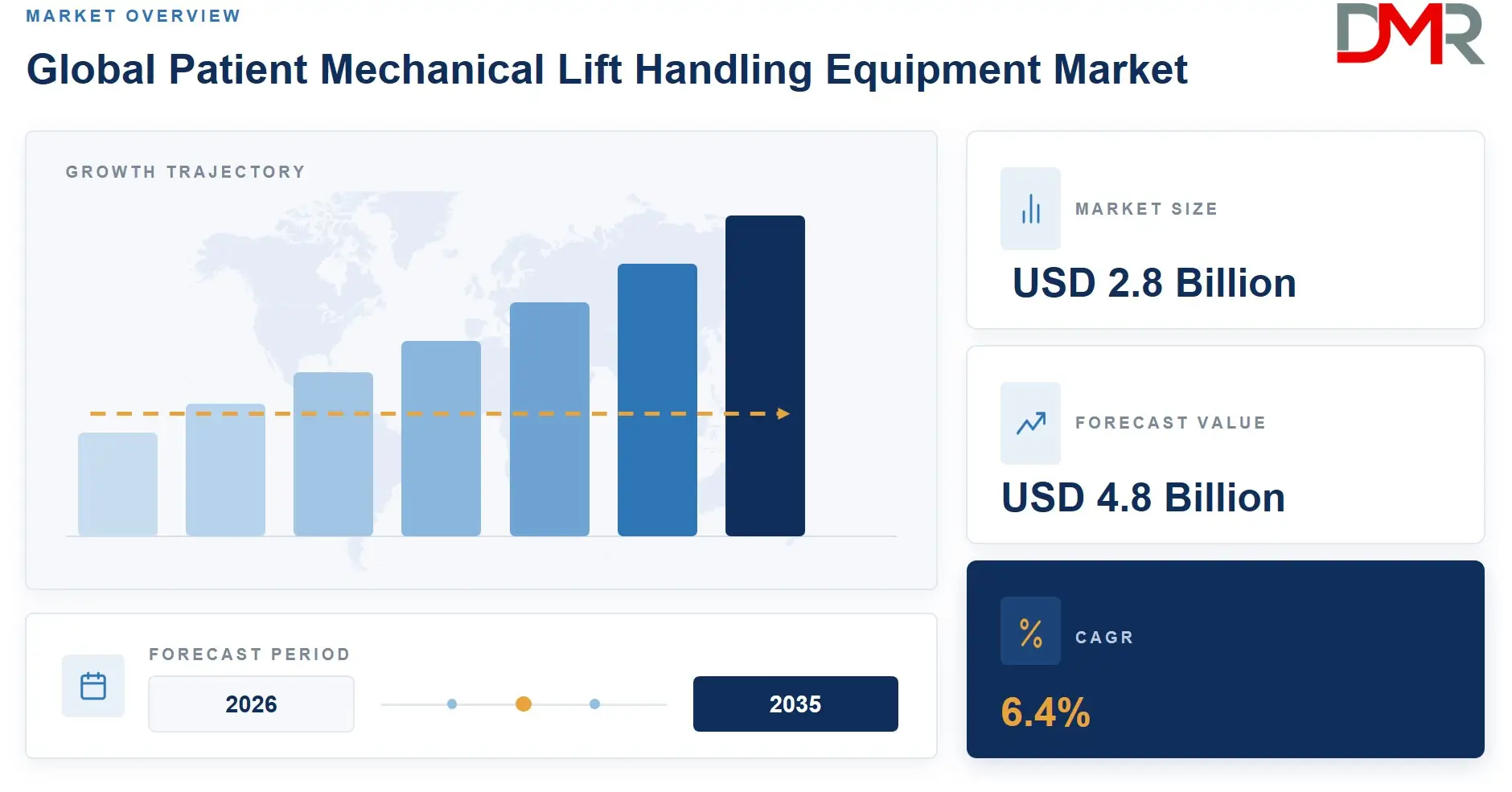
- Global Patient Mechanical Lift Handling Equipment Market Size in 2026: USD 2.8 Billion
- Global Patient Mechanical Lift Handling Equipment Market Size in 2035: USD 4.8 Billion
- Global CAGR from 2026 to 2035: 6.4%
- Floor-based or Mobile Lifts is the leading product type segment in 2026: 34.5%
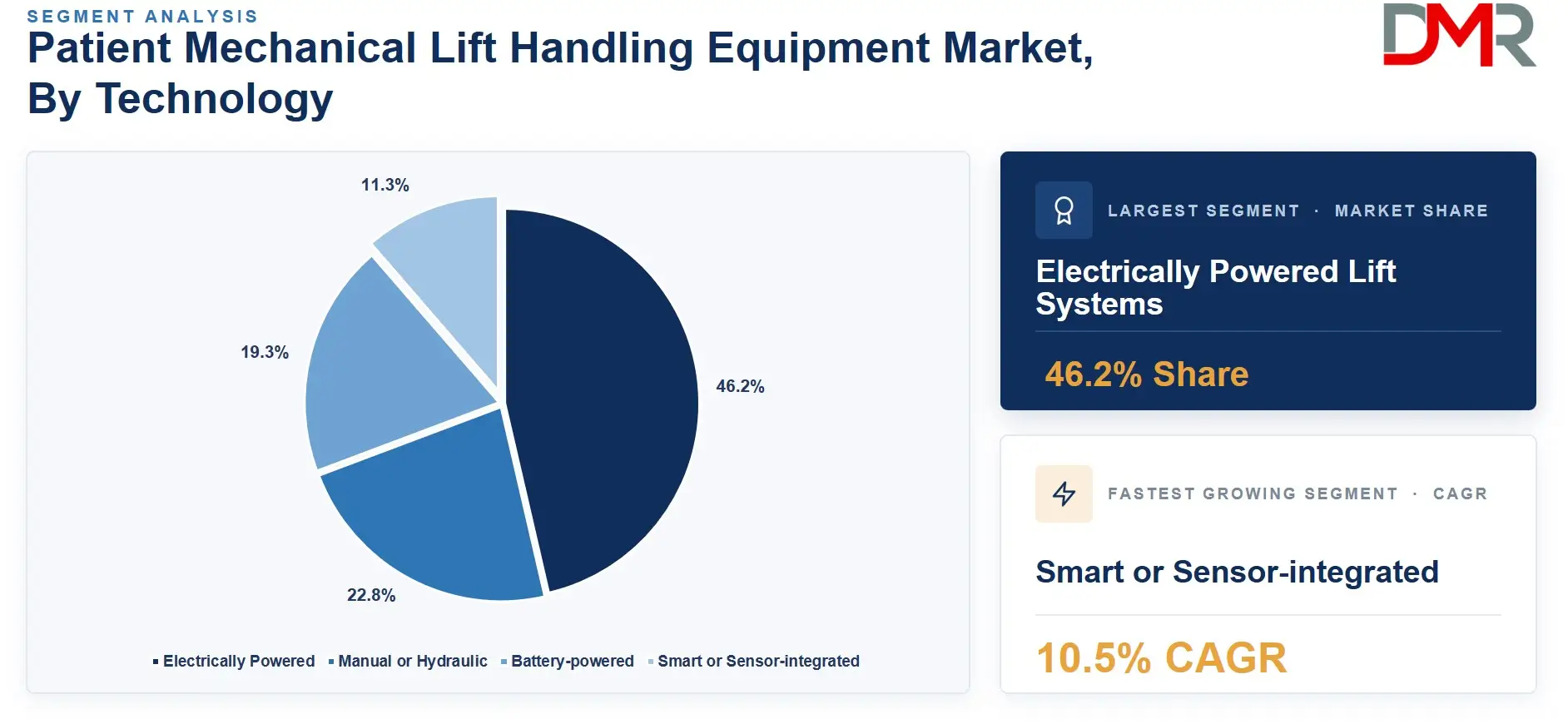
- Electrically Powered is the leading technology segment in 2026: 48.6%
- Medical Equipment Distributors and Dealers is the leading distribution channel segment in 2026: 41.3%
- Bed-to-Chair Transfer is the leading application segment in 2026: 29.7%
- Hospitals is the leading end user segment in 2026: 36.4%
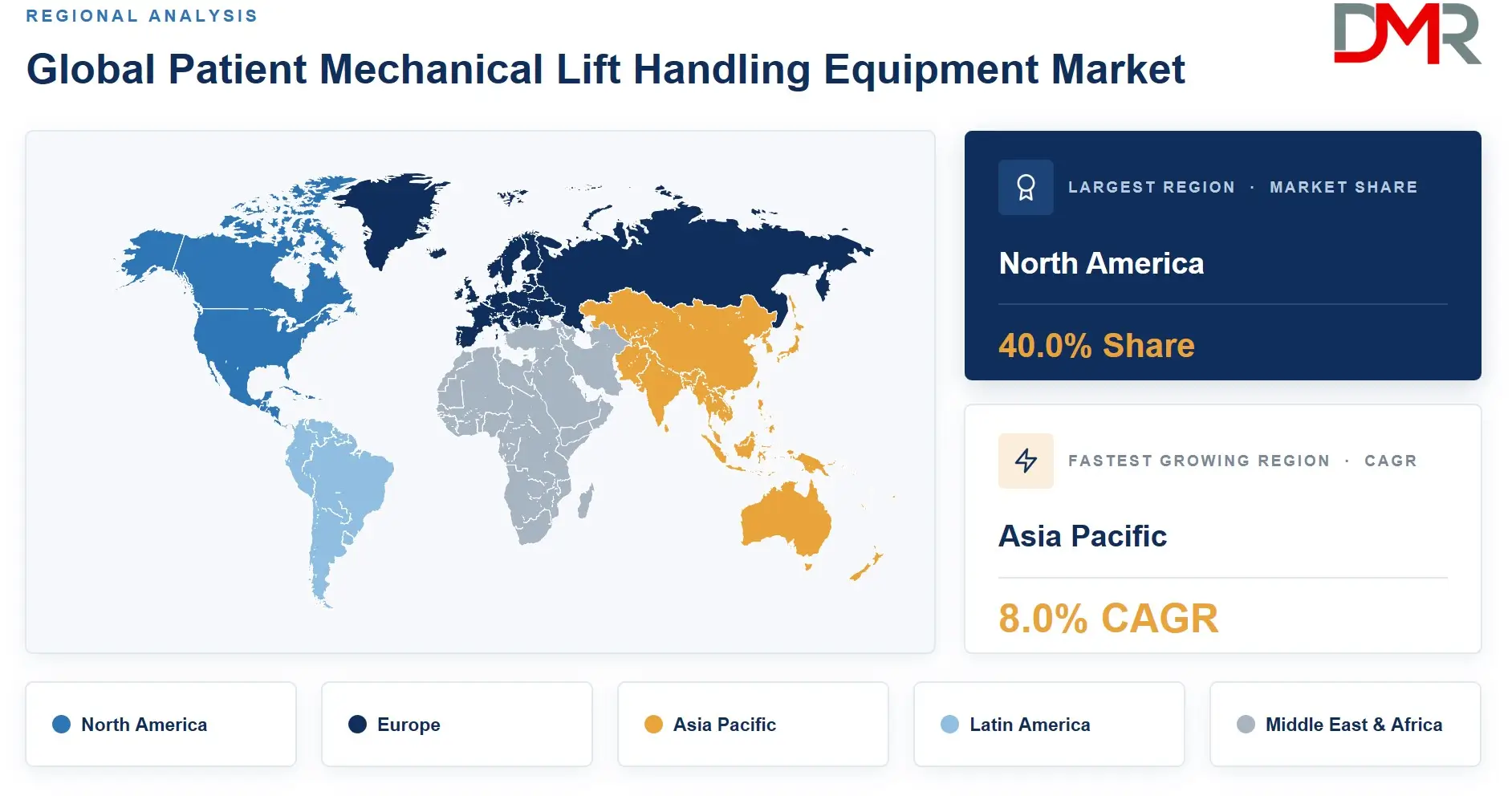
- North America is the leading region in 2026: 40.0%
What is the Global Patient Mechanical Lift Handling Equipment and its Market Size?
The Global Patient Mechanical Lift Handling Equipment Market is projected to be valued at USD 2.8 billion in 2026 and is projected to reach USD 4.8 billion by 2035, expanding at a CAGR of 6.4% during the forecast period.
ℹ
To learn more about this report –
Download Your Free Sample Report Here
Growth is being propelled by the rapidly aging global population, the rising prevalence of mobility-limiting conditions such as stroke, spinal cord injury, obesity, and neurodegenerative disease, and mounting regulatory and institutional pressure to eliminate manual patient handling in favor of mechanical patient lift equipment. The adoption of ceiling-mounted lift systems with proven caregiver injury reduction outcomes, rising clinical implementation of safe patient handling and mobility (SPHM) programs, and expanding reimbursement and procurement frameworks for home healthcare mobility aids are reshaping care paradigms. Investment is accelerating as health systems and long-term care operators pivot from reactive, manual patient transfer practices toward proactive, ergonomically engineered, sensor-integrated patient handling ecosystems designed to bend the cost curve of caregiver musculoskeletal injury and patient fall-related complications.
Use Cases
- Safe Patient Handling and Mobility (SPHM) Programs in Acute Care: Hospitals and health systems deploy floor-based mobile lifts and ceiling-mounted lift systems as part of formal zero-manual-lift policies to reduce caregiver back and shoulder injuries during bed-to-chair and bed-to-bathroom transfers.
- Fall Recovery and Repositioning in Long-Term Care: Nursing homes and assisted-living facilities utilize sit-to-stand lifts and patient slings to support floor recovery, routine repositioning, and rehabilitation ambulation for residents with limited mobility.
- Bariatric Patient Handling and Transfer: Specialty bariatric care units and hospitals employ heavy-duty gantry lift systems and reinforced slings engineered with higher weight capacities to safely transfer and reposition bariatric patients while minimizing caregiver strain.
- Home-Based Caregiver-Assisted Mobility Support: Home healthcare providers and family caregivers use compact, battery-powered mobile and sit-to-stand lifts to enable safe bed, bathroom, and chair transfers for aging-in-place patients, reducing dependence on institutional care settings.
Key Takeaways
- Market Size: The Global Patient Mechanical Lift Handling Equipment Market is anticipated to be valued at USD 2.8 billion in 2026 and is forecast to reach USD 4.8 billion by 2035, expanding at a CAGR of 6.4%.
- Growth Outlook: Market expansion is sustained by the accelerating global aging demographic, the widening adoption of institutional safe patient handling mandates, the push toward home-based caregiver-assisted mobility equipment, and the integration of smart, sensor-enabled lift technology for load monitoring and fall prevention.
- Primary Growth Drivers: A mounting population of mobility-impaired and bariatric patients requiring mechanical transfer assistance, regulatory and occupational-safety incentives discouraging manual patient handling, growing hospital and long-term care capital investment in ceiling-mounted lift infrastructure, and shifting care delivery models toward home healthcare are accelerating investment across the patient handling equipment continuum.
- By Product Type Analysis: Floor-based or Mobile Lifts is projected to lead the product type segment with a dominant 34.5% share in 2026, driven by their versatility, portability, and suitability across acute care, long-term care, and home healthcare settings, while Ceiling-mounted Lifts are projected to exhibit the highest CAGR at 8.2% due to expanding new-build and retrofit installation in hospitals and nursing facilities.
- By Technology Analysis: Electrically Powered lifts are anticipated to hold a 48.6% share in 2026, reflecting their entrenched role in reducing caregiver physical exertion during transfers, while Smart or Sensor-integrated lift systems are projected to post the highest CAGR at 10.5% as connected load-sensing and fall-detection features gain institutional adoption.
- By Distribution Channel Analysis: Medical Equipment Distributors and Dealers is poised to lead with a 41.3% share in 2026, representing the primary procurement pathway for hospitals and long-term care facilities, while Online and E-commerce Platforms are expected to grow at the highest CAGR of 9.8% as direct-to-consumer home healthcare purchasing accelerates.
- By Application Analysis: Bed-to-Chair Transfer is expected to command a 29.7% share in 2026, underpinned by its status as the most frequently performed patient handling maneuver across care settings, with Bariatric Patient Handling achieving the fastest growth at 8.9% CAGR amid rising obesity-related care demand.
- By End User Analysis: Hospitals is expected to lead with a 36.4% share in 2026 as the central hub for acute patient transfer, post-surgical mobility support, and formal SPHM program implementation, while Home Healthcare is the fastest-growing end-user segment at 9.6% CAGR due to patient preference for aging in place, caregiver injury-prevention awareness, and favorable reimbursement for home mobility equipment.
How AI/Gen AI is Transforming the Patient Mechanical Lift Handling Equipment Market?
AI and Generative AI are transforming the Patient Mechanical Lift Handling Equipment Market by enabling smarter, safer, and more efficient patient transfers. AI-powered sensors can monitor patient weight, positioning, sling security, equipment utilization, and movement patterns in real time, helping reduce transfer-related risks for patients and caregivers. Machine learning also supports predictive maintenance by identifying potential equipment failures before breakdowns occur, improving lift availability and lifecycle management. Gen AI can further assist caregivers through intelligent operating guidance, troubleshooting support, training, and automated documentation. Growing integration of AI, IoT connectivity, and smart monitoring is consequently encouraging development of increasingly connected, automated patient-handling solutions.
Key Drivers in the Global Patient Mechanical Lift Handling Equipment Market
Escalating Global Burden of Age-Related and Mobility-Limiting Conditions
An aging global population, coupled with the rising prevalence of stroke, spinal cord injury, neurodegenerative disease, and obesity-related mobility impairment, remains the dominant demand driver behind patient mechanical lift handling equipment. The unabated rise in life expectancy, chronic disease burden, and post-acute rehabilitation needs is expanding the pool of patients requiring routine mechanical transfer assistance across hospitals, nursing homes, and home healthcare settings. As the global population aged 65 and older continues to expand rapidly, downstream demand for floor-based lifts, ceiling-mounted lift systems, sit-to-stand lifts, and patient slings intensifies commensurately, reinforcing institutional procurement of patient handling equipment as a guideline-supported component of caregiver safety and patient dignity-preserving care.
Regulatory and Occupational Safety Mandates Discouraging Manual Patient Handling
Growing occupational health and safety evidence linking manual patient lifting to caregiver musculoskeletal injury has repositioned mechanical patient lift equipment as a mandated or strongly recommended component of institutional safe patient handling and mobility programs. Regulatory bodies and nursing associations increasingly discourage manual lifting techniques in favor of mechanical assistive devices, reducing workers' compensation costs and caregiver turnover associated with lifting-related injuries. This evidence-driven policy shift is generating sustained institutional demand across hospital, long-term care, and rehabilitation settings, elevating ceiling-mounted and electrically powered lift adoption and propelling above-market growth for sensor-integrated equipment that enforces safe handling compliance.
Restraints in the Global Patient Mechanical Lift Handling Equipment Market
High Upfront Capital Cost and Facility Retrofit Constraints
Despite their caregiver-safety and patient-care benefits, ceiling-mounted lift systems and gantry lift infrastructure require substantial upfront capital investment, structural assessment, and facility retrofitting, particularly in older hospital and nursing home buildings not originally designed for overhead track installation. This creates budgetary barriers for smaller long-term care operators and facilities in low- and middle-income regions, where limited capital expenditure and reimbursement support restrict adoption. Even in higher-income markets, competing capital priorities and lengthy procurement cycles for group purchasing organizations can slow the pace of ceiling-mounted and smart lift system deployment relative to lower-cost floor-based mobile lift alternatives.
Growth Opportunities in the Global Patient Mechanical Lift Handling Equipment Market
Expansion of Home Healthcare and Aging-in-Place Mobility Support
The global shift toward home-based care and aging-in-place preferences represents a high-growth opportunity for patient lift equipment manufacturers, home healthcare providers, and caregiver training service organizations. Health systems and payers are increasingly incentivizing home-based mobility support through value-based and readmission-reduction care models that reward reduced institutionalization and improved caregiver safety outcomes. This trend is creating a fertile market for compact, battery-powered mobile and sit-to-stand lifts, user-friendly patient slings, and structured caregiver training and telehealth support services. Companies that integrate lightweight, easy-to-store lift designs, direct-to-consumer e-commerce distribution, and remote caregiver coaching into a cohesive home patient handling ecosystem are positioned to capture a disproportionate share of the rapidly growing home healthcare end-user segment.
Bariatric-Specific Patient Handling Solutions
Rising global obesity prevalence is expanding demand for heavy-duty, bariatric-rated lift systems, reinforced slings, and gantry lift solutions engineered with higher weight capacities and wider transfer platforms. Manufacturers that develop and commercialize validated, reimbursable bariatric patient handling equipment capable of safely supporting higher-weight patients while minimizing caregiver strain will unlock a premium-priced specialty equipment market. Concurrently, hospitals and long-term care operators are pursuing dedicated bariatric care unit build-outs equipped with reinforced ceiling track systems, creating high-value niche procurement opportunities across the patient handling equipment continuum.
Trends in the Global Patient Mechanical Lift Handling Equipment Market
Integration of Patient Lift Equipment into Broader Fall Prevention and Caregiver Safety Platforms
A defining trend is the dissolution of silos between nursing workflow management, occupational safety, and facilities engineering, driven by the shared institutional priority of reducing both patient falls and caregiver lifting injuries. Care delivery is consolidating around holistic risk management that simultaneously addresses patient mobility, transfer safety, and caregiver ergonomics. This convergence is expanding the use of equipment with multi-purpose benefits (sit-to-stand lifts, ceiling-mounted systems, sensor-integrated slings) and fostering the development of integrated facility safety platforms that track patient transfer frequency, equipment utilization, and caregiver injury incidence on a single dashboard. The market implications include broader procurement across nursing, rehabilitation, and facilities management functions, increased equipment utilization monitoring, and the rise of caregiver-safety-focused digital workflow applications.
Emergence of Smart, Sensor-Integrated Lift and Sling Systems
Connected, sensor-enabled patient lift and sling technology is transforming institutional patient handling practice. Devices equipped with load cells, transfer-frequency logging, and Bluetooth or Wi-Fi connectivity can now quantify daily transfer volumes, flag improper sling configurations, and support asset utilization reporting with facility-level accuracy. This trend is commercializing as cloud-based patient handling analytics services that hospitals and long-term care operators adopt to standardize safe patient handling compliance, reduce caregiver injury rates, and enrich equipment maintenance scheduling with usage-based data. The increasing use of smart lift technology in occupational safety programs particularly for high-acuity and bariatric care units requiring consistent transfer documentation is creating a new adjacency market at the intersection of medical devices and digital workplace safety.
Research Scope and Analysis
The Global Patient Mechanical Lift Handling Equipment Market is segmented by product type, technology, distribution channel, application, and end user. Product type includes floor-based lifts, ceiling-mounted lifts, sit-to-stand lifts, bath patient lifters, gantry lift systems, slings, transfer aids, accessories, and other products. End users include hospitals, nursing homes, assisted-living facilities, home healthcare, rehabilitation centers, ambulatory surgical centers, and other healthcare facilities.
ℹ
To learn more about this report –
Download Your Free Sample Report Here
By Product Type Analysis
Floor-based or Mobile Lifts dominate the Global Patient Mechanical Lift Handling Equipment Market, accounting for an estimated 34.5% share in 2026. Mobile lift units are widely used across hospitals, long-term care facilities, and home healthcare settings due to their portability, lower upfront cost relative to fixed installations, and suitability for facilities without overhead track infrastructure. Their broad clinical applicability, ease of relocation between patient rooms, and established use in standard patient transfer protocols sustain high procurement volumes globally. Ceiling-mounted Lifts are anticipated to register the highest CAGR of 8.2% during 2026–2035, driven by expanding new hospital construction incorporating built-in overhead track systems and growing retrofit investment in existing facilities.
By Technology Analysis
Electrically Powered lift systems lead the technology segment, holding an estimated 48.6% share in 2026. Electrically powered lifts significantly reduce caregiver physical exertion during transfers compared to manual or hydraulic alternatives, supporting institutional safe patient handling compliance and reducing lifting-related caregiver injury claims. Their consistent, controlled lifting motion and broad availability across product categories sustain their leadership position. Smart or Sensor-integrated lift technology is expected to post the highest CAGR of 10.5% during 2026–2035, propelled by rising institutional demand for connected load monitoring, fall-risk alerting, and equipment utilization analytics.
By Distribution Channel Analysis
Medical Equipment Distributors and Dealers lead the distribution channel segment, commanding an estimated 41.3% share in 2026. Distributors and dealers remain the primary procurement channel for hospitals and long-term care facilities, supported by established institutional purchasing relationships, on-site installation services, and ongoing equipment maintenance support. Online and E-commerce Platforms are projected to post the fastest CAGR of 9.8% during 2026–2035, propelled by rising direct-to-consumer purchasing of compact mobile and sit-to-stand lifts for home healthcare use.
By Application Analysis
Bed-to-Chair Transfer leads the application segment, accounting for an estimated 29.7% share in 2026. Bed-to-chair transfer represents the most frequently performed patient handling maneuver across hospital, nursing home, and home healthcare settings, sustaining consistent demand for both floor-based and ceiling-mounted lift equipment. Bariatric Patient Handling is anticipated to record the highest CAGR of 8.9% from 2026 to 2035, reflecting rising global obesity prevalence and growing institutional investment in dedicated bariatric care equipment.
By End User Analysis
Hospitals dominate the end user segment, accounting for an estimated 36.4% share in 2026. They provide integrated acute patient transfer support, post-surgical mobility assistance, formal safe patient handling and mobility program implementation, and management of high-acuity and bariatric patient populations. Their established infrastructure and regulatory compliance obligations sustain their leading position. Home Healthcare is expected to grow at the highest CAGR of 9.6% during 2026 to 2035, driven by patient preference for aging in place, expanding caregiver injury-prevention awareness, and improving accessibility of compact, portable lift equipment.
The Global Patient Mechanical Lift Handling Equipment Market Report is segmented based on the following:
By Product Type
- Floor-based or Mobile Lifts
- Ceiling-mounted Lifts
- Sit-to-Stand Lifts
- Bath Patient Lifters
- Gantry Lift Systems
- Patient Slings
- Transfer Aids
- Accessories
- Other Products
By Technology
- Electrically Powered
- Manual or Hydraulic
- Battery-powered
- Smart or Sensor-integrated
By Distribution Channel
- Direct Sales
- Medical Equipment Distributors and Dealers
- Medical Supply Retailers
- Group Purchasing Organizations
- Online and E-commerce Platforms
By Application
- Bed-to-Chair Transfer
- Bed-to-Bathroom Transfer
- Floor Recovery
- Patient Repositioning
- Rehabilitation and Mobility Assistance
- Bariatric Patient Handling
- Emergency and Evacuation Handling
- Other Applications
By End User
- Hospitals
- Nursing Homes and Long-term Care Facilities
- Assisted-living Facilities
- Home Healthcare
- Rehabilitation Centers
- Ambulatory Surgical Centers
- Other Healthcare Facilities
Regional Analysis
North America Is the Leading Region in the Global Patient Mechanical Lift Handling Equipment Market
North America is poised to lead the Global Patient Mechanical Lift Handling Equipment Market with an estimated 40.0% revenue share in 2026. The region's dominance is anchored by a high prevalence of age-related mobility impairment, a mature and well-enforced occupational safety framework discouraging manual patient handling, and the world's highest per-facility expenditure on ceiling-mounted lift infrastructure. The United States, in particular, is characterized by early and broad adoption of smart, sensor-integrated lift technology, robust institutional investment in safe patient handling and mobility programs, and a dynamic home healthcare ecosystem supported by favorable reimbursement policy.
ℹ
To learn more about this report –
Download Your Free Sample Report Here
Asia Pacific Is the Fastest-Growing Region in the Global Patient Mechanical Lift Handling Equipment Market
Asia Pacific is projected to register the fastest CAGR of 8.0% through 2035, driven by the region's rapidly aging population particularly in Japan, China, and South Korea, alongside expanding healthcare infrastructure investment across emerging economies including India and Southeast Asia. Economic development is enabling substantial investment in hospital and long-term care facility construction, with both public and private providers increasingly incorporating ceiling-mounted lift systems into new-build design. Additionally, governments are implementing national elder-care and caregiver-safety initiatives that are boosting institutional procurement of mechanical patient handling equipment.
The Europe Patient Mechanical Lift Handling Equipment Market
Europe represents one of the largest regional markets, characterized by comprehensive occupational health and safety regulation that mandates mechanical assistance for patient transfer in institutional care settings, alongside significant cross-national variation in home healthcare equipment reimbursement. Germany and the United Kingdom hold leading European market shares, driven by large long-term care sectors, strong nursing workforce safety advocacy, and broad reimbursement for institutional patient handling equipment.
Latin America Patient Mechanical Lift Handling Equipment Market
The Latin America Patient Mechanical Lift Handling Equipment Market is expanding as rising elderly population share, growing private hospital investment, and increasing caregiver injury awareness drive demand for mechanical patient transfer solutions. Brazil and Mexico are the primary national markets, with Brazil's expanding private hospital network and Mexico's growing long-term care sector fueling equipment adoption.
Middle East and Africa Patient Mechanical Lift Handling Equipment Market
The Middle East and Africa Patient Mechanical Lift Handling Equipment Market is developing against a backdrop of expanding hospital infrastructure investment and rising government healthcare spending in Gulf Cooperation Council (GCC) countries. Saudi Arabia and the United Arab Emirates are the most attractive markets, supported by high government healthcare expenditure, expansive new hospital construction incorporating built-in patient handling infrastructure, and growing adoption of internationally sourced mechanical lift equipment.
Major Countries Analysis
The US Patient Mechanical Lift Handling Equipment Market
The United States Patient Mechanical Lift Handling Equipment Market is projected to be valued at USD 1.1 billion in 2026 registering a CAGR of 6.0% from 2026 to 2035. This robust trajectory reflects the U.S.'s position as the highest-value single-country patient handling equipment market globally, underpinned by a substantial aging population, an extensive hospital and long-term care facility network, and well-established occupational safety enforcement around manual patient handling. Growth is fueled by continued institutional investment in ceiling-mounted lift infrastructure and the rapid adoption of smart, sensor-integrated lift systems across acute and post-acute care settings.
Japan Patient Mechanical Lift Handling Equipment Market
Japan's super-aged society and correspondingly high demand for institutional and home-based elder care sustain steady demand for mechanical patient handling equipment. The market is distinguished by sophisticated long-term care infrastructure, strong caregiver-safety policy support, and growing adoption of compact, home healthcare-oriented lift equipment supported by national healthy aging and long-term care insurance initiatives.
Saudi Arabia Patient Mechanical Lift Handling Equipment Market
Market expansion is directly tied to the Kingdom's growing hospital infrastructure investment and rising demand for institutional elder and rehabilitative care. The Ministry of Health funds extensive hospital and long-term care facility expansion, while Vision 2030's healthcare transformation agenda, which emphasizes public-private partnerships and modern facility design, is opening significant opportunities for international patient handling equipment manufacturers and distributors.
Regulatory Landscape
The regulatory landscape for patient mechanical lift handling equipment is shaped by medical device and occupational safety agencies that balance patient safety requirements with caregiver injury-prevention mandates. In the United States, the FDA regulates patient lifts as Class II medical devices, typically requiring 510(k) premarket notification, while occupational safety authorities issue guidance strongly encouraging or mandating mechanical patient handling equipment in place of manual lifting techniques across hospital and long-term care settings. Regulatory bodies in Europe, Japan, and other major markets similarly apply moderate-risk device classification frameworks alongside institutional occupational safety standards, supporting continued procurement of compliant, quality-certified patient lift, sling, and transfer aid equipment.
Epidemiology Analysis
Mobility-limiting conditions requiring routine mechanical patient transfer assistance represent a substantial and growing global healthcare burden. Age-related frailty, stroke, spinal cord injury, and neurodegenerative disease remain leading contributors to institutional and home-based patient handling needs, while rising global obesity prevalence is expanding demand for bariatric-specific lift and sling solutions. Rising awareness of caregiver musculoskeletal injury risk, improved access to occupational safety training, and expanding facilities engineering investment in ceiling track infrastructure are together supporting higher rates of mechanical lift adoption across both high-income and emerging healthcare markets, reinforcing the long-term demand outlook for the patient mechanical lift handling equipment category.
By Region
North America
Europe
- Germany
- France
- The U.K.
- Italy
- Spain
- Rest of Europe
Asia-Pacific
- China
- Japan
- India
- Australia
- South Korea
- Rest of APAC
Latin America
- Mexico
- Brazil
- Rest of LATAM
Middle East & Africa
- Saudi Arabia
- The UAE
- South Africa
- Rest of MEA
Competitive Landscape
The Global Patient Mechanical Lift Handling Equipment Market features a mix of established medical device manufacturers, specialty patient handling equipment companies, and durable medical equipment distributors. Leading manufacturers compete on lift capacity, sling compatibility, ease of installation and maintenance, and expanding smart, sensor-integrated product portfolios, while distributors and long-term care operators compete on facility installation services, staff training, and equipment lifecycle support.
Some of the prominent players in the Global Patient Mechanical Lift Handling Equipment Market are:
- Arjo AB
- Baxter International Inc.
- Stryker Corporation
- Invacare Corporation
- Savaria Corporation
- Etac AB
- Joerns Healthcare LLC
- GF Health Products, Inc.
- V. Guldmann A/S
- Drive DeVilbiss Healthcare
- Prism Medical
- Medline Industries, LP
- Getinge AB
- Enovis Corporation
- Benmor Medical Ltd.
- Sunrise Medical LLC
- Human Care Group
- HoverTech International
- LINET Group SE
- Stiegelmeyer GmbH & Co. KG
- Mangar Health
- Winncare Group
- OpeMed Ltd.
- Handi-Move International
- Bestcare LLC
- Paramount Bed Holdings Co., Ltd.
- Lojer Oy
- Malvestio S.p.A.
- Antano Group
- Umano Medical
- Apex Medical Corp.
- Aidacare Pty Ltd.
- REBOTEC Rehabilitationsmittel GmbH
- Transfer Master Products, Inc.
- Pelstar LLC
- Gainsborough Healthcare Group
- Hospimek Pte Ltd.
- AGA Sanitätsartikel GmbH
- medifa GmbH
- UFSK-International OSYS GmbH
- Other Key Players
Recent Developments
- July 2026: Yashoda Medicity introduced Paramount Bed’s VitalGo Total Lift Bed into its critical-care infrastructure. The system supports powered patient boosting, automatic repositioning, gradual verticalization, and early mobility while reducing physical demands on caregivers.
- April 2026: The U.S. FDA posted a Class II recall for Arjo’s Tenor Lift, following a firm-initiated action on March 10, 2026. The development highlights the continuing importance of product safety, quality controls, and post-market surveillance in mechanical patient-handling equipment.
- June 2025: Winncare launched the LUNA X5 ceiling lift, an all-in-one system configurable as a fixed or portable lift with adjustable capacities of 150 kg, 200 kg, or 275 kg, targeting home and institutional care environments.
- April 2025 Arjo launched the Maxi Move 5, a new-generation mobile patient floor lift incorporating technologies intended to reduce caregiver physical strain, improve maneuverability, and increase efficiency during patient transfers.
Report Details
| Report Characteristics |
| Market Size (2026) |
USD 2.8 Bn |
| Forecast Value (2035) |
USD 4.8 Bn |
| CAGR (2026–2035) |
6.4% |
| The US Market Size (2026) |
USD 1.1 Bn |
| Historical Data |
2021 – 2025 |
| Forecast Data |
2026 – 2035 |
| Base Year |
2025 |
| Segments Covered |
By Product Type, By Technology, By Distribution Channel, By Application, By End User |
| Regional Coverage |
North America – The US and Canada; Europe – Germany, France, The UK, Italy, Spain, Rest of Europe; Asia-Pacific – China, Japan, India, Australia, South Korea, Rest of APAC; Latin America – Mexico, Brazil, Colombia, Argentina, Rest of LATAM; Middle East & Africa – Saudi Arabia, The UAE, South Africa, Rest of MEA |
Frequently Asked Questions
How big is the Global Patient Mechanical Lift Handling Equipment Market?
▾ The Global Patient Mechanical Lift Handling Equipment Market is valued at USD 2.8 billion in 2026 and is projected to reach USD 4.8 billion by 2035, reflecting steady global demand for mechanical patient transfer, repositioning, and caregiver-safety equipment.
What is the CAGR of the Global Patient Mechanical Lift Handling Equipment Market from 2026 to 2035?
▾ The market is projected to expand at a compound annual growth rate (CAGR) of 6.4% between 2026 and 2035, supported by an aging global population, expanding safe patient handling mandates, and rising home healthcare adoption.
What factors are driving the growth of the Global Patient Mechanical Lift Handling Equipment Market?
▾ Growth is driven by the escalating prevalence of age-related and mobility-limiting conditions, regulatory and occupational safety mandates discouraging manual patient handling, growing hospital and long-term care investment in ceiling-mounted lift infrastructure, and the integration of smart, sensor-enabled lift technology.
What are the major trends in the Global Patient Mechanical Lift Handling Equipment Market?
▾ Major trends include the integration of patient lift equipment into broader fall-prevention and caregiver-safety platforms, the emergence of smart, sensor-integrated lift and sling systems, growing bariatric-specific equipment development, and expanding direct-to-consumer e-commerce distribution for home healthcare lifts.
Which region held the largest share of the Global Patient Mechanical Lift Handling Equipment Market in 2026?
▾ North America is expected to lead the global market with a 40.0% share in 2026, supported by high age-related mobility impairment prevalence, a mature occupational safety framework, and strong institutional investment in ceiling-mounted lift infrastructure.
Which region is expected to grow the fastest in the Global Patient Mechanical Lift Handling Equipment Market?
▾ Asia Pacific is expected to record the fastest growth at an 8.0% CAGR through 2035, driven by its rapidly aging population and expanding healthcare infrastructure investment.
Who are the key players in the Global Patient Mechanical Lift Handling Equipment Market?
▾ Key market participants include Arjo AB, Hillrom (Baxter International), Invacare Corporation, Handicare Group, Prism Medical, Etac AB, Joerns Healthcare, GF Health Products, Drive DeVilbiss Healthcare, and other patient handling equipment manufacturers and distributors.
How is the Global Patient Mechanical Lift Handling Equipment Market segmented?
▾ The market is segmented by product type, technology, distribution channel, application, and end user, with regional analysis covering North America, Europe, Asia Pacific, Latin America, and the Middle East and Africa.