Market Snapshot
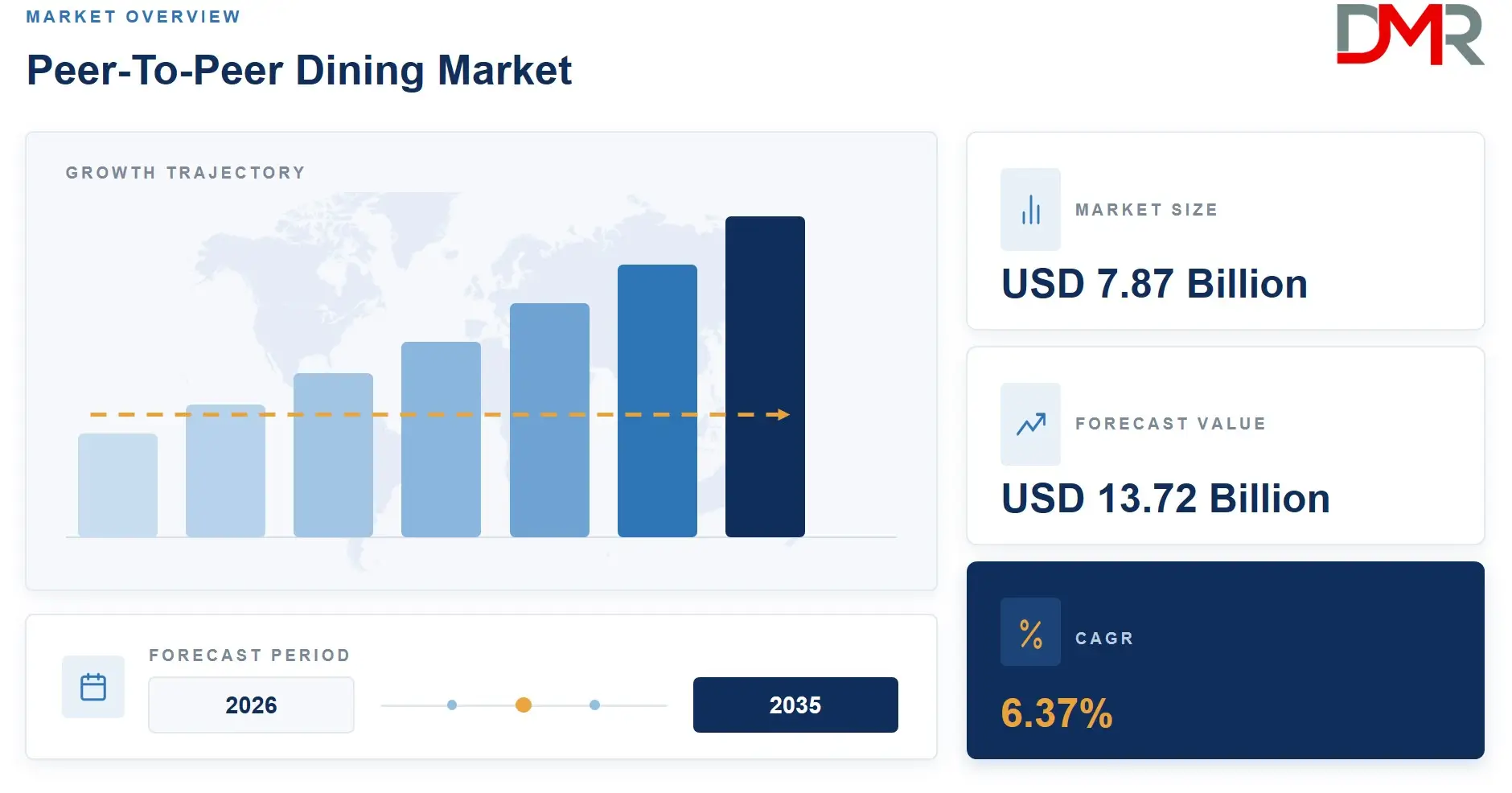
- The Global Peer-To-Peer Dining Market was valued at USD 7.4 Billion in 2025 and is projected to reach USD 13.72 Billion by 2035, at a CAGR of 6.37%.
- By Platform Business Model, Aggregator Marketplace led with a 53.4% share in 2025, reflecting platform consolidation around commission-based discovery models.
- By Occasion / Purpose, Leisure & Experiential Dining held the largest share at 48.7% in 2025, anchored by tourist-facing culinary experience demand.
- By End-User Demographics, Domestic users dominated at 68.2% in 2025, indicating most P2P dining activity originates within travelers' and residents' home markets.
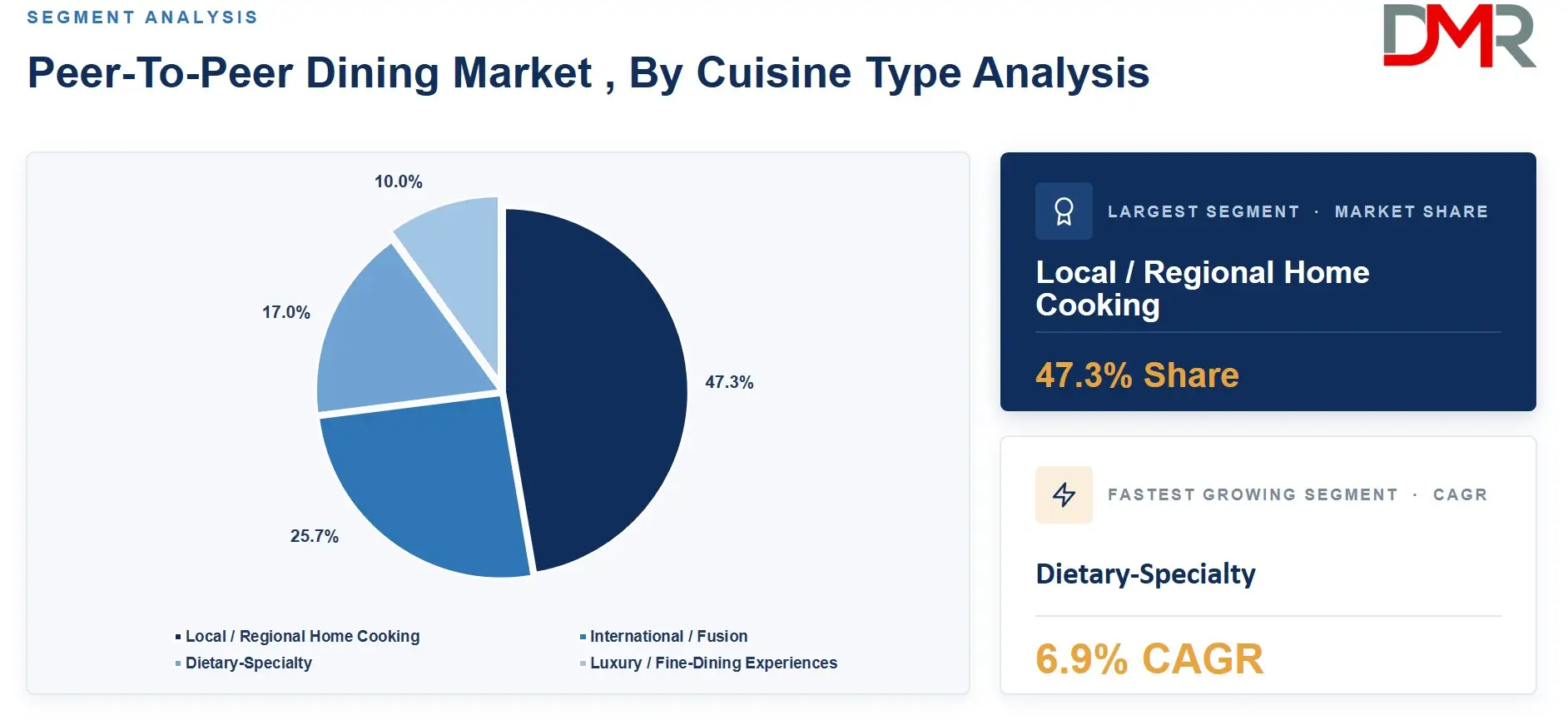
- By Cuisine Type, Local / Regional Home Cooking commanded 47.3% of demand in 2025, reflecting guests' preference for authentic, non-restaurantized food experiences.
- North America held 34.2% of global market share in 2025, the largest of any region, valued at approximately USD 2.53 Billion.
- Asia Pacific is the fastest-growing region, supported by rising urban middle-class spending and mobile payment infrastructure depth.
Market Overview
The peer-to-peer dining market connects independent home cooks, micro-hosts, and culinary entrepreneurs directly with paying guests through digital platforms. The market covers hosted meals in private residences, curated chef-led supper clubs, and home-delivery experiences from non-commercial kitchens. Commercial restaurant operations, catering companies, and licensed food service establishments are excluded. The connective tissue between P2P dining and the broader food services industry is thin but strengthening, as platform operators increasingly position home-based meal experiences as a culturally differentiated alternative to commodity restaurant supply.
Algorithmic matching of niche culinary preferences with local micro-hosts separates Peer-To-Peer Dining Market from traditional food delivery. Platforms use behavioral data, dietary tagging, and social graph signals to surface relevant hosts to prospective guests. Based on operational guidance from Bokun and Airbnb Experiences published in May 2025, the recommended guest group size is 6 to 10 people per session, a design parameter that intentionally limits throughput in favor of intimacy and quality. That ceiling creates a structural scarcity that sustains premium pricing and repeat demand among early adopters.
Mobile payment penetration underpins the transactional layer. Instant peer-to-peer settlement removes the friction that historically kept home cooks from monetizing their skills commercially. As platforms mature, the market is bifurcating between mass-market aggregator models that compete on discovery volume and niche community platforms that compete on curation quality. Operators building brand equity in curation are better positioned to hold margin as the market matures.
Market Size and Forecast
The Global Peer-To-Peer Dining Market size is estimated at USD 7.87 Billion in 2026 from USD 7.4 Billion in 2025, and is projected to reach USD 13.72 Billion by 2035, exhibiting a CAGR of 6.37% during the forecast period.
Growth assumptions rest on the continued expansion of platform-mediated trust infrastructure, stable urban density in primary markets, and the sustained consumer shift toward experience-based spending over transactional dining. As reported by Travel Courier, Traveling Spoon had reached culinary experiences across 233 cities and 70 countries as of 2024, a geographic footprint that illustrates the cross-border scalability of peer-hosted dining as a commercial format. Figures from Forbes confirm that EatWith had facilitated approximately 70,000 guest bookings through roughly 600 active home chefs by 2016, a host-to-guest ratio that signals how thin the host supply side remains even at a platform's commercial peak. Supply-side constraints continue to shape the ceiling on addressable capacity.
ℹ
To learn more about this report –
Download Your Free Sample Report Here
Pricing economics define where revenue pools accumulate. A Forbes-sourced analysis of EatWith pricing shows hosts typically charge between USD 25 and USD 50 per guest, with the platform retaining a 15% commission. At the midpoint of USD 37.50 per guest and the recommended group ceiling of 6–10 guests, a single event generates USD 225 to USD 375 in gross revenue before host costs. Scaling this model to a USD 13.72 Billion market by 2035 requires a dramatic rise in event volume, host density, or average ticket values, all of which depend on regulatory normalization of home kitchen commercialization in key geographies.
Platform Business Model Analysis
Aggregator Marketplace led the Platform Business Model segment with a 53.4% share in 2026.
Aggregator marketplaces dominate because they lower discovery friction for both hosts and guests without requiring upfront commitment from either side. Commission-based monetization aligns platform incentives with transaction volume, which suits markets where host supply is still building. The aggregator format also allows platforms to accumulate behavioral data at scale, which in turn improves matching precision and repeat booking rates.
Subscription-Based platforms captured a smaller but strategically significant share by locking in recurring guest spend and giving hosts predictable income visibility. Niche Community Platforms grow fastest among urban cohorts with strong identity-based food preferences, such as dietary-specialty and cultural exchange dining. Corporate / Group Catering represents the highest average ticket value per booking. Vendors entering that sub-segment face longer sales cycles but benefit from repeat volume contracts that reduce customer acquisition costs over time. An optimal hosted dining session runs within 2 to 4 hours, per operational guidance from Bokun and Airbnb Experiences, which limits per-event labor and supports multiple seatings per day for high-volume hosts.
Occasion / Purpose Analysis
With a 48.7% share in 2026, Leisure & Experiential Dining outpaced all other Occasion / Purpose categories.
Tourist-facing experiential demand anchors this segment. Travelers consistently allocate discretionary spend toward authentic local food encounters that hotels and restaurants cannot replicate. Leisure dining's dominance also reflects the early-adopter profile of P2P dining consumers, who skew toward curious, mobile, and internationally experienced guests.
Cultural Exchange dining commands growing attention from both platforms and investors, as cultural specificity is the segment's most defensible competitive attribute. Professional Networking Meals represent an underdeveloped but commercially promising sub-segment where ticket values exceed leisure dining averages. Home-Chef Meal Delivery bridges the P2P dining model with the established food delivery infrastructure, attracting guests unwilling to dine in a stranger's home but willing to pay a premium for a personally prepared meal.
End-User Demographics Analysis
Domestic users accounted for 68.2% of End-User demand in 2026, the highest of any category.
Domestic dominance reflects two structural realities. First, P2P dining adoption scales faster within existing community trust networks than across cultural or linguistic barriers. Second, platforms built on domestic demand generate denser review data faster, which compounds their matching advantage. The domestic majority also means most P2P dining sessions do not depend on tourism cycles, reducing seasonal revenue volatility for hosts.
International guests represent the higher-margin cohort. Cross-border travelers consistently pay more per seat and generate more social content per dining experience than domestic guests. Platforms that convert more of their domestic-leaning base toward international guest acquisition are better positioned to access premium willingness-to-pay without expanding host supply.
Cuisine Type Analysis
A 47.3% share made Local / Regional Home Cooking the clear leader across Cuisine Type categories in 2026.
Guests explicitly seek food that restaurants cannot reliably produce: recipes tied to family tradition, regional ingredient sourcing, and preparation techniques passed across generations. Local / Regional Home Cooking wins because it is the format most clearly differentiated from commercial alternatives. Platforms holding this cuisine concentration build the strongest brand equity among culturally motivated diners.
ℹ
To learn more about this report –
Download Your Free Sample Report Here
International / Fusion cuisine occupies the second tier, growing among younger urban hosts who blend culinary traditions as a form of personal expression. Dietary-Specialty hosting, covering vegan, gluten-free, and keto menus, is growing fastest in absolute terms. Supply in this niche is thin relative to the size of the dietary-restricted consumer population, creating a pricing premium opportunity for specialized hosts. Luxury / Fine-Dining Experiences hold the smallest share but the highest per-seat revenue potential, and function as brand anchors for platforms seeking media coverage and high-net-worth guest acquisition.
Key Market Segments
By Platform Business Model
- Aggregator Marketplace
- Subscription-Based
- Niche Community Platforms
- Corporate / Group Catering
By Occasion / Purpose
- Leisure & Experiential Dining
- Cultural Exchange
- Professional Networking Meals
- Home-Chef Meal Delivery
By End-User Demographics
By Cuisine Type
- Local / Regional Home Cooking
- International / Fusion
- Dietary-Specialty (Vegan, Gluten-Free, Keto)
- Luxury / Fine-Dining Experiences
Regional Analysis
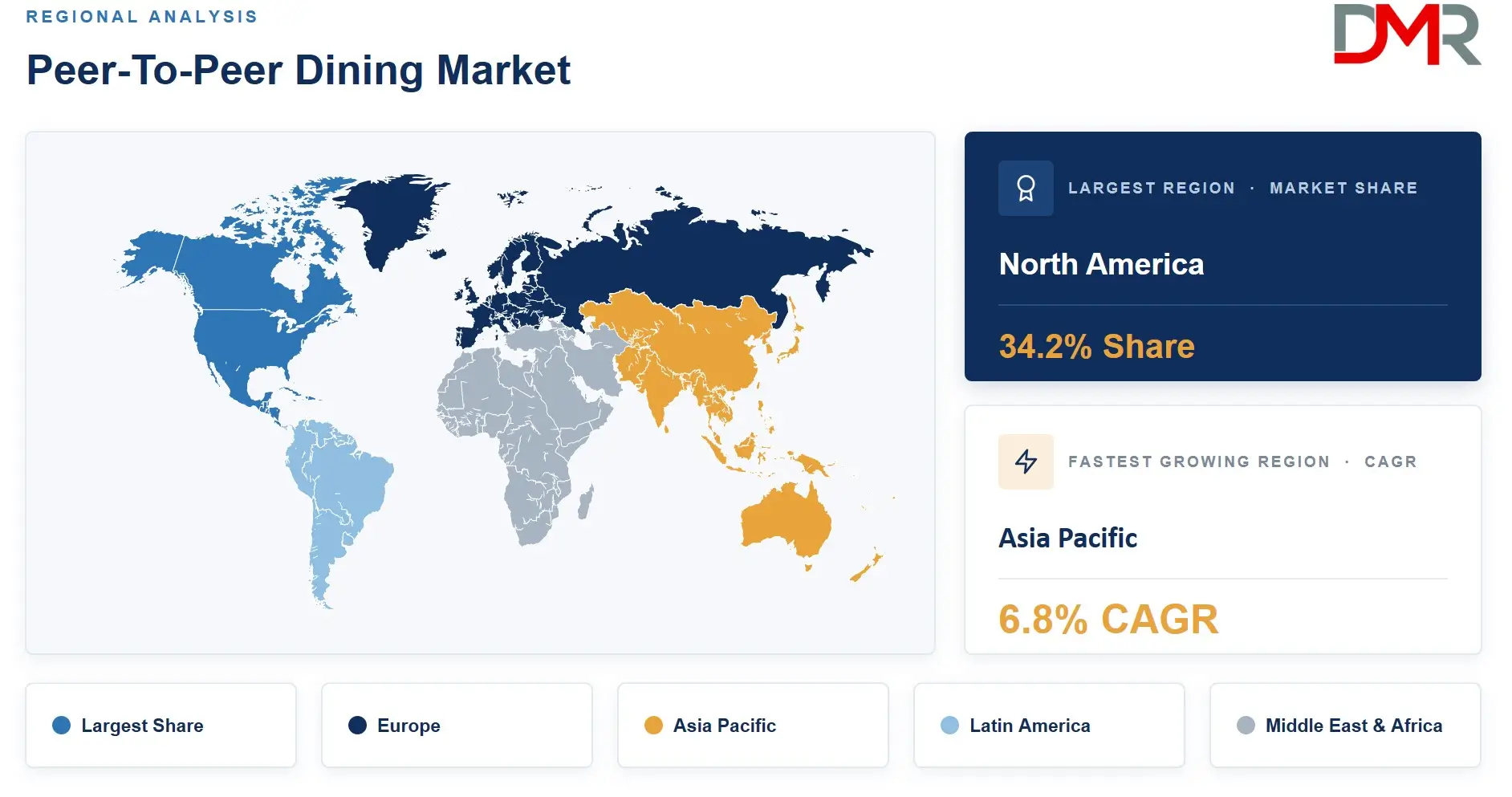
North America led all regions with a 34.2% share of the global Peer-To-Peer Dining Market in 2026, equivalent to approximately USD 2.53 Billion.
North America's lead reflects a convergence of structural advantages: deep smartphone penetration, mature digital payment rails, a large population of mobile-first urban professionals, and a regulatory environment that, while inconsistent across states, has not actively suppressed home kitchen commercialization at scale. The US accounts for the bulk of regional revenue, driven by platform headquarters concentration and first-mover host communities built by EatWith, Feastly, and Cozymeal. Canada contributes through major urban centers but at smaller volume.
Asia Pacific is the fastest-growing region. Mobile payment ecosystems in China, India, and Southeast Asia have made P2P settlement frictionless for host-guest transactions in markets where cash-first habits once created barriers. Research from bookheregivehere.com confirms Traveling Spoon now offers over 1,000 experiences across 180 cities and 60 countries, with significant Asia Pacific representation reflecting the region's culinary diversity and growing inbound tourism. Europe holds a structurally important position, particularly in Italy, France, and Spain, where culinary heritage gives hosts a built-in product differentiation advantage. Latin America and the Middle East and Africa remain early-stage markets, where low host density and regulatory uncertainty limit near-term scale, but where urbanization trends support medium-term platform entry strategies.
ℹ
To learn more about this report –
Download Your Free Sample Report Here
Key Regions and Countries
North America
Europe
- Germany
- France
- The UK
- Spain
- Italy
- Rest of Europe
Asia Pacific
- China
- Japan
- South Korea
- India
- Australia
- Rest of APAC
Latin America
- Brazil
- Mexico
- Rest of Latin America
Middle East & Africa
- GCC
- South Africa
- Rest of MEA
Market Dynamics
Young Urban Cohorts and Mobile Payment Rails Drive Host-Guest Volume
Densely populated cities with high concentrations of young professionals generate the demand conditions that make P2P dining viable. Young urban adults actively seek dining alternatives that combine social value with cost efficiency, and home-hosted meals deliver both. The critical mass of this cohort in cities like New York, London, Singapore, and Mumbai creates the guest pool that justifies a host community building in the same geography.
Instant peer-to-peer payment settlement removes the commercial friction that historically deterred home cooks from hosting paying guests. Airbnb's decision in September 2025 to deepen dining inside its Experiences ecosystem, expanding chef-led and hosted dining formats globally, confirms that platform operators now treat P2P dining as a high-priority product category rather than a peripheral feature. Forbes data shows EatWith had accumulated roughly 600 active home chefs and hosted approximately 70,000 guests by 2016, an early-stage throughput figure that illustrates how rapidly trust networks scale once payment infrastructure removes transactional friction.
Food Safety Liability and Trust Deficit Constrain Host Supply
Inconsistent local health-code enforcement across jurisdictions creates legal ambiguity for hosts who want to commercialize their home kitchens. A host operating without a commercial kitchen license faces personal liability exposure in the event of a foodborne illness claim. Platforms cannot fully indemnify hosts against regulatory action at the local level, which means the legal risk is borne by the individual, a deterrent strong enough to keep many potential hosts inactive.
Beyond regulatory risk, a trust deficit around dining with strangers in private residences limits conversion among guests who have not yet experienced the format. Airbnb Experiences addresses this partly through a platform-enforced cap of 15 guests per event, as confirmed by Bokun and Airbnb guidelines updated in May 2025. That cap simultaneously reduces per-event capacity and signals to prospective guests that experiences remain small and controlled. The constraint limits revenue per host but improves perceived safety, a tradeoff that platforms must manage carefully as they scale.
Premium Immersion Dining and Corporate Offsites Open High-Margin Channels
High-spending inbound tourists represent the clearest near-term monetization upgrade for P2P dining platforms. Cultural immersion dining circuits, where travelers move across multiple curated home-hosted meals in a single destination, command ticket prices well above the USD 25–50 per-guest baseline of standard bookings. Operators that build multi-meal itinerary products can serve the premium tour market without building new host supply, by repackaging existing hosts into sequenced experiences.
Corporate team-building represents a structurally different growth channel. Small-group professional offsites hosted across multiple home kitchens combine social cohesion with culinary novelty in a format that HR and experience budgets already recognize. EatWith's host onboarding pipeline, which processes new applications within 14 business days, gives platforms a defined timeline for host supply expansion to meet corporate booking demand. White-label P2P infrastructure partnerships with real estate developers, activating underused communal spaces as social kitchens, extend the market beyond private residences into shared-living and mixed-use property contexts where liability is easier to manage.
Market Trends
Influencer-Led Events and Plant-Based Specialization Reshape Host Economics
Social commerce integration is converting P2P dining from a private transaction into a content production event. Influencers who monetize intimate home dining sessions on P2P platforms generate audience reach that subsidizes host earnings beyond the per-seat ticket. EatWith's 2-business-day post-event payment cycle, as confirmed by the platform's host guidance, makes cash flow predictable enough to support this content-commerce hybrid model. Airbnb added five Chef's Table experiences under its Airbnb Originals portfolio in September 2025, signaling that curated, influencer-adjacent dining formats now attract institutional platform investment. Plant-based and functional nutrition hosts are growing fastest in listing volume, capturing dietary-specialty demand that restaurants still struggle to serve consistently.
Market Competition Overview
The peer-to-peer dining market is fragmented, with no single operator controlling more than a low double-digit share of global bookings. Fragmentation reflects the hyper-local nature of host supply: guests book a specific person in a specific place, which means platform substitutability is low when host communities are strong but high when platforms compete for the same undifferentiated guest pool. The largest platforms by listing volume compete through discovery breadth, algorithmic matching quality, and brand recognition among inbound tourists. Smaller niche platforms compete through curation depth, charging host application fees or commission premiums in exchange for quality signals that mass-market aggregators cannot replicate.
Trust infrastructure is the primary competitive moat. Platforms that require hosts to post at least 5 to 7 high-quality photos, per Bokun and Airbnb platform guidance, and that enforce review verification protocols convert browsers to bookers at meaningfully higher rates than platforms that allow unverified listings. Competitive pressure from adjacent markets, particularly restaurant reservation platforms and curated food tour operators, is intensifying as those operators add home-dining discovery to their product surfaces. Platforms that own both the host community and the guest review graph will be harder to displace than those that rely solely on listing volume.
Company Profiles
EatWith operates as one of the highest-profile aggregator marketplace platforms in the P2P dining segment, with a commission structure that retains 15% of each transaction while giving hosts the potential to earn up to USD 700 per event. That earnings ceiling is a deliberate positioning signal: EatWith targets culinary-passionate hosts who treat home dining as a meaningful income source rather than a casual side activity. The platform's 14-business-day host application review cycle filters supply quality before listings go live, reducing guest-facing trust risk at the expense of supply-side growth speed. EatWith's early-mover advantage in the US and Western European markets, combined with its review-dense host community, makes it a difficult incumbent to displace for new entrants competing on the same geography.
Key Players
- EatWith
- Withlocals
- Airbnb Experiences (Dining)
- Travelling Spoon
- Feastly
- BonAppetour
- Mealsharing
- PlateCulture
- Home Food (Italy)
- DineWith
- EatWithChef
- Traveling Spoon China
- MuniKitchen
- BookaLokal
- The Chef & The Dish
- Pop-Up Dinner Club
- SideChef Community
- Cozymeal
- Traveling Spoon India
- Cookly
Regulatory Landscape
Regulatory recognition of micro-entrepreneurship in food services varies sharply across geographies. Several US states and European municipalities have created cottage food exemptions or home-restaurant pilot licenses that allow home cooks to sell meals commercially up to defined revenue thresholds. Regulatory formalization in these jurisdictions directly expands the viable host supply pool by removing the legal ambiguity that deters otherwise willing participants. Where no such exemptions exist, platforms face ongoing host supply constraints irrespective of guest demand levels.
Health code enforcement is the operational variable that platforms cannot control. Even in jurisdictions with supportive micro-enterprise frameworks, enforcement inconsistency creates uncertainty for hosts weighing the personal liability risk of commercial home kitchen operation. Platforms operating across multiple legal jurisdictions carry a structural compliance burden: they must simultaneously maintain host communities in permissive markets and manage legal exposure in markets where home-based food sale remains technically unlicensed. Regulatory harmonization, if it occurs, would represent the single largest structural catalyst for host supply expansion in Peer-To-Peer Dining Market .
Recent Developments
- November 2025 — Uber Eats and Toast entered a multi-year strategic partnership to improve restaurant digital operations, guest experience, and online ordering infrastructure, signaling that major food delivery operators are deepening restaurant ecosystem integration.
- September 2025 — DoorDash launched "Going Out," a feature combining restaurant reservations and in-store rewards inside its app to drive dine-in discovery, placing a major delivery platform in direct competition with experiential dining discovery surfaces.
Report Details
| Report Characteristics |
| Market Value (2025) |
USD 7.4 Billion |
| Market Value (2026) |
USD 7.87 Billion |
| Forecast Revenue (2035) |
USD 13.72 Billion |
| CAGR (2026–2035) |
6.37% |
| Base Year for Estimation |
2025 |
| Historic Period |
2020 – 2024 |
| Forecast Period |
2026 – 2035 |
| Report Coverage |
Revenue Forecast, Market Dynamics, Competitive Landscape, Recent Developments |
| Segments Covered |
By Platform Business Model (Aggregator Marketplace, Subscription-Based, Niche Community Platforms, Corporate / Group Catering), By Occasion / Purpose (Leisure & Experiential Dining, Cultural Exchange, Professional Networking Meals, Home-Chef Meal Delivery), By End-User Demographics (Domestic, International), By Cuisine Type (Local / Regional Home Cooking, International / Fusion, Dietary-Specialty, Luxury / Fine-Dining Experiences) |
| Regional Analysis |
North America – US and Canada; Europe – Germany, France, The UK, Spain, Italy, and Rest of Europe; Asia Pacific – China, Japan, South Korea, India, Australia, and Rest of APAC; Latin America – Brazil, Mexico, and Rest of Latin America; Middle East & Africa – GCC, South Africa, and Rest of MEA |
| Competitive Landscape |
EatWith, Withlocals, Airbnb Experiences (Dining), Travelling Spoon, Feastly, BonAppetour, Mealsharing, PlateCulture, Home Food (Italy), DineWith, EatWithChef, Traveling Spoon China, MuniKitchen, BookaLokal, The Chef & The Dish, Pop-Up Dinner Club, SideChef Community, Cozymeal, Traveling Spoon India, Cookly |
| Customization Scope |
Customization for segments and region or country level will be provided. Additional customization can be done based on requirements. |
| Purchase Options |
Three license options: Single User License, Multi-User License (Up to 5 Users), and Corporate Use License (Unlimited Users and Printable PDF) |
Frequently Asked Questions
What is the biggest investment opportunity in Peer-To-Peer Dining Market ?
▾ Premium cultural immersion dining circuits targeting high-spend inbound tourists represent the highest near-term value creation opportunity. Average ticket values in this sub-segment exceed the USD 25–50 per-guest standard booking range without requiring expanded host supply. Operators that bundle multi-meal itinerary products for tour operators or luxury travel agencies can access this demand immediately through existing host communities.
Who are the top companies in Peer-To-Peer Dining Market ?
▾ EatWith, Withlocals, Airbnb Experiences (Dining), Travelling Spoon, and Cozymeal are among the most active operators by platform presence and geographic host coverage. EatWith holds a particularly strong position through its commission-based aggregator model and established host review graph in the US and Western Europe. Airbnb Experiences benefits from the largest inbound guest acquisition funnel of any platform in the market.
Which segment is growing fastest in Peer-To-Peer Dining Market and why?
▾ Dietary-Specialty hosting, covering vegan, gluten-free, and keto menus, is growing fastest within the Cuisine Type segment. Host supply in this niche remains thin relative to the size of the dietary-restricted consumer population, creating a pricing premium for specialized hosts. Platforms that prioritize onboarding certified dietary-specialty hosts can capture outsized guest conversion rates in a consumer cohort that currently underserves on mainstream platforms.
Which region is growing fastest in Peer-To-Peer Dining Market and why?
▾ Asia Pacific is growing fastest, supported by mobile payment infrastructure depth, expanding urban middle-class purchasing power, and rich culinary heritage that gives home hosts a natural product differentiation advantage. Traveling Spoon's presence across 180 cities and 60 countries, with strong Asia Pacific representation, confirms the region's growing share of globally available peer-hosted culinary experiences. Platform density in China, India, and Southeast Asia remains low relative to demand potential, which sustains the region's growth premium.
What is the biggest challenge holding Peer-To-Peer Dining Market back?
▾ Food safety liability and inconsistent local health-code enforcement are the primary constraints on host supply expansion. Home cooks who lack commercial kitchen licensing face personal legal exposure that platforms cannot fully absorb through indemnification. Until regulatory frameworks in major markets formally recognize and license home-based food service micro-enterprises, the host supply ceiling will continue to compress the market's capacity growth below its demand potential.