Global Perfusion System Market Snapshot
- Global Perfusion Systems Market Size in 2026: USD 5.4 Billion
- Global Perfusion Systems Market Size in 2035: USD 9.7 Billion
- Global CAGR from 2026 to 2035: 6.8%
- Oxygenators is the leading component segment in 2026: 28.4%
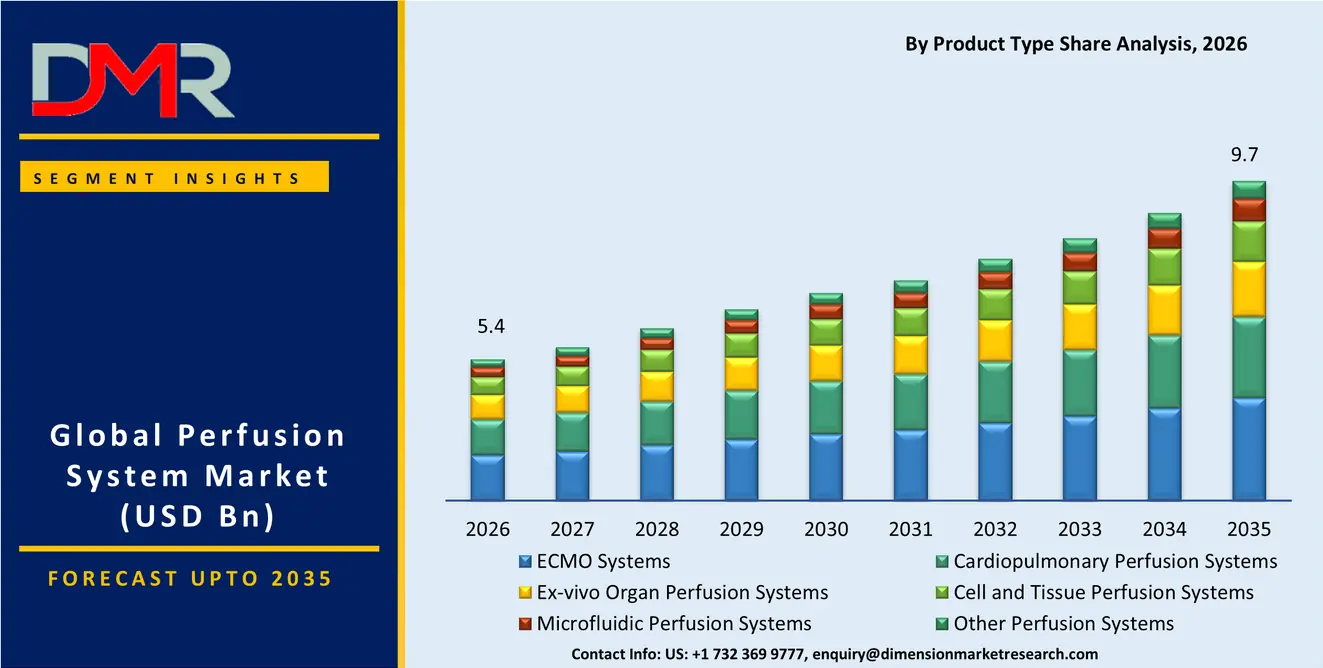
- ECMO Systems is the leading product type segment in 2026: 34.2%
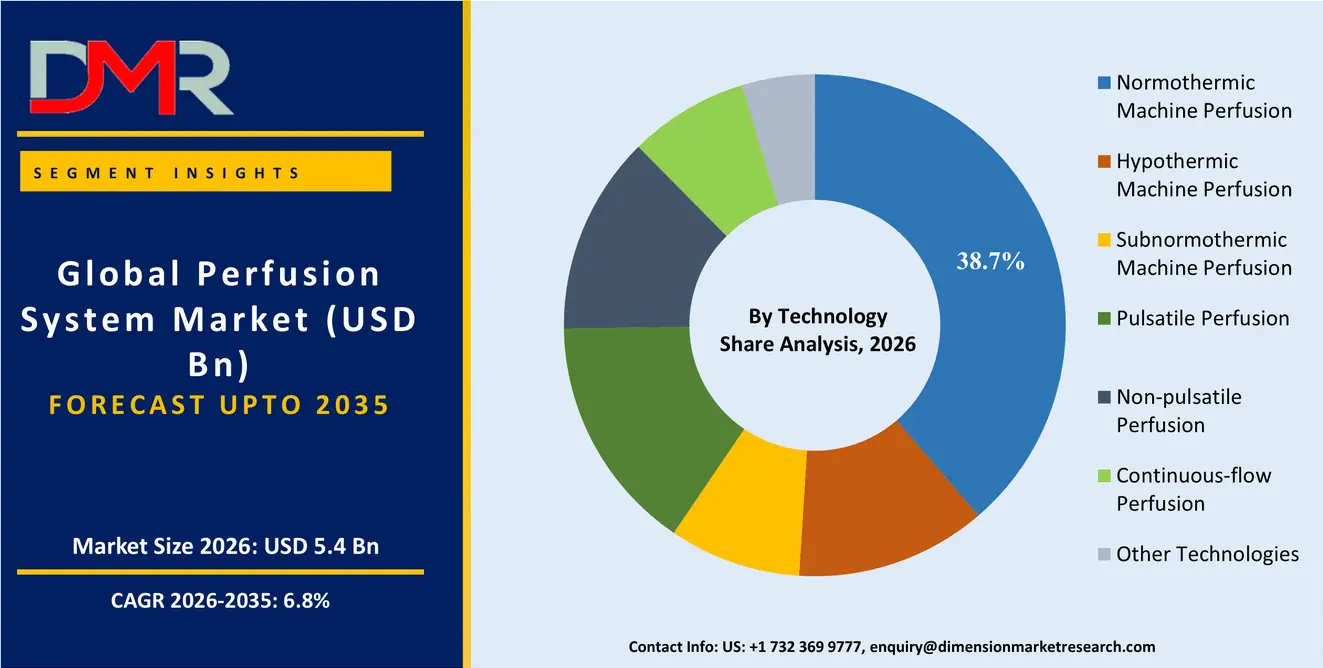
- Non-pulsatile Perfusion is the leading technology segment in 2026: 38.7%
- Direct Sales is the leading distribution channel segment in 2026: 44.6%
- Cardiac Surgery is the leading application segment in 2026: 41.5%
- Hospitals is the leading end user segment in 2026: 39.8%
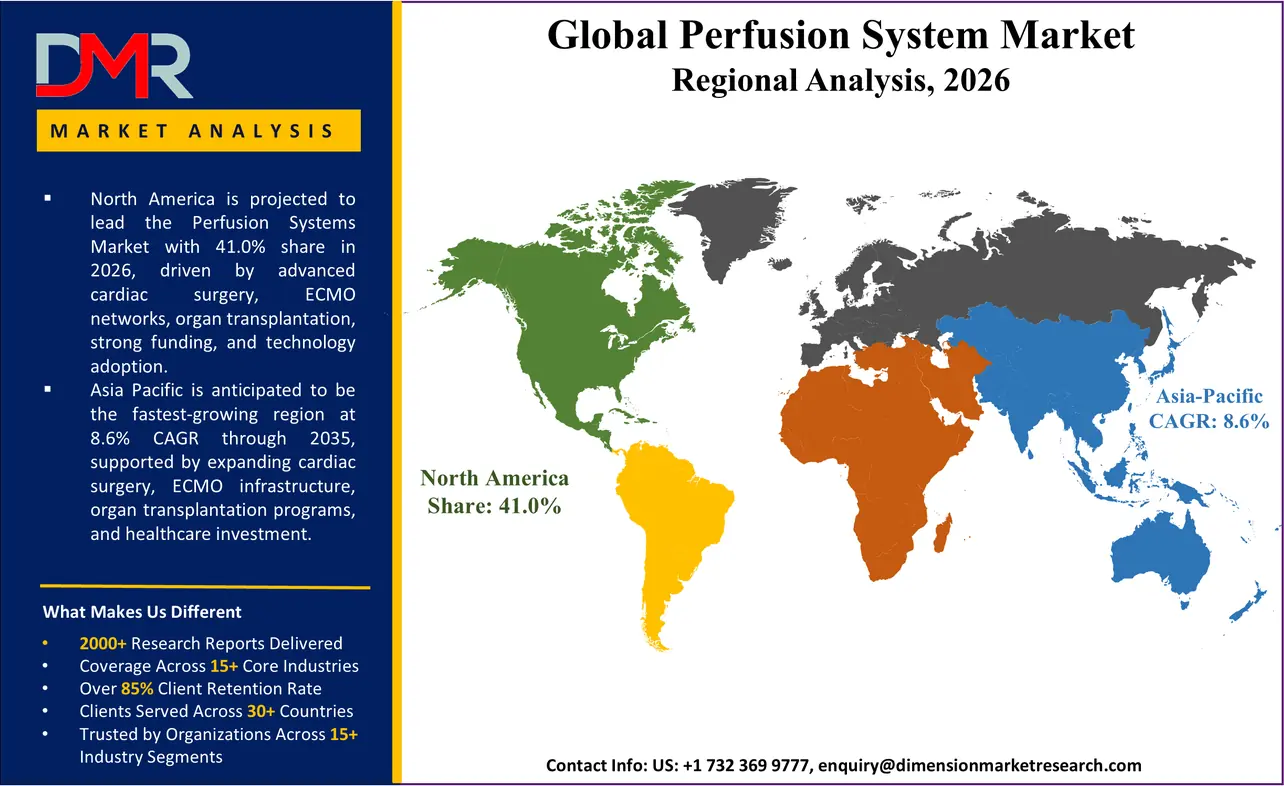
- North America is the leading region in 2026: 41.0%
What is the Global Perfusion System and its Market Size?
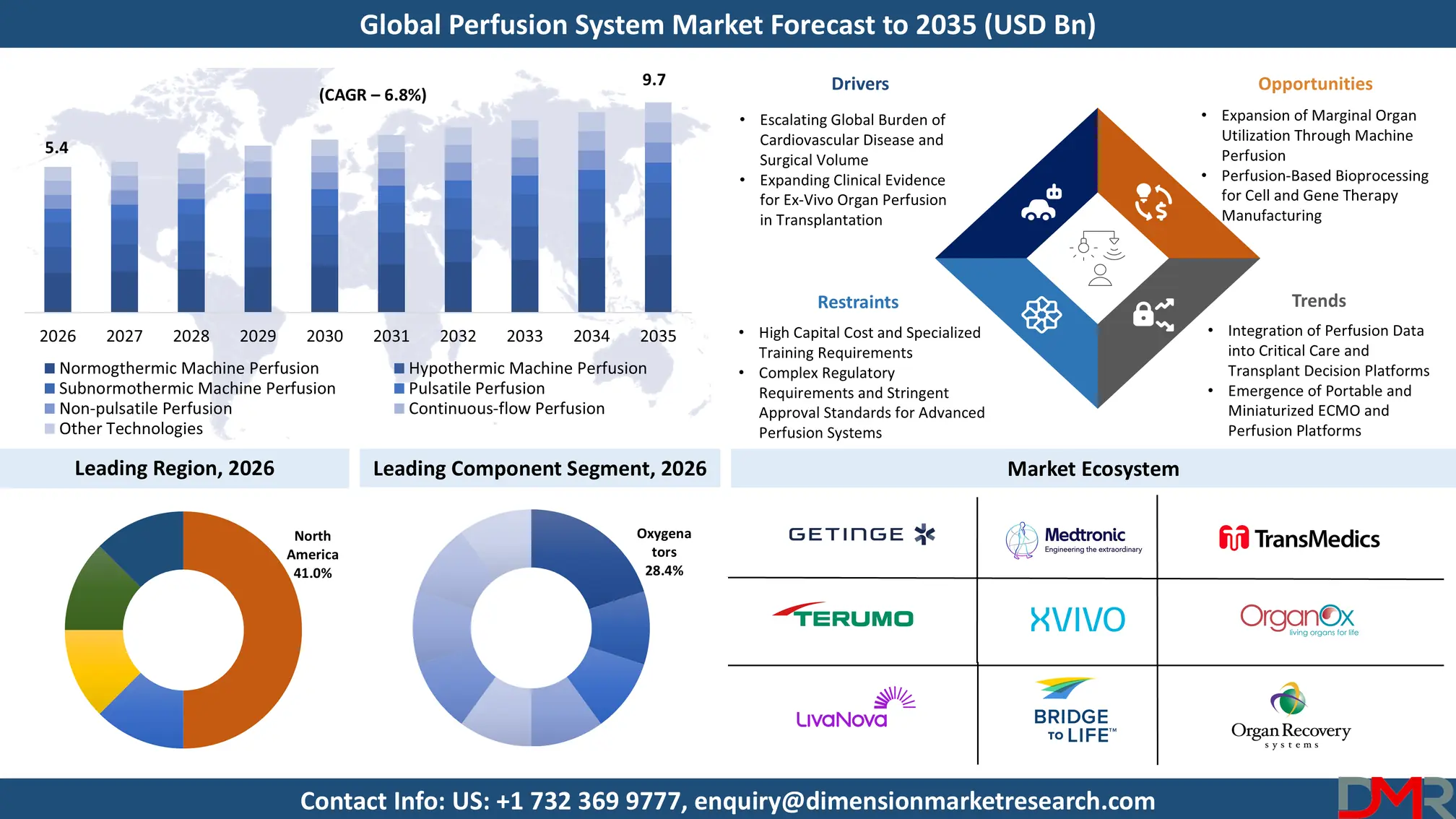
The Global Perfusion Systems Market is projected to be valued at USD 5.4 billion in 2026 and is projected to reach USD 9.7 billion by 2035, expanding at a CAGR of 6.8% during the forecast period. Growth is being propelled by the rising global volume of complex cardiac surgery, the widening clinical adoption of extracorporeal membrane oxygenation (ECMO) for both respiratory and cardiac life support, and the accelerating global organ transplant shortage driving demand for ex-vivo organ perfusion and preservation technology.
ℹ
To learn more about this report –
Download Your Free Sample Report Here
The adoption of normothermic machine perfusion with proven graft viability outcomes, rising clinical implementation of veno-arterial and veno-venous ECMO in critical care, and expanding institutional investment in cell and tissue perfusion systems for bioprocessing and regenerative medicine are reshaping the extracorporeal circulation and organ preservation landscape. Investment is accelerating as hospitals, transplant centers, and biopharmaceutical developers pivot from static cold storage and conventional bypass toward dynamic, sensor-monitored, perfusion-based organ and tissue support systems designed to extend viability windows and improve procedural outcomes.
Use Cases
- Cardiopulmonary Bypass Support in Cardiac Surgery: Cardiac surgical teams deploy heart-lung machines, oxygenators, and roller or centrifugal perfusion pumps to temporarily assume cardiac and pulmonary function during coronary artery bypass grafting, valve repair, and complex congenital cardiac procedures.
- Extracorporeal Life Support in Critical Care: Intensive care units and ECMO referral centers utilize veno-arterial and veno-venous ECMO systems to provide temporary cardiac and respiratory support for patients with refractory cardiogenic shock or severe acute respiratory failure.
- Ex-vivo Organ Preservation and Viability Assessment in Transplantation: Transplant centers employ normothermic and hypothermic machine perfusion systems for kidney, liver, heart, and lung grafts to extend preservation time, enable functional viability assessment, and expand the usable donor organ pool, including marginal and donation-after-circulatory-death organs.
- Cell and Tissue Culture Perfusion in Bioprocessing and Regenerative Medicine: Biotechnology and tissue engineering laboratories use microfluidic and continuous-flow perfusion systems to maintain nutrient and oxygen delivery for scalable cell culture, organoid development, and engineered tissue construct maturation.
Key Takeaways
- Market Size: The Global Perfusion Systems Market is anticipated to be valued at USD 5.4 billion in 2026 and is forecast to reach USD 9.7 billion by 2035, expanding at a CAGR of 6.8%.
- Growth Outlook: Market expansion is sustained by the rising global burden of cardiovascular disease requiring surgical intervention, the widening clinical footprint of ECMO in critical care, the persistent global organ donor shortage driving ex-vivo perfusion adoption, and the integration of digital monitoring tools for real-time perfusion parameter tracking.
- Primary Growth Drivers: A mounting volume of complex cardiac and thoracic surgical procedures, breakthrough clinical evidence supporting normothermic organ perfusion for graft viability extension, regulatory incentives for innovative extracorporeal life support devices, and growing biopharmaceutical investment in perfusion-based bioprocessing are accelerating investment across the perfusion technology continuum.
- By Component Analysis: Oxygenators is projected to lead the component segment with a dominant 28.4% share in 2026, driven by their essential and consumable role in every cardiopulmonary bypass and ECMO circuit, while Monitoring Systems are projected to exhibit the highest CAGR at 9.4% due to rising demand for real-time perfusion parameter and blood gas tracking.
- By Product Type Analysis: ECMO Systems is expected to dominate with a 34.2% share in 2026, supported by expanding critical care adoption of veno-arterial and veno-venous configurations, while Ex-vivo Organ Perfusion Systems are projected to post the highest CAGR at 10.1% due to accelerating transplant center investment in organ viability extension technology.
- By Technology Analysis: Non-pulsatile Perfusion is anticipated to hold a 38.7% share in 2026, reflecting its entrenched role in standard cardiopulmonary bypass procedures, while Normothermic Machine Perfusion is projected to exhibit the highest CAGR at 9.8% due to landmark transplant outcome evidence supporting warm, metabolically active organ preservation.
- By Distribution Channel Analysis: Direct Sales is expected to command a 44.6% share in 2026, underpinned by the capital-equipment nature of perfusion systems and the need for specialized clinical training and service support, with Institutional Procurement achieving the fastest growth at 8.1% CAGR as hospital networks and transplant consortia consolidate purchasing.
- By Application Analysis: Cardiac Surgery is projected to account for 41.5% of the market in 2026, fueled by the persistently high global volume of bypass-dependent surgical procedures, while Organ Transplantation and Preservation is the fastest-expanding application at 9.7% CAGR driven by rising deceased-donor organ utilization and machine perfusion adoption.
- By End User Analysis: Hospitals is expected to lead with a 39.8% share in 2026 as the central hub for cardiac surgery and ECMO-supported critical care, while Transplant Centers is the fastest-growing end-user segment at 9.2% CAGR due to expanding organ perfusion program adoption and growing marginal-organ utilization protocols.
How AI/Gen AI is Transforming the Perfusion System Market?
Digital monitoring technology and artificial intelligence are fundamentally reshaping perfusion practice by enabling continuous, data-driven oversight of extracorporeal circuits and ex-vivo organ perfusion sessions. Sensor-integrated monitoring systems now capture real-time flow rate, pressure, oxygenation, and temperature parameters across cardiopulmonary bypass, ECMO, and organ perfusion circuits, transmitting this information to perfusionist and transplant surgical teams for immediate intervention when parameters drift outside safe thresholds. These connected perfusion platforms are increasingly embedded into clinical workflow tools that flag early signs of circuit thrombosis, hemolysis, or declining organ viability during machine perfusion, closing critical gaps between static preservation and dynamic, physiologically monitored organ support. AI-assisted analysis of perfusate biomarker trends and organ-specific viability metrics is also supplementing traditional visual and biochemical assessment, enabling more confident transplant decision-making for marginal and extended-criteria donor organs.
Key Drivers in the Global Perfusion Systems Market
Escalating Global Burden of Cardiovascular Disease and Surgical Volume
Cardiovascular disease remains the leading cause of global mortality, sustaining a high and growing volume of coronary artery bypass grafting, valve replacement, and congenital cardiac repair procedures that require cardiopulmonary bypass support. The unabated rise in aging populations, metabolic syndrome prevalence, and improved surgical access in emerging economies is expanding the pool of patients requiring perfusion-supported cardiac surgery. As global cardiac surgical volumes continue to climb, downstream demand for oxygenators, perfusion pumps, cannulas, and circuit sets intensifies commensurately, reinforcing routine institutional procurement of cardiopulmonary perfusion systems as a foundational component of cardiac surgical infrastructure.
Expanding Clinical Evidence for Ex-Vivo Organ Perfusion in Transplantation
Landmark transplant outcome studies over the past decade have repositioned normothermic and hypothermic machine perfusion as a superior alternative to static cold storage for kidney, liver, heart, and lung preservation, demonstrating reduced ischemia-reperfusion injury, extended safe preservation windows, and improved utilization rates for marginal and donation-after-circulatory-death organs. This evidence-driven shift has triggered major updates to transplant center protocols, expanding machine perfusion adoption beyond high-volume academic centers to a broader network of regional transplant programs. This evidence-driven therapeutic paradigm shift is generating sustained, high-value demand for ex-vivo organ perfusion systems, elevating the transplant application segment's growth trajectory and propelling above-market expansion for normothermic perfusion technology.
Restraints in the Global Perfusion Systems Market
High Capital Cost and Specialized Training Requirements
Despite their clinical benefits, ECMO systems, heart-lung machines, and ex-vivo organ perfusion platforms require substantial upfront capital investment, specialized perfusionist and transplant surgical training, and dedicated facility infrastructure, limiting adoption among smaller hospitals and transplant programs in low- and middle-income countries. Circuit consumables, including oxygenators, cannulas, and tubing sets, add significant recurring per-procedure costs, creating budgetary pressure for health systems managing high ECMO or perfusion caseloads. Even in high-income markets, the limited global supply of trained perfusionists constrains the pace at which institutions can expand cardiopulmonary bypass, ECMO, and organ perfusion program capacity.
Growth Opportunities in the Global Perfusion Systems Market
Expansion of Marginal Organ Utilization Through Machine Perfusion
The global shortage of transplantable organs represents a high-growth opportunity for ex-vivo perfusion device manufacturers, organ preservation solution developers, and transplant logistics providers. Health systems and organ procurement organizations are increasingly incentivizing machine perfusion adoption through protocols that reward improved marginal-organ utilization rates and reduced post-transplant graft dysfunction. This creates a fertile market for portable normothermic perfusion devices, connected viability-monitoring platforms, and specialized perfusionist training services. Companies that integrate real-time biomarker analytics, extended transport-duration perfusion capability, and telehealth-supported remote viability assessment into a cohesive organ preservation ecosystem can capture a disproportionate share of the rapidly growing organ transplantation and preservation application segment.
Perfusion-Based Bioprocessing for Cell and Gene Therapy Manufacturing
Rising global investment in cell and gene therapy manufacturing is expanding demand for continuous-flow and microfluidic perfusion systems capable of supporting high-density, scalable cell culture processes. This paves the way for a specialized bioprocessing perfusion market where systems are matched to specific cell therapy production workflows rather than generic laboratory-scale culture. Equipment developers that design and commercialize validated, GMP-compliant perfusion bioreactor systems capable of supporting consistent nutrient delivery and waste removal for advanced therapy manufacturing will unlock a premium-priced specialty equipment market. Concurrently, contract research and development organizations are pursuing dedicated perfusion-based tissue engineering capacity, creating high-value niche markets at the intersection of medical devices and regenerative medicine.
Trends in the Global Perfusion Systems Market
Integration of Perfusion Data into Broader Critical Care and Transplant Decision Platforms
A defining trend is the dissolution of silos between cardiac surgery, critical care, and transplant surgery, driven by the shared reliance on continuously monitored extracorporeal circulation. Clinical practice is consolidating around integrated perfusion data platforms that track flow, pressure, oxygenation, and biomarker trends across cardiopulmonary bypass, ECMO, and organ perfusion sessions on a single dashboard. This convergence is expanding the use of systems with cross-application benefits (centrifugal pumps, advanced oxygenators, multi-parameter monitoring systems) and fostering the development of integrated perfusion informatics platforms that support both intraoperative decision-making and post-procedure outcome analysis. The market implications include broader procurement across surgical, critical care, and transplant specialties, and the rise of perfusion-data-focused digital health applications.
Emergence of Portable and Miniaturized ECMO and Perfusion Platforms
Manufacturers are increasingly focused on compact, portable ECMO and perfusion system designs that enable inter-hospital transport, mobile organ retrieval perfusion, and rapid deployment in emergency and disaster response settings. Innovations in lightweight centrifugal pump technology, integrated battery power, and simplified circuit priming are commercializing rapidly as manufacturers compete on transport durability and ease of use outside the traditional operating room or transplant laboratory. This trend is particularly pronounced in the extracorporeal life support and ex-vivo organ retrieval segments, where portability directly expands the geographic reach of advanced perfusion-supported care.
Research Scope and Analysis
The Global Perfusion Systems Market is segmented by component, product type, technology, distribution channel, application, and end user. Component includes perfusion pumps, oxygenators, heart-lung machines, cannulas, tubing and circuit sets, monitoring systems, temperature-control systems, and perfusion chambers. End users include hospitals, transplant centers, academic and research institutions, biotechnology and pharmaceutical companies, and contract research organizations.
ℹ
To learn more about this report –
Download Your Free Sample Report Here
By Component Analysis
Oxygenators is projected to dominate the Global Perfusion Systems Market, accounting for an estimated 28.4% share in 2026. Oxygenators serve as the essential gas-exchange component of every cardiopulmonary bypass and ECMO circuit, and their single-use, consumable nature across cardiac surgery and extracorporeal life support procedures sustains high recurring procurement volumes across hospitals and ECMO referral centers. Monitoring Systems are anticipated to register the highest CAGR of 9.4% during 2026–2035, driven by rising demand for continuous, sensor-based tracking of perfusion parameters and organ viability biomarkers.
By Product Type Analysis
ECMO Systems is anticipated to represent the dominant product type segment, with an estimated 34.2% market share in 2026. This leadership reflects the rapidly expanding clinical footprint of veno-arterial and veno-venous ECMO in critical care management of refractory cardiogenic shock and severe respiratory failure, supported by growing ECMO center accreditation and referral network expansion. Ex-vivo Organ Perfusion Systems are projected to record the highest CAGR of 10.1% from 2026 to 2035, propelled by accelerating transplant center adoption of machine perfusion for kidney, liver, heart, and lung preservation.
ℹ
To learn more about this report –
Download Your Free Sample Report Here
By Technology Analysis
Non-pulsatile Perfusion is poised to lead the technology segment, holding an estimated 38.7% share in 2026. Non-pulsatile, continuous-flow centrifugal pump technology remains the standard approach for the majority of cardiopulmonary bypass procedures due to its operational simplicity, established safety profile, and broad compatibility with existing perfusion circuit infrastructure. Normothermic Machine Perfusion is expected to achieve the highest CAGR of 9.8% during 2026–2035, reflecting mounting clinical evidence supporting warm, metabolically active organ preservation for improved post-transplant graft function.
By Distribution Channel Analysis
Direct Sales is expected to lead the distribution channel segment, holding an estimated 44.6% share in 2026. As capital medical equipment requiring specialized installation, perfusionist training, and ongoing technical service support, perfusion systems are predominantly sold through direct manufacturer sales relationships with hospitals and transplant centers. Institutional Procurement is projected to register the highest CAGR of 8.1% during 2026–2035, as integrated hospital networks and multi-center transplant consortia increasingly consolidate purchasing through centralized procurement frameworks.
By Application Analysis
Cardiac Surgery is anticipated to be the largest application segment, representing an estimated 41.5% share in 2026. The consistently high global volume of bypass-dependent cardiac surgical procedures, combined with the essential and non-substitutable role of perfusion systems in these procedures, sustains this segment's leadership. Organ Transplantation and Preservation is anticipated to record the highest CAGR of 9.7% from 2026 to 2035, driven by expanding machine perfusion adoption to improve marginal-organ utilization and extend safe preservation windows amid a persistent global donor organ shortage.
By End User Analysis
Hospitals is projected to dominate the end user segment, accounting for an estimated 39.8% share in 2026. They provide integrated cardiac surgical services, ECMO-supported critical care, and perioperative perfusion management, and their established infrastructure and ability to support complex, high-acuity extracorporeal procedures sustain their leading position. Transplant Centers are expected to grow at the highest CAGR of 9.2% during 2026–2035, driven by expanding ex-vivo organ perfusion program adoption and growing utilization of extended-criteria donor organs.
The Global Perfusion System Market Report is segmented based on the following:
By Component
- Oxygenators
- Perfusion Pumps
- Heart-lung Machines
- Cannulas
- Tubing and Circuit Sets
- Monitoring Systems
- Temperature-control Systems
- Perfusion Chambers
- Other Components
By Product Type
- ECMO Systems
- Veno-arterial ECMO
- Veno-venous ECMO
- Cardiopulmonary Perfusion Systems
- Ex-vivo Organ Perfusion Systems
- Kidney Perfusion Systems
- Liver Perfusion Systems
- Heart Perfusion Systems
- Lung Perfusion Systems
- Other Organ Perfusion Systems
- Cell and Tissue Perfusion Systems
- Microfluidic Perfusion Systems
- Other Perfusion Systems
By Technology
- Normogthermic Machine Perfusion
- Hypothermic Machine Perfusion
- Subnormothermic Machine Perfusion
- Pulsatile Perfusion
- Non-pulsatile Perfusion
- Continuous-flow Perfusion
- Other Technologies
By Distribution Channel
- Direct Sales
- Medical Device Distributors
- Specialty Equipment Suppliers
- Institutional Procurement
- Other Distribution Channels
By Application
- Cardiac Surgery
- Organ Transplantation and Preservation
- Extracorporeal Life Support
- Cell Culture and Bioprocessing
- Tissue Engineering and Regenerative Medicine
- Drug Discovery and Toxicology
- Preclinical Research
- Other Applications
By End User
- Hospitals
- Transplant Centers
- Academic and Research Institutions
- Biotechnology and Pharmaceutical Companies
- Contract Research Organizations
- Other End Users
Regional Analysis
North America Is the Leading Region in the Global Perfusion Systems Market
North America is poised to lead the Global Perfusion Systems Market with an estimated 41.0% revenue share in 2026. The region's dominance is anchored by a high volume of cardiac surgical procedures, a mature and well-accredited ECMO referral center network, and the world's highest per-capita investment in ex-vivo organ perfusion technology for transplantation. The United States, in particular, is characterized by early and broad adoption of normothermic organ perfusion platforms, robust reimbursement and institutional funding for extracorporeal life support programs, and a dynamic transplant ecosystem supported by expanding organ procurement organization infrastructure.
ℹ
To learn more about this report –
Download Your Free Sample Report Here
Asia Pacific Is the Fastest-Growing Region in the Global Perfusion Systems Market
Asia Pacific is projected to register the fastest CAGR of approximately 8.6% through 2035, driven by the region's rapidly rising cardiovascular disease burden, expanding cardiac surgical infrastructure particularly in China and India, and growing government investment in transplant program development. Economic development is enabling substantial investment in ECMO center accreditation and machine perfusion adoption, with both public and private providers rapidly expanding critical care and transplant capacity to meet previously unmet demand. Additionally, governments are implementing national organ donation and transplant infrastructure initiatives that are boosting institutional adoption of advanced perfusion technology.
The Europe Perfusion Systems Market
Europe represents one of the largest regional markets, characterized by well-established cardiac surgical centers and coordinated organ donation and transplant networks that support broad access to both cardiopulmonary bypass and ex-vivo organ perfusion technology, though with notable cross-national variation in machine perfusion adoption rates. Germany and the United Kingdom hold leading European market shares, driven by large cardiac surgical volumes, strong transplant center infrastructure, and broad institutional funding for perfusion technology innovation.
Latin America Perfusion Systems Market
The Latin America Perfusion Systems Market is expanding as rising cardiovascular disease prevalence and growing private hospital investment in cardiac surgery and transplant infrastructure drive demand for advanced perfusion technology. Brazil and Mexico are the primary national markets, with Brazil's large cardiac surgical caseload and expanding transplant program supporting sustained equipment demand.
Middle East and Africa Perfusion Systems Market
The Middle East and Africa Perfusion Systems Market is developing against a backdrop of rising government healthcare investment and expanding cardiac surgery and transplant center capacity in Gulf Cooperation Council (GCC) countries. Saudi Arabia and the United Arab Emirates are the most attractive markets, supported by high government healthcare spending, growing cardiac center infrastructure, and active national organ donation and transplant programs.
Major Countries Analysis
The US Perfusion Systems Market
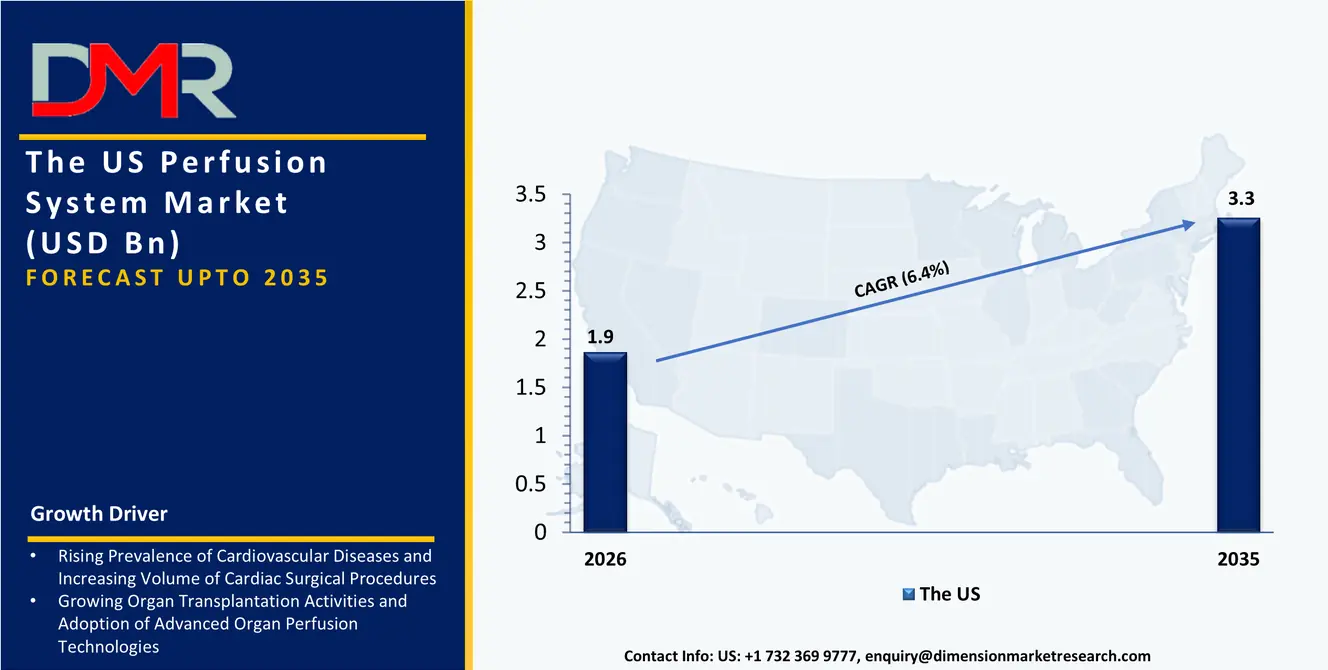
The United States Perfusion Systems Market is projected to be valued at approximately USD 1.9 billion in 2026 and is expected to reach USD 3.3 billion by 2035, registering a CAGR of 6.4% from 2026 to 2035. This robust trajectory reflects the U.S.'s position as the highest-value single-country perfusion systems market globally, underpinned by a large cardiac surgical caseload, an extensive network of accredited ECMO centers, and rapidly expanding institutional adoption of normothermic organ perfusion for transplantation. Growth is fueled by continued investment in extracorporeal life support program expansion and the rapid clinical adoption of ex-vivo organ perfusion to address the persistent national organ transplant shortage.
ℹ
To learn more about this report –
Download Your Free Sample Report Here
Japan Perfusion Systems Market
Japan possesses a well-established cardiac surgical infrastructure and a growing extracorporeal life support program network, supported by a super-aged society with rising cardiovascular disease burden. The market is distinguished by sophisticated perfusion technology adoption, gradual expansion of machine perfusion in transplant centers, and strong regulatory support for innovative extracorporeal circulation devices.
Saudi Arabia Perfusion Systems Market
Market expansion is directly tied to the Kingdom's growing cardiac surgical infrastructure and expanding national organ transplant program. The Saudi Center for Organ Transplantation oversees a growing transplant program supported by a national deceased-donor registry, while the Ministry of Health funds extensive cardiac surgical and critical care infrastructure. Vision 2030's healthcare transformation agenda, which emphasizes public-private partnerships and advanced medical technology adoption, is opening significant opportunities for international perfusion system manufacturers and organ preservation technology vendors.
Regulatory Landscape
The regulatory landscape for perfusion systems is shaped by agencies that apply rigorous evidence and safety requirements given the life-sustaining nature of extracorporeal circulation and organ preservation devices. In the United States, the FDA classifies heart-lung machines, ECMO systems, and ex-vivo organ perfusion platforms as Class II or Class III medical devices depending on intended use, generally requiring premarket approval or 510(k) clearance demonstrating substantial equivalence and clinical safety and performance data. Regulatory bodies in Europe, Japan, and other major markets similarly apply high-scrutiny device classification frameworks for perfusion technology, supporting rigorous quality and performance standards for circuit integrity, oxygenation efficiency, and organ viability outcomes.
Clinical and Technical Analysis
Demand for perfusion technology is closely tied to the global burden of cardiovascular disease requiring surgical intervention, the expanding clinical role of extracorporeal life support in critical care, and the persistent worldwide shortage of transplantable organs. Cardiovascular disease remains a leading cause of global mortality, sustaining consistently high cardiac surgical volumes that require cardiopulmonary bypass support, while critical care adoption of ECMO for severe cardiac and respiratory failure continues to expand as referral networks and clinician familiarity grow. Simultaneously, the gap between organ transplant waitlist demand and available donor organs continues to widen in most major markets, reinforcing the long-term demand outlook for ex-vivo organ perfusion technology capable of improving marginal-organ utilization and preservation outcomes.
By Region
North America
Europe
- Germany
- France
- The U.K.
- Italy
- Spain
- Rest of Europe
Asia-Pacific
- China
- Japan
- India
- Australia
- South Korea
- Rest of APAC
Latin America
- Mexico
- Brazil
- Rest of LATAM
Middle East & Africa
- Saudi Arabia
- The UAE
- South Africa
- Rest of MEA
Competitive Landscape
The Global Perfusion Systems Market features a mix of established cardiac surgical device manufacturers, specialty ECMO and extracorporeal life support companies, and emerging ex-vivo organ perfusion innovators. Leading manufacturers compete on circuit biocompatibility, oxygenation efficiency, portability, and expanding digital monitoring and organ viability analytics portfolios, while transplant-focused perfusion companies compete on preservation duration, viability assessment capability, and transport logistics integration.
Some of the prominent players in the Global Perfusion System Market are:
- Getinge AB
- Medtronic plc
- LivaNova PLC
- Terumo Corporation
- XVIVO Perfusion AB
- TransMedics Group, Inc.
- OrganOx Limited
- Organ Recovery Systems, Inc.
- Bridge to Life Ltd.
- Paragonix Technologies, Inc.
- Nipro Corporation
- Fresenius Medical Care AG
- XENIOS AG
- Repligen Corporation
- Spectrum Medical Ltd.
- Harvard Bioscience, Inc.
- ALA Scientific Instruments, Inc.
- EBERS Medical Technology SL
- Waters Medical Systems LLC
- Preservation Solutions, Inc.
- Institut Georges Lopez SA
- Eurosets S.r.l.
- Cytiva
- Merck KGaA
- Delcath Systems, Inc.
- Vascular Perfusion Solutions, Inc.
- Nanjing Biolight Meditech Co., Ltd.
- Shenzhen Lifotronic Technology Co., Ltd.
- Genus Medical Technologies LLC
- Cytosorbents Corporation
- OriGen Biomedical, Inc.
- Baxter International Inc.
- Asahi Kasei Medical Co., Ltd.
- Nikkiso Co., Ltd.
- Toray Medical Co., Ltd.
- MicroPort Scientific Corporation
- Bioptechs Inc.
- Hugo Sachs Elektronik
- Radnoti LLC
- AutoMate Scientific, Inc.
- Other Key Players
Recent Developments
- January 2025: Paragonix announced the first-in-human use of its KidneyVault Renal Perfusion System, a portable hypothermic perfusion technology for donor kidney preservation and transportation.
- February 2025: OrganOx completed a USD 142 million financing round to accelerate expansion of its metra normothermic machine perfusion platform, which had been used in more than 5,000 liver transplants.
- May 2024: Terumo Cardiovascular received U.S. FDA 510(k) clearance for its CDI OneView Monitoring System, designed to measure or display up to 22 patient parameters during cardiopulmonary bypass procedures.
Report Details
| Report Characteristics |
| Market Size (2026) |
USD 5.4 Bn |
| Forecast Value (2035) |
USD 9.7 Bn |
| CAGR (2026–2035) |
6.8% |
| The US Market Size (2026) |
USD 1.9 Bn |
| Historical Data |
2021 – 2025 |
| Forecast Data |
2026 – 2035 |
| Base Year |
2025 |
| Segments Covered |
By Component, By Product Type, By Technology, By Distribution Channel, By Application, By End User |
| Regional Coverage |
North America – The US and Canada; Europe – Germany, France, The UK, Italy, Spain, Rest of Europe; Asia-Pacific – China, Japan, India, Australia, South Korea, Rest of APAC; Latin America – Mexico, Brazil, Colombia, Argentina, Rest of LATAM; Middle East & Africa – Saudi Arabia, The UAE, South Africa, Rest of MEA |
Frequently Asked Questions
How big is the Global Perfusion Systems Market?
▾ The Global Perfusion Systems Market is valued at USD 5.4 billion in 2026 and is projected to reach USD 9.7 billion by 2035, reflecting steady global demand for cardiopulmonary bypass, ECMO, and organ preservation technology.
What is the CAGR of the Global Perfusion Systems Market from 2026 to 2035?
▾ The market is projected to expand at a compound annual growth rate (CAGR) of 6.8% between 2026 and 2035, supported by rising cardiac surgical volumes, expanding ECMO adoption, and growing machine perfusion use in organ transplantation.
What factors are driving the growth of the Global Perfusion Systems Market?
▾ Growth is driven by the escalating global burden of cardiovascular disease, expanding clinical use of ECMO in critical care, mounting evidence supporting normothermic machine perfusion for organ preservation, and rising biopharmaceutical investment in perfusion-based bioprocessing.
What are the major trends in the Global Perfusion Systems Market?
▾ Major trends include the integration of perfusion data into broader critical care and transplant decision platforms, the emergence of portable and miniaturized ECMO systems, growing marginal-organ utilization through machine perfusion, and expanding use of perfusion bioreactors in cell and gene therapy manufacturing.
Which region held the largest share of the Global Perfusion Systems Market in 2026?
▾ North America is expected to lead the global market with a 41.0% share in 2026, supported by high cardiac surgical volumes, a mature ECMO center network, and strong institutional investment in organ perfusion technology.
Which region is expected to grow the fastest in the Global Perfusion Systems Market?
▾ Asia Pacific is expected to record the fastest growth at approximately an 8.6% CAGR through 2035, driven by rising cardiovascular disease burden and expanding cardiac surgical and transplant infrastructure.
Who are the key players in the Global Perfusion Systems Market?
▾ Key market participants include Getinge AB, Medtronic, LivaNova, Terumo Corporation, Abbott Laboratories, Baxter International, TransMedics, XVIVO Perfusion, OrganOx, and other cardiac surgical, ECMO, and organ perfusion technology manufacturers.
How is the Global Perfusion Systems Market segmented?
▾ The market is segmented by component, product type, technology, distribution channel, application, and end user, with regional analysis covering North America, Europe, Asia Pacific, Latin America, and the Middle East and Africa.