What is the Perimeter Security Market Size?
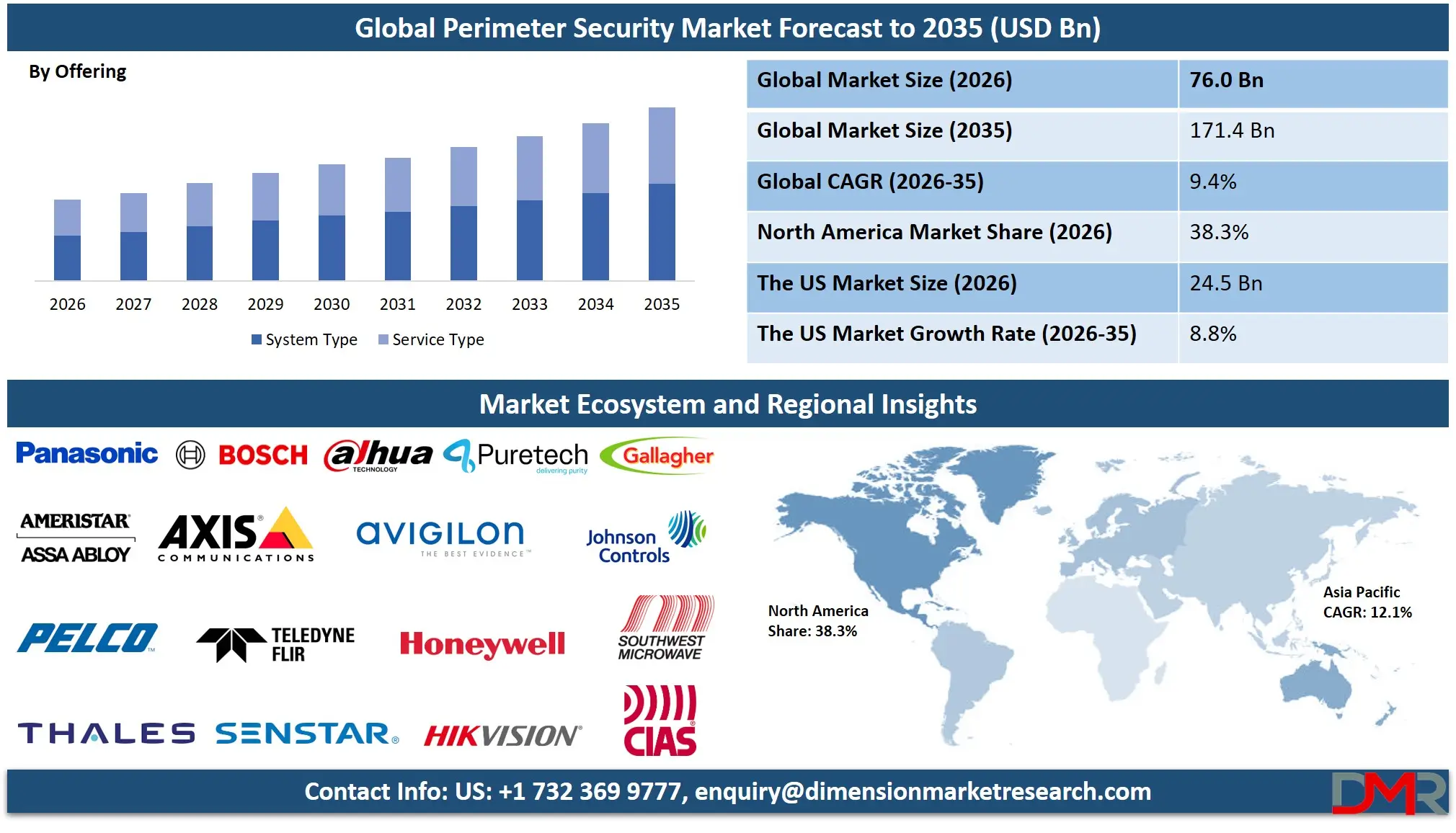
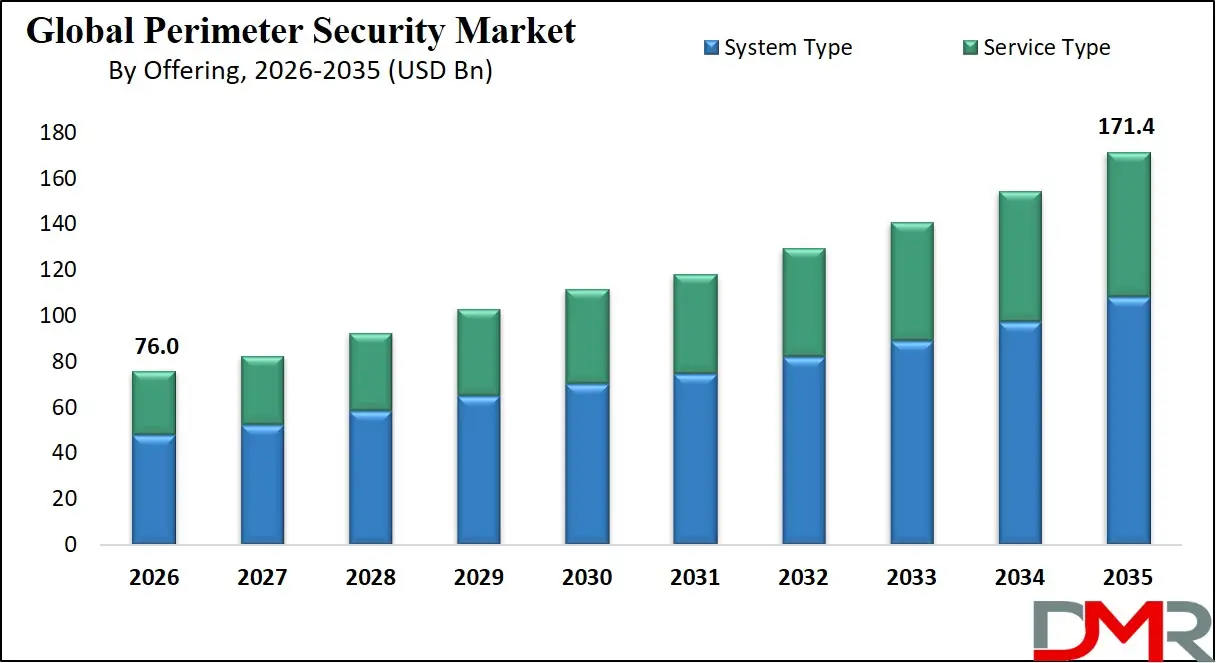
The Global Perimeter Security Market is expected to reach a value of USD 76.0 billion in 2026, and it is further anticipated to reach USD 171.4 billion by 2035, growing at a CAGR of 9.4% during the forecast period.
ℹ
To learn more about this report –
Download Your Free Sample Report Here
The perimeter security market is also witnessing a strong growth due to the growing geopolitical tensions, increasing cross-border intrusion, and the growing susceptibility of critical infrastructure to both physical and cyber-physical attacks. The market includes an extensive list of physical and electronic solutions, such as fencing, video surveillance, access control, and advanced drone detection that are used to protect the outer perimeter of assets such as national borders or corporate campuses.
ℹ
To learn more about this report –
Download Your Free Sample Report Here
The growing complexity of intrusion methods, along with the adoption of AI-powered video analytics and IoT-based sensors, is contributing to a surge in demand for specialized system integration and managed security services. The government, military, defense, and critical infrastructure are still among the first adopters because they require the high-availability and fail-safe security ecosystems that can proactively address the threats before they can reach a core asset.
The US Perimeter Security Market
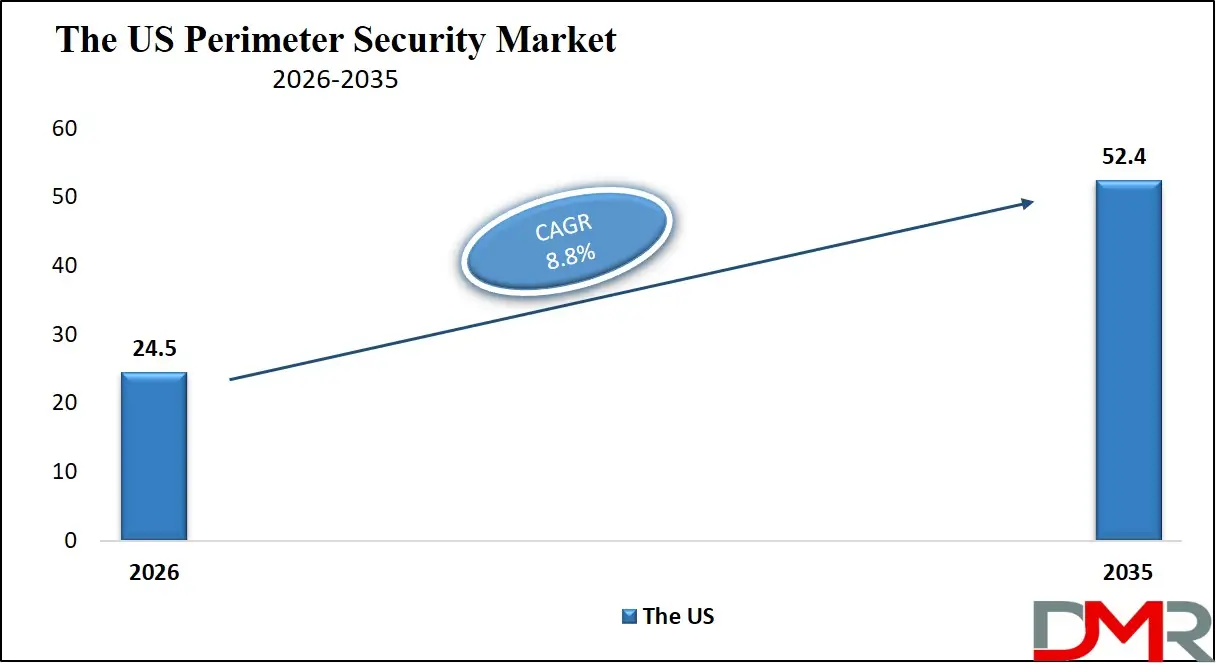
The US Perimeter Security Market is projected to reach USD 24.5 billion in 2026 at a compound annual growth rate of 8.8% over its forecast period, which is further forecasted to reach a value of USD 52.4 billion by 2035.
ℹ
To learn more about this report –
Download Your Free Sample Report Here
The US continues to represent the biggest and most technologically sophisticated perimeter security market in the world, which is supported by federal funding of border security modernization and protection of energy grids and data center infrastructure. The market is characterized by the high demand of Radar & Drone Detection Systems because federal and commercial organizations are trying to combat the rise of the threat of unauthorized unmanned aerial systems (UAS) in the restricted airspace. Moreover, the large-scale replacement of legacy analog camera networks with AI-based Video Analytics is creating a parallel demand of System Integration & Consulting services to handle the massive data streams and false-alarm filtering to standard operational efficiency requirements.
The Europe Perimeter Security Market
The Europe Perimeter Security Market is estimated to be valued at USD 22.5 billion in 2026 and is further anticipated to reach USD 48.7 billion by 2035 at a CAGR of 9.0%. The demand in Fiber Optic Detection and Seismic Sensors to check long span borders and remote pipeline systems is on the increase as the European market is highly influenced by regulatory policies such as NIS2 and the protection of Schengen external borders. The accelerating pace of Hybrid Deployment Modes in campus security is also being observed in the region, where manufacturing and automotive centers in Germany and France are trying to find a balance between on-premise control of operational technology (OT) networks and cloud-based remote monitoring analytics to provide after-hours supervision.
The Japan Perimeter Security Market
The Japan Perimeter Security Market is projected to be valued at USD 4.5 billion in 2026. It is further expected to witness robust growth, holding USD 9.8 billion in 2035 at a CAGR of 9.1%. The Japanese market is a special market that is nationally focused on disaster resilience and physical vulnerability of aging critical infrastructure to both natural and human-made disasters. Risk Assessment and Analysis and Intrusion Detection Systems take up a big part of expenditure as large industrial conglomerates and government utilities implement perimeter barriers around nuclear facilities and ports and semiconductor fabrication plant. System Integration is also highly sought after at the local level to fill the gap between the older analog sensor loops and newer IP-based Video Surveillance Systems, and provide a niche market in custom hardware-software translation layers.
Key Takeaways
- Market Size & Forecast: The Global Perimeter Security market is projected to reach USD 76.0 billion in 2026, expanding to USD 171.4 billion by 2035, due to the integration of physical security infrastructure with sophisticated software analytics and the increased attempts at perimeter intrusion worldwide.
- Growth Rate & Outlook: Global market growth is expected at a CAGR of 9.4%, due to the severe shortage of physical security operations center (SOC) analysts and the mounting complexity of operation in massive networks of IoT-based Sensors, covering large geographical locations.
- Primary Growth Drivers: The main drivers are the replacement of outdated physical Barrier Systems with smart perimeter solutions, the necessity of Risk Assessment & Analysis to meet the requirements of the protective infrastructure in the harsh and strict conditions, and the introduction of Thermal Imaging that ensures 24/7 visibility during the zero-light environment or in bad weather conditions.
- Key Market Trends: Major trends in the market include increasing the use of Radar and Drone Detection Systems to secure the airspace and the adoption of AI to radically change the rate of false alarms in Intrusion Detection Systems and the transition to Managed Services as end-users are becoming focused on operational expenditure (OpEX), rather than sustaining special in house security engineering departments.
- By Offering Analysis: In system offering is poised to dominate this segment as video surveillance systems capture major part of this market as it is used for continuous monitoring, data collection, quick response, and simple integration with alarms, access control, and analytics throughout the global airports, borders, industrial plants, and commercial buildings today.
- By Deployment Mode Analysis : On-premise deployment is projected to dominate this segment as governments, utilities, airports, and industrial operators must have maximum control, low latency, enhanced cybersecurity, regulatory compliance, and continuous access to surveillance and security data across critical facilities worldwide daily.
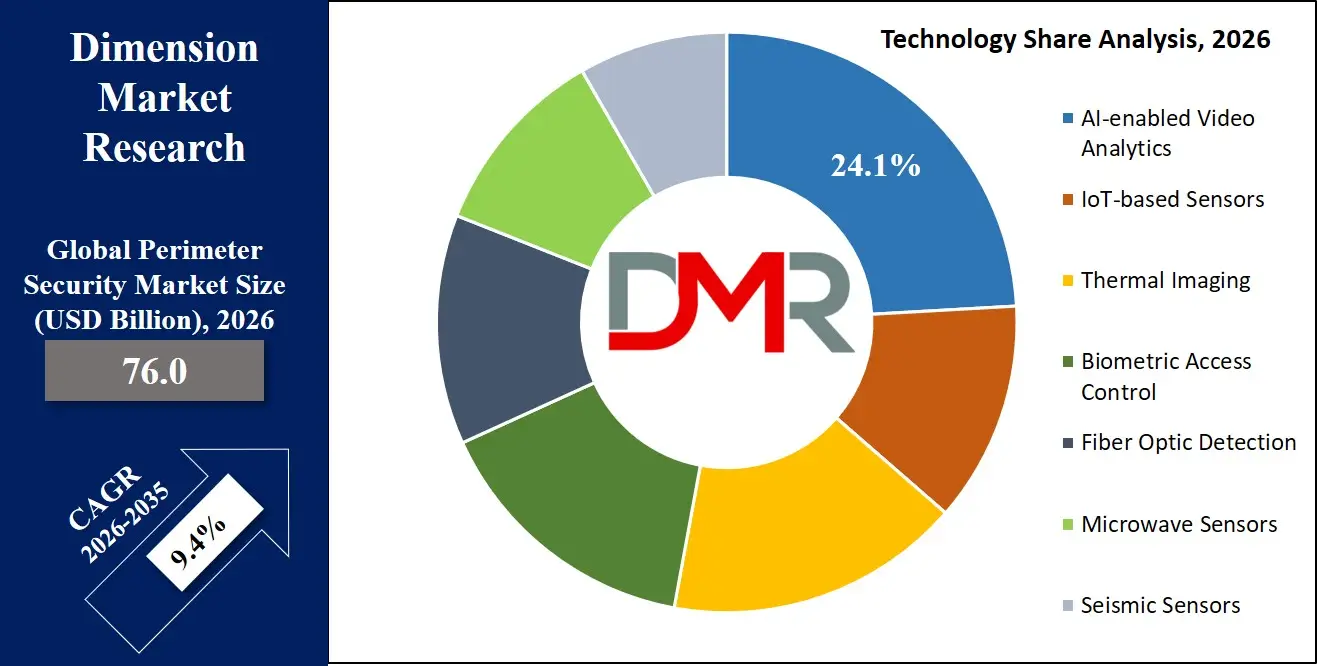
- By Technology Analysis: AI-enabled video analytics is expected to lead this segment due to its ability to efficiently detect intrusions, suspicious activity, vehicles, drones, and abandoned items and reduce false alarms and provide faster, more accurate and efficient responses in large security settings around the world today.
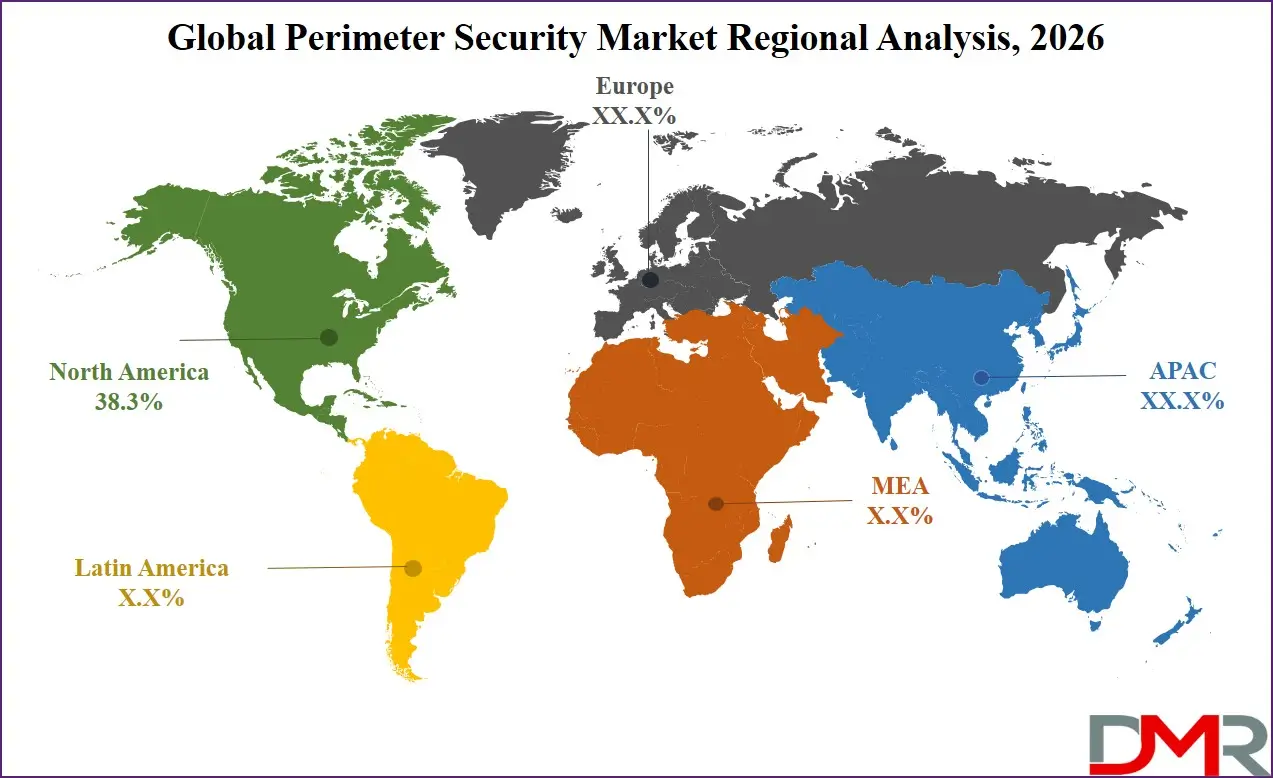
- Regional Leadership: North America is poised to command this market with about 38.3% of the market share in 2026 because of massive government expenditure on homeland security and the high concentration of critical data center assets in need of layered perimeter defense.
What is the Perimeter Security Market?
Perimeter Security is the combined systems and strategies used to protect the very physical boundaries of a specific area, facility, or national border. In contrast to interior building security (locks on doors), perimeter security is concerned with detection and delay before an intruder can gain access to the asset. This encompasses not only System Types such as Fencing Systems (physical deterrence) and Video Surveillance Systems (detection and verification) but also Service Types such as System Integration and Consulting that helps assure these divergent technologies (Microwave Sensors to Biometric Access Control) to communicate with each other on a common security platform. As drones and advanced tunneling methods become more widespread, expert services are needed to develop stacked defenses where Barrier Systems are combined with Seismic Sensors and Radar so that a perimeter violation would lead to a timely, confirmed, and prompt response.
Use Cases
- Drone Defense at Airports: Airport operators use Radar and Drone Detection Systems that include RF Jammers to establish a virtual geofence around the runway perimeter and activate automatically to notify air traffic control and security forces when unauthorized UAS activity is detected within the airport and may disrupt flight operations.
- Pipeline Vandalism Prevention in Energy: Utility companies utilize Fiber Optic Detection cables buried alongside remote oil and gas pipelines. These cables are used as Seismic Sensors and they can sense any digging or tampering up to a few miles and identify the exact location of the threat so that the rapid response teams can respond.
- Data Center Multi-Layer Protection: Hyperscale data center operators use a combination of the Anti-Ram Barrier Systems at the outer perimeter, Thermal Imaging cameras to detect objects over long distances in the dark, and Biometric Access Control and liveness detection to secure high-value compute assets at the facility entrance.
- Smart City Urban Safety: Municipal authorities apply AI-powered Video Analytics to cameras on streetlights to establish virtual boundaries around civic squares. The system automatically identifies behaviors such as mob behaviors, discarded goods, or vehicles in pedestrian-exclusive areas, alerting the command centers of a city.
How AI is Transforming the Perimeter Security Market?
The application of AI is essentially transforming the perimeter security environment where security operations are replaced by forensic analysis, which is reactive but not proactive in terms of detecting the threat. In Video Surveillance Systems, AI-enabled Video Analytics can now simultaneously process multiple camera streams, classifying a human intruder, a swinging tree branch, or an animal with 98-plus percent accuracy, which saves much operational effort on human guards and false-alarm dispatches that could be expensive.
In addition to mere detection, AI is used to operate more complex Radar and Drone Detection Systems capable of identifying the type of drone (consumer or military) based on flight signature and anticipating flight paths to coordinate countermeasures. Access Control Systems are also improving their logic with AI. Through the examination of historical entry data, AI algorithms can detect patterns of anomalous behavior, including tailgating attempts, or the use of credential at odd times, automatically activate secondary biometric verification locks.
Market Dynamics
Key Drivers in the Global Perimeter Security Market
The Escalating Asymmetric Threat Landscape
The increasing trend of drones intruding on airports and infrastructures, along with the stealing of goods and resources in manufacturing facilities and warehouses, has made static fencing an old concept. There are new threats coming into the picture, which can’t be detected by the usual methods. In other words, there is a structural gap in the current security system used by most organizations. It is for this reason that there is a need to deploy systems that will integrate radar and drone detection systems and seismic and fiber optics detection systems.
Integration Complexity of Legacy and New Technology
Numerous large facilities, particularly those in government, military, and transportation, have a patchwork of security systems that have been built over decades. Combining an old analog Fencing System alarm relay with a new IP-based AI-enabled Video Analytics system is not easy technically. System Integration and Consulting services are specialized ones that companies need to develop middleware to convert protocols, store alarm control in one pane of glass, and make sure that the activation of a Microwave Sensor causes a Thermal Imaging PTZ camera to be directed to the right coordinates without human involvement.
Restraints in the Global Perimeter Security Market
High Total Cost of Ownership for Rugged Environments
Implementation of sophisticated perimeter protection in large, remote, or otherwise hostile environments like border walls, offshore wind farms, or mining facilities is both costly in capital and expensive to maintain. Barrier Systems also demand civil works and anti-corrosion treatment and Thermal Imaging cameras and Radar units in the coastal areas demand special housings to resist the salt spray and high temperatures. It is often the logistics of powering and connecting IoT-based Sensors over miles of desolate terrain that causes the initial cost of the project to increase and creates a dependency on costly Maintenance and Support contracts, dragging more cost-constrained municipalities and smaller industrial operators into slow adoption.
Nuisance Alarms and Operator Fatigue
Even with the progress of AI, perimeter security systems that are installed in dynamic outdoor settings continue to be susceptible to false alarms caused by wildlife, adverse weather, or vegetation. Microwave Sensor Nuisance Rates of nuisance alarms brought about by Microwave Sensors or Fiber Optic Detection can saturate security operations centers causing alarm fatigue where operators start to ignore or postpone checking alerts. This operational inefficiency will debase the confidence in the system, and may result in a real intrusion being overlooked. To counter this, it would be necessary to invest in further refinements of AI-powered Video Analytics and Risk Assessment and Analysis in order to adjust the sensitivity of the sensor to local environmental conditions.
Growth Opportunities in the Global Perimeter Security Market
Critical Infrastructure Modernization (Grid & Water)
The process of making national energy grids and water treatment facilities hardened is one of the most important opportunities. After high-profile physical attacks on substations around the world, regulators are mandating utilities to deploy NERC CIP-014-compliant perimeter security. This offers a continuous pipeline of demand to Anti-Climb Fencing Systems, Thermal Imaging cameras with long-range view and Radar systems to guard remote substation perimeters both on the ground and by air. These unique electrical safety environments have service providers who specialize in Risk Assessment and Analysis and are placed in high-value contracts.
The Proliferation of Hyperscale Data Centers and Warehouses
The high rate of cloud infrastructure and e-commerce logistics development pushes the building of thousands of new data centers and mega-warehouses all over the world. The facilities need a powerful Industrial Site Protection and Warehouse and Logistics Security to secure high-value goods and servers of paramount importance. This would form an enormous, repetitive market of Vehicle Barrier Systems (crash-rated gates), License Plate Recognition (LPR) with Access Control Systems, and AI-enabled Video Analytics to monitor loading docks and fenced storage yards 24/7.
Trends in the Global Perimeter Security Market
The Convergence of Cyber-Physical Security
The trend has been to incorporate cybersecurity governance into the physical perimeter systems. Video Surveillance Systems and Access Control Systems are becoming Cloud-Based and IoT-enabled, which makes them potential points of entry of a cyberattack. During a physical intrusion, a security camera with a compromised security camera can be used to disable video coverage. This convergence is leading to a new wave of Risk Assessment & Analysis demand which considers not only physical vulnerability but also network hygiene of the deployed devices. The end-users are also demanding vendors to meet rigid principles of Secure by Design, preferring systems that have hardware-based encryption, with frequent firmware updates that are offered through Managed Services.
Subscription-Based Security as a Service (VSaaS & ACaaS)
The market is experiencing remarkable transition towards on-premise hardware purchase models to operational expenditure. The Commercial and Residential Premises Security segments are seeing the growth of Cloud-Based Video Surveillance as a Service (VSaaS) and Access Control as a Service (ACaaS). This trend allows small and medium businesses to deploy AI-enabled Video Analytics and remote Barrier System control at enterprise grade without the hassle of managing local servers. This continuity in revenue model to service providers underlines the significance of Maintenance and Support and trusted Cloud-Based infrastructure availability.
Research Scope and Analysis
By Offering Analysis
Video surveillance systems are poised to dominate the offerings in the global perimeter security market due to their ability to offer real-time alerting, uninterrupted monitoring, evidence capture, and the ability to integrate with analytics. These systems are favored by organizations in government, transportation, industrial plants, airports, campuses and commercial buildings due to the enhanced situational awareness and the minimization of response time. This segment has been enhanced by the growing popularity of IP cameras, CCTV, thermal cameras, and AI-based video analytics. Video surveillance is also simpler to combine with access control, alarms and intrusion detection systems and is the backbone of the majority of perimeter security deployments. System integration and consulting are the most popular in service offerings as organizations are demanding multi-vendor platforms that can collaborate effectively in large, complex facilities.
By Deployment Mode Analysis
On-premise deployment is projected to dominate the perimeter security market in context of deployment mode since most of the organizations dealing with sensitive resources would want to have full control over their data, hardware and network infrastructure. Government agencies, military installations, operators of critical infrastructure, utilities, airports, and industrial facilities are often unable to fully depend on external cloud environments because of cybersecurity and privacy issues and government regulations. Physical systems have less latency, greater customization, continuous availability, and compliance with national security requirements. They also enable organizations to retention direct ownership of the surveillance footage, access logs, and intrusion alerts. In spite of the growing popularity of cloud-based and hybrid models due to its flexibility and reduced costs, the majority of large and security-sensitive organizations deploy on-premise solutions as their major model of deployment.
By Technology Analysis
AI-enabled video analytics is projected to be the leading technology segment due to its ability to convert conventional surveillance into smart perimeter security. Rather than merely capturing images, AI can automatically detect suspicious activity, trespassing, left items, vehicle motion, and drone activity in real-time. This minimizes security false alarms and improves speed in security responses.
ℹ
To learn more about this report –
Download Your Free Sample Report Here
The application of AI analytics on the border, at airports, industrial plants, military bases, and smart cities is on the rise, as the technology has the ability to process high amounts of video in real-time without being fully reliant on human operators. Facial recognition, license plate recognition, object tracking, and predictive threat analysis are also supported by the technology. With organizations pursuing more efficiencies and automation, AI-enabled video analytics has emerged as the most impactful and generally used technology in contemporary perimeter security systems
By Application Analysis
Critical infrastructure protection is expected to be the dominant application segment as vital assets like power plants, oil and gas facilities, water treatment facilities, telecom networks, ports and data centers are increasingly vulnerable to terrorism, sabotage, theft and cyber-physical attacks. These facilities demand utmost perimeter security since any form of disruption can impact whole regions and economies. Operators thus spend a lot of money on multi-layered security systems such as surveillance cameras, intrusion detection, biometric access control, fencing, thermal imaging and radar. Governments across the globe are also enacting more stringent laws and security requirements on critical infrastructure, which is further escalating expenditure in this field. Airport security, border security and smart city projects are growing, but the most significant and most strategically important application segment is critical infrastructure.
By End User Analysis
Military and defense is expected to dominate the end-user segment since military installations, border installations, government buildings, prisons, and other strategic national assets demand high-level perimeter security against terrorism, intrusion, espionage, and sabotage. These users normally have bigger security budgets and install very advanced systems that comprise video surveillance, radar, drone detection, access control, fencing, and intrusion detection. Governments are also among the first to use other newly developed technologies like AI-powered surveillance, thermal imaging, and combined command centers. The growing geopolitical tension and growing investments in border security are only enhancing this segment in the world. Government and defense is the largest end-user sectors, although commercial, industrial, transportation, and residential sectors are also expanding fast, since they have major security roles and are actively investing in new high-tech perimeter protection systems.
The Global Perimeter Security Market Report is segmented on the basis of the following:
By Offering
- Access Control Systems
- Video Surveillance Systems
- Intrusion Detection Systems
- Alarm & Notification Systems
- Barrier Systems
- Fencing Systems
- Radar & Drone Detection Systems
- Others
- System Integration & Consulting
- Risk Assessment & Analysis
- Managed Services
- Maintenance & Support
By Deployment Mode
- On-Premise
- Cloud-Based
- Hybrid
By Technology
- AI-enabled Video Analytics
- IoT-based Sensors
- Thermal Imaging
- Biometric Access Control
- Fiber Optic Detection
- Microwave Sensors
- Seismic Sensors
By Application
- Critical Infrastructure Protection
- Border Security
- Airport Security
- Campus & Facility Security
- Industrial Site Protection
- Smart City Security
- Warehouse & Logistics Security
- Residential Premises Security
- Other Application
By End User
- Government
- Military & Defence
- Transportation
- Commercial
- Industrial
- Residential
- Critical Infrastructure
- Utilities & Energy
- Other End User
Regional Analysis
Leading Region by Market Share
North America is poised to dominate the global perimeter security market, as it is projected to hold 38.3% of the market share by the end of 2026. This domination is particularly led by the United States, which has continued to fund Border Security technology through the Department of Homeland Security (DHS) and Customs and Border Protection (CBP), such as state-of-the-art radar and drone detection systems and integrated fixed towers.
ℹ
To learn more about this report –
Download Your Free Sample Report Here
Moreover, the high concentration of more than Fortune 500 corporate headquarters and hyperscale data centers in North America contributes to a steady demand in the services of System Integration and Consulting to modernize old-fashioned analog Video Surveillance under AI-based Video Analytics solutions and install rigorous Access Control Systems.
Fastest-Growing Regional Market
Asia-Pacific is projected to have the fastest-growing perimeter security market, due to a high rate of urbanization, building of new international airports, and increasing defense budgets in India, China, and Southeast Asia. The fast industrialization of the region requires effective Industrial Site Protection and Critical Infrastructure Protection of new power plants and manufacturing centers. Moreover, APAC government-driven Smart City Security programs are implementing tens of thousands of AI-powered cameras and IoT-based Sensors, generating an enormous need to utilize scalable cloud-based video management and managed services to manage the data onslaught.
By Region
North America
Europe
- Germany
- The U.K.
- France
- Italy
- Russia
- Spain
- Benelux
- Nordic
- Rest of Europe
Asia-Pacific
- China
- Japan
- South Korea
- India
- ANZ
- ASEAN
- Rest of Asia-Pacific
Latin America
- Brazil
- Mexico
- Argentina
- Colombia
- Rest of Latin America
Middle East & Africa
- Saudi Arabia
- UAE
- South Africa
- Israel
- Egypt
- Rest of MEA
Competitive Landscape
The competitive dynamics in the global perimeter security market are rather fragmented, comprising international arms manufacturers, suppliers of dedicated physical security equipment, and emerging System Integration companies whose core competence is software development. The primary competitive advantage will be a cohesive solution enabling data collection and analysis from different types of Systems, ranging from microwave sensors to fencing systems. Collaboration among providers of hardware for radar & drone detection systems and providers of software solutions based on artificial intelligence-driven video analytics is essential in order to win major deals in critical infrastructure protection or smart cities projects. Another competitive advantage will be comprehensive managed services and maintenance & support services for perimeter security equipment.
Some of the prominent players in the Global Perimeter Security Market are:
- Honeywell International Inc.
- Johnson Controls International plc
- Bosch Security Systems
- Hikvision Digital Technology Co., Ltd.
- Zhejiang Dahua Technology Co., Ltd.
- Axis Communications AB
- Senstar Corporation
- Teledyne FLIR LLC
- Thales Group
- Pelco
- Ameristar Perimeter Security
- Fiber SenSys Inc.
- OPTEX Co., Ltd.
- Panasonic Corporation
- Southwest Microwave Inc.
- Avigilon Corporation
- Gallagher Group Limited
- CIAS Elettronica
- PureTech Systems Inc.
- Hanwha Vision Co., Ltd.
- Other Key Players
Recent Developments
- February 2026: Honeywell announced its latest strategic partnership to combine its Radar and Drone Detection systems with a top-of-the-line AI video management solution. The company intends to offer a consolidated Thermal Imaging and AI-powered Video Analytics solution for countering UAS activities at airports and critical infrastructure sites.
- October 2025: Johnson Controls introduced an additional module within its Managed Services portfolio for Cloud-Based Access Control. The module would allow organizations to conduct Risk Assessment and Analysis for their hybrid workplaces and help their Campus & Facility Security departments adjust accordingly.
- September 2025: Senstar Corp. introduced a next-generation Fiber Optic Detection system that uses advanced AI technology to process signals and significantly lower false alarms in border security and critical infrastructure protection applications such as pipelines by up to 70%.
Report Details
| Report Characteristics |
| Market Size (2026) |
USD 76.0 Bn |
| Forecast Value (2035) |
USD 171.4 Bn |
| CAGR (2026–2035) |
9.4% |
| The US Market Size (2026) |
USD 24.5 Bn |
| Historical Period |
2021 – 2025 |
| Forecast Period |
2027 – 2035 |
| Base Year |
2025 |
| Estimated Year |
2026 |
| Segments Covered |
By Offering (System Type, and Service Type), By Deployment Mode (On-Premise, Cloud-Based, and Hybrid), By Technology (AI-enabled Video Analytics, IoT-based Sensors, Thermal Imaging, Biometric Access Control, Fiber Optic Detection, Microwave Sensors, and Seismic Sensors), By Application (Border Security, Airport Security, Critical Infrastructure Protection, Campus & Facility Security, Industrial Site Protection, Smart City Security, Warehouse & Logistics Security, Residential Premises Security, and Other Application), By End User (Government, Military & Defence, Transportation, Commercial, Industrial, Residential, Critical Infrastructure, Utilities & Energy, and Other End User) |
| Regional Coverage |
North America – The US and Canada; Europe – Germany, The UK, France, Russia, Spain, Italy, Benelux, Nordic, & Rest of Europe; Asia-Pacific – China, Japan, South Korea, India, ANZ, ASEAN, Rest of APAC; Latin America – Brazil, Mexico, Argentina, Colombia, Rest of Latin America; Middle East & Africa – Saudi Arabia, UAE, South Africa, Turkey, Egypt, Israel, & Rest of MEA |
Frequently Asked Questions
How big is the Global Perimeter Security Market?
▾ The Global Perimeter Security market is poised to be valued at USD 76.0 billion in 2026 and is projected to reach USD 171.4 billion by 2035, driven by the universal need for layered physical defense of borders, critical assets, and commercial properties.
What is the CAGR of the Global Perimeter Security Market from 2026 to 2035?
▾ The market is expected to grow at a CAGR of 9.4% from 2026 to 2035, reflecting the increasing sophistication of threats and the integration of AI and sensor fusion technologies into traditional security hardware.
What factors are driving the growth of the Global Perimeter Security Market?
▾ Key drivers include the escalation of drone incursions, the need to protect aging critical infrastructure (energy and water), the complexity of integrating legacy analog systems with new IP-based IoT Sensors, and the demand for AI-enabled Video Analytics to reduce reliance on human monitoring.
Which region held the largest share of the Perimeter Security Market in 2026?
▾ North America is poised to hold 38.3% of market share in 2026, driven by robust federal spending on Border Security and extensive private investment in data center and corporate Campus & Facility Security.
Which region is expected to grow the fastest in the Perimeter Security Market?
▾ The Asia-Pacific region is expected to grow the fastest, fueled by rapid urbanization, Smart City Security projects, and the expansion of transportation infrastructure in India, China, and Southeast Asia.
What are the major trends in the Global Perimeter Security Market?
▾ Major trends include the convergence of cybersecurity with physical security (cyber-physical systems), the adoption of Cloud-Based VSaaS and ACaaS subscription models, and the use of AI-enabled Video Analytics to filter false alarms and provide predictive threat detection.
Who are the key players in the Global Perimeter Security Market?
▾ Key players include major multinationals like Honeywell, Johnson Controls, and Bosch, specialized video surveillance leaders like Axis Communications and Hikvision, and niche detection specialists like Senstar and Teledyne FLIR.
How is the Global Perimeter Security Market segmented?
▾ The market is segmented by Offering (System Type & Service Type), Deployment Mode (On-Premise, Cloud-Based, Hybrid), Technology (AI Video Analytics, Thermal Imaging, etc.), Application (Border Security, Critical Infrastructure, and other application), and End User (Government, Military, Commercial, and other end user).