What is the Perovskite Solar Cell Market Size?
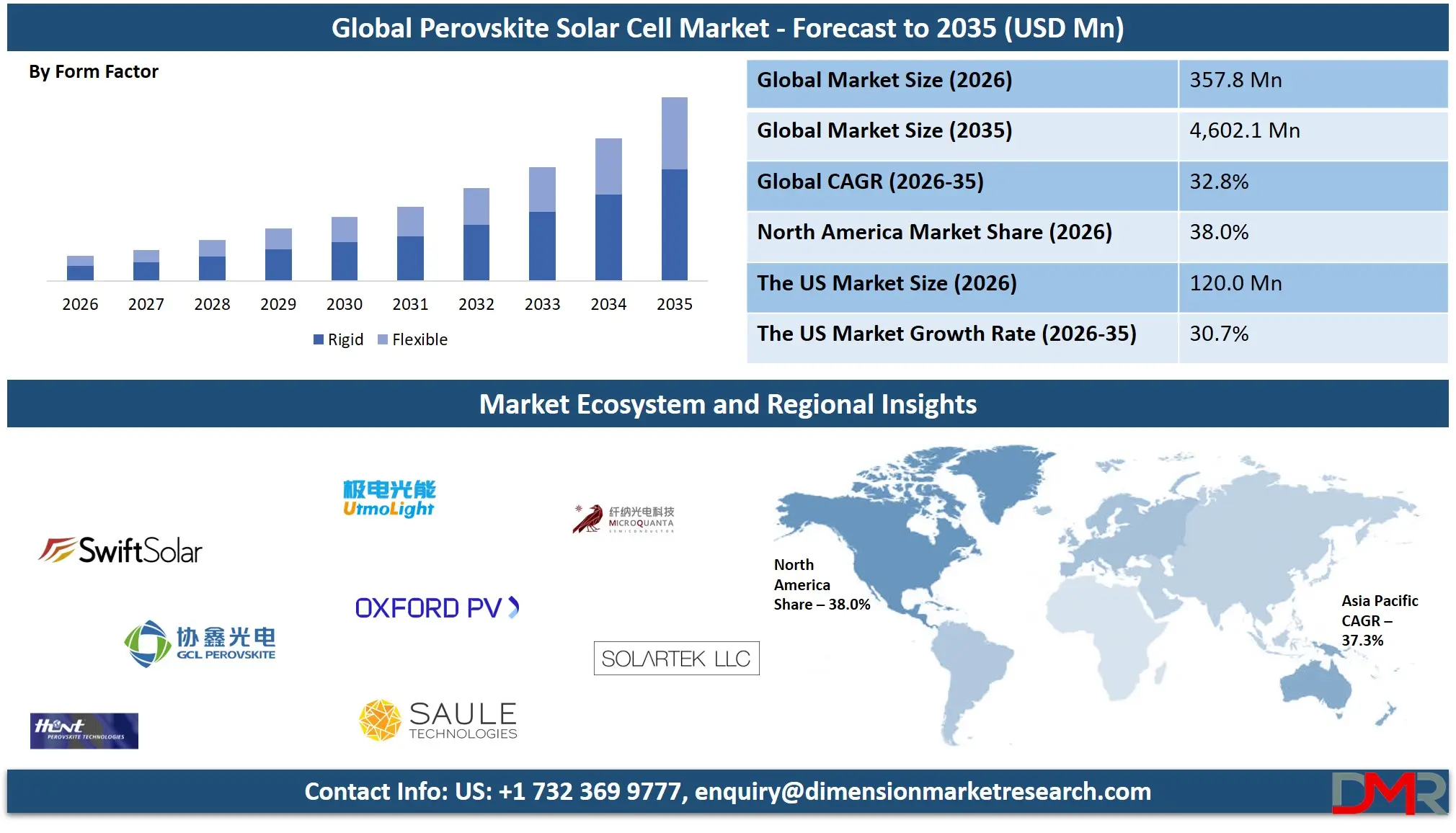
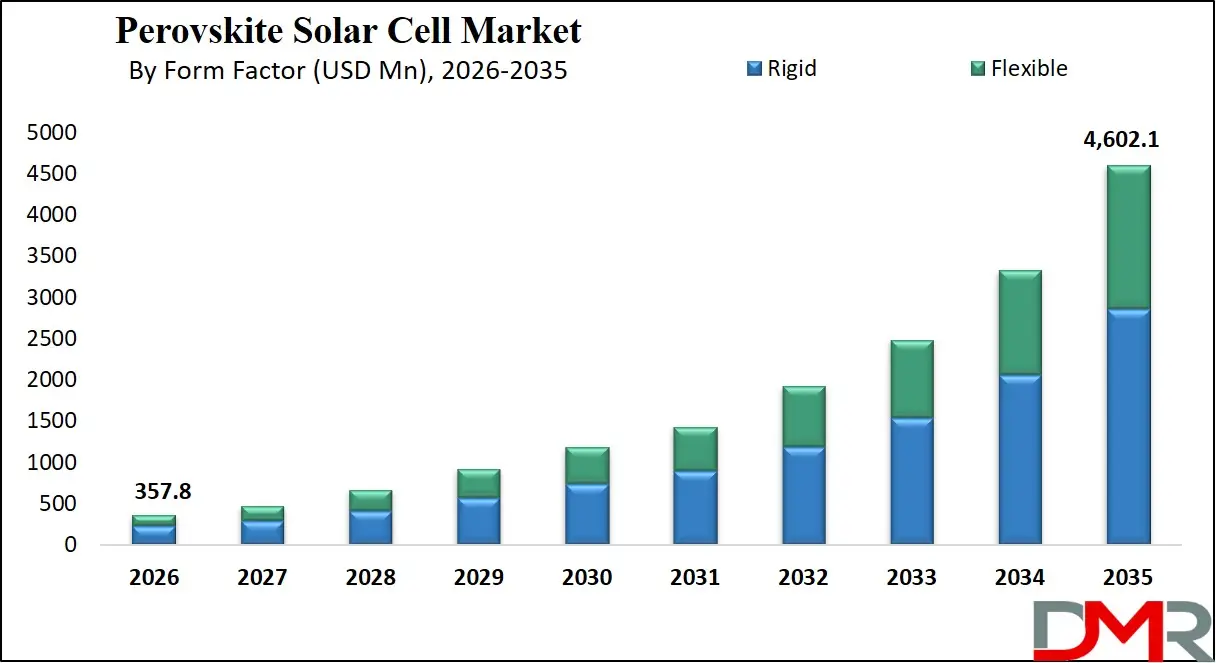
The Perovskite Solar Cell Market size is expected to be USD 357.9 million in 2026 and increase at a compound annual growth rate of 32.8% to USD 4,602.1 million in 2035 due to the advancements in efficiency levels, especially with tandem solar cells.
ℹ
To learn more about this report –
Download Your Free Sample Report Here
The Perovskite Solar Cell market is the industry that deals with the creation and commercialization of solar cells that make use of perovskite-type materials as the active layer responsible for converting sunlight into electricity. Perovskites have higher efficiencies, are cheaper to manufacture, and are more flexible than silicon photovoltaic cells. The industry includes players involved in the provision of raw materials, manufacturing of cells, module integration, and applications. Its importance is highlighted by its revolutionary potential in renewables by making solar energy cheaper and introducing new uses like lightweight and flexible solar modules.
ℹ
To learn more about this report –
Download Your Free Sample Report Here
The US Perovskite Solar Cell Market
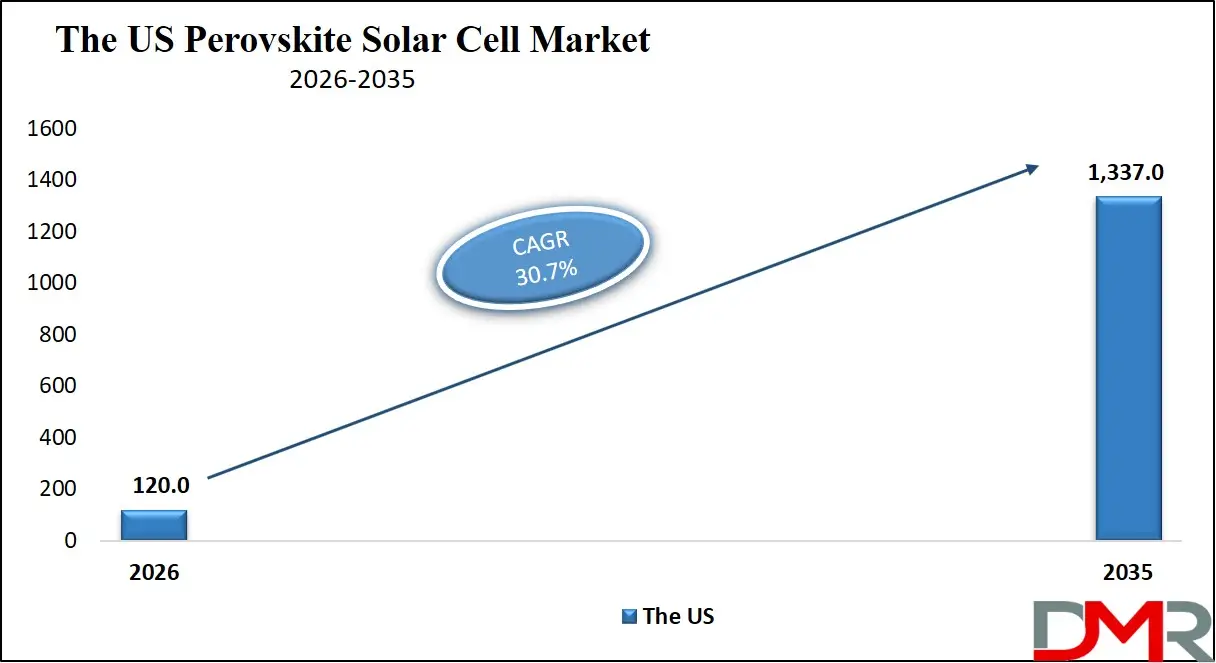
The US Perovskite Solar Cell Market size is estimated to be USD 120.0 million in 2026 and is expected to increase at a CAGR of 30.7% over the forecast period.
ℹ
To learn more about this report –
Download Your Free Sample Report Here
The US solar panel market has well-organized research communities and private-sector innovations as well as government support. Programs run by the government to encourage clean energy utilization along with different kinds of tax credits and grants are driving growth in the market. Universities and start-ups are key players in improving efficiency and durability. The demand for solar panels within the US and energy security drive growth in the market.
Europe Perovskite Solar Cell Market
The Europe Perovskite Solar Cell Market size is estimated to be USD 107.3 million in 2026 and at a CAGR of 31.1% over the forecast period.
Sustainability policies and decarbonization targets determine the market conditions for Europe. Regulations and policy instruments like the European Green Deal encourage investments in state-of-the-art solar cells. Europe excels in pilot-scale manufacturing and technological innovations, especially in tandem cells. Excellent coordination between academia and companies facilitates adoption, but regulatory requirements and environmental impacts on materials affect development timelines.
Japan Perovskite Solar Cell Market
The market size of Japan's Perovskite Solar Cell will be USD 14.3 million in 2026, with a CAGR of 31.5% in the forecast period.
The market for Japan is growing due to the scarcity of land, as well as the requirement for light weight and flexibility when it comes to solar energy. Incentives supported by the government promote the implementation of advanced photovoltaics in infrastructure and portable uses. Japan focuses on innovation concerning thin-film technology and flexible panels, but faces issues such as costly production and stiff competition with silicon systems.
Key Takeaways
- Market Size & Forecast: The Perovskite Solar Cell Market size is projected to reach USD 357.8 billion in 2026 and is anticipated to have a value of USD 4,602.1 billion in 2035.
- Growth Rate & Outlook: The Perovskite Solar Cell Market size is set to grow at a compound annual growth rate of 32.8% during the forecast period of 2026 to 2035.
- Primary Growth Drivers: Some of the major growth drivers in the market include technological advancements in efficiency, growing demand for low-cost renewable energy, and more.
- Key Market Trends: Some of the major trends in the market are a shift toward flexible and lightweight solar solutions, increased investment in commercialization, and more.
- By Form Factor: The rigid segment is anticipated to get the majority share of the Perovskite Solar Cell market in 2026.
- By Manufacturing Method: The solution-based segment is expected to get the largest revenue share in 2026 in the Perovskite Solar Cell market.
- By End Use: The utility segment is expected to get the largest revenue share in 2026 in the Perovskite Solar Cell market.
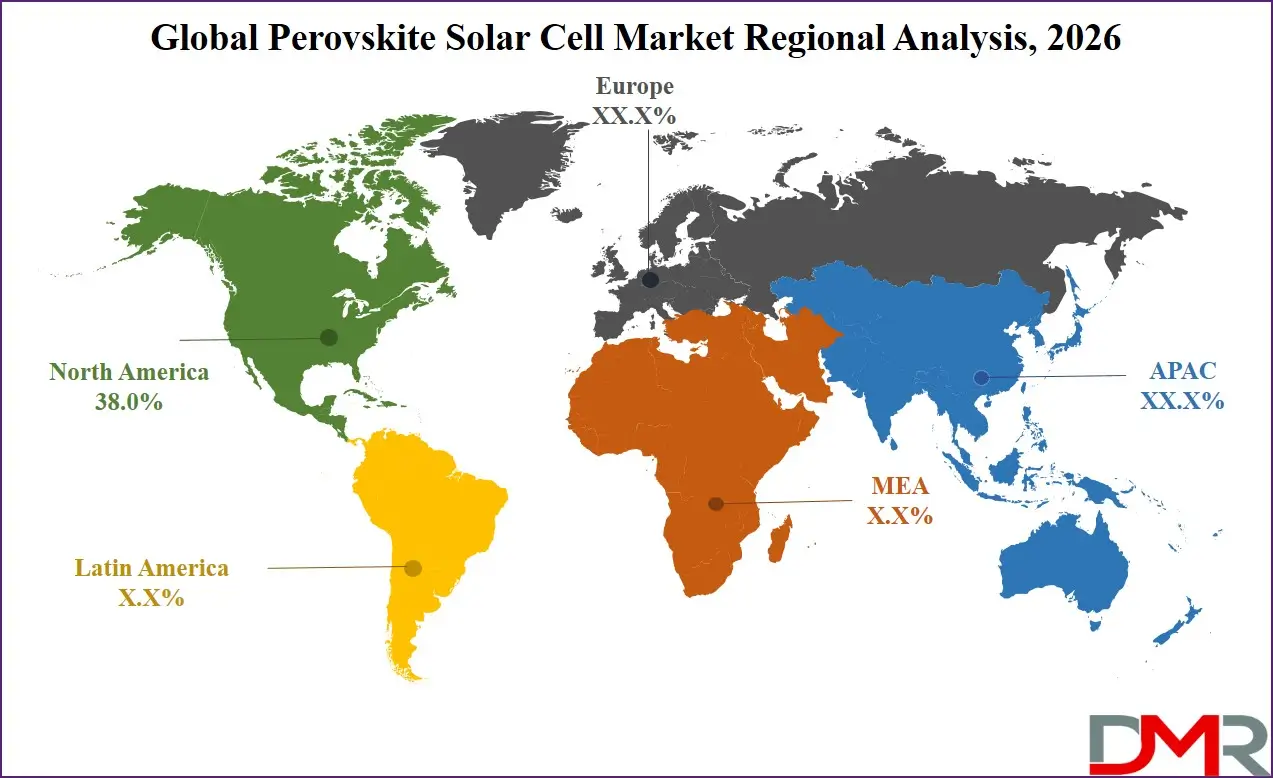
- Regional Leadership: North America is set to lead the Perovskite Solar Cell market with an estimated 38.0% share in 2026.
What is the Perovskite Solar Cell?
Perovskite Solar Cell cells constitute an array of solar cell technologies that make use of perovskite materials as their light-harvesting material. Perovskites are known for their high efficiency as a light absorber and carrier transport properties along with adjustable bandgaps, making them ideal for solar energy harvesting. They can be implemented as single junction cells, tandems, fabricated through different deposition processes, including liquid phase and vapor deposition methods, among others, with applications spanning both rigid and flexible devices.
Use Cases
- Building-Integrated Photovoltaics (BIPV): Perovskite solar cells are increasingly used in windows, facades, and rooftops due to their lightweight and semi-transparent properties, enabling seamless energy generation in modern architecture.
- Portable & Wearable Devices: Flexible perovskite modules power wearable electronics, IoT devices, and portable chargers, offering convenience and adaptability for on-the-go energy needs.
- Automotive Applications: Integration into electric vehicles supports auxiliary power generation, enhancing energy efficiency and extending driving range through lightweight solar surfaces.
- Utility-Scale Solar Farms: Tandem perovskite-silicon cells improve efficiency in large-scale solar installations, helping utilities achieve higher energy yields and lower costs per watt.
How AI Is Transforming the Perovskite Solar Cell Market
Artificial intelligence is revolutionizing the perovskite solar industry in its material discovery and optimization phases and by speeding up research processes. The AI algorithms are able to analyze large datasets and detect material compositions that have high stability and high efficiency. Artificial intelligence increases efficiency in manufacturing perovskites through predictive maintenance and quality assurance.
Moreover, the efficiency of perovskite panels is optimized by artificial intelligence in performance prediction and energy management, as well as integrating them into power grids.
Market Dynamic
Driving Factors in the Perovskite Solar Cell Market
Technological Advancements in Efficiency
Advancements in efficiency levels, especially with tandem solar cells, have become an important source of growth in the industry. The ongoing research is helping improve efficiencies to levels that exceed those of conventional silicon cells, thus becoming commercially more attractive. There have been breakthroughs in materials, encapsulation techniques, and manufacturing processes, which have resulted in higher efficiencies.
Growing Demand for Low-Cost Renewable Energy
There is a great demand for efficient sources of renewable energy that can be implemented at low costs. The use of solar perovskites is gaining momentum because of the relatively lower cost of production, which stems from less complex processes compared to those used in making cells based on silicon.
Restraints in the Perovskite Solar Cell Market
Stability and Durability Challenges
There are many problems that are associated with stability and the degradation of perovskites under various conditions. Such elements as water vapor, heat, and ultraviolet light can influence their performance in the negative way. This problem should be resolved via using some advanced methods of encapsulation.
Environmental and Regulatory Concerns
Due to lead used in various compositions of perovskites, there is a question of environmental safety. Adherence to environmental standards and creation of new types of materials not containing lead create difficulties in production. All this may hamper the process of market development.
Opportunities in the Perovskite Solar Cell Market
Expansion in Emerging Markets
Developing countries offer good prospects because of increasing energy demands and lack of adequate infrastructure in those areas. The advantage of perovskite solar cells is their cheapness and flexibility; hence they can be used to provide power in remote areas where other forms of energy cannot reach.
Integration with Tandem Technologies
Combining perovskites with silicon solar cells through tandem structures provides one of the biggest potentials for improving performance beyond what is currently possible. This technique allows more energy production at no additional expense, making it appealing to both residential and industrial uses. Further developments in this field will likely spur market expansion.
Trends in the Perovskite Solar Cell Market
Shift Toward Flexible and Lightweight Solar Solutions
There is an increasing preference for flexible solar modules due to the requirement for adaptable energy sources. Solar panels made from perovskites can be utilized in wearables, mobile phones, and non-traditional surfaces. This is leading to greater possibilities in the solar energy sector, including new sources of income.
Increased Investment in Commercialization
Increased investment by both public and private sectors is hastening the move from laboratory work to industrial production. The construction of pilot plants and collaborations between laboratories and industries are now more prevalent, suggesting a move towards wide adoption and commercialization.
Research Scope and Analysis
By Form Factor Analysis
The dominant form factors in the industry are rigid form factors because of their extensive use in solar panels installed using conventional methods and are likely to have about a 62% share in 2026. The resilience, longevity, and compatibility of rigid form factors with mounting structures and power grids make them the most favored form factors among utilities as well as individual consumers. Besides, the mature supply chain and experienced installers contribute to the dominance of rigid form factors. On the other hand, the fastest growing form factor is flexible form factor because of the rising popularity of portable and lightweight energy devices. Recent improvements in flexible substrates, roll-to-roll processing, and encapsulation technology are making them more durable and efficient.
By Cell Architecture Analysis
The most dominant architecture is that of single-junction cells that account for about 55% of the total market by 2026, mainly due to its ease of manufacture and cost-effectiveness. Single-junction cells have been predominantly used in commercial applications and pilot-scale operations, which makes them a natural choice when first deploying PV systems. However, other architectures such as tandem cells and multi-junction cells are gaining ground fast due to their ability to break through the efficiency barriers set by single-junction cells. The continued development and investments in tandem cells will facilitate further adoption. With improved efficiency translating to increased energy production and profitability, these technologies are poised to dominate future market growth phases.
By Manufacturing Method Analysis
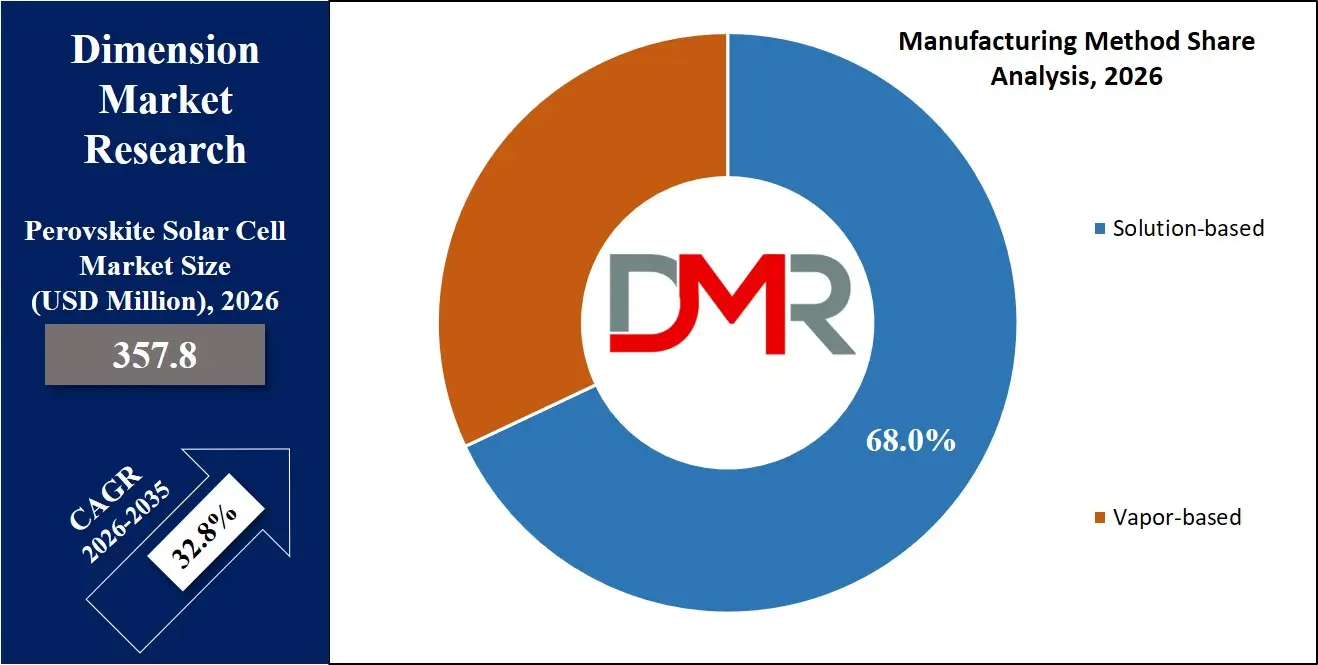
Solution-based approaches dominate the market and are forecasted to account for around 68% of the market in 2026, thanks to their low-cost manufacturing process, efficient use of materials, and capability to fabricate films on a large scale. Methods like one-step and two-step deposition find common usage even in commercialization phases due to their ease and scalability.
ℹ
To learn more about this report –
Download Your Free Sample Report Here
They also allow roll-to-roll processes, which are beneficial in case of flexible films. On the other hand, vapor-based approaches are anticipated to be the fastest-growing market segment due to their ability to provide better control over film uniformity and thickness and, therefore, better quality of films.
By Application Analysis
Solar panels are the dominant in terms of applications, with forecasted market share at an impressive 58% by 2026. Solar panels are seen as the most common application for perovskite technology when it comes to the generation of electricity. The ability to incorporate solar panels into current power plants as well as grid-based systems makes them the most practical means of using perovskite technology. But building integrated photovoltaics (BIPV) and portable electronic devices are gaining momentum because of the increasing need for multi-purpose energy applications that require limited space. The flexibility, transparency, and light weight of perovskites help integrate them into buildings, windows, and devices.
By End Use Analysis
The utility scale application sector dominates the market, accounting for around 60% of the market by 2026, owing to solar farm installations, government renewable energy programs, and rising demand for clean energy on a global level. Such applications have the advantage of economy of scale, along with supportive policies and incentives. Other segments such as residential and commercial are growing consistently due to awareness regarding renewable energy and installation of rooftop solar panels. On the other hand, industrial applications are becoming popular in industries that consume a lot of energy in their production process.
The Perovskite Solar Cell Market Report is segmented on the basis of the following:
By Form Factor
By Cell Architecture
- Single-Junction
- Tandem / Multi-Junction
- Perovskite-Silicon
- All-Perovskite
By Manufacturing Method
- Solution-Based
- Vapor-Based
By Application
- Solar Panels
- Building-Integrated Photovoltaics (BIPV)
- Portable & Wearable Devices
- Automotive
- Consumer Electronics
By End-Use
- Utility
- Residential
- Commercial
- Industrial
Regional Analysis
Leading Region in the Perovskite Solar Cell Market
The region of North America is forecasted to lead the market with a predicted share of 38% in 2026 because of extensive research facilities, abundant funding from the government, and implementation of advanced solar technology. Regulations that provide tax and other types of incentive payments, in addition to favorable governmental framework, are continuously pulling investors' attention to this region. North America boasts a solid network of companies dedicated to enhancing efficiency and stability of perovskites. Growing importance placed on domestic production and energy independence further drives commercialization of perovskite solar technologies.
ℹ
To learn more about this report –
Download Your Free Sample Report Here
Fastest Growing Region in the Perovskite Solar Cell Market
Asia-Pacific is the leading growing region owing to high rates of industrialization and urbanization, as well as the continuous rise in energy requirements throughout both the developing and developed countries. The Asia-Pacific governments have been investing a lot in renewable energy sources infrastructure as a measure of cutting down dependency on fossil fuels as well as achieving climate goals. Efficient manufacturing processes are present in countries like China, Japan, and South Korea, which facilitate mass manufacturing of solar energy at reduced costs. Apart from that, there is a high level of government involvement in the promotion of solar energy use through various initiatives.
By Region
North America
Europe
- Germany
- The U.K.
- France
- Italy
- Russia
- Spain
- Benelux
- Nordic
- Rest of Europe
Asia-Pacific
- China
- Japan
- South Korea
- India
- ANZ
- ASEAN
- Rest of Asia-Pacific
Latin America
- Brazil
- Mexico
- Argentina
- Colombia
- Rest of Latin America
Middle East & Africa
- Saudi Arabia
- UAE
- South Africa
- Israel
- Egypt
- Rest of MEA
Competitive Landscape
There is very stiff competition in the Perovskite Solar Cell Cells industry due to the rapid rate at which innovation and technological developments take place. Businesses have a lot of interest in improving efficiency levels, durability, and manufacturability in order to create a competitive advantage. Very high entry barriers exist in the form of the high cost associated with the research, development, and manufacture of the product as well as the high level of technical know-how required. Collaboration between companies and academic institutions, investment in piloting projects, and the use of patents represent some of the strategies being used by businesses in the sector.
Some of the prominent players in the global Perovskite Solar Cell are:
- Oxford PV
- Saule Technologies
- Microquanta Semiconductor
- GCL Optoelectronics
- Hunt Perovskite Technologies
- Swift Solar
- Energy Materials Corporation
- Greatcell Solar
- Solar-Tectic
- Solartek
- UtmoLight
- EneCoat Technologies
- Tandem PV
- SoFab Inks
- CubicPV
- Caelux
- G24 Power
- Dyenamo AB
- FrontMaterials Co. Ltd.
- Frontier Energy Solutions
- Other Key Players
Recent Developments
- In April 2026, JinkoSolar reported major breakthroughs in TOPCon and perovskite tandem technologies through three papers in Nature Energy. The company achieved 26.66% efficiency on industrial-scale TOPCon cells using dual-sided optimization, narrowing the gap to theoretical limits. Innovations in emitter design, grid structure, and tunneling layers enhanced performance, delivering high voltage, fill factor, and bifaciality, strengthening TOPCon’s competitiveness in the solar market.
- In April 2026, Solx and Caelux announced a five-year partnership to produce perovskite-silicon tandem modules. Solx’s Puerto Rico facility will deliver 3 GW of Aurora modules using Caelux’s Active Glass, adding an extra power-generating layer. The hybrid modules are expected to reach 28% efficiency, exceeding conventional silicon performance, though below the record set by LONGi.
- In June 2025, LONGi announced major breakthroughs, achieving 33% efficiency for large-area crystalline silicon–perovskite tandem solar cells, certified by National Renewable Energy Laboratory, setting a global record. Its back-contact module also exceeded 26% efficiency. Both were listed in the Solar Cell Efficiency Tables, highlighting continued advancements in PV technology and strengthening the company’s innovation leadership.
Report Details
| Report Characteristics |
| Market Size (2026) |
USD 357.8 Mn |
| Forecast Value (2035) |
USD 4,602.1 Mn |
| CAGR (2026–2035) |
32.8% |
| Historical Period |
2021 – 2025 |
| Forecast Period |
2027 – 2035 |
| Base Year |
2025 |
| Estimate Year |
2026 |
| Segments Covered |
By Form Factor (Rigid, Flexible), By Cell Architecture (Single-Junction, Tandem / Multi-Junction), By Manufacturing Method (Solution-Based, Vapor-Based), By Application (Solar Panels, Building-Integrated Photovoltaics (BIPV), Portable & Wearable Devices, Automotive, Consumer Electronics), By End-Use (Utility, Residential, Commercial, Industrial) |
| Regional Coverage |
North America – The US and Canada; Europe – Germany, The UK, France, Russia, Spain, Italy, Benelux, Nordic, & Rest of Europe; Asia-Pacific – China, Japan, South Korea, India, ANZ, ASEAN, Rest of APAC; Latin America – Brazil, Mexico, Argentina, Colombia, Rest of Latin America; Middle East & Africa – Saudi Arabia, UAE, South Africa, Turkey, Egypt, Israel, & Rest of MEA |
Frequently Asked Questions
How big is the Perovskite Solar Cell Market?
▾ The Perovskite Solar Cell Market size is expected to reach USD 357.8 million by 2026 and is projected to reach USD 4,602.1 million by the end of 2035.
What is the CAGR of the Perovskite Solar Cell Market from 2026 to 2035?
▾ The market is growing at a CAGR of 32.8 percent over the forecasted period.
What factors are driving the growth of the Perovskite Solar Cell Market?
▾ Technological advancements in efficiency, growing demand for low-cost renewable energy, and other factors are driving the growth of the Perovskite Solar Cell Market.
What are the major trends in the Perovskite Solar Cell Market?
▾ Shift toward flexible and lightweight solar solutions, increased investment in commercialization, and more are some of the major trends in the market.
Who are the key players in the Perovskite Solar Cell Market?
▾ Some of the key players in the Perovskite Solar Cell Market include Oxford, Swift, Solartex, and more
How is the Perovskite Solar Cell Market segmented?
▾ The Perovskite Solar Cell Market is segmented by form factor, cell architecture, manufacturing method, application, and end-use.
Which region held the largest share of the Perovskite Solar Cell Market in 2026?
▾ North America is set to lead the Perovskite Solar Cell market with an estimated 38.0% share in 2026.
Which region is expected to grow the fastest in the Perovskite Solar Cell Market?
▾ Asia-Pacific is the fastest-growing region in the Perovskite Solar Cell market during the forecast period.