What is the Personal Care Ingredients Market Size?
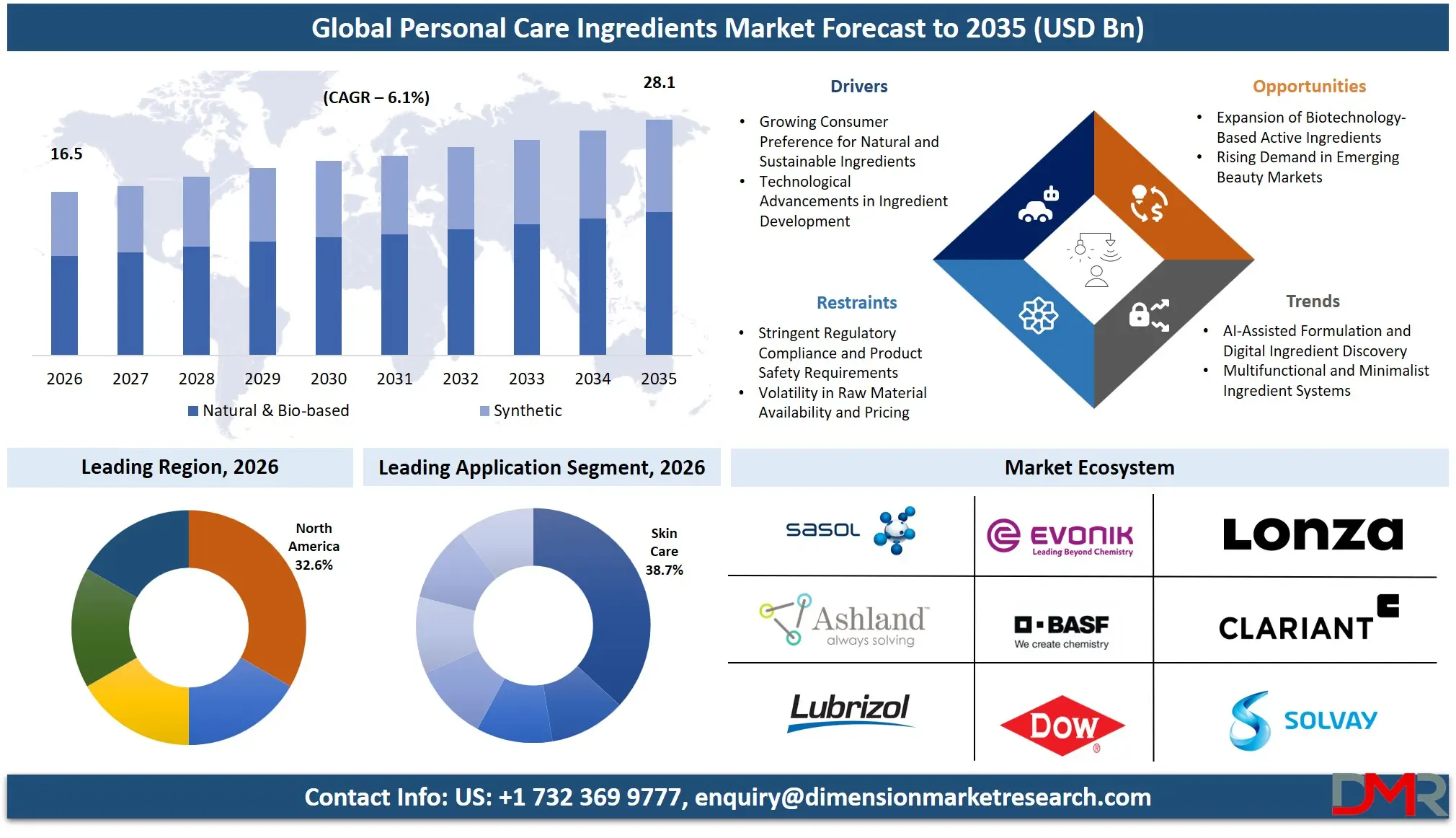
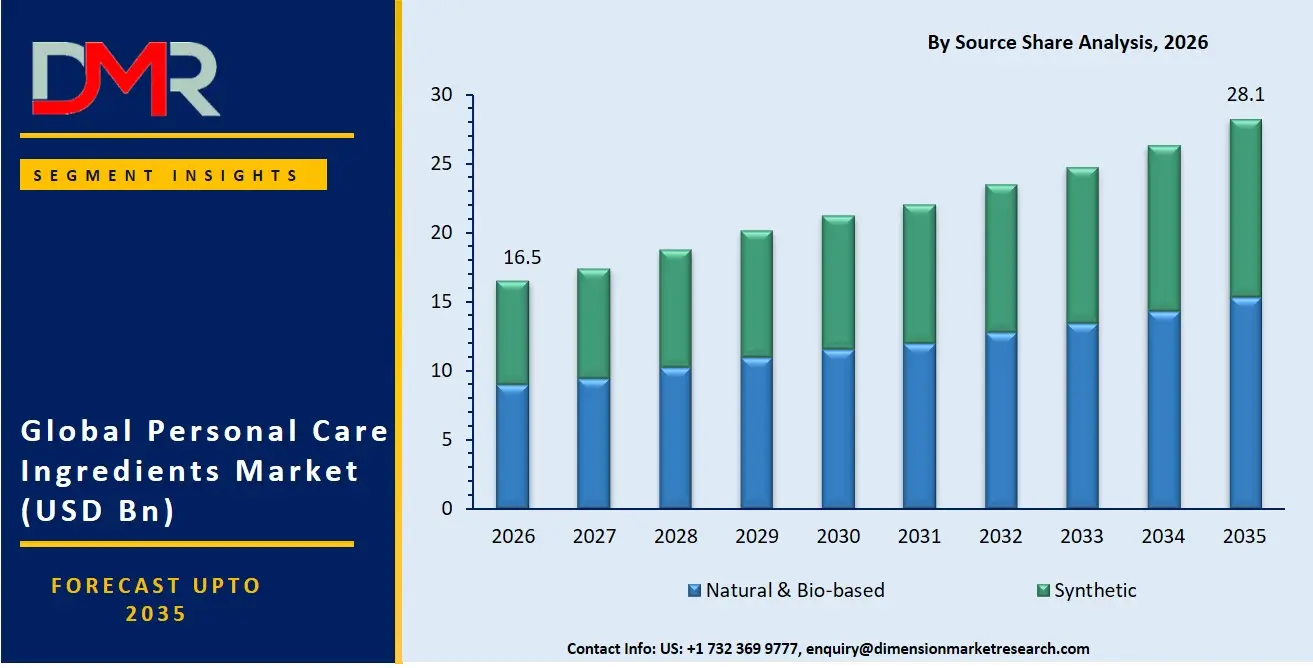
The Personal Care Ingredients Market size is expected to be USD 16.5 billion in 2026 and increase at a compound annual growth rate of 6.1% to USD 28.1 billion in 2035 due to growing consumer preference for natural and sustainable ingredients.
ℹ
To learn more about this report –
Download Your Free Sample Report Here
Personal care ingredients are specialized chemical and biological substances used in the formulation of cosmetics, toiletries, and hygiene products to enhance functionality, stability, appearance, and consumer experience. These ingredients include surfactants, emollients, emulsifiers, humectants, preservatives, conditioning polymers, rheology modifiers, and active compounds that provide cleansing, moisturizing, protection, texture improvement, and skin or hair benefits. The market plays a critical role in the global beauty and personal care industry as manufacturers increasingly focus on sustainable formulations, multifunctional ingredients, biotechnology-derived actives, and clean-label solutions. Growing consumer awareness regarding ingredient transparency, product safety, and environmentally responsible sourcing continues to accelerate innovation and long-term market expansion.
The US Personal Care Ingredients Market
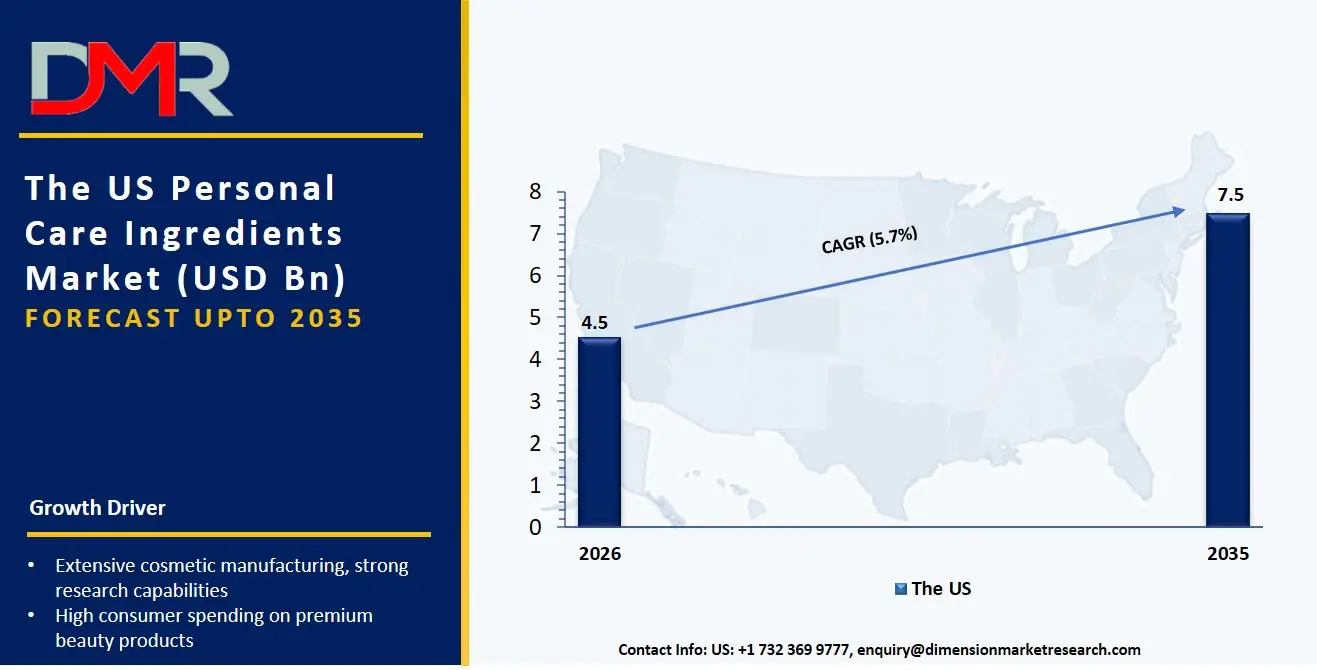
The US Personal Care Ingredients Market size is estimated to be USD 4.5 billion in 2026 and is expected to increase at a CAGR of 5.7% over the forecast period.
ℹ
To learn more about this report –
Download Your Free Sample Report Here
The United States represents one of the world's most technologically advanced personal care ingredients markets owing to extensive cosmetic manufacturing, strong research capabilities, and high consumer spending on premium beauty products. Continuous investment in biotechnology, naturally derived ingredients, and multifunctional formulations supports market expansion. Regulatory oversight emphasizing product safety and ingredient transparency further encourages innovation while increasing demand for sustainable, clinically validated, and high-performance ingredient solutions across skincare, haircare, and wellness products.
Europe Personal Care Ingredients Market
The Europe Personal Care Ingredients Market size is estimated to be USD 4.1 billion in 2026 and is expected to increase at a CAGR of 5.6% over the forecast period.
Europe remains a mature and innovation-driven market supported by stringent environmental regulations, sustainability initiatives, and strong consumer preference for eco-friendly formulations. Policies aligned with the European Green Deal encourage the adoption of renewable raw materials, biodegradable ingredients, and circular manufacturing practices. Manufacturers continue investing in green chemistry, biotechnology, and certified natural ingredients while premium skincare, dermocosmetics, and luxury beauty products maintain strong demand for advanced ingredient technologies.
Japan Personal Care Ingredients Market
The market size of Japan Personal Care Ingredients will be USD 1.2 billion in 2026 and at a CAGR of 5.9% in the forecast period.
Japan's personal care ingredients market benefits from sophisticated cosmetic manufacturing, advanced formulation science, and consistent consumer demand for premium skincare products. Innovation in anti-aging ingredients, fermented bio-based materials, functional actives, and sensitive-skin formulations supports market growth. Government support for research, combined with strong quality standards and an aging population seeking high-performance skincare, continues to stimulate product development while creating opportunities for biotechnology-derived ingredients and sustainable cosmetic formulations.
Key Takeaways
- Market Size & Forecast: The Personal Care Ingredients Market size is projected to reach USD 16.5 billion in 2026 and is anticipated to have a value of USD 28.1 billion in 2035.
- Growth Rate & Outlook: The Personal Care Ingredients Market size is set to grow at a compound annual growth rate of 6.1% during the forecast period of 2026 to 2035.
- Primary Growth Drivers: Some of the major growth drivers in the market are Growing Consumer Preference for Natural and Sustainable Ingredients and more.
- Key Market Trends: Some of the major trends in the market are AI-Assisted Formulation and Digital Ingredient Discovery and more.
- By Source Type: Natural & Bio-based segment is anticipated to get the majority share of the Personal Care Ingredients Market in 2026.
- By Ingredient Type: Emollient sis expected to get the largest revenue share in 2026 in the Personal Care Ingredients Market.
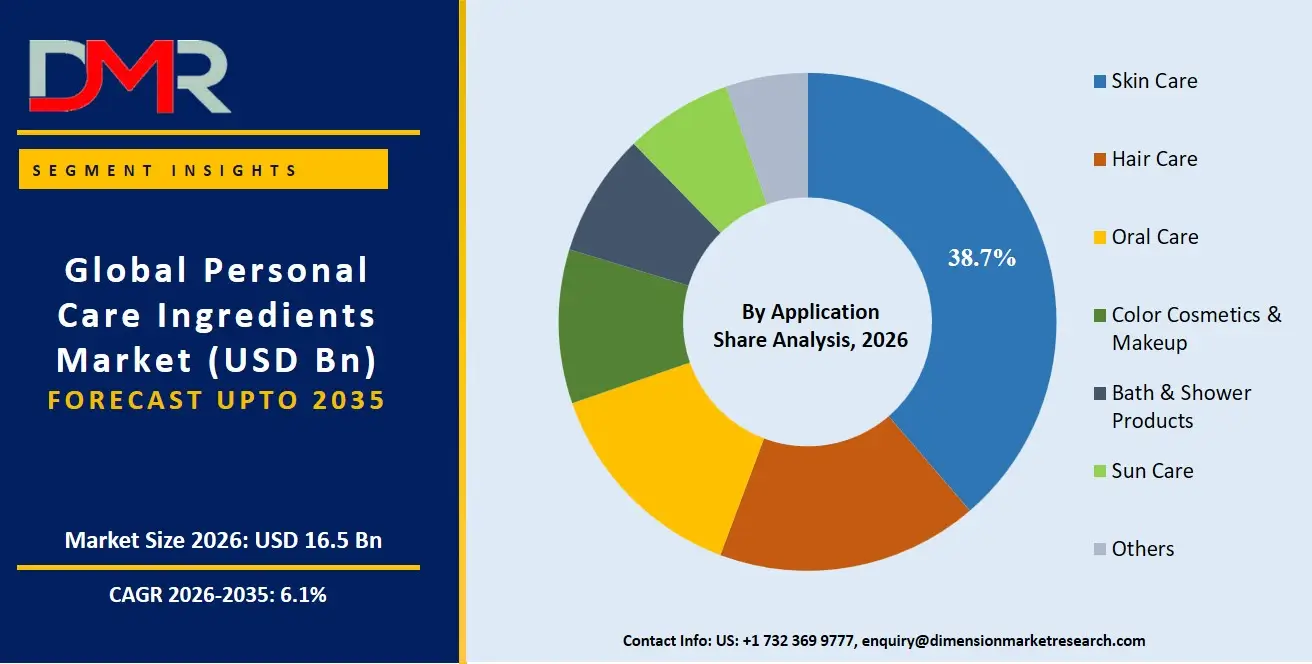
- By Application Type: Skin Care is expected to get the largest revenue share in 2026 in the Personal Care Ingredients Market.
- Regional Leadership: North America is set to lead the Personal Care Ingredients Market with an estimated 32.6% share in 2026.
What is the Personal Care Ingredients?
Personal care ingredients are natural or synthetic substances used in the formulation of skincare, haircare, oral care, cosmetics, and hygiene products to enhance their performance, stability, safety, and sensory properties. These ingredients include emollients, surfactants, preservatives, emulsifiers, fragrances, active compounds, and conditioning agents that provide cleansing, moisturizing, protection, anti-aging, and other functional benefits to consumers.
Use Cases
- Skin Care Formulations: Personal care ingredients are extensively used in facial creams, moisturizers, serums, cleansers, and anti-aging products. Active ingredients, humectants, emollients, and preservatives improve hydration, skin barrier protection, elasticity, and product stability while enhancing consumer satisfaction through superior sensory characteristics.
- Hair Care Products: Conditioning polymers, surfactants, emulsifiers, proteins, and botanical extracts are essential for shampoos, conditioners, scalp treatments, and styling products. These ingredients improve cleansing efficiency, manageability, moisture retention, hair strength, shine, and protection against environmental damage.
- Oral Care Applications: Surfactants, humectants, preservatives, flavoring agents, and antimicrobial ingredients are widely utilized in toothpaste, mouthwash, and dental gels. They contribute to cleaning performance, foam generation, moisture retention, freshness, microbial control, and overall oral hygiene effectiveness.
- Color Cosmetics and Makeup: Pigment dispersants, emulsifiers, rheology modifiers, preservatives, and specialty polymers enable improved texture, color stability, long-lasting wear, and enhanced application performance in foundations, lipsticks, mascaras, concealers, and other decorative cosmetic products.
How AI Is Transforming the Personal Care Ingredients Market
Artificial Intelligence (AI) is transforming the personal care ingredients market by improving ingredient discovery, formulation optimization, and product personalization. AI-powered platforms analyze large datasets related to consumer preferences, skin biology, ingredient interactions, and clinical results to identify high-performing formulations. Ingredient manufacturers are using machine learning models to predict ingredient compatibility, stability, efficacy, and safety before physical testing, reducing research timelines and development costs.
AI technologies are also enhancing supply chain management, demand forecasting, and quality control within ingredient manufacturing. Predictive analytics helps companies optimize raw material procurement, reduce waste, and improve production efficiency. In addition, AI-driven consumer insights enable brands to develop targeted skincare and haircare solutions based on individual needs, accelerating demand for personalized beauty products and advanced active ingredients.
Market Dynamic
Driving Factors in the Personal Care Ingredients Market
Growing Consumer Preference for Natural and Sustainable Ingredients
Consumers increasingly prefer clean-label cosmetics formulated with naturally derived, biodegradable, and ethically sourced ingredients. This transition encourages manufacturers to replace conventional synthetic materials with plant-based alternatives, biotechnology-derived actives, and environmentally friendly preservatives. Regulatory emphasis on sustainability, coupled with rising awareness regarding ingredient transparency, has accelerated investments in green chemistry, renewable feedstocks, and sustainable sourcing strategies, making environmental responsibility a significant long-term driver for market growth.
Restraints in the Personal Care Ingredients Market
Stringent Regulatory Compliance and Product Safety Requirements
Manufacturers must comply with complex regulatory frameworks governing ingredient safety, labeling, environmental impact, and product claims across multiple countries. Continuous toxicological testing, documentation, certification, and compliance verification increase product development costs and extend commercialization timelines. Smaller ingredient suppliers may face financial challenges in meeting evolving regulatory standards, limiting market participation and slowing innovation.
Opportunities in the Personal Care Ingredients Market
Expansion of Biotechnology-Based Active Ingredients
Biotechnology offers significant opportunities through fermentation-derived peptides, bioengineered proteins, microbiome-friendly ingredients, and naturally produced actives. These innovative ingredients provide superior efficacy while supporting sustainability objectives. Growing demand for clinically validated, science-backed skincare products creates substantial commercial opportunities for companies investing in biotechnology-enabled ingredient development and advanced manufacturing capabilities.
Trends in the Personal Care Ingredients Market
AI-Assisted Formulation and Digital Ingredient Discovery
Artificial intelligence is increasingly integrated into cosmetic ingredient research through predictive formulation, ingredient compatibility analysis, virtual screening, and accelerated product development. AI enables faster identification of effective ingredient combinations, improves formulation efficiency, reduces development costs, and supports personalized beauty solutions tailored to diverse consumer requirements.
Research Scope and Analysis
The research scope of the Personal Care Ingredients Market covers analysis of ingredient types, applications, sources, functions, end users, and distribution channels. The study evaluates market trends, growth drivers, restraints, opportunities, regional performance, technological advancements, and competitive strategies. It provides insights into consumer preferences, sustainability developments, innovation patterns, and segment-level growth prospects influencing the global market landscape.
ℹ
To learn more about this report –
Download Your Free Sample Report Here
By Ingredient Type Analysis
The ingredient type segment is led by emollients, which are estimated to account for approximately 22.4% of the global personal care ingredients market share in 2026. Emollients maintain dominance due to their extensive application in skincare, haircare, and cosmetic formulations where they improve softness, smoothness, moisture retention, and sensory properties. Increasing demand for moisturizers, anti-aging creams, and premium skincare products continues supporting their consumption. Meanwhile, active ingredients represent one of the fastest-growing segments due to rising consumer interest in functional beauty products, including anti-aging, brightening, barrier repair, and dermatological skincare solutions. Growth is driven by biotechnology advancements, peptide innovation, plant-derived extracts, and clinically proven cosmetic formulations.
By Application Analysis
The application segment is dominated by skin care products, which are expected to represent approximately 38.7% of the personal care ingredients market in 2026. Skincare maintains the leading position due to increasing global demand for moisturizers, sunscreens, anti-aging products, facial treatments, and dermatological solutions. Rising awareness about preventive skincare, changing beauty standards, and premium product adoption significantly contribute to segment expansion. The fastest-growing application is expected to be sun care products, supported by increasing awareness of UV protection, climate-related skin concerns, and regulatory focus on sunscreen effectiveness. Innovation in lightweight formulations, mineral-based UV filters, and multifunctional sun protection products is accelerating ingredient demand in this category.
By Source Analysis
The natural and bio-based ingredients segment is projected to hold the largest share, accounting for approximately 54.2% of the market in 2026. This segment continues to expand as consumers increasingly demand sustainable, clean-label, organic, and environmentally responsible beauty products.
ℹ
To learn more about this report –
Download Your Free Sample Report Here
Cosmetic manufacturers are replacing petroleum-based materials with botanical extracts, biodegradable surfactants, fermentation-derived compounds, and renewable ingredients. The fastest-growing segment within this category is expected to be bioengineered ingredients, driven by biotechnology advancements and the ability to create highly effective sustainable alternatives. Fermentation technology, synthetic biology, and precision biotechnology are enabling manufacturers to develop innovative ingredients with improved performance, consistency, and environmental benefits.
The Personal Care Ingredients Market Report is segmented on the basis of the following:
By Ingredient Type
- Emollients
- Surfactants
- Emulsifiers
- Humectants
- Rheology Modifiers & Thickeners
- Conditioning Polymers
- Active Ingredients
- Preservatives
- Others
By Application
- Skin Care
- Hair Care
- Oral Care
- Color Cosmetics & Makeup
- Bath & Shower Products
- Sun Care
- Others
By Source
- Natural & Bio-based Ingredients
- Synthetic Ingredients
Regional Analysis
Leading Region in the Personal Care Ingredients Market
ℹ
To learn more about this report –
Download Your Free Sample Report Here
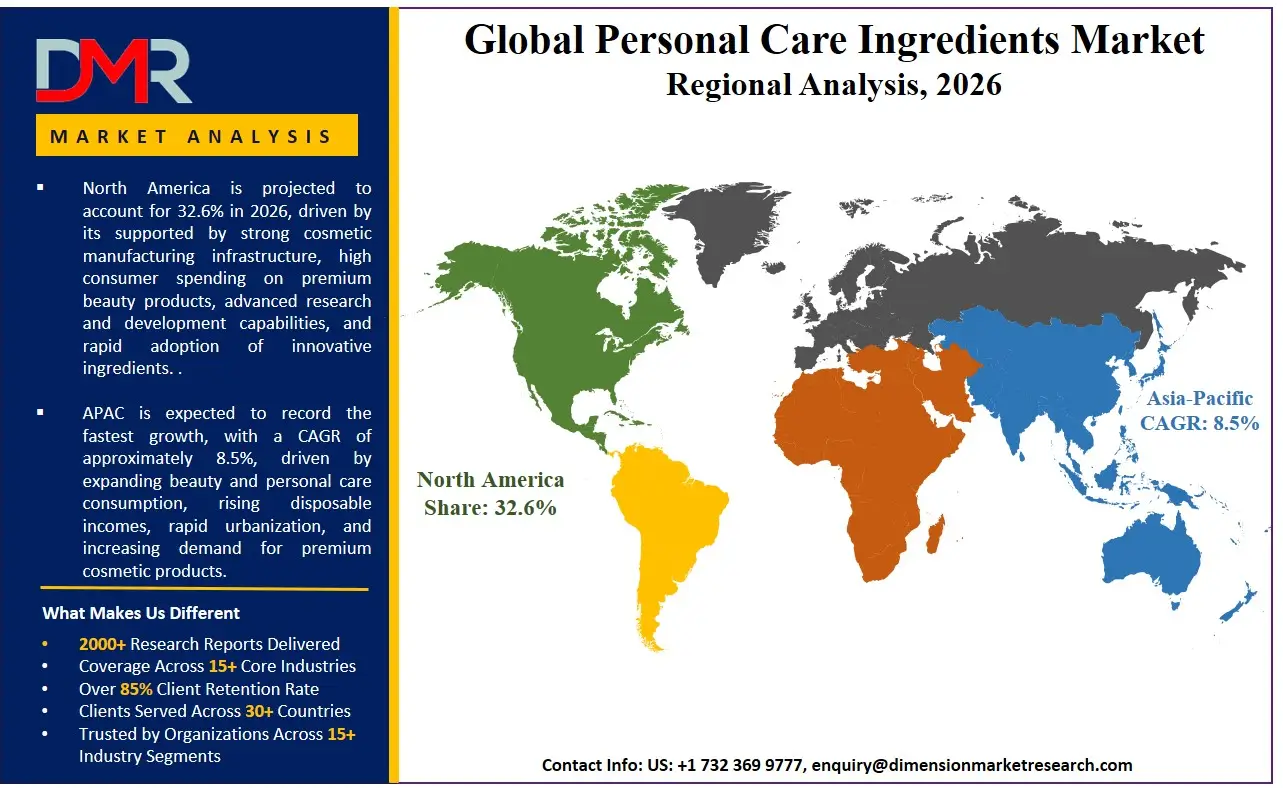
North America is expected to remain the leading region in the personal care ingredients market, accounting for an estimated 32.6% share of the global market in 2026. The region's dominance is supported by strong cosmetic manufacturing infrastructure, high consumer spending on premium beauty products, advanced research and development capabilities, and rapid adoption of innovative ingredients. The United States represents the largest contributor due to extensive demand for skincare, haircare, and wellness products. Strong regulatory frameworks, increasing investments in biotechnology-derived ingredients, and rising consumer preference for clean-label and sustainable formulations continue strengthening regional growth. The presence of advanced ingredient suppliers, cosmetic research centers, and technology-driven formulation capabilities further reinforces North America's leadership position.
Fastest Growing Region in the Personal Care Ingredients Market
Asia-Pacific is projected to be the fastest-growing region in the personal care ingredients market due to expanding beauty and personal care consumption, rising disposable incomes, rapid urbanization, and increasing demand for premium cosmetic products. Countries including China, India, Japan, South Korea, and Southeast Asian economies are experiencing strong growth in skincare, haircare, and cosmetic manufacturing. The region benefits from a large consumer base, increasing influence of K-beauty and J-beauty trends, and growing investment in local cosmetic production facilities. Government initiatives supporting domestic manufacturing, biotechnology research, and sustainable ingredient development are creating additional opportunities. Increasing digital commerce penetration and demand for personalized beauty solutions are expected to accelerate ingredient consumption throughout the region.
By Region
North America
Europe
- Germany
- The U.K.
- France
- Italy
- Russia
- Spain
- Benelux
- Nordic
- Rest of Europe
Asia-Pacific
- China
- Japan
- South Korea
- India
- ANZ
- ASEAN
- Rest of Asia-Pacific
Latin America
- Brazil
- Mexico
- Argentina
- Colombia
- Rest of Latin America
Middle East & Africa
- Saudi Arabia
- UAE
- South Africa
- Israel
- Egypt
- Rest of MEA
Competitive Landscape
The personal care ingredients market is characterized by strong competition driven by innovation capabilities, sustainability initiatives, formulation expertise, and supply chain efficiency rather than price competition alone. Market participants focus on expanding specialty ingredient portfolios, developing bio-based alternatives, investing in research and development, and creating multifunctional solutions to meet evolving consumer preferences. Strategic partnerships with cosmetic manufacturers, biotechnology firms, and research institutions are becoming increasingly important for accelerating product innovation. High entry barriers exist due to regulatory compliance requirements, technical expertise, manufacturing capabilities, and the need for extensive safety testing. Companies are strengthening market positions through sustainable sourcing, customized formulation support, digital supply chain solutions, and investment in advanced ingredient technologies.
Some of the prominent players in the global Personal Care Ingredients are:
- BASF SE
- Evonik Industries AG
- Croda International Plc
- Ashland Inc.
- Clariant AG
- Dow Inc.
- Lubrizol Corporation
- Solvay SA
- Innospec Inc.
- Symrise AG
- Givaudan SA
- dsm-firmenich
- Kao Corporation
- Nouryon
- Stepan Company
- Lonza Group AG
- Elementis Plc
- Galaxy Surfactants Ltd.
- Sasol Limited
- Wacker Chemie AG
- Other Key Players
Recent Developments
- In April 2025, BASF expanded its personal care ingredient portfolio by launching new natural-based solutions focused on sustainable beauty formulations. The company introduced Verdessence® Maize, a natural styling polymer; Lamesoft® OP Plus, a wax-based opacifier dispersion; and Dehyton® PK45 GA/RA, a betaine derived from Rainforest Alliance Certified coconut oil. These innovations were designed to provide biodegradable alternatives to conventional ingredients while maintaining high formulation performance across skincare, haircare, and cleansing applications. BASF presented these solutions through its Longevity Ecosystem initiative at in-cosmetics Global 2025, highlighting sustainability, responsible sourcing, and advanced formulation strategies for the evolving personal care industry.
- In April 2025, Clariant expanded its beauty ingredient portfolio by introducing new sustainable solutions designed for modern personal care formulations. The company focused on ingredients supporting clean beauty trends, improved formulation performance, and environmentally responsible product development. The launch addressed growing demand for biodegradable, renewable, and multifunctional cosmetic ingredients used in skincare, haircare, and personal hygiene applications. Clariant emphasized innovation around sustainable chemistry, formulation efficiency, and consumer-focused product performance. The development reflects the broader industry movement toward reducing environmental impact while maintaining high standards of sensory performance, product stability, and functional benefits in personal care applications. Clariant Beauty Solutions.
Report Details
| Report Characteristics |
| Market Size (2026) |
USD 16.5 Bn |
| Forecast Value (2035) |
USD 28.1 Bn |
| CAGR (2026–2035) |
6.1% |
| Historical Period |
2021 – 2025 |
| Forecast Period |
2027 – 2035 |
| Base Year |
2025 |
| Estimate Year |
2026 |
| Segments Covered |
By Ingredient Type, By Application, By Source |
| Regional Coverage |
North America – The US and Canada; Europe – Germany, The UK, France, Russia, Spain, Italy, Benelux, Nordic, & Rest of Europe; Asia-Pacific – China, Japan, South Korea, India, ANZ, ASEAN, Rest of APAC; Latin America – Brazil, Mexico, Argentina, Colombia, Rest of Latin America; Middle East & Africa – Saudi Arabia, UAE, South Africa, Turkey, Egypt, Israel, & Rest of MEA |
Frequently Asked Questions
How big is the Personal Care Ingredients Market?
▾ The Personal Care Ingredients Market size is expected to reach USD 16.5 billion by 2026 and is projected to reach USD 28.1 billion by the end of 2035.
What is the CAGR of the Personal Care Ingredients Market from 2026 to 2035?
▾ The market is growing at a CAGR of 6.1 percent over the forecasted period.
What factors are driving the growth of the Personal Care Ingredients Market?
▾ Growing Consumer Preference for Natural and Sustainable Ingredients, and more are the factors driving the growth of the Personal Care Ingredients Market.
What are the major trends in the Personal Care Ingredients Market?
▾ AI-Assisted Formulation and Digital Ingredient Discovery, and more are some of the major trends in the market.
Who are the key players in the Personal Care Ingredients Market?
▾ Some of the key players in the Personal Care Ingredients Market include BASF, Lonza, Sasol, and more.
How is the Personal Care Ingredients Market segmented?
▾ The Personal Care Ingredients Market is segmented by ingredient type, application, and source.
Which region held the largest share of the Personal Care Ingredients Market in 2026?
▾ North America is set to lead the Personal Care Ingredients Market with an estimated 32.6% share in 2026.
Which region is expected to grow the fastest in the Personal Care Ingredients Market?
▾ Asia Pacific is the fastest-growing region in the Personal Care Ingredients Market during the forecast period.