What is the Personal Care Products Market Size?
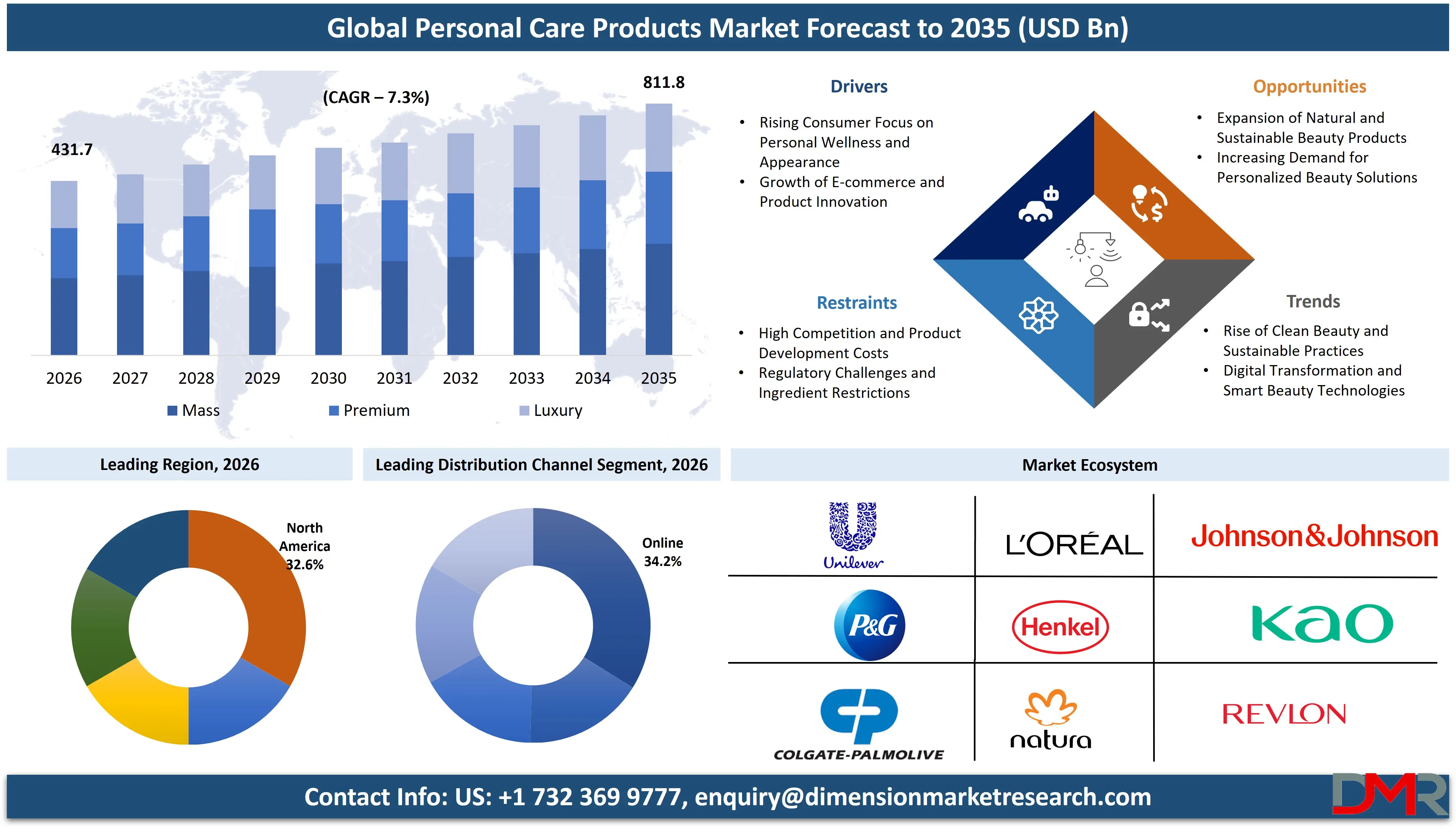
The Personal Care Products Market size is expected to be USD 431.7 billion in 2026 and increase at a compound annual growth rate of 7.3% to USD 811.8 billion in 2035 due to rising consumer focus on personal wellness and appearance.
ℹ
To learn more about this report –
Download Your Free Sample Report Here
The Personal Care Products market encompasses a broad range of consumer products designed for hygiene, grooming, skincare, haircare, oral care, cosmetics, fragrances, and overall wellness enhancement. The market includes products formulated with synthetic, natural, and organic ingredients, supported by innovations in biotechnology, artificial intelligence, personalization, and sustainable packaging. Growing consumer awareness regarding appearance, hygiene, self-care, and preventive wellness is strengthening demand across developed and emerging economies. Rising disposable incomes, changing lifestyles, e-commerce expansion, and increasing preference for clean-label and environmentally responsible products are reshaping the industry landscape. The market is witnessing a shift toward personalized formulations, multifunctional products, and digital beauty solutions.
The US Personal Care Products Market
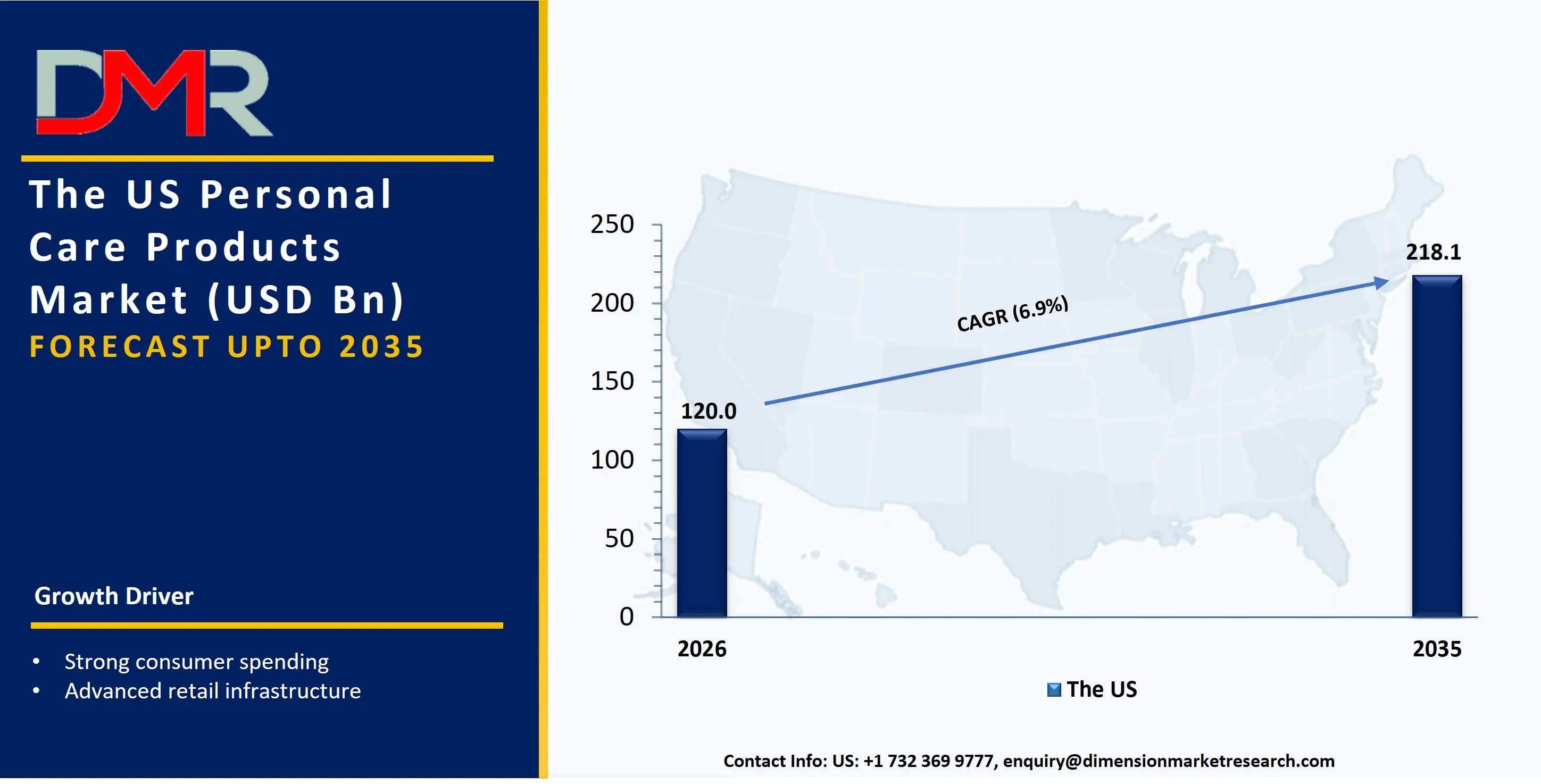
The US Personal Care Products Market size is estimated to be USD 120.0 billion in 2026 and is expected to increase at a CAGR of 6.9% over the forecast period.
ℹ
To learn more about this report –
Download Your Free Sample Report Here
The U.S. Personal Care Products market is one of the most developed markets globally, driven by strong consumer spending, advanced retail infrastructure, and high demand for premium beauty and wellness products. Consumers increasingly prefer personalized skincare, clean beauty formulations, and multifunctional products. Innovation in biotechnology-based ingredients, sustainable packaging, and digital beauty platforms is accelerating market growth. Regulatory oversight from agencies such as the U.S. Food and Drug Administration influences product safety standards and ingredient transparency. The market remains highly competitive due to established brands, strong e-commerce adoption, and increasing demand for men's grooming and wellness-focused personal care solutions.
Europe Personal Care Products Market
The Europe Personal Care Products Market size is estimated to be USD 107.9 billion in 2026 and is expected to increase at a CAGR of 7.0% over the forecast period.
The European Personal Care Products market is characterized by strong demand for sustainable, organic, and environmentally friendly products. Regional policies promoting sustainability, including initiatives aligned with the European Green Deal, are encouraging companies to adopt recyclable packaging, responsible sourcing, and reduced carbon footprints. Countries such as Germany, France, the United Kingdom, and Italy represent major markets due to high consumer awareness and premium beauty demand. Strict regulations regarding cosmetic ingredients and product safety are influencing innovation in formulation development. The growing popularity of vegan cosmetics, natural skincare, and personalized beauty solutions continues to support market expansion across Europe.
Japan Personal Care Products Market
The market size of Japan Personal Care Products will be USD 25.9 billion in 2026 and at a CAGR of 7.1% in the forecast period.
The Japan Personal Care Products market is driven by advanced skincare innovation, aging population needs, technological adoption, and strong consumer preference for high-quality beauty products. Japan has significant opportunities in anti-aging skincare, functional cosmetics, haircare solutions, and premium personal hygiene products. Urbanization and increasing interest in wellness-oriented lifestyles are supporting market development. Government initiatives promoting innovation and manufacturing efficiency further contribute to industry growth. However, challenges such as population decline and mature market conditions require companies to focus on product differentiation, export opportunities, and advanced technologies to maintain competitiveness.
Key Takeaways
- Market Size & Forecast: The Personal Care Products Market size is projected to reach USD 431.7 billion in 2026 and is anticipated to have a value of USD 811.8 billion in 2035.
- Growth Rate & Outlook: The Personal Care Products Market size is set to grow at a compound annual growth rate of 7.3% during the forecast period of 2026 to 2035.
- Primary Growth Drivers: Some of the major growth drivers in the market are Rising Consumer Focus on Personal Wellness and Appearance, and more.
- Key Market Trends: Some of the major trends in the market are Increasing Digital Transformation and Smart Beauty Technologies, and more.
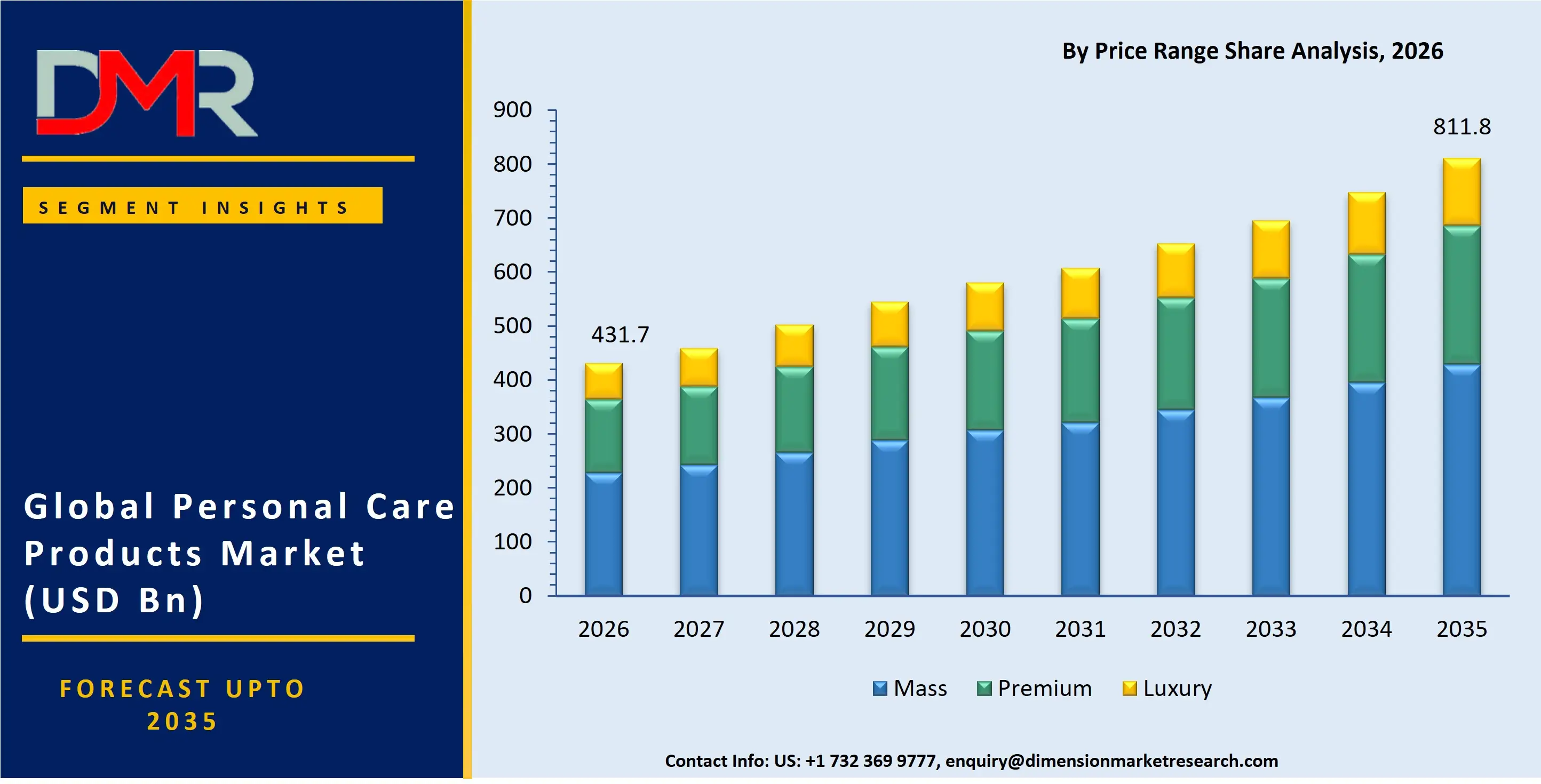
- By Price Range Type: Mass are anticipated to get the majority share of the Personal Care Products Market in 2026.
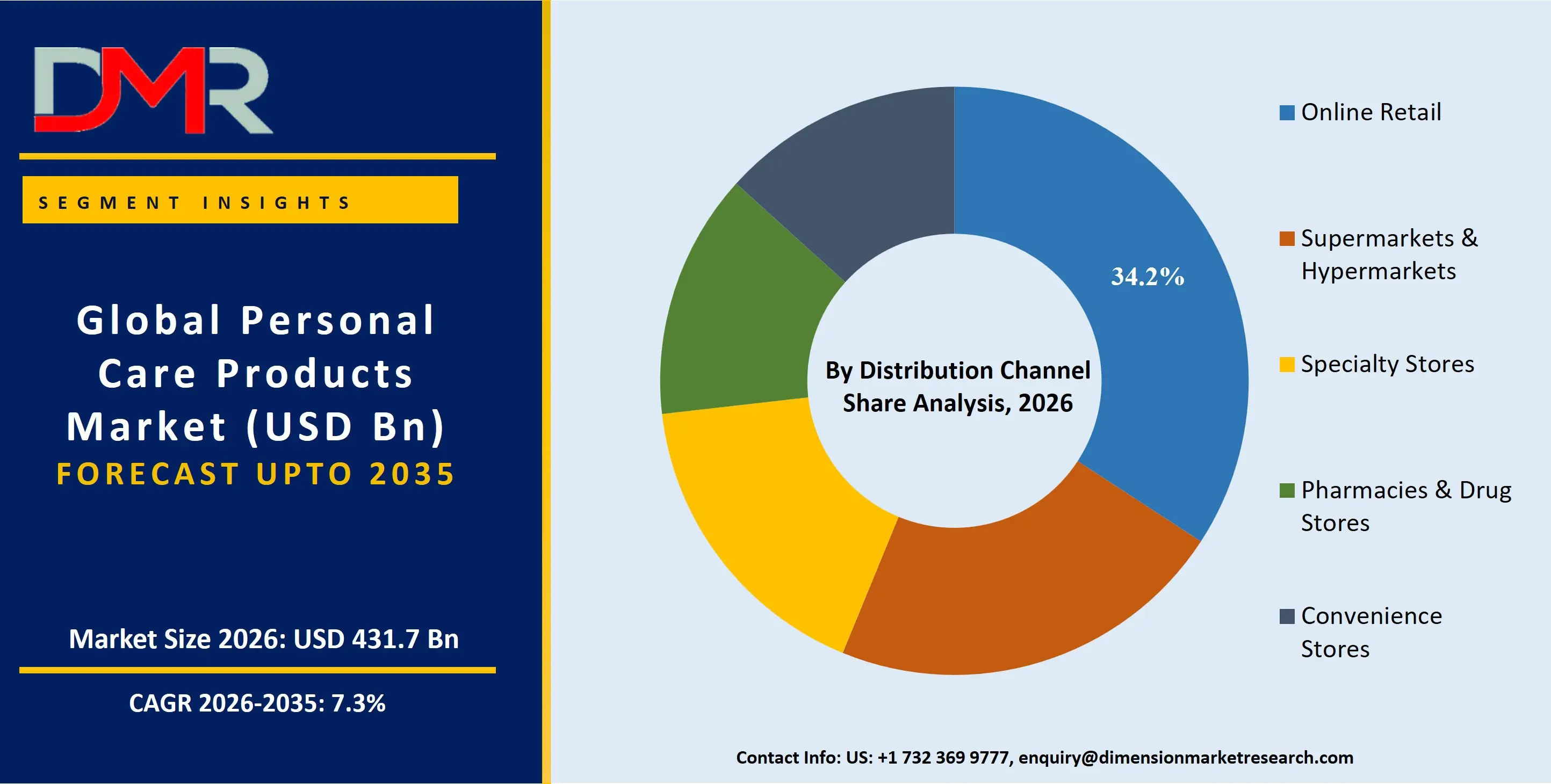
- By Distribution Channel Type: Online Retail is expected to get the largest revenue share in 2026 in the Personal Care Products Market.
- Regional Leadership: North America is set to lead the Personal Care Products Market with an estimated 32.6% share in 2026.
What is the Personal Care Products?
Personal Care Products are consumer goods used for maintaining personal hygiene, improving appearance, enhancing grooming routines, and supporting skin, hair, oral, and body wellness. These products include skincare, haircare, cosmetics, fragrances, deodorants, oral care items, and hygiene solutions formulated with active ingredients, natural extracts, chemicals, or biotechnology-derived compounds. They are distributed through retail stores, pharmacies, specialty outlets, and online platforms.
Use Cases
- Skincare and Beauty Enhancement: Personal Care Products are widely used for improving skin health, hydration, protection, and appearance. Skincare products such as moisturizers, cleansers, anti-aging creams, and sunscreens address diverse consumer needs. Increasing awareness regarding preventive skincare and ingredient transparency has expanded adoption among different age groups.
- Haircare and Scalp Health Management: Haircare products support cleansing, conditioning, styling, coloring, and scalp treatment requirements. Growing concerns related to hair loss, damage, and pollution exposure are driving demand for specialized shampoos, conditioners, and treatment products. Natural ingredients and customized haircare solutions are becoming increasingly popular.
- Hygiene and Wellness Applications: Personal Care Products play an essential role in maintaining hygiene through oral care, deodorants, bath products, and feminine hygiene solutions. Rising health awareness and improved hygiene practices have increased demand for convenient and effective personal care solutions worldwide.
- Personalized Beauty Solutions: Advancements in artificial intelligence, skin analysis technologies, and digital platforms are enabling personalized recommendations and customized formulations. Consumers increasingly seek products tailored to their individual skin type, lifestyle, and environmental conditions, creating new opportunities for brands.
How AI Is Transforming the Personal Care Products Market
Artificial Intelligence is transforming the Personal Care Products market by enabling advanced personalization, predictive analytics, and improved customer engagement. AI-powered skin and hair analysis tools allow consumers to receive customized product recommendations based on individual characteristics, environmental conditions, and lifestyle factors. Brands are using machine learning algorithms to analyze consumer preferences, optimize product formulations, and forecast emerging beauty trends.
AI technologies are also improving operational efficiency through automated quality control, demand forecasting, inventory management, and supply chain optimization. Virtual beauty assistants, augmented reality-based product trials, and intelligent chatbots are enhancing digital shopping experiences by helping consumers make informed purchasing decisions. Additionally, AI-driven research platforms are accelerating ingredient discovery and formulation development, supporting innovation in sustainable, effective, and personalized personal care solutions.
Market Dynamic
Driving Factors in the Personal Care Products Market
Rising Consumer Focus on Personal Wellness and Appearance
Increasing consumer awareness regarding hygiene, grooming, skincare, and overall wellness is a major factor driving the growth of the Personal Care Products market. Changing lifestyles, social media influence, and growing beauty consciousness are encouraging consumers to invest in premium and specialized products. The rising popularity of self-care routines has expanded demand beyond traditional hygiene products toward advanced skincare, anti-aging solutions, and wellness-oriented formulations. Consumers are also becoming more informed about ingredients, leading to higher adoption of clean-label, organic, and sustainable personal care products. These behavioral shifts are significantly influencing product innovation and market expansion.
Restraints in the Personal Care Products Market
High Competition and Product Development Costs
The Personal Care Products market faces intense competition due to the presence of numerous global and regional manufacturers. Developing innovative formulations requires significant investment in research, testing, regulatory compliance, and marketing activities. Smaller companies often experience challenges competing with established brands that have stronger distribution networks and customer loyalty. Increasing demand for premium ingredients and sustainable packaging further increases production costs. These factors can limit profitability and create barriers for new entrants seeking to establish themselves in the market.
Opportunities in the Personal Care Products Market
Expansion of Natural and Sustainable Beauty Products
Growing environmental awareness and consumer preference for clean beauty products create significant opportunities for market participants. Demand for plant-based ingredients, cruelty-free products, recyclable packaging, and ethical sourcing is increasing worldwide. Companies focusing on sustainability can attract environmentally conscious consumers and strengthen brand positioning. Emerging markets also provide opportunities as consumers increasingly seek premium personal care products with natural formulations.
Trends in the Personal Care Products Market
Digital Transformation and Smart Beauty Technologies
Digitalization is transforming the Personal Care Products industry through artificial intelligence-based recommendations, virtual try-on technologies, online consultations, and data-driven product development. Consumers are increasingly using digital platforms to discover, compare, and purchase products. Smart beauty technologies are improving personalization, enhancing customer experiences, and enabling companies to better understand consumer preferences.
Research Scope and Analysis
The research scope analyzes the Personal Care Products market by examining key segments, regional performance, growth drivers, competitive dynamics, emerging trends, and technological developments. The analysis evaluates product categories, distribution channels, and price ranges to identify market opportunities, consumer preferences, and future growth prospects.
ℹ
To learn more about this report –
Download Your Free Sample Report Here
By Product Type Analysis
The skincare segment dominates the Personal Care Products market due to increasing consumer focus on skin health, preventive care, anti-aging solutions, and premium beauty products. In 2026, skincare is estimated to account for approximately 38.5% of the global Personal Care Products market share, supported by strong demand for facial care, sun protection, moisturizers, and specialized treatment products. Consumers are increasingly adopting products containing active ingredients such as peptides, retinol, hyaluronic acid, and botanical extracts. The fastest-growing segment within this category is expected to be sun care products, driven by rising awareness of UV protection, climate change concerns, and increasing adoption across emerging economies. Innovation in multifunctional skincare products combining hydration, protection, and anti-aging benefits is expected to accelerate segment expansion.
The haircare segment remains a significant contributor due to increasing concerns related to hair damage, pollution exposure, hair loss, and scalp health. Shampoo and conditioner products continue to represent high-volume categories, while specialized treatments, hair color products, and styling solutions are gaining momentum. The fastest-growing area within haircare is expected to be premium scalp-care solutions, supported by consumer demand for targeted treatments and personalized formulations. Growing interest in natural ingredients, sulfate-free products, and biotechnology-based hair treatments is encouraging companies to introduce innovative offerings. Rising disposable incomes in developing regions and increasing male grooming adoption are further supporting haircare market growth.
The cosmetics and color cosmetics segment continues to experience strong demand due to social media influence, beauty trends, and increasing consumer interest in self-expression. Face makeup, eye makeup, and lip products remain major contributors, although consumers are increasingly shifting toward lightweight, multifunctional, and skin-enhancing cosmetics. The fastest-growing segment is expected to be clean and sustainable cosmetics, as younger consumers prioritize ethical sourcing, vegan formulations, and environmentally responsible packaging. Technology-enabled beauty experiences, including virtual makeup applications and digital consultations, are also supporting market expansion.
By Distribution Channel Analysis
Online retail is emerging as the leading distribution channel in the Personal Care Products market due to rapid digital transformation, increasing smartphone penetration, and changing consumer shopping behavior. In 2026, online retail is estimated to represent approximately 34.2% of the global market share, making it the largest distribution channel. E-commerce platforms provide consumers with wider product selections, competitive pricing, customer reviews, and personalized recommendations. Subscription-based models and direct-to-consumer brand strategies are further strengthening online sales growth. The fastest-growing channel within this category is expected to be direct-to-consumer digital platforms, as brands increasingly focus on building customer relationships through personalized online experiences.
Supermarkets and hypermarkets continue to maintain a strong position due to their accessibility, established consumer trust, and ability to offer a wide range of personal care products under one roof. These channels remain particularly important for mass-market products such as shampoo, toothpaste, deodorants, and bath products. However, competition from online platforms is encouraging traditional retailers to enhance customer experiences through loyalty programs, digital integration, and private-label product development.
Specialty stores and pharmacies are gaining importance due to growing consumer demand for expert guidance, premium products, and dermatologically tested solutions. Pharmacy channels benefit from increasing interest in clinical skincare, therapeutic personal care products, and wellness-focused solutions. Specialty beauty stores are also expanding their role by offering personalized consultations and exclusive product ranges. The growth of premium and science-backed personal care products is expected to support continued expansion of these channels.
By Price Range Analysis
The mass-market segment represents the largest portion of the Personal Care Products industry due to broad consumer accessibility, affordability, and high-volume demand. In 2026, the mass-market segment is estimated to account for approximately 52.8% of the global market share. Everyday products such as shampoos, soaps, oral care products, deodorants, and basic skincare solutions continue to drive segment dominance. Strong demand from emerging economies, expanding retail networks, and increasing hygiene awareness are major contributors to growth. However, the fastest-growing segment is expected to be premium personal care products, supported by rising disposable incomes and consumer willingness to pay for advanced formulations.
ℹ
To learn more about this report –
Download Your Free Sample Report Here
Premium personal care products are experiencing rapid growth as consumers increasingly prioritize quality, effectiveness, and specialized benefits. Products featuring natural ingredients, dermatological testing, personalized solutions, and sustainable packaging are gaining popularity. Premium skincare, anti-aging products, and wellness-oriented formulations are particularly benefiting from this trend. Social media marketing, influencer-driven purchasing decisions, and digital brand engagement are further supporting premium segment expansion.
The luxury personal care segment continues to attract affluent consumers seeking exclusive formulations, high-quality ingredients, and premium brand experiences. Luxury skincare, fragrances, and cosmetics remain major contributors within this category. Although smaller compared with mass and premium segments, luxury products benefit from strong brand loyalty and innovation-focused strategies. Increasing demand from developing economies with expanding wealthy consumer groups is expected to create additional opportunities for luxury personal care manufacturers.
The Personal Care Products Market Report is segmented on the basis of the following:
By Product Type
- Skin Care
- Facial Care
- Body Care
- Sun Care
- Hair Care
- Shampoo
- Conditioner
- Hair Styling Products
- Hair Color
- Oral Care
- Bath & Shower Products
- Cosmetics & Color Cosmetics
- Face Makeup
- Eye Makeup
- Lip Products
- Fragrances
- Deodorants & Antiperspirants
- Men's Grooming Products
- Baby Care Products
- Feminine Hygiene Products
By Distribution Channel
- Supermarkets & Hypermarkets
- Specialty Stores
- Pharmacies & Drug Stores
- Online Retail
- Convenience Stores
By Price Range
- Mass Market
- Premium
- Luxury
Regional Analysis
Leading Region in the Personal Care Products Market
ℹ
To learn more about this report –
Download Your Free Sample Report Here
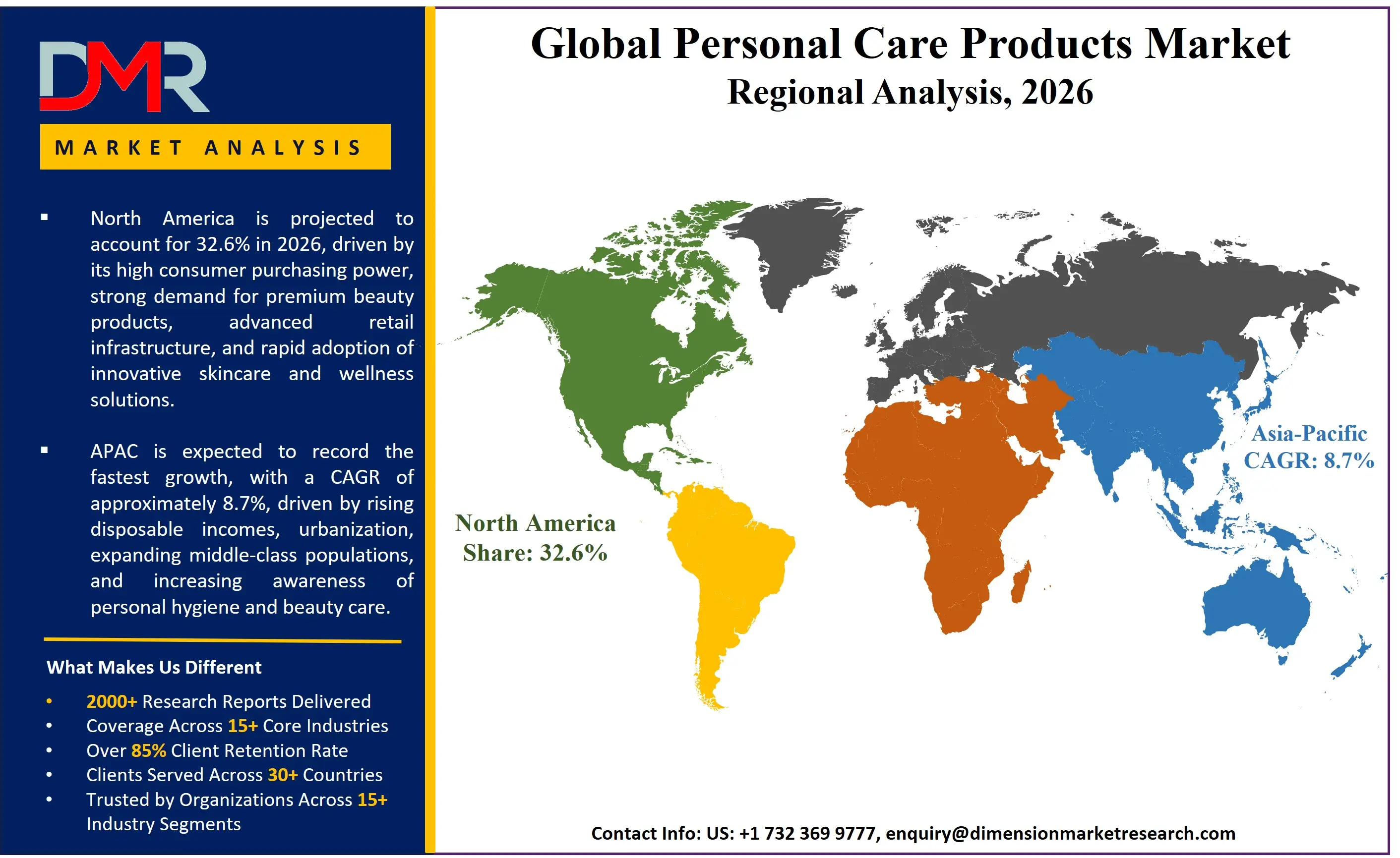
North America is expected to remain the leading region in the global Personal Care Products market, accounting for an estimated 32.6% market share in 2026. The region's dominance is supported by high consumer purchasing power, strong demand for premium beauty products, advanced retail infrastructure, and rapid adoption of innovative skincare and wellness solutions. The U.S. represents the largest contributor due to strong brand presence, extensive e-commerce penetration, and increasing demand for clean beauty, personalized products, and sustainable packaging. Government regulations related to product safety, ingredient transparency, and environmental standards are encouraging companies to invest in safer and more innovative formulations. Growth in men's grooming, anti-aging products, and technology-enabled beauty solutions further strengthens North America's market position.
Fastest Growing Region in the Personal Care Products Market
Asia Pacific is projected to be the fastest-growing region in the Personal Care Products market due to rising disposable incomes, urbanization, expanding middle-class populations, and increasing awareness of personal hygiene and beauty care. Countries including China, India, Japan, South Korea, and Southeast Asian economies are witnessing strong demand for skincare, cosmetics, haircare, and premium personal care products. The region benefits from growing e-commerce adoption, increasing smartphone usage, and strong influence from social media beauty trends. Government initiatives supporting manufacturing capabilities and digital commerce development are creating favorable conditions for market expansion. Rising demand for natural ingredients, multifunctional products, and affordable premium offerings is expected to accelerate regional growth. The increasing popularity of Asian beauty trends, particularly advanced skincare routines and innovative cosmetic formulations, provides additional opportunities for global and regional manufacturers.
By Region
North America
Europe
- Germany
- The U.K.
- France
- Italy
- Russia
- Spain
- Benelux
- Nordic
- Rest of Europe
Asia-Pacific
- China
- Japan
- South Korea
- India
- ANZ
- ASEAN
- Rest of Asia-Pacific
Latin America
- Brazil
- Mexico
- Argentina
- Colombia
- Rest of Latin America
Middle East & Africa
- Saudi Arabia
- UAE
- South Africa
- Israel
- Egypt
- Rest of MEA
Competitive Landscape
The Personal Care Products market is highly competitive, with companies focusing on innovation, product differentiation, sustainability, and consumer engagement strategies to maintain market positions. Competitive advantages are increasingly determined by research and development capabilities, ingredient innovation, efficient supply chains, strong digital presence, and the ability to respond quickly to changing consumer preferences. Companies are investing in clean-label formulations, personalized beauty technologies, environmentally friendly packaging, and direct-to-consumer distribution models. Strategic partnerships, acquisitions, and expansion into emerging markets are being used to strengthen global reach. High brand loyalty, regulatory compliance requirements, and significant marketing investments create entry barriers for new market participants.
Some of the prominent players in the global Personal Care Products are:
- Procter & Gamble
- Unilever
- L'Oréal S.A.
- The Estée Lauder Companies Inc.
- Johnson & Johnson
- Beiersdorf AG
- Colgate-Palmolive Company
- Henkel AG & Co. KGaA
- Shiseido Company, Limited
- Kao Corporation
- Coty Inc.
- Amorepacific Corporation
- Natura &Co
- Revlon, Inc.
- Edgewell Personal Care
- Church & Dwight Co., Inc.
- Lion Corporation
- LG Household & Health Care Ltd.
- Oriflame Holding AG
- Avon Products, Inc.
- Other Key Players
Recent Developments
- In June 2025, Estée Lauder Companies increased its focus on digital innovation and advanced consumer engagement strategies within the beauty and personal care sector. The company emphasized technology-driven customer experiences, including digital personalization tools, enhanced online shopping capabilities, and data-based insights for product development. These investments support changing consumer expectations for customized beauty solutions and seamless digital purchasing experiences.
- In March 2025, Unilever continued advancing its sustainability-focused initiatives within its personal care portfolio by emphasizing environmentally responsible formulations, packaging improvements, and resource-efficient manufacturing processes. The company increased efforts to reduce environmental impact across personal care categories while responding to growing consumer demand for sustainable beauty and hygiene products. The initiative included continued development of products using responsibly sourced ingredients and packaging solutions designed to support circular economy goals.
- In January 2025, L'Oréal continued expanding its technology-driven beauty strategy by strengthening the integration of artificial intelligence and digital personalization solutions across its product portfolio. The company focused on enhancing consumer experiences through AI-powered beauty consultations, virtual product recommendations, and advanced consumer analytics. These initiatives aim to improve personalized skincare and cosmetic recommendations while helping consumers identify products suited to their individual needs.
Report Details
| Report Characteristics |
| Market Size (2026) |
USD 431.7 Bn |
| Forecast Value (2035) |
USD 811.8 Bn |
| CAGR (2026–2035) |
7.3% |
| Historical Period |
2021 – 2025 |
| Forecast Period |
2027 – 2035 |
| Base Year |
2025 |
| Estimate Year |
2026 |
| Segments Covered |
By Product Type, By Distribution Channel, By Price Range |
| Regional Coverage |
North America – The US and Canada; Europe – Germany, The UK, France, Russia, Spain, Italy, Benelux, Nordic, & Rest of Europe; Asia-Pacific – China, Japan, South Korea, India, ANZ, ASEAN, Rest of APAC; Latin America – Brazil, Mexico, Argentina, Colombia, Rest of Latin America; Middle East & Africa – Saudi Arabia, UAE, South Africa, Turkey, Egypt, Israel, & Rest of MEA |
Frequently Asked Questions
How big is the Personal Care Products Market?
▾ The Personal Care Products Market size is expected to reach USD 431.7 billion by 2026 and is projected to reach USD 811.8 billion by the end of 2035.
What is the CAGR of the Personal Care Products Market from 2026 to 2035?
▾ The market is growing at a CAGR of 7.3 percent over the forecasted period.
What factors are driving the growth of the Personal Care Products Market?
▾ Rising Consumer Focus on Personal Wellness and Appearance, and more are the factors driving the growth of the Personal Care Products Market.
What are the major trends in the Personal Care Products Market?
▾ Digital Transformation and Smart Beauty Technologies, and more are some of the major trends in the market.
Who are the key players in the Personal Care Products Market?
▾ Some of the key players in the Personal Care Products Market include P&G, Unilever, Revlon, more
How is the Personal Care Products Market segmented?
▾ The Personal Care Products Market is segmented product type, distribution channel, price range.
Which region held the largest share of the Personal Care Products Market in 2026?
▾ North America is set to lead the Personal Care Products Market with an estimated 32.6% share in 2026.
Which region is expected to grow the fastest in the Personal Care Products Market?
▾ Asia Pacific is the fastest-growing region in the Personal Care Products Market during the forecast period.