Global Pest Control Market Snapshot
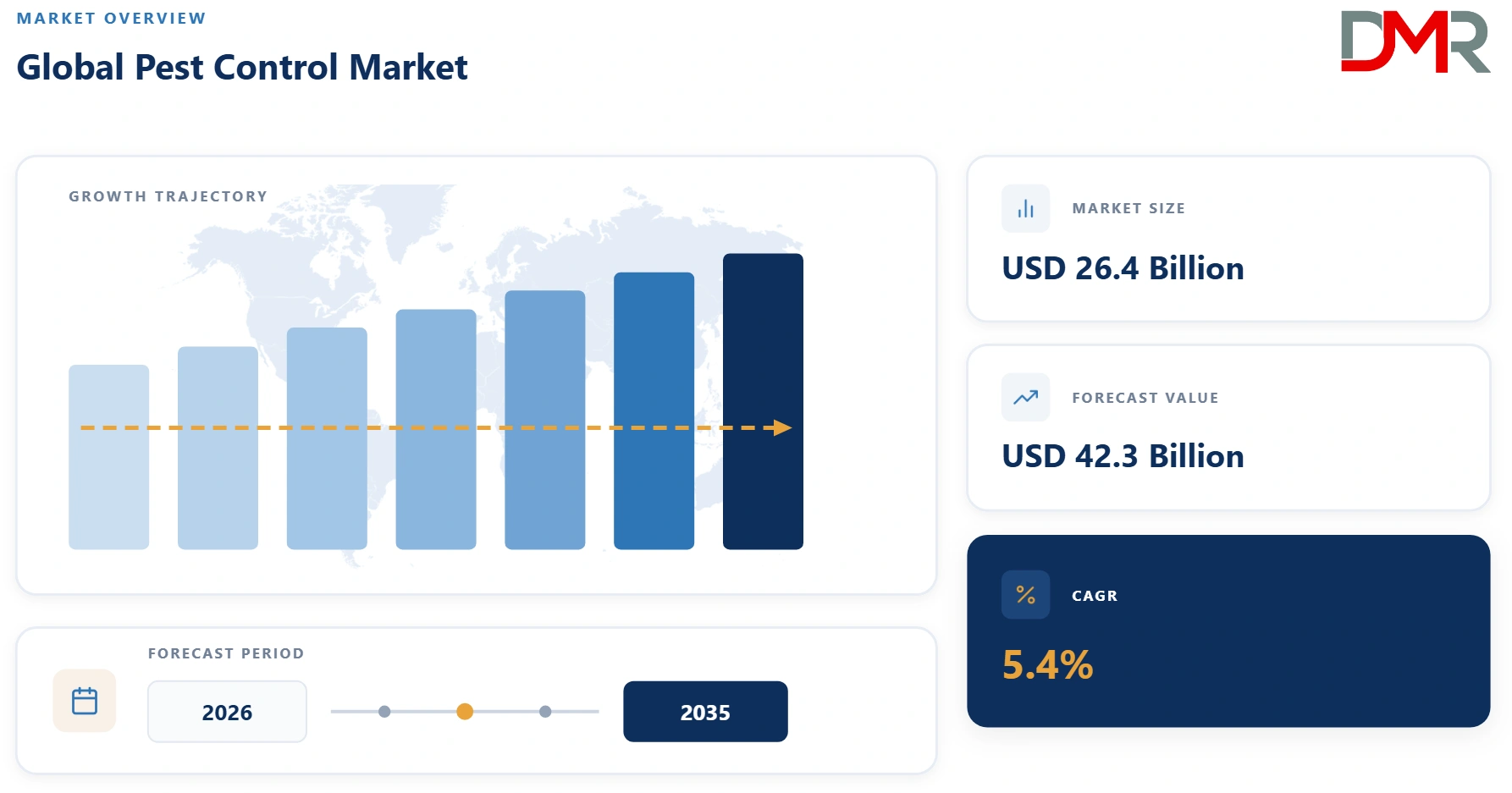
- Global Pest Control Market Size in 2026: USD 26.4 Billion
- Global Pest Control Market Size in 2035: USD 42.3 Billion
- Global CAGR from 2026 to 2035: 5.4%
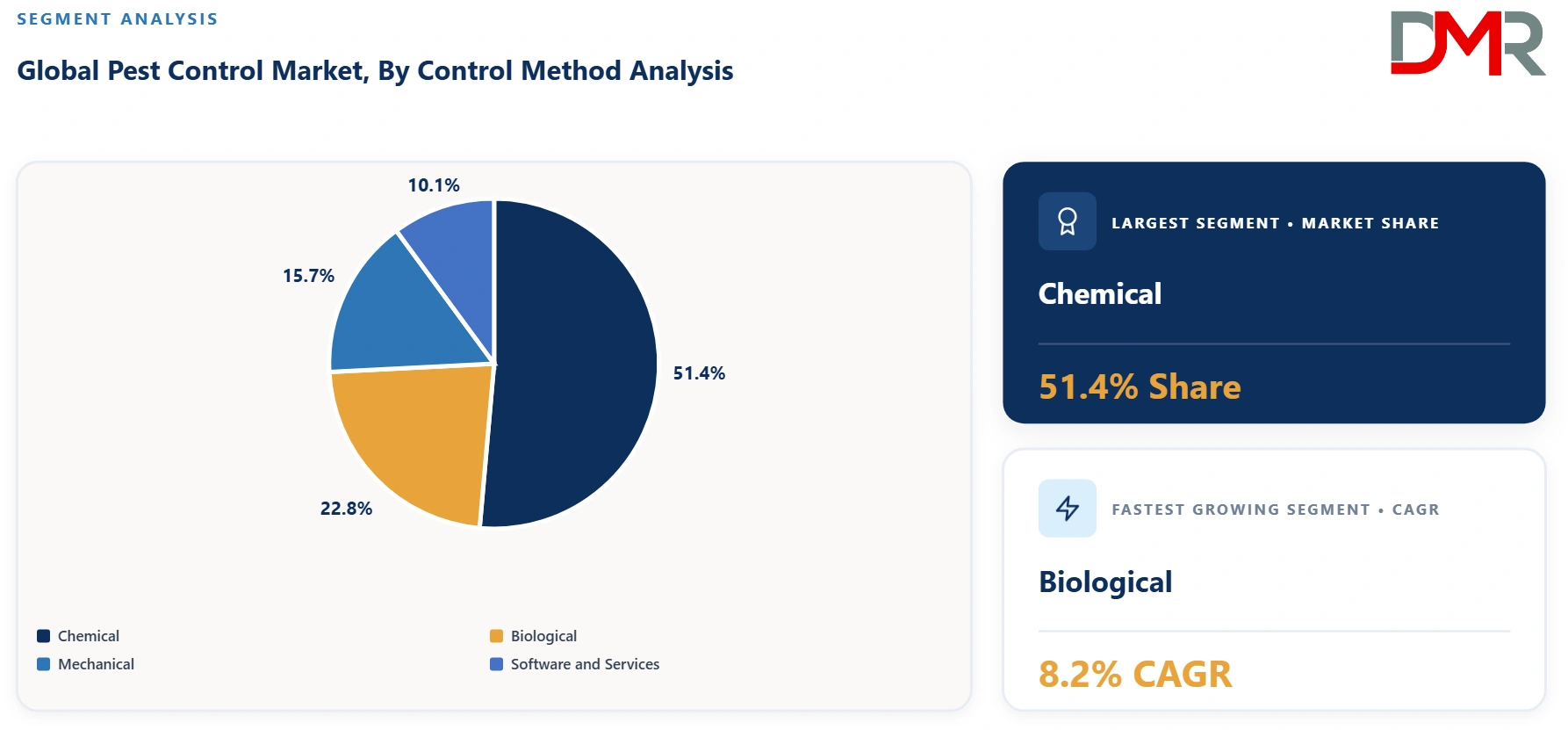
- Chemical is the leading control method segment in 2026: 51.4%
- Insects is the leading pest type segment in 2026: 42.0%
- Sprays is the leading mode of application segment in 2026: 38.4%
- Commercial is the leading application segment in 2026: 46.8%
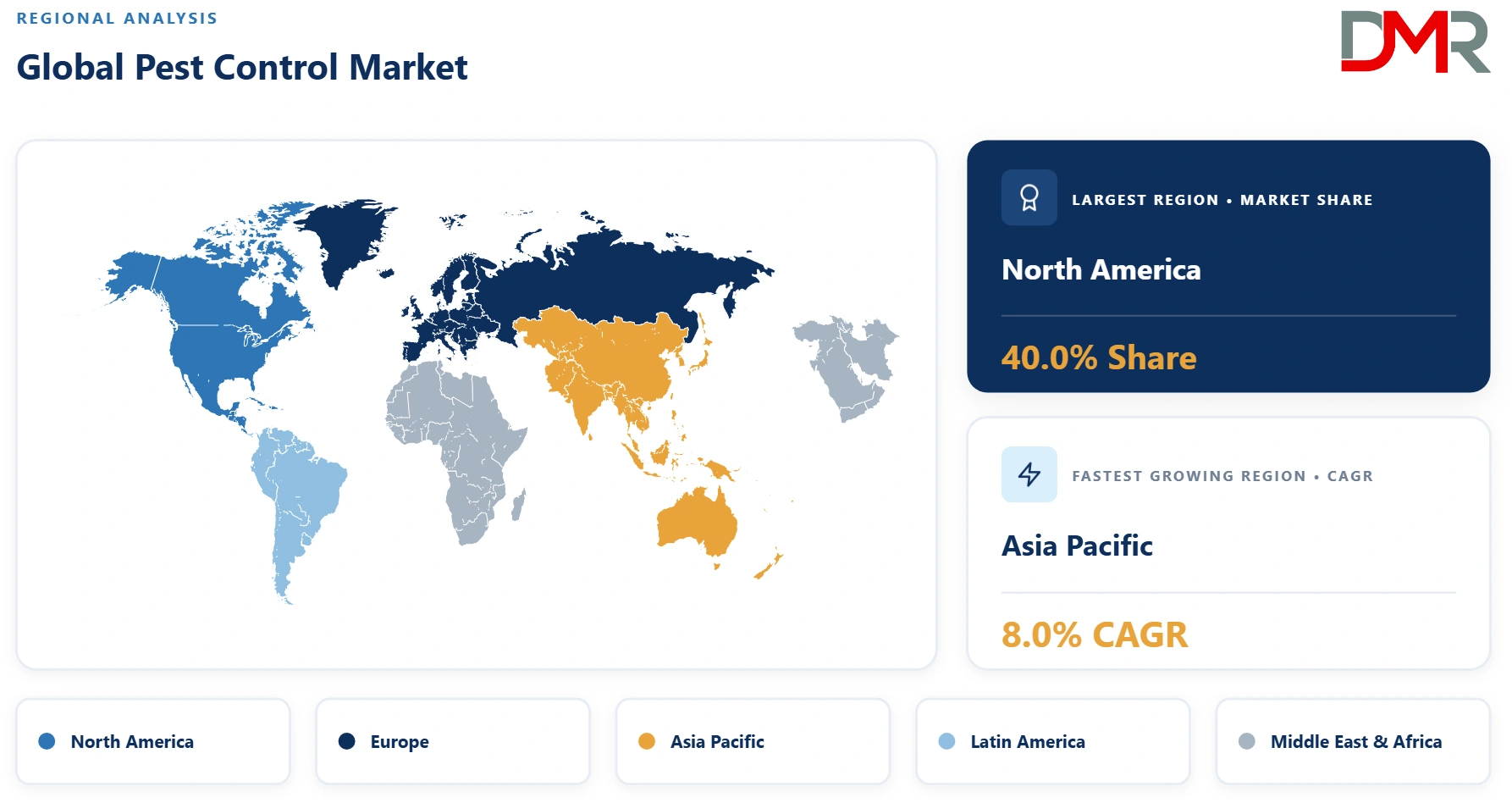
- North America is the leading region in 2026: 40.0%
What is the Global Pest Control Market and its Market Size?
The Global Pest Control Market is projected to reach USD 26.4 billion in 2026 and grow at a compound annual growth rate of 5.4% from there until 2035 to reach a value of USD 42.3 billion.
ℹ
To learn more about this report –
Download Your Free Sample Report Here
Growth is being propelled by climate-driven expansion of pest habitats and infestation risk, rapid urbanization and commercial and industrial infrastructure growth increasing exposure to insects, termites, and rodents, and tightening food safety and hygiene regulations compelling businesses across food processing, hospitality, and healthcare to adopt routine professional pest management programs. The market covers chemical, biological, mechanical, and software and services based control methods deployed across residential, commercial, industrial, and livestock settings, reflecting a structural shift from reactive treatment toward integrated pest management combining monitoring, prevention, and targeted intervention. Continued investment in smart monitoring technology, biological and low-toxicity control methods, and digital service platforms is reshaping a historically fragmented, locally delivered service industry into an increasingly consolidated, technology-enabled global market.
Use Cases
- Structural Pest Management for Commercial and Food Processing Facilities: Restaurants, food processing plants, hotels, and healthcare facilities use professional pest control services to meet food safety and sanitation compliance requirements, protecting brand reputation and regulatory standing through routine inspection and treatment programs.
- Residential Rodent and Insect Control: Homeowners use chemical, mechanical, and trap-based pest control products and professional services to manage infestations of rodents, ants, cockroaches, and other common household pests, protecting property and family health.
- Agricultural and Livestock Pest Management: Farms and livestock operations use insecticides, biological control agents, and mechanical traps to protect crops and animal health from insect, rodent, and wildlife pest pressure, reducing yield loss and disease transmission risk.
- Smart Monitoring for Early Infestation Detection: Commercial property managers and pest control providers use connected sensor-based traps and monitoring software to detect pest activity early, enabling targeted intervention and reducing reliance on scheduled, broad-based chemical treatment.
Key Takeaways
- Market Size: The Global Pest Control Market is projected to reach USD 26.4 billion in 2026 and USD 42.3 billion by 2035.
- Growth Rate and Outlook: The market is expected to expand at a CAGR of 5.4% between 2026 and 2035, supported by rising infestation pressure, urbanization, and regulatory-driven demand for professional pest management.
- Primary Growth Drivers: Climate-driven infestation risk, rapid urbanization and infrastructure growth, tightening food safety and hygiene regulations, and growing adoption of smart monitoring technology are accelerating market growth.
- By Control Method Analysis: Chemical is the leading control method segment with a 51.4% share in 2026, while Biological is the fastest-growing control method segment at an 8.2% CAGR.
- By Pest Type Analysis: Insects are the leading pest type segment with a 42.0% share in 2026, while Rodents is the fastest-growing pest type segment at a 7.5% CAGR.
- By Mode of Application Analysis: Sprays is the leading mode of application segment with a 38.4% share in 2026, while Traps is the fastest-growing mode of application segment at a 7.6% CAGR.
- By Application Analysis: Commercial is the leading application segment with a 46.8% share in 2026, while Industrial is the fastest-growing application segment at a 7.1% CAGR.
- Regional Leadership: North America leads the market with a 40.0% share in 2026, while Asia Pacific is the fastest-growing region at an 8.0% CAGR.
How AI/Gen AI is Transforming the Global Pest Control Market?
AI and Gen AI are transforming pest control from scheduled, reactive treatment toward predictive, data-driven management. Computer vision and sensor-equipped smart traps identify pest species and activity levels in real time, enabling technicians to prioritize high-risk locations before infestations spread. Predictive analytics models combine weather, seasonal, and historical infestation data to forecast outbreak risk across property portfolios, supporting proactive scheduling. Generative AI tools are increasingly used to draft inspection reports, customer communications, and compliance documentation automatically, reducing technician administrative burden. AI-enabled route optimization and dynamic scheduling are improving technician productivity across large commercial and residential service networks. Together, these capabilities are shifting competitive advantage toward providers with strong data infrastructure and analytics capability alongside traditional field service scale.
Key Drivers in the Global Pest Control Market
Climate-Driven Expansion of Pest Habitats and Infestation Risk
Rising global temperatures and shifting precipitation patterns are expanding the geographic range and active season of insects, rodents, and other pests, increasing infestation risk across both agricultural and urban environments. Warmer winters are allowing pest populations to survive in previously inhospitable regions, while extended breeding seasons are increasing population density in existing markets. This climate-driven expansion is compelling residential, commercial, and agricultural customers to adopt more frequent and comprehensive pest management programs, directly increasing service and product demand across the Global Pest Control Market and reinforcing the shift toward proactive, integrated pest management approaches.
Tightening Food Safety and Hygiene Regulations Across Commercial Sectors
Governments and industry bodies worldwide continue to tighten food safety, sanitation, and hygiene regulations applicable to food processing facilities, restaurants, hospitality operators, and healthcare institutions, requiring documented, routine pest management programs as a condition of licensing and certification. Non-compliance carries meaningful regulatory and reputational risk, compelling commercial operators to engage professional pest control providers rather than relying on ad hoc treatment. This regulatory-driven demand is particularly pronounced in the commercial and industrial application segments, where compliance requirements are directly tied to operational continuity and brand protection, sustaining stable, recurring service revenue for established providers.
Restraints in the Global Pest Control Market
Growing Regulatory Restrictions on Chemical Pesticide Active Ingredients
Regulatory agencies across major markets continue to restrict or phase out chemical pesticide active ingredients associated with environmental persistence, pollinator harm, or human health risk, representing a meaningful restraint on the chemical control method segment of the Global Pest Control Market. Manufacturers must invest significantly in reformulation, new active ingredient development, and expanded safety data generation to maintain product registrations, increasing development costs and compliance timelines. Smaller manufacturers with more limited regulatory affairs resources face particular difficulty maintaining broad product portfolios across multiple jurisdictions, constraining their ability to compete against larger, well-capitalized chemical and biological control companies.
Persistent Shortage of Skilled Pest Control Technicians
The pest control services industry continues to face a persistent shortage of licensed, trained technicians relative to growing service demand, representing a meaningful restraint on service capacity expansion across the Global Pest Control Market. Providers must compete for a limited pool of qualified technicians, driving up labor costs and extending service scheduling windows, particularly during peak seasonal infestation periods. This technician shortage constrains the ability of both large national providers and smaller regional operators to fully capture available demand growth, particularly in rapidly urbanizing markets where new service area expansion requires proportional technician hiring.
Growth Opportunities in the Global Pest Control Market
Expansion of AI-Enabled Smart Monitoring and Predictive Pest Management Platforms
Growing commercial and residential customer interest in AI-enabled smart monitoring platforms capable of detecting pest activity early and forecasting infestation risk presents a substantial opportunity for providers and technology vendors to differentiate through advanced, subscription-based monitoring services layered on top of traditional treatment offerings. Companies capable of demonstrating measurable reductions in infestation incidence and treatment cost through predictive monitoring can capture premium positioning and stronger customer retention as smart pest management technology continues maturing across both developed and emerging markets.
Development of Biological and Low-Toxicity Control Solutions
Growing regulatory and consumer preference for environmentally sustainable pest management presents a substantial opportunity for companies developing biological control agents, botanical extracts, and other low-toxicity alternatives to conventional chemical pesticides. Companies developing validated, efficacious biological control products that meet both efficacy and environmental safety expectations can capture significant value from continued market transition away from broad-spectrum chemical treatments, particularly across food processing, healthcare, and residential segments where chemical exposure sensitivity is highest.
Trends in the Global Pest Control Market
Growing Adoption of Integrated Pest Management Combining Multiple Control Methods
Pest control providers and end customers are increasingly adopting integrated pest management approaches that combine chemical, biological, and mechanical control methods alongside continuous monitoring, rather than relying on a single treatment modality. This trend reflects growing recognition that combined approaches improve long-term efficacy while reducing chemical usage and associated regulatory and environmental exposure risk, particularly across commercial and agricultural settings subject to sustainability reporting requirements.
Digital Transformation of Pest Control Service Delivery and Customer Engagement
Pest control providers are increasingly adopting digital service platforms for scheduling, route optimization, digital inspection reporting, and customer communication, reflecting broader home and commercial services industry digitization. This trend is improving technician productivity and customer transparency while creating a growing software and services segment within the broader pest control value chain, as providers increasingly differentiate through digital customer experience alongside traditional treatment quality.
Research Scope and Analysis
The Global Pest Control Market study evaluates control method pest type mode of application and application segments across residential commercial industrial and livestock settings worldwide. It captures demand across insects termites rodents wildlife and other pest categories through chemical biological mechanical and software and services based approaches supporting integrated pest management adoption throughout the forecast period.
ℹ
To learn more about this report –
Download Your Free Sample Report Here
By Control Method Analysis
Chemical is projected to dominate the Global Pest Control Market with a 51.4% share in 2026, reflecting the continued cost-effectiveness and broad efficacy of insecticides and rodenticides across residential, commercial, and agricultural applications. Biological is expected to register the highest CAGR of 8.2% during 2026-2035, driven by growing regulatory and consumer preference for microbial, plant extract, and predatory insect based control methods offering reduced environmental and health risk relative to conventional chemical treatments.
By Pest Type Analysis
Insects are anticipated to dominate the Global Pest Control Market, accounting for a 42.0% share in 2026, supported by the widespread prevalence of ants, cockroaches, mosquitoes, and other insect pests across residential, commercial, and agricultural settings globally. Rodents are projected to register the fastest CAGR of 7.5% through 2035, driven by rapid urbanization, growing rodent-borne disease awareness, and expanding adoption of smart, sensor-based rodent monitoring and control technology.
By Mode of Application Analysis
Sprays are projected to lead the Global Pest Control Market with an estimated 38.4% share in 2026, reflecting their versatility and widespread use across both professional and consumer pest control applications. Traps are expected to register the fastest CAGR of 7.6% through 2035, driven by growing adoption of connected, sensor-based smart trap technology supporting non-chemical, continuous monitoring and control approaches.
By Application Analysis
Commercial is projected to lead the Global Pest Control Market with a 46.8% share in 2026, reflecting sustained regulatory-driven demand from food processing, hospitality, and healthcare facilities requiring documented pest management compliance. Industrial is expected to register the fastest CAGR of 7.1% through 2035, driven by expanding manufacturing and warehousing infrastructure and tightening workplace hygiene and safety compliance requirements across global supply chains.
The Global Pest Control Market Report is segmented based on the following:
By Control Method
- Chemical
- Insecticides
- Rodenticides
- Biological
- Microbials
- Plant Extracts
- Predatory Insects
- Mechanical
- Light Traps
- Adhesive Traps
- Malaise Traps
- UV Radiation Devices
- Mesh Screens
- Ultrasonic Vibrations
- Software and Services
By Pest Type
- Insects
- Termites
- Rodents
- Wildlife
- Other Pest Types
By Mode of Application
- Powder
- Sprays
- Pellets
- Traps
- Baits
By Application
- Residential
- Commercial
- Industrial
- Livestock
- Other Applications
Regional Analysis
North America is the Leading Region in the Global Pest Control Market
North America holds approximately 40.0% share of the Global Pest Control Market in 2026, supported by high professional pest control penetration, strong regulatory enforcement of food safety and sanitation standards, and the presence of leading national pest control providers with extensive branch networks. The region's mature, highly consolidated service industry and high consumer willingness to pay for recurring professional treatment continue to sustain its leading position despite slower underlying population growth relative to emerging markets.
ℹ
To learn more about this report –
Download Your Free Sample Report Here
Asia Pacific is the Fastest-Growing Region in the Global Pest Control Market
Asia Pacific is projected to register the fastest CAGR of approximately 8.0% in the Global Pest Control Market through 2035, driven by rapid urbanization, expanding middle-class populations, growing construction activity, and increasing government focus on public health and sanitation standards. Rising awareness of pest-borne disease risk and growing adoption of professional pest management services across China, India, and Southeast Asian markets are accelerating regional demand well above the global average growth rate.
The Europe Pest Control Market
The Europe Pest Control Market is estimated to be valued at USD 6.9 billion in 2026 and is further anticipated to reach USD 10.9 billion by 2035 at a CAGR of 5.2%. Growth is supported by stringent European Union biocidal product and food safety regulations requiring documented pest management programs across commercial and food processing sectors. Growing adoption of biological and mechanical control methods, reflecting regional sustainability priorities, is further shaping product and service mix across the region relative to more chemical-intensive markets elsewhere.
Latin America Pest Control Market
The Latin America Pest Control Market is expanding steadily, supported by rapid urbanization, growing commercial and hospitality sector infrastructure, and rising awareness of pest-borne disease risk, particularly mosquito-borne illness, across Brazil and Mexico. Growing foreign direct investment in food processing and agricultural export industries is driving demand for compliant, professional pest management programs, while affordability constraints continue to limit residential segment penetration relative to more mature markets.
MEA Pest Control Market
The Middle East and Africa Pest Control Market is growing steadily, supported by rapid urban infrastructure development, expanding hospitality and commercial real estate sectors across the Gulf Cooperation Council countries, and growing government focus on public health and food safety standards. Extreme climate conditions across the region create persistent structural pest pressure, sustaining demand for both chemical and mechanical control methods, while broader African markets continue to develop professional pest control service infrastructure from a lower base.
Major Countries Analysis
United States Pest Control Market
The United States Pest Control Market is valued at USD 9.0 billion in 2026 and is expected to reach USD 14.4 billion by 2035, registering a CAGR of approximately 5.4% from 2026 to 2035. Growth is supported by a highly consolidated, acquisition-driven service industry, stringent commercial food safety compliance requirements, and continued residential demand for termite and rodent protection across both established and rapidly growing Sun Belt metropolitan markets.
Japan Pest Control Market
The Japan Pest Control Market continues to grow steadily, supported by strict food safety and building sanitation regulations, an aging housing stock requiring termite protection, and strong consumer preference for professional, technology-enabled pest management services. Leading domestic providers continue to invest in smart monitoring and low-toxicity control technology, reflecting both regulatory pressure and consumer sensitivity to chemical treatment in densely populated residential and commercial environments.
Saudi Arabia Pest Control Market
The Saudi Arabia Pest Control Market is expanding rapidly, supported by large-scale urban development and giga-project construction activity, growing hospitality and commercial real estate infrastructure, and government public health initiatives addressing pest-borne disease risk in a hot, arid climate favorable to structural pest activity. Growing foreign investment in food processing and retail infrastructure is further driving demand for compliant, professional pest management programs across the Kingdom.
Regulatory Landscape
Regulatory oversight is a defining structural factor in the Global Pest Control Market, with agencies including the US Environmental Protection Agency, the European Chemicals Agency, and equivalent national bodies continuing to tighten active ingredient approval, biocidal product registration, and pesticide application standards. Regulators are increasingly favoring lower-risk biological and mechanical control methods over broad-spectrum chemical treatments, reshaping product development priorities industry-wide. Digital modernization of registration processes, including new real-time application tracking systems, is improving review efficiency and reducing new product approval timelines. Compliance costs continue rising for manufacturers maintaining multi-jurisdiction product registrations, favoring larger, well-capitalized companies over smaller regional manufacturers. Food safety and sanitation regulations applicable to commercial and food processing end users remain a primary structural demand driver, embedding regulatory compliance directly into recurring service contract economics across the industry.
Technology Analysis
Technology development is increasingly shaping competitiveness in the Global Pest Control Market as providers invest in AI-enabled smart monitoring and predictive analytics platforms, connected sensor-based trap networks, and digital service delivery and customer engagement tools. Growing integration of computer vision for species identification and infestation severity assessment is improving treatment targeting accuracy while reducing unnecessary chemical application. Biological control formulation technology is advancing rapidly, improving efficacy and shelf stability of microbial and botanical active ingredients. Opportunities are expanding for companies developing validated smart monitoring platforms, low-toxicity formulation technology, and interoperable service management software supporting large, multi-location commercial accounts. However, achieving cost-competitive smart technology deployment across price-sensitive residential and small commercial segments remains an ongoing adoption challenge industry-wide.
By Region
North America
Europe
- Germany
- France
- The U.K.
- Italy
- Spain
- Rest of Europe
Asia-Pacific
- China
- Japan
- India
- Australia
- South Korea
- Rest of APAC
Latin America
- Mexico
- Brazil
- Rest of LATAM
Middle East & Africa
- Saudi Arabia
- The UAE
- South Africa
- Rest of MEA
Competitive Landscape
The Global Pest Control Market is moderately consolidated at the top, with the six largest service providers collectively holding roughly 45% share, while thousands of regional and local operators account for the remainder. Competition centers on branch network scale, technician workforce quality, smart monitoring technology capability, and recurring commercial contract relationships. Large national and multinational providers continue active acquisition strategies to consolidate fragmented regional operators, while agrochemical manufacturers compete on active ingredient innovation and regulatory portfolio breadth. Software and services providers are emerging as a distinct competitive category, supplying scheduling, monitoring, and customer engagement platforms to both large consolidators and independent operators, reshaping competitive dynamics across the broader pest management value chain.
Some of the prominent players in the Global Pest Control Market are:
- Rentokil Initial plc
- Rollins, Inc.
- Ecolab Inc.
- Anticimex Group
- Massey Services, Inc.
- Terminix Global Holdings, Inc.
- SANIX INC.
- Arrow Exterminators, Inc.
- Dodson Pest Control, Inc.
- Asante Inc.
- Bayer AG
- BASF SE
- Syngenta AG
- Corteva Agriscience
- FMC Corporation
- Sumitomo Chemical Co., Ltd.
- Nufarm Limited
- UPL Limited
- ADAMA Ltd.
- PelGar International Ltd.
- Bell Laboratories, Inc.
- Liphatech, Inc.
- Central Garden & Pet Company
- Wellmark International
- Woodstream Corporation
- AP&G Co., Inc.
- Bird-X, Inc.
- Bird Barrier America, Inc.
- Ehrlich Pest Control
- Western Exterminator Company
- Aptive Environmental, LLC
- Truly Nolen of America, Inc.
- FieldRoutes, LLC
- PestPac (WorkWave)
- Briostack Software
- Fumakilla Ltd.
- Earth Chemical Co., Ltd.
- Ikari Shodoku Co., Ltd.
- Northwest Exterminating
- Rainbow International, LLC
- Other Key Players
Recent Developments
- January 2026: The US EPA launched MyPest, a new digital pesticide registration system providing real-time application tracking, aimed at accelerating new product registrations and reducing review backlogs.
- January 2026: Rentokil Initial announced that CEO Andy Ransom would retire following the company's May 2026 Annual General Meeting, with Mike Duffy set to succeed him as the group refocuses on North American integration.
- April 2026: Rollins, Inc. acquired Romex Pest Control, a Utah-based operator with more than 200 employees, extending its footprint across Texas, Oklahoma, Louisiana, and Mississippi.
- October 2025: The US EPA proposed registration of a new Priestia megaterium biopesticide strain, expanding lower-risk, target-specific biological pest management options for agricultural and structural pest control applications.
Report Details
| Report Characteristics |
| Market Size (2026) |
USD 26.4 Bn |
| Forecast Value (2035) |
USD 42.3 Bn |
| CAGR (2026–2035) |
5.4% |
| The US Market Size (2026) |
USD 9.0 Bn |
| Historical Data |
2021 – 2025 |
| Forecast Data |
2026 – 2035 |
| Base Year |
2025 |
| Segments Covered |
By Control Method, By Pest Type, By Mode of Application, and By Application |
| Regional Coverage |
North America – The US and Canada; Europe – Germany, France, The UK, Italy, Spain, Rest of Europe; Asia-Pacific – China, Japan, India, Australia, South Korea, Rest of APAC; Latin America – Mexico, Brazil, Rest of LATAM; Middle East & Africa – Saudi Arabia, The UAE, South Africa, Rest of MEA |
Frequently Asked Questions
How big is the Global Pest Control Market?
▾ The Global Pest Control Market is projected to reach USD 26.4 billion in 2026 and is expected to grow to USD 42.3 billion by 2035.
What is the CAGR of the Global Pest Control Market from 2026 to 2035?
▾ The market is projected to expand at a compound annual growth rate (CAGR) of 5.4% between 2026 and 2035.
What factors are driving the growth of the Global Pest Control Market?
▾ Growth is driven by climate-driven expansion of pest habitats, rapid urbanization and infrastructure growth, tightening food safety and hygiene regulations, and growing adoption of smart monitoring and biological control technology.
What are the major trends in the Global Pest Control Market?
▾ Major trends include growing adoption of integrated pest management combining multiple control methods, digital transformation of service delivery, and increasing use of AI-enabled predictive monitoring and biological control solutions.
Which region held the largest share of the Global Pest Control Market in 2026?
▾ North America held the largest share of the Global Pest Control Market in 2026, accounting for approximately 40.0% of global revenue.
Which region is expected to grow the fastest in the Global Pest Control Market?
▾ Asia Pacific is expected to grow the fastest in the Global Pest Control Market, registering a CAGR of approximately 8.0% between 2026 and 2035.
Who are the key players in the Global Pest Control Market?
▾ Key market participants include Rentokil Initial, Rollins, Ecolab, Anticimex, and Bayer, among other global chemical manufacturers, service providers, and pest management software companies.
How is the Global Pest Control Market segmented?
▾ The market is segmented by control method, pest type, mode of application, and application, with demand analysis concentrated across North America, Europe, Asia-Pacific, Latin America, and the Middle East and Africa.