What is the Physical Identity and Access Management (PIAM) Software Market Size?
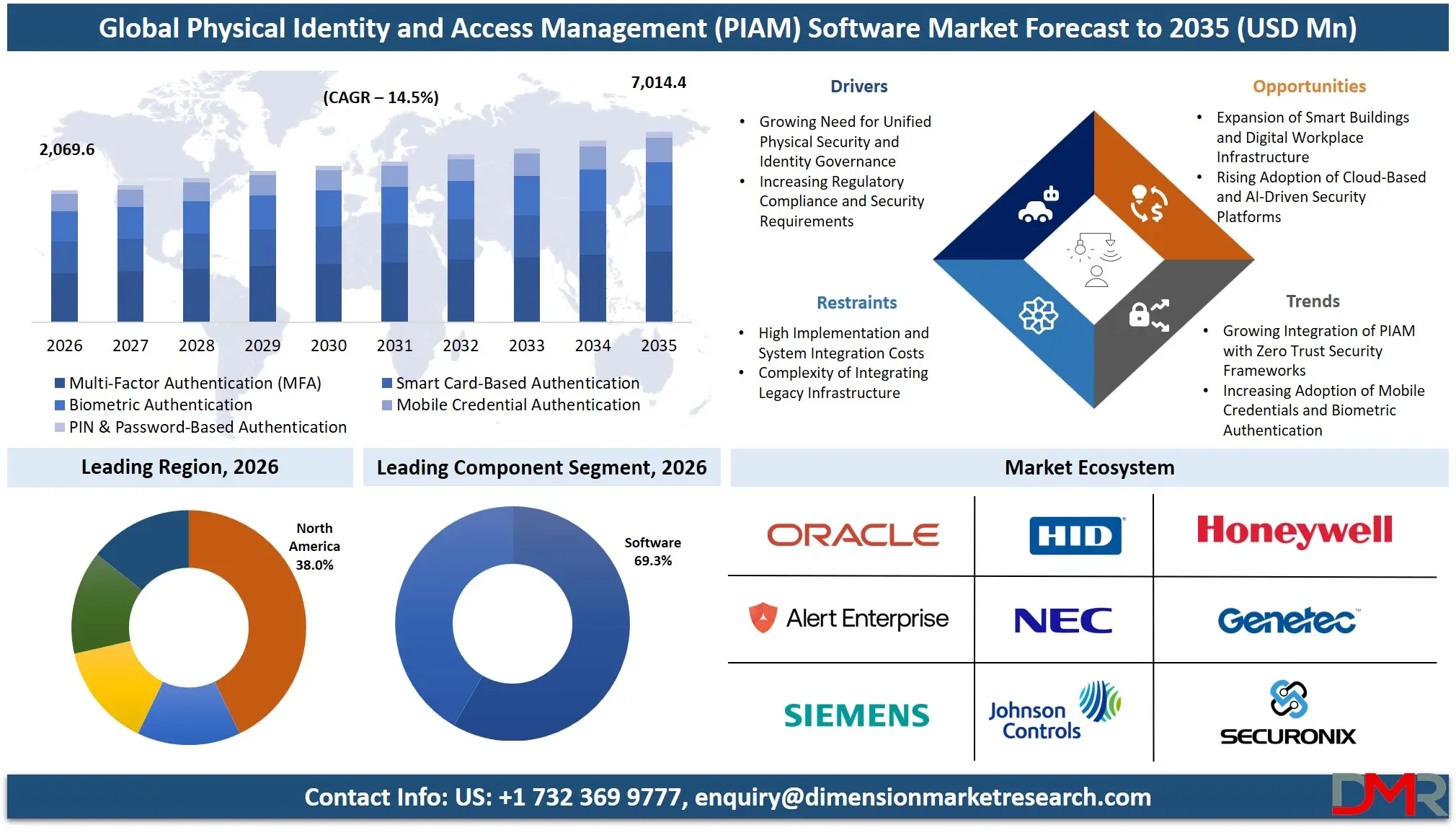
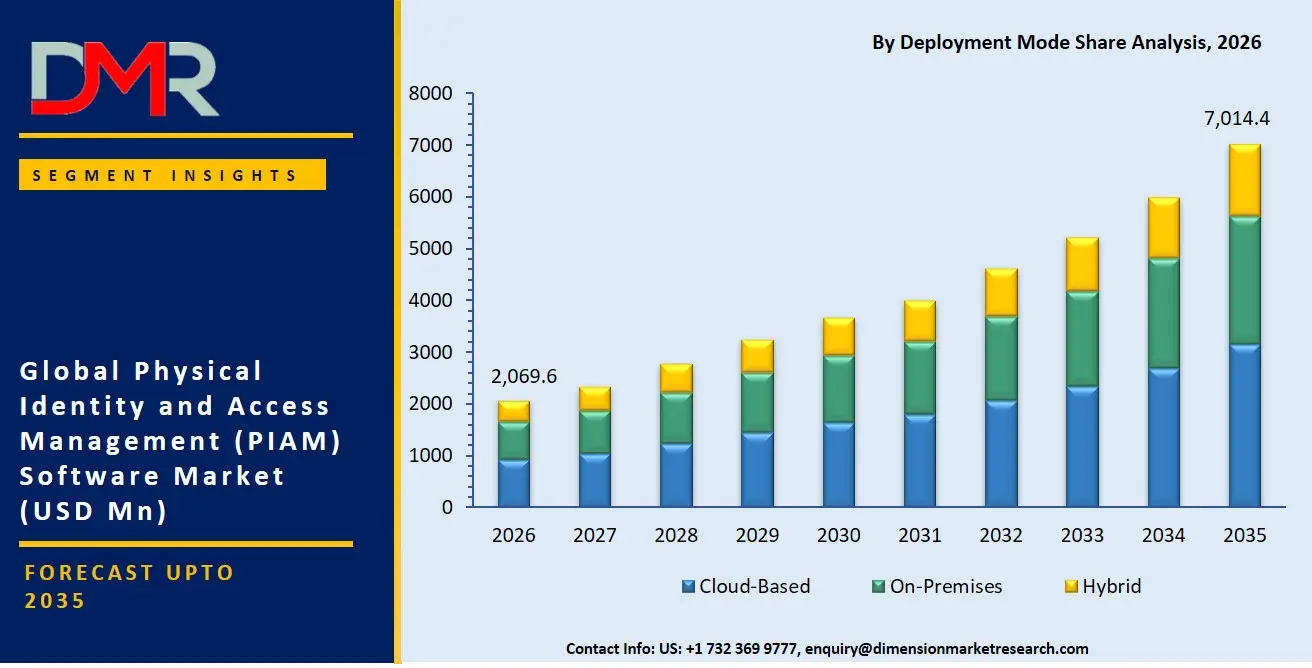
The Global Physical Identity and Access Management (PIAM) Software Market is expected to reach a value of USD 2,069.6 million in 2026, and it is further anticipated to reach USD 7,014.4 million by 2035, growing at a CAGR of 14.5% during the forecast period.
ℹ
To learn more about this report –
Download Your Free Sample Report Here
The PIAM software market has been growing at a high rate as enterprises increasingly prioritize security automation and the convergence of physical and digital identity systems. The market consists of software and services that manage, govern, and automate the lifecycle of identities requiring access to physical spaces, including employees, contractors, visitors, and vendors. Increasing demand to implement Zero Trust security frameworks, integrate access control systems with enterprise HR and IT directories, and ensure regulatory compliance is driving the necessity of specialized PIAM solutions. Large enterprises are the most frequent adopters, with cloud-based deployments remaining popular due to their scalability and ability to centralize management across globally distributed facilities. The government & defense, BFSI, and healthcare industries are key players as they require highly secure, compliant, and auditable physical access ecosystems.
The US Physical Identity and Access Management (PIAM) Software Market
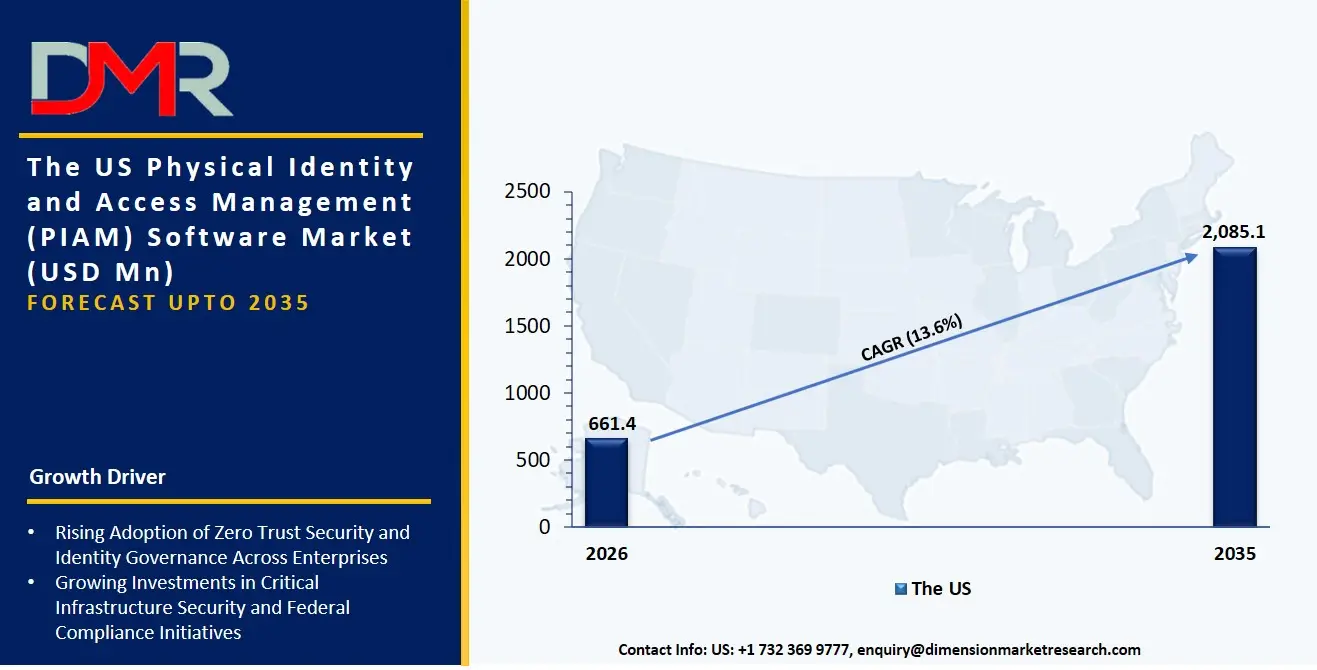
The US PIAM Software Market is projected to reach USD 661.4 million in 2026 at a compound annual growth rate of 13.6% over its forecast period, culminating in a value of USD 2,085.1 million by 2035.
ℹ
To learn more about this report –
Download Your Free Sample Report Here
The US continues to be the largest and most developed market for PIAM software due to the aggressive security postures of Fortune 500 companies and a heightened focus on insider threat management. The market has been typified by high demand for Access Governance & Compliance software, whereby organizations are aimed at automating the enforcement of access policies for a hybrid workforce. Besides, the implementation of advanced biometric authentication in critical infrastructure is producing a similar need for System Integration & Deployment services to unify legacy access control systems with modern, AI-driven identity governance platforms.
The Europe Physical Identity and Access Management (PIAM) Software Market
The Europe PIAM Software Market is estimated to be valued at USD 499.0 million in 2026 at a CAGR of 14.2%. Regulatory frameworks including GDPR and the NIS2 Directive have a significant impact on the European market and drive the need to employ stringent Visitor Management and Compliance & Audit Management solutions. Accelerated growth of hybrid deployment models is also being experienced in the region as manufacturing and automotive industries in Germany and France are trying to strike a balance between operational technology (OT) security and centralized identity management for floor workers and contractors. In addition, efforts to protect citizen data are challenging service providers to create dedicated Policy & Workflow Management tools that provide data residency and sovereign identity management across European corporate ecosystems.
The Japan Physical Identity and Access Management (PIAM) Software Market
The Japan PIAM Software Market is projected to be valued at USD 126.9 million in 2026 at a CAGR of 13.7%. The Japanese market is unique, with a corporate drive to enhance national security and manage a complex ecosystem of rotating contractors and vendors in response to a declining workforce and the digitization of legacy processes. Biometric Authentication and Visitor Identity Management modules make up a large part of the spending as large conglomerates retrofit existing facilities with touchless, automated entry systems. There is also a strong need for deep local market integration to bridge the gaps between traditional Japanese business practices, such as physical hanko stamps, and modern mobile credentials, which forms a niche in Credential & Badge Management and workflow customization.
Key Takeaways
- Market Size & Forecast: The Global PIAM Software market is projected to reach USD 2,069.6 million in 2026, expanding dramatically to USD 7,014.4 million by 2035, fueled by the dual drivers of enterprise Zero Trust adoption and the mandatory automation of complex access policies for a diverse, transient workforce.
- Growth Rate & Outlook: Global market growth is expected at a CAGR of 14.5%, driven by a critical imperative to mitigate insider threats and the escalating complexity of managing physical access across multi-site, multi-national corporate campuses.
- Primary Growth Drivers: Key forces include the widespread migration from siloed, hardware-centric access control to software-led, identity-centric security models, the need for Access Governance & Compliance to automate audit trails for regulations like SOX and HIPAA, and the integration of physical access systems with HR-driven identity lifecycle management requiring specialized System Integration & Deployment services.
- Key Market Trends: Major trends include the rise of converged identity platforms that unify physical and logical access, the use of AI-powered analytics within Reporting & Analytics modules to detect anomalous access patterns, and the shift toward cloud-based Managed Services as organizations seek to offload the continuous administration of PIAM systems.
- By Component Analysis: Software, particularly Identity Lifecycle Management and Access Governance & Compliance modules, is expected to dominate enterprise discussions due to the operational need for automating joiner-mover-leaver processes. Professional Services, especially System Integration & Deployment, are increasingly required to weave together disparate physical security systems and HR platforms into a cohesive identity fabric.
- By Authentication Type Analysis: Biometric Authentication and Mobile Credential Authentication are the fastest-growing authentication modes due to their superior security and user convenience. BFSI and Government & Defense are the most lucrative verticals for multi-factor authentication, as they fuse biometrics with PINs and smart cards for high-security areas.
- By Application Analysis: Physical Access Control and Identity Governance & Administration are the core application pillars. Manufacturing and Energy & Utilities are the fastest-growing sectors for Contractor & Vendor Management, as complex supply chains require robust, time-bound identity credentials that are rigorously audited.
- Regional Leadership: North America is poised to dominate this market with 38.0% of the market share in 2026 due to its stringent regulatory environment and the presence of a highly developed ecosystem of security technology providers, system integrators, and a mature end-user base that prioritizes advanced identity management to its fullest extent.
What is the Physical Identity and Access Management (PIAM) Software Market?
Physical Identity and Access Management (PIAM) Software provides the specialized policy, workflow, and automation engine that governs physical access rights across an organization. These software solutions, unlike physical access control systems (PACS) which execute door unlocks, are concerned with the who, what, where, and when of access authorization and its lifecycle. This involves Identity Lifecycle Management to automatically provision and de-provision access based on HR events, Visitor Management to pre-register and track guests, and Access Governance & Compliance to conduct periodic access reviews and generate audit trails. With organizations managing a fluid mix of employees, contractors, and visitors across hundreds of facilities, PIAM software is needed to achieve continuous risk management, automate security operations, and translate fragmented access rights into a centrally governed, auditable identity posture, as opposed to a purely reactive hardware-focused function.
Use Cases
- Aerospace Manufacturing Contractor Compliance: Defense contractors hire System Integration & Deployment services to integrate PIAM software with their ERP and HR systems, automatically issuing time-limited, role-based smart card credentials to subcontractors and revoking access instantly upon project completion to meet ITAR compliance.
- Hospital Visitor Risk Screening: Hospital networks use Visitor Management software and Identity Governance & Administration modules to screen all visitors against external watchlists, print temporary photo ID badges, and link visitor identity to the patient's record, ensuring both patient privacy (HIPAA) and campus safety.
- Energy Sector Critical Infrastructure Protection: Utility companies deploy Policy & Workflow Management and Biometric Authentication to enforce strict, multi-factor access policies at substations and control rooms. A credential requires a biometric match and a verified, time-bound work order in the system, preventing unauthorized access to critical cyber-physical assets.
- Global Financial Institution M&A Integration: A large bank undergoing a merger uses Access Governance & Compliance and Reporting & Analytics modules to consolidate access privileges across two disparate physical security systems. They can visualize all access rights across the new combined entity, identify and remediate toxic combinations of access, and satisfy regulatory mandates for a unified control environment.
How AI is Transforming the Physical Identity and Access Management (PIAM) Software Market?
AI is changing the PIAM software market by accelerating the process of access governance and enhancing operational risk detection. In Access Governance & Compliance, AI-based analytics tools have the potential to automatically analyze millions of access rights, identifying orphaned accounts, separation-of-duty violations, and anomalous access patterns that manual reviewers would miss, significantly reducing identity risk and audit preparation timelines. Meanwhile, AI-powered features in Reporting & Analytics allow businesses to better manage security postures by detecting suspicious access behavior, predicting potential policy violations, and suggesting rule optimizations like dynamic access thresholds to enforce Zero Trust principles.
Physical security and business transformation projects are also revolving around AI. In the area of Visitor Management, intelligent video-analytics agents are used to continuously verify that individuals moving through a facility match the identity they presented at the kiosk, flagging instances of tailgating or credential swapping to security operations teams in real-time. Moreover, generative AI assistants are complementing Policy & Workflow Management by simulating the impact of new access rules and modelling complex workflows, giving security stakeholders a visualization of operational changes before committing them into the live PIAM system.
Market Dynamics
Key Drivers in the Global Physical Identity and Access Management (PIAM) Software Market
Growing Need for Unified Physical Security and Identity Governance
Organizations are increasingly adopting PIAM software to centralize the management of employee, contractor, and visitor identities while integrating with physical access control systems, HR platforms, and security infrastructure. As enterprises expand across multiple locations, manual identity management becomes inefficient and prone to security gaps. PIAM solutions automate identity lifecycle processes, credential provisioning, and access approvals, reducing administrative burden while improving operational efficiency. The need for unified governance, enhanced workplace security, and standardized access policies across complex enterprise environments is significantly driving the adoption of advanced PIAM software solutions worldwide.
Increasing Regulatory Compliance and Security Requirements
Governments and industry regulators continue to enforce strict security and compliance requirements across sectors such as BFSI, healthcare, defense, and critical infrastructure. Organizations must maintain accurate identity records, access logs, audit trails, and policy-based access controls to meet regulatory standards. PIAM software simplifies compliance by automating access reviews, maintaining comprehensive audit documentation, and enforcing role-based permissions. Rising concerns over insider threats, unauthorized facility access, and cyber-physical security risks are encouraging enterprises to invest in robust PIAM platforms that strengthen governance while ensuring adherence to evolving national and international security regulations.
Restraints in the Global Physical Identity and Access Management (PIAM) Software Market
High Implementation and System Integration Costs
Deploying enterprise-grade PIAM software often requires significant investment in software licensing, system customization, infrastructure upgrades, and integration with existing physical security systems such as access control, surveillance, HR platforms, and identity management solutions. Organizations with legacy infrastructure may face additional expenses and longer deployment timelines. Small and medium-sized enterprises frequently find these implementation costs challenging, limiting wider adoption. Continuous maintenance, software upgrades, employee training, and professional consulting services further increase the total cost of ownership, creating a barrier for organizations operating with limited technology and security budgets.
Complexity of Integrating Legacy Infrastructure
Many organizations continue to rely on aging physical access control systems, fragmented identity databases, and legacy security technologies that were not designed for modern PIAM integration. Migrating from disconnected systems to centralized identity governance platforms requires careful planning, extensive testing, and business process modifications. Compatibility issues between vendors, inconsistent identity records, and operational disruptions during deployment may delay implementation. The complexity of integrating diverse technologies while maintaining uninterrupted security operations discourages some enterprises from rapidly adopting comprehensive PIAM solutions, particularly within highly regulated or operationally sensitive environments.
Growth Opportunities in the Global Physical Identity and Access Management (PIAM) Software Market
Expansion of Smart Buildings and Digital Workplace Infrastructure
The rapid development of smart buildings, intelligent campuses, and digitally connected workplaces presents significant opportunities for PIAM software providers. Modern facilities increasingly integrate IoT devices, automated building management systems, biometric authentication, and intelligent access control technologies that require centralized identity management. PIAM platforms enable seamless coordination between physical security infrastructure and enterprise identity systems, improving operational efficiency and occupant safety. Growing investments in smart cities, commercial real estate modernization, and intelligent facility management are expected to accelerate demand for scalable PIAM solutions capable of managing complex physical security environments.
Rising Adoption of Cloud-Based and AI-Driven Security Platforms
Organizations are increasingly investing in cloud-native PIAM platforms enhanced with artificial intelligence, machine learning, and predictive analytics to improve identity governance and physical security. AI-powered solutions automate anomaly detection, risk assessment, identity verification, and access decision-making while reducing manual administrative tasks. Cloud deployment further enables centralized management across geographically distributed facilities with lower infrastructure costs and faster implementation. As enterprises pursue digital transformation and zero-trust security strategies, demand for intelligent, cloud-enabled PIAM platforms is expected to create substantial long-term growth opportunities for software vendors worldwide.
Trends in the Global Physical Identity and Access Management (PIAM) Software Market
Growing Integration of PIAM with Zero Trust Security Frameworks
Organizations are increasingly integrating PIAM software into broader zero trust security architectures that continuously verify identities before granting physical access. Rather than relying solely on credentials, modern PIAM platforms evaluate user roles, access history, authentication methods, and contextual risk factors before authorizing entry. This integrated approach strengthens enterprise security by minimizing insider threats and unauthorized access. As organizations combine physical and cybersecurity strategies into unified governance frameworks, PIAM solutions are evolving into essential components of enterprise-wide zero trust security ecosystems across multiple industries.
Increasing Adoption of Mobile Credentials and Biometric Authentication
Traditional access cards are gradually being replaced by mobile credentials, facial recognition, fingerprint scanning, and other biometric authentication technologies integrated with PIAM platforms. Mobile-enabled identity management improves user convenience while reducing dependence on physical badges that can be lost or duplicated. Biometric authentication enhances security by providing stronger identity verification and minimizing credential misuse. Organizations across corporate offices, healthcare facilities, educational institutions, and government agencies are increasingly deploying these advanced authentication technologies, making mobile-first and biometric-enabled PIAM solutions one of the strongest technology trends shaping the market.
Research Scope and Analysis
The Global Physical Identity and Access Management (PIAM) Software Market is segmented by Component (Software and Services), Deployment Mode (Cloud-Based, On-Premises, Hybrid), Organization Size (Large Enterprises and SMEs), Authentication Type, Application, and End User, covering industries such as Government & Defense, BFSI, Healthcare, IT & Telecommunications, Manufacturing, Energy & Utilities, Education, Retail, Transportation, and others.
ℹ
To learn more about this report –
Download Your Free Sample Report Here
By Component Analysis
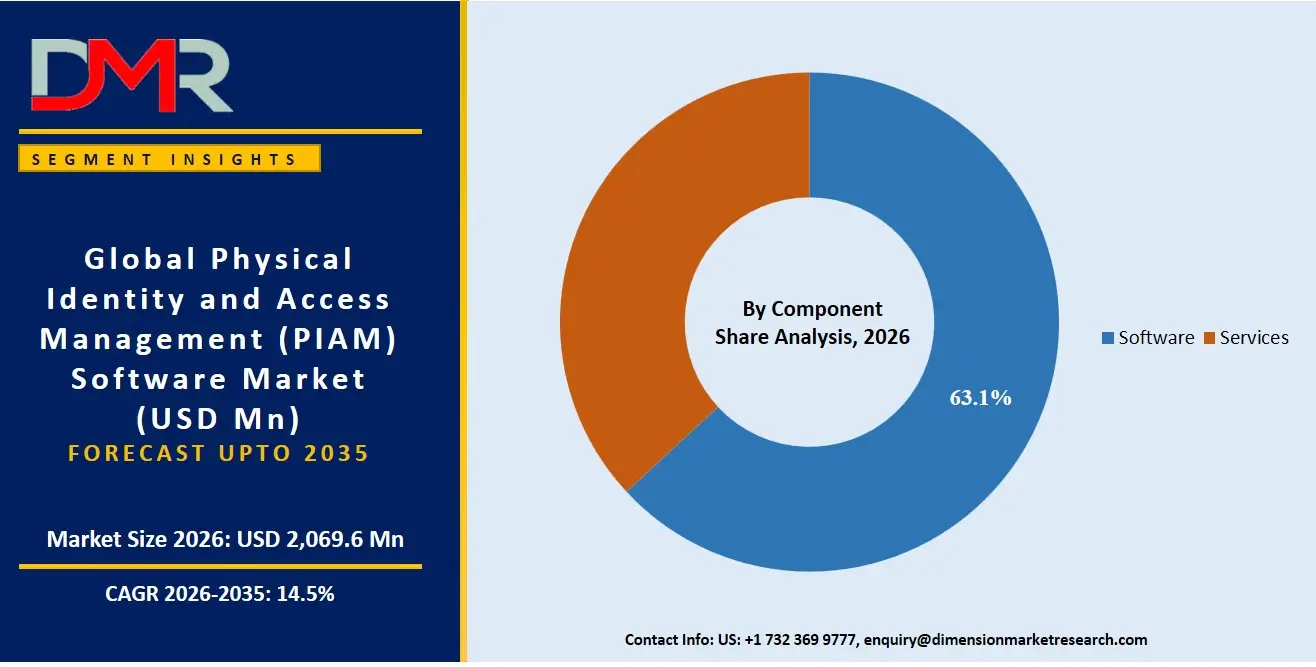
The Software segment is projected to dominate the Global Physical Identity and Access Management (PIAM) Software Market because it serves as the central platform for managing identities, access rights, credentials, compliance policies, and security workflows across organizations. Enterprises increasingly prioritize digital transformation and centralized security management, driving investments in advanced PIAM software integrated with physical access control systems (PACS), HR databases, and identity governance solutions. Cloud-enabled software, AI-powered analytics, and automation further strengthen adoption by reducing administrative effort and improving security. Continuous software updates, regulatory compliance requirements, and growing demand for unified identity management ensure that software remains the largest revenue-generating component compared with professional and managed services.
By Deployment Mode Analysis
The Cloud-Based deployment segment is poised to dominate the PIAM Software Market due to its scalability, lower upfront investment, rapid deployment, and ease of remote management. Organizations increasingly prefer cloud-hosted PIAM platforms to support hybrid workforces, multi-site facilities, and centralized identity governance.
ℹ
To learn more about this report –
Download Your Free Sample Report Here
Cloud solutions enable seamless software updates, disaster recovery, and integration with cloud-based HR, IAM, and physical security systems. Subscription-based pricing reduces capital expenditure while improving operational flexibility. Growing adoption among enterprises seeking faster implementation, AI-driven security analytics, and continuous compliance monitoring has accelerated cloud deployment, making it the preferred model over on-premises and hybrid deployments across most industry verticals.
By Organization Size Analysis
Large Enterprises is expected to dominate the PIAM Software Market because they operate multiple facilities, employ thousands of personnel, and require sophisticated identity lifecycle management across geographically distributed locations. These organizations invest heavily in integrated security platforms to manage employees, contractors, visitors, and third-party vendors while meeting strict regulatory and compliance requirements. Large enterprises also possess the financial resources to deploy enterprise-grade PIAM solutions integrated with access control, surveillance, HR, and cybersecurity systems. Increasing cybersecurity risks, complex organizational structures, and demand for centralized governance continue to drive strong adoption among multinational corporations across banking, healthcare, manufacturing, government, and critical infrastructure sectors.
By Authentication Type Analysis
Multi-Factor Authentication (MFA) is anticipated to dominate the authentication segment because organizations increasingly require stronger identity verification to protect critical facilities and sensitive assets. MFA combines multiple authentication factors such as smart cards, biometrics, mobile credentials, or PINs, significantly reducing unauthorized access risks. Regulatory requirements, zero-trust security strategies, and rising cyber-physical threats have accelerated MFA adoption across industries. Modern PIAM platforms integrate MFA seamlessly with physical access systems, ensuring secure yet convenient authentication. As enterprises strengthen both cybersecurity and physical security frameworks, MFA has become the preferred authentication approach due to its superior protection and compliance capabilities.
By Application Analysis
Physical Access Control is projected to represent the dominant application in the PIAM Software Market because it is the core function of every PIAM deployment. Organizations rely on PIAM platforms to control, monitor, and audit access to offices, manufacturing facilities, data centers, healthcare institutions, and critical infrastructure. Integration with access control hardware, surveillance systems, visitor management, and identity governance enhances operational security and regulatory compliance. Growing concerns regarding insider threats, unauthorized access, and workplace safety continue to drive investments in advanced physical access control solutions. As enterprises modernize security infrastructure, physical access control remains the primary application generating the highest demand.
By End User Analysis
The Government & Defense segment is expected to dominate the Global PIAM Software Market owing to stringent national security requirements, highly regulated environments, and the need to protect sensitive facilities and classified information. Government agencies and defense organizations require robust identity verification, credential management, visitor control, and continuous access monitoring across military bases, administrative offices, and critical infrastructure. PIAM solutions help enforce security policies, ensure compliance with government regulations, and prevent unauthorized physical access. Increasing investments in homeland security, smart government infrastructure, and integrated physical-cybersecurity strategies continue to strengthen demand, making Government & Defense the leading end-user segment globally.
The Global Physical Identity and Access Management (PIAM) Software Market Report is segmented on the basis of the following:
By Component
- Software
- Identity Lifecycle Management
- Visitor Management
- Access Governance & Compliance
- Credential & Badge Management
- Policy & Workflow Management
- Reporting & Analytics
- Services
- Consulting
- System Integration & Deployment
- Training & Support
- Managed Services
By Deployment Mode
- Cloud-Based
- On-Premises
- Hybrid
By Organization Size
- Large Enterprises
- Small & Medium Enterprises (SMEs)
By Authentication Type
- Multi-Factor Authentication (MFA)
- Smart Card-Based Authentication
- Biometric Authentication
- Mobile Credential Authentication
- PIN & Password-Based Authentication
By Application
- Physical Access Control
- Employee Identity Management
- Visitor Identity Management
- Contractor & Vendor Management
- Compliance & Audit Management
- Facility Security Management
- Identity Governance & Administration
By End User
- Government & Defense
- Banking, Financial Services & Insurance (BFSI)
- Healthcare & Life Sciences
- Information Technology & Telecommunications
- Manufacturing
- Energy & Utilities
- Transportation & Logistics
- Education
- Retail & Commercial Buildings
- Others
Regional Analysis
Leading Region by Market Share
ℹ
To learn more about this report –
Download Your Free Sample Report Here
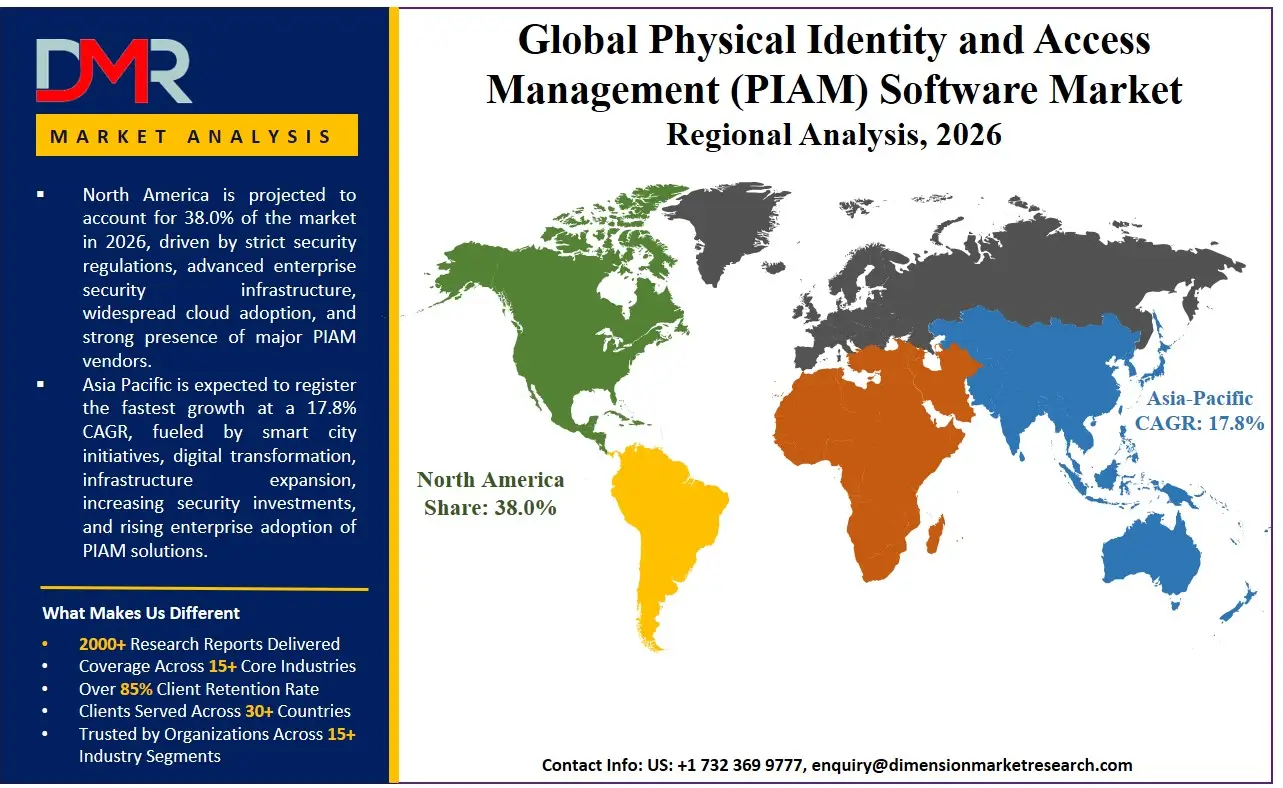
North America is poised to dominate the global PIAM software market as it is projected to hold 38.0% of the market share by the end of 2026. The United States, which dominates North America, has the highest share in the PIAM market because of the unmatched concentration of federal mandates like HSPD-12 and the aggressive security modernization agendas of Fortune 500 companies and critical infrastructure operators. The area has an established ecosystem of global system integrators, boutique cybersecurity consultancies, and a rich pool of talent in identity architects and physical security engineers. Enterprise investment in Zero Trust, insider threat programs, and the overall retirement of legacy, non-auditable access control systems contribute to the continued demand for identity governance and compliance modules along with managed services. Moreover, a strong class-action liability climate perpetually finances proactive legal compliance tools that need expert professional services for rapid deployment and robust audit defense.
Fastest-Growing Regional Market
Asia-Pacific is expected to be the most rapidly expanding PIAM software market, driven by sweeping government-led smart city and national security initiatives in India, China, and Southeast Asia. The fast-paced economic growth, the rise of a massive, specialized manufacturing base, and the dynamic expansion of the enterprise sector are compelling established conglomerates and state-owned enterprises to discard inefficient, manual visitor logs and siloed access systems. Business transformation consulting is in high demand to help these large organizations head in the direction of converged, identity-centric security operating models. There is also a severe lack of qualified cyber-physical security talent in the region, and it is necessary to outsource professional services for system integration, credential management, and managed security operations to cover the skills gap and enable faster time-to-value on PIAM investments.
By Region
North America
Europe
- Germany
- The U.K.
- France
- Italy
- Russia
- Spain
- Benelux
- Nordic
- Rest of Europe
Asia-Pacific
- China
- Japan
- South Korea
- India
- ANZ
- ASEAN
- Rest of Asia-Pacific
Latin America
- Brazil
- Mexico
- Argentina
- Colombia
- Rest of Latin America
Middle East & Africa
- Saudi Arabia
- UAE
- South Africa
- Israel
- Egypt
- Rest of MEA
Competitive Landscape
The competitive environment of the global PIAM software market has become highly dynamic with a heterogeneous array of pure-play PIAM software vendors, global physical security manufacturers expanding their software portfolios, and niche identity security consultancies. The key to success will be profound strategic alliances with leading PACS providers like LenelS2, Genetec, and CCure because they open the necessary pre-certified integration paths and co-selling opportunities with established security channels. The movement towards market consolidation is rapidly progressing with the traditional security integrators acquiring specialized PIAM and identity analytics boutiques to stay afloat. Proprietary intellectual property, including automated access review engines, industry-specific compliance workflow accelerators, and AI-driven risk scoring models, is becoming a more important basis of competitive differentiation than just simple badge management or generic workflow automation.
Some of the prominent players in the Global Physical Identity and Access Management (PIAM) Software Market are:
- HID Global
- Genetec
- Honeywell International Inc.
- Johnson Controls International plc
- Siemens AG
- NEC Corporation
- AlertEnterprise Inc.
- Securonix
- AlertEnterprise Guardian (AlertEnterprise)
- Quantum Secure (HID Global)
- Envoy
- Veristream
- Oracle Corporation
- Microsoft Corporation
- IBM Corporation
- AWS (Amazon Web Services)
- Cisco Systems, Inc.
- Gallagher Security
- Kastle Systems
- AMAG Technology
- Other Key Players
Recent Developments
- March 2026: Genetec expanded Security Center SaaS with new cloud-based access control capabilities, including an enhanced front desk experience, integrated visitor management, policy-driven access controls, expanded hardware support, and optional biometric authentication to modernize enterprise physical security environments.
- February 2026: Genetec introduced AI-powered investigation capabilities in Security Center SaaS, enabling natural language search, contextual video analytics, case management, and automated evidence organization to accelerate enterprise security investigations across multi-site deployments.
- September 2025: Genetec launched intelligent automation-powered investigation capabilities in Security Center SaaS, allowing security operators to rapidly search, analyze, and manage physical security events using AI-driven workflows and contextual insights, strengthening enterprise security operations.
Report Details
| Report Characteristics |
| Market Size (2026) |
USD 2,069.6 Mn |
| Forecast Value (2035) |
USD 7,014.4 Mn |
| CAGR (2026–2035) |
14.5% |
| The US Market Size (2026) |
USD 661.4 Mn |
| Historical Data |
2021 – 2025 |
| Forecast Data |
2027 – 2035 |
| Base Year |
2025 |
| Estimate Year |
2026 |
| Segments Covered |
By Component, By Deployment Mode, By Organization Size, By Authentication Type, By Application, and By End User |
| Regional Coverage |
North America – The US and Canada; Europe – Germany, The UK, France, Russia, Spain, Italy, Benelux, Nordic, & Rest of Europe; Asia-Pacific – China, Japan, South Korea, India, ANZ, ASEAN, Rest of APAC; Latin America – Brazil, Mexico, Argentina, Colombia, Rest of Latin America; Middle East & Africa – Saudi Arabia, UAE, South Africa, Turkey, Egypt, Israel, & Rest of MEA |
Frequently Asked Questions
How big is the Global Physical Identity and Access Management (PIAM) Software Market?
▾ The Global PIAM Software market is poised to be valued at USD 2,069.6 million in 2026 and is projected to reach USD 7,014.4 million by 2035, driven by the universal need for automated identity governance and the mitigation of physical security risks.
What is the CAGR of the Global PIAM Software Market from 2026 to 2035?
▾ The market is expected to grow at a CAGR of 14.5% from 2026 to 2035, reflecting the accelerating complexity of enterprise physical environments and the persistent mandate to converge physical and logical security.
What factors are driving the growth of the Global PIAM Software Market?
▾ Key drivers include the global insider threat landscape, the imperative to automate compliance auditing, the management complexity of a fluid workforce of employees and contractors, and the surge in demand for Access Governance & Compliance software amid evolving data privacy and critical infrastructure protection laws.
Which region held the largest share of the PIAM Software Market in 2026?
▾ North America is projected to hold a 38.0% market share in 2026, driven by a mature federal identity credentialing ecosystem and aggressive enterprise investment in converged identity platforms and AI-driven physical security analytics.
Which region is expected to grow the fastest in the PIAM Software Market?
▾ The Asia-Pacific region is expected to grow the fastest, fueled by rapid smart city development and industrial expansion in India, China, and Southeast Asia, where identity lifecycle automation is critical for transitioning large conglomerates to modern, auditable security operations.
What are the major trends in the Global PIAM Software Market?
▾ Major trends include the integration of Generative AI into access review and policy creation workflows, the rise of unified identity platforms, the demand for touchless mobile biometrics, and the focus on continuous identity risk-scoring within complex converged environments.
Who are the key players in the Global PIAM Software Market?
▾ Key players include pure-play PIAM specialists like AlertEnterprise, Quantum Secure (HID Global), and Splan, as well as the software divisions of major security manufacturers like Genetec and Honeywell, alongside identity governance leaders like Saviynt and CyberArk that are expanding into physical access.
How is the Global PIAM Software Market segmented?
▾ The market is segmented by Component, Deployment Mode, Organization Size, Authentication Type, Application, and End User.