What is the Global Physical Security Market Size?
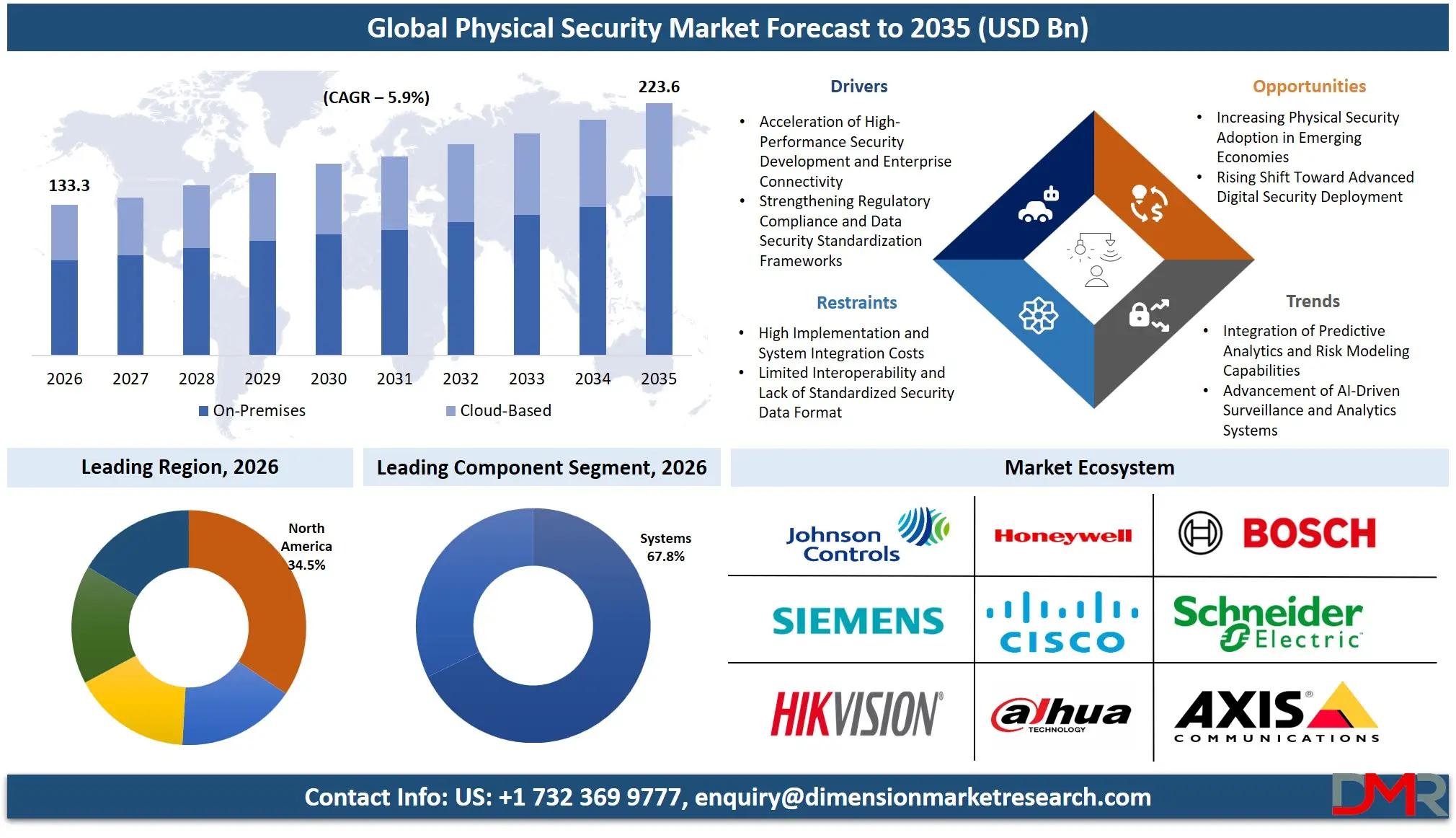
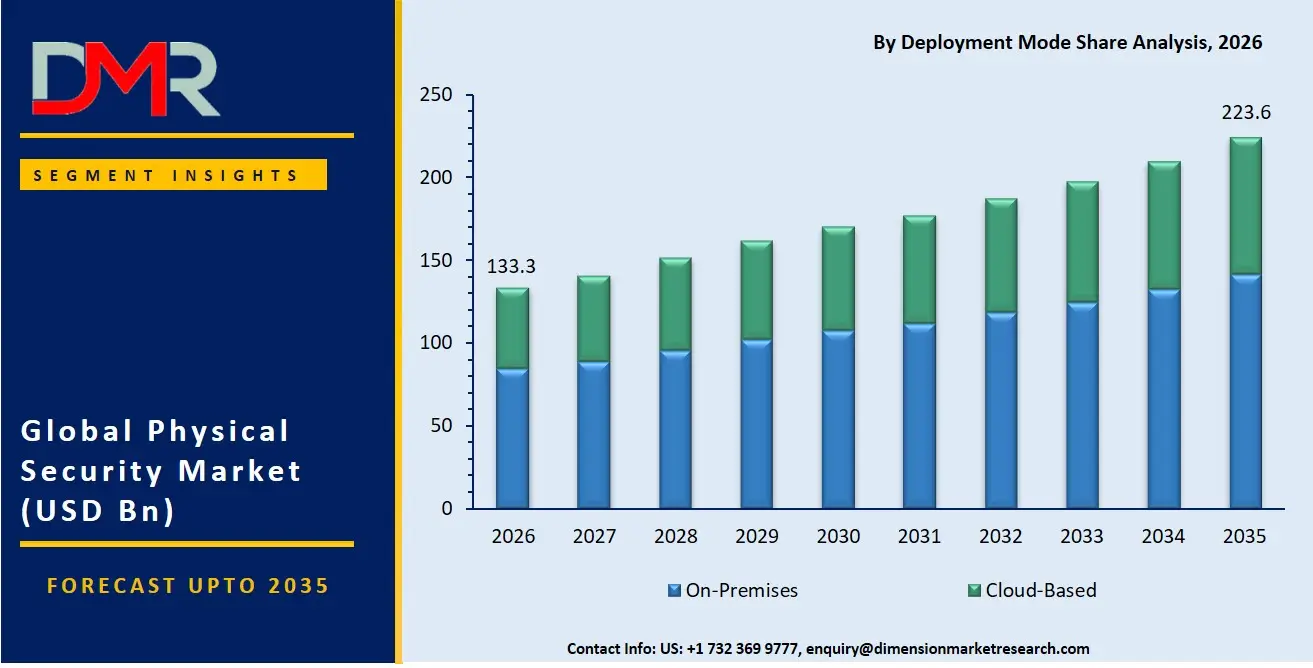
The global Physical Security Market is estimated at USD 133.3 billion in 2026 and projected to reach USD 223.6 billion by 2035, registering a CAGR of 5.9%. Growth is supported by demand for video surveillance, access control, perimeter intrusion detection, and integrated security systems across commercial, industrial, government, and transportation facilities.
ℹ
To learn more about this report –
Download Your Free Sample Report Here
Organizations are investing in physical security systems to protect people, buildings, equipment, and other assets. IP cameras, video management software, access control, intrusion alarms, and remote monitoring help security teams detect incidents and coordinate responses across multiple locations. AI-enabled video analytics and cloud-based platforms are also improving monitoring and system management.
Demand is further supported by smart-city projects, critical infrastructure protection, and security upgrades in commercial buildings, transport hubs, factories, and public facilities. Buyers also consider privacy, cybersecurity, interoperability, and data-retention requirements when selecting systems. Integration with legacy equipment and installation costs can affect deployment timelines.
ℹ
To learn more about this report –
Download Your Free Sample Report Here
The US Physical Security Market
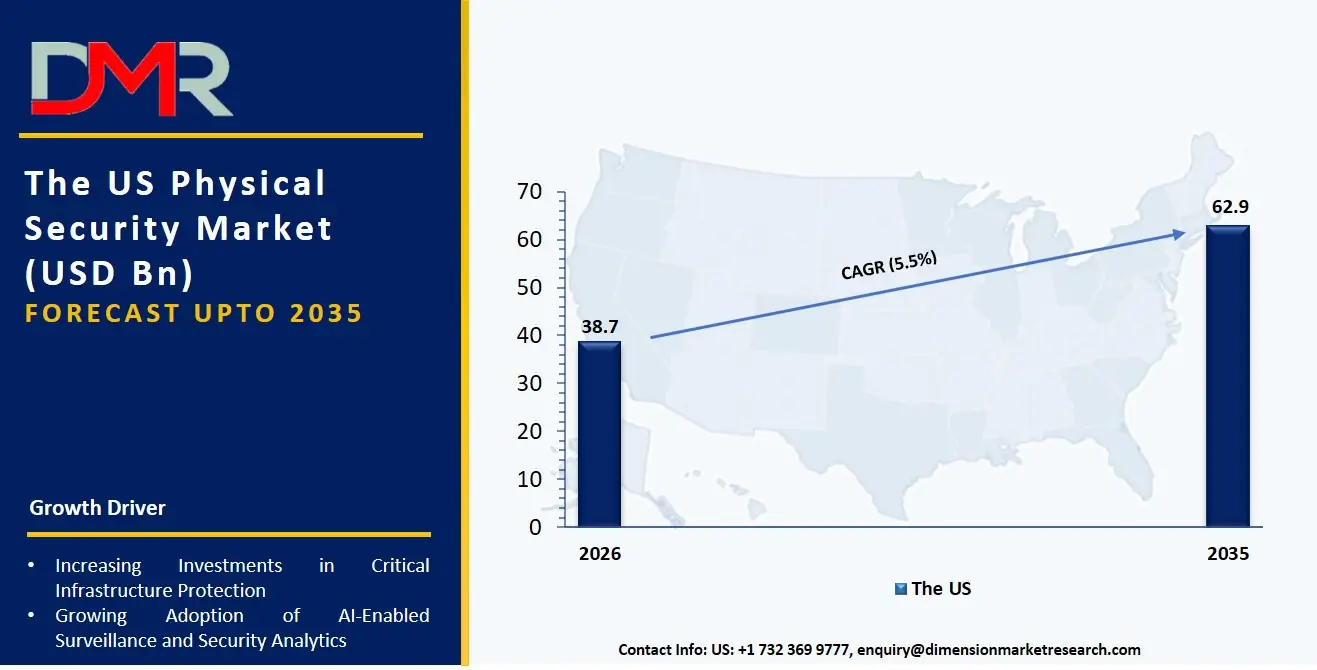
The US Physical Security Market is estimated to grow to USD 38.7 billion in 2026 with a compound annual growth rate of 5.5% during the forecast period.
The US market is shaped by major federal and state-level programs promoting secure security architectures, digital adoption supported by DHS and CISA, and DOD-led critical infrastructure modernization initiatives. These programs encourage the use of AI-powered surveillance, real-time video-in-transit protection, and predictive compliance software for security workflows. Automated security monitoring platforms are being rapidly adopted, and the US continues to invest in better data sharing between federal agencies, encrypted audit systems, and reliable threat detection tools for physical security platforms. Service providers are also influenced by laws like HIPAA, SOX, and national infrastructure strategies to offer services that ensure data security, rule-following, and smooth integration across hybrid and multi-site environments.
ℹ
To learn more about this report –
Download Your Free Sample Report Here
Europe Physical Security Market
The European Physical Security Market is estimated to be valued at USD 35.9 billion in 2026, witnessing growth at a CAGR of 5.4%, during the forecast period.
Europe's physical security market is well-established, shaped by the need to protect public spaces, commercial facilities, transport networks, and critical infrastructure. Organizations are upgrading video surveillance, access control, perimeter detection, and alarm systems to improve site monitoring and incident response. The region’s strong focus on data protection also influences how surveillance footage is collected, stored, and accessed. Demand is supported by smart-city projects, modernization of transport hubs and industrial sites, and the adoption of IP-based cameras and integrated security platforms. Cloud and hybrid solutions enable remote monitoring across multiple locations, while system integration and privacy requirements remain important purchasing considerations.
Japan Physical Security Market
The Japan Physical Security Market is projected to be valued at USD 5.0 billion in 2026, progressing at a CAGR of 5.1%, during the period spanning from 2026 to 2035.
Japan’s physical security market is supported by demand for surveillance, access control, and alarm systems across commercial buildings, factories, transport facilities, government sites, and public venues. Smart-city projects and efforts to modernize existing facilities are encouraging investment in connected cameras, video analytics, remote monitoring, and integrated security platforms. Older equipment and differences between vendors can make upgrades and system integration more complex, creating retrofit opportunities for interoperable IP cameras, access-control systems, and centralized monitoring platforms across commercial buildings, factories, transport facilities, and government sites.
Key Takeaways
- Market Size & Forecast: The Global Physical Security Market is estimated to be valued at USD 133.3 billion in 2026 and is expected to grow to USD 223.6 billion by 2035.
- Growth Rate & Outlook: The market is expected to witness growth at a CAGR of 5.9% in the forecast period.
- Primary Growth Drivers: The availability of new security technologies that use real-time threat detection, the need to speed up compliance results and improve success rates of public safety data sharing, and more government investment in national critical infrastructure protection are key growth drivers.
- Key Market Trends: The real-time profiling of access control stability risks, encrypted video data handling, and the shift to AI-driven surveillance platforms and automated security asset inventory management are key market trends.
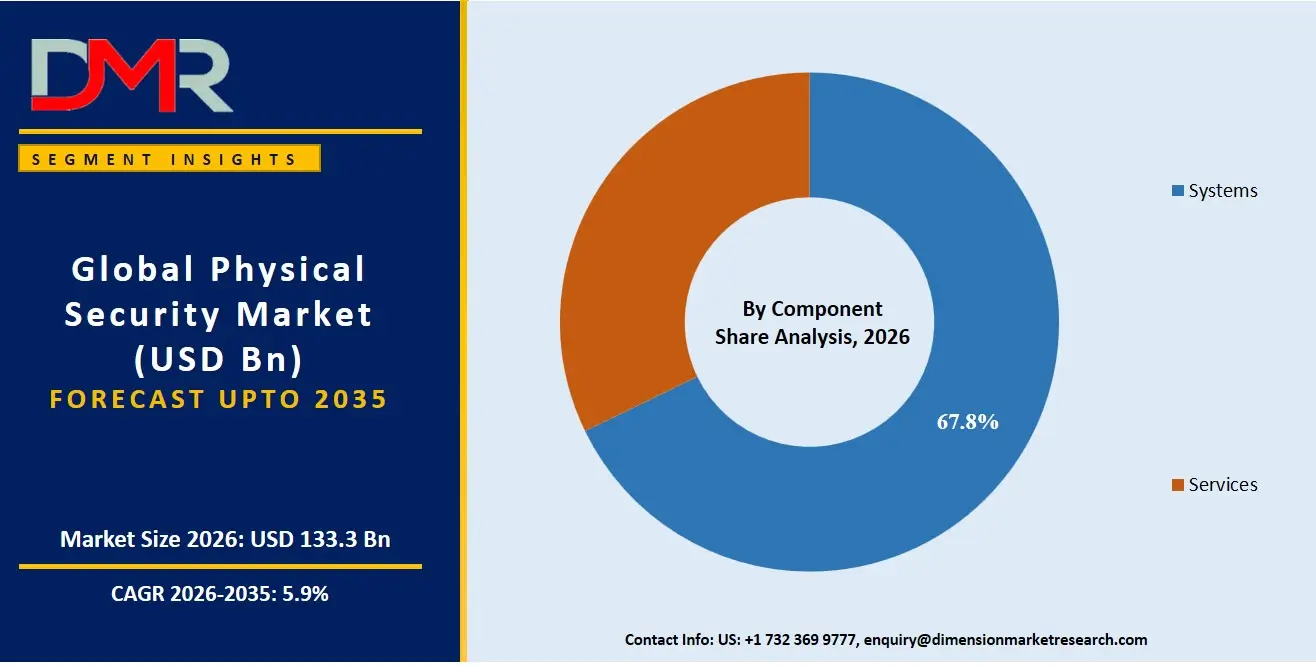
- By Component: The Systems segment is expected to take the largest revenue share in the global physical security market in 2026.
- By Deployment Mode: On-Premises is expected to take the largest revenue share in 2026 in the physical security market.
- By End-Use Vertical: The Government segment is estimated to take the lead in 2026 with the largest share in the physical security market.
- Regional Leadership: North America is estimated to take the lead in 2026 with 34.5% share in the physical security market.
What is Physical Security?
Physical security refers to the systems and measures used to protect people, buildings, equipment, and other physical assets from unauthorized access, theft, vandalism, intrusion, and safety hazards. The market includes video surveillance, physical access control, perimeter intrusion detection, security screening, physical security information management, and fire and life-safety systems. Solutions use cameras, sensors, alarms, identity credentials, and monitoring software. They can be deployed on premises, in the cloud, or through a hybrid model.
Use Cases
-
Video Surveillance and Incident Response: Cameras and video management systems monitor entrances, public areas, workplaces, and restricted zones. Operators can review live or recorded footage, verify alerts, and coordinate an appropriate response. Video analytics can also flag activity that may require attention.
-
Access Control and Visitor Management: Credential readers, mobile access, and biometric systems help verify identities, manage permissions, and record entry to buildings or restricted areas. Visitor-management tools can register guests, issue temporary credentials, and maintain entry logs.
-
Perimeter and Facility Protection: Cameras, motion detectors, and intrusion alarms help detect unauthorized entry around factories, warehouses, utilities, and transport sites. When a sensor detects activity, alerts can be sent to security staff for prompt investigation.
-
Integrated Security Operations: Physical security information management platforms combine video, access-control, and alarm data in one interface. This gives operators a shared view of events across systems and helps them assess incidents, prioritize alerts, and coordinate responses..
How AI Is Transforming the Global Physical Security Market?
Artificial intelligence is being used in video surveillance and access-control systems to identify objects, detect unusual activity, flag restricted-area entry, and prioritize alerts. These tools can help security teams review large volumes of footage and direct attention to events that may require investigation. Human review, privacy safeguards, and appropriate access controls remain important when using AI to assess security footage.
AI can also support equipment monitoring by identifying camera outages, storage issues, or other system faults. When integrated with access-control and alarm platforms, analytics can help operators understand an incident across multiple devices and locations. These capabilities can improve alert triage and system maintenance, while reducing reliance on manual monitoring alone.
Market Dynamics
Key Drivers of the Global Physical Security Market
Rising Adoption of Video Surveillance and Integrated Security Systems
Businesses and public agencies are installing IP cameras, video management systems, access-control platforms, and intrusion alarms to monitor facilities and manage security incidents. Multi-site organizations are adopting integrated platforms to oversee locations from centralized security operations centers. AI-enabled analytics and remote monitoring add tools for reviewing alerts and maintaining visibility across sites.
Greater Focus on Privacy, Cybersecurity, and System Interoperabilit
Organizations are paying closer attention to how surveillance footage and access records are collected, stored, shared, and retained. Privacy rules and procurement requirements can influence camera selection, data handling, and system configuration. Buyers also look for cybersecurity protections and compatibility with existing cameras, alarms, access-control platforms, and building systems.
Restraints in the Global Physical Security Market
High Implementation and System Integration Costs
The rollout of physical security systems remains costly, requiring significant investment in surveillance cameras, access control technologies, system integration, testing, and alignment with existing security workflows. In addition, following data regulations such as GDPR and other regional laws adds to setup complexity. These factors increase upfront costs and can limit adoption, especially among smaller enterprises and new companies entering the market.
Limited Interoperability and Lack of Standardized Security Data Format
There is still fragmentation in the market in terms of video data formats and access control procedures. Although some areas have put in place organized security management systems, many enterprises continue to work with both legacy systems and modern AI-based systems. Lack of standardized sensor protocols limits the ability to share security performance data between IT teams and security platform suppliers and results in inefficiencies in production, deployment, and system integration.
Growth Opportunities in the Global Physical Security Market
Increasing Physical Security Adoption in Emerging Economies
Emerging economies offer opportunities as governments and businesses upgrade security across expanding cities, transport networks, commercial properties, warehouses, utilities, and industrial sites. Demand is shifting from standalone analog CCTV toward IP video surveillance, access control, intrusion detection, and integrated monitoring platforms. Cloud-managed video and subscription-based monitoring can help organizations deploy systems across multiple locations, while local integrators can support installation and maintenance. Smart-city and infrastructure projects may create opportunities for vendors offering interoperable systems, cybersecurity features, and options to connect with existing equipment.
Rising Shift Toward Advanced Digital Security Deployment
The move to cloud-based security systems, decentralized IT networks, and real-time performance checks is driving the adoption of advanced physical security systems. These systems allow centralized video access, better coordination between security teams and market participants, and faster security asset inventory management. Advanced digital setups are increasingly becoming a trend among modern security providers as operational efficiency becomes one of the competitive factors.
Global Physical Security Market Trends
Integration of Predictive Analytics and Risk Modeling Capabilities
Physical security platforms are gradually adding AI-driven technology to find system degradation trends and improve accuracy in security asset inventory management. These systems allow security teams and enterprise operators to study their surveillance units' video activity behavior better, simplify the management of their security portfolios, and improve their overall security performance. This move is slowly turning the industry more proactive and data-driven in threat prevention instead of being purely reactive in security operations.
Advancement of AI-Driven Surveillance and Analytics Systems
The use of AI-based surveillance systems is currently becoming a basic part of today's cloud-based security operations. These systems allow real-time access control stability monitoring, centralized security asset administration, and better network coordination among market participants. Advanced physical security platforms are improving the efficiency and responsiveness of platform providers that operate in different regions by reducing dependence on manual security processes and allowing operations to grow more easily.
Research Scope and Analysis
The global physical security market is witnessing strong growth driven by rising adoption of advanced surveillance technologies, site-wide optimization, and increasing demand for high-security and high-efficiency asset protection processes. The market is segmented based on component, deployment mode, organization size, and end-use vertical.
ℹ
To learn more about this report –
Download Your Free Sample Report Here
By Component Analysis
The Systems segment is likely to continue dominating the market in 2026, accounting for approximately 67.8% of the global physical security market share. This dominance is driven by widespread deployment of video surveillance systems, physical access control systems (PACS), perimeter intrusion detection and prevention systems (PIDS), and fire & life safety solutions across commercial, industrial, government, and transportation environments. Growing investments in AI-enabled surveillance, biometric authentication, and integrated security platforms are further supporting demand for advanced physical security systems. Within the Systems segment, Video Surveillance Systems hold the largest share, driven by increasing adoption of IP-based cameras, cloud-connected monitoring, and AI-powered video analytics for real-time threat detection and situational awareness. The Services segment continues to expand steadily, driven by increasing demand for system integration, managed monitoring, maintenance, and security consulting services.
By Deployment Mode Analysis
The On-Premises segment is likely to continue holding the lead in 2026, accounting for approximately 56.0% of the global physical security market share, driven by strong demand for high-control, compliance-ready security, regulatory flexibility, and flexible processing across government and defense sectors. This segment reflects the continued preference for air-gapped and auditable security operations. The Cloud-Based segment is the second-largest and fastest-growing, supported by enterprise scalability needs and government incentives for remote monitoring services such as VSaaS and ACaaS. On-Premises remains a mature segment focused on regulated industries where data security and compliance are critical.
By Organization Size Analysis
The Large Enterprises segment is expected to dominate with around 68.5% market share in 2026, driven by the need for enterprise-wide digital transformation, multi-site standardization, and significant capital budgets. Large-scale enterprises are adopting integrated security platforms to optimize global security networks and ensure operational excellence. The Small & Medium Enterprises (SMEs) segment is the fastest-growing, supported by lower entry costs, subscription-based pricing (VSaaS, ACaaS), and increasing awareness of automation benefits.
By End-Use Vertical Analysis
The Government segment is the largest end-use vertical in 2026, accounting for approximately 26.0% share, driven by the need for consistent real-time threat data, critical infrastructure protection, and public safety performance. This segment reflects the continued shift toward digitalization of large-scale continuous security operations. The Transportation segment is the second-largest and fastest-growing, supported by regulatory mandates for cargo and passenger security (e.g., TSA, AEO), high-traffic data requirements, and traceability needs. Retail and Industrial represent specialized segments with dedicated physical security requirements for loss prevention and asset protection.
The Global Physical Security Market Report is segmented based on the following:
By Component
- Systems
- Physical Access Control Systems (PACS)
- Video Surveillance Systems
- Perimeter Intrusion Detection and Prevention Systems (PIDS)
- Physical Security Information Management (PSIM)
- Physical Identity and Access Management (PIAM)
- Security Scanning, Imaging & Metal Detection Systems
- Fire & Life Safety Systems
- Services
- System Integration & Professional Services
- Managed & Remote Monitoring Services
- Other Services
By Deployment Mode
By Organization Size
- Large Enterprises
- Small and Medium Enterprises (SMEs)
By End-Use Vertical
- Transportation
- Government
- Retail
- Residential
- Industrial
- BFSI
- Others
Regional Analysis
Largest Region in the Physical Security Market
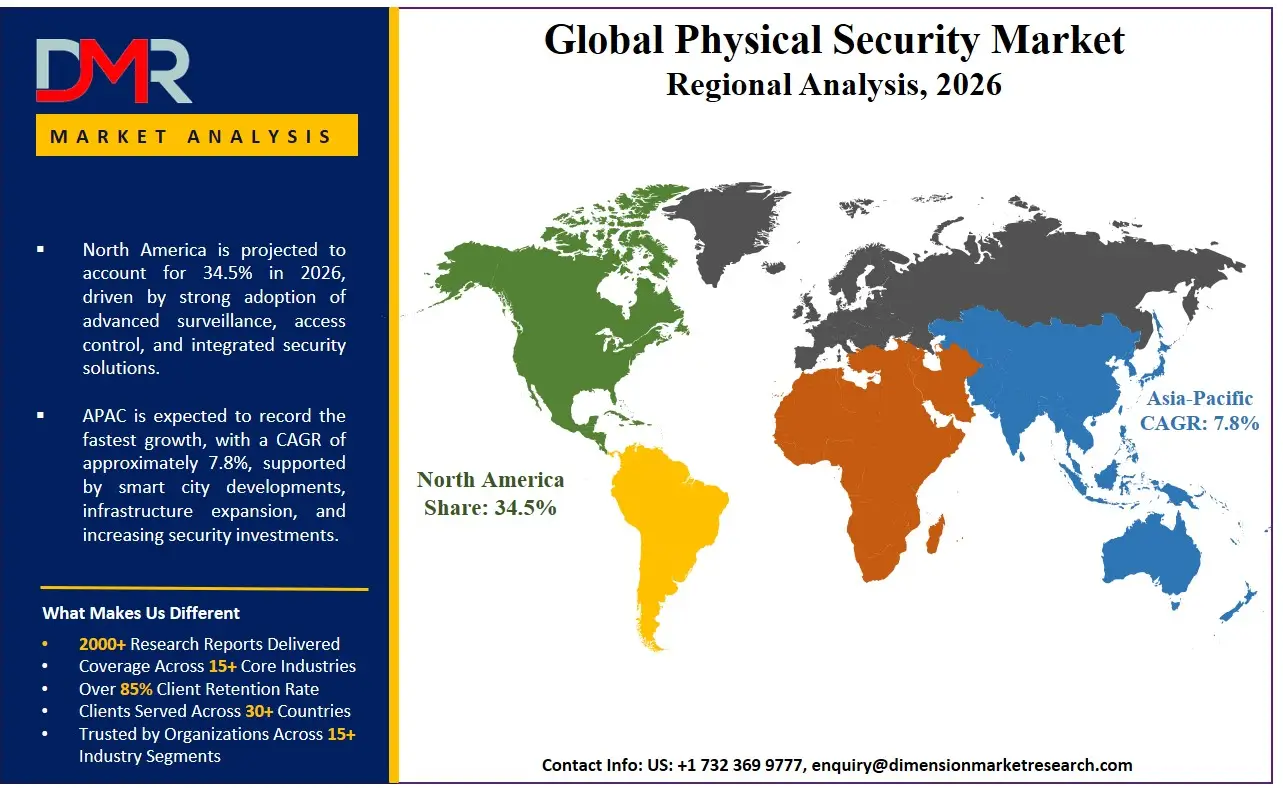
It is projected that North America will take the lead in the global physical security market, covering a market share of about 34.5% in the year 2026. The region's dominance is driven by the presence of major physical security vendors, strong regulatory frameworks such as HIPAA, SOX, and state-level video privacy mandates, and early adoption of AI-driven surveillance and predictive maintenance technologies across the government and BFSI sectors. North America benefits from significant investment in enterprise digitalization, the highest concentration of cloud modernization projects in the US, and strong government support through DHS and NIST funding for secure integration. The region is also home to major security platform providers and system integrators, enabling rapid deployment of enterprise-wide PSIM. Additionally, ongoing investments in workforce training using AR/VR and operator training simulators further strengthen North America's leading position. The widespread adoption of AI-based video analytics for threat detection, security optimization, and site-wide surveillance continues to reinforce the region's market leadership.
ℹ
To learn more about this report –
Download Your Free Sample Report Here
Fastest-Growing Region in the Physical Security Market
Asia-Pacific is the fastest-growing region, supported by aggressive domestic security expansion in China and India, substantial government funding for smart city and Safe City initiatives, and increasing investments in greenfield security complexes that integrate AI surveillance from the initial design phase. The region is witnessing rapid growth in cloud-based security deployments, driving demand for cloud-based video management and analytics software. Asia-Pacific is also at the forefront of AI-driven security deployment in high-growth sectors like transportation and retail. The region benefits from lower installation costs, driving faster ROI on automation, along with rising corporate commitments to operational excellence and security compliance. Growing focus on video data protection for export markets further accelerates market expansion. Moreover, increasing data privacy regulations and the need to reduce security breaches in rapidly industrializing economies are expected to keep Asia-Pacific's growth momentum as the highest CAGR region during the forecast period.
By Region
North America
Europe
- Germany
- The U.K.
- France
- Italy
- Russia
- Spain
- Benelux
- Nordic
- Rest of Europe
Asia-Pacific
- China
- Japan
- South Korea
- India
- ANZ
- ASEAN
- Rest of Asia-Pacific
Latin America
- Brazil
- Mexico
- Argentina
- Colombia
- Rest of Latin America
Middle East & Africa
- Saudi Arabia
- UAE
- South Africa
- Israel
- Egypt
- Rest of MEA
Competitive Landscape
Competition in the physical security market is shaped by the range and performance of vendors’ cameras, access-control systems, intrusion detection products, video management software, and integrated security platforms. Companies compete through video analytics, cybersecurity features, cloud-management options, interoperability, installation support, and the ability to serve multi-site customers.
Entry barriers include product development costs, certification and testing requirements where applicable, integration with installed equipment, technical support, and the need to build trusted relationships with customers and channel partners. Companies seek to strengthen their position through product launches, partnerships with system integrators, acquisitions, cloud-based services, and long-term maintenance contracts.
Some of the prominent players in the Global Physical Security Market are:
- Johnson Controls International plc
- Honeywell International Inc.
- Robert Bosch GmbH
- Siemens AG
- Schneider Electric SE
- Cisco Systems, Inc.
- Hangzhou Hikvision Digital Technology Co., Ltd.
- Zhejiang Dahua Technology Co., Ltd.
- Axis Communications AB
- ASSA ABLOY AB
- Allegion plc
- Motorola Solutions, Inc.
- Genetec Inc.
- Hanwha Vision Co., Ltd.
- Milestone Systems A/S
- Verkada Inc.
- ADT Inc.
- SECOM Co., Ltd.
- Securitas AB
- Allied Universal Holdco, LLC
- Other Key Players
Recent Developments
- March 2026: Johnson Controls International announced next-generation upgrades across its physical security portfolio at ISC West 2026, including enhancements to the C•CURE IQ platform, integrated video management capabilities, AI-driven incident management tools, and expanded interoperability across access control and surveillance ecosystems. The development strengthens the company’s position in enterprise-grade integrated physical security solutions.
- March 2026: Motorola Solutions, Inc. announced the acquisition of Exacom, a provider of cloud-native recording and logging solutions for emergency communications and public safety operations. The acquisition enhances Motorola Solutions’ command center and physical security ecosystem by improving incident recording, evidentiary management, and AI-enabled emergency response workflows.
- March 2026: Hanwha Vision Co., Ltd. launched BLAZE Hybrid AI Video Management System (VMS), a next-generation platform integrating AI-powered analytics, hybrid cloud architecture, centralized multi-site management, and seamless interoperability with Hanwha surveillance devices. The launch supports the company’s strategy of expanding software-driven and AI-enabled physical security ecosystems.
- February 2026: Verkada Inc. introduced its AI-Powered Deterrence platform, leveraging large vision, language, and audio models to proactively identify suspicious behavior, automate threat detection, and generate contextual voice-based warnings before security incidents occur. The launch reflects the growing integration of generative AI and autonomous response capabilities within cloud-based physical security systems.
Report Details
| Report Characteristics |
| Market Size (2026) |
USD 133.3 Bn |
| Forecast Value (2035) |
USD 223.6 Bn |
| CAGR (2026–2035) |
5.9% |
| The US Market Size (2026) |
USD 38.7 Bn |
| Historical Period |
2021 – 2025 |
| Forecast Period |
2027 – 2035 |
| Base Year |
2025 |
| Estimated Year |
2026 |
| Segments Covered |
By Component, By Deployment Mode, By Organization Size, By End-Use Vertical |
| Regional Coverage |
North America – The US and Canada; Europe – Germany, The UK, France, Russia, Spain, Italy, Benelux, Nordic, & Rest of Europe; Asia-Pacific – China, Japan, South Korea, India, ANZ, ASEAN, Rest of APAC; Latin America – Brazil, Mexico, Argentina, Colombia, Rest of Latin America; Middle East & Africa – Saudi Arabia, UAE, South Africa, Turkey, Egypt, Israel, & Rest of MEA |
Frequently Asked Questions
How big is the Global Physical Security Market?
▾ The Global Physical Security Market is estimated to be valued at USD 133.3 billion in 2026 and is expected to reach USD 223.6 billion by the end of 2035.
What is the CAGR of the Global Physical Security Market from 2026 to 2035?
▾ The market is growing at a CAGR of 5.9% over the forecasted period.
What factors are driving the growth of the Global Physical Security Market?
▾ The market is driven by advances in real-time threat detection and automated security enforcement, regulatory pressure to speed up security compliance results and reduce system failure mistakes, and increased government investment in national critical infrastructure protection.
What are the major trends in the Global Physical Security Market?
▾ The key market trends include the adoption of real-time access control stability tracking and encrypted video analysis, along with a growing shift toward AI-driven surveillance platforms and automated security asset inventory management systems.
Which region held the largest share of the Global Physical Security Market in 2026?
▾ North America is expected to account for the largest market share in 2026, with a share of about 34.5%.
Which region is expected to grow the fastest in the Global Physical Security Market?
▾ Asia Pacific is the fastest-growing region in the market during the forecast period.
Who are the key players in the Global Physical Security Market?
▾ Some of the major key players in the Global Physical Security Market are Johnson Controls International plc, Honeywell International Inc., Robert Bosch GmbH, Motorola Solutions Inc., Axis Communications AB, and many others.
How is the Global Physical Security Market segmented?
▾ The market is segmented by component, deployment mode, organization size, and end-use vertical.