Market Overview
The global physiotherapy equipment market covers devices and systems used by clinicians, rehabilitation specialists, and patients to restore physical function, manage pain, and prevent long-term disability. Product categories span electrotherapy systems, ultrasound units, hydrotherapy equipment, cryotherapy devices, continuous passive motion machines, heat therapy tools, and therapeutic exercise platforms. The market excludes pharmaceutical pain management and surgical interventions, positioning it squarely within the physical rehabilitation and non-invasive care continuum.
As reported by the World Health Organization, about 2.4 billion people globally live with a health condition that may benefit from rehabilitation. That scale of unmet need converts directly into sustained institutional purchasing pressure across hospitals, outpatient clinics, and rehabilitation centers worldwide. No single product category or geography captures that demand alone, which explains why the market spans a wide competitive field of specialist device makers and diversified medical technology companies.
Technology integration is reshaping procurement decisions at the facility level. Buyers now evaluate equipment on connectivity, data output, and compatibility with electronic health record systems, not only on therapeutic efficacy. Vendors unable to offer digital reporting or remote monitoring capabilities face displacement, regardless of their clinical reputation. The shift is structural, not cyclical.
Key Takeaways
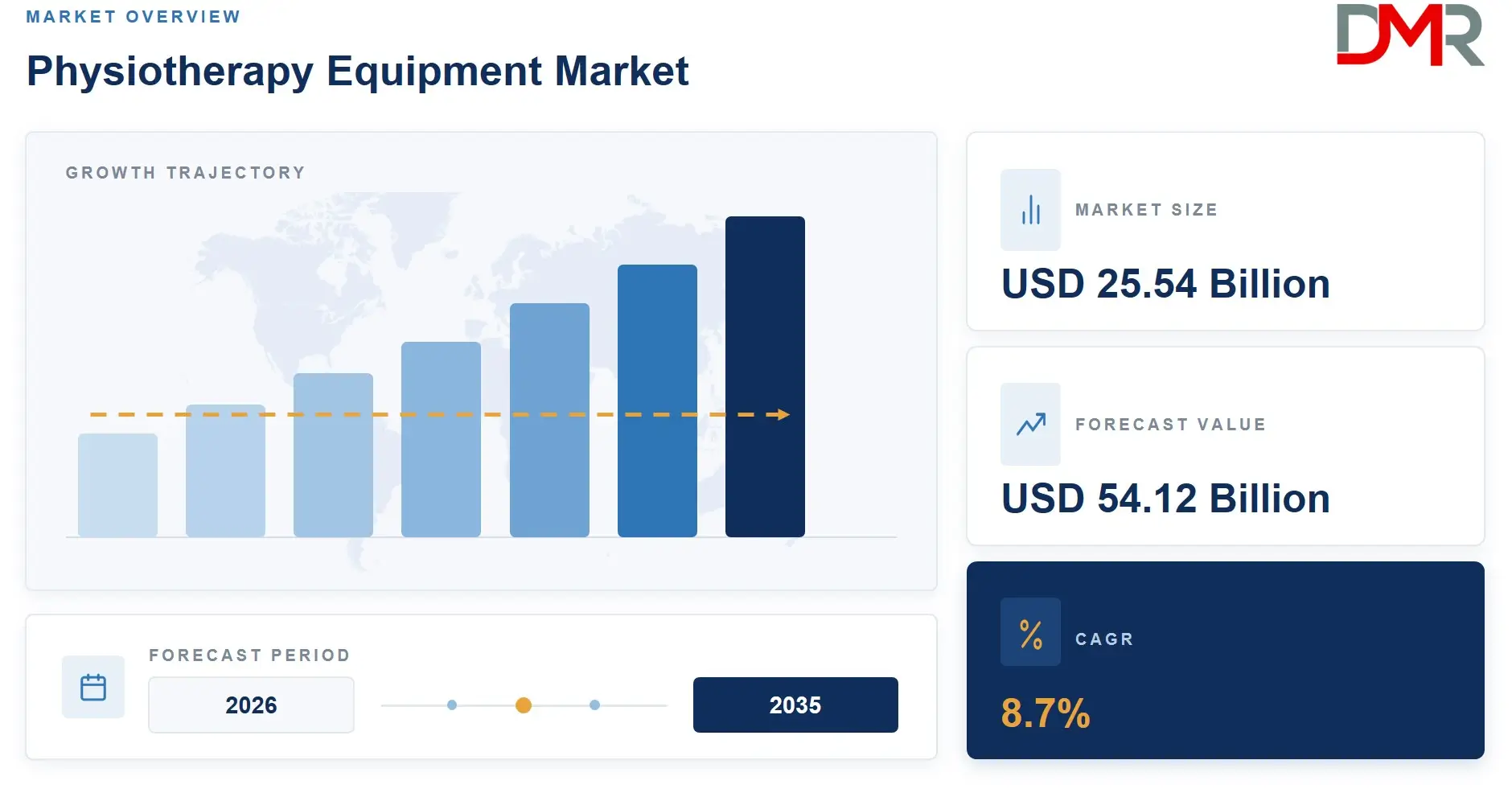
- The market size is USD 25.54 Billion in 2026, and is projected to hit USD 54.12 Billion by 2035 at a CAGR of 8.7%.
- By Application: Musculoskeletal led as the largest category with a 61.2% share in 2026.
- By Type: Ultrasound led as the largest and fastest-growing category in 2026.
- By Demographics: Non-Geriatric Population led as the largest category with a 54.8% share in 2026.
- By End Use: Hospitals & Clinics led as the largest category with a 50.6% share in 2026.
- By Region: North America led with a 40.6% share, valued at USD 9.4 Billion, in 2026.
- Cardiovascular & Pulmonary is the fastest-growing application segment, and the Geriatric Population is the fastest-growing demographic group, signaling accelerating demand from aging and chronic-disease patient cohorts.
Market Size and Forecast
The Global Physiotherapy Equipment Market size is estimated at USD 25.54 Billion in 2026, and is projected to reach USD 54.12 Billion by 2035, exhibiting a CAGR of 8.7% during the forecast period.
According to WHO projections, the global population aged 60 years and above will rise from 1.1 billion in 2023 to 1.4 billion by 2030. That demographic shift underpins the forecast directly. Rehabilitation device demand scales with age-related functional decline, chronic disease prevalence, and post-surgical recovery volumes, all of which rise as populations age. Forecasters building the 2026 to 2035 trajectory embed these aging dynamics as baseline assumptions, not upside scenarios.
ℹ
To learn more about this report –
Download Your Free Sample Report Here
Enovis Corporation completed the acquisition of LimaCorporate, with total cash consideration of $757.7 million net of acquired cash, at an announced enterprise value of approximately €800 million. Transactions of this scale confirm that leading vendors are consolidating clinical portfolios rather than competing on device categories alone. Buyers can expect broader multi-modality offerings from the top tier of competitors across the forecast window.
Application Analysis
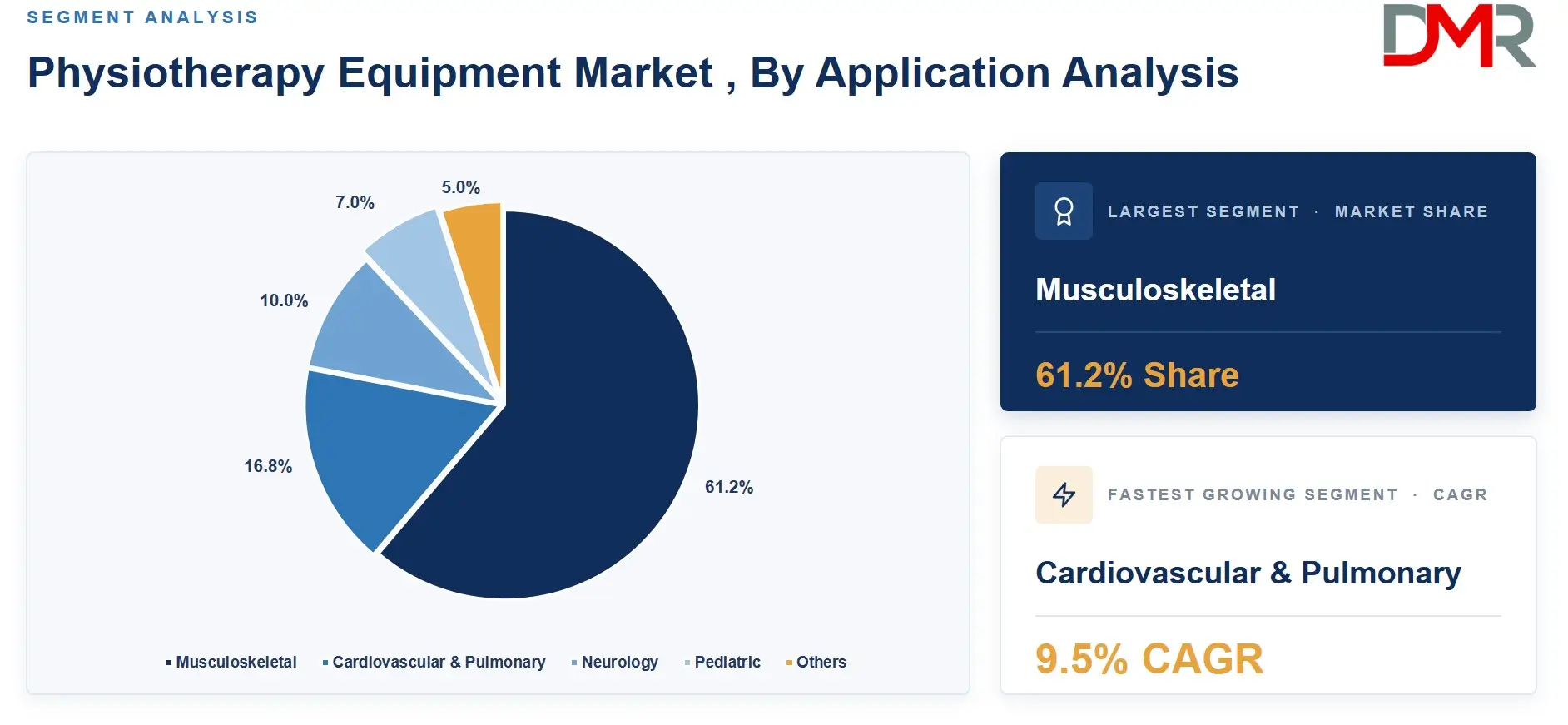
Musculoskeletal accounted for 61.2% of application demand in 2026, the highest of any category.
Musculoskeletal disorders generate the largest and most consistent volume of physiotherapy referrals across hospital and outpatient settings globally. Orthopedic post-operative rehabilitation, chronic back pain management, and sports injury recovery collectively sustain equipment utilization at high weekly rates. Facilities treating musculoskeletal patients require diverse device mixes, from ultrasound and electrotherapy to exercise equipment, making this segment the primary revenue driver for most equipment vendors.
Cardiovascular and pulmonary therapy is the fastest-growing application category, supported by a disease burden of serious scale. Cardiovascular diseases caused an estimated 19.8 million deaths in 2022, equivalent to approximately 32% of all global deaths, as reported by the World Health Organization. Survivor populations require structured cardiopulmonary rehabilitation, and hospital systems are expanding dedicated programs to address that need. Neurology, pediatric, and other application areas represent smaller but clinically distinct demand pools that specialist vendors target with dedicated product lines.
ℹ
To learn more about this report –
Download Your Free Sample Report Here
Type Analysis
Ultrasound led the Type segment as the largest and fastest-growing category in 2026.
Ultrasound therapy devices hold the top position across the type segment because they address multiple clinical applications, including soft tissue repair, pain relief, and post-operative recovery, within a single platform. Clinics across physiotherapy specialties rely on ultrasound as a foundational modality. Vendors offering portable and tabletop ultrasound units capture demand from both high-volume hospital departments and smaller outpatient practices.
Electric stimulation, heat therapy, and hydrotherapy represent established but slower-growing type categories that compete primarily on price in mature markets. Cryotherapy and continuous passive motion devices serve narrower post-surgical and orthopedic niches. Therapeutic exercise equipment is expanding in scope as robotic and digitally guided systems enter the category, creating a premium tier that commands higher per-unit revenue than conventional exercise tools.
Demographics Analysis
With a 54.8% share in 2026, Non-Geriatric Population outpaced all other demographic categories.
Non-geriatric patients account for the majority of physiotherapy encounters because sports injuries, workplace musculoskeletal strain, post-surgical rehabilitation, and neurological recovery events affect working-age populations at high frequency. Employers, insurers, and national health systems all fund rehabilitation for this cohort, sustaining reliable institutional procurement cycles.
Geriatric patients are the fastest-growing demographic segment. Age-related functional decline, hip and knee replacement volumes, and stroke recovery needs create a structurally expanding demand pool as populations age in North America, Europe, and Asia Pacific. Vendors designing lightweight, easy-to-operate devices suitable for older patients are well-positioned to capture share in both long-term care and home rehabilitation settings.
End Use Analysis
Hospitals & Clinics captured 50.6% of the End Use segment in 2026, ahead of all rivals.
Hospitals and clinics command the largest end-use share because they concentrate the highest volumes of acute rehabilitation cases, including post-surgical patients, trauma recovery, and neurological events. Procurement cycles at hospital level involve capital budgets, multi-year service contracts, and formal tender processes, creating predictable revenue streams for established equipment suppliers.
Rehabilitation centers represent the next significant end-use category, driven by outpatient expansion across major economies. Independent physiotherapy clinics and the others category, including home care and corporate wellness programs, are smaller in current share but growing in relevance as care delivery shifts away from acute hospital settings toward ambulatory and home-based models.
Key Market Segments
By Application
- Musculoskeletal
- Neurology
- Cardiovascular & Pulmonary
- Pediatric
- Others
By Type
- Ultrasound
- Hydrotherapy
- Cryotherapy
- Continuous Passive Motion (CPM)
- Electric Stimulation
- Heat Therapy
- Therapeutic Exercise
- Others
By Demographics
- Non-Geriatric Population
- Geriatric Population
By End Use
- Hospitals & Clinics
- Rehabilitation Centers
- Others
Regional Analysis
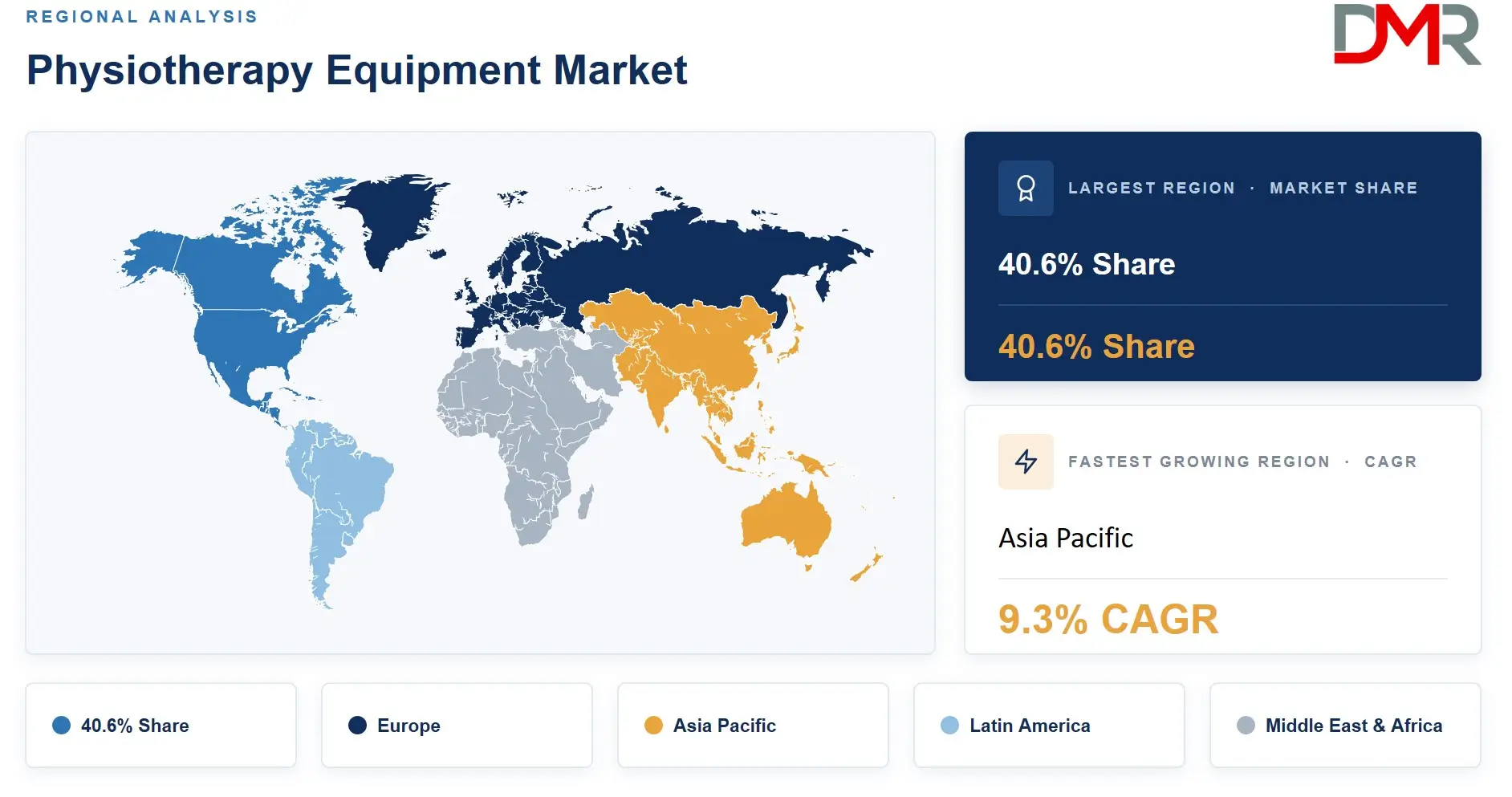
North America led the physiotherapy equipment market with a 40.6% share, valued at USD 9.4 Billion, in 2026.
North America
North America's dominance reflects a combination of high per-capita healthcare expenditure, established private insurance reimbursement for outpatient physiotherapy, and a large aging population concentrated in the United States. Hospital systems and outpatient rehabilitation chains invest in advanced electrotherapy, robotic rehabilitation, and digitally connected modalities at a pace no other region matches. Canada contributes meaningfully through publicly funded rehabilitation programs, particularly in post-acute and long-term care settings.
ℹ
To learn more about this report –
Download Your Free Sample Report Here
Europe
Europe holds the second-largest regional position, anchored by Germany, France, and the United Kingdom. Public health systems in these markets fund physiotherapy as a standard care pathway for orthopedic, neurological, and cardiac patients. Regulatory alignment under EU medical device frameworks supports faster cross-border product commercialization, giving European-headquartered vendors such as BTL Industries, EMS Physio, and Ottobock structural advantages in their home markets.
Asia Pacific
Asia Pacific is the highest-growth regional opportunity across the forecast period. China's hospital infrastructure expansion, Japan's rapidly aging population, and India's growing outpatient rehabilitation sector each pull demand from different product tiers. Government-led healthcare investment programs in South Korea and Australia are funding equipment upgrades in public hospitals, while private clinic networks across Southeast Asia absorb mid-tier portable devices.
Latin America
Latin America remains an emerging market for physiotherapy equipment, with Brazil and Mexico as the primary demand centers. Public hospital systems in both countries face constrained capital budgets, which limits adoption of premium robotic and advanced electrotherapy platforms. Mid-tier equipment vendors and leasing model providers are best positioned to capture share as outpatient rehabilitation infrastructure develops.
Middle East & Africa
Gulf Cooperation Council nations are the primary demand drivers within the Middle East and Africa region. Saudi Arabia and the UAE are funding hospital expansion and rehabilitation center development under national health transformation programs. Sub-Saharan Africa and other MEA markets remain constrained by purchasing power and limited specialist clinical infrastructure, leaving near-term potential concentrated in GCC urban centers.
Key Regions and Countries
North America
Europe
- Germany
- France
- The UK
- Spain
- Italy
- Rest of Europe
Asia Pacific
- China
- Japan
- South Korea
- India
- Australia
- Rest of APAC
Latin America
- Brazil
- Mexico
- Rest of Latin America
Middle East & Africa
- GCC
- South Africa
- Rest of MEA
Macroeconomic Impact
The World Bank projected global economic growth at 2.3% in 2025, a subdued pace that constrains capital equipment budgets in public health systems across emerging markets. As reported by the WTO, world merchandise-trade volume grew by 4.6% in 2025, supporting supplier logistics and component sourcing for device manufacturers operating global supply chains. Modest GDP growth compresses procurement timelines at the hospital level, particularly in Latin America and parts of the Middle East, where government budget cycles directly govern equipment purchasing.
Medical device supply chains depend on maritime freight networks. Data from UNCTAD shows global maritime trade increased by 2.4% to 12.3 billion tons in 2023, with maritime transport carrying more than 80% of world trade volume. Freight cost volatility and port congestion events pass through to device manufacturers as input cost risk, reinforcing the case for regional production strategies among vendors serving high-volume Asian markets.
Market Dynamics
Driver: Ageing Populations and Chronic Disease Burden Expand Rehabilitation Volumes
Musculoskeletal conditions affect approximately 1.71 billion people worldwide, as reported by the World Health Organization. Osteoarthritis alone affected 528 million people globally in 2019, a 113% increase from 1990, according to WHO data. Both figures show the underlying patient pool is not static. Rehabilitation device demand scales directly with this population, converting chronic disease prevalence into sustained equipment procurement across hospital, clinic, and home settings.
Neurological conditions present a parallel demand source. More than 3 billion people were living with a neurological condition in 2021, as confirmed by WHO findings. Stroke survivors, patients with multiple sclerosis, and those recovering from traumatic brain injuries all require structured physical rehabilitation programs, many of them long-term. Enovis launched the Intelect® Legend 2 and Intelect® Transport 2 electrotherapy systems in February 2024, expanding clinical tool availability for physiotherapists managing these complex patient profiles.
Restraint: High Equipment Costs and Reimbursement Instability Slow Procurement
Robotic rehabilitation systems and advanced electrotherapy platforms carry high capital costs that most independent physiotherapy clinics and small rehabilitation centers cannot absorb from operating budgets alone. Specialist training requirements for robotic systems add recurring cost layers on top of acquisition price. Together, these factors concentrate advanced technology purchases within large hospital networks and well-funded rehabilitation chains, leaving a substantial portion of the clinical market underequipped.
Reimbursement policy volatility compounds the capital barrier. Unstable physiotherapy reimbursement rates in markets including parts of the United States and several European healthcare systems reduce provider confidence in multi-year equipment investments. Restricted direct-access policies in certain jurisdictions limit patient self-referral volumes, directly constraining clinic throughput and the economic case for premium device purchases.
Opportunity: Flexible Procurement Models and Home-Care Demand Unlock New Buyer Segments
Pay-per-use and equipment-leasing structures are removing the capital barrier for cash-constrained independent clinics and emerging-market providers. Vendors offering subscription or utilization-based pricing gain access to buyer segments that traditional direct-sale models cannot reach. An estimated 1.3 billion people globally experience significant disability, as per WHO data, and many require rehabilitation support in settings where conventional equipment ownership is not financially viable.
Employer-sponsored musculoskeletal prevention programs represent a distinct and underexploited opportunity channel. Corporate buyers purchasing on-site digital assessment and therapy devices operate outside traditional healthcare procurement, reducing exposure to reimbursement volatility. Value-based procurement platforms that link device utilization data to measurable functional recovery outcomes give institutional buyers quantifiable return-on-investment evidence, accelerating purchasing decisions in health systems under cost-efficiency pressure.
Porter's Five Forces
Competitive rivalry in the physiotherapy equipment market is high across mid-tier electrotherapy and ultrasound categories, where more than a dozen established vendors compete on price, clinical features, and distributor relationships. Threat of new entrants is moderate at the product level but low in robotic rehabilitation and advanced neuromodulation, where regulatory clearance costs, clinical validation requirements, and service infrastructure create durable entry barriers. Supplier bargaining power is concentrated among manufacturers of precision electronic components and specialized transducer materials, giving component suppliers meaningful pricing influence over device manufacturers with narrow component-sourcing options.
Buyer bargaining power is strongest among large hospital networks and group purchasing organizations, which negotiate volume-based contracts across multiple device categories. Individual clinics and small rehabilitation centers hold limited leverage. Threat of substitutes is real but bounded: pharmaceutical pain management and surgical intervention address overlapping patient conditions, but neither replicates the functional restoration outcomes that physical rehabilitation delivers, preserving physiotherapy equipment's clinical necessity across most patient pathways.
AI and Gen AI Impact
Artificial intelligence is entering the physiotherapy equipment market primarily through motion analytics, wearable sensor data interpretation, and adaptive therapy protocol generation. AI-enabled systems analyze patient movement data in real time, identifying compensation patterns and recovery plateaus that manual observation misses. Vendors embedding AI-driven progress monitoring into connected therapy platforms differentiate on clinical outcomes data, a capability that resonates strongly with value-based procurement buyers.
Ottobock announced the second generation of its exopulse suit in June 2025, an electrical neuromodulation device targeting people with neurological conditions including cerebral palsy, multiple sclerosis, and stroke. The device embeds adaptive stimulation logic that adjusts to patient response, moving beyond static protocol delivery toward responsive neurorehabilitation. Vendors without equivalent real-time adaptive capabilities risk being displaced from premium rehabilitation segments as clinicians demand outcome evidence alongside device performance data.
Market Trends
Modular Connected Platforms and Portable Devices Reshape Therapy Delivery Models
Connected modular therapy platforms that consolidate electrotherapy, ultrasound, exercise guidance, and patient-progress monitoring into unified workflows are displacing single-modality standalone devices at the facility level. Compact TENS, portable ultrasound, and handheld electrotherapy tools are simultaneously enabling hybrid home-and-clinic rehabilitation models that reduce per-session facility costs. Ottobock introduced the Nexgear family of orthotic joints in January 2025, comprising five titanium- and steel-based joints supporting personalized AFO and KAFO rehabilitation applications. Early movers embedding connectivity and portability into core product design capture both institutional and home-care buyer segments simultaneously.
Market Competition Overview
The physiotherapy equipment market is fragmented across product categories but shows consolidation at the top tier. Large diversified medical technology companies compete across multiple device categories through acquisition-led portfolio expansion, while specialist vendors defend niche positions in electrotherapy, hydrotherapy, or robotic rehabilitation. No single competitor holds dominant share across all segments, creating an environment where category leadership is contested rather than structurally fixed.
Enovis Corporation completed five bolt-on acquisitions in Q1 2025 for total consideration of $30.0 million, with three targeting its Prevention and Recovery business directly. This acquisition pace signals that scale players are prioritizing portfolio breadth over organic product development speed. Vendors that cannot match the pace of portfolio expansion through M&A or internal R&D investment risk ceding clinical category leadership to better-resourced competitors within the forecast window.
Pricing Analysis
Physiotherapy equipment pricing spans several orders of magnitude, from sub-hundred-dollar portable TENS units sold direct-to-consumer to robotic rehabilitation systems priced above USD 100,000 per installation. Electrotherapy and ultrasound units occupy the mid-market tier, where competition among established vendors creates sustained pricing pressure. Heat therapy and basic exercise equipment compete on commodity economics in mature markets, with price leadership going to manufacturers with the lowest-cost production bases.
Premium pricing holds in robotic rehabilitation, AI-enabled motion analysis, and neuromodulation devices where clinical evidence supports outcome differentiation. Vendors in these categories face a two-tier negotiation dynamic: hospital procurement teams seek volume discounts while demanding full-service contracts, and individual clinics favor leasing structures that convert capital cost into predictable monthly expense. Geographic pricing variance is significant, with North American and Western European markets absorbing higher list prices than Asia Pacific or Latin American buyers at equivalent clinical specifications.
Company Profiles
Enovis Corporation positions itself as a broad-based musculoskeletal technology company with a rehabilitation device portfolio spanning electrotherapy, bracing, and recovery products. The Chattanooga brand anchors its physiotherapy equipment presence in clinical settings across North America and Europe. Enovis's acquisition strategy, including five bolt-on deals in Q1 2025 and the LimaCorporate transaction, builds scale advantages in distribution, service networks, and clinical product breadth that smaller specialist competitors cannot replicate organically. The company's February 2026 revenue forecast of approximately $2.31–$2.37 billion with 4–6% organic growth confirms sustained commercial momentum across its medical technology portfolio.
Zimmer Biomet agreed to acquire Monogram Technologies for approximately $177 million in July 2025, adding semi-autonomous and fully autonomous robotic capabilities to its orthopedic and rehabilitation portfolio. Zimmer Biomet's strategic move into robotic musculoskeletal treatment integrates the mBôs system into a portfolio already serving orthopedic surgeons and rehabilitation specialists globally. Vendors that control the full care pathway from surgical intervention to post-operative physiotherapy equipment hold structural pricing and loyalty advantages that pure-play rehabilitation device makers cannot match.
Key Players
- Enovis Corporation (US)
- Dynatronics Corporation (US)
- Altivera Medical / Zynex, Inc. (US)
- BTL Industries (UK/US)
- Zimmer MedizinSysteme GmbH (Germany)
- EMS Physio Ltd. (UK)
- Enraf-Nonius B.V. (Netherlands)
- ITO Co., Ltd. (Japan)
- Performance Health (US)
- Storz Medical AG (Switzerland)
- Hocoma (Switzerland)
- Biodex Medical Systems, Inc. (US)
- Technogym (Italy)
- PHYSIOMED Elektromedizin AG (Germany)
- Whitehall Manufacturing (US)
- Gymna (Belgium)
- ASTAR (Poland)
- Guangzhou Longest Science & Technology (China)
- Tactile Medical (US)
- Kinvent (France)
- RICHMAR
Supply Chain and Value Chain Analysis
Physiotherapy equipment supply chains begin with precision electronic components, including transducers, power electronics, motion sensors, and structural materials such as medical-grade polymers and titanium alloys. Component manufacturers in East Asia, particularly in China, Japan, and South Korea, supply the majority of electro-mechanical inputs to device assemblers globally. Disruption at this tier cascades directly into device production timelines and cost structures for manufacturers without diversified sourcing.
Maximum value in the chain concentrates at the device integration and clinical software layer, where proprietary therapy protocols, outcome-tracking dashboards, and connectivity features create defensible margins. Distributors and direct sales forces add cost but remain essential in markets where clinical relationships and service contracts drive purchasing decisions. End-user value accrues through functional recovery outcomes, which vendors increasingly quantify and present as procurement justification to value-based hospital buyers.
Regulatory Landscape
Physiotherapy equipment is classified as a medical device across all major markets, requiring regulatory clearance before commercial sale. In the United States, electrotherapy, ultrasound, and robotic rehabilitation devices fall under FDA oversight, with Class II devices typically cleared through the 510(k) pathway. The European Union's Medical Device Regulation framework applies in EU member states, with CE marking mandatory for market access. Both systems require clinical performance data, quality management certification, and post-market surveillance, raising the compliance cost floor for new entrants.
Regulatory divergence between markets creates commercial complexity for vendors selling globally. Product modifications required for local regulatory clearance increase time-to-market and development cost. Markets including Japan, China, and Brazil operate independent device approval frameworks, each with distinct documentation and testing requirements. Vendors with established regulatory affairs capabilities hold a durable advantage in multi-market commercial strategies compared to smaller or newer competitors.
Investment and White Space Analysis
Investment is flowing toward robotic rehabilitation, AI-enabled motion analytics, and connected therapy platforms across the forecast period. Venture and strategic capital targets companies that combine clinical device capability with software-driven outcome measurement, as value-based purchasing frameworks reward vendors able to demonstrate measurable functional recovery data. Portable neurorehabilitation for stroke recovery in rural and home-care settings represents a structurally underserved segment, particularly across Asia Pacific and Latin America where clinical infrastructure gaps are widest.
White space exists at the intersection of employer health programs and physiotherapy device deployment. Corporate musculoskeletal prevention programs equipped with digital assessment tools represent a buyer segment largely outside current vendor commercial strategies. Equipment-leasing and pay-per-use models remain underdeveloped relative to the size of the cash-constrained clinic market, particularly in emerging economies where direct purchase barriers exclude significant clinical demand from the addressable market.
Recent Developments
- October 2025 — Enovis Corporation completed the sale of its Dr. Comfort Footcare Solutions business for proceeds of up to $60 million, comprising $45 million upfront and up to $15 million in contingent milestone payments, as the company sharpened its focus on core rehabilitation and recovery segments.
- May 2024 — Dynatronics introduced three new additions to its rehabilitation furniture portfolio, including the Timber line of solid treatment furniture and the Titan Premier line of height-adjustable treatment tables, expanding its offerings for physical therapy and rehabilitation clinics.
- July 2024 — Ottobock acquired Sahva A/S, a Danish professional orthopaedic technology and patient-care network, strengthening its rehabilitation presence in Scandinavia through more than 30 locations.
- September 2024 — Ottobock showcased new rehabilitation and mobility solutions at REHACARE 2024, highlighting its integrated NeuroMobility treatment concept for people with neurological conditions.
- April 2025 — Ottobock introduced the C-Brace Interim Solution (CBI), designed to support verticalization and mobilization during early-stage neurorehabilitation while helping clinicians evaluate patients before longer-term C-Brace deployment.
- July 2025 — Ottobock began the regional launch of its exopulse suit in the DACH region, expanding access to neuromodulation-based rehabilitation technology for people with neurological disorders.
- October 2025 — Zimmer Biomet highlighted its latest musculoskeletal and robotics technologies, including advancements associated with the mBôs™ system following its acquisition of Monogram Technologies, strengthening its technology portfolio across orthopaedic and rehabilitation-related care pathways.
- February 2026 — Enovis reported full-year 2025 results and provided its 2026 outlook, forecasting revenue of approximately $2.31–$2.37 billion with 4–6% organic growth, reflecting continued investment across its medical-technology and rehabilitation portfolio.
- April 2026 — Ottobock launched the updated exopulse suit 9.5, featuring improved electrode placement, enhanced comfort, rechargeable wireless control units, and a more user-friendly design for neuromodulation-based rehabilitation.
Report Details
| Report Characteristics |
| Market Value (2026) |
USD 25.54 Billion |
| Forecast Revenue (2035) |
USD 54.12 Billion |
| CAGR (2026–2035) |
8.7% |
| Base Year for Estimation |
2025 |
| Historic Period |
2020 – 2024 |
| Forecast Period |
2026 – 2035 |
| Report Coverage |
Revenue Forecast, Market Dynamics, Competitive Landscape, Recent Developments |
| Segments Covered |
By Application (Musculoskeletal, Neurology, Cardiovascular & Pulmonary, Pediatric, Others), By Type (Ultrasound, Hydrotherapy, Cryotherapy, CPM, Electric Stimulation, Heat Therapy, Therapeutic Exercise, Others), By Demographics (Non-Geriatric Population, Geriatric Population), By End Use (Hospitals & Clinics, Rehabilitation Centers, Others) |
| Regional Analysis |
North America – US and Canada; Europe – Germany, France, The UK, Spain, Italy, and Rest of Europe; Asia Pacific – China, Japan, South Korea, India, Australia, and Rest of APAC; Latin America – Brazil, Mexico, and Rest of Latin America; Middle East & Africa – GCC, South Africa, and Rest of MEA |
| Competitive Landscape |
Enovis Corporation, Dynatronics Corporation, Altivera Medical / Zynex Inc., BTL Industries, Zimmer MedizinSysteme GmbH, EMS Physio Ltd., Enraf-Nonius B.V., ITO Co. Ltd., Performance Health, Storz Medical AG, Hocoma, Biodex Medical Systems Inc., Technogym, PHYSIOMED Elektromedizin AG, Whitehall Manufacturing, Gymna, ASTAR, Guangzhou Longest Science & Technology, Tactile Medical, Kinvent, RICHMAR |
| Customization Scope |
Customization for segments and region or country level will be provided. Additional customization can be done based on requirements. |
| Purchase Options |
Three license options: Single User License, Multi-User License (Up to 5 Users), and Corporate Use License (Unlimited Users and Printable PDF) |
Frequently Asked Questions
What is the biggest investment opportunity in the Physiotherapy Equipment market?
▾ Portable neurorehabilitation systems for stroke recovery across underserved rural and home-care populations represent the most undercapitalized high-growth segment. Equipment-leasing and pay-per-use models that open access for cash-constrained independent clinics in emerging markets carry comparable upside, particularly across Asia Pacific where outpatient rehabilitation infrastructure is expanding rapidly but capital purchase barriers remain high.
Who are the top companies in the Physiotherapy Equipment market?
▾ Enovis Corporation, BTL Industries, Zimmer Biomet, Dynatronics Corporation, Hocoma, Technogym, and Ottobock are among the most active competitors shaping the market through product launches, acquisitions, and technology investments. Enovis and Ottobock have been the most acquisitive players since 2024, each building portfolio breadth across electrotherapy, robotics, and neuromodulation categories.
Which segment is growing fastest in the Physiotherapy Equipment market and why?
▾ Cardiovascular and pulmonary rehabilitation is the fastest-growing application segment, driven by the scale of cardiovascular disease survival rates and the structured recovery programs that follow cardiac events. Geriatric Population is the fastest-growing demographic category, reflecting structural aging trends across North America, Europe, and Asia Pacific that expand rehabilitation volumes every year regardless of economic cycles.
Which region is growing fastest in the Physiotherapy Equipment market and why?
▾ Asia Pacific is growing fastest, supported by China's hospital infrastructure investment, Japan's aging population, and expanding private clinic networks across Southeast Asia. Government-led healthcare modernization programs in South Korea and India are funding equipment upgrades that pull demand forward from the latter half of the forecast window into the near term.
What is the biggest challenge holding Physiotherapy Equipment Market back?
▾ High capital costs for robotic rehabilitation and advanced electrotherapy systems, combined with unstable reimbursement environments in major markets, are the most significant structural barriers to broader adoption. Independent clinics and rehabilitation providers in emerging economies face a financing gap that current vendor commercial models do not adequately address, leaving a large portion of potential clinical demand outside the reachable market.