Market Overview
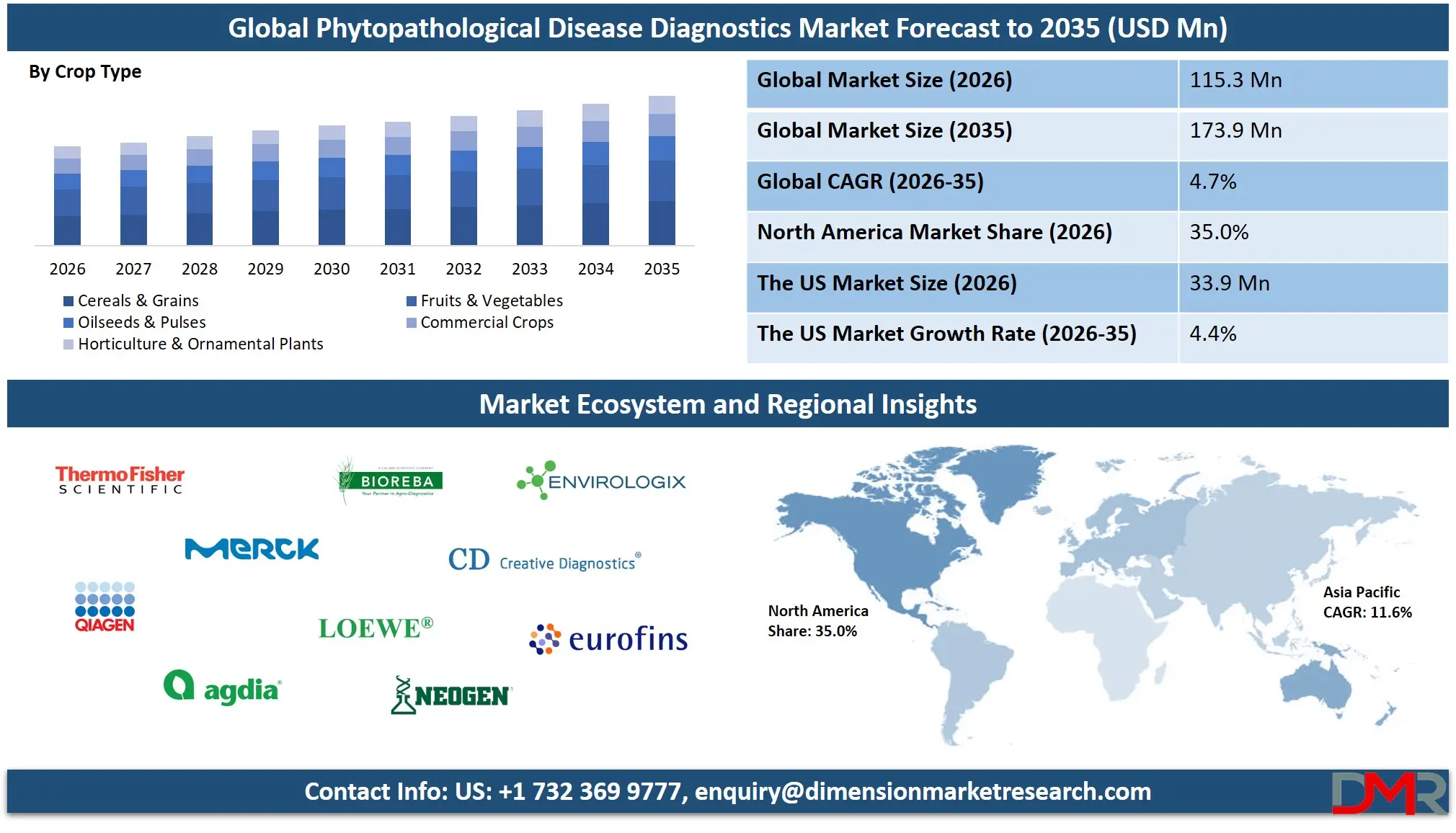
The Global Phytopathological Disease Diagnostics Market is estimated to reach USD 115.3 million in 2026 and is expected to grow at a CAGR of 4.7% from 2026 to 2035, reaching approximately USD 173.9 million by 2035, driven by rising demand for plant pathogen detection, crop disease monitoring, agricultural diagnostic kits, and molecular plant disease testing technologies.
ℹ
To learn more about this report –
Download Your Free Sample Report Here
Phytopathological disease diagnostics refers to the scientific processes and technologies used to detect, identify, and analyze diseases affecting plants caused by pathogens such as fungi, bacteria, viruses, nematodes, and other microorganisms. It involves laboratory based and field based diagnostic methods that enable early identification of plant infections before severe crop damage occurs. These diagnostic approaches include molecular testing, serological assays, microscopy examination, and rapid detection kits that analyze plant tissues, seeds, soil, and environmental samples. The objective of phytopathological diagnostics is to support effective plant disease management, improve agricultural productivity, and protect crop health by enabling accurate pathogen detection and monitoring. By providing timely information about plant pathogens and disease outbreaks, these diagnostic solutions help farmers, agricultural scientists, and plant health authorities implement appropriate treatment strategies, quarantine measures, and integrated pest management practices to safeguard global food production systems.
The global phytopathological disease diagnostics market represents the industry that develops and supplies technologies, tools, and services used for identifying plant diseases across agricultural ecosystems. The market includes diagnostic kits, laboratory instruments, reagents, and molecular testing platforms that assist in detecting pathogens affecting major crops such as cereals, fruits, vegetables, and oilseeds. Increasing concerns regarding crop losses caused by plant pathogens, growing demand for sustainable agricultural practices, and expanding research in plant pathology are driving the adoption of advanced plant disease detection technologies. Governments and agricultural institutions are also strengthening plant biosecurity programs and disease surveillance systems to prevent the spread of invasive plant pathogens, which further contributes to the demand for phytopathological diagnostic solutions.
ℹ
To learn more about this report –
Download Your Free Sample Report Here
The market is also expanding due to the integration of modern technologies such as polymerase chain reaction testing, next generation sequencing, biosensor based pathogen detection, and portable diagnostic devices used for rapid field testing. Agricultural laboratories, seed certification agencies, and research institutes are increasingly adopting these tools to ensure seed health testing, crop disease monitoring, and quality assurance in agricultural production. Rising investments in precision agriculture, increasing global food demand, and the need to minimize yield losses caused by plant diseases are expected to accelerate the development of innovative plant pathogen detection technologies, thereby strengthening the growth of the global phytopathological disease diagnostics market.
The US Phytopathological Disease Diagnostics Market
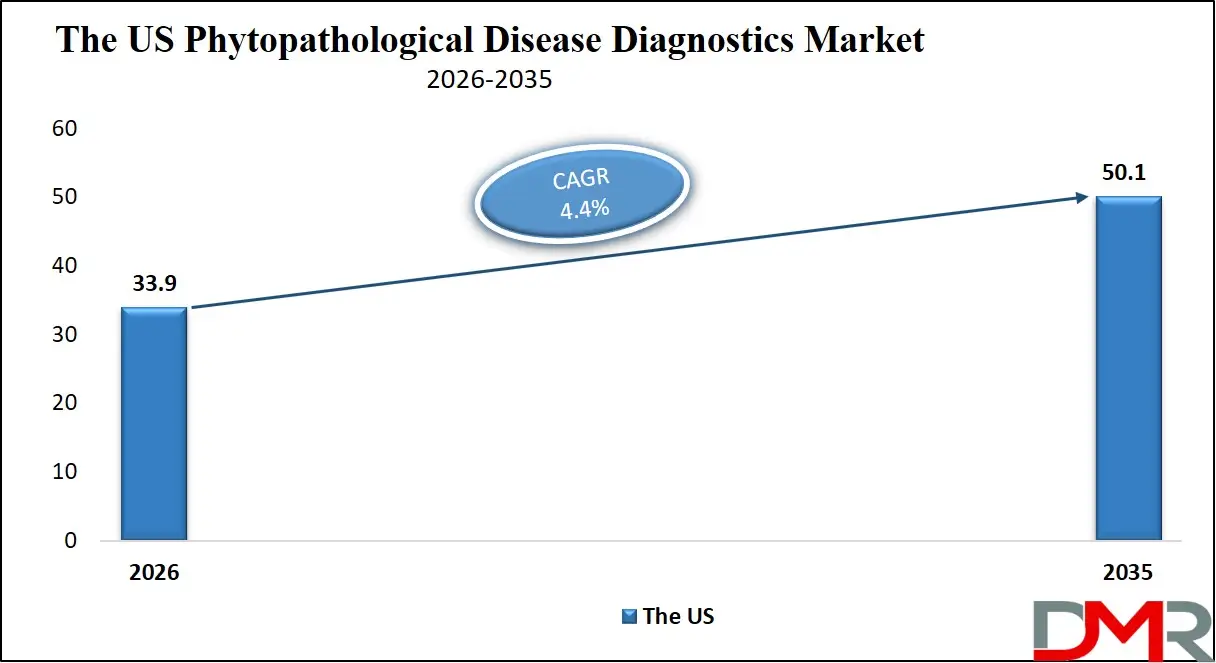
The U.S. Phytopathological Disease Diagnostics Market size is expected to reach at USD 33.9 million in 2026. It is further expected to witness subsequent growth in the upcoming period, holding USD 50.1 million in 2035 at a CAGR of 4.4%.
ℹ
To learn more about this report –
Download Your Free Sample Report Here
The United States phytopathological disease diagnostics market represents a technologically advanced segment of the agricultural diagnostics industry, supported by strong research infrastructure and extensive crop protection programs. The country has a well-established network of agricultural laboratories, university research centers, and plant health monitoring agencies that actively conduct plant pathogen detection and disease surveillance. Increasing concerns about crop losses caused by fungal, viral, and bacterial infections in major crops such as corn, soybeans, wheat, and fruits are encouraging the adoption of molecular plant diagnostics, serological testing, and rapid field detection technologies across commercial farming operations.
Growing investments in precision agriculture and plant biosecurity initiatives are further strengthening the demand for advanced plant disease detection tools across the United States. Agricultural biotechnology companies, seed producers, and government phytosanitary agencies are increasingly using PCR based pathogen identification, seed health testing, and biosensor diagnostic platforms to ensure crop health and maintain high agricultural productivity. In addition, rising awareness regarding sustainable farming practices and integrated pest management is driving the adoption of early disease monitoring solutions, enabling farmers and agronomists to reduce yield losses and improve crop quality through timely disease management strategies.
The Europe Phytopathological Disease Diagnostics Market
The Europe phytopathological disease diagnostics market is projected to reach USD 32.0 million in 2026, expanding at a CAGR of 5.8% during 2026 to 2035. The region holds a significant position in the global market due to its strong agricultural research infrastructure, well-established plant pathology laboratories, and strict regulatory frameworks related to plant health and biosecurity. European countries place strong emphasis on early plant pathogen detection and crop disease surveillance to protect high-value crops such as wheat, barley, fruits, and vegetables. This has led to increased adoption of advanced plant disease diagnostic technologies including molecular diagnostics, PCR based testing, and immunoassay based detection kits.
Growth in the regional market is also supported by increasing investments in agricultural biotechnology, precision farming practices, and plant health monitoring programs across several European countries. Government supported crop protection initiatives and collaborations between agricultural research institutes and biotechnology companies are driving the development of innovative plant pathogen detection solutions. Additionally, the rising need to minimize crop losses caused by fungal, bacterial, and viral plant diseases is encouraging farmers and agricultural laboratories to adopt advanced crop disease diagnostics, further strengthening the expansion of the phytopathological disease diagnostics market across Europe.
The Japan Phytopathological Disease Diagnostics Market
The Japan phytopathological disease diagnostics market is projected to reach USD 8.0 million in 2026, expanding at a CAGR of 3.5% during 2026 to 2035. The market growth is supported by the country's strong agricultural research capabilities and advanced plant health monitoring systems. Japan places significant emphasis on crop protection and plant pathogen surveillance to maintain the quality and productivity of crops such as rice, vegetables, and fruits. As a result, agricultural laboratories and research institutions increasingly adopt molecular plant diagnostics, PCR based testing, and serological assays to detect fungal, bacterial, and viral plant diseases.
The demand for phytopathological disease diagnostics in Japan is also driven by increasing adoption of precision agriculture technologies and improved crop disease management strategies. Government supported agricultural innovation programs and collaborations between biotechnology companies and research institutes are encouraging the development of advanced plant disease detection technologies. In addition, the need to minimize crop yield losses and ensure food security is pushing farmers and agricultural agencies to implement early plant pathogen detection and crop disease monitoring solutions across the country's agricultural sector.
Global Phytopathological Disease Diagnostics Market: Key Takeaways
- Steady Market Expansion: The global phytopathological disease diagnostics market is projected to grow from USD 115.3 million in 2026 to USD 173.9 million by 2035, reflecting a 4.7% CAGR driven by rising crop disease monitoring and plant pathogen detection technologies.
- North America Market Leadership: North America accounts for approximately 35.0% of global market revenue in 2026, supported by strong agricultural research infrastructure, advanced molecular diagnostics adoption, and extensive plant disease surveillance programs.
- Dominance of Molecular Diagnostics: Molecular diagnostic technologies capture around 42.0% of the diagnostic method segment in 2026, highlighting the increasing reliance on PCR, genetic sequencing, and nucleic acid-based plant pathogen detection.
- High Adoption of Diagnostic Kits: Diagnostic kits hold about 43.0% share of the product type segment in 2026, reflecting strong demand for rapid, portable, and field-deployable plant disease testing solutions across agricultural laboratories and farms.
- Plant Tissue as Primary Sample Type: Plant tissue samples represent approximately 53.0% of diagnostic sample usage in 2026, making them the most commonly analyzed samples for identifying fungal, viral, and bacterial plant infections in crop monitoring programs.
Global Phytopathological Disease Diagnostics Market: Use Cases
- Early Plant Disease Detection: Phytopathological diagnostics enable early identification of fungal, bacterial, and viral plant pathogens in crops. Technologies such as PCR testing and immunoassay based diagnostic kits help detect infections before visible symptoms appear. Early crop disease detection supports effective plant disease management, reduces yield losses, and improves agricultural productivity.
- Seed Health Testing: Seed companies and certification agencies use plant pathogen detection tools to ensure disease free seeds. Molecular diagnostics and ELISA based testing help identify seed borne pathogens that may spread infections across crops. This process supports quality assurance, crop protection, and sustainable agricultural production.
- Crop Disease Surveillance Programs: Government agricultural agencies and research institutions use phytopathological diagnostics for large scale crop disease monitoring. Plant disease surveillance programs track pathogen outbreaks and support plant biosecurity measures. These diagnostics help prevent the spread of harmful plant pathogens across agricultural regions.
- Agricultural Research and Plant Breeding: Research institutes use plant disease diagnostics to study pathogen behavior and evaluate disease resistant crop varieties. Advanced molecular detection tools support plant pathology research, resistance screening, and crop improvement programs aimed at enhancing long term agricultural resilience.
Global Phytopathological Disease Diagnostics Market: Stats & Facts
- Food and Agriculture Organization
- Around 20–40% of global crop production is lost every year due to plant pests and diseases worldwide.
- Plant pests destroy up to 40% of global food crops annually, significantly affecting agricultural productivity.
- Plant diseases and pests collectively cause over USD 220 billion in annual economic losses globally.
- Invasive insect pests alone contribute to global economic losses of at least USD 70 billion annually.
- Plants provide approximately 80% of the food consumed globally.
- Plants also generate about 98% of the world's oxygen supply.
- Global agricultural production will need to increase by about 60% by 2050 to meet future food demand.
- Climate change is increasing the spread and severity of plant pests across multiple agricultural ecosystems.
- Global crop losses caused by plant pests and diseases can reach up to 40% of production each year.
- International trade and travel are responsible for about 50% of emerging plant disease spread globally.
Global Phytopathological Disease Diagnostics Market: Market Dynamic
Driving Factors in the Global Phytopathological Disease Diagnostics Market
Rising Global Crop Losses Due to Plant Pathogens
Increasing crop losses caused by fungal infections, bacterial diseases, viral plant pathogens, and nematodes are significantly driving demand for phytopathological disease diagnostics. Farmers and agricultural institutions are increasingly adopting plant pathogen detection technologies to identify diseases before they spread across fields. Advanced crop disease diagnostics such as PCR based testing, immunoassays, and rapid plant disease detection kits help monitor infections in crops like wheat, corn, rice, and vegetables. As global food demand continues to grow, the need for reliable plant health monitoring systems and early plant disease identification is becoming essential for maintaining agricultural productivity and reducing economic losses in farming systems.
Expansion of Precision Agriculture and Smart Farming
The rapid growth of precision agriculture and digital farming technologies is accelerating the adoption of modern plant disease diagnostics. Farmers are integrating crop monitoring systems, biosensor based plant pathogen detection tools, and portable plant diagnostic kits to detect diseases in real time. These technologies support data driven crop management and enable early disease intervention strategies. The increasing use of agricultural biotechnology, remote sensing, and automated crop surveillance platforms is strengthening the demand for accurate plant disease testing solutions that help farmers optimize pesticide use, protect crop yield, and improve overall farm efficiency.
Restraints in the Global Phytopathological Disease Diagnostics Market
High Cost of Advanced Diagnostic Technologies
One of the major restraints in the phytopathological disease diagnostics market is the high cost associated with advanced diagnostic equipment and molecular testing technologies. Techniques such as next generation sequencing, real time PCR platforms, and automated plant disease detection systems require significant capital investment and technical expertise. Many small and medium scale farmers in developing agricultural regions have limited access to laboratory infrastructure and specialized diagnostic tools. As a result, the adoption of sophisticated plant pathogen identification technologies remains limited in several rural farming areas where basic crop disease management practices are still widely used.
Limited Awareness of Plant Disease Diagnostic Tools
Lack of awareness about plant disease diagnostics and pathogen detection technologies among farmers and small agricultural enterprises can hinder market growth. In many agricultural regions, farmers rely on visual crop inspection or traditional disease identification methods, which may lead to delayed or inaccurate diagnosis of plant infections. Limited access to agricultural extension services and plant pathology laboratories further restricts the adoption of modern crop disease detection methods. Without proper knowledge of early plant disease monitoring tools and diagnostic services, farmers may struggle to control outbreaks effectively, resulting in crop damage and reduced agricultural output.
Opportunities in the Global Phytopathological Disease Diagnostics Market
Increasing Demand for Rapid Field Diagnostic Kits
The growing need for quick and portable plant disease detection tools is creating strong opportunities in the phytopathological diagnostics market. Rapid diagnostic kits, handheld biosensors, and point of care plant testing devices allow farmers to detect pathogens directly in the field without relying solely on laboratory analysis. These portable plant pathogen detection solutions enable faster disease diagnosis, improving response time for crop protection measures. As agriculture becomes more technology driven, the demand for easy to use plant disease testing kits and on site diagnostic platforms is expected to expand significantly across both developed and emerging agricultural markets.
Growing Investments in Agricultural Biotechnology Research
Rising investments in plant biotechnology, crop protection research, and plant pathology studies are creating new opportunities for advanced phytopathological diagnostics. Research institutes and agricultural technology companies are developing innovative plant disease detection technologies including DNA based pathogen identification, biosensor diagnostics, and artificial intelligence assisted crop disease analysis. These innovations support improved crop disease surveillance and enable the development of disease resistant crop varieties. Increasing collaboration between agricultural research organizations, biotechnology companies, and government plant health agencies is expected to accelerate innovation in plant disease diagnostics and strengthen the global market landscape.
Trends in the Global Phytopathological Disease Diagnostics Market
Integration of Molecular Diagnostics in Plant Disease Testing
Molecular diagnostics is becoming a dominant trend in phytopathological disease diagnostics due to its high accuracy and sensitivity in pathogen detection. Techniques such as polymerase chain reaction testing, loop mediated isothermal amplification, and genetic sequencing are increasingly used for precise identification of plant pathogens. These molecular plant diagnostic technologies enable early disease detection and support advanced crop health monitoring programs. Agricultural laboratories and research institutes are rapidly adopting molecular testing platforms to improve plant disease diagnosis, strengthen crop disease surveillance systems, and support modern agricultural biotechnology applications.
Adoption of Digital and Biosensor Based Plant Diagnostics
The adoption of digital agriculture technologies and biosensor based diagnostic tools is transforming plant disease detection methods. Smart biosensors, mobile based plant disease identification applications, and connected crop monitoring systems are enabling real time analysis of plant health conditions. These technologies help farmers and agronomists detect disease symptoms earlier and respond quickly to potential outbreaks. Integration of artificial intelligence, machine learning, and remote crop monitoring systems with plant pathogen diagnostics is emerging as a key trend that enhances the efficiency and accessibility of modern crop disease management solutions.
Global Phytopathological Disease Diagnostics Market: Research Scope and Analysis
By Diagnostic Method Analysis
Molecular diagnostics are anticipated to dominate the diagnostic method segment of the phytopathological disease diagnostics market, accounting for around 42.0% of the total market share in 2026. The strong adoption of molecular plant disease detection techniques is driven by their high sensitivity, rapid detection capability, and accuracy in identifying plant pathogens at early infection stages. Technologies such as polymerase chain reaction testing, real time PCR, loop mediated isothermal amplification, and genetic sequencing enable precise detection of fungal, bacterial, and viral pathogens in crops. These molecular plant diagnostics are widely used in agricultural laboratories, seed health testing facilities, and plant pathology research centers to support crop disease monitoring, pathogen identification, and plant biosecurity programs across global agricultural systems.
Serological diagnostics also hold a significant share in this segment as they provide cost effective and reliable solutions for routine plant disease detection. Methods such as enzyme linked immunosorbent assay and immunostrip based diagnostic kits are commonly used to detect specific plant pathogens through antigen antibody interactions. These plant disease diagnostic kits are widely utilized in large scale crop disease surveillance programs, seed certification testing, and agricultural research applications. Serological testing offers practical advantages such as ease of use, relatively low operational cost, and suitability for screening large numbers of plant samples, making it an important diagnostic approach in modern plant pathology and crop protection practices.
By Product Type Analysis
Diagnostic kits are anticipated to dominate the product type segment of the phytopathological disease diagnostics market, capturing around 43.0% of the total market share in 2026. The widespread adoption of plant disease diagnostic kits is primarily driven by their convenience, portability, and ability to provide rapid plant pathogen detection in both laboratory and field conditions. These kits are widely used for detecting fungal, bacterial, and viral infections in crops through techniques such as immunoassays, PCR based testing, and lateral flow assays. Agricultural laboratories, seed testing centers, and plant health monitoring agencies rely heavily on diagnostic kits for routine crop disease testing, seed health screening, and large scale plant pathogen surveillance across different agricultural regions.
Instruments and detection systems also represent a significant portion of the market as they support advanced plant disease diagnostics and laboratory based pathogen identification. These systems include PCR machines, molecular testing platforms, automated analyzers, and biosensor based detection devices used for precise plant pathogen analysis. Research institutes, agricultural biotechnology companies, and plant pathology laboratories utilize these instruments to conduct detailed crop disease investigations, molecular plant pathogen identification, and plant health research. The increasing adoption of high precision agricultural diagnostic equipment is strengthening the role of instruments and detection systems in improving the accuracy, reliability, and efficiency of modern plant disease detection processes.
By Pathogen Type Analysis
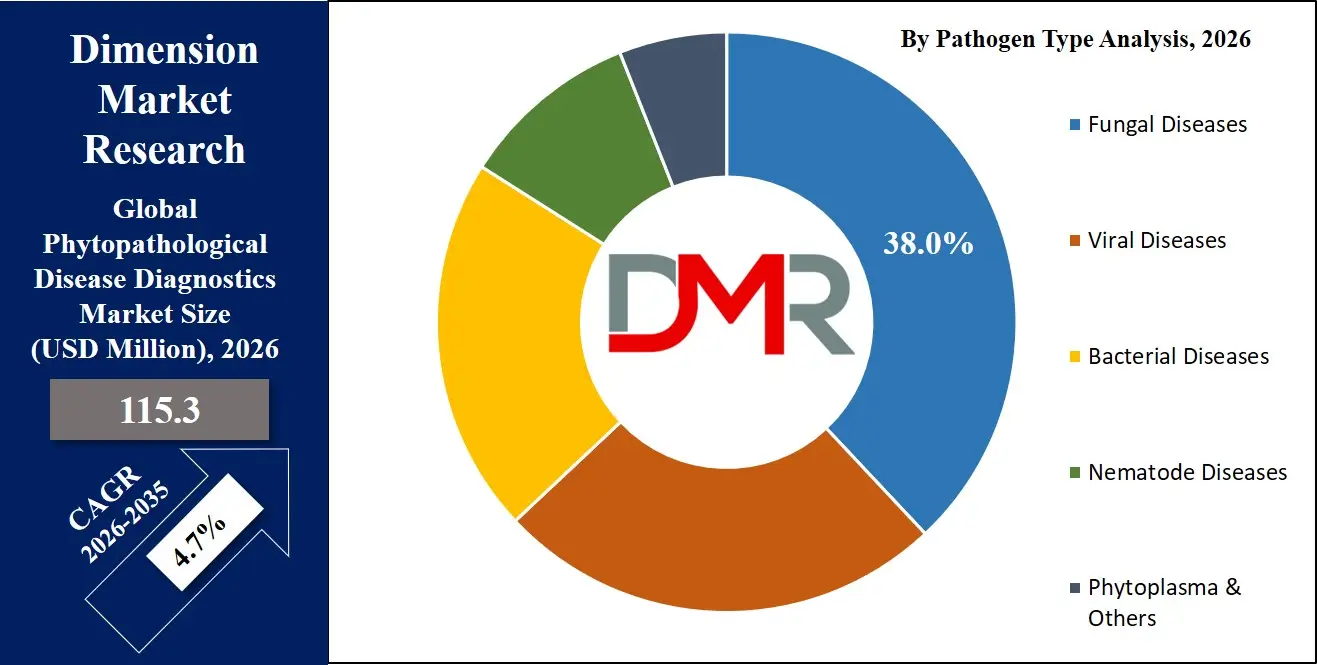
Fungal diseases are anticipated to dominate the pathogen type segment of the phytopathological disease diagnostics market, capturing around 38.0% of the total market share in 2026. Fungal pathogens are among the most widespread causes of crop infections globally, affecting major crops such as wheat, rice, maize, fruits, and vegetables. Diseases such as rust, blight, mildew, and wilt can significantly reduce crop yield and quality if not detected early. As a result, farmers and agricultural laboratories increasingly rely on plant pathogen detection technologies including molecular diagnostics, serological assays, and microscopic examination to identify fungal infections at early stages. The high prevalence of fungal plant diseases and their rapid spread across agricultural regions continue to drive the demand for advanced crop disease diagnostic solutions.
ℹ
To learn more about this report –
Download Your Free Sample Report Here
Viral diseases also represent a significant segment in the phytopathological disease diagnostics market due to their ability to cause severe and often irreversible damage to crops. Plant viruses can spread through insect vectors, infected seeds, and contaminated agricultural tools, making early detection essential for effective disease control. Diagnostic technologies such as polymerase chain reaction testing, ELISA based assays, and nucleic acid detection methods are widely used to identify viral pathogens in plant tissues and seeds. Increasing outbreaks of viral plant diseases in crops such as tomatoes, potatoes, cucumbers, and citrus are encouraging agricultural research institutes and plant health agencies to adopt advanced plant virus detection methods to protect crop productivity and maintain food security.
By Crop Type Analysis
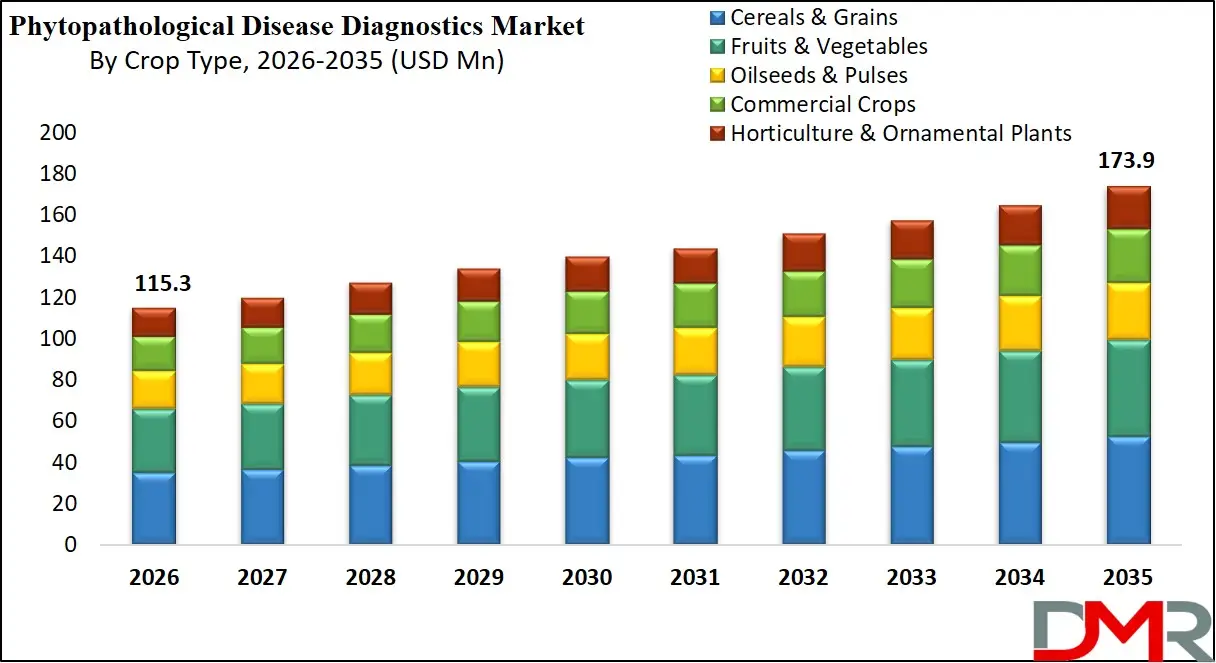
Cereals and grains are anticipated to dominate the crop type segment of the phytopathological disease diagnostics market, capturing around 30.0% of the total market share in 2026. Major cereal crops such as wheat, rice, maize, and barley are cultivated extensively across global agricultural regions and are highly vulnerable to fungal, bacterial, and viral plant diseases. Because these crops serve as staple food sources for a large portion of the global population, maintaining their health and productivity is a critical priority. Agricultural laboratories, crop protection agencies, and farmers increasingly rely on plant pathogen detection technologies, molecular plant diagnostics, and crop disease monitoring systems to identify infections early and minimize yield losses in large scale cereal production.
Fruits and vegetables also represent a significant segment in the phytopathological disease diagnostics market due to their high economic value and susceptibility to various plant pathogens. Crops such as tomatoes, potatoes, citrus fruits, berries, and leafy vegetables are frequently affected by viral infections, fungal diseases, and bacterial pathogens that can quickly spread under favorable environmental conditions. Advanced plant disease detection methods including serological assays, PCR based diagnostics, and rapid plant pathogen testing kits are widely used to monitor crop health and prevent disease outbreaks. The growing global demand for high quality fresh produce and the need to maintain strict agricultural quality standards are encouraging greater adoption of crop disease diagnostics in fruit and vegetable cultivation.
By Sample Type Analysis
Plant tissue samples are anticipated to dominate the sample type segment of the phytopathological disease diagnostics market, capturing around 53.0% of the total market share in 2026. Plant leaves, stems, roots, and other infected tissues are the most commonly collected samples for plant disease detection because they directly contain visible symptoms and active pathogens. Agricultural laboratories and plant pathology research centers frequently analyze plant tissue samples using molecular diagnostics, microscopy examination, and immunoassay based testing to accurately identify fungal, bacterial, and viral infections. The widespread use of plant tissue sampling in crop disease monitoring programs, pathogen identification studies, and plant health surveillance initiatives is driving its dominance in diagnostic applications.
Seeds also represent an important sample type in the phytopathological disease diagnostics market due to their role in spreading seed borne plant pathogens. Infected seeds can transmit diseases across fields, regions, and international agricultural trade networks, making seed health testing a critical part of crop protection and plant biosecurity programs. Diagnostic techniques such as PCR based pathogen detection, ELISA assays, and seed health screening are widely used by seed companies, certification agencies, and agricultural laboratories to identify viral, fungal, and bacterial pathogens in seed batches. Increasing emphasis on quality assurance in seed production and the prevention of crop disease outbreaks is supporting the growing importance of seed based plant pathogen diagnostics.
By Application Analysis
Pathogen detection and disease diagnosis are anticipated to dominate the application segment of the phytopathological disease diagnostics market, capturing around 45.0% of the total market share in 2026. This dominance is largely attributed to the growing need for accurate plant pathogen identification to control crop diseases and prevent large scale agricultural losses. Farmers, agricultural laboratories, and plant health agencies rely on advanced plant disease detection technologies such as molecular diagnostics, PCR based testing, and immunoassay methods to identify fungal, bacterial, and viral infections in crops. Early and precise disease diagnosis enables effective crop disease management, supports integrated pest management strategies, and helps maintain agricultural productivity and food supply stability.
Seed health testing also represents a significant application in this market because seeds act as a primary pathway for the transmission of plant pathogens across agricultural regions. Detecting infected seeds before planting is essential to prevent the spread of crop diseases and protect crop yields. Diagnostic techniques such as ELISA based assays, nucleic acid testing, and molecular plant pathogen detection methods are widely used by seed producers, agricultural laboratories, and certification authorities to ensure disease free seed distribution. The increasing focus on seed quality assurance, global seed trade regulations, and plant biosecurity measures is driving the adoption of advanced seed health testing solutions in modern agriculture.
By End User Analysis
Agricultural diagnostic laboratories are anticipated to dominate the end user segment of the phytopathological disease diagnostics market, capturing around 48.0% of the total market share in 2026. These laboratories play a central role in plant disease detection, crop disease monitoring, and plant pathogen identification across agricultural regions. They conduct routine testing of plant tissues, seeds, and soil samples using advanced plant diagnostic technologies such as molecular diagnostics, PCR testing, and serological assays. Farmers, seed companies, and government agricultural agencies rely on these laboratories for accurate disease diagnosis and crop health assessment. The increasing need for reliable plant disease testing services and large scale crop surveillance programs continues to strengthen the demand for agricultural diagnostic laboratories.
Research and academic institutes also represent an important segment in the phytopathological disease diagnostics market as they contribute significantly to plant pathology research and the development of advanced plant disease detection technologies. Universities and agricultural research centers conduct studies on plant pathogens, disease resistance mechanisms, and crop disease management strategies. These institutes utilize molecular plant diagnostics, genetic analysis, and pathogen identification tools to understand disease patterns and develop improved crop protection solutions. Growing investments in agricultural biotechnology research, plant health studies, and sustainable farming innovations are increasing the adoption of phytopathological diagnostic tools within research and academic institutions.
The Global Phytopathological Disease Diagnostics Market Report is segmented on the basis of the following:
By Diagnostic Method
- Molecular Diagnostics
- Serological Diagnostics
- Culture & Microscopy Methods
- Biosensor & Digital Diagnostics
- Biochemical Assays
By Product Type
- Diagnostic Kits
- Instruments & Detection Systems
- Reagents & Consumables
- Software / Data Platforms
By Pathogen Type
- Fungal Diseases
- Viral Diseases
- Bacterial Diseases
- Nematode Diseases
- Phytoplasma & Others
By Crop Type
- Cereals & Grains
- Fruits & Vegetables
- Oilseeds & Pulses
- Commercial Crops
- Horticulture & Ornamental Plants
By Sample Type
- Plant Tissue Samples
- Seeds
- Fruits & Vegetables Samples
- Soil Samples
- Water / Environmental Samples
By Application
- Pathogen Detection & Disease Diagnosis
- Seed Health Testing
- Crop Disease Surveillance Programs
- Resistance Screening & Breeding
- Yield Loss & Risk Assessment
By End User
- Agricultural Diagnostic Laboratories
- Research & Academic Institutes
- Seed Certification Agencies
- Government Phytosanitary Agencies
- Farmers & Commercial Growers
Impact of Artificial Intelligence in the Global Phytopathological Disease Diagnostics Market
Artificial intelligence is significantly transforming the global phytopathological disease diagnostics market by improving the efficiency and accuracy of plant disease detection. AI powered image recognition and machine learning algorithms are increasingly used to analyze plant symptoms such as leaf spots, discoloration, lesions, and abnormal growth patterns. These technologies enable rapid identification of fungal, bacterial, and viral plant pathogens through smartphone applications, drones, and remote sensing tools. By automating plant disease diagnosis, artificial intelligence helps farmers and agricultural experts detect crop infections earlier, enabling timely intervention and reducing crop yield losses.
Artificial intelligence is also enhancing crop disease monitoring and predictive plant health analytics through the integration of big data and precision agriculture technologies. AI systems analyze environmental conditions, weather data, soil health information, and historical disease patterns to predict potential pathogen outbreaks before symptoms appear. This predictive capability supports better crop disease management strategies and optimized pesticide usage. In addition, AI assisted plant pathology research and digital agriculture platforms are improving plant pathogen surveillance and accelerating the development of advanced plant disease diagnostic solutions across global agricultural systems.
Global Phytopathological Disease Diagnostics Market: Regional Analysis
Region with the Largest Revenue Share
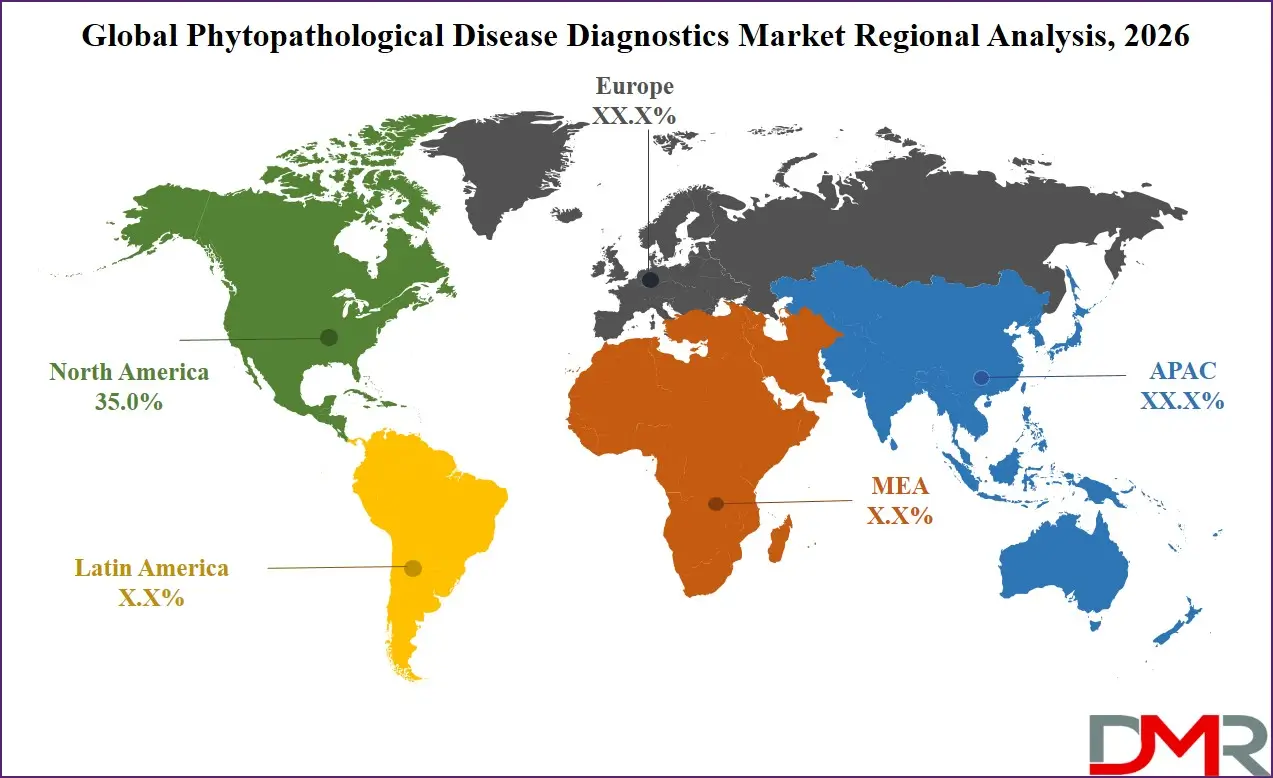
North America is anticipated to lead the global phytopathological disease diagnostics market, accounting for approximately 35.0% of total global market revenue in 2026. The region's dominance is primarily driven by advanced agricultural research infrastructure, strong presence of plant pathology laboratories, and widespread adoption of molecular plant disease diagnostics technologies. Countries such as the United States and Canada have well established crop disease monitoring programs, strict plant biosecurity regulations, and significant investments in agricultural biotechnology. Increasing focus on crop protection, precision agriculture, and early plant pathogen detection across large scale farming operations is further supporting the growth of phytopathological disease diagnostic solutions in the North American agricultural sector.
ℹ
To learn more about this report –
Download Your Free Sample Report Here
Region with the Highest CAGR
Asia Pacific is expected to register the highest CAGR in the global phytopathological disease diagnostics market during the forecast period. The rapid growth of the region is driven by expanding agricultural production, increasing awareness about crop disease management, and rising adoption of modern plant pathogen detection technologies. Countries such as China, India, and Japan are investing heavily in agricultural research, plant health monitoring systems, and advanced crop disease diagnostics to improve food security and agricultural productivity. In addition, growing demand for high quality seeds, increasing prevalence of plant diseases, and government initiatives supporting precision agriculture are accelerating the adoption of phytopathological diagnostic solutions across the Asia Pacific agricultural sector.
By Region
North America
Europe
- Germany
- The U.K.
- France
- Italy
- Russia
- Spain
- Benelux
- Nordic
- Rest of Europe
Asia-Pacific
- China
- Japan
- South Korea
- India
- ANZ
- ASEAN
- Rest of Asia-Pacific
Latin America
- Brazil
- Mexico
- Argentina
- Colombia
- Rest of Latin America
Middle East & Africa
- Saudi Arabia
- UAE
- South Africa
- Israel
- Egypt
- Rest of MEA
Global Phytopathological Disease Diagnostics Market: Competitive Landscape
The global phytopathological disease diagnostics market is characterized by a moderately competitive and innovation driven landscape, with several biotechnology, agricultural diagnostics, and life science companies focusing on developing advanced plant pathogen detection solutions. Market participants are increasingly investing in research and development to enhance diagnostic accuracy through technologies such as molecular diagnostics, PCR based testing, immunoassays, and rapid plant disease detection kits. Companies are also expanding their product portfolios with portable diagnostic tools and automated laboratory systems to support crop disease monitoring and plant health surveillance. Strategic partnerships with agricultural research institutions and government plant protection agencies are further strengthening market competitiveness and technological advancement.
Some of the prominent players in the Global Phytopathological Disease Diagnostics Market are:
- Thermo Fisher Scientific
- Merck KGaA
- Qiagen N.V.
- Agdia, Inc.
- BIOREBA AG
- LOEWE Biochemica GmbH
- Envirologix Inc.
- Creative Diagnostics
- Neogen Corporation
- Eurofins Scientific
- PerkinElmer Inc.
- Promega Corporation
- Agilent Technologies
- Abingdon Health plc
- OptiGene Limited
- TwistDx Limited
- Qualiplante SAS
- Bio-Rad Laboratories
- DiaSorin S.p.A.
- Sartorius AG
- Other Key Players
Recent Developments in the Global Phytopathological Disease Diagnostics Market
- February 2026: Agdia, Inc. released a rapid molecular diagnostic test kit and laboratory testing service for detecting Beet pseudoyellows virus and Strawberry pallidosis-associated virus, enabling faster plant pathogen detection and improving crop disease monitoring for fruits and vegetable crops.
- December 2025: Agdia, Inc. launched new ImmunoStrip and ELISA diagnostic kits designed to detect Pseudomonas plant pathogens, supporting rapid identification of bacterial infections across agricultural crops and strengthening plant disease diagnostic capabilities for laboratories and field testing.
- October 2025: Thermo Fisher Scientific announced an approximately USD 8.88 billion investment to acquire Clario, aimed at expanding diagnostic data and testing capabilities across life science and advanced diagnostics markets.
- July 2025: bioMérieux completed the acquisition of Neoprospecta, a biotechnology company specializing in genomic and microbiological data solutions, to strengthen advanced diagnostic technologies and expand microbial testing capabilities across food safety and agricultural applications.
Report Details
| Report Characteristics |
| Market Size (2026) |
USD 115.3 Mn |
| Forecast Value (2035) |
USD 173.9 Mn |
| CAGR (2026–2035) |
4.7% |
| The US Market Size (2026) |
USD 33.9 Mn |
| Historical Data |
2021 – 2025 |
| Forecast Data |
2027 – 2035 |
| Base Year |
2025 |
| Estimate Year |
2026 |
| Report Coverage |
Market Revenue Estimation, Market Dynamics, Competitive Landscape, Growth Factors and etc. |
| Segments Covered |
By Diagnostic Method (Molecular Diagnostics, Serological Diagnostics, Culture & Microscopy Methods, Biosensor & Digital Diagnostics, Biochemical Assays), By Product Type (Diagnostic Kits, Instruments & Detection Systems, Reagents & Consumables, Software / Data Platforms), By Pathogen Type (Fungal Diseases, Viral Diseases, Bacterial Diseases, Nematode Diseases, Phytoplasma & Others), By Crop Type (Cereals & Grains, Fruits & Vegetables, Oilseeds & Pulses, Commercial Crops, Horticulture & Ornamental Plants), By Sample Type (Plant Tissue Samples, Seeds, Fruits & Vegetables Samples, Soil Samples, Water / Environmental Samples), By Application (Pathogen Detection & Disease Diagnosis, Seed Health Testing, Crop Disease Surveillance Programs, Resistance Screening & Breeding, Yield Loss & Risk Assessment), and By End User (Agricultural Diagnostic Laboratories, Research & Academic Institutes, Seed Certification Agencies, Government Phytosanitary Agencies, Farmers & Commercial Growers). |
| Regional Coverage |
North America – The US and Canada; Europe – Germany, The UK, France, Russia, Spain, Italy, Benelux, Nordic, & Rest of Europe; Asia-Pacific – China, Japan, South Korea, India, ANZ, ASEAN, Rest of APAC; Latin America – Brazil, Mexico, Argentina, Colombia, Rest of Latin America; Middle East & Africa – Saudi Arabia, UAE, South Africa, Turkey, Egypt, Israel, & Rest of MEA |
| Prominent Players |
Thermo Fisher Scientific, Merck KGaA, Qiagen N.V., Agdia, Inc., BIOREBA AG, LOEWE Biochemica GmbH, Envirologix Inc., Creative Diagnostics, Neogen Corporation, Eurofins Scientific, PerkinElmer Inc., Promega Corporation, Agilent Technologies, Abingdon Health plc, OptiGene Limited, TwistDx Limited, Qualiplante SAS, Bio-Rad Laboratories, DiaSorin S.p.A., Sartorius AG, along with other key players. |
| Purchase Options |
We have three licenses to opt for: Single User License (Limited to 1 user), Multi-User License (Up to 5 Users) and Corporate Use License (Unlimited User) along with free report customization equivalent to 0 analyst working days, 3 analysts working days and 5 analysts working days respectively. |
Frequently Asked Questions
How big is the Global Phytopathological Disease Diagnostics Market?
▾ The Global Phytopathological Disease Diagnostics Market size is estimated to have a value of USD 115.3 million in 2026 and is expected to reach USD 173.9 million by the end of 2035.
What is the growth rate in the Global Phytopathological Disease Diagnostics Market in 2026?
▾ The market is growing at a CAGR of 4.7% over the forecasted period of 2026.
What is the size of the US Phytopathological Disease Diagnostics Market?
▾ The US Phytopathological Disease Diagnostics market is projected to be valued at USD 33.9 million in 2026. It is expected to witness subsequent growth in the upcoming period as it holds USD 50.1 million in 2035 at a CAGR of 4.4%.
Which region accounted for the largest Global Phytopathological Disease Diagnostics Market?
▾ North America is expected to have the largest market share in the Global Phytopathological Disease Diagnostics Market with a share of about 35.0% in 2026.
Who are the key players in the Global Phytopathological Disease Diagnostics Market?
▾ Some of the major key players in the Global Phytopathological Disease Diagnostics Market are Thermo Fisher Scientific, Merck KGaA, Qiagen N.V., Agdia, Inc., BIOREBA AG, LOEWE Biochemica GmbH, Envirologix Inc., Creative Diagnostics, Neogen Corporation, and many others.