Market Snapshot
- Global market size in 2025: USD 2.81 Billion
- Forecast market size by 2035: USD 4.62 Billion
- CAGR (2026 to 2035): 5.1%
- Dominant product type: Pipettes, holding a 46.31% share
- Dominant material: Glass, holding a 45.24% share
- Dominant volume capacity segment: Variable-Volume, holding a 55.52% share
- Dominant end-user segment: Pharmaceutical and Biotechnology Companies, holding a 38.52% share
- Dominant region: North America, holding a 43.7% share
- Fastest-growing region: Asia-Pacific
Market Overview
The global pipettes, pipettors, and accessories market covers manual and electronic pipettes, multichannel instruments, serological pipettes, and the full range of consumable and calibration accessories that support precise liquid transfer in scientific settings. The market excludes robotic liquid-handling platforms sold as standalone workstation systems and bulk fluid dispensing equipment used outside laboratory workflows. Valued at USD 2.81 Billion in 2025, the market sits at the intersection of laboratory supply chains and occupational health compliance, making it both a procurement category and an operational risk management tool for research organizations.
As per a Lab Manager survey of 446 laboratory professionals, 81% reported currently using manual single-channel pipettes, while 46% used manual multichannel and 38% used manual fixed-volume instruments. That data confirms manual pipetting remains the volume backbone of the category, even as compliance and ergonomic pressures shift institutional purchasing toward electronic alternatives. In January 2025, Dynarex Corporation launched its LabChoice laboratory product line, introducing serological pipettes and related liquid-handling consumables as part of a broader entry into core lab equipment, a signal that adjacent suppliers now see the accessories segment as a viable revenue channel.
Electronic controls and sensor feedback are redefining the performance floor buyers expect from all pipetting instruments. Microprocessor-controlled pipettes that log dispense data directly into electronic records are compressing the gap between manual and automated performance. Pharmaceutical and biotechnology buyers treat accurate liquid transfer as a GLP compliance variable, not merely a skill. That framing has made pipette accuracy a procurement criterion rather than an assumed capability across regulated end-user segments.
Market Size and Forecast
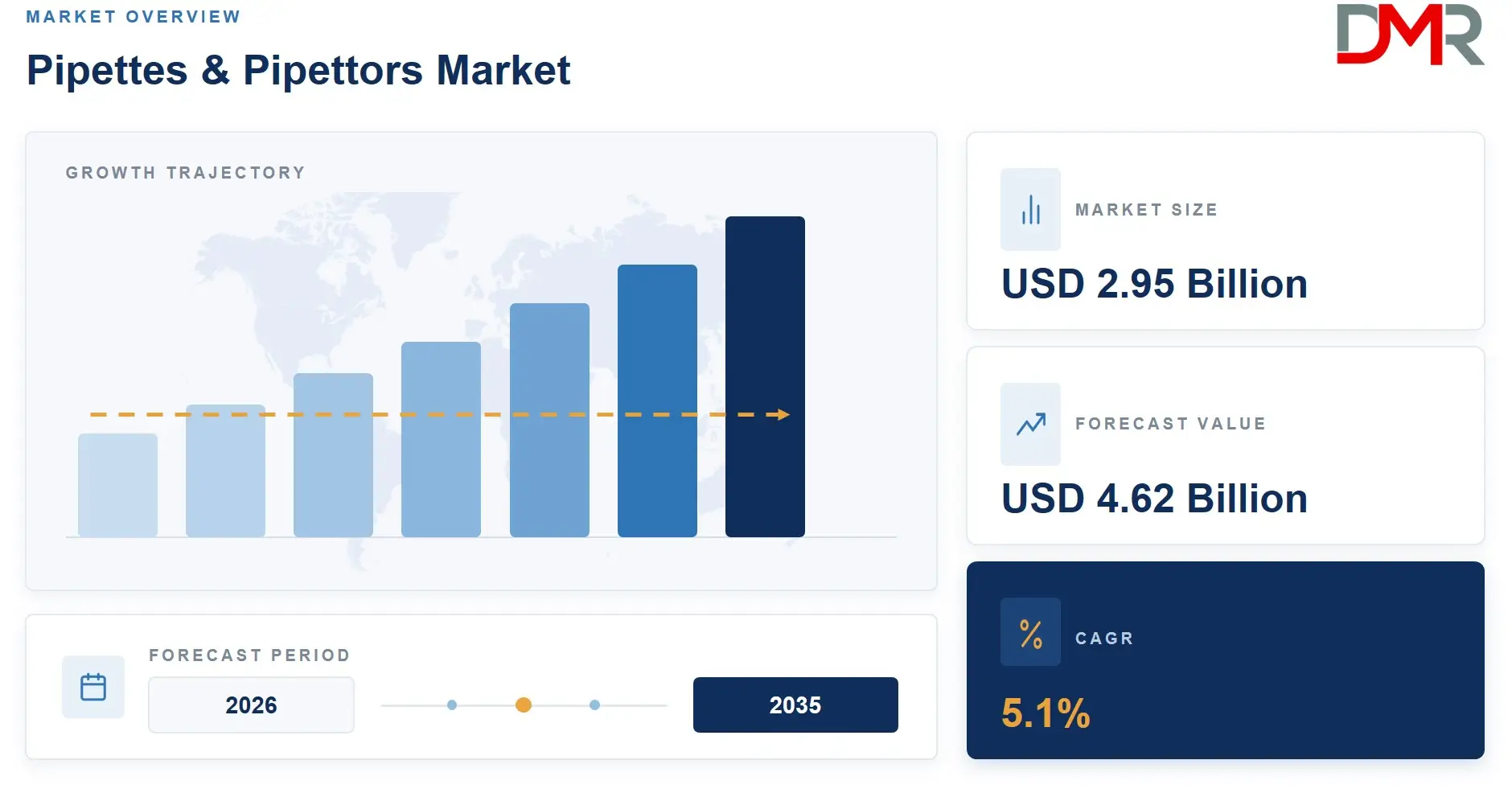
The Global Pipettes, Pipettors, and Accessories Market size is estimated at USD 2.95 Billion in 2026 from USD 2.81 Billion in 2025, and is projected to reach USD 4.62 Billion by 2035, exhibiting a CAGR of 5.1% during the forecast period.
Growth through the forecast window rests on three intersecting forces: expansion of regulated drug discovery workflows, tightening occupational health requirements that accelerate electronic pipette procurement, and steady laboratory capacity additions across Asia-Pacific. The 5.1% CAGR reflects a market where unit volumes are supported by replacement cycles tied to GLP calibration mandates rather than discretionary upgrades alone. U.S. labs reported a national pipette-tip shortage during the COVID-19 period, with academic laboratories rationing supplies and delaying experiments, as reported by the Cornell Sun. That episode exposed single-supplier dependency in the accessories segment and has since pushed procurement managers toward dual-sourcing strategies that expand the total addressable accessories revenue base.
ℹ
To learn more about this report –
Download Your Free Sample Report Here
Precision performance data reinforces the case for hardware investment. A 2026 comparative study published in JALM found that 24% of participants surpassed ISO imprecision limits at 10 µL and 13% exceeded them at 100 µL, demonstrating that user-to-user variability is measurable and consequential. Laboratories facing reproducibility audits now treat pipette upgrades as a documented error-reduction measure, not a discretionary capital expenditure. That positioning converts a portion of the market from commodity consumable to compliance instrument, supporting stronger average selling prices through the forecast period.
Product Type Analysis
Pipettes led the product type segment with a 46.31% share in 2026.
Pipettes command the largest product-type share because they serve every laboratory tier, from high-throughput pharmaceutical screening to single-researcher academic benches. Manual single-channel pipettes remain the default instrument in most settings, and the breadth of that installed base creates a durable, recurring demand for pipette calibration services and replacement tip consumables. Vendors that anchor a laboratory's pipette fleet effectively own the downstream accessories revenue for the duration of that relationship.
Accessories represent the fastest-growing product-type sub-segment, propelled by calibration mandates and the tip-compatibility requirements of newer electronic and multichannel instruments. Pipettors occupy the middle ground, with electronic variants gaining budget allocation as institutions formalize ergonomic purchasing criteria. A Lab Manager survey found that only 21% of respondents used electronic single-channel pipettors and 17% electronic multichannel instruments, confirming that electronic pipettors remain a minority technology today but represent the largest
addressable upgrade pool in the near term. Vendors positioned in electronic pipettors face both a timing and a pricing challenge in converting the large manual installed base.
.webp)
ℹ
To learn more about this report –
Download Your Free Sample Report Here
Material Analysis
With a 45.24% share in 2026, Glass outpaced all other material categories.
Glass pipettes retain their dominant material share because borosilicate glass offers chemical inertness across nearly all reagent classes, a property no polymer fully replicates at equivalent price points. Academic and reference laboratories that run mixed-reagent workflows default to glass for that reason. Autoclaving compatibility adds a sterilization advantage that extends glass instrument life in microbiology settings where disposable plastics create compliance overhead.
Plastic is the fastest-growing material sub-segment, driven by single-use clinical workflows and tip-rack systems that eliminate cross-contamination risk. Pharmaceutical production environments in particular are migrating disposable plastic formats into GMP-critical liquid transfer steps, where validated single-use materials shorten cleaning validation timelines. Stainless steel instruments hold a smaller but stable position in specialized industrial and high-temperature applications where neither glass nor plastic performs reliably.
Volume Capacity Analysis
Variable-Volume accounted for 55.52% of volume capacity demand in 2026, the highest of any category.
Variable-volume pipettes dominate because they give researchers one instrument capable of covering multiple protocol steps, reducing per-bench instrument counts. Drug discovery workflows that shift between microliter ranges during assay development treat variable-volume instruments as essential rather than optional. Vendors benefit from the format's higher average unit price and the compatibility requirements it creates with dedicated tip lines.
Fixed-volume pipettes serve repetitive, high-throughput tasks where speed and consistency matter more than flexibility. Multi-channel capacity formats are gaining traction in plate-based screening and ELISA workflows, where parallel dispensing across 8 or 12 wells compresses assay cycle times. Both sub-segments benefit from the migration of pharmaceutical quality-control labs toward standardized, validated liquid transfer platforms.
End User Analysis
Pharmaceutical and Biotechnology Companies captured 38.52% of end-user demand in 2026, ahead of all rivals.
Pharmaceutical and biotechnology organizations drive category leadership because GLP compliance frameworks mandate documented pipette calibration across every production-linked analytical step. A single audit finding on liquid transfer accuracy can trigger batch rejection. That consequence converts pipette investment from a cost to a risk-mitigation measure, sustaining premium pricing for traceable, validated instruments across this end-user group.
Laboratories represent the fastest-growing end-user sub-segment, pulled forward by expanding contract research organization capacity and the growth of clinical diagnostics workflows that require ISO 17025-aligned liquid handling. Hospitals and academic and research institutes follow with stable demand anchored in routine testing and teaching protocols. Other end-users, including environmental and food testing facilities, form the tail of the demand curve but are gaining relevance as regulatory coverage of analytical testing extends into new sectors.
Key Market Segments
By Product Type
- Pipettes
- Pipettors
- Manual Pipettors
- Electronic Pipettors
- Accessories
- Tips and Tip Racks
- Calibration and Verification Tools
- Other Accessories
By Material
- Glass
- Plastic
- Stainless Steel
By Volume Capacity
- Variable-Volume
- Fixed-Volume
- Multi-Channel Capacity Formats
By End User
- Pharmaceutical and Biotechnology Companies
- Laboratories
- Hospitals
- Academic and Research Institutes
- Other End-Users
Regional Analysis
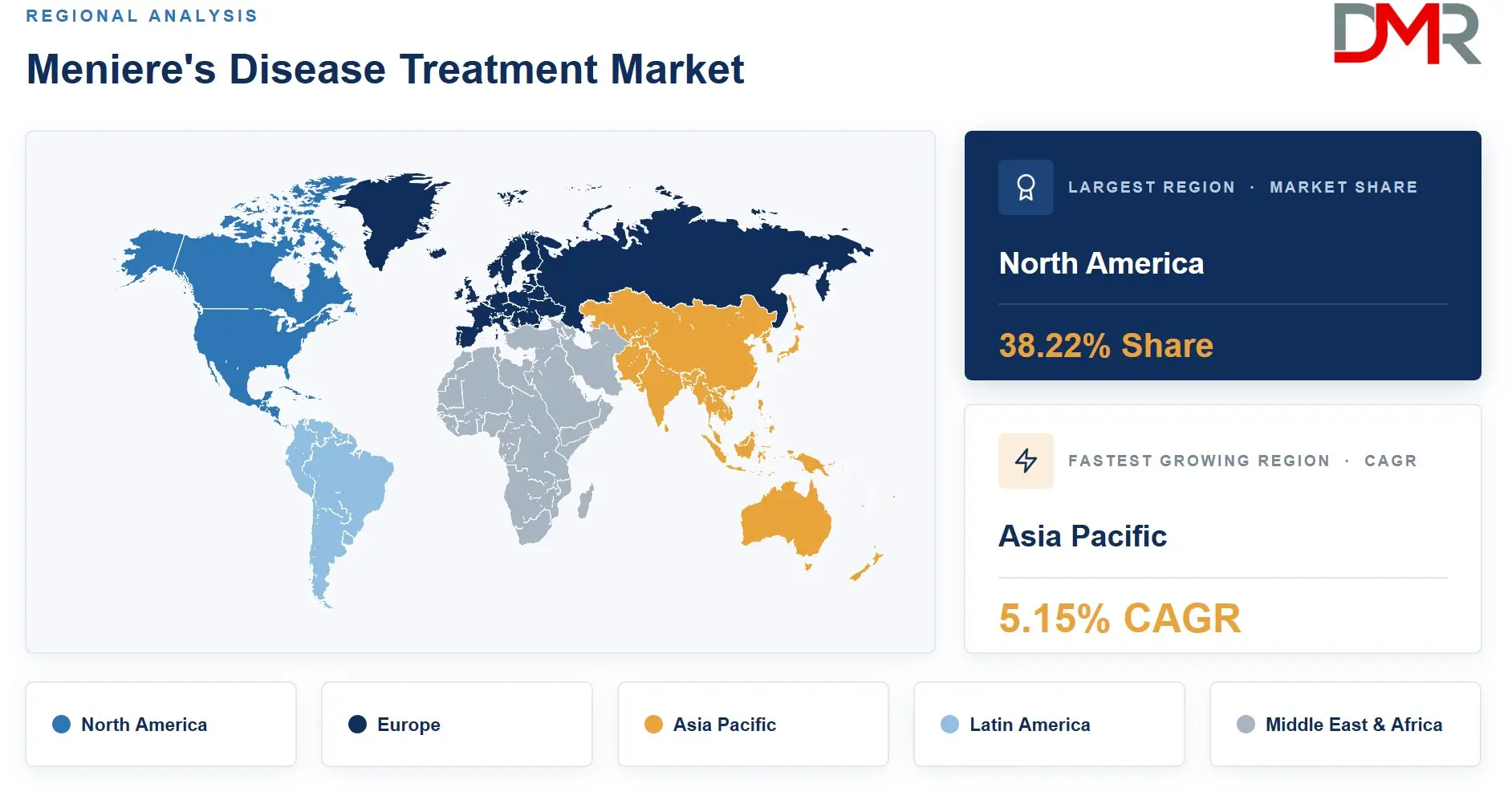
North America led all regions with a 43.7% share in 2026, equivalent to approximately USD 1.23 Billion.
North America's leadership reflects the concentration of global pharmaceutical R&D spend, the density of GLP-regulated testing facilities, and a procurement culture that moves quickly toward electronic and compliance-ready instruments. U.S. laboratories operate under OSHA laboratory safety standards and CDC ergonomics guidance that explicitly create institutional pressure to procure ergonomic liquid-handling equipment. Federal procurement channels for public health and NIH-funded research add another stable demand layer that insulates the regional market from short-cycle economic swings.
ℹ
To learn more about this report –
Download Your Free Sample Report Here
Asia-Pacific is the fastest-growing region, driven by pharmaceutical manufacturing capacity expansion in China and India, expanding contract research organization networks across South Korea and Japan, and government investment in biomedical research infrastructure. Europe holds a strong second position, anchored by stringent ISO 17025 and OECD GLP compliance requirements across Germany, France, and the UK. Latin America and the Middle East and Africa regions show early-stage but accelerating demand in national reference laboratories and emerging pharmaceutical production hubs, particularly in Brazil and the GCC.
Key Regions and Countries
North America
Europe
- Germany
- France
- The UK
- Spain
- Italy
- Rest of Europe
Asia Pacific
- China
- Japan
- South Korea
- India
- Australia
- Rest of APAC
Latin America
- Brazil
- Mexico
- Rest of Latin America
Middle East & Africa
- GCC
- South Africa
- Rest of MEA
Market Dynamics
GLP Compliance and Ergonomic Risk Pressure Drive Instrument Upgrades
OECD Good Laboratory Practice and ISO 17025 mandates require traceable, gravimetrically verified pipette calibration at regular intervals, locking replacement and servicing spend into laboratory operating budgets regardless of economic conditions. A questionnaire study across six organizations, published in PubMed, found a significantly higher rate of elbow and hand musculoskeletal complaints among the 80 pipette users compared with 85 non-users. That clinical evidence has given procurement teams a documented basis for prioritizing ergonomic instruments under occupational health programs, shifting electronic pipette purchases from discretionary to policy-driven.
Almost 90% of subjects in the longest continuous-pipetting exposure group, those pipetting more than 60 minutes per working period, reported hand complaints in the same study, as confirmed by PubMed. Institutions running formal RULA and Strain Index risk assessments now use that figure to justify fleet upgrades. Microprocessor-controlled pipettes that reduce thumb force and stroke distance simultaneously satisfy OSHA guidance and improve dispense reproducibility, making them a dual-purpose compliance investment. In May 2024, Advanced Instruments released ArtelWare 2.2, an upgraded calibration software platform adding multichannel pipette verification and centralized digital performance tracking, directly addressing the documentation overhead that compliance programs impose on laboratories managing large pipette fleets.
Manual Pipette Inertia and Supply Chain Fragility Cap Growth
Persistent reliance on low-cost manual pipettes as the laboratory default suppresses migration to electronic and automated alternatives. A large installed manual base carries its own institutional momentum: retraining costs, SOP revision overhead, and tip-compatibility validation all make switching more expensive than procurement managers initially calculate. Recurring calibration and gravimetric verification under GLP frameworks add ongoing total-cost-of-ownership friction that makes large electronic fleets harder to justify on a per-instrument basis.
Supply chain fragility compounds the restraint. A global shortage of pipette tips during the pandemic, driven by testing demand and compounded by factory outages and border closures, threatened research continuity across nearly every corner of the scientific world, as reported by STAT News. Laboratories that rationed tips and delayed experiments experienced direct productivity losses. Tip supply concentration among a small number of manufacturers means future demand surges, whether from pandemic response or from accelerating pharmaceutical production, can quickly exhaust inventory buffers and stall laboratory operations.
Electronic Pipette Adoption and Service Subscription Models Open New Revenue Channels
Guidance from the University of Pittsburgh's ergonomics office explicitly recommends using electronic pipettes when possible to reduce plunger force and repetitive thumb motion, positioning electronic models as the primary institutional control for musculoskeletal risk. That institutional endorsement, replicated across hospital systems and major research universities, is accelerating budget line items for electronic instrument procurement. Semi-automated benchtop pipetting robots priced below full liquid-handling workstations offer an accessible entry point for small and mid-volume laboratories currently excluded from automation by capital constraints.
Service and recalibration subscription models are converting GLP compliance overhead into predictable recurring revenue for instrument vendors. Validated software-linked pipettes that auto-log dispense data into electronic records create a sticky relationship between the instrument and the compliance workflow. Laboratories that integrate these platforms face high switching costs, giving vendors with service capabilities a long-term retention advantage over pure hardware competitors.
Market Trends
Traceability and Electronic Verification Redefine Laboratory Pipetting Standards
A 2026 JALM study found that 10% of laboratory participants exceeded ISO accuracy limits for 10 µL pipetting and 22% exceeded limits for 100 µL, making user-to-user performance variability a documented audit risk. Laboratories moving earliest to software-linked, auto-logging pipette systems will convert that compliance risk into a competitive operational advantage. Early movers in electronic verification infrastructure stand to capture calibration service contracts and software subscription revenue as regulatory scrutiny of liquid transfer accuracy intensifies across pharmaceutical and clinical sectors.
Market Competition Overview
The pipettes, pipettors, and accessories market is moderately consolidated at the premium tier and fragmented at the consumables and accessories level. A small group of established instrument manufacturers holds dominant positions in electronic and precision pipette categories, supported by decades of brand trust, calibration service networks, and GLP-validated product portfolios. Entry barriers in the regulated instrument segment are high, anchored in certification timelines, calibration traceability requirements, and the reluctance of pharmaceutical buyers to substitute away from audited supplier relationships.
Competitive pressure is intensifying from two directions. Manufacturers in Asia, particularly India, are expanding export capacity in manual and semi-automated instruments, applying price pressure on standard configurations. Simultaneously, established Western players are differentiating through software integration, ergonomic design enhancements, and service subscription bundling. Share shifts will favor vendors that combine hardware credibility with digital traceability platforms, as compliance documentation requirements raise the total value of each instrument relationship beyond the unit price.
Company Profiles
Eppendorf SE maintains competitive advantage through a dual-track value proposition: its mechanical pipettes are marketed on quality, accuracy, longevity, and ergonomic comfort, as highlighted directly in Eppendorf's product communications, while its electronic pipettes and automated liquid handlers are positioned as offering almost no operating forces and superior precision versus manual instruments, per Eppendorf's own comparative framing. That architecture allows Eppendorf to serve buyers at every point on the manual-to-automated migration path without ceding account relationships during the transition. The breadth of the portfolio creates cross-selling leverage that narrower instrument vendors cannot replicate.
In March 2026, Thermo Fisher Scientific introduced the Fluid Ease Pro ClipTip electronic pipette, featuring what the company describes as the first large high-resolution touchscreen on a pipette, alongside intelligent power management and advanced programming for reproducible pipetting across routine and demanding workflows. That launch signals Thermo Fisher's intent to compete on user interface and programmability rather than price alone, targeting high-throughput pharmaceutical and clinical laboratories where workflow integration and ease of programming reduce technician training time and error rates.
Thermo Fisher Scientific competes across the full liquid-handling spectrum, from consumable tips to high-specification electronic instruments. Its scale in pharmaceutical supply chains gives it procurement relationships that smaller specialists cannot access, and its global distribution and service infrastructure supports calibration programs across multi-site research organizations. The company's strategy of advancing instrument programmability and touchscreen interfaces positions it against ergonomic-specialist competitors by adding workflow configurability as a differentiator alongside user comfort.
Key Players
- Greiner Bio-One International GmbH
- Integra Biosciences AG
- Microlit India Pvt. Ltd.
- Nichiryo Co., Ltd.
- Hamilton Company
- Accumax Lab Devices Pvt. Ltd.
- AHN Biotechnologie GmbH
- BRAND GMBH + CO KG
- CAPP ApS
- Scilogex LLC
- Socorex Isba SA
- Thermo Fisher Scientific Inc.
- Eppendorf SE
- Sartorius AG
- Mettler-Toledo International Inc.
- Corning Incorporated
Supply Chain and Value Chain Analysis
The pipettes and accessories supply chain begins with raw material suppliers for borosilicate glass, engineering polymers, and precision metal components. Instrument manufacturers convert these inputs into calibrated pipetting instruments and validated consumable tip formats. Value creation is highest at the instrument manufacturing and calibration certification stages, where GLP compliance requirements create pricing power unavailable in commodity consumable production.
Distribution channels span direct sales to pharmaceutical accounts, specialty laboratory distributors, and group purchasing organizations serving hospital and academic buyers. The biggest supply chain risk sits in the injection-molded tip segment, where a small number of contract manufacturers supply the majority of the global market. Concentration in tip manufacturing, as the pandemic shortage demonstrated, is the most acute bottleneck in the full value chain, capable of halting downstream laboratory operations regardless of instrument availability.
Regulatory Landscape
OECD Good Laboratory Practice principles require that all pipetting instruments used in test facilities are calibrated against national measurement standards, with records traceable through the full calibration chain. ISO 17025 sets equivalent requirements for testing and calibration laboratories, mandating documented measurement uncertainty for all liquid-handling instruments. In North America, OSHA laboratory standards and CDC ergonomics guidance create a separate compliance layer that effectively mandates institutional ergonomic risk assessments, creating indirect demand for electronic pipettes as documented control measures.
Regulatory expectations around electronic data integrity are tightening. FDA 21 CFR Part 11 and EU Annex 11 requirements for electronic records in pharmaceutical environments are now interpreted to include auto-logged pipette dispense data in GMP-critical workflows. Vendors whose instruments generate and export validated electronic records gain a direct compliance advantage in pharmaceutical accounts, converting regulatory burden into a product feature that sustains premium pricing.
Investment and White Space Analysis
Investment is flowing toward electronic pipette platforms with integrated software logging and toward calibration service infrastructure that can support large pharmaceutical and CRO accounts under GLP frameworks. The highest-return white space sits in semi-automated benchtop pipetting robots priced below USD 10,000, a segment currently underserved by both full-workstation automation vendors and pure manual pipette manufacturers. Small and mid-volume laboratories represent a large, addressable base that full liquid-handling workstations price out of the automation market.
Asia-Pacific offers the clearest combination of high growth and low competitive intensity at the premium instrument tier. India and Southeast Asia are building out pharmaceutical manufacturing capacity under national industrial policy programs, and compliance-grade electronic pipettes remain underpenetrated in these markets relative to Western equivalents. Service subscription models built around recalibration and GLP documentation represent an undermonetized revenue channel across all regions, particularly where vendors currently earn calibration revenue only on instrument sale rather than across the instrument lifetime.
Recent Developments
- January 2024 — Antrum Biotech reported integrating INTEGRA Biosciences' serological pipette controllers into its production and R&D workflows, citing these instruments as essential to scaling liquid-handling efficiency in commercializing its healthcare products.
- April 2025 — Sartorius AG entered a collaboration with LiveLabs, a life-science incubator, to supply early-stage biotech startups with electronic pipettes, balances, and live-cell analysis systems, accelerating electronic liquid-handling adoption in young companies with limited capital.
- March 2026 — Thermo Fisher Scientific introduced the Fluid Ease Pro ClipTip electronic pipette, featuring what the company describes as the first large high-resolution touchscreen on a pipette, alongside intelligent power management and advanced programming to support reproducible pipetting across routine and demanding workflows.
Report Details
| Report Characteristics |
| Market Value (2025) |
USD 2.81 Billion |
| Market Value (2026) |
USD 2.95 Billion |
| Forecast Revenue (2035) |
USD 4.62 Billion |
| CAGR (2026–2035) |
5.1% |
| Base Year for Estimation |
2025 |
| Historic Period |
2020 – 2024 |
| Forecast Period |
2026 – 2035 |
| Report Coverage |
Revenue Forecast, Market Dynamics, Competitive Landscape, Recent Developments |
| Segments Covered |
By Product Type (Pipettes, Pipettors, Accessories), By Material (Glass, Plastic, Stainless Steel), By Volume Capacity (Variable-Volume, Fixed-Volume, Multi-Channel Capacity Formats), By End User (Pharmaceutical and Biotechnology Companies, Laboratories, Hospitals, Academic and Research Institutes, Other End-Users) |
| Regional Analysis |
North America – US, Canada; Europe – Germany, France, The UK, Spain, Italy, Rest of Europe; Asia Pacific – China, Japan, South Korea, India, Australia, Rest of APAC; Latin America – Brazil, Mexico, Rest of Latin America; Middle East & Africa – GCC, South Africa, Rest of MEA |
| Competitive Landscape |
Greiner Bio-One International GmbH, Integra Biosciences AG, Microlit India Pvt. Ltd., Nichiryo Co. Ltd., Hamilton Company, Accumax Lab Devices Pvt. Ltd., AHN Biotechnologie GmbH, BRAND GMBH + CO KG, CAPP ApS, Scilogex LLC, Socorex Isba SA, Thermo Fisher Scientific Inc., Eppendorf SE, Sartorius AG, Mettler-Toledo International Inc., Corning Incorporated |
| Customization Scope |
Customization for segments and region or country level will be provided. Additional customization can be done based on requirements. |
| Purchase Options |
Three license options: Single User License, Multi-User License (Up to 5 Users), and Corporate Use License (Unlimited Users and Printable PDF). |
Frequently Asked Questions
What is the biggest investment opportunity in Pipettes & Pipettors Market ?
▾ Semi-automated benchtop pipetting robots priced for small and mid-volume laboratories represent the clearest white space in the market today. Asia-Pacific pharmaceutical manufacturing hubs, particularly India and Southeast Asia, combine rapid capacity expansion with underpenetrated compliance-grade electronic pipette adoption. Service subscription models built around GLP recalibration and electronic data logging offer vendors a recurring revenue stream that currently goes largely uncaptured.
Who are the top companies in Pipettes & Pipettors Market ?
▾ The market's leading players include Eppendorf SE, Thermo Fisher Scientific Inc., Sartorius AG, Mettler-Toledo International Inc., BRAND GMBH + CO KG, Hamilton Company, Integra Biosciences AG, and Corning Incorporated, among others. Eppendorf and Thermo Fisher hold particularly strong positions in electronic and precision pipette categories, supported by global service networks and validated GLP portfolios.
Which segment is growing fastest in Pipettes & Pipettors Market and why?
▾ Accessories is the fastest-growing product-type sub-segment, driven by calibration mandate requirements and the tip-compatibility demands of expanding electronic pipette fleets. Laboratories represent the fastest-growing end-user category, pulled forward by contract research organization capacity additions and expanding clinical diagnostics infrastructure. Both trends are compounding, as more laboratory facilities require more validated consumable and calibration accessory spend per installed instrument.
Which region is growing fastest in Pipettes & Pipettors Market and why?
▾ Asia-Pacific is the fastest-growing region, driven by pharmaceutical manufacturing expansion in China and India, growing contract research organization networks in South Korea and Japan, and government investment in biomedical research capacity. Regulatory alignment with international GLP and ISO 17025 standards across the region is also increasing the addressable market for premium, compliance-validated pipetting instruments.
What is the biggest challenge holding Pipettes & Pipettors Market back?
▾ Persistent reliance on low-cost manual pipettes as the laboratory default is the primary growth constraint. The large installed manual base creates switching friction through retraining costs, SOP revision requirements, and tip-compatibility validation overhead. Supply chain concentration in the tip manufacturing segment compounds the restraint, as demonstrated by the pandemic-era tip shortage that forced laboratories to ration supplies and delay experiments.