Global PLM Software in Discrete Manufacturing Market Snapshot
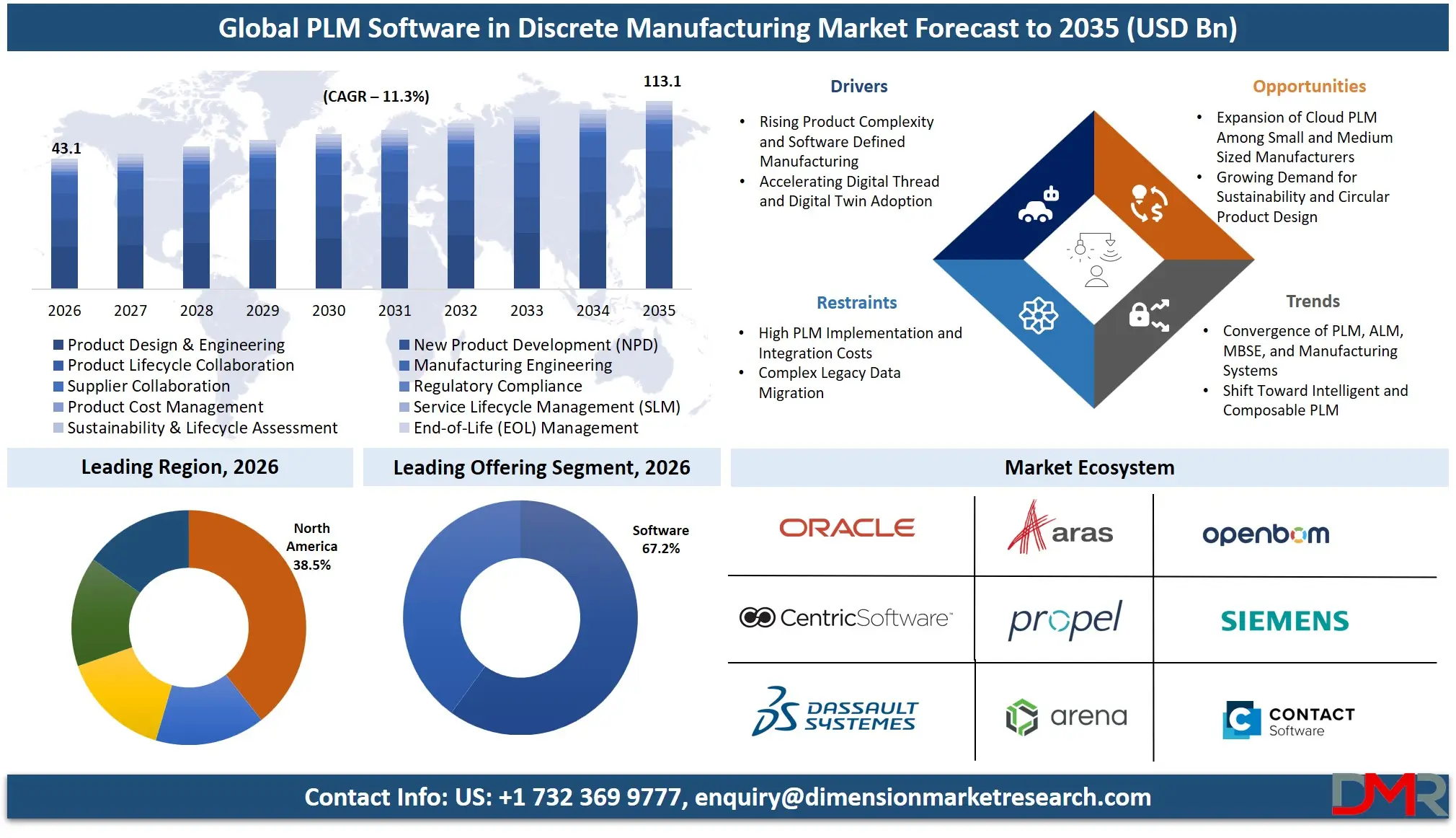
- Global PLM Software in Discrete Manufacturing Market Size in 2026: USD 43.1 Billion
- Global PLM Software in Discrete Manufacturing Market Size in 2035: USD 113.1 Billion
- Global CAGR from 2026 to 2035: 11.3%
- Software is the leading offering segment in 2026: 67.2%
- Cloud is the leading deployment mode segment in 2026: 64.9%
- Product Design and Engineering is the leading application segment in 2026: 32.3%
- Automotive is the leading discrete manufacturing industry segment in 2026: 31.8%
- North America is the leading region in 2026: 38.5%
What is the Global Supply Chain Consulting Service and its Market Size?
Product lifecycle management software in discrete manufacturing is an integrated digital platform that governs product information, engineering processes, configurations, and collaboration from initial concept through design, production, service, and retirement. It creates an authoritative product record by connecting computer aided design data, bills of materials, requirements, changes, quality documentation, supplier inputs, manufacturing plans, and service information. Automotive, aerospace, industrial machinery, electronics, medical device, rail, marine, and other discrete manufacturers use PLM software to coordinate complex products across mechanical, electrical, electronic, and software engineering domains. The technology supports configuration control, traceability, regulatory compliance, digital thread continuity, product cost management, and faster new product introduction.
ℹ
To learn more about this report –
Download Your Free Sample Report Here
The Global PLM Software in Discrete Manufacturing Market is projected to be valued at USD 43.1 billion in 2026 and is projected to reach USD 113.1 billion by 2035, expanding at a CAGR of 11.3% during the forecast period. Growth is being driven by increasing product complexity, shorter innovation cycles, rising adoption of digital twins, migration toward cloud PLM, and the convergence of product lifecycle management with application lifecycle management, manufacturing execution, enterprise resource planning, and service systems. Manufacturers are investing in connected product data to manage software defined products, multidisciplinary bills of materials, global supplier networks, sustainability requirements, and increasingly stringent quality regulations. Artificial intelligence, model based systems engineering, simulation management, and product analytics are further expanding the strategic role of PLM as the digital backbone of discrete manufacturing.
Use Cases
- Product Design and Engineering: Discrete manufacturers use PLM platforms to manage computer aided design files, engineering specifications, product structures, revisions, and multidisciplinary collaboration. A controlled product record reduces data duplication, improves design reuse, strengthens intellectual property governance, and enables mechanical, electrical, electronic, and software teams to work from synchronized information.
- New Product Development: PLM software coordinates stage gate processes, requirements, portfolios, tasks, approvals, costs, and launch readiness across product development programs. Manufacturers use it to shorten development cycles, improve resource allocation, identify program risks, and maintain traceability from customer requirements to validated product configurations.
- Bill of Materials and Change Management: PLM connects engineering, manufacturing, and service bills of materials while controlling deviations, effectivity, variants, and engineering changes. Automated workflows route impact assessments and approvals to relevant teams, reducing errors and ensuring that factories, suppliers, and service organizations use the correct configuration.
- Digital Twin and Closed Loop Lifecycle Management: Manufacturers use PLM as the information backbone for digital twins by linking product definitions with simulation, production, quality, and field performance data. Closed loop insights support design optimization, predictive service, root cause analysis, lifecycle extension, and continuous product improvement.
Key Takeaways
- Market Size: The Global PLM Software in Discrete Manufacturing Market is anticipated to be valued at USD 43.1 billion in 2026 and is forecast to reach USD 113.1 billion by 2035, expanding at a CAGR of 11.3%.
- Growth Outlook: Market expansion is supported by cloud migration, digital thread programs, software defined product development, model-based systems engineering, digital twin adoption, artificial intelligence, and growing demand for enterprise-wide product data governance.
- Primary Growth Drivers: Increasing product complexity, compressed development schedules, globally distributed engineering teams, regulatory traceability, mass customization, supplier collaboration, and integration of mechanical, electrical, electronic, and software data are accelerating PLM investment.
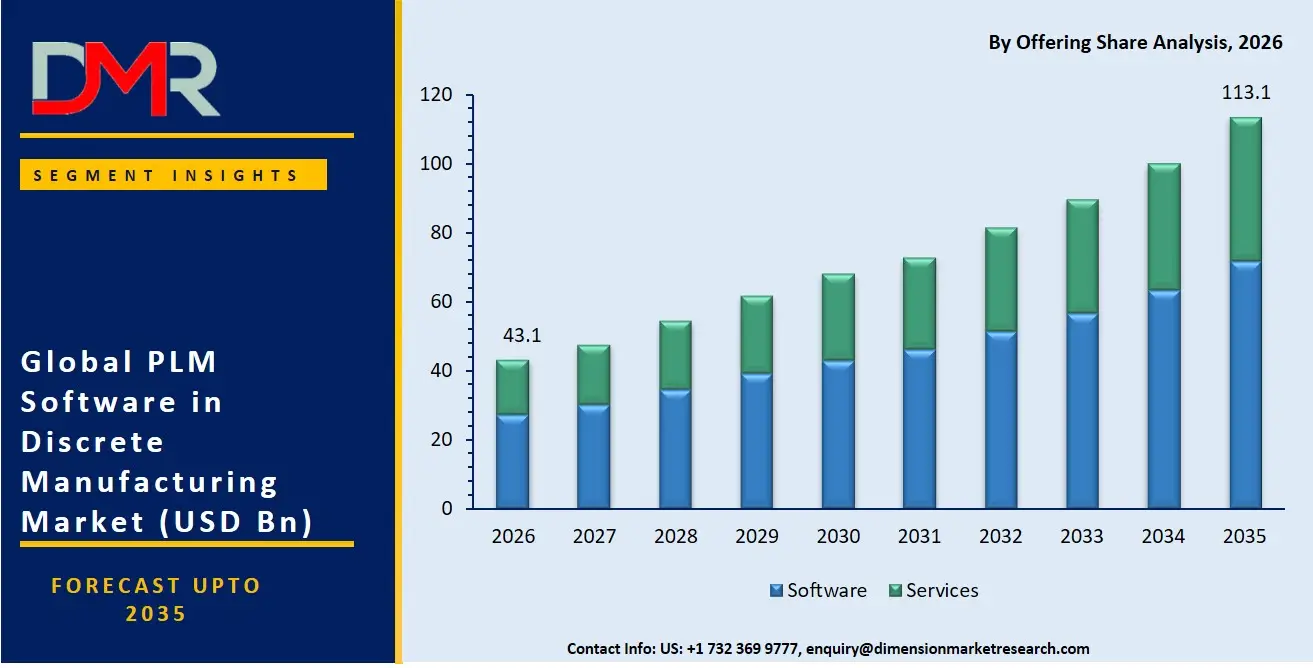
- By Offering Analysis: Software is projected to lead the offering segment with a 67.2% share in 2026, supported by demand for core product data management, configuration control, digital thread, and specialized industry capabilities. Services are expected to expand rapidly as enterprises require implementation, integration, migration, customization, and managed support.
- By Deployment Mode Analysis: Cloud is expected to lead deployment with a 64.9% share in 2026. Hybrid cloud is projected to record strong growth as manufacturers combine scalable collaboration with controlled storage for sensitive intellectual property and regulated product information.
- By Application Analysis: Product Design and Engineering is anticipated to dominate with a 32.3% share in 2026. Sustainability and Lifecycle Assessment is expected to record the fastest growth as manufacturers measure product carbon footprints, material compliance, circularity, and end of life performance.
- Regional Leadership: North America is expected to account for 38.5% of global revenue in 2026, supported by mature aerospace, automotive, high technology, medical device, and industrial machinery sectors and early adoption of cloud, artificial intelligence, and digital twin platforms.
How AI/Gen AI is Transforming the PLM Software in Discrete Manufacturing Market?
Artificial intelligence is transforming PLM by converting large volumes of product data into contextual engineering intelligence. Machine learning can classify parts, detect duplicates, recommend reuse, predict change impacts, identify quality risks, optimize product portfolios, and improve cost estimation. Generative artificial intelligence assistants allow engineers to search bills of materials, specifications, test records, and change histories through natural language. They can summarize technical documents, generate workflow guidance, extract compliance requirements, and accelerate routine documentation. When grounded in governed PLM data, these capabilities improve decision quality while preserving traceability and access controls.
The next phase of adoption is moving toward agentic workflows that coordinate actions across PLM, computer aided design, application lifecycle management, enterprise resource planning, manufacturing execution, and service platforms. AI assisted requirements analysis, automated configuration validation, predictive supplier risk assessment, and simulation driven optimization can reduce engineering effort and shorten development cycles. However, manufacturers must address intellectual property protection, model accuracy, explainability, data lineage, cybersecurity, and human approval. PLM providers are therefore embedding governed AI within product data platforms rather than relying on disconnected general purpose tools.
Key Drivers in the Global PLM Software in Discrete Manufacturing Market
Rising Product Complexity and Software Defined Manufacturing
Discrete products increasingly combine mechanical systems, electronics, embedded software, connectivity, and cloud enabled services. Automotive manufacturers are developing electric, connected, and autonomous vehicles, while aerospace, industrial equipment, medical device, and electronics companies are managing similarly complex multidisciplinary architectures. Traditional document based processes cannot efficiently control thousands of requirements, variants, interfaces, and engineering changes. PLM provides configuration governance, traceability, systems engineering support, and a shared digital thread across engineering domains. The need to synchronize hardware and software development, control product variants, and maintain accurate bills of materials is making modern PLM infrastructure essential for competitive product development.
Accelerating Digital Thread and Digital Twin Adoption
Manufacturers are connecting engineering data with simulation, production, quality, supply chain, and service information to create an uninterrupted digital thread. PLM serves as the authoritative backbone for these initiatives by governing product definitions, configurations, changes, and lifecycle relationships. Digital twins depend on trusted product structures and contextual operational data to support virtual validation, production optimization, predictive maintenance, and closed loop engineering. As companies scale smart factory and Industry 4.0 programs, demand is increasing for PLM platforms that integrate with computer aided design, enterprise resource planning, manufacturing execution, Internet of Things, and service lifecycle systems
Restraints in the Global PLM Software in Discrete Manufacturing Market
High Transformation Cost and Implementation Complexity
Enterprise PLM programs require substantial investment in software subscriptions, systems integration, data cleansing, process redesign, customization, training, and change management. Migrating decades of drawings, bills of materials, specifications, and engineering history from fragmented legacy systems is technically demanding. Large manufacturers must also align multiple business units, acquired companies, suppliers, and regional processes around common product data standards. Poor data quality or excessive customization can extend implementation schedules and reduce expected returns. These barriers are particularly significant for small and medium sized manufacturers with limited information technology resources, engineering capacity, and transformation budgets.
Growth Opportunities in the Global PLM Software in Discrete Manufacturing Market
Expansion of Cloud PLM Among Small and Medium Sized Manufacturers
Cloud based PLM reduces infrastructure requirements and provides faster deployment, scalable capacity, remote access, automated upgrades, and subscription based purchasing. These advantages make enterprise grade product data management increasingly accessible to small and medium sized manufacturers that previously depended on shared drives, spreadsheets, and disconnected engineering tools. Vendors can expand adoption through packaged industry templates, configurable workflows, application programming interfaces, and modular subscriptions. Hybrid deployments also create opportunities among regulated and intellectual property intensive manufacturers that need cloud collaboration while retaining selected workloads in controlled environments.
Growing Demand for Sustainability and Circular Product Design
Manufacturers face increasing pressure to document material origin, restricted substances, product carbon footprints, repairability, recyclability, and end of life treatment. PLM platforms can embed sustainability criteria in requirements, material selection, supplier collaboration, design reviews, and lifecycle assessment. Connecting product structures with environmental data allows engineering teams to compare design alternatives before production and maintain evidence for regulatory reporting. Digital product passports, extended producer responsibility, ecodesign rules, and corporate net zero programs are creating demand for PLM capabilities that connect compliance, cost, quality, and environmental performance within a governed product record.
Trends in the Global PLM Software in Discrete Manufacturing Market
Convergence of PLM, ALM, MBSE, and Manufacturing Systems
Manufacturers are replacing isolated engineering applications with connected platforms that unify product lifecycle management, application lifecycle management, model based systems engineering, simulation, manufacturing planning, and service information. This convergence is required for software defined products, where hardware configurations, software releases, requirements, and verification evidence must remain synchronized. Open interfaces, low code integration, common data models, and digital thread architectures are becoming major selection criteria. Vendors are expanding beyond conventional product data management to support cross domain engineering and lifecycle orchestration.
Shift Toward Intelligent and Composable PLM
PLM platforms are becoming more modular, cloud enabled, role based, and intelligence driven. Manufacturers increasingly prefer configurable applications that can be deployed incrementally around priority processes such as bill of materials management, change control, quality, supplier collaboration, or portfolio planning. Embedded analytics and generative artificial intelligence improve search, knowledge discovery, workflow automation, and decision support. Low code tools allow companies to extend applications without extensive customization. This composable approach improves time to value and enables PLM environments to evolve with product, regulatory, and organizational requirements.
Research Scope and Analysis
The Global PLM Software in Discrete Manufacturing Market is segmented by Offering, Deployment Mode, Organization Size, PLM Functionality, Application, and Discrete Manufacturing Industry. The analysis evaluates software and service demand, cloud and on premises adoption, enterprise size, core lifecycle functions, operational applications, and industry specific requirements. Regional assessment covers North America, Europe, Asia Pacific, Latin America, and the Middle East and Africa.
ℹ
To learn more about this report –
Download Your Free Sample Report Here
By Offering Analysis
Software is projected to lead the offering segment with a 67.2% share in 2026. Demand is supported by enterprise modernization of product data management, configuration control, engineering change, digital thread, portfolio, quality, and collaboration processes.
ℹ
To learn more about this report –
Download Your Free Sample Report Here
Core PLM platforms remain central because they establish the governed product record, while industry specific solutions address specialized workflows in automotive, aerospace, electronics, medical devices, and industrial machinery. PLM Add on Modules are expected to gain adoption as manufacturers expand existing environments with analytics, compliance, cost, sustainability, simulation, and supplier collaboration capabilities. Services will grow strongly as complex deployments require strategic consulting, implementation, system integration, data migration, user enablement, and continuous platform administration.
By Deployment Mode Analysis
Cloud is expected to dominate deployment with a 64.9% share in 2026 as manufacturers prioritize scalability, remote engineering collaboration, faster upgrades, reduced infrastructure management, and subscription based access. Public Cloud supports standardized and cost efficient implementations, while Private Cloud addresses stronger isolation, security, and governance requirements. Hybrid Cloud is expected to record the fastest growth because it allows enterprises to combine cloud collaboration and analytics with controlled environments for sensitive product intellectual property and regulated workloads. On premises deployment remains important among aerospace, defense, medical device, and other manufacturers that require extensive customization, deterministic control, data sovereignty, or restricted network operation.
By Organization Size Analysis
Large Enterprises are expected to remain the dominant organization size segment because they operate complex global engineering networks, extensive product portfolios, multiple manufacturing sites, and large supplier ecosystems. These organizations require enterprise configuration management, multidisciplinary engineering, compliance traceability, and integration across computer aided design, enterprise resource planning, manufacturing execution, quality, and service systems. Small and Medium Sized Enterprises are projected to grow faster as cloud subscriptions, packaged workflows, industry templates, and lower code configuration reduce adoption barriers. SMEs increasingly use PLM to replace uncontrolled documents, improve change discipline, support customer audits, and collaborate with larger original equipment manufacturers.
By PLM Functionality Analysis
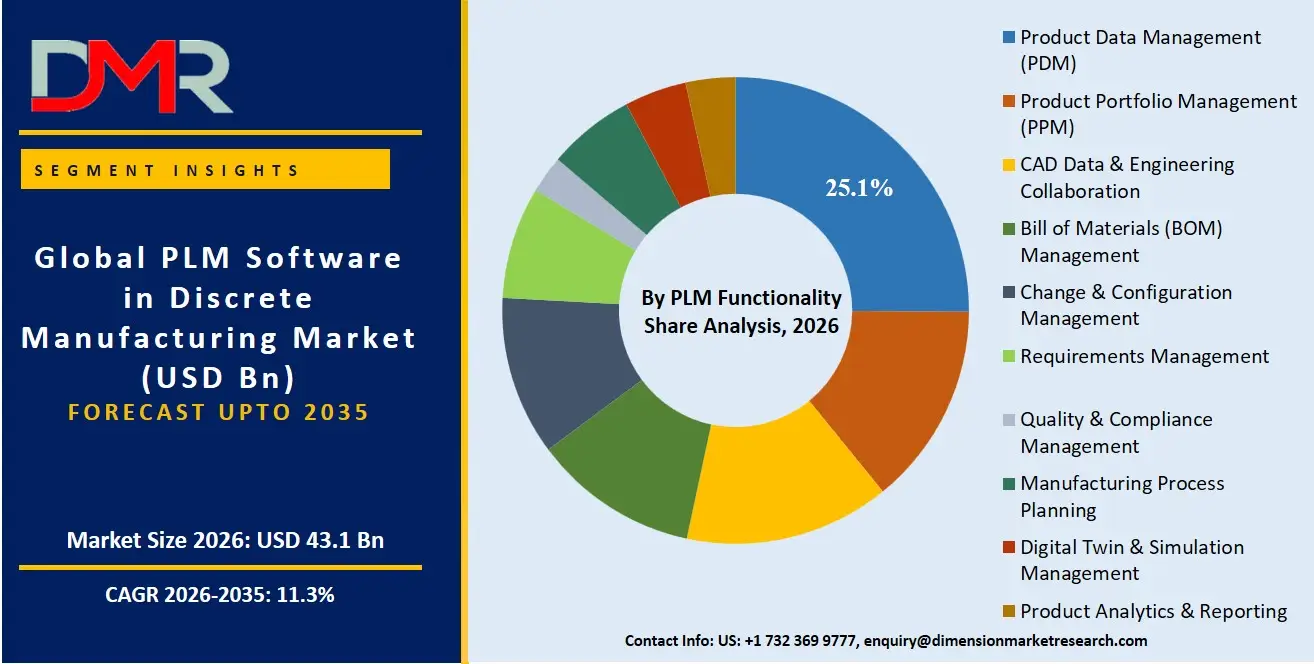
Product Data Management is expected to lead the functionality segment with 25.1% of market share in 2026 because it provides the foundational control of product structures, computer aided design files, documents, revisions, classifications, and access rights. Bill of Materials Management and Change and Configuration Management will remain critical for variant rich and regulated products. Digital Twin and Simulation Management is projected to record the fastest growth as manufacturers connect virtual models with production and field data. Requirements Management is expanding with systems engineering, while Quality and Compliance Management supports traceability, audit readiness, and corrective action. Product Analytics and Reporting is gaining importance as artificial intelligence and lifecycle intelligence turn governed product data into operational insight.
By Application Analysis
Product Design and Engineering is projected to dominate the application segment with a 32.3% share in 2026. Its leadership reflects the central role of PLM in managing multidisciplinary design data, revisions, approvals, reuse, and engineering collaboration. New Product Development and Product Lifecycle Collaboration are also major applications as manufacturers seek faster launches and coordinated global workflows. Manufacturing Engineering links product definitions with process plans, work instructions, and production bills of materials. Sustainability and Lifecycle Assessment is expected to grow rapidly due to environmental reporting and circular design requirements. Service Lifecycle Management and End of Life Management are expanding as manufacturers pursue recurring service revenue, repairability, remanufacturing, and closed loop product improvement.
By Discrete Manufacturing Industry Analysis
Automotive is projected to lead the industry segment with a 31.8% share in 2026. Vehicle electrification, advanced driver assistance, embedded software, regulatory validation, variant complexity, and global supplier coordination require rigorous lifecycle governance. Aerospace and Defense represents a major market due to long product lifecycles, stringent configuration control, certification evidence, and secure collaboration. High Tech and Electronics adoption is driven by short innovation cycles and complex component sourcing. Industrial Machinery and Heavy Equipment uses PLM for engineer to order configurations and service information. Medical Devices is expected to grow strongly as manufacturers strengthen design controls, risk management, quality records, and regulatory traceability.
The Global PLM Software in Discrete Manufacturing Market Report is segmented on the basis of the following:
By Offering
- Software
- Core PLM Platform
- Industry Specific PLM Solutions
- PLM Add on Modules
- Services
- Consulting and Advisory
- Implementation and Integration
- Training and Support
- Managed Services
By Deployment Mode
- Cloud
- Public Cloud
- Private Cloud
- Hybrid Cloud
- On premises
By Organization Size
- Large Enterprises
- Small and Medium Sized Enterprises (SMEs)
By PLM Functionality
- Product Data Management (PDM)
- Product Portfolio Management (PPM)
- CAD Data & Engineering Collaboration
- Bill of Materials (BOM) Management
- Change & Configuration Management
- Requirements Management
- Quality & Compliance Management
- Manufacturing Process Planning
- Digital Twin & Simulation Management
- Product Analytics & Reporting
By Application
- Product Design & Engineering
- New Product Development (NPD)
- Product Lifecycle Collaboration
- Manufacturing Engineering
- Supplier Collaboration
- Regulatory Compliance
- Product Cost Management
- Service Lifecycle Management (SLM)
- Sustainability & Lifecycle Assessment
- End-of-Life (EOL) Management
By Discrete Manufacturing Industry
- Automotive
- Aerospace & Defense
- Industrial Machinery & Heavy Equipment
- High-Tech & Electronics
- Semiconductor Equipment
- Medical Devices
- Consumer Electronics
- Consumer Durable Goods
- Electrical Equipment
- Furniture & Fixtures
- Marine & Shipbuilding
- Rail & Rolling Stock
- Defense Equipment
- Others (Sports Equipment, Toys, Precision Instruments)
Regional Analysis
North America is the Leading Region in the Global PLM Software in Discrete Manufacturing Market
ℹ
To learn more about this report –
Download Your Free Sample Report Here
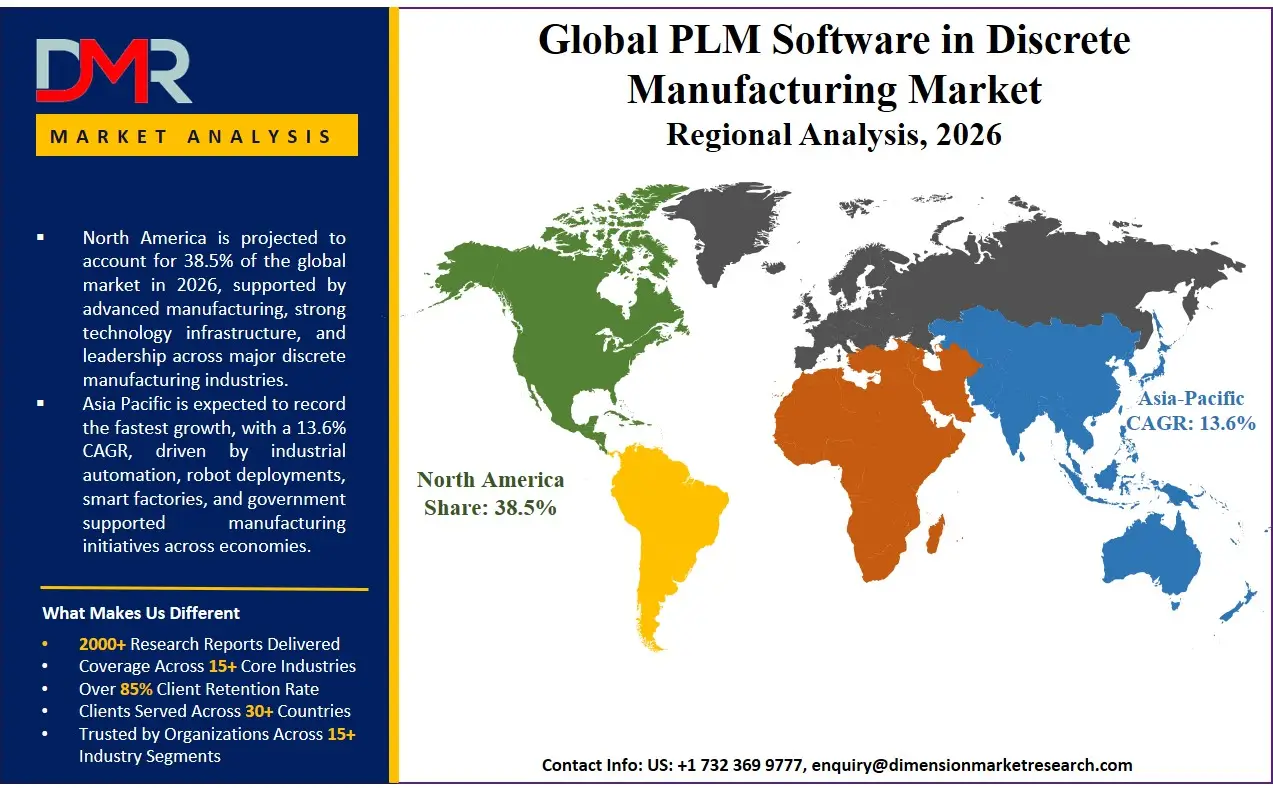
North America is expected dominate this market as it is poised to account for 38.5% of the global market in 2026. The region benefits from advanced aerospace and defense, automotive, high technology, medical device, electronics, and industrial equipment industries. Manufacturers are investing in cloud PLM, model based systems engineering, digital twins, artificial intelligence, and connected product development to manage increasingly software intensive products. Strong vendor presence, mature engineering information technology infrastructure, high research and development expenditure, and early adoption of digital thread strategies reinforce regional leadership. Regulatory requirements for product safety, quality, cybersecurity, and traceability also support demand for controlled product records and configuration management.
Asia Pacific is the Fastest Growing Region in the Global PLM Software in Discrete Manufacturing Market
Asia Pacific is expected to record the fastest growth, with a CAGR ranging from 13.6%% in 2026. China, Japan, South Korea, and India maintain substantial automotive, electronics, semiconductor equipment, machinery, rail, shipbuilding, and consumer durable manufacturing bases. Rapid industrial automation, large scale robot deployment, smart factory development, and government supported manufacturing initiatives are accelerating PLM adoption. Regional companies are modernizing product development to improve quality, coordinate suppliers, and shorten innovation cycles. Cloud adoption is also extending PLM implementation beyond large original equipment manufacturers to component suppliers and medium sized enterprises.
Europe PLM Software in Discrete Manufacturing Market
The Europe PLM Software in Discrete Manufacturing Market is projected to be estimated at USD 11.6 billion in 2026 at a CAGR of 10.8% from 2026 to 2035. Europe represents the second largest regional market, supported by established automotive, aerospace, industrial machinery, rail, marine, medical device, and electrical equipment industries. Sustainability regulations, digital product passports, carbon reporting, circular economy policies, and ecodesign requirements are strengthening demand for material intelligence and lifecycle assessment. Investment in Industry 4.0, model based engineering, cloud PLM, and digital twins is further expanding the role of PLM as a cross enterprise product information backbone.
Latin America PLM Software in Discrete Manufacturing Market
The Latin America market is expanding as automotive, aerospace, industrial machinery, electronics, and consumer durable manufacturers modernize engineering operations. Brazil and Mexico lead regional adoption due to their established production clusters and integration with global manufacturing supply chains. Multinational original equipment manufacturers are encouraging suppliers to adopt controlled product data, quality, and collaboration systems. Cloud PLM offers an accessible route for regional companies seeking lower infrastructure costs and faster implementation. Skills gaps, budget constraints, and fragmented legacy systems may moderate adoption, but nearshoring, export manufacturing, and industrial digitalization create long term growth opportunities.
Middle East and Africa PLM Software in Discrete Manufacturing Market
The Middle East and Africa market is developing alongside economic diversification, defense manufacturing, aerospace maintenance, industrial equipment, mobility, electronics, and emerging local production programs. Saudi Arabia and the United Arab Emirates are investing in advanced manufacturing capabilities and digital infrastructure, supporting demand for product data management, engineering collaboration, and configuration control. South Africa maintains opportunities in automotive and industrial manufacturing. Cloud platforms and implementation services are expected to support adoption where internal PLM expertise is limited. Data governance, cybersecurity, workforce development, and integration with established engineering systems remain important purchasing considerations.
Major Countries Analysis
United States PLM Software in Discrete Manufacturing Market
ℹ
To learn more about this report –
Download Your Free Sample Report Here
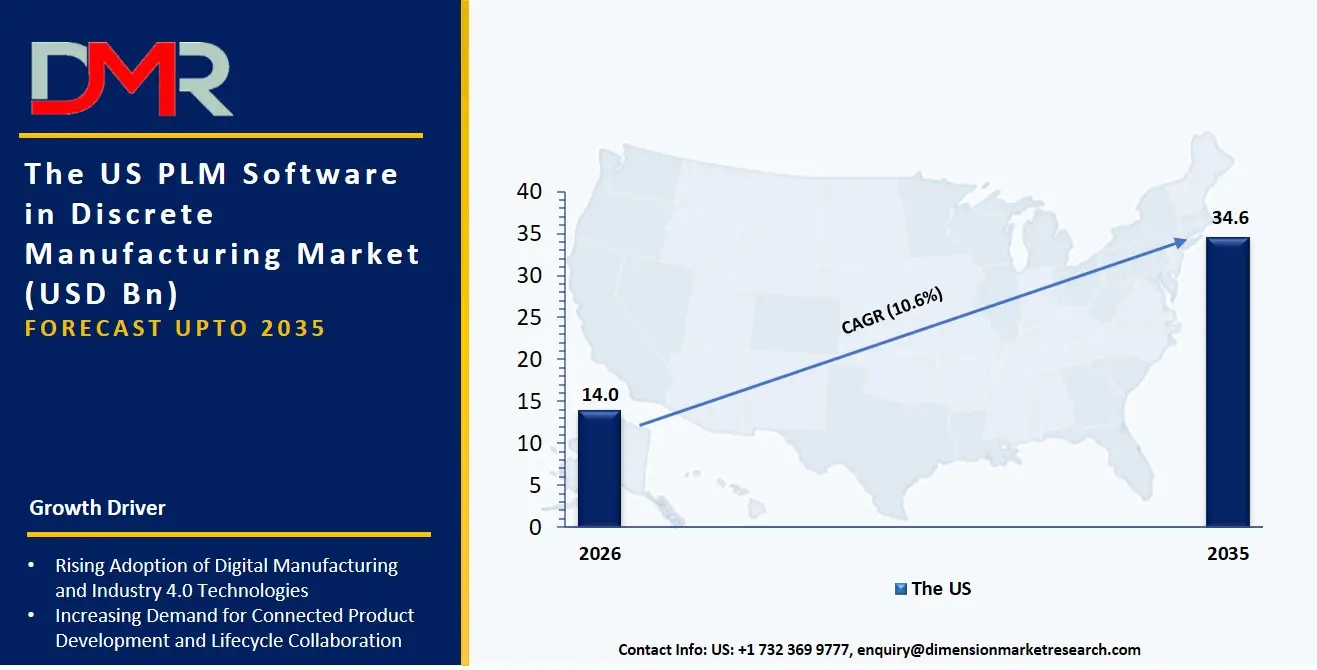
The United States PLM Software in Discrete Manufacturing Market is poised to be estimated at USD 14.0 billion in 2026 and is projected to reach USD 34.6 billion by 2035, expanding at a CAGR of 10.6% during the forecast period. The United States represents the largest national market, supported by extensive aerospace and defense, automotive, high technology, semiconductor equipment, medical device, industrial machinery, and electronics industries. Manufacturers are using PLM to manage software defined products, digital engineering, secure supplier collaboration, regulatory traceability, and complex configurations. Adoption is moving toward cloud subscriptions, generative artificial intelligence, model-based systems engineering, and integration with application lifecycle management and manufacturing systems. Federal investment in domestic semiconductor, advanced manufacturing, defense, and clean technology capacity is also increasing demand for controlled engineering data and scalable product development infrastructure.
Japan PLM Software in Discrete Manufacturing Market
The Japan PLM Software in Discrete Manufacturing Market is estimated at USD 3.0 billion in 2026 and is projected to reach USD 7.0 billion by 2035, expanding at a CAGR of 9.9%. Market development is supported by Japan's automotive, electronics, robotics, industrial machinery, semiconductor equipment, rail, and precision instrument industries. Manufacturers are modernizing established engineering processes to address workforce constraints, product complexity, global collaboration, and shorter development cycles. PLM platforms support design reuse, configuration governance, supplier coordination, quality management, and engineering knowledge retention. Increasing adoption of digital twins, artificial intelligence, simulation, and cloud collaboration will support sustained market expansion.
Saudi Arabia PLM Software in Discrete Manufacturing Market
The Saudi Arabia PLM Software in Discrete Manufacturing Market is estimated at USD 450 million in 2026 and is projected to reach USD 1.45 billion by 2035, expanding at a CAGR of 13.9%. Growth is supported by national diversification programs encouraging aerospace, defense, automotive, electrical equipment, industrial machinery, and technology manufacturing. New production ventures require structured product data, configuration management, quality control, supplier collaboration, and technology transfer. Opportunities are particularly strong for PLM vendors and service providers offering secure deployment, localized implementation, workforce training, cloud capabilities, and integration with enterprise and manufacturing systems.
Regulatory Landscape
The regulatory landscape is increasing the importance of traceability, controlled changes, product safety, cybersecurity, environmental compliance, and auditable design records. Aerospace and defense manufacturers must maintain rigorous configuration and certification evidence, while medical device companies require documented design controls, risk management, and quality processes. Automotive companies must manage functional safety, software updates, emissions, recycling, and vehicle cybersecurity obligations. Electronics manufacturers track restricted substances, material declarations, and waste requirements. Emerging digital product passport, ecodesign, repairability, and carbon reporting rules are expanding the volume of lifecycle information that manufacturers must govern. PLM platforms support compliance by linking requirements, materials, suppliers, tests, approvals, configurations, and field changes in a controlled digital thread.
Investment and White Space Analysis
The strongest investment opportunities lie in cloud native PLM, artificial intelligence grounded in engineering data, software defined product lifecycle management, digital twin orchestration, sustainability intelligence, and packaged solutions for small and medium sized manufacturers. White space remains in connecting PLM with application lifecycle management, simulation, manufacturing execution, quality, supplier networks, and field service without costly custom integration. Vendors can differentiate through open architectures, low code configuration, industry templates, faster data migration, cybersecurity, and measurable implementation outcomes. Emerging manufacturing regions offer additional potential for localized deployment and services. Specialized capabilities for semiconductor equipment, medical devices, marine, rail, and engineer to order machinery can address requirements not fully served by broad horizontal platforms.
By Region
North America
Europe
- Germany
- The U.K.
- France
- Italy
- Russia
- Spain
- Benelux
- Nordic
- Rest of Europe
Asia-Pacific
- China
- Japan
- South Korea
- India
- ANZ
- ASEAN
- Rest of Asia-Pacific
Latin America
- Brazil
- Mexico
- Argentina
- Colombia
- Rest of Latin America
Middle East & Africa
- Saudi Arabia
- UAE
- South Africa
- Israel
- Egypt
- Rest of MEA
Competitive Landscape
The Global PLM Software in Discrete Manufacturing Market is moderately consolidated at the enterprise platform level and fragmented across industry specialists, add on developers, system integrators, and advisory providers. Leading vendors compete through digital thread breadth, multidisciplinary bill of materials management, scalability, cloud deployment, industry templates, computer aided design integration, model based systems engineering, simulation connectivity, and embedded artificial intelligence. Siemens Digital Industries Software, Dassault Systèmes, PTC, Autodesk, Oracle, SAP, and Aras maintain broad platform portfolios, while specialist providers address fashion, food, quality, electronics, engineering integration, and midmarket requirements.
Competitive differentiation increasingly depends on support for software defined products, open application programming interfaces, rapid deployment, configurable workflows, cybersecurity, and interoperability with enterprise resource planning, manufacturing execution, application lifecycle management, quality, and service systems. Vendors are expanding subscription offerings and cloud managed services while building partner ecosystems for migration, implementation, and process transformation. Strategic alliances, acquisitions, and artificial intelligence development remain important as manufacturers seek fewer disconnected tools and a more coherent product lifecycle data backbone.
Some of the prominent players in the Global PLM Software in Discrete Manufacturing Market are:
- Siemens Digital Industries Software
- Dassault Systèmes
- PTC
- Autodesk
- Oracle
- SAP
- Aras
- IBM
- Propel Software
- Centric Software
- Infor
- OpenBOM
- Omnify Software
- CONTACT Software
- IFS
- beCPG
- NEC
- Cadence Design Systems
- Synopsys
- Ansys
- Hexagon AB
- AVEVA
- Bentley Systems
- Lectra
- Zuken
- MasterControl
- XPLM
- TECHNIA
- Razorleaf (Tata Technologies)
- PROSTEP
- Elysium
- Other Key Players
Recent Developments
- In June 2026, Siemens announced that it had been recognized as a Leader in the 2026 Gartner Magic Quadrant for PLM Software in Discrete Manufacturing Industries. Siemens also reported leading scores across five of six evaluated critical capability use cases, including software defined products, regulatory and product compliance, product lifecycle intelligence, supply chain collaboration, and model based enterprise.
- In December 2025, PTC announced that HOLON was using Windchill Plus to support the development of its automotive standard Level 4 electric autonomous vehicle. The deployment was intended to replace manual processes, connect product teams, and support a five year production timeline.
- In August 2025, Siemens announced that Teamcenter had been named a leader in an independent evaluation of PLM platforms for discrete manufacturers. The assessment highlighted Teamcenter capabilities in interoperability, digital thread, embedded software, bill of process, partner ecosystem, and support for complex manufacturing use cases.
- In April 2025, PTC and Schaeffler expanded their strategic relationship through the adoption of Windchill Plus. The cloud PLM deployment supports Schaeffler's continued modernization of product development and lifecycle processes.
- In March 2025, PTC previewed Windchill AI at Hannover Messe. The generative artificial intelligence assistant was designed to use governed product information in Windchill to help engineers retrieve technical knowledge, compare specifications, access test information, and make product development decisions more efficiently.
Report Details
| Report Characteristics |
| Market Size (2026) |
USD 43.1 Bn |
| Forecast Value (2035) |
USD 113.1 Bn |
| CAGR (2026–2035) |
11.3% |
| The US Market Size (2026) |
USD 14.0 Bn |
| Historical Data |
2021 – 2025 |
| Forecast Data |
2027 – 2035 |
| Base Year |
2025 |
| Estimate Year |
2026 |
| Segments Covered |
By Offering, By Deployment Mode, By Organization Size, By PLM Functionality, By Application, and By Discrete Manufacturing Industry |
| Regional Coverage |
North America – The US and Canada; Europe – Germany, The UK, France, Russia, Spain, Italy, Benelux, Nordic, & Rest of Europe; Asia-Pacific – China, Japan, South Korea, India, ANZ, ASEAN, Rest of APAC; Latin America – Brazil, Mexico, Argentina, Colombia, Rest of Latin America; Middle East & Africa – Saudi Arabia, UAE, South Africa, Turkey, Egypt, Israel, & Rest of MEA |
Frequently Asked Questions
How big is the Global PLM Software in Discrete Manufacturing Market?
▾ The Global PLM Software in Discrete Manufacturing Market is valued at USD 43.1 billion in 2026 and is projected to reach USD 113.1 billion by 2035, reflecting strong worldwide demand for solutions.
What is the CAGR of the Global PLM Software in Discrete Manufacturing Market from 2026 to 2035?
▾ The market is projected to expand at a compound annual growth rate of 11.3% between 2026 and 2035, supported by sustained investment in digital manufacturing transformation and lifecycle management technologies worldwide across platforms.
What factors are driving the growth of the Global PLM Software in Discrete Manufacturing Market?
▾ Growth is driven by rising product complexity, software defined products, cloud migration, digital twins, shorter innovation cycles, multidisciplinary engineering, regulatory traceability, supplier collaboration, artificial intelligence, and advanced product analytics across manufacturing enterprises.
What are the major trends in the Global PLM Software in Discrete Manufacturing Market?
▾ Major trends include cloud and hybrid PLM, generative artificial intelligence, connected digital twins, composable applications, lifecycle intelligence, sustainability management, and convergence with application lifecycle management and model based systems engineering platforms worldwide.
Which offering segment leads the Global PLM Software in Discrete Manufacturing Market?
▾ Software is projected to lead the offering segment with a 67.2% market share in 2026, supported by strong demand for core PLM platforms, specialized solutions, analytics, and lifecycle management modules across global manufacturing.
Which application segment leads the Global PLM Software in Discrete Manufacturing Market?
▾ Product Design and Engineering is projected to lead the application segment with a 32.3% share in 2026, supported by increasing demand for multidisciplinary collaboration, design control, data governance, and reuse across manufacturing enterprises.
Which discrete manufacturing industry leads the market?
▾ Automotive is projected to dominate the discrete manufacturing industry segment with a 31.8% share in 2026, driven by electrification, connected vehicles, software intensive architectures, configuration complexity, and supplier collaboration requirements across worldwide manufacturing.
Which region holds the largest share of the Global PLM Software in Discrete Manufacturing Market?
▾ North America is expected to lead the global market with a 38.5% share in 2026, supported by advanced manufacturing, substantial research investment, mature digital infrastructure, and a strong PLM vendor ecosystem presence.
Which region is expected to grow the fastest in PLM Software in Discrete Manufacturing Market ?
▾ Asia Pacific is expected to record the fastest growth at a 13.6% CAGR through 2035, driven by industrial automation, smart factories, government manufacturing programs, electronics expansion, and cloud PLM adoption across industries.
Who are the key players in the Global PLM Software in Discrete Manufacturing Market?
▾ Key market participants include Siemens Digital Industries Software, Dassault Systèmes, PTC, Autodesk, Oracle, SAP, Aras, IBM, Propel Software, Centric Software, Infor, OpenBOM, Arena Solutions, CONTACT Software, IFS, and Ansys serving manufacturers globally.
How is the Global PLM Software in Discrete Manufacturing Market segmented?
▾ The market is segmented by offering, deployment mode, organization size, PLM functionality, application, and discrete manufacturing industry, with regional analysis covering North America, Europe, Asia Pacific, Latin America, and MEA worldwide markets.